1
Managerial Economics
Prepared by Dr. Samita Mahapatra
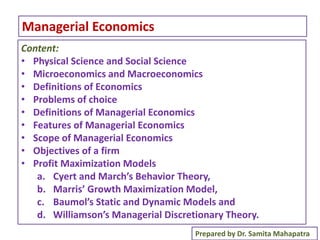
Content:
• Physical Science and Social Science
• Microeconomics and Macroeconomics
• Definitions of Economics
• Problems of choice
• Definitions of Managerial Economics
• Features of Managerial Economics
• Scope of Managerial Economics
• Objectives of a firm
• Profit Maximization Models
a. Cyert and March’s Behavior Theory,
b. Marris’ Growth Maximization Model,
c. Baumol’s Static and Dynamic Models and
d. Williamson’s Managerial Discretionary Theory.
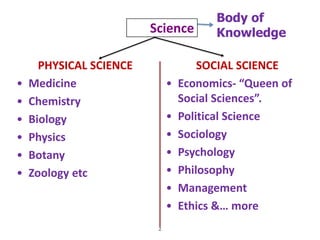
Science
PHYSICAL SCIENCE
• Medicine
• Chemistry
• Biology
• Physics
• Botany
• Zoology etc
SOCIAL SCIENCE
• Economics- “Queen of
Social Sciences”.
• Political Science
• Sociology
• Psychology
• Philosophy
• Management
• Ethics &… more
2
Body of
Knowledge
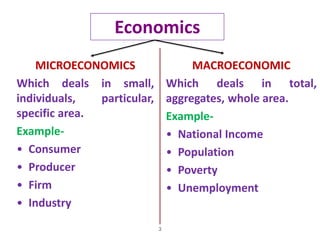
Economics
MICROECONOMICS
Which deals in small,
individuals, particular,
specific area.
Example-
• Consumer
• Producer
• Firm
• Industry
MACROECONOMIC
Which deals in total,
aggregates, whole area.
Example-
• National Income
• Population
• Poverty
• Unemployment
3
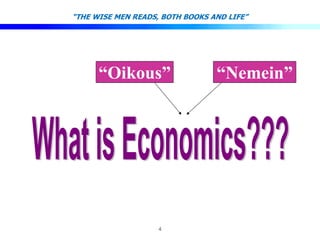
4
“THE WISE MEN READS, BOTH BOOKS AND LIFE”
“Oikous” “Nemein”
Definitions of Economics
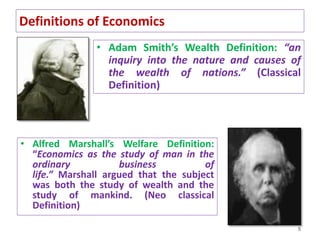
• Adam Smith’s Wealth Definition: “an
inquiry into the nature and causes of
the wealth of nations.” (Classical
Definition)
5
• Alfred Marshall’s Welfare Definition:
“Economics as the study of man in the
ordinary business of
life.” Marshall argued that the subject
was both the study of wealth and the
study of mankind. (Neo classical
Definition)
Scarcity Definition
6
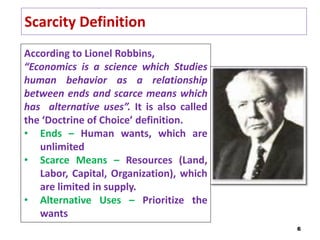
According to Lionel Robbins,
“Economics is a science which Studies
human behavior as a relationship
between ends and scarce means which
has alternative uses”. It is also called
the ‘Doctrine of Choice’ definition.
• Ends – Human wants, which are
unlimited
• Scarce Means – Resources (Land,
Labor, Capital, Organization), which
are limited in supply.
• Alternative Uses – Prioritize the
wants
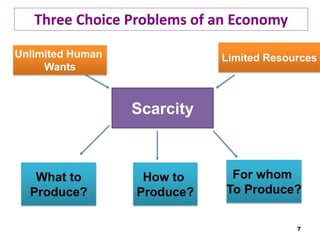
Three Choice Problems of an Economy
7
Unlimited Human
Wants
Limited Resources
Scarcity
What to
Produce?
How to
Produce?
For whom
To Produce?
8
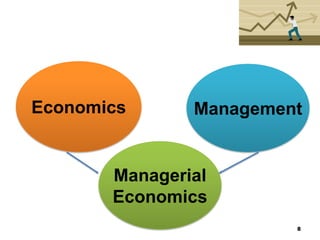
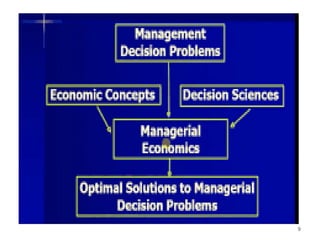
Economics Management
Managerial
Economics
9
10
“IT IS EASIER TO BE CRITICAL THAN TO BE CORRECT”
Economic Analysis for Business Decisions
Or
Managerial Economics
Or
Business Economics
Or
Economics for Managers
11
Managerial Economics
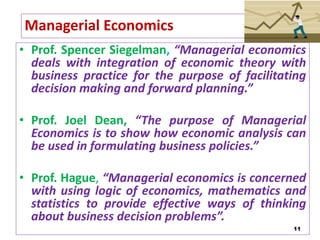
• Prof. Spencer Siegelman, “Managerial economics
deals with integration of economic theory with
business practice for the purpose of facilitating
decision making and forward planning.”
• Prof. Joel Dean, “The purpose of Managerial
Economics is to show how economic analysis can
be used in formulating business policies.”
• Prof. Hague, “Managerial economics is concerned
with using logic of economics, mathematics and
statistics to provide effective ways of thinking
about business decision problems”.
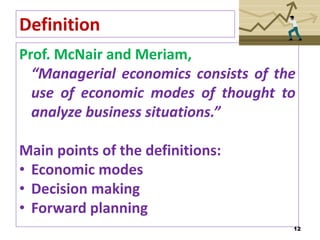
Definition
Prof. McNair and Meriam,
“Managerial economics consists of the
use of economic modes of thought to
analyze business situations.”
Main points of the definitions:
• Economic modes
• Decision making
• Forward planning
12
Features/Characteristics:
• Applied branch of economics
• Normative science
• Theory of Firm and Profit
• Microeconomics
13
Importance:
• Decisions of business are to be taken under
the conditions of Uncertainty and Risk.
Profits is the bottom line of every
business
14
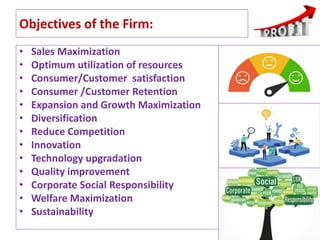
Objectives of the Firm:
• Sales Maximization
• Optimum utilization of resources
• Consumer/Customer satisfaction
• Consumer /Customer Retention
• Expansion and Growth Maximization
• Diversification
• Reduce Competition
• Innovation
• Technology upgradation
• Quality improvement
• Corporate Social Responsibility
• Welfare Maximization
• Sustainability
15
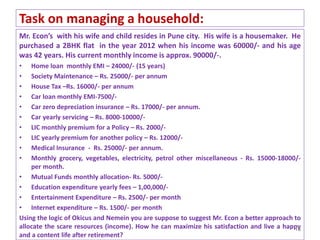
Task on managing a household:
Mr. Econ’s with his wife and child resides in Pune city. His wife is a housemaker. He
purchased a 2BHK flat in the year 2012 when his income was 60000/- and his age
was 42 years. His current monthly income is approx. 90000/-.
• Home loan monthly EMI – 24000/- (15 years)
• Society Maintenance – Rs. 25000/- per annum
• House Tax –Rs. 16000/- per annum
• Car loan monthly EMI-7500/-
• Car zero depreciation insurance – Rs. 17000/- per annum.
• Car yearly servicing – Rs. 8000-10000/-
• LIC monthly premium for a Policy – Rs. 2000/-
• LIC yearly premium for another policy – Rs. 12000/-
• Medical Insurance - Rs. 25000/- per annum.
• Monthly grocery, vegetables, electricity, petrol other miscellaneous - Rs. 15000-18000/-
per month.
• Mutual Funds monthly allocation- Rs. 5000/-
• Education expenditure yearly fees – 1,00,000/-
• Entertainment Expenditure – Rs. 2500/- per month
• Internet expenditure – Rs. 1500/- per month
Using the logic of Okicus and Nemein you are suppose to suggest Mr. Econ a better approach to
allocate the scare resources (income). How he can maximize his satisfaction and live a happy
and a content life after retirement?
16
• Profit Maximization Model
• Economist Theory of the Firm:
1. Cyert and March’s Behavior Theory,
2. Marris’ Growth Maximization Model,
3. Baumol’s Static and Dynamic Models,
4. Williamson’s Managerial Discretionary Theory.
17
Objectives of the Firm:
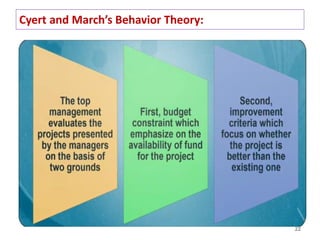
Cyert and March’s Behavior Theory:
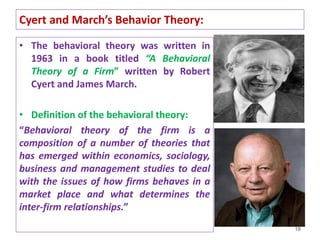
• The behavioral theory was written in
1963 in a book titled “A Behavioral
Theory of a Firm” written by Robert
Cyert and James March.
• Definition of the behavioral theory:
“Behavioral theory of the firm is a
composition of a number of theories that
has emerged within economics, sociology,
business and management studies to deal
with the issues of how firms behaves in a
market place and what determines the
inter-firm relationships.”
18
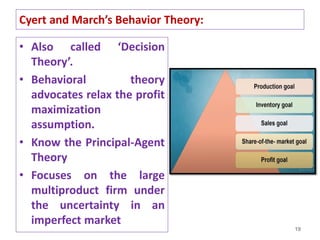
• Also called ‘Decision
Theory’.
• Behavioral theory
advocates relax the profit
maximization
assumption.
• Know the Principal-Agent
Theory
• Focuses on the large
multiproduct firm under
the uncertainty in an
imperfect market
19
Cyert and March’s Behavior Theory:
20
Cyert and March’s Behavior Theory:
21
Cyert and March’s Behavior Theory:
22
Cyert and March’s Behavior Theory:
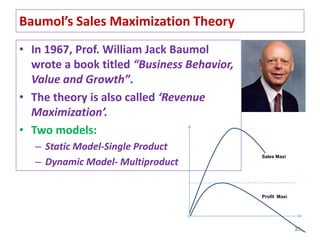
Baumol’s Sales Maximization Theory
• In 1967, Prof. William Jack Baumol
wrote a book titled “Business Behavior,
Value and Growth”.
• The theory is also called ‘Revenue
Maximization’.
• Two models:
– Static Model-Single Product
– Dynamic Model- Multiproduct
23
Sales Maxi
Profit Maxi
Assumptions:
1. The time horizon of the firm is a single period
2. The firm aims at maximizing the total sales
revenue in the long run subject to a profit
constraint.
3. The firm’s minimum profit constraints is set
competitively in terms of the current market value
of its shares.
4. The firm is oligopolistic whose cost curves are U-
shaped and the demand curve is downward
sloping. Its total cost and total revenues curves are
conventional in nature.
24
Baumol’s Sales Maximization Theory
25
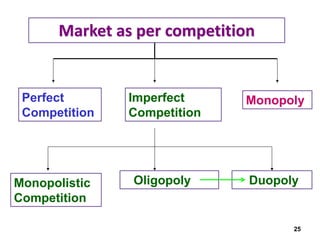
Market as per competition
Perfect
Competition
Imperfect
Competition
Monopoly
Monopolistic
Competition
Oligopoly Duopoly
26
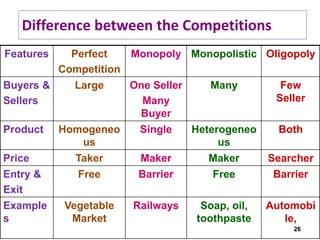
Difference between the Competitions
Features Perfect
Competition
Monopoly Monopolistic Oligopoly
Buyers &
Sellers
Large One Seller
Many
Buyer
Many Few
Seller
Product Homogeneo
us
Single Heterogeneo
us
Both
Price Taker Maker Maker Searcher
Entry &
Exit
Free Barrier Free Barrier
Example
s
Vegetable
Market
Railways Soap, oil,
toothpaste
Automobi
le,
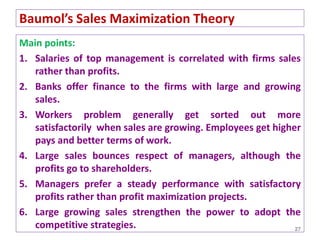
Main points:
1. Salaries of top management is correlated with firms sales
rather than profits.
2. Banks offer finance to the firms with large and growing
sales.
3. Workers problem generally get sorted out more
satisfactorily when sales are growing. Employees get higher
pays and better terms of work.
4. Large sales bounces respect of managers, although the
profits go to shareholders.
5. Managers prefer a steady performance with satisfactory
profits rather than profit maximization projects.
6. Large growing sales strengthen the power to adopt the
competitive strategies. 27
Baumol’s Sales Maximization Theory
28
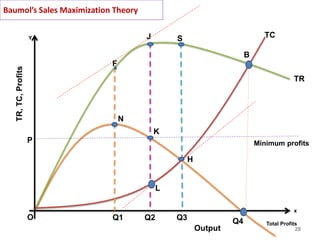
Baumol’s Sales Maximization Theory
P
O
TC
TR
Minimum profits
Total Profits
Y
x
Q1 Q2 Q3
N
F
K
J S
H
TR,
TC,
Profits
Output
B
Q4
L
29
Williamson’s Managerial Discretionary Theory
30
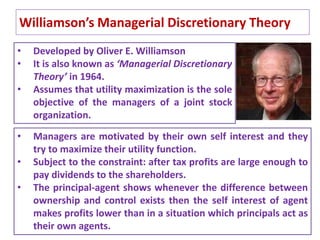
• Developed by Oliver E. Williamson
• It is also known as ‘Managerial Discretionary
Theory’ in 1964.
• Assumes that utility maximization is the sole
objective of the managers of a joint stock
organization.
• Managers are motivated by their own self interest and they
try to maximize their utility function.
• Subject to the constraint: after tax profits are large enough to
pay dividends to the shareholders.
• The principal-agent shows whenever the difference between
ownership and control exists then the self interest of agent
makes profits lower than in a situation which principals act as
their own agents.
31
Williamson’s Managerial Discretionary Theory
• Limit to the manager’s utility maximization – shareholders
require a minimum profit to be paid as a dividends
• If this minimum profits is not covered then the –Job security
of the managers is in danger.
• But the managers are able to hold a powerful position if firm
is showing a:
• Reasonable rate of growth
• Minimum dividends are paid
• Profits are at acceptable levels
• Assumptions:
1. Imperfect Competition
2. Separation of Ownership and Management
3. Minimum profits to be able to pay to the shareholders
32
Williamson’s Managerial Discretionary Theory
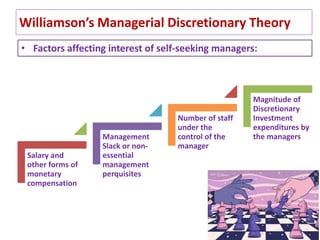
• Factors affecting interest of self-seeking managers:
Salary and
other forms of
monetary
compensation
Management
Slack or non-
essential
management
perquisites
Number of staff
under the
control of the
manager
Magnitude of
Discretionary
Investment
expenditures by
the managers
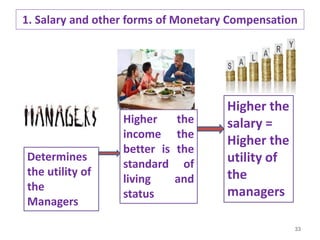
1. Salary and other forms of Monetary Compensation
33
Determines
the utility of
the
Managers
Higher the
income the
better is the
standard of
living and
status
Higher the
salary =
Higher the
utility of
the
managers
34
2. Management slack or Non-essential management
perquisites
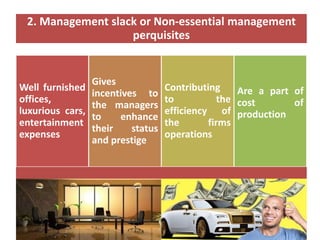
Well furnished
offices,
luxurious cars,
entertainment
expenses
Gives
incentives to
the managers
to enhance
their status
and prestige
Contributing
to the
efficiency of
the firms
operations
Are a part of
cost of
production
3. Number of staff under the control of the manager
35
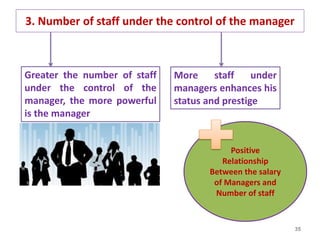
Greater the number of staff
under the control of the
manager, the more powerful
is the manager
More staff under
managers enhances his
status and prestige
Positive
Relationship
Between the salary
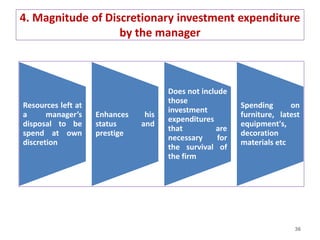
of Managers and
Number of staff
4. Magnitude of Discretionary investment expenditure
by the manager
36
Resources left at
a manager’s
disposal to be
spend at own
discretion
Enhances his
status and
prestige
Does not include
those
investment
expenditures
that are
necessary for
the survival of
the firm
Spending on
furniture, latest
equipment's,
decoration
materials etc
37
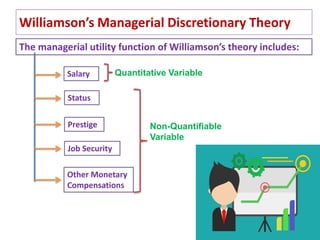
Williamson’s Managerial Discretionary Theory
The managerial utility function of Williamson’s theory includes:
Salary
Status
Prestige
Job Security
Other Monetary
Compensations
Quantitative Variable
Non-Quantifiable
Variable
38
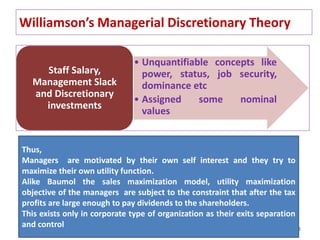
Williamson’s Managerial Discretionary Theory
• Unquantifiable concepts like
power, status, job security,
dominance etc
• Assigned some nominal
values
Staff Salary,
Management Slack
and Discretionary
investments
Thus,
Managers are motivated by their own self interest and they try to
maximize their own utility function.
Alike Baumol the sales maximization model, utility maximization
objective of the managers are subject to the constraint that after the tax
profits are large enough to pay dividends to the shareholders.
This exists only in corporate type of organization as their exits separation
and control
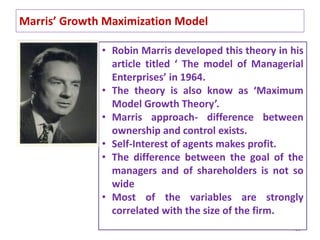
Marris’ Growth Maximization Model
39
• Robin Marris developed this theory in his
article titled ‘ The model of Managerial
Enterprises’ in 1964.
• The theory is also know as ‘Maximum
Model Growth Theory’.
• Marris approach- difference between
ownership and control exists.
• Self-Interest of agents makes profit.
• The difference between the goal of the
managers and of shareholders is not so
wide
• Most of the variables are strongly
correlated with the size of the firm.
40
Marris’ Growth Maximization Model
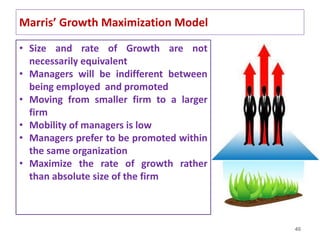
• Size and rate of Growth are not
necessarily equivalent
• Managers will be indifferent between
being employed and promoted
• Moving from smaller firm to a larger
firm
• Mobility of managers is low
• Managers prefer to be promoted within
the same organization
• Maximize the rate of growth rather
than absolute size of the firm
Marris’ Growth Maximization Model
41
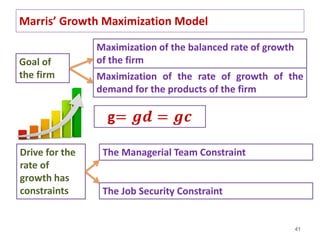
Goal of
the firm
Maximization of the balanced rate of growth
of the firm
Maximization of the rate of growth of the
demand for the products of the firm
Drive for the
rate of
growth has
constraints
The Managerial Team Constraint
The Job Security Constraint
42
Marris’ Growth Maximization Model -
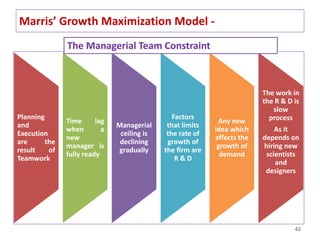
Planning
and
Execution
are the
result of
Teamwork
Time lag
when a
new
manager is
fully ready
Managerial
ceiling is
declining
gradually
Factors
that limits
the rate of
growth of
the firm are
R & D
Any new
idea which
affects the
growth of
demand
The work in
the R & D is
slow
process
As it
depends on
hiring new
scientists
and
designers
The Managerial Team Constraint
43
Marris’ Growth Maximization Model
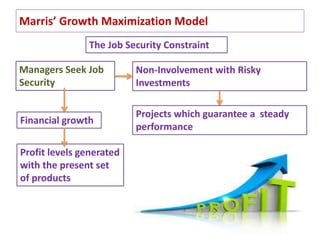
The Job Security Constraint
Managers Seek Job
Security
Non-Involvement with Risky
Investments
Financial growth
Projects which guarantee a steady
performance
Profit levels generated
with the present set
of products
Reference Books:
44
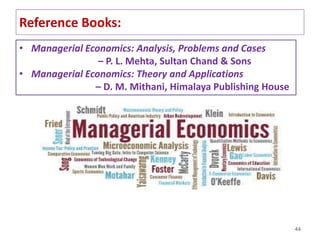
• Managerial Economics: Analysis, Problems and Cases
– P. L. Mehta, Sultan Chand & Sons
• Managerial Economics: Theory and Applications
– D. M. Mithani, Himalaya Publishing House
Practice Multiple Choice Questions
4/27/2021
1. Managerial economics generally refers to the
integration of economic theory with business:
a. Ethics
b. Management
c. Practice
d. All of the above
46
2. The tendency for managers to operate a firm in a
way that maximizes their personal utility rather than
the firm's profits is referred to as the:
a. consumer utility incentive.
b. principal-agent problem.
c. hidden agenda scenario.
d. Modigliani hypothesis

Introduction managerial economics 2021

  • 1.
    1 Managerial Economics Prepared byDr. Samita Mahapatra Content: • Physical Science and Social Science • Microeconomics and Macroeconomics • Definitions of Economics • Problems of choice • Definitions of Managerial Economics • Features of Managerial Economics • Scope of Managerial Economics • Objectives of a firm • Profit Maximization Models a. Cyert and March’s Behavior Theory, b. Marris’ Growth Maximization Model, c. Baumol’s Static and Dynamic Models and d. Williamson’s Managerial Discretionary Theory.
  • 2.
    Science PHYSICAL SCIENCE • Medicine •Chemistry • Biology • Physics • Botany • Zoology etc SOCIAL SCIENCE • Economics- “Queen of Social Sciences”. • Political Science • Sociology • Psychology • Philosophy • Management • Ethics &… more 2 Body of Knowledge
  • 3.
    Economics MICROECONOMICS Which deals insmall, individuals, particular, specific area. Example- • Consumer • Producer • Firm • Industry MACROECONOMIC Which deals in total, aggregates, whole area. Example- • National Income • Population • Poverty • Unemployment 3
  • 4.
    4 “THE WISE MENREADS, BOTH BOOKS AND LIFE” “Oikous” “Nemein”
  • 5.
    Definitions of Economics •Adam Smith’s Wealth Definition: “an inquiry into the nature and causes of the wealth of nations.” (Classical Definition) 5 • Alfred Marshall’s Welfare Definition: “Economics as the study of man in the ordinary business of life.” Marshall argued that the subject was both the study of wealth and the study of mankind. (Neo classical Definition)
  • 6.
    Scarcity Definition 6 According toLionel Robbins, “Economics is a science which Studies human behavior as a relationship between ends and scarce means which has alternative uses”. It is also called the ‘Doctrine of Choice’ definition. • Ends – Human wants, which are unlimited • Scarce Means – Resources (Land, Labor, Capital, Organization), which are limited in supply. • Alternative Uses – Prioritize the wants
  • 7.
    Three Choice Problemsof an Economy 7 Unlimited Human Wants Limited Resources Scarcity What to Produce? How to Produce? For whom To Produce?
  • 8.
  • 9.
  • 10.
    10 “IT IS EASIERTO BE CRITICAL THAN TO BE CORRECT” Economic Analysis for Business Decisions Or Managerial Economics Or Business Economics Or Economics for Managers
  • 11.
    11 Managerial Economics • Prof.Spencer Siegelman, “Managerial economics deals with integration of economic theory with business practice for the purpose of facilitating decision making and forward planning.” • Prof. Joel Dean, “The purpose of Managerial Economics is to show how economic analysis can be used in formulating business policies.” • Prof. Hague, “Managerial economics is concerned with using logic of economics, mathematics and statistics to provide effective ways of thinking about business decision problems”.
  • 12.
    Definition Prof. McNair andMeriam, “Managerial economics consists of the use of economic modes of thought to analyze business situations.” Main points of the definitions: • Economic modes • Decision making • Forward planning 12
  • 13.
    Features/Characteristics: • Applied branchof economics • Normative science • Theory of Firm and Profit • Microeconomics 13 Importance: • Decisions of business are to be taken under the conditions of Uncertainty and Risk.
  • 14.
    Profits is thebottom line of every business 14
  • 15.
    Objectives of theFirm: • Sales Maximization • Optimum utilization of resources • Consumer/Customer satisfaction • Consumer /Customer Retention • Expansion and Growth Maximization • Diversification • Reduce Competition • Innovation • Technology upgradation • Quality improvement • Corporate Social Responsibility • Welfare Maximization • Sustainability 15
  • 16.
    Task on managinga household: Mr. Econ’s with his wife and child resides in Pune city. His wife is a housemaker. He purchased a 2BHK flat in the year 2012 when his income was 60000/- and his age was 42 years. His current monthly income is approx. 90000/-. • Home loan monthly EMI – 24000/- (15 years) • Society Maintenance – Rs. 25000/- per annum • House Tax –Rs. 16000/- per annum • Car loan monthly EMI-7500/- • Car zero depreciation insurance – Rs. 17000/- per annum. • Car yearly servicing – Rs. 8000-10000/- • LIC monthly premium for a Policy – Rs. 2000/- • LIC yearly premium for another policy – Rs. 12000/- • Medical Insurance - Rs. 25000/- per annum. • Monthly grocery, vegetables, electricity, petrol other miscellaneous - Rs. 15000-18000/- per month. • Mutual Funds monthly allocation- Rs. 5000/- • Education expenditure yearly fees – 1,00,000/- • Entertainment Expenditure – Rs. 2500/- per month • Internet expenditure – Rs. 1500/- per month Using the logic of Okicus and Nemein you are suppose to suggest Mr. Econ a better approach to allocate the scare resources (income). How he can maximize his satisfaction and live a happy and a content life after retirement? 16
  • 17.
    • Profit MaximizationModel • Economist Theory of the Firm: 1. Cyert and March’s Behavior Theory, 2. Marris’ Growth Maximization Model, 3. Baumol’s Static and Dynamic Models, 4. Williamson’s Managerial Discretionary Theory. 17 Objectives of the Firm:
  • 18.
    Cyert and March’sBehavior Theory: • The behavioral theory was written in 1963 in a book titled “A Behavioral Theory of a Firm” written by Robert Cyert and James March. • Definition of the behavioral theory: “Behavioral theory of the firm is a composition of a number of theories that has emerged within economics, sociology, business and management studies to deal with the issues of how firms behaves in a market place and what determines the inter-firm relationships.” 18
  • 19.
    • Also called‘Decision Theory’. • Behavioral theory advocates relax the profit maximization assumption. • Know the Principal-Agent Theory • Focuses on the large multiproduct firm under the uncertainty in an imperfect market 19 Cyert and March’s Behavior Theory:
  • 20.
    20 Cyert and March’sBehavior Theory:
  • 21.
    21 Cyert and March’sBehavior Theory:
  • 22.
    22 Cyert and March’sBehavior Theory:
  • 23.
    Baumol’s Sales MaximizationTheory • In 1967, Prof. William Jack Baumol wrote a book titled “Business Behavior, Value and Growth”. • The theory is also called ‘Revenue Maximization’. • Two models: – Static Model-Single Product – Dynamic Model- Multiproduct 23 Sales Maxi Profit Maxi
  • 24.
    Assumptions: 1. The timehorizon of the firm is a single period 2. The firm aims at maximizing the total sales revenue in the long run subject to a profit constraint. 3. The firm’s minimum profit constraints is set competitively in terms of the current market value of its shares. 4. The firm is oligopolistic whose cost curves are U- shaped and the demand curve is downward sloping. Its total cost and total revenues curves are conventional in nature. 24 Baumol’s Sales Maximization Theory
  • 25.
    25 Market as percompetition Perfect Competition Imperfect Competition Monopoly Monopolistic Competition Oligopoly Duopoly
  • 26.
    26 Difference between theCompetitions Features Perfect Competition Monopoly Monopolistic Oligopoly Buyers & Sellers Large One Seller Many Buyer Many Few Seller Product Homogeneo us Single Heterogeneo us Both Price Taker Maker Maker Searcher Entry & Exit Free Barrier Free Barrier Example s Vegetable Market Railways Soap, oil, toothpaste Automobi le,
  • 27.
    Main points: 1. Salariesof top management is correlated with firms sales rather than profits. 2. Banks offer finance to the firms with large and growing sales. 3. Workers problem generally get sorted out more satisfactorily when sales are growing. Employees get higher pays and better terms of work. 4. Large sales bounces respect of managers, although the profits go to shareholders. 5. Managers prefer a steady performance with satisfactory profits rather than profit maximization projects. 6. Large growing sales strengthen the power to adopt the competitive strategies. 27 Baumol’s Sales Maximization Theory
  • 28.
    28 Baumol’s Sales MaximizationTheory P O TC TR Minimum profits Total Profits Y x Q1 Q2 Q3 N F K J S H TR, TC, Profits Output B Q4 L
  • 29.
  • 30.
    Williamson’s Managerial DiscretionaryTheory 30 • Developed by Oliver E. Williamson • It is also known as ‘Managerial Discretionary Theory’ in 1964. • Assumes that utility maximization is the sole objective of the managers of a joint stock organization. • Managers are motivated by their own self interest and they try to maximize their utility function. • Subject to the constraint: after tax profits are large enough to pay dividends to the shareholders. • The principal-agent shows whenever the difference between ownership and control exists then the self interest of agent makes profits lower than in a situation which principals act as their own agents.
  • 31.
    31 Williamson’s Managerial DiscretionaryTheory • Limit to the manager’s utility maximization – shareholders require a minimum profit to be paid as a dividends • If this minimum profits is not covered then the –Job security of the managers is in danger. • But the managers are able to hold a powerful position if firm is showing a: • Reasonable rate of growth • Minimum dividends are paid • Profits are at acceptable levels • Assumptions: 1. Imperfect Competition 2. Separation of Ownership and Management 3. Minimum profits to be able to pay to the shareholders
  • 32.
    32 Williamson’s Managerial DiscretionaryTheory • Factors affecting interest of self-seeking managers: Salary and other forms of monetary compensation Management Slack or non- essential management perquisites Number of staff under the control of the manager Magnitude of Discretionary Investment expenditures by the managers
  • 33.
    1. Salary andother forms of Monetary Compensation 33 Determines the utility of the Managers Higher the income the better is the standard of living and status Higher the salary = Higher the utility of the managers
  • 34.
    34 2. Management slackor Non-essential management perquisites Well furnished offices, luxurious cars, entertainment expenses Gives incentives to the managers to enhance their status and prestige Contributing to the efficiency of the firms operations Are a part of cost of production
  • 35.
    3. Number ofstaff under the control of the manager 35 Greater the number of staff under the control of the manager, the more powerful is the manager More staff under managers enhances his status and prestige Positive Relationship Between the salary of Managers and Number of staff
  • 36.
    4. Magnitude ofDiscretionary investment expenditure by the manager 36 Resources left at a manager’s disposal to be spend at own discretion Enhances his status and prestige Does not include those investment expenditures that are necessary for the survival of the firm Spending on furniture, latest equipment's, decoration materials etc
  • 37.
    37 Williamson’s Managerial DiscretionaryTheory The managerial utility function of Williamson’s theory includes: Salary Status Prestige Job Security Other Monetary Compensations Quantitative Variable Non-Quantifiable Variable
  • 38.
    38 Williamson’s Managerial DiscretionaryTheory • Unquantifiable concepts like power, status, job security, dominance etc • Assigned some nominal values Staff Salary, Management Slack and Discretionary investments Thus, Managers are motivated by their own self interest and they try to maximize their own utility function. Alike Baumol the sales maximization model, utility maximization objective of the managers are subject to the constraint that after the tax profits are large enough to pay dividends to the shareholders. This exists only in corporate type of organization as their exits separation and control
  • 39.
    Marris’ Growth MaximizationModel 39 • Robin Marris developed this theory in his article titled ‘ The model of Managerial Enterprises’ in 1964. • The theory is also know as ‘Maximum Model Growth Theory’. • Marris approach- difference between ownership and control exists. • Self-Interest of agents makes profit. • The difference between the goal of the managers and of shareholders is not so wide • Most of the variables are strongly correlated with the size of the firm.
  • 40.
    40 Marris’ Growth MaximizationModel • Size and rate of Growth are not necessarily equivalent • Managers will be indifferent between being employed and promoted • Moving from smaller firm to a larger firm • Mobility of managers is low • Managers prefer to be promoted within the same organization • Maximize the rate of growth rather than absolute size of the firm
  • 41.
    Marris’ Growth MaximizationModel 41 Goal of the firm Maximization of the balanced rate of growth of the firm Maximization of the rate of growth of the demand for the products of the firm Drive for the rate of growth has constraints The Managerial Team Constraint The Job Security Constraint
  • 42.
    42 Marris’ Growth MaximizationModel - Planning and Execution are the result of Teamwork Time lag when a new manager is fully ready Managerial ceiling is declining gradually Factors that limits the rate of growth of the firm are R & D Any new idea which affects the growth of demand The work in the R & D is slow process As it depends on hiring new scientists and designers The Managerial Team Constraint
  • 43.
    43 Marris’ Growth MaximizationModel The Job Security Constraint Managers Seek Job Security Non-Involvement with Risky Investments Financial growth Projects which guarantee a steady performance Profit levels generated with the present set of products
  • 44.
    Reference Books: 44 • ManagerialEconomics: Analysis, Problems and Cases – P. L. Mehta, Sultan Chand & Sons • Managerial Economics: Theory and Applications – D. M. Mithani, Himalaya Publishing House
  • 45.
    Practice Multiple ChoiceQuestions 4/27/2021
  • 46.
    1. Managerial economicsgenerally refers to the integration of economic theory with business: a. Ethics b. Management c. Practice d. All of the above 46 2. The tendency for managers to operate a firm in a way that maximizes their personal utility rather than the firm's profits is referred to as the: a. consumer utility incentive. b. principal-agent problem. c. hidden agenda scenario. d. Modigliani hypothesis