COMP3170  Artificial Intelligence and Machine Learning Lecture 1 Hong Kong Baptist University
COMP 3170 (COMP3010/SCI3790/COMP4070) Course home page:  http://www.comp.hkbu.edu.hk/~comp3170   Lecturers:  Pinata Winoto (RSS715) Guoping Qiu (RSS711) Textbook: S. Russell and P. Norvig  Artificial Intelligence: A Modern Approach  Prentice Hall, 2003, Second Edition
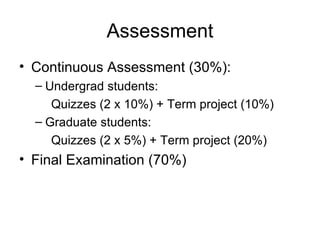
Assessment Continuous Assessment (30%):  Undergrad students:  Quizzes (2 x 10%) + Term project (10%) Graduate students:  Quizzes (2 x 5%) + Term project (20%) Final Examination (70%)
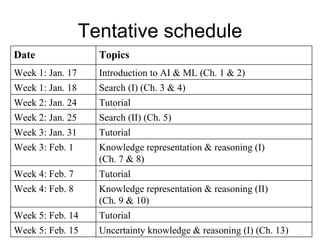
Tentative schedule Tentative schedule/topics: Knowledge representation & reasoning (II)  (Ch. 9 & 10)  Week 4: Feb. 8 Tutorial Week 5: Feb. 14 Uncertainty knowledge & reasoning (I) (Ch. 13)  Week 5: Feb. 15 Tutorial Week 4: Feb. 7 Knowledge representation & reasoning (I)  (Ch. 7 & 8) Week 3: Feb. 1 Tutorial Week 3: Jan. 31  Search (II) (Ch. 5) Week 2: Jan. 25 Tutorial Week 2: Jan. 24  Search (I) (Ch. 3 & 4) Week 1: Jan. 18 Introduction to AI & ML (Ch. 1 & 2) Week 1: Jan. 17 Topics Date
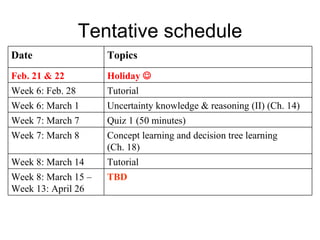
Tentative schedule Tentative schedule/topics: Holiday   Feb. 21 & 22 TBD Week 8: March 15 – Week 13: April 26 Tutorial Week 8: March 14 Concept learning and decision tree learning  (Ch. 18) Week 7: March 8 Quiz 1 (50 minutes) Week 7: March 7  Uncertainty knowledge & reasoning (II) (Ch. 14) Week 6: March 1 Tutorial Week 6: Feb. 28 Topics Date
The History of Artificial Intelligence Chapter 1
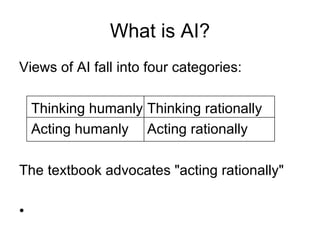
What is AI? Views of AI fall into four categories: Thinking humanly Thinking rationally  Acting humanly Acting rationally  The textbook advocates "acting rationally"
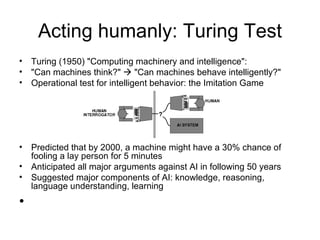
Acting humanly: Turing Test Turing (1950) "Computing machinery and intelligence": "Can machines think?"    "Can machines behave intelligently?" Operational test for intelligent behavior: the Imitation Game Predicted that by 2000, a machine might have a 30% chance of fooling a lay person for 5 minutes Anticipated all major arguments against AI in following 50 years Suggested major components of AI: knowledge, reasoning, language understanding, learning
Thinking humanly: cognitive modeling 1960s "cognitive revolution": information-processing psychology  Requires scientific theories of internal activities of the brain -- How to validate? Requires  1) Predicting and testing behavior of human subjects (top-down) or 2) Direct identification from neurological data (bottom-up) Both approaches (roughly, Cognitive Science and Cognitive Neuroscience)  are now distinct from AI
Thinking rationally: "laws of thought" Aristotle: what are correct arguments/thought processes? Several Greek schools developed various forms of  logic :  notation  and  rules of derivation  for thoughts; may or may not have proceeded to the idea of mechanization Direct line through mathematics and philosophy to modern AI Problems:  Not all intelligent behavior is mediated by logical deliberation What is the purpose of thinking? What thoughts should I have?
Acting rationally: rational agent Rational  behavior: doing the right thing The right thing: that which is expected to maximize goal achievement, given the available information Doesn't necessarily involve thinking – e.g., blinking reflex – but  thinking should be in the service of rational action
Rational agents An  agent  is an entity that perceives and acts This course is about designing rational agents Abstractly, an agent is a function from percept histories to actions: [ f :  P*      A ] For any given class of environments and tasks, we seek the agent (or class of agents) with the best performance Caveat: computational limitations make perfect rationality unachievable    design best  program  for given machine resources
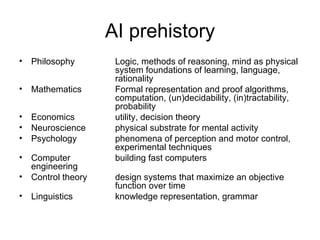
AI prehistory Philosophy Logic, methods of reasoning, mind as physical    system foundations of learning, language, rationality Mathematics Formal representation and proof algorithms, computation, (un)decidability, (in)tractability, probability Economics utility, decision theory  Neuroscience physical substrate for mental activity Psychology  phenomena of perception and motor control, experimental techniques Computer  building fast computers  engineering Control theory design systems that maximize an objective function over time  Linguistics knowledge representation, grammar
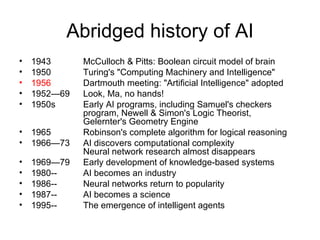
Abridged history of AI 1943  McCulloch & Pitts: Boolean circuit model of brain 1950  Turing's "Computing Machinery and Intelligence" 1956 Dartmouth meeting: "Artificial Intelligence" adopted 1952—69 Look, Ma, no hands!  1950s Early AI programs, including Samuel's checkers program, Newell & Simon's Logic Theorist,  Gelernter's Geometry Engine 1965 Robinson's complete algorithm for logical reasoning 1966—73 AI discovers computational complexity Neural network research almost disappears 1969—79 Early development of knowledge-based systems 1980--  AI becomes an industry  1986--  Neural networks return to popularity 1987-- AI becomes a science  1995-- The emergence of intelligent agents
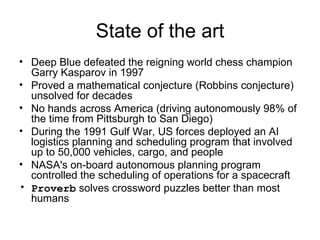
State of the art Deep Blue defeated the reigning world chess champion Garry Kasparov in 1997  Proved a mathematical conjecture (Robbins conjecture) unsolved for decades  No hands across America (driving autonomously 98% of the time from Pittsburgh to San Diego)  During the 1991 Gulf War, US forces deployed an AI logistics planning and scheduling program that involved up to 50,000 vehicles, cargo, and people  NASA's on-board autonomous planning program controlled the scheduling of operations for a spacecraft  Proverb  solves crossword puzzles better than most humans
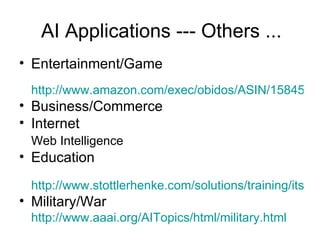
AI Applications --- Others ... Entertainment/Game http://www.amazon.com/exec/obidos/ASIN/1584500778/thegameaipage/002-0547139-8046433 Business/Commerce Internet Web Intelligence Education http://www.stottlerhenke.com/solutions/training/its_background.htm Military/War http:// www.aaai.org/AITopics/html/military.html
Discussion on Turing Test (The Imitation Game) Do we need AI to pass Turing test? References: http://www.rci.rutgers.edu/~cfs/472_html/Intro/NYT_Intro/History/MachineIntelligence1.html MegaHal
Intelligent Agents Chapter 2
Agents An  agent  is anything that can be viewed as  perceiving  its  environment  through  sensors  and  acting  upon that environment through  actuators Human agent: eyes, ears, and other organs for sensors; hands, legs, mouth, and other body parts for actuators Robotic agent: cameras and infrared range finders for sensors; various motors for actuators
Agents and environments The  agent   function  maps from percept histories to actions: [ f :  P*      A ] The  agent   program  runs on the physical  architecture  to produce  f agent = architecture + program
Vacuum-cleaner world Percepts: location and contents, e.g., [A,Dirty] Actions:  Left ,  Right ,  Suck ,  NoOp
Rational agents An agent should strive to  "do the right thing" , based on what it can perceive and the actions it can perform. The right action is the one that will cause the agent to be most successful Performance measure:  An objective criterion for success of an agent's behavior E.g., performance measure of a vacuum-cleaner agent could be amount of dirt cleaned up, amount of time taken, amount of electricity consumed, amount of noise generated, etc.
Rational agents Rational   Agent : For each possible percept sequence, a rational agent should select an action that is expected to maximize its performance measure, given the evidence provided by the percept sequence and whatever built-in knowledge the agent has.
Rational agents Rationality is distinct from omniscience (all-knowing with infinite knowledge) Agents can perform actions in order to modify future percepts so as to obtain useful information (information gathering, exploration) An agent is  autonomous  if its behavior is determined by its own experience (with ability to learn and adapt) How to design a rational agent?
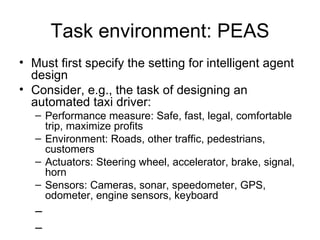
Task environment: PEAS Must first specify the setting for intelligent agent design Consider, e.g., the task of designing an automated taxi driver: Performance measure: Safe, fast, legal, comfortable trip, maximize profits Environment: Roads, other traffic, pedestrians, customers Actuators: Steering wheel, accelerator, brake, signal, horn Sensors: Cameras, sonar, speedometer, GPS, odometer, engine sensors, keyboard
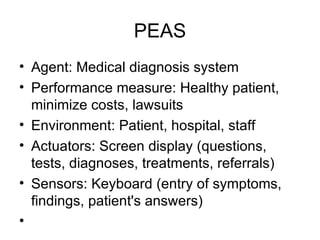
PEAS Agent: Medical diagnosis system Performance measure: Healthy patient, minimize costs, lawsuits Environment: Patient, hospital, staff Actuators: Screen display (questions, tests, diagnoses, treatments, referrals) Sensors: Keyboard (entry of symptoms, findings, patient's answers)
PEAS Agent: Part-picking robot Performance measure: Percentage of parts in correct bins Environment: Conveyor belt with parts, bins Actuators: Jointed arm and hand Sensors: Camera, joint angle sensors
PEAS Agent: Interactive English tutor Performance measure: Maximize student's score on test Environment: Set of students Actuators: Screen display (exercises, suggestions, corrections) Sensors: Keyboard What kind of environment?
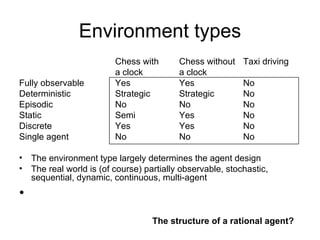
Environment types Fully observable  (vs. partially observable): An agent's sensors give it access to the complete state of the environment at each point in time. Deterministic  (vs. stochastic): The next state of the environment is completely determined by the current state and the action executed by the agent. (If the environment is deterministic except for the actions of other agents, then the environment is  strategic ) Episodic  (vs. sequential): The agent's experience is divided into atomic "episodes" (each episode consists of the agent perceiving and then performing a single action), and the choice of action in each episode depends only on the episode itself.
Environment types Static  (vs. dynamic): The environment is unchanged while an agent is deliberating. (The environment is  semidynamic  if the environment itself does not change with the passage of time but the agent's performance score does) Discrete  (vs. continuous): A limited number of distinct, clearly defined percepts and actions. Single agent  (vs. multiagent): An agent operating by itself in an environment.
Environment types Chess with  Chess without  Taxi driving  a clock a clock Fully observable Yes Yes No  Deterministic Strategic Strategic No  Episodic  No No No  Static  Semi Yes  No  Discrete Yes  Yes No Single agent No No No  The environment type largely determines the agent design The real world is (of course) partially observable, stochastic, sequential, dynamic, continuous, multi-agent The structure of a rational agent?
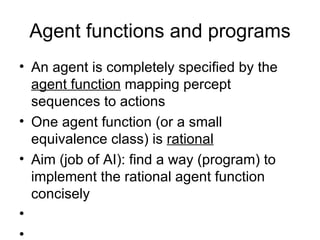
Agent functions and programs An agent is completely specified by the  agent function  mapping percept sequences to actions One agent function (or a small equivalence class) is  rational Aim (job of AI): find a way (program) to implement the rational agent function concisely
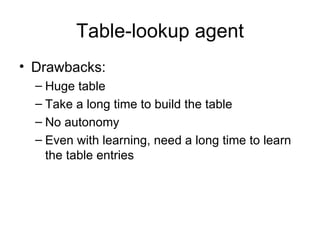
Table-lookup agent Drawbacks: Huge table Take a long time to build the table No autonomy Even with learning, need a long time to learn the table entries
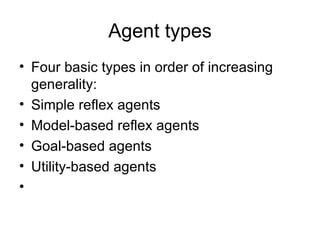
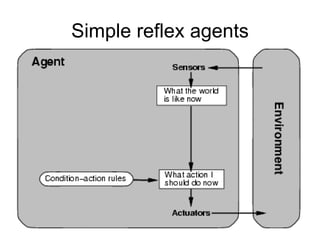
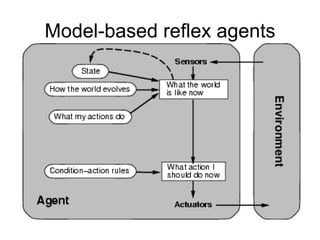
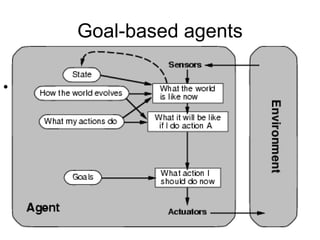
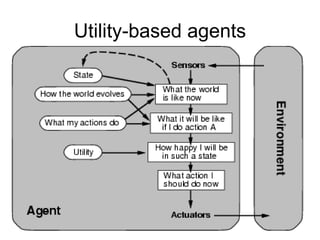
Agent types Four basic types in order of increasing generality: Simple reflex agents Model-based reflex agents Goal-based agents Utility-based agents
Simple reflex agents
Model-based reflex agents
Goal-based agents
Utility-based agents
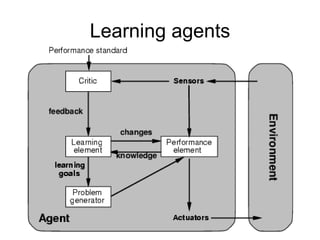
Learning agents

Introduction

  • 1.
    COMP3170 ArtificialIntelligence and Machine Learning Lecture 1 Hong Kong Baptist University
  • 2.
    COMP 3170 (COMP3010/SCI3790/COMP4070)Course home page: http://www.comp.hkbu.edu.hk/~comp3170 Lecturers: Pinata Winoto (RSS715) Guoping Qiu (RSS711) Textbook: S. Russell and P. Norvig Artificial Intelligence: A Modern Approach Prentice Hall, 2003, Second Edition
  • 3.
    Assessment Continuous Assessment(30%): Undergrad students: Quizzes (2 x 10%) + Term project (10%) Graduate students: Quizzes (2 x 5%) + Term project (20%) Final Examination (70%)
  • 4.
    Tentative schedule Tentativeschedule/topics: Knowledge representation & reasoning (II) (Ch. 9 & 10) Week 4: Feb. 8 Tutorial Week 5: Feb. 14 Uncertainty knowledge & reasoning (I) (Ch. 13) Week 5: Feb. 15 Tutorial Week 4: Feb. 7 Knowledge representation & reasoning (I) (Ch. 7 & 8) Week 3: Feb. 1 Tutorial Week 3: Jan. 31 Search (II) (Ch. 5) Week 2: Jan. 25 Tutorial Week 2: Jan. 24 Search (I) (Ch. 3 & 4) Week 1: Jan. 18 Introduction to AI & ML (Ch. 1 & 2) Week 1: Jan. 17 Topics Date
  • 5.
    Tentative schedule Tentativeschedule/topics: Holiday  Feb. 21 & 22 TBD Week 8: March 15 – Week 13: April 26 Tutorial Week 8: March 14 Concept learning and decision tree learning (Ch. 18) Week 7: March 8 Quiz 1 (50 minutes) Week 7: March 7 Uncertainty knowledge & reasoning (II) (Ch. 14) Week 6: March 1 Tutorial Week 6: Feb. 28 Topics Date
  • 6.
    The History ofArtificial Intelligence Chapter 1
  • 7.
    What is AI?Views of AI fall into four categories: Thinking humanly Thinking rationally Acting humanly Acting rationally The textbook advocates "acting rationally"
  • 8.
    Acting humanly: TuringTest Turing (1950) "Computing machinery and intelligence": "Can machines think?"  "Can machines behave intelligently?" Operational test for intelligent behavior: the Imitation Game Predicted that by 2000, a machine might have a 30% chance of fooling a lay person for 5 minutes Anticipated all major arguments against AI in following 50 years Suggested major components of AI: knowledge, reasoning, language understanding, learning
  • 9.
    Thinking humanly: cognitivemodeling 1960s "cognitive revolution": information-processing psychology Requires scientific theories of internal activities of the brain -- How to validate? Requires 1) Predicting and testing behavior of human subjects (top-down) or 2) Direct identification from neurological data (bottom-up) Both approaches (roughly, Cognitive Science and Cognitive Neuroscience) are now distinct from AI
  • 10.
    Thinking rationally: "lawsof thought" Aristotle: what are correct arguments/thought processes? Several Greek schools developed various forms of logic : notation and rules of derivation for thoughts; may or may not have proceeded to the idea of mechanization Direct line through mathematics and philosophy to modern AI Problems: Not all intelligent behavior is mediated by logical deliberation What is the purpose of thinking? What thoughts should I have?
  • 11.
    Acting rationally: rationalagent Rational behavior: doing the right thing The right thing: that which is expected to maximize goal achievement, given the available information Doesn't necessarily involve thinking – e.g., blinking reflex – but thinking should be in the service of rational action
  • 12.
    Rational agents An agent is an entity that perceives and acts This course is about designing rational agents Abstractly, an agent is a function from percept histories to actions: [ f : P*  A ] For any given class of environments and tasks, we seek the agent (or class of agents) with the best performance Caveat: computational limitations make perfect rationality unachievable  design best program for given machine resources
  • 13.
    AI prehistory PhilosophyLogic, methods of reasoning, mind as physical system foundations of learning, language, rationality Mathematics Formal representation and proof algorithms, computation, (un)decidability, (in)tractability, probability Economics utility, decision theory Neuroscience physical substrate for mental activity Psychology phenomena of perception and motor control, experimental techniques Computer building fast computers engineering Control theory design systems that maximize an objective function over time Linguistics knowledge representation, grammar
  • 14.
    Abridged history ofAI 1943 McCulloch & Pitts: Boolean circuit model of brain 1950 Turing's "Computing Machinery and Intelligence" 1956 Dartmouth meeting: "Artificial Intelligence" adopted 1952—69 Look, Ma, no hands! 1950s Early AI programs, including Samuel's checkers program, Newell & Simon's Logic Theorist, Gelernter's Geometry Engine 1965 Robinson's complete algorithm for logical reasoning 1966—73 AI discovers computational complexity Neural network research almost disappears 1969—79 Early development of knowledge-based systems 1980-- AI becomes an industry 1986-- Neural networks return to popularity 1987-- AI becomes a science 1995-- The emergence of intelligent agents
  • 15.
    State of theart Deep Blue defeated the reigning world chess champion Garry Kasparov in 1997 Proved a mathematical conjecture (Robbins conjecture) unsolved for decades No hands across America (driving autonomously 98% of the time from Pittsburgh to San Diego) During the 1991 Gulf War, US forces deployed an AI logistics planning and scheduling program that involved up to 50,000 vehicles, cargo, and people NASA's on-board autonomous planning program controlled the scheduling of operations for a spacecraft Proverb solves crossword puzzles better than most humans
  • 16.
    AI Applications ---Others ... Entertainment/Game http://www.amazon.com/exec/obidos/ASIN/1584500778/thegameaipage/002-0547139-8046433 Business/Commerce Internet Web Intelligence Education http://www.stottlerhenke.com/solutions/training/its_background.htm Military/War http:// www.aaai.org/AITopics/html/military.html
  • 17.
    Discussion on TuringTest (The Imitation Game) Do we need AI to pass Turing test? References: http://www.rci.rutgers.edu/~cfs/472_html/Intro/NYT_Intro/History/MachineIntelligence1.html MegaHal
  • 18.
  • 19.
    Agents An agent is anything that can be viewed as perceiving its environment through sensors and acting upon that environment through actuators Human agent: eyes, ears, and other organs for sensors; hands, legs, mouth, and other body parts for actuators Robotic agent: cameras and infrared range finders for sensors; various motors for actuators
  • 20.
    Agents and environmentsThe agent function maps from percept histories to actions: [ f : P*  A ] The agent program runs on the physical architecture to produce f agent = architecture + program
  • 21.
    Vacuum-cleaner world Percepts:location and contents, e.g., [A,Dirty] Actions: Left , Right , Suck , NoOp
  • 22.
    Rational agents Anagent should strive to "do the right thing" , based on what it can perceive and the actions it can perform. The right action is the one that will cause the agent to be most successful Performance measure: An objective criterion for success of an agent's behavior E.g., performance measure of a vacuum-cleaner agent could be amount of dirt cleaned up, amount of time taken, amount of electricity consumed, amount of noise generated, etc.
  • 23.
    Rational agents Rational Agent : For each possible percept sequence, a rational agent should select an action that is expected to maximize its performance measure, given the evidence provided by the percept sequence and whatever built-in knowledge the agent has.
  • 24.
    Rational agents Rationalityis distinct from omniscience (all-knowing with infinite knowledge) Agents can perform actions in order to modify future percepts so as to obtain useful information (information gathering, exploration) An agent is autonomous if its behavior is determined by its own experience (with ability to learn and adapt) How to design a rational agent?
  • 25.
    Task environment: PEASMust first specify the setting for intelligent agent design Consider, e.g., the task of designing an automated taxi driver: Performance measure: Safe, fast, legal, comfortable trip, maximize profits Environment: Roads, other traffic, pedestrians, customers Actuators: Steering wheel, accelerator, brake, signal, horn Sensors: Cameras, sonar, speedometer, GPS, odometer, engine sensors, keyboard
  • 26.
    PEAS Agent: Medicaldiagnosis system Performance measure: Healthy patient, minimize costs, lawsuits Environment: Patient, hospital, staff Actuators: Screen display (questions, tests, diagnoses, treatments, referrals) Sensors: Keyboard (entry of symptoms, findings, patient's answers)
  • 27.
    PEAS Agent: Part-pickingrobot Performance measure: Percentage of parts in correct bins Environment: Conveyor belt with parts, bins Actuators: Jointed arm and hand Sensors: Camera, joint angle sensors
  • 28.
    PEAS Agent: InteractiveEnglish tutor Performance measure: Maximize student's score on test Environment: Set of students Actuators: Screen display (exercises, suggestions, corrections) Sensors: Keyboard What kind of environment?
  • 29.
    Environment types Fullyobservable (vs. partially observable): An agent's sensors give it access to the complete state of the environment at each point in time. Deterministic (vs. stochastic): The next state of the environment is completely determined by the current state and the action executed by the agent. (If the environment is deterministic except for the actions of other agents, then the environment is strategic ) Episodic (vs. sequential): The agent's experience is divided into atomic "episodes" (each episode consists of the agent perceiving and then performing a single action), and the choice of action in each episode depends only on the episode itself.
  • 30.
    Environment types Static (vs. dynamic): The environment is unchanged while an agent is deliberating. (The environment is semidynamic if the environment itself does not change with the passage of time but the agent's performance score does) Discrete (vs. continuous): A limited number of distinct, clearly defined percepts and actions. Single agent (vs. multiagent): An agent operating by itself in an environment.
  • 31.
    Environment types Chesswith Chess without Taxi driving a clock a clock Fully observable Yes Yes No Deterministic Strategic Strategic No Episodic No No No Static Semi Yes No Discrete Yes Yes No Single agent No No No The environment type largely determines the agent design The real world is (of course) partially observable, stochastic, sequential, dynamic, continuous, multi-agent The structure of a rational agent?
  • 32.
    Agent functions andprograms An agent is completely specified by the agent function mapping percept sequences to actions One agent function (or a small equivalence class) is rational Aim (job of AI): find a way (program) to implement the rational agent function concisely
  • 33.
    Table-lookup agent Drawbacks:Huge table Take a long time to build the table No autonomy Even with learning, need a long time to learn the table entries
  • 34.
    Agent types Fourbasic types in order of increasing generality: Simple reflex agents Model-based reflex agents Goal-based agents Utility-based agents
  • 35.
  • 36.
  • 37.
  • 38.
  • 39.