ENVS 161:
Writing
Workshop
Anna Yang, Science Librarian
Library and Learning Commons
Santa Clara University
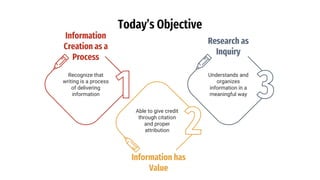
Today’s Objective
Information
Creation as a
Process
Recognize that
writing is a process
of delivering
information
Research as
Inquiry
Understands and
organizes
information in a
meaningful way
Information has
Value
Able to give credit
through citation
and proper
attribution
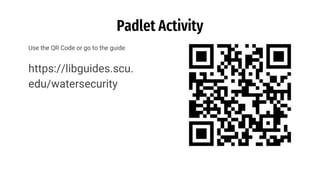
Padlet Activity
Use the QR Code or go to the guide
https://libguides.scu.
edu/watersecurity
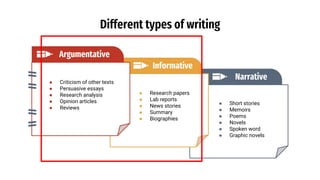
● Short stories
● Memoirs
● Poems
● Novels
● Spoken word
● Graphic novels
Narrative
Informative
● Research papers
● Lab reports
● News stories
● Summary
● Biographies
Different types of writing
Argumentative
● Criticism of other texts
● Persuasive essays
● Research analysis
● Opinion articles
● Reviews
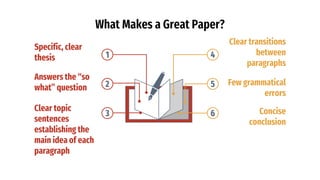
Specific, clear
thesis
Answers the “so
what” question
Clear topic
sentences
establishing the
main idea of each
paragraph
What Makes a Great Paper?
Clear transitions
between
paragraphs
Few grammatical
errors
Concise
conclusion
1
2
3
4
5
6
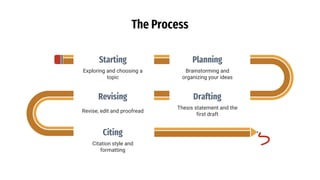
The Process
Brainstorming and
organizing your ideas
Planning
Starting
Exploring and choosing a
topic
Citing
Citation style and
formatting
Revising
Revise, edit and proofread
Drafting
Thesis statement and the
first draft
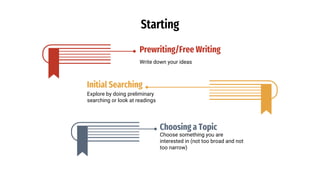
Starting
Prewriting/Free Writing
Write down your ideas
Initial Searching
Explore by doing preliminary
searching or look at readings
Choosing a Topic
Choose something you are
interested in (not too broad and not
too narrow)
Exercise 1
For the next 10 minutes, conduct a preliminary search for
more information on your topic. Use the research guide for
this class or the library’s website. Find at least 3 sources that
might pertain to your topic. Be prepared to share.
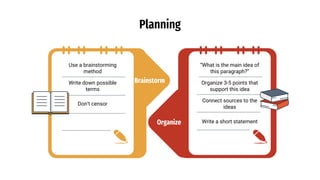
Brainstorm
Planning
Use a brainstorming
method
Write down possible
terms
Don’t censor
“What is the main idea of
this paragraph?”
Organize 3-5 points that
support this idea
Connect sources to the
ideas
Write a short statement
Organize
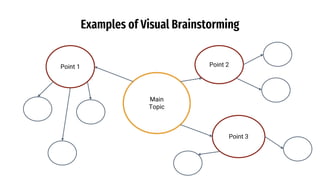
Examples of Visual Brainstorming
Main
Topic
Point 3
Point 2
Point 1
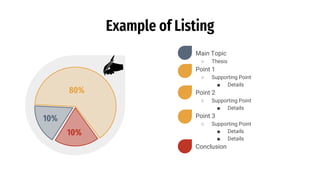
Example of Listing
Main Topic
○ Thesis
Point 1
○ Supporting Point
■ Details
Point 2
○ Supporting Point
■ Details
Point 3
○ Supporting Point
■ Details
■ Details
Conclusion
80%
10%
10%
Exercise 2
Spend the next 5 minutes brainstorming your topic. You can
use a visual graph or list it out. Think about how the evidence
you have so far can be organized.
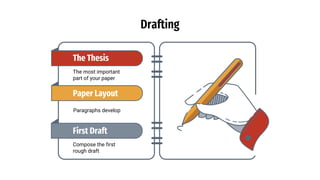
Drafting
The most important
part of your paper
The Thesis
Paper Layout
Paragraphs develop
First Draft
Compose the first
rough draft
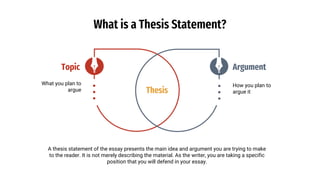
What is a Thesis Statement?
Argument
Topic
How you plan to
argue it
Thesis
What you plan to
argue
A thesis statement of the essay presents the main idea and argument you are trying to make
to the reader. It is not merely describing the material. As the writer, you are taking a specific
position that you will defend in your essay.
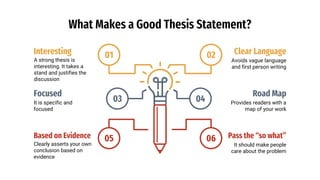
What Makes a Good Thesis Statement?
Interesting
A strong thesis is
interesting. It takes a
stand and justifies the
discussion
Based on Evidence
Clearly asserts your own
conclusion based on
evidence
Clear Language
Avoids vague language
and first person writing
Focused
It is specific and
focused
Pass the “so what”
It should make people
care about the problem
Road Map
Provides readers with a
map of your work
01 02
03 04
05 06
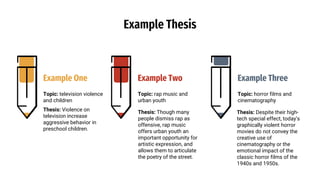
Example Thesis
Example One
Topic: television violence
and children
Example Three
Topic: horror films and
cinematography
Example Two
Topic: rap music and
urban youth
Thesis: Violence on
television increase
aggressive behavior in
preschool children.
Thesis: Though many
people dismiss rap as
offensive, rap music
offers urban youth an
important opportunity for
artistic expression, and
allows them to articulate
the poetry of the street.
Thesis: Despite their high-
tech special effect, today’s
graphically violent horror
movies do not convey the
creative use of
cinematography or the
emotional impact of the
classic horror films of the
1940s and 1950s.
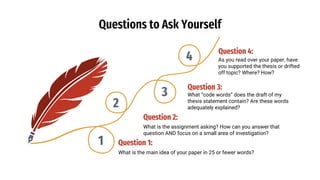
Questions to Ask Yourself
Question 2:
What is the assignment asking? How can you answer that
question AND focus on a small area of investigation?
Question 4:
As you read over your paper, have
you supported the thesis or drifted
off topic? Where? How?
Question 3:
What “code words” does the draft of my
thesis statement contain? Are these words
adequately explained?
Question 1:
What is the main idea of your paper in 25 or fewer words?
1
2
3
4
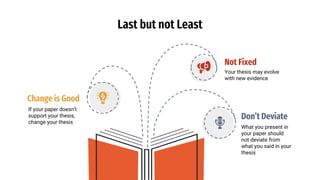
Last but not Least
Change is Good
If your paper doesn’t
support your thesis,
change your thesis
Not Fixed
Your thesis may evolve
with new evidence
Don’t Deviate
What you present in
your paper should
not deviate from
what you said in your
thesis
Exercise 3
Now you try! Take a look at your topic and the evidence you
have so far. Spend the next 10 minutes developing your
preliminary thesis statement. WARNING: It can change!
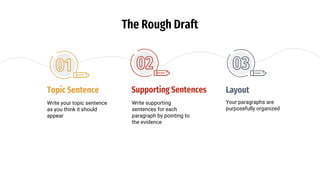
The Rough Draft
Layout
Your paragraphs are
purposefully organized
Write your topic sentence
as you think it should
appear
Topic Sentence Supporting Sentences
Write supporting
sentences for each
paragraph by pointing to
the evidence
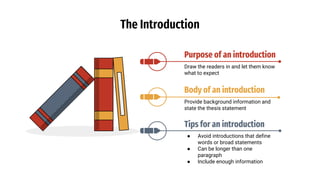
The Introduction
Tips for an introduction
● Avoid introductions that define
words or broad statements
● Can be longer than one
paragraph
● Include enough information
Purpose of an introduction
Draw the readers in and let them know
what to expect
Body of an introduction
Provide background information and
state the thesis statement
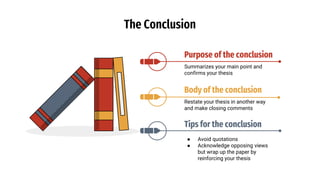
The Conclusion
Tips for the conclusion
● Avoid quotations
● Acknowledge opposing views
but wrap up the paper by
reinforcing your thesis
Purpose of the conclusion
Summarizes your main point and
confirms your thesis
Body of the conclusion
Restate your thesis in another way
and make closing comments
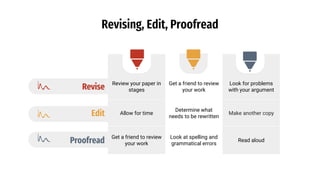
Revise Review your paper in
stages
Get a friend to review
your work
Look for problems
with your argument
Edit Allow for time
Determine what
needs to be rewritten
Make another copy
Proofread Get a friend to review
your work
Look at spelling and
grammatical errors
Read aloud
Revising, Edit, Proofread
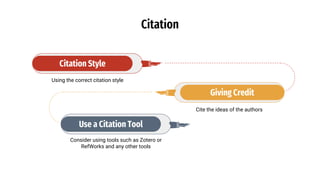
Citation
Cite the ideas of the authors
Giving Credit
Consider using tools such as Zotero or
RefWorks and any other tools
Use a Citation Tool
Using the correct citation style
Citation Style
Exercise 4
You remember those sources you found at the very
beginning of class? Take 5 minutes and format them into the
preferred citation style for this class.
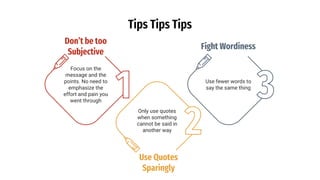
Tips Tips Tips
Don’t be too
Subjective
Focus on the
message and the
points. No need to
emphasize the
effort and pain you
went through
Fight Wordiness
Use fewer words to
say the same thing
Use Quotes
Sparingly
Only use quotes
when something
cannot be said in
another way
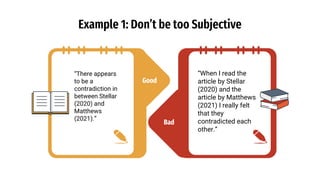
Good
Example 1: Don’t be too Subjective
“There appears
to be a
contradiction in
between Stellar
(2020) and
Matthews
(2021).”
“When I read the
article by Stellar
(2020) and the
article by Matthews
(2021) I really felt
that they
contradicted each
other.”
Bad
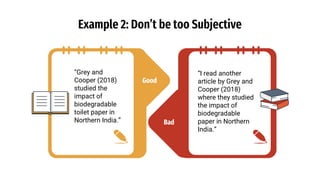
Good
Example 2: Don’t be too Subjective
“Grey and
Cooper (2018)
studied the
impact of
biodegradable
toilet paper in
Northern India.”
“I read another
article by Grey and
Cooper (2018)
where they studied
the impact of
biodegradable
paper in Northern
India.”
Bad
Good
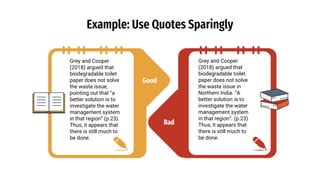
Example: Use Quotes Sparingly
Grey and Cooper
(2018) argued that
biodegradable toilet
paper does not solve
the waste issue,
pointing out that “a
better solution is to
investigate the water
management system
in that region” (p.23).
Thus, it appears that
there is still much to
be done.
Grey and Cooper
(2018) argued that
biodegradable toilet
paper does not solve
the waste issue in
Northern India. “A
better solution is to
investigate the water
management system
in that region”. (p.23)
Thus, it appears that
there is still much to
be done.
Bad
Good
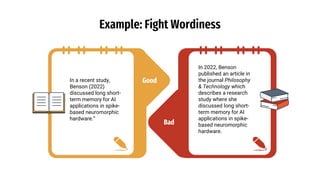
Example: Fight Wordiness
In a recent study,
Benson (2022)
discussed long short-
term memory for AI
applications in spike-
based neuromorphic
hardware.”
In 2022, Benson
published an article in
the journal Philosophy
& Technology which
describes a research
study where she
discussed long short-
term memory for AI
applications in spike-
based neuromorphic
hardware.
Bad
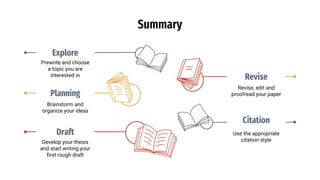
Summary
Prewrite and choose
a topic you are
interested in
Explore
Brainstorm and
organize your ideas
Planning
Develop your thesis
and start writing your
first rough draft
Draft
Revise, edit and
proofread your paper
Revise
Use the appropriate
citation style
Citation
Exercise 5 (optional)
For the remainder of class, work on your topic. Read your
evidence. Flush out your thesis. Think about the layout of
your paper.
Contact
Anna Yang
Science Librarian
ayang3@scu.edu
*Slide template can be found from Slidesgo.

ENVS 161 : Writing Workshop.pptx

  • 1.
    ENVS 161: Writing Workshop Anna Yang,Science Librarian Library and Learning Commons Santa Clara University
  • 2.
    Today’s Objective Information Creation asa Process Recognize that writing is a process of delivering information Research as Inquiry Understands and organizes information in a meaningful way Information has Value Able to give credit through citation and proper attribution
  • 3.
    Padlet Activity Use theQR Code or go to the guide https://libguides.scu. edu/watersecurity
  • 4.
    ● Short stories ●Memoirs ● Poems ● Novels ● Spoken word ● Graphic novels Narrative Informative ● Research papers ● Lab reports ● News stories ● Summary ● Biographies Different types of writing Argumentative ● Criticism of other texts ● Persuasive essays ● Research analysis ● Opinion articles ● Reviews
  • 5.
    Specific, clear thesis Answers the“so what” question Clear topic sentences establishing the main idea of each paragraph What Makes a Great Paper? Clear transitions between paragraphs Few grammatical errors Concise conclusion 1 2 3 4 5 6
  • 6.
    The Process Brainstorming and organizingyour ideas Planning Starting Exploring and choosing a topic Citing Citation style and formatting Revising Revise, edit and proofread Drafting Thesis statement and the first draft
  • 7.
    Starting Prewriting/Free Writing Write downyour ideas Initial Searching Explore by doing preliminary searching or look at readings Choosing a Topic Choose something you are interested in (not too broad and not too narrow)
  • 8.
    Exercise 1 For thenext 10 minutes, conduct a preliminary search for more information on your topic. Use the research guide for this class or the library’s website. Find at least 3 sources that might pertain to your topic. Be prepared to share.
  • 9.
    Brainstorm Planning Use a brainstorming method Writedown possible terms Don’t censor “What is the main idea of this paragraph?” Organize 3-5 points that support this idea Connect sources to the ideas Write a short statement Organize
  • 10.
    Examples of VisualBrainstorming Main Topic Point 3 Point 2 Point 1
  • 11.
    Example of Listing MainTopic ○ Thesis Point 1 ○ Supporting Point ■ Details Point 2 ○ Supporting Point ■ Details Point 3 ○ Supporting Point ■ Details ■ Details Conclusion 80% 10% 10%
  • 12.
    Exercise 2 Spend thenext 5 minutes brainstorming your topic. You can use a visual graph or list it out. Think about how the evidence you have so far can be organized.
  • 13.
    Drafting The most important partof your paper The Thesis Paper Layout Paragraphs develop First Draft Compose the first rough draft
  • 14.
    What is aThesis Statement? Argument Topic How you plan to argue it Thesis What you plan to argue A thesis statement of the essay presents the main idea and argument you are trying to make to the reader. It is not merely describing the material. As the writer, you are taking a specific position that you will defend in your essay.
  • 15.
    What Makes aGood Thesis Statement? Interesting A strong thesis is interesting. It takes a stand and justifies the discussion Based on Evidence Clearly asserts your own conclusion based on evidence Clear Language Avoids vague language and first person writing Focused It is specific and focused Pass the “so what” It should make people care about the problem Road Map Provides readers with a map of your work 01 02 03 04 05 06
  • 16.
    Example Thesis Example One Topic:television violence and children Example Three Topic: horror films and cinematography Example Two Topic: rap music and urban youth Thesis: Violence on television increase aggressive behavior in preschool children. Thesis: Though many people dismiss rap as offensive, rap music offers urban youth an important opportunity for artistic expression, and allows them to articulate the poetry of the street. Thesis: Despite their high- tech special effect, today’s graphically violent horror movies do not convey the creative use of cinematography or the emotional impact of the classic horror films of the 1940s and 1950s.
  • 17.
    Questions to AskYourself Question 2: What is the assignment asking? How can you answer that question AND focus on a small area of investigation? Question 4: As you read over your paper, have you supported the thesis or drifted off topic? Where? How? Question 3: What “code words” does the draft of my thesis statement contain? Are these words adequately explained? Question 1: What is the main idea of your paper in 25 or fewer words? 1 2 3 4
  • 18.
    Last but notLeast Change is Good If your paper doesn’t support your thesis, change your thesis Not Fixed Your thesis may evolve with new evidence Don’t Deviate What you present in your paper should not deviate from what you said in your thesis
  • 19.
    Exercise 3 Now youtry! Take a look at your topic and the evidence you have so far. Spend the next 10 minutes developing your preliminary thesis statement. WARNING: It can change!
  • 20.
    The Rough Draft Layout Yourparagraphs are purposefully organized Write your topic sentence as you think it should appear Topic Sentence Supporting Sentences Write supporting sentences for each paragraph by pointing to the evidence
  • 21.
    The Introduction Tips foran introduction ● Avoid introductions that define words or broad statements ● Can be longer than one paragraph ● Include enough information Purpose of an introduction Draw the readers in and let them know what to expect Body of an introduction Provide background information and state the thesis statement
  • 22.
    The Conclusion Tips forthe conclusion ● Avoid quotations ● Acknowledge opposing views but wrap up the paper by reinforcing your thesis Purpose of the conclusion Summarizes your main point and confirms your thesis Body of the conclusion Restate your thesis in another way and make closing comments
  • 23.
    Revise Review yourpaper in stages Get a friend to review your work Look for problems with your argument Edit Allow for time Determine what needs to be rewritten Make another copy Proofread Get a friend to review your work Look at spelling and grammatical errors Read aloud Revising, Edit, Proofread
  • 24.
    Citation Cite the ideasof the authors Giving Credit Consider using tools such as Zotero or RefWorks and any other tools Use a Citation Tool Using the correct citation style Citation Style
  • 25.
    Exercise 4 You rememberthose sources you found at the very beginning of class? Take 5 minutes and format them into the preferred citation style for this class.
  • 26.
    Tips Tips Tips Don’tbe too Subjective Focus on the message and the points. No need to emphasize the effort and pain you went through Fight Wordiness Use fewer words to say the same thing Use Quotes Sparingly Only use quotes when something cannot be said in another way
  • 27.
    Good Example 1: Don’tbe too Subjective “There appears to be a contradiction in between Stellar (2020) and Matthews (2021).” “When I read the article by Stellar (2020) and the article by Matthews (2021) I really felt that they contradicted each other.” Bad
  • 28.
    Good Example 2: Don’tbe too Subjective “Grey and Cooper (2018) studied the impact of biodegradable toilet paper in Northern India.” “I read another article by Grey and Cooper (2018) where they studied the impact of biodegradable paper in Northern India.” Bad
  • 29.
    Good Example: Use QuotesSparingly Grey and Cooper (2018) argued that biodegradable toilet paper does not solve the waste issue, pointing out that “a better solution is to investigate the water management system in that region” (p.23). Thus, it appears that there is still much to be done. Grey and Cooper (2018) argued that biodegradable toilet paper does not solve the waste issue in Northern India. “A better solution is to investigate the water management system in that region”. (p.23) Thus, it appears that there is still much to be done. Bad
  • 30.
    Good Example: Fight Wordiness Ina recent study, Benson (2022) discussed long short- term memory for AI applications in spike- based neuromorphic hardware.” In 2022, Benson published an article in the journal Philosophy & Technology which describes a research study where she discussed long short- term memory for AI applications in spike- based neuromorphic hardware. Bad
  • 31.
    Summary Prewrite and choose atopic you are interested in Explore Brainstorm and organize your ideas Planning Develop your thesis and start writing your first rough draft Draft Revise, edit and proofread your paper Revise Use the appropriate citation style Citation
  • 32.
    Exercise 5 (optional) Forthe remainder of class, work on your topic. Read your evidence. Flush out your thesis. Think about the layout of your paper.
  • 33.

Editor's Notes

  • #2 Hello and welcome to today’s workshop. We won’t be talking about library resources and I won’t be demoing a database search. Instead, today we’ll be talking about the writing process and essentially, what it could look like. Be prepared to do small exercises in class today and be able to share.
  • #3 We will be focusing on 3 objectives today. Hopefully by the end of this session, you’ll be able to recognize that writing in itself is a process of delivery information. You as the researcher and writer is creating a piece of work and you are sharing that with us, the reader. I also hope that by the end of this session, you’ll be able to understand that it’s important to give credit to the sources you have found. I’m sure that many of you have written many research papers and reports so I hope this is more of a reminder then an initial teaching moment. Last but certainly not least, that you as the researcher is able to take the information that you have found, and organize them in a meaningful way that supports the paper you are writing.
  • #4 Well, let’s get started with an activity. You can use the QR code and go straight to the research guide for this class or you can go to this website. You can also go to the library’s website and search for the research guide for this course. Look for the library session tab and the padlet should be on the first page. You’ll also notice that the slides for today are located there as well. Thank you for doing that activity. Let's move on,
  • #5 Let’s start by establishing the background for the different types of writing. All your life, you have been exposed to or asked to do writing. There are many ways to categorizes this but we’ll look at this from three types; argumentative, informative, and narrative. Argumentative writing includes things like persuasive essays or position papers. Informative writing seeks to just provide information and that can be things such as the standard research paper, lap reports and news coverage. The other type of writing that is more common in creative writing courses are narrative writing such as short stories and poems. What types of writing do you think is most common in college writing?
  • #6 So, we know about the different types of writing and yes, we’re going to focus on the academic paper but what actually makes a great paper. I’ve narrowed it down to 6 main points. You have a clear thesis. This means your topic and argument create a specific tone for your paper. We’ll talk more about the thesis statement so look forward to that. A great paper needs to answer the “so what” question. Basically, why do we need to care. My recommendation is that you understand that your paper is kind of addressing a problem. It should be something that hooks the reader. A great also has clear topic sentences that establishes the main idea of each paragraph. Think of it as a preview to what will be presented in the paragraph. This leads us into the next part, which is to have clear transitions between paragraphs. The last sentence of a paragraph should lead your readers into the next paragraph. If you think it’s an awkward transition, it’s mostly likely an awkward transition so this is definitely important to do during the revision process. Another thing, and if not, one of the most important parts of what makes a great paper is literally, few grammatical errors. This is true for almost anything. This includes things like spelling, the use of tenses, misplacement of commas, citations, etc. And number 6, although this can be said about the introduction as well, that you have a concise conclusion. There shouldn’t be new evidence or new theories being presented in your conclusion. The reason why it’s a conclusion is because it’s the end of your paper. Let it be the end!
  • #7 Now we move to the point of this presentation. We’re going to look at the writing process. Many of you or maybe all of you already know that writing isn’t a simple thing. It’s a whole process that requires many different skills. It’s important to see this in a way where you can compartmentalize this process so it’s not overwhelming. This is a possibility of how the writing process could look like. First, we have what’s called the “starting” part of this process. This is where you are exploring different topics and problems that exist. This can also include looking at recent readings that are part of class or doing a google search. We then move onto the planning phase which is where you do your brainstorming. Then this transitions to drafting the paper and establishing the thesis statement. Once you are done drafting, you move onto the revision process of your paper. The process can also include citing as the last part but to be honest, this can happen at anytime in the process. But it’s really here that you wrap up your bibliography and that all your citations are done correctly. We will be talking about each step in the writing process so stay with me.
  • #8 The starting part of the writing process can be daunting. I’ve literally had students stare blankly at me and say, I don’t even know where to start or which topic I want to focus on. My recommendation is to free write or prewrite. Just start writing down your ideas. Anything that pops up in your mind. Don’t worry, you don’t have to marry that idea. You’re just saying your introductions to each other. Think of it like those speed dating things. You have 5 minutes. You introduce yourself. Share like one or two facts. Not interested, swipe left. Something like that. In this process, if you literally have no idea what to even free write, then just start searching. Remember the keywords or the readings from class to help you get started. Use the library’s website to search for articles. All of this is just to get the wheels in your brain turning. Don’t spend forever on this part of the writing process but be very careful. It’s almost like you’re building a relationship with your topic. PIck something interesting, that you want to spend time with, and someone who’s a good cook. And by that, I mean has just enough information to move you forward.
  • #9 That being said, the first exercise of today’s workshop.
  • #10 The second step in the writing process is the Planning process. This includes brainstorming your topic to identify the different ideas that are connected to your topic. This is also where you start to organize those ideas. Not necessarily in how it will appear in your paper but more about what could be said about those ideas or points. For brainstorming, use a method to conduct this activity. Write down all the possible keyterms for your topic and don’t censor yourself. This means, don’t limit yourself. When it’s time to organize your ideas within those topics, ask yourself “what is the main idea of this paragraph?” mention 3-5 points that would support this main idea. You can also start to connect sources here to your ideas. Even writing a short statement might help you think through the idea of each of your point. Lets look at two examples of brainstorming techniques that you might find useful.
  • #11 This is an example of a visual brainstorm. Some people are visual learners and find this method to be more effective. As you can see, you start out with the main topic and then identify the different points you’d like to make in your paper. Once you have a point, the other statement or findings.
  • #12 Then we have something a little more simple such as listing. In no particular order, you are just listing your points and then listing supporting points. Think of it as taking notes, each with its own section. It doesn’t matter which method of brainstorming you use as long as it works for you. It’s almost like a brain dump on your topic.
  • #13 Speaking of brainstorming. For the next 5 minutes, brainstorm on your topic. Choose a brainstorming technique and try to identify some points to your topic. Maybe even identity supporting points.
  • #14 In the third part of the writing process, we have drafting. This portion includes the development of your thesis statement as well as your actual first rough draft. I know people might say, don’t you need a thesis statement before you even start brainstorming. I’d argue no because the thesis statement means that you have read the evidence and have decided on the point you’d like to argue in your paper. Don’t confuse a topic with a thesis but don’t worry, we’ll talk about the thesis statement really soon. Also in this section, you will have to start to decide the layout of your paper. This means all the points you’ve brainstormed is now coming together and there is going to be a systematic approach to how you will present those points in your paper. The layout can change but this is where you’ll have to really think about how each paragraph moves into the other.
  • #15 So, what is a thesis statement. It’s essentially a topic and argument. Think of the topic as what you plan to argue and the argument is like how you plan to argue it. A thesis statement of the essay presents the main idea and argument you are trying to make to the reader. It is not merely describing the material. As the writer, you are taking a specific position that you will defend in your essay. We’ll look at examples, because honestly, I learn and understand concepts better with examples.
  • #16 But first, what makes a good thesis statement? Although I have these numbered, it can come in any order. So, is it interesting? A strong thesis is interesting to you as the writer and to us, the reader. It takes a stand on something and justifies the discussion throughout the paper. A good thesis statement has clear language. That means you are avoid vague language such as maybe, like, I think, and also avoids the first person narrative such as using “I” in your paper or “in my opinion”. A good thesis statement is focused and specific. It’s not broad or unclear. A good thesis statement also acts as a road back to the readers. It gives the us the road map to your work in a snap shot. A good thesis statement is also based on evidence which is why a good thesis statement isn’t constructed in the “starting” phase. It clearly asserts your own conclusion based on evidence from your findings. Lastly, A good thesis statement passes the “so what” test. Your thesis should make people care about the problem. Give your readers something to feel dedicated to.
  • #17 Enough said, let’s look at actual thesis. For example one, we have the topic television violence and children. A possible thesis can be “violence on television increase aggressive behavior in preschool children. You have your topic violence on television and your argument is increases aggressive behavior” Example 2 is on rap music and urban youths. A possible thesis can be “though many people dismiss rap as offensive, rap music offers urban youth an important opportunity for artistic expression, and allows them to articulate the poetry of the street. Example 3’s topic is on horror film and cinematography. A potential thesis could be somethin glike this: “despite their high-tech special effect, today’s graphically violent horror movies do not convey the creative use of cinematography or the emotional impact of the classic horror films of the 1940s and 1950s.” I think something you’ll notice quickly is “how did you get those thesis statements from that simple topic”. Good point. I develop these only after I’ve done some research, which is why the thesis statement isn’t something that can be established in the starting phase.
  • #18 Here are some questions you should ask yourself about your thesis statement as well as your paper.
  • #19 I promise this is the end of the thesis portion but I couldn’t live with myself if I didn’t put out these disclaimers. One, your thesis is not fixed. That means it can evolve as you discover new evidence. Again, you are not married to it once you write it down. Change is good. If your paper doesn’t support your thesis, you can change your thesis. Often times, students get so fixated on their thesis that they disregard the evidence and attempt to find new evidence. Sometimes, that evidence doesn’t exist or there isn’t enough evidence out there. It’s okay to change your thesis. Lastly, don’t deviate from what you have said in your thesis. That means whatever it is that you present in your paper should connect to your thesis.
  • #20 That brings us to our next exercise. I want you to take the next 10 minutes to scan your evidence and work on a thesis. Again, you don’t have to keep this thesis forever but I do want you to start somewhere. You can go back to the slides and use the examples to help you think through your thesis.
  • #21 We move onto the rough draft part of drafting. This all happens once you’ve done your research and develop your thesis. Now, it’s time to create those topic sentences. This is usually that first sentence in the paragraph that summarizes the main idea of that paragraph. Kind of like setting the stage for what’s to come in the paragraph. Then you’ll want to start writing your supporting sentences. These flesh out your points with details. It also provides evidence for what you are claiming. This is also the time you are really thinking about how each paragraph or point progresses into the next point. Think about how you want to bridge those paragraphs and create those effortless transitions.
  • #22 I’m sure you all know what is an introduction and a conclusion to a paper, so think of this as a reminder. The purpose of an introduction is to draw the readers in and to also let them know what to expect. It’s like the trailer for a movie. You want to catch your reader here. The body of an introduction is also where you paint a background for your topic and state your thesis statement. Other tips that I would recommend is to avoid introductions that define a word or broad statements. For example, avoid stuff like merriam webster’s dictionary defines so and so as so and so. Or the landscape of solar panels is every changing. You see what I meant? It’s also important to note that an introduction can be longer than a paragraph and often times, this is because you as the writer is providing background information and maybe even identifying the problem, because really, you are trying to include enough introductory information so that you are not providing background information mid-way through your paper.
  • #23 That leads us into the conclusion of your paper. The purpose of the conclusion is for you to summarize your main and confirm your thesis. The body of the conclusion should restate your thesis in another way and make closing comments. You should definitely acknowledge opposing views here but wrap up the paper by reinforcing your thesis. As much as possible, avoid using quotes in the conclusion since it’s suppose to be a summarization of your main points.
  • #24 We proceed into the fourth part of the process. We’re almost at the end! The revision period is known as the revising, editing, and proofreading period. This part can happen over and over again so it doesn’t happen just once. But really, review your paper in stages. What does that mean? It means take a look at each part of your paper separately. Maybe even get your friend to review it and give you feedback. This might be helpful in identifying if there is any problems with your argument. Editing is when you make the changes. Allow for time so that you can actually determines what needs to be rewritten. My other tip is to make another copy when you actually start to edit the paper. This way, you’ll have an old copy. Kind of like a before and after paper. Proofreading is really when you are just reading it. I highly encourage you to get someone else to read your paper and look at grammatical errors such as spelling mistakes or incorrect punctuation. Another thing that will be helpful is when you’re actually reading aloud. We know that there is a correlation between reading something with our mind and when we’re reading it aloud and hearing it. You’ll be surprised how many mistakes we overlook.
  • #25 And we’re finally a the end of the process. The citation part. This is where you are formatting your paper to reflect the appropriate citation style. This is also when you are reminding yourself about how you are citing the ideas of authors, making sure you are doing correct in-text citations and forming that bibliography. Another thing to consider is using a citation tool. This can be a citation tool generator or an actual reference tool such as Zotero or RefWorks. Whatever works for you.
  • #26 Now, do you remember those sources you found at the beginning of class. Let’s take the next 5 minutes to format that into the preferred citation style for class. I believe we are using APA citation. Go to the the research guide for this class and access the “The Writing Process” tab and locate “Citing”. Explore the different citation generators or watch the video on how to generate a citation using the library’s platform interface.
  • #27 We’re at the finish line everyone so let me part ways with you by offering more tips with some examples Don’t be too subjective. Focus on the message and the points. There really isn’t any need to emphasize the effort and pain you went through while putting this paper together. My other tip is to again, use quotes sparingly. You should really only use quotes or quotations when something cannot be said in any other way. My final tip is fight wordiness. Basically, use fewer words to say the same thing. Let’s move to examples.
  • #28 Here is an example of don’t be too subjective. A bad example is “when I read the article by Stellar (2020) and the article by Matthews (2021) I really felt that they contradicted each other.” Here is another way it can be rewritten: “There appears to be a contradiction between Stellar (2020) and Matthews (2021). Do you see what happened there?
  • #29 Here’s another example of being objective, not subjective. The not so good version says “I read another article by Grey and Cooper (2018) where they studied the impact of biodegradable toilet paper in Northern India.” Here’s another way to write that: “Grey and Cooper (2018) studied the impact of biodegradable toilet paper in northern india.” Do you see what we did there? I also want to say that these studies/examples are just made up.
  • #30 Now, if you need to use quotes, trying your best to weave it into your sentence. Here’s a bad example: Grey and Cooper (2018) argued that biodegradable toilet paper does not solve the waste issue in Northern India. “A better solution is to investigate the water management system in that region”. (p.23) Thus, it appears that there is still much to be done. Now, here is the better example: Grey and Cooper (2018) argued that biodegradable toilet paper does not solve the waste issue, pointing out that “a better solution is to investigate the water management system in that region” (p.23). Thus, it appears that there is still much to be done. Do you see what we did there?
  • #31 Finally, fight the urge to be wordy. Here is an bad example: In 2022, Benson published an article in the journal Philosophy & Technology which describes a research study where she discussed long short-term memory for AI applications in spike-based neuromorphic hardware. Now here is a good example: In a recent study, Benson (2022) discussed long short-term memory for AI applications in spike-based neuromorphic hardware.” What do you see there?
  • #32 At Last! Let’s quickly summarize today’s incredibly lengthy lesson. Explore. When you are getting started, just explore. Give yourself time to find something of interest to you. Trust me, you don’t want to spend 4 weeks writing about something you are not even remotely interested in. Before you know it, you’ll shart ghosting your paper. Next, brainstorm and organize your ideas. It doesn't have to be exhaustive and there doesn’t even have to be an order but think about each of your points and they can develop. Start drafting. Now that you know more about your topic and you have evidence, develop your thesis. This could definitely change but really do consider your topic and what you’d like to argue. Once you have completed your first rough draft, start the revision process. This can go back and forth and include multiple revised copies but trust me. You want to turn something in that is good. Also, consider getting a friend or a classmate to read your paper. Even your librarian! You’ll want a second pair of eyes. Finally, don’t forget to cite your sources appropriately.The whole idea behind why we cite is to of course, give credit to the authors but it also shows that we are continuing that scholarly conversation. When we cite someone we are joining them. And so, the conversation continues.
  • #33 Only if we have time. Spend the remainder of class working on your topic. Look at the evidence you have found so far. What jumps out at you. You can even think about the layout of your paper and consider starting the introduction.