EVERYTHING YOU NEED TO
KNOW WHEN WRITING AN
ESSAY
WHAT IS AN ESSAY?
An organized piece of writing that
focuses on a single topic
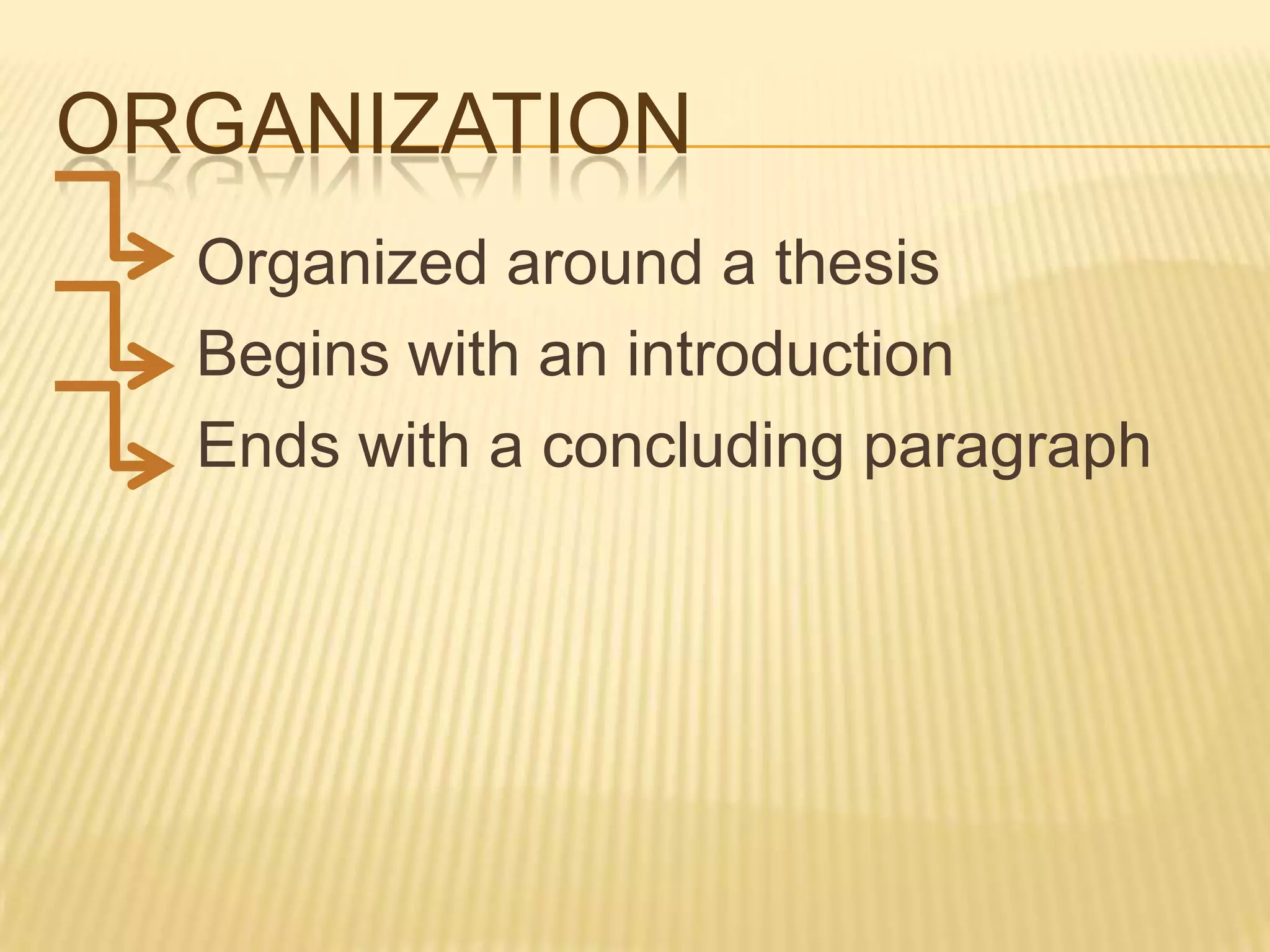
ORGANIZATION
Organized around a thesis
Begins with an introduction
Ends with a concluding paragraph
REASONS FOR WRITING AN
ESSAY
 Helps you to express ideas more clearly
and effectively
 It is a required part of almost all
colleges courses
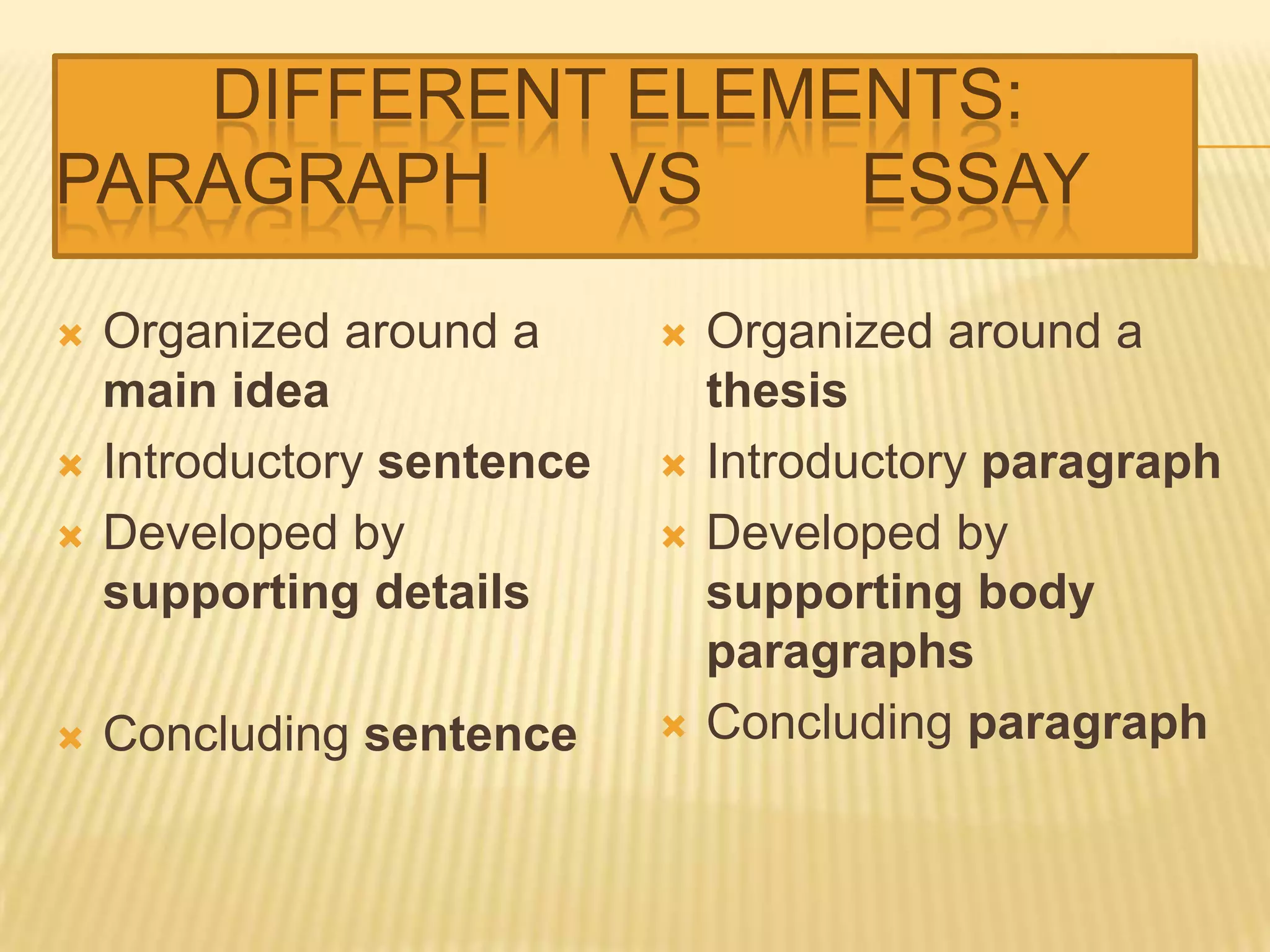
DIFFERENT ELEMENTS:
PARAGRAPH VS ESSAY
 Organized around a
main idea
 Introductory sentence
 Developed by
supporting details
 Concluding sentence
 Organized around a
thesis
 Introductory paragraph
 Developed by
supporting body
paragraphs
 Concluding paragraph
THESIS
It has to do with what you are writing about
THESIS STATEMENT
Sentence in the essay that states the thesis
Expressed in the first paragraph
Key step in developing an effective essay
TIPS FOR WRITING YOUR
THESIS STATEMENT
Determined the kind of paper you are writing.
 An Analytical paper (breaks down an issue or idea into its
component parts)
 An Expository paper (explains something to the audience)
 An Argumentative paper (makes a claim about a topic and
justifies this claim with specify evidence)
Should be specific.
 Appears at the end of the first paragraph of a paper.
Should reflect exactly what you have discussed in the
paper.
INTRODUCTORY PARAGRAPH
 First part of an essay which has a major
influence on the reader s desire to keep
reading.
 Includes different strategies to get the
readers attention that should be
connected with the thesis statement
 It should conclude with the most
important idea of the essay.
BODY OF AN ESSAY
 Set of paragraphs that develop the idea
expressed in the thesis statement
BODY PARAGRAPHS
Provide the content of the essay
Each one should be unique, be unified
around a main idea and arranged coherently
CONCLUSION OF AN ESSAY
 Purpose: To leave the reader with a
positive impression, a sense of
completeness and the inclination to
think about the topic
 Should not give more information about
the topic
 Restates your thesis statement in other
words
THE REVISION AND EDITING
PROCESS
 Process of reviewing and rewriting to
make your ideas more logical
 Aspects:
I. revision through reading
II. revision through collaboration
TYPES OF ESSAYS
Analyse/analysis
Argumentative
Persuasive
Cause and effect
Comparison and
contrast
Definition
Narrative
Descriptive
Division
Classification
Mixed pattern
ANALYZE/ANALYSIS
 To write an analysis, you need to think about
how each part of something contributes to
the success of the whole.
 Describe HOW and WHY its
elements function.
ARGUMENT/ARGUMENTATIVE
 An argument paper presents a stronger claim to
a more resistant audience.
 To write an argument essay, you’ll need to
gather evidence and present a well-reasoned
argument on a debatable issue.
 You must base your paper on a strong position.
 You must choose one side or the other when
you write an argument paper!
DO…
 …use passionate language
 …cite experts who agree with you
 …provide facts, evidence, and statistics to
support your position
 …provide reasons to support your claim
 …address the opposing side’s argument and
refute their claims
DON’T…
 …use weak qualifiers like “I believe,” “I feel,”
or “I think”—just tell us!
 …claim to be an expert if you’re not one
 …use strictly moral or religious claims as
support for your argument
 …assume the audience will agree with you
about any aspect of your argument
 …attempt to make others look bad
PERSUASIVE/PERSUADE
 To write a persuasive paper, you’ll need to
use evidence and good reasons to convince
others to agree with your point of view on a
particular subject.
 Conduct the effective research by obtaining
facts and evidence to support your ideas.
 It doesn't simply report information (like a typical
research paper would)--it uses that information
to make an argument or prove a point.
PERSUASIVE THESIS STATEMENT
 It is a one-sentence description of your topic
and the argument that you plan to make
 Not only tell us what the essay will be about,
but also where the author stands on that
issue (his or her opinion) and briefly explain
why.
CAUSE & EFFECT
 First, determine a scenario in which one
action or event caused certain effects to
occur.
 Second, explain what took place and why
 This essay allows us to identify patterns and
explain why things turned out the way that
they did
NARROWING A LARGE TOPIC
Ask yourself…
 What's the main (most important) cause?
 Can I break the different types of effects
down into categories?
 Which category interests me the most?
COMPARE/CONTRAST
You should…
 Make new connections or express new
differences between two things. You can
compare, contrast or compare and contrast.
 Choose 2 things that could go in the same
category, but are also quite different
ORGANIZING YOUR COMPARE AND
CONTRAST PAPER
Chunking: placing all of the information for
each individual subject in one place
(chunk), and then using similarities as
transitions.
 Piecing: giving pieces of the information for
each individual subject in each paragraph,
arranging the information by topic rather
than by subject.
DEFINITION/DEFINE
To write a definition essay, you’ll need to define
a word that:
 has a complex meaning
 is disputable (could mean different things to
different people)
NARRATIVE/DESCRIPTIVE
Narrative essay tells a story,
relates events that had happened.
Descriptive essay describes a
person, object, or event.
TIPS FOR WRITING EFFECTIVE
NARRATIVE AND DESCRIPTIVE ESSAYS:
 Tell a story about a moment or event that
means a lot to you
 Avoid long introductions and lengthy
descriptions.
 Make sure your story has a point. Describe
what you learned from this experience.
 Describe the setting, characters, the plot,
conflicts and resolution of your story.
USING CONCRETE DETAILS FOR
NARRATIVES
Concrete Language
 …makes the story or
image seem clearer
and more real to us.
 …gives us information
that we can easily
grasp and perhaps
empathize with.
Abstract Language…
 ...makes the story or
image difficult to
visualize.
 …leaves your reader
feeling empty,
disconnected, and
possibly confused.
DIVISION & CLASSIFICATION
 Division Essay:
Choose something that
the majority of people
might not know much
about and therefore
can't understand how
complex that topic
is. You will break your
topic down into
meaningful and
important categories.
 Classification Essay:
Type of analysis in which
you classify information,
organize or sort it into
appropriate categories.
 How to classify the topic:
 These categories will be
the basis for the details you
will include.
 Make sure you create
useful and meaningful
categories.
 It is useful to create a chart
to plan out your categories.
BIBLIOGRAPHY
 Types of papers & students samples by the
Roane State Community College. Retrieved
from http://www.roanestate.edu/owl/Types.html
Accessed on: September 5, 2013
 Tips and Examples for Writing Thesis
Statements. Retrieved from
http://owl.english.purdue.edu Accessed on:
September 6, 2013

Everything you need to know when writing an essay

  • 1.
    EVERYTHING YOU NEEDTO KNOW WHEN WRITING AN ESSAY
  • 2.
    WHAT IS ANESSAY? An organized piece of writing that focuses on a single topic
  • 3.
    ORGANIZATION Organized around athesis Begins with an introduction Ends with a concluding paragraph
  • 4.
    REASONS FOR WRITINGAN ESSAY  Helps you to express ideas more clearly and effectively  It is a required part of almost all colleges courses
  • 5.
    DIFFERENT ELEMENTS: PARAGRAPH VSESSAY  Organized around a main idea  Introductory sentence  Developed by supporting details  Concluding sentence  Organized around a thesis  Introductory paragraph  Developed by supporting body paragraphs  Concluding paragraph
  • 6.
    THESIS It has todo with what you are writing about THESIS STATEMENT Sentence in the essay that states the thesis Expressed in the first paragraph Key step in developing an effective essay
  • 7.
    TIPS FOR WRITINGYOUR THESIS STATEMENT Determined the kind of paper you are writing.  An Analytical paper (breaks down an issue or idea into its component parts)  An Expository paper (explains something to the audience)  An Argumentative paper (makes a claim about a topic and justifies this claim with specify evidence) Should be specific.  Appears at the end of the first paragraph of a paper. Should reflect exactly what you have discussed in the paper.
  • 8.
    INTRODUCTORY PARAGRAPH  Firstpart of an essay which has a major influence on the reader s desire to keep reading.  Includes different strategies to get the readers attention that should be connected with the thesis statement  It should conclude with the most important idea of the essay.
  • 9.
    BODY OF ANESSAY  Set of paragraphs that develop the idea expressed in the thesis statement BODY PARAGRAPHS Provide the content of the essay Each one should be unique, be unified around a main idea and arranged coherently
  • 10.
    CONCLUSION OF ANESSAY  Purpose: To leave the reader with a positive impression, a sense of completeness and the inclination to think about the topic  Should not give more information about the topic  Restates your thesis statement in other words
  • 11.
    THE REVISION ANDEDITING PROCESS  Process of reviewing and rewriting to make your ideas more logical  Aspects: I. revision through reading II. revision through collaboration
  • 12.
    TYPES OF ESSAYS Analyse/analysis Argumentative Persuasive Causeand effect Comparison and contrast Definition Narrative Descriptive Division Classification Mixed pattern
  • 13.
    ANALYZE/ANALYSIS  To writean analysis, you need to think about how each part of something contributes to the success of the whole.  Describe HOW and WHY its elements function.
  • 14.
    ARGUMENT/ARGUMENTATIVE  An argumentpaper presents a stronger claim to a more resistant audience.  To write an argument essay, you’ll need to gather evidence and present a well-reasoned argument on a debatable issue.  You must base your paper on a strong position.  You must choose one side or the other when you write an argument paper!
  • 15.
    DO…  …use passionatelanguage  …cite experts who agree with you  …provide facts, evidence, and statistics to support your position  …provide reasons to support your claim  …address the opposing side’s argument and refute their claims
  • 16.
    DON’T…  …use weakqualifiers like “I believe,” “I feel,” or “I think”—just tell us!  …claim to be an expert if you’re not one  …use strictly moral or religious claims as support for your argument  …assume the audience will agree with you about any aspect of your argument  …attempt to make others look bad
  • 17.
    PERSUASIVE/PERSUADE  To writea persuasive paper, you’ll need to use evidence and good reasons to convince others to agree with your point of view on a particular subject.  Conduct the effective research by obtaining facts and evidence to support your ideas.  It doesn't simply report information (like a typical research paper would)--it uses that information to make an argument or prove a point.
  • 18.
    PERSUASIVE THESIS STATEMENT It is a one-sentence description of your topic and the argument that you plan to make  Not only tell us what the essay will be about, but also where the author stands on that issue (his or her opinion) and briefly explain why.
  • 19.
    CAUSE & EFFECT First, determine a scenario in which one action or event caused certain effects to occur.  Second, explain what took place and why  This essay allows us to identify patterns and explain why things turned out the way that they did
  • 20.
    NARROWING A LARGETOPIC Ask yourself…  What's the main (most important) cause?  Can I break the different types of effects down into categories?  Which category interests me the most?
  • 21.
    COMPARE/CONTRAST You should…  Makenew connections or express new differences between two things. You can compare, contrast or compare and contrast.  Choose 2 things that could go in the same category, but are also quite different
  • 22.
    ORGANIZING YOUR COMPAREAND CONTRAST PAPER Chunking: placing all of the information for each individual subject in one place (chunk), and then using similarities as transitions.  Piecing: giving pieces of the information for each individual subject in each paragraph, arranging the information by topic rather than by subject.
  • 23.
    DEFINITION/DEFINE To write adefinition essay, you’ll need to define a word that:  has a complex meaning  is disputable (could mean different things to different people)
  • 24.
    NARRATIVE/DESCRIPTIVE Narrative essay tellsa story, relates events that had happened. Descriptive essay describes a person, object, or event.
  • 25.
    TIPS FOR WRITINGEFFECTIVE NARRATIVE AND DESCRIPTIVE ESSAYS:  Tell a story about a moment or event that means a lot to you  Avoid long introductions and lengthy descriptions.  Make sure your story has a point. Describe what you learned from this experience.  Describe the setting, characters, the plot, conflicts and resolution of your story.
  • 26.
    USING CONCRETE DETAILSFOR NARRATIVES Concrete Language  …makes the story or image seem clearer and more real to us.  …gives us information that we can easily grasp and perhaps empathize with. Abstract Language…  ...makes the story or image difficult to visualize.  …leaves your reader feeling empty, disconnected, and possibly confused.
  • 27.
    DIVISION & CLASSIFICATION Division Essay: Choose something that the majority of people might not know much about and therefore can't understand how complex that topic is. You will break your topic down into meaningful and important categories.  Classification Essay: Type of analysis in which you classify information, organize or sort it into appropriate categories.  How to classify the topic:  These categories will be the basis for the details you will include.  Make sure you create useful and meaningful categories.  It is useful to create a chart to plan out your categories.
  • 28.
    BIBLIOGRAPHY  Types ofpapers & students samples by the Roane State Community College. Retrieved from http://www.roanestate.edu/owl/Types.html Accessed on: September 5, 2013  Tips and Examples for Writing Thesis Statements. Retrieved from http://owl.english.purdue.edu Accessed on: September 6, 2013