Introducing Networks
By
www.aiict.com
Admin By: Mansoor Ali Shar
Instructor
Network Administration & System Administration
Agenda
 Networks
 Why Networks (Need)
 Types
 Logical Classification
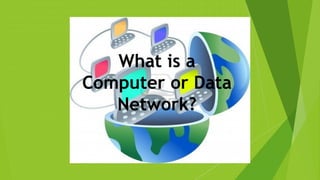
What is a
Computer or Data
Network?
What is Network and
Networking?
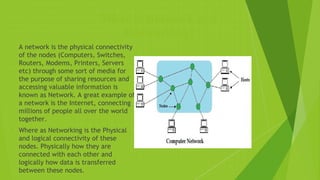
 A network is the physical connectivity
of the nodes (Computers, Switches,
Routers, Modems, Printers, Servers
etc) through some sort of media for
the purpose of sharing resources and
accessing valuable information is
known as Network. A great example of
a network is the Internet, connecting
millions of people all over the world
together.
 Where as Networking is the Physical
and logical connectivity of these
nodes. Physically how they are
connected with each other and
logically how data is transferred
between these nodes.
What is Computer Network?
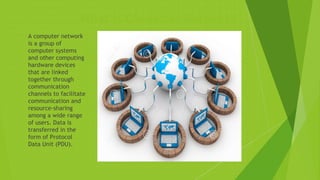
 A computer network
is a group of
computer systems
and other computing
hardware devices
that are linked
together through
communication
channels to facilitate
communication and
resource-sharing
among a wide range
of users. Data is
transferred in the
form of Protocol
Data Unit (PDU).
Why Computer
Networks?
?
Computer Networks
 Before the advent of Computer Networks
business activities were carried out
manually i-e paper work
 Much amount of information caused
information searching and analysis more
difficult
 Information exchange took hours even
days to get there causing late in critical
decisions
Lets go 55 years
back
Yes!
1960s
60s
History
 Mid 1960s
 Mainframe Computers in research organizations were standalone devices
(No more networks)
 Need
 Advance Research Projects Agency (ARPA) in Department of Defense (DoD)
had funded some researcher, and the researchers needed to share their
findings with each other. ARPA decided to have such an infrastructure that
could provide facility to exchange information thereby reducing costs.
History Cont…
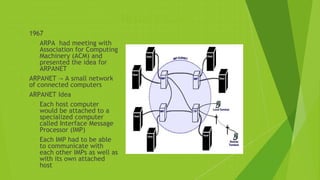
 1967
 ARPA had meeting with
Association for Computing
Machinery (ACM) and
presented the idea for
ARPANET
 ARPANET A small network→
of connected computers
 ARPANET Idea
 Each host computer
would be attached to a
specialized computer
called Interface Message
Processor (IMP)
 Each IMP had to be able
to communicate with
each other IMPs as well as
with its own attached
host
History Cont…
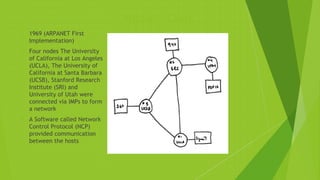
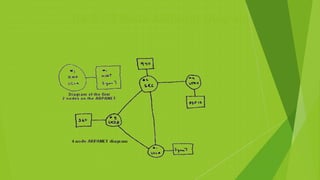
 1969 (ARPANET First
Implementation)
 Four nodes The University
of California at Los Angeles
(UCLA), The University of
California at Santa Barbara
(UCSB), Stanford Research
Institute (SRI) and
University of Utah were
connected via IMPs to form
a network
 A Software called Network
Control Protocol (NCP)
provided communication
between the hosts
04 & 02 Node ARPAnet Diagram
Todays Network Requirement
 Business decisions have
to be made ever more
quickly
 Decision makers require
immediate access to
data/ information
 Data is supposed to be
confidential hence
require security
Network Types
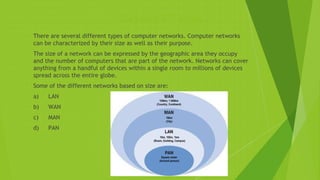
 There are several different types of computer networks. Computer networks
can be characterized by their size as well as their purpose.
 The size of a network can be expressed by the geographic area they occupy
and the number of computers that are part of the network. Networks can cover
anything from a handful of devices within a single room to millions of devices
spread across the entire globe.
 Some of the different networks based on size are:
 a) LAN
 b) WAN
 c) MAN
 d) PAN
Local Area Network
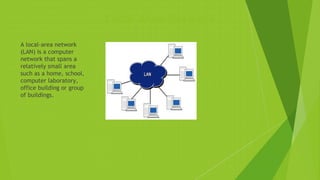
A local-area network
(LAN) is a computer
network that spans a
relatively small area
such as a home, school,
computer laboratory,
office building or group
of buildings.
Wide Area Network
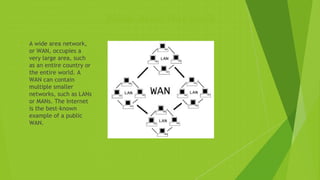
 A wide area network,
or WAN, occupies a
very large area, such
as an entire country or
the entire world. A
WAN can contain
multiple smaller
networks, such as LANs
or MANs. The Internet
is the best-known
example of a public
WAN.
Metropolitan Area Network
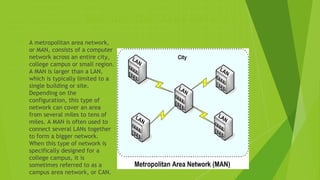
 A metropolitan area network,
or MAN, consists of a computer
network across an entire city,
college campus or small region.
A MAN is larger than a LAN,
which is typically limited to a
single building or site.
Depending on the
configuration, this type of
network can cover an area
from several miles to tens of
miles. A MAN is often used to
connect several LANs together
to form a bigger network.
When this type of network is
specifically designed for a
college campus, it is
sometimes referred to as a
campus area network, or CAN.
Personal Area Network
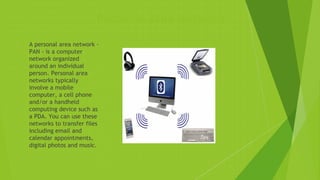
 A personal area network -
PAN - is a computer
network organized
around an individual
person. Personal area
networks typically
involve a mobile
computer, a cell phone
and/or a handheld
computing device such as
a PDA. You can use these
networks to transfer files
including email and
calendar appointments,
digital photos and music.
Adhoc Network
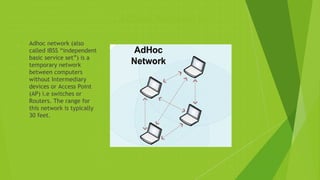
 Adhoc network (also
called IBSS “independent
basic service set”) is a
temporary network
between computers
without Intermediary
devices or Access Point
(AP) i.e switches or
Routers. The range for
this network is typically
30 feet.
Internet
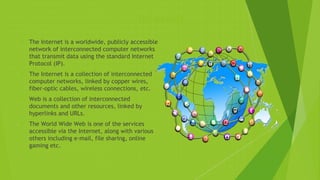
 The Internet is a worldwide, publicly accessible
network of interconnected computer networks
that transmit data using the standard Internet
Protocol (IP).
 The Internet is a collection of interconnected
computer networks, linked by copper wires,
fiber-optic cables, wireless connections, etc.
 Web is a collection of interconnected
documents and other resources, linked by
hyperlinks and URLs.
 The World Wide Web is one of the services
accessible via the Internet, along with various
others including e-mail, file sharing, online
gaming etc.
Intranet
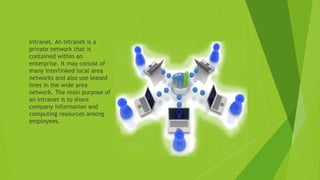
 Intranet. An Intranet is a
private network that is
contained within an
enterprise. It may consist of
many interlinked local area
networks and also use leased
lines in the wide area
network. The main purpose of
an Intranet is to share
company information and
computing resources among
employees.
Extranet
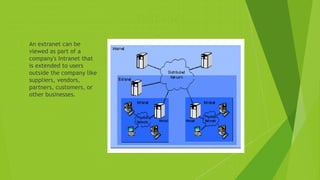
 An extranet can be
viewed as part of a
company's Intranet that
is extended to users
outside the company like
suppliers, vendors,
partners, customers, or
other businesses.

Introducing networks

  • 1.
    Introducing Networks By www.aiict.com Admin By:Mansoor Ali Shar Instructor Network Administration & System Administration
  • 2.
    Agenda  Networks  WhyNetworks (Need)  Types  Logical Classification
  • 3.
    What is a Computeror Data Network?
  • 4.
    What is Networkand Networking?  A network is the physical connectivity of the nodes (Computers, Switches, Routers, Modems, Printers, Servers etc) through some sort of media for the purpose of sharing resources and accessing valuable information is known as Network. A great example of a network is the Internet, connecting millions of people all over the world together.  Where as Networking is the Physical and logical connectivity of these nodes. Physically how they are connected with each other and logically how data is transferred between these nodes.
  • 5.
    What is ComputerNetwork?  A computer network is a group of computer systems and other computing hardware devices that are linked together through communication channels to facilitate communication and resource-sharing among a wide range of users. Data is transferred in the form of Protocol Data Unit (PDU).
  • 6.
  • 7.
    Computer Networks  Beforethe advent of Computer Networks business activities were carried out manually i-e paper work  Much amount of information caused information searching and analysis more difficult  Information exchange took hours even days to get there causing late in critical decisions
  • 8.
    Lets go 55years back Yes! 1960s 60s
  • 9.
    History  Mid 1960s Mainframe Computers in research organizations were standalone devices (No more networks)  Need  Advance Research Projects Agency (ARPA) in Department of Defense (DoD) had funded some researcher, and the researchers needed to share their findings with each other. ARPA decided to have such an infrastructure that could provide facility to exchange information thereby reducing costs.
  • 10.
    History Cont…  1967 ARPA had meeting with Association for Computing Machinery (ACM) and presented the idea for ARPANET  ARPANET A small network→ of connected computers  ARPANET Idea  Each host computer would be attached to a specialized computer called Interface Message Processor (IMP)  Each IMP had to be able to communicate with each other IMPs as well as with its own attached host
  • 11.
    History Cont…  1969(ARPANET First Implementation)  Four nodes The University of California at Los Angeles (UCLA), The University of California at Santa Barbara (UCSB), Stanford Research Institute (SRI) and University of Utah were connected via IMPs to form a network  A Software called Network Control Protocol (NCP) provided communication between the hosts
  • 12.
    04 & 02Node ARPAnet Diagram
  • 13.
    Todays Network Requirement Business decisions have to be made ever more quickly  Decision makers require immediate access to data/ information  Data is supposed to be confidential hence require security
  • 14.
    Network Types  Thereare several different types of computer networks. Computer networks can be characterized by their size as well as their purpose.  The size of a network can be expressed by the geographic area they occupy and the number of computers that are part of the network. Networks can cover anything from a handful of devices within a single room to millions of devices spread across the entire globe.  Some of the different networks based on size are:  a) LAN  b) WAN  c) MAN  d) PAN
  • 15.
    Local Area Network Alocal-area network (LAN) is a computer network that spans a relatively small area such as a home, school, computer laboratory, office building or group of buildings.
  • 16.
    Wide Area Network A wide area network, or WAN, occupies a very large area, such as an entire country or the entire world. A WAN can contain multiple smaller networks, such as LANs or MANs. The Internet is the best-known example of a public WAN.
  • 17.
    Metropolitan Area Network A metropolitan area network, or MAN, consists of a computer network across an entire city, college campus or small region. A MAN is larger than a LAN, which is typically limited to a single building or site. Depending on the configuration, this type of network can cover an area from several miles to tens of miles. A MAN is often used to connect several LANs together to form a bigger network. When this type of network is specifically designed for a college campus, it is sometimes referred to as a campus area network, or CAN.
  • 18.
    Personal Area Network A personal area network - PAN - is a computer network organized around an individual person. Personal area networks typically involve a mobile computer, a cell phone and/or a handheld computing device such as a PDA. You can use these networks to transfer files including email and calendar appointments, digital photos and music.
  • 19.
    Adhoc Network  Adhocnetwork (also called IBSS “independent basic service set”) is a temporary network between computers without Intermediary devices or Access Point (AP) i.e switches or Routers. The range for this network is typically 30 feet.
  • 20.
    Internet  The Internetis a worldwide, publicly accessible network of interconnected computer networks that transmit data using the standard Internet Protocol (IP).  The Internet is a collection of interconnected computer networks, linked by copper wires, fiber-optic cables, wireless connections, etc.  Web is a collection of interconnected documents and other resources, linked by hyperlinks and URLs.  The World Wide Web is one of the services accessible via the Internet, along with various others including e-mail, file sharing, online gaming etc.
  • 21.
    Intranet  Intranet. AnIntranet is a private network that is contained within an enterprise. It may consist of many interlinked local area networks and also use leased lines in the wide area network. The main purpose of an Intranet is to share company information and computing resources among employees.
  • 22.
    Extranet  An extranetcan be viewed as part of a company's Intranet that is extended to users outside the company like suppliers, vendors, partners, customers, or other businesses.