ERP
      Created by the

Syntech Solution Ltd
ERP Overview

What is ERP?
Advantages of ERP.
ERP Modules & Features.
How ERP System Works?
How ERP Systems are implemented within
companies?
Why ERP packages now?
Future of ERP packages.
What is ERP?

Enterprise resource planning or ERP consists of three word—

enterprise, resource and planning.

But ERP combines them all together into a single,

software program that runs off a single database so

that the various departments can more easily share information

and Communicate with each other. That integrated

Approach can have a tremendous payback if companies install

the software correctly.
Advantages of ERP
Information integration.
Design engineering.
Order tracking.
Maintaining supply chain with the demands.
Communicating faster with all the departments of company.
Ensures quicker processing of information.
Helps in disposing queries immediately.
Eliminates redundancy in data entry.
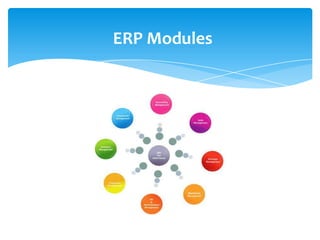
ERP Modules
Objective of ERP Solution
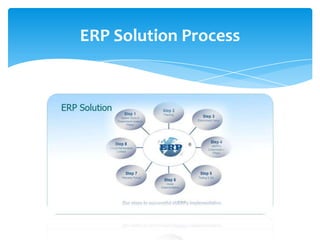
ERP Solution Process
ERP
Modules
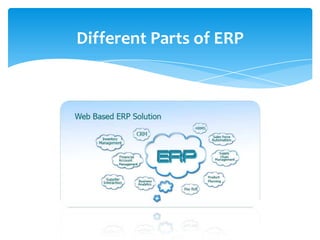
Different Parts of ERP
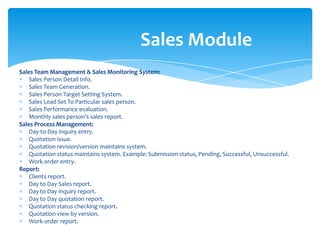
Sales Module
Sales Team Management & Sales Monitoring System:
    Sales Person Detail Info.
    Sales Team Generation.
    Sales Person Target Setting System.
    Sales Lead Set To Particular sales person.
    Sales Performance evaluation.
    Monthly sales person’s sales report.
Sales Process Management:
    Day-to-Day inquiry entry.
    Quotation issue.
    Quotation revision/version maintains system.
    Quotation status maintains system. Example: Submission status, Pending, Successful, Unsuccessful.
    Work order entry.
Report:
    Clients report.
    Day to Day Sales report.
    Day to Day inquiry report.
    Day to Day quotation report.
    Quotation status checking report.
    Quotation view by version.
    Work order report.
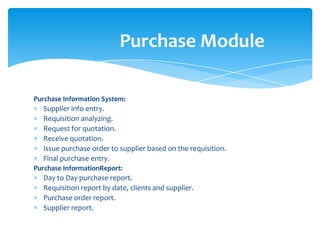
Purchase Module

Purchase Information System:
  Supplier info entry.
  Requisition analyzing.
  Request for quotation.
  Receive quotation.
  Issue purchase order to supplier based on the requisition.
  Final purchase entry.
Purchase InformationReport:
  Day to Day purchase report.
  Requisition report by date, clients and supplier.
  Purchase order report.
  Supplier report.
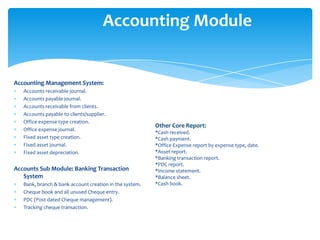
Accounting Module


Accounting Management System:
   Accounts receivable journal.
   Accounts payable journal.
   Accounts receivable from clients.
   Accounts payable to clients/supplier.
   Office expense type creation.
                                                         Other Core Report:
   Office expense journal.
                                                         *Cash received.
   Fixed asset type creation.                            *Cash payment.
   Fixed asset journal.                                  *Office Expense report by expense type, date.
   Fixed asset depreciation.                             *Asset report.
                                                         *Banking transaction report.
                                                         *PDC report.
Accounts Sub Module: Banking Transaction                 *Income statement.
   System                                                *Balance sheet.
   Bank, branch & bank account creation in the system.   *Cash book.
   Cheque book and all unused Cheque entry.
   PDC (Post dated Cheque management).
   Tracking cheque transaction.
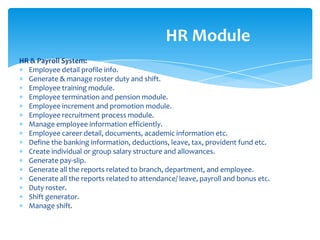
HR Module
HR & Payroll System:
  Employee detail profile info.
  Generate & manage roster duty and shift.
  Employee training module.
  Employee termination and pension module.
  Employee increment and promotion module.
  Employee recruitment process module.
  Manage employee information efficiently.
  Employee career detail, documents, academic information etc.
  Define the banking information, deductions, leave, tax, provident fund etc.
  Create individual or group salary structure and allowances.
  Generate pay-slip.
  Generate all the reports related to branch, department, and employee.
  Generate all the reports related to attendance/ leave, payroll and bonus etc.
  Duty roster.
  Shift generator.
  Manage shift.
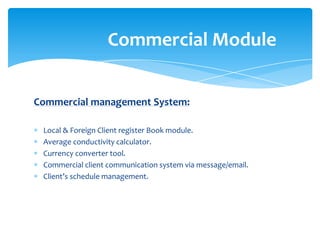
Commercial Module


Commercial management System:

 Local & Foreign Client register Book module.
 Average conductivity calculator.
 Currency converter tool.
 Commercial client communication system via message/email.
 Client’s schedule management.
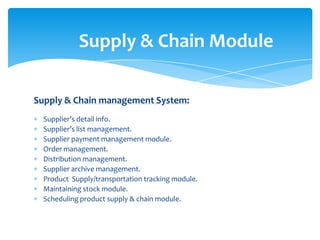
Supply & Chain Module

Supply & Chain management System:
  Supplier’s detail info.
  Supplier’s list management.
  Supplier payment management module.
  Order management.
  Distribution management.
  Supplier archive management.
  Product Supply/transportation tracking module.
  Maintaining stock module.
  Scheduling product supply & chain module.
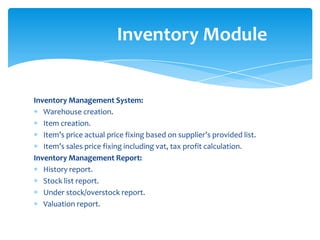
Inventory Module


Inventory Management System:
   Warehouse creation.
   Item creation.
   Item’s price actual price fixing based on supplier’s provided list.
   Item’s sales price fixing including vat, tax profit calculation.
Inventory Management Report:
   History report.
   Stock list report.
   Under stock/overstock report.
   Valuation report.
CRM Module

Client Information System:
   Client profile.
   Add, Edit, Delete option for every client.
   Call information and date option.

Client Management System:
   Clients categorize option.
   Client payment and installment management.
   Project handover to client.
   Appointment scheduling.
   Follow-up date calculation.
   Contact history.
   Order entry and tracking system.
Production Module

Production Features:

  Bill of materials.
  work orders Entry.
  Time scheduling production.
  Capacity of production.
  workflow management.
  quality control.
  cost management.
  manufacturing process.
  manufacturing projects.
  product lifecycle management.
How ERP Systems Works?


A typical ERP system would use multiple component
and integrate all the components into one.

ERP Provides a single database that contains all data
for the software module.
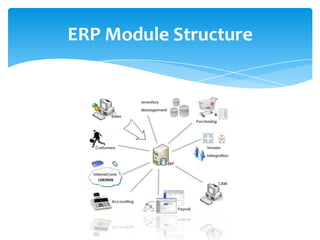
ERP Module Structure
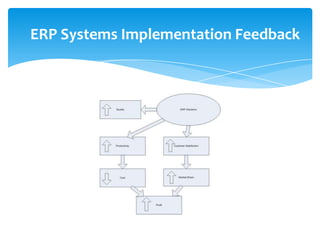
ERP Systems Implementation Feedback
How ERP systems are implemented within companies?


    ERP Software Companies start analysing the various
    departments and identifing their individual needs.
    Setup of ERP systems
      Small companies 4-8 months
      For Mid-size companies 5-12 months
      Large Companies 6-18 months
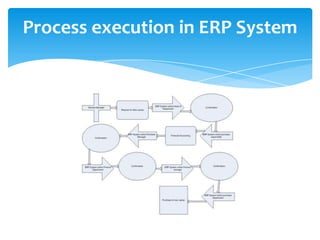
Process execution in ERP System
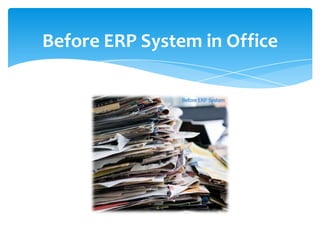
Before ERP System in Office
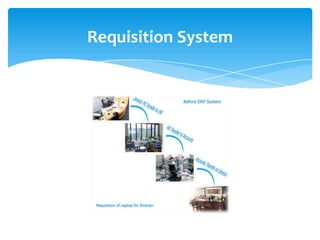
Requisition System
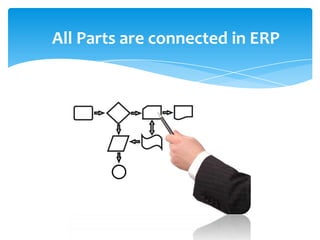
All Parts are connected in ERP
Companies After ERP System
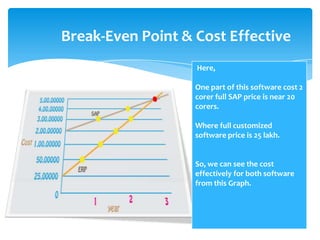
Break-Even Point & Cost Effective
                   Here,

                   One part of this software cost 2
                   corer full SAP price is near 20
                   corers.

                   Where full customized
                   software price is 25 lakh.


                   So, we can see the cost
                   effectively for both software
                   from this Graph.
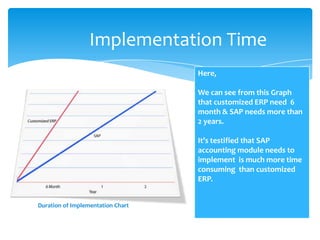
Implementation Time
                                   Here,

                                   We can see from this Graph
                                   that customized ERP need 6
                                   month & SAP needs more than
                                   2 years.

                                   It’s testified that SAP
                                   accounting module needs to
                                   implement is much more time
                                   consuming than customized
                                   ERP.


Duration of Implementation Chart
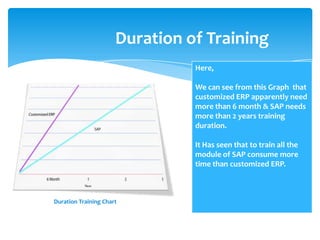
Duration of Training
                                Here,

                                We can see from this Graph that
                                customized ERP apparently need
                                more than 6 month & SAP needs
                                more than 2 years training
                                duration.

                                It Has seen that to train all the
                                module of SAP consume more
                                time than customized ERP.


Duration Training Chart
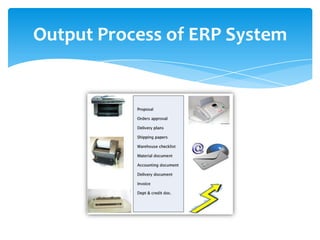
Output Process of ERP System
The biggest and most complex since the industrial revolution feels the
necessity of ERP.
 To conduct business to get it in automated way require ERP.
E-Commerce businesses can’t meet the demand of consumers and
business partners than it requires ERP.
The manual process of business is tiresome and frustrating and get rid of
it need ERP solution.


              Why ERP packages now?
Future of ERP packages

The future of the ERP is very bright.
ERP forms a foundation for successfully meeting your e-business needs.
ERP systems have to be integrated with the Internet, WWW and
technologies like SCM, CRM, business intelligence etc.
Thanks


For More Details Please visit

   www.syntechbd.com

Introducing ERP Solution | Syntech Solution Ltd

  • 1.
    ERP Created by the Syntech Solution Ltd
  • 2.
    ERP Overview What isERP? Advantages of ERP. ERP Modules & Features. How ERP System Works? How ERP Systems are implemented within companies? Why ERP packages now? Future of ERP packages.
  • 3.
    What is ERP? Enterpriseresource planning or ERP consists of three word— enterprise, resource and planning. But ERP combines them all together into a single, software program that runs off a single database so that the various departments can more easily share information and Communicate with each other. That integrated Approach can have a tremendous payback if companies install the software correctly.
  • 4.
    Advantages of ERP Informationintegration. Design engineering. Order tracking. Maintaining supply chain with the demands. Communicating faster with all the departments of company. Ensures quicker processing of information. Helps in disposing queries immediately. Eliminates redundancy in data entry.
  • 5.
  • 6.
  • 7.
  • 8.
  • 9.
  • 10.
    Sales Module Sales TeamManagement & Sales Monitoring System: Sales Person Detail Info. Sales Team Generation. Sales Person Target Setting System. Sales Lead Set To Particular sales person. Sales Performance evaluation. Monthly sales person’s sales report. Sales Process Management: Day-to-Day inquiry entry. Quotation issue. Quotation revision/version maintains system. Quotation status maintains system. Example: Submission status, Pending, Successful, Unsuccessful. Work order entry. Report: Clients report. Day to Day Sales report. Day to Day inquiry report. Day to Day quotation report. Quotation status checking report. Quotation view by version. Work order report.
  • 11.
    Purchase Module Purchase InformationSystem: Supplier info entry. Requisition analyzing. Request for quotation. Receive quotation. Issue purchase order to supplier based on the requisition. Final purchase entry. Purchase InformationReport: Day to Day purchase report. Requisition report by date, clients and supplier. Purchase order report. Supplier report.
  • 12.
    Accounting Module Accounting ManagementSystem: Accounts receivable journal. Accounts payable journal. Accounts receivable from clients. Accounts payable to clients/supplier. Office expense type creation. Other Core Report: Office expense journal. *Cash received. Fixed asset type creation. *Cash payment. Fixed asset journal. *Office Expense report by expense type, date. Fixed asset depreciation. *Asset report. *Banking transaction report. *PDC report. Accounts Sub Module: Banking Transaction *Income statement. System *Balance sheet. Bank, branch & bank account creation in the system. *Cash book. Cheque book and all unused Cheque entry. PDC (Post dated Cheque management). Tracking cheque transaction.
  • 13.
    HR Module HR &Payroll System: Employee detail profile info. Generate & manage roster duty and shift. Employee training module. Employee termination and pension module. Employee increment and promotion module. Employee recruitment process module. Manage employee information efficiently. Employee career detail, documents, academic information etc. Define the banking information, deductions, leave, tax, provident fund etc. Create individual or group salary structure and allowances. Generate pay-slip. Generate all the reports related to branch, department, and employee. Generate all the reports related to attendance/ leave, payroll and bonus etc. Duty roster. Shift generator. Manage shift.
  • 14.
    Commercial Module Commercial managementSystem: Local & Foreign Client register Book module. Average conductivity calculator. Currency converter tool. Commercial client communication system via message/email. Client’s schedule management.
  • 15.
    Supply & ChainModule Supply & Chain management System: Supplier’s detail info. Supplier’s list management. Supplier payment management module. Order management. Distribution management. Supplier archive management. Product Supply/transportation tracking module. Maintaining stock module. Scheduling product supply & chain module.
  • 16.
    Inventory Module Inventory ManagementSystem: Warehouse creation. Item creation. Item’s price actual price fixing based on supplier’s provided list. Item’s sales price fixing including vat, tax profit calculation. Inventory Management Report: History report. Stock list report. Under stock/overstock report. Valuation report.
  • 17.
    CRM Module Client InformationSystem: Client profile. Add, Edit, Delete option for every client. Call information and date option. Client Management System: Clients categorize option. Client payment and installment management. Project handover to client. Appointment scheduling. Follow-up date calculation. Contact history. Order entry and tracking system.
  • 18.
    Production Module Production Features: Bill of materials. work orders Entry. Time scheduling production. Capacity of production. workflow management. quality control. cost management. manufacturing process. manufacturing projects. product lifecycle management.
  • 19.
    How ERP SystemsWorks? A typical ERP system would use multiple component and integrate all the components into one. ERP Provides a single database that contains all data for the software module.
  • 20.
  • 21.
  • 22.
    How ERP systemsare implemented within companies? ERP Software Companies start analysing the various departments and identifing their individual needs. Setup of ERP systems Small companies 4-8 months For Mid-size companies 5-12 months Large Companies 6-18 months
  • 23.
  • 24.
  • 25.
  • 26.
    All Parts areconnected in ERP
  • 27.
  • 28.
    Break-Even Point &Cost Effective Here, One part of this software cost 2 corer full SAP price is near 20 corers. Where full customized software price is 25 lakh. So, we can see the cost effectively for both software from this Graph.
  • 29.
    Implementation Time Here, We can see from this Graph that customized ERP need 6 month & SAP needs more than 2 years. It’s testified that SAP accounting module needs to implement is much more time consuming than customized ERP. Duration of Implementation Chart
  • 30.
    Duration of Training Here, We can see from this Graph that customized ERP apparently need more than 6 month & SAP needs more than 2 years training duration. It Has seen that to train all the module of SAP consume more time than customized ERP. Duration Training Chart
  • 31.
  • 32.
    The biggest andmost complex since the industrial revolution feels the necessity of ERP. To conduct business to get it in automated way require ERP. E-Commerce businesses can’t meet the demand of consumers and business partners than it requires ERP. The manual process of business is tiresome and frustrating and get rid of it need ERP solution. Why ERP packages now?
  • 33.
    Future of ERPpackages The future of the ERP is very bright. ERP forms a foundation for successfully meeting your e-business needs. ERP systems have to be integrated with the Internet, WWW and technologies like SCM, CRM, business intelligence etc.
  • 34.
    Thanks For More DetailsPlease visit www.syntechbd.com