Chapter 5 ERP Modules By Sonali Chauhan UDIT, TYBSc. IT
Objective:  ERP Modules Introduction Finance Plant Maintenance  Quality Management  Materials Management
ERP Packages contains many modules Features vary with ERP packages Most common modules in ERP are: Finance Manufacturing & Production Planning Sales and Distribution Plant maintenance Quality Management Materials Management etc
FINANCE  : Introduction Concept of Information technologies means providing: Right information Right time Right people Can make critical difference to the organization Financial data provides key information
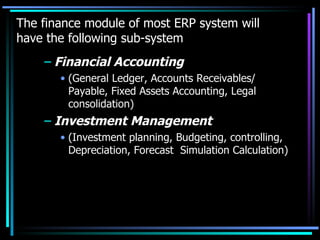
The finance module of most ERP system will have the following sub-system Financial Accounting (General Ledger, Accounts Receivables/ Payable, Fixed Assets Accounting, Legal consolidation) Investment Management (Investment planning, Budgeting, controlling, Depreciation, Forecast  Simulation Calculation)
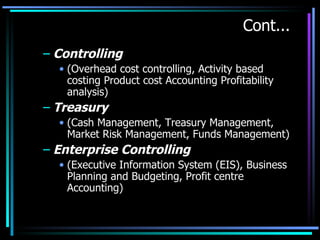
Cont... Controlling (Overhead cost controlling, Activity based costing Product cost Accounting Profitability analysis) Treasury   (Cash Management, Treasury Management, Market Risk Management, Funds Management) Enterprise Controlling   (Executive Information System (EIS), Business Planning and Budgeting, Profit centre Accounting)
Financial Accounting... Objective : Integration of financial information essential for strategic decision-making Centrally track financial accounting data within international framework
General Ledger : Essential for financial accounting and decision making Serves as a central pool of financial data and in accounting area, Origin of a transaction can be traced,  Supports all the functional needs in financial accounting. Financial Accounting...
Typical General Ledger contains i.e. summary information of other components: Purchasing (Quantity and value) Sales (order and bill) Vendor (Payable)  Customer (Receivables) Fixed assets  Employees (salary and wages) Financial Accounting...
Accounts Receivables/ Payable: These subsystems are integrated with all other subsystems where financial data originates: both with  General Ledger ,Sales and Distribution, Material Management. Transaction performed automatically Financial Accounting...
Accounts Receivable and Payable functions include: Internet integration Document management Important support for EDI processing Enterprise-wide credit management payment automation Financial Accounting...
Asset Accounting: Serves as a sub ledger to the General Ledger Manages company’s fix assets and provides detail info abt assets related transaction. Integration with plant management Management of leased assets and lease under construction Financial Accounting...
Legal Consolidation: serves as a tool to make a consolidated financial statement with operational data Legal consolidation is closely integrated with Financial Accounting system permit direct data transfer from individual statement into consolidated report Financial Accounting...
Ease the workload and reduces data entry error Allows multiple view of ur consolidation data.   Generate reports about legal entries and segments of ur business. Financial Accounting...
Introduction Gathers functions for Internal cost accounting Versatile information system Generate reports Controlling...   FINANCE
Overhead Cost Controlling: Focus on monitoring n allocation of overhead Cost Centre Accounting: Analyses where overhead occurs Overhead Orders: Collects and analysis cost based on individual internal measures Monitors and automatically check budgets assign to each measures Controlling... FINANCE
Activity Based Costing: Goals of the entire enterprise should come before the goals of individual activity Product Cost Controlling: determine cost of product or services Use to determines the lowest price limit Controlling... FINANCE
Cost Object Controlling: Helps to monitor manufacturing orders Integration with logistics, provides actual cost of the object costs Determine n analysis Variance betw actual manufacturing cost and plan cost Profitability analysis: Examines the sources of returns. Revenues are assigned according to market segment Controlling... FINANCE
Investment planning  – Where to invest, what is the expected profit of each ventures. Which department to need more investment? Budgeting  – Financial layout of new or existing project – Availability and cost of finance Controlling  – The expenses, the overheads Depreciation   - Budgeted balance sheets and cost planning are always on current values.  Forecast  – Speculation and forecast of market trend. Rising or declining?  Simulation Calculation : Making a mathematical model and deriving alternatives to choose from. Investment management...   FINANCE
Treasury Modules... Managing long ,short, medium payment flow Managing Risk factor Planning financial transaction. FINANCE
Cash Management: Analysis financial transaction for given period Manages cash inflow and outflow Distinction is made according to time period (short medium long) Information is available to make cash management decision and for analyzing purpose. Treasury Management: Current liquidity, Currency, Risk position Conditions prevailing on the money and capital market Securities and loans Treasury... FINANCE
Market Risk Management: Ensures competitiveness Complex feed back loop: from data collection, risk management, analysis and simulation Assessing the interest rates Assessing the currency rates Simulate market data – “what if” analysis Funds Management: From budgeting to payment on one side and  From Billing to actual receiving on the other Enables to control funds commitments and determine the budget utility. Helps to identify budget bottleneck Treasury... FINANCE
Introduction Compromise to optimize share holder value, for growth and investment. Modules includes : Executive information system Business planning and budgeting Profit centre Accounting Enterprise Controlling...   FINANCE
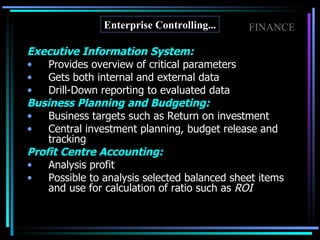
Executive Information System: Provides overview of critical parameters Gets both internal and external data Drill-Down reporting to evaluated data Business Planning and Budgeting: Business targets such as Return on investment Central investment planning, budget release and tracking Profit Centre Accounting: Analysis profit Possible to analysis selected balanced sheet items and use for calculation of ratio such as  ROI Enterprise Controlling... FINANCE
Introduction Preventive Maintenance control Equipment Tracking Component Tracking Plant Maintenance Calibration Tracking Plant Maintenance Warranty Claims Tracking PLANT MAINTENANCE ...
Planning Scheduling Control of facilities and equipment Equipment lubrication Component replacement Safety inspection Monitoring Keeping track of Hours of usage Production produced Consumables (fuel) Days in operation Life of each component  Lower repair cost Avoiding downtime, m/c breakage etc. Improve m/c reliability whc leads to  higher production Plant Maintenance... Preventive Maintenance Control:
Equipment tracking: Equipment is an asset to be used, monitored and protected History of equipment: acquisition to write off Operational dependencies  (special features, imported spare parts, their cost and expected life ,Guarantee period, Next service due) Information (model and serial no) for each equipment to be made available. Provide detail information to technical specialist. Plant Maintenance...
Component Tracking: Components  are typically sub-set of large equipment. Enable to identify chronic repair problem of component – replacement or repair Do not wait for components to fail, replace it before that Reduce downtime Also include repair/exchange history and component service life.   Plant Maintenance...
Plant Maintenance... Plant Maintenance Calibration Tracking : Allows organization to leverage their investment in Plant Maintenance module by providing for tracking of equipment calibration in support of ISO 9000 requirement
Plant Maintenance... Plant Maintenance Warranty Claim Tracking  : Administrative system designed to provide control of all items covered by manufacturer and vendor warranty Recover imbursement to which they are entitled. Type and length of warranty – elapsed time ,operating unit generate Complete information regarding warranty  service provider
Introduction ISO Standards defines: Functions of QM  Elements of QMS  In Production, Quality Assurance No longer just “Inspection” and “Elimination” But also the production process becomes the focus of attention. Quality spreads to the entire loop: Product development – procurement of sales and distribution – (entire usage phase) QUALITY MAINTENANCE...
Quality Maintenance... CAQ and CIQ: CAQ :  Computer Aided Quality Management Isolated, cnt carry out comprehensive tasks of QMS CIQ:  Computer – Integrated Quality Management More appropriate Supports quality management in procurement, product verification, quality documentation, processing of the problem Module do not direct interact wit other modules
Quality Maintenance... The quality Management Module fulfills the following functions: Quality Planning  : Management for basic data for quality planning and Inspection planning, Material Specification Quality Inspection: Trigger inspections, Inspection processing with inspection plan selection and sample calculation,  Print shop papers for sampling and inspection. Records results and defects  Makes the usage decision and trigger follow up action
Quality Maintenance... Quality Control: Dynamic sample determination on the basis of Quality level history. Application of statistical process control techniques using quality control charts Quality scores for inspection lots, Quality notification for processing internal or external problems and initiating corrective action to correct the problems Inspection of lot processing QMIS (Quality Management Information System) for inspection and inspection results and quality notification Cont ...
Quality Maintenance... CIQ (Computer – Integrated Quality Management) Only an integrated system can support all the elements of Quality Management System. Quality Management function influence all the function within company, affecting all the phase. QM Module integrate with other modules to link the task on quality management.
The quality Management Module is integrated with the master data and processes of the following applications... Material Management:   Purchasing, inventory management, warehouse management, Material requirement planning Production : Work scheduling, shop floor control Sales and Distribution:   Delivery, creation of quality certificates Quality Maintenance...
The Quality Management module supports the exchange of data with other application in order to: Prevent related data from being recorded and stored  redundantly . Quality Maintenance...
Introduction: The Material Management Module optimizes: All purchasing process with work-flow driven processing functions Enables automated supplier evaluation, Lowers procurement and warehousing costs Integrates invoice verification In short decides  - When to buy, What to buy and How much to buy! MATERIALS MANAGEMENT...
The main Modules of Material Management Module are: Pre-purchasing Activities Purchasing Vendor Evaluation Inventory Management Invoice Verifications and Material Inspection Material Management...
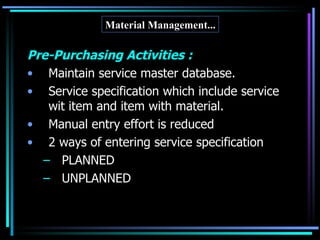
Pre-Purchasing Activities : Maintain service master database. Service specification which include service wit item and item with material. Manual entry effort is reduced 2 ways of entering service specification PLANNED UNPLANNED Material Management...
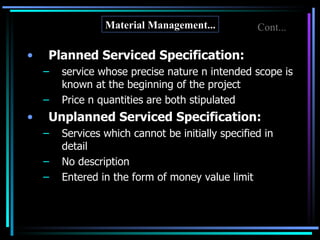
Planned Serviced Specification: service whose precise nature n intended scope is known at the beginning of the project Price n quantities are both stipulated Unplanned Serviced Specification: Services which cannot be initially specified in detail No description Entered in the form of money value limit Cont... Material Management...
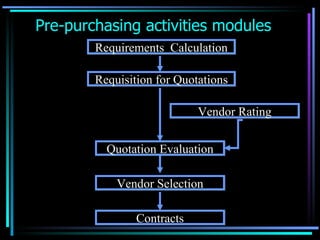
Pre-purchasing activities modules Requirements  Calculation Requisition for Quotations Quotation Evaluation Vendor Selection Contracts Vendor Rating
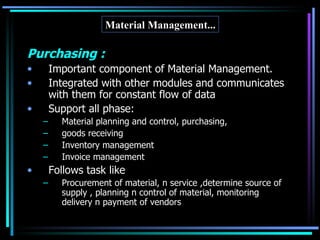
Purchasing : Important component of Material Management. Integrated with other modules and communicates with them for constant flow of data Support all phase: Material planning and control, purchasing, goods receiving Inventory management Invoice management Follows task like Procurement of material, n service ,determine source of supply , planning n control of material, monitoring  delivery n payment of vendors Material Management...
Vendor Evaluation: Integrated into MM Information like delivery dates ,prices n quantity are taken from purchase order Also used data of QM Material Management...
In procurement of material: Select suppler according to existing supply relationship Provide with proper information on prices n terms of payment and delivery Evaluate vendors In procurement of service: Check reliability of vendors Check vendors performance Material Management...
Inventory Management: Allows to manage stocks  Obtain overview of  current stock Shows all entries of stocks like  warehouse,  stock orders but not delivered,  reserved for production or for customers,  quality inspection monitored Stocks frm vendors and from customers managed separately Material Management...
Stocks are managed by values and quantity basis Prerequisite cost accounting With every goods movement following are updated Stock value for inventory Management Account assignment for cost accounting G/L account Both quantity n values are updated automatically with the goods movement Goods movement includes Internal movement (goods from production,stock transfer) External movement (goods from sales order) Material Management... Cont...
Inventory management includes inventory methods: Periodic Inventory Continuous Inventory Inventory Sampling Cycle Counting  Material Management... Cont...
Invoice Verification and Material Inspection: Link between MM and financial management, controlling and asset accounting components It serves the following propose: Completes the material procurement Allows invoice that do not originate in material procurement Allows credit memos Material Management...
Donot handle payment or invoice Information is passed on to other department Invoice contains many information which has to be posted i.e. enter into the system. Refers to current transaction, purchase transaction posting invoice completes invoice verification System now contains data necessary for invoice to be paid. Accounting department retrieve this data for appropriated payment Material Management... Cont...
Thank you

Erp Alex Leon Chapter 5

  • 1.
    Chapter 5 ERPModules By Sonali Chauhan UDIT, TYBSc. IT
  • 2.
    Objective: ERPModules Introduction Finance Plant Maintenance Quality Management Materials Management
  • 3.
    ERP Packages containsmany modules Features vary with ERP packages Most common modules in ERP are: Finance Manufacturing & Production Planning Sales and Distribution Plant maintenance Quality Management Materials Management etc
  • 4.
    FINANCE :Introduction Concept of Information technologies means providing: Right information Right time Right people Can make critical difference to the organization Financial data provides key information
  • 5.
    The finance moduleof most ERP system will have the following sub-system Financial Accounting (General Ledger, Accounts Receivables/ Payable, Fixed Assets Accounting, Legal consolidation) Investment Management (Investment planning, Budgeting, controlling, Depreciation, Forecast Simulation Calculation)
  • 6.
    Cont... Controlling (Overheadcost controlling, Activity based costing Product cost Accounting Profitability analysis) Treasury (Cash Management, Treasury Management, Market Risk Management, Funds Management) Enterprise Controlling (Executive Information System (EIS), Business Planning and Budgeting, Profit centre Accounting)
  • 7.
    Financial Accounting... Objective: Integration of financial information essential for strategic decision-making Centrally track financial accounting data within international framework
  • 8.
    General Ledger :Essential for financial accounting and decision making Serves as a central pool of financial data and in accounting area, Origin of a transaction can be traced, Supports all the functional needs in financial accounting. Financial Accounting...
  • 9.
    Typical General Ledgercontains i.e. summary information of other components: Purchasing (Quantity and value) Sales (order and bill) Vendor (Payable) Customer (Receivables) Fixed assets Employees (salary and wages) Financial Accounting...
  • 10.
    Accounts Receivables/ Payable:These subsystems are integrated with all other subsystems where financial data originates: both with General Ledger ,Sales and Distribution, Material Management. Transaction performed automatically Financial Accounting...
  • 11.
    Accounts Receivable andPayable functions include: Internet integration Document management Important support for EDI processing Enterprise-wide credit management payment automation Financial Accounting...
  • 12.
    Asset Accounting: Servesas a sub ledger to the General Ledger Manages company’s fix assets and provides detail info abt assets related transaction. Integration with plant management Management of leased assets and lease under construction Financial Accounting...
  • 13.
    Legal Consolidation: servesas a tool to make a consolidated financial statement with operational data Legal consolidation is closely integrated with Financial Accounting system permit direct data transfer from individual statement into consolidated report Financial Accounting...
  • 14.
    Ease the workloadand reduces data entry error Allows multiple view of ur consolidation data. Generate reports about legal entries and segments of ur business. Financial Accounting...
  • 15.
    Introduction Gathers functionsfor Internal cost accounting Versatile information system Generate reports Controlling... FINANCE
  • 16.
    Overhead Cost Controlling:Focus on monitoring n allocation of overhead Cost Centre Accounting: Analyses where overhead occurs Overhead Orders: Collects and analysis cost based on individual internal measures Monitors and automatically check budgets assign to each measures Controlling... FINANCE
  • 17.
    Activity Based Costing:Goals of the entire enterprise should come before the goals of individual activity Product Cost Controlling: determine cost of product or services Use to determines the lowest price limit Controlling... FINANCE
  • 18.
    Cost Object Controlling:Helps to monitor manufacturing orders Integration with logistics, provides actual cost of the object costs Determine n analysis Variance betw actual manufacturing cost and plan cost Profitability analysis: Examines the sources of returns. Revenues are assigned according to market segment Controlling... FINANCE
  • 19.
    Investment planning – Where to invest, what is the expected profit of each ventures. Which department to need more investment? Budgeting – Financial layout of new or existing project – Availability and cost of finance Controlling – The expenses, the overheads Depreciation - Budgeted balance sheets and cost planning are always on current values. Forecast – Speculation and forecast of market trend. Rising or declining? Simulation Calculation : Making a mathematical model and deriving alternatives to choose from. Investment management... FINANCE
  • 20.
    Treasury Modules... Managinglong ,short, medium payment flow Managing Risk factor Planning financial transaction. FINANCE
  • 21.
    Cash Management: Analysisfinancial transaction for given period Manages cash inflow and outflow Distinction is made according to time period (short medium long) Information is available to make cash management decision and for analyzing purpose. Treasury Management: Current liquidity, Currency, Risk position Conditions prevailing on the money and capital market Securities and loans Treasury... FINANCE
  • 22.
    Market Risk Management:Ensures competitiveness Complex feed back loop: from data collection, risk management, analysis and simulation Assessing the interest rates Assessing the currency rates Simulate market data – “what if” analysis Funds Management: From budgeting to payment on one side and From Billing to actual receiving on the other Enables to control funds commitments and determine the budget utility. Helps to identify budget bottleneck Treasury... FINANCE
  • 23.
    Introduction Compromise tooptimize share holder value, for growth and investment. Modules includes : Executive information system Business planning and budgeting Profit centre Accounting Enterprise Controlling... FINANCE
  • 24.
    Executive Information System:Provides overview of critical parameters Gets both internal and external data Drill-Down reporting to evaluated data Business Planning and Budgeting: Business targets such as Return on investment Central investment planning, budget release and tracking Profit Centre Accounting: Analysis profit Possible to analysis selected balanced sheet items and use for calculation of ratio such as ROI Enterprise Controlling... FINANCE
  • 25.
    Introduction Preventive Maintenancecontrol Equipment Tracking Component Tracking Plant Maintenance Calibration Tracking Plant Maintenance Warranty Claims Tracking PLANT MAINTENANCE ...
  • 26.
    Planning Scheduling Controlof facilities and equipment Equipment lubrication Component replacement Safety inspection Monitoring Keeping track of Hours of usage Production produced Consumables (fuel) Days in operation Life of each component Lower repair cost Avoiding downtime, m/c breakage etc. Improve m/c reliability whc leads to higher production Plant Maintenance... Preventive Maintenance Control:
  • 27.
    Equipment tracking: Equipmentis an asset to be used, monitored and protected History of equipment: acquisition to write off Operational dependencies (special features, imported spare parts, their cost and expected life ,Guarantee period, Next service due) Information (model and serial no) for each equipment to be made available. Provide detail information to technical specialist. Plant Maintenance...
  • 28.
    Component Tracking: Components are typically sub-set of large equipment. Enable to identify chronic repair problem of component – replacement or repair Do not wait for components to fail, replace it before that Reduce downtime Also include repair/exchange history and component service life. Plant Maintenance...
  • 29.
    Plant Maintenance... PlantMaintenance Calibration Tracking : Allows organization to leverage their investment in Plant Maintenance module by providing for tracking of equipment calibration in support of ISO 9000 requirement
  • 30.
    Plant Maintenance... PlantMaintenance Warranty Claim Tracking : Administrative system designed to provide control of all items covered by manufacturer and vendor warranty Recover imbursement to which they are entitled. Type and length of warranty – elapsed time ,operating unit generate Complete information regarding warranty service provider
  • 31.
    Introduction ISO Standardsdefines: Functions of QM Elements of QMS In Production, Quality Assurance No longer just “Inspection” and “Elimination” But also the production process becomes the focus of attention. Quality spreads to the entire loop: Product development – procurement of sales and distribution – (entire usage phase) QUALITY MAINTENANCE...
  • 32.
    Quality Maintenance... CAQand CIQ: CAQ : Computer Aided Quality Management Isolated, cnt carry out comprehensive tasks of QMS CIQ: Computer – Integrated Quality Management More appropriate Supports quality management in procurement, product verification, quality documentation, processing of the problem Module do not direct interact wit other modules
  • 33.
    Quality Maintenance... Thequality Management Module fulfills the following functions: Quality Planning : Management for basic data for quality planning and Inspection planning, Material Specification Quality Inspection: Trigger inspections, Inspection processing with inspection plan selection and sample calculation, Print shop papers for sampling and inspection. Records results and defects Makes the usage decision and trigger follow up action
  • 34.
    Quality Maintenance... QualityControl: Dynamic sample determination on the basis of Quality level history. Application of statistical process control techniques using quality control charts Quality scores for inspection lots, Quality notification for processing internal or external problems and initiating corrective action to correct the problems Inspection of lot processing QMIS (Quality Management Information System) for inspection and inspection results and quality notification Cont ...
  • 35.
    Quality Maintenance... CIQ(Computer – Integrated Quality Management) Only an integrated system can support all the elements of Quality Management System. Quality Management function influence all the function within company, affecting all the phase. QM Module integrate with other modules to link the task on quality management.
  • 36.
    The quality ManagementModule is integrated with the master data and processes of the following applications... Material Management: Purchasing, inventory management, warehouse management, Material requirement planning Production : Work scheduling, shop floor control Sales and Distribution: Delivery, creation of quality certificates Quality Maintenance...
  • 37.
    The Quality Managementmodule supports the exchange of data with other application in order to: Prevent related data from being recorded and stored redundantly . Quality Maintenance...
  • 38.
    Introduction: The MaterialManagement Module optimizes: All purchasing process with work-flow driven processing functions Enables automated supplier evaluation, Lowers procurement and warehousing costs Integrates invoice verification In short decides - When to buy, What to buy and How much to buy! MATERIALS MANAGEMENT...
  • 39.
    The main Modulesof Material Management Module are: Pre-purchasing Activities Purchasing Vendor Evaluation Inventory Management Invoice Verifications and Material Inspection Material Management...
  • 40.
    Pre-Purchasing Activities :Maintain service master database. Service specification which include service wit item and item with material. Manual entry effort is reduced 2 ways of entering service specification PLANNED UNPLANNED Material Management...
  • 41.
    Planned Serviced Specification:service whose precise nature n intended scope is known at the beginning of the project Price n quantities are both stipulated Unplanned Serviced Specification: Services which cannot be initially specified in detail No description Entered in the form of money value limit Cont... Material Management...
  • 42.
    Pre-purchasing activities modulesRequirements Calculation Requisition for Quotations Quotation Evaluation Vendor Selection Contracts Vendor Rating
  • 43.
    Purchasing : Importantcomponent of Material Management. Integrated with other modules and communicates with them for constant flow of data Support all phase: Material planning and control, purchasing, goods receiving Inventory management Invoice management Follows task like Procurement of material, n service ,determine source of supply , planning n control of material, monitoring delivery n payment of vendors Material Management...
  • 44.
    Vendor Evaluation: Integratedinto MM Information like delivery dates ,prices n quantity are taken from purchase order Also used data of QM Material Management...
  • 45.
    In procurement ofmaterial: Select suppler according to existing supply relationship Provide with proper information on prices n terms of payment and delivery Evaluate vendors In procurement of service: Check reliability of vendors Check vendors performance Material Management...
  • 46.
    Inventory Management: Allowsto manage stocks Obtain overview of current stock Shows all entries of stocks like warehouse, stock orders but not delivered, reserved for production or for customers, quality inspection monitored Stocks frm vendors and from customers managed separately Material Management...
  • 47.
    Stocks are managedby values and quantity basis Prerequisite cost accounting With every goods movement following are updated Stock value for inventory Management Account assignment for cost accounting G/L account Both quantity n values are updated automatically with the goods movement Goods movement includes Internal movement (goods from production,stock transfer) External movement (goods from sales order) Material Management... Cont...
  • 48.
    Inventory management includesinventory methods: Periodic Inventory Continuous Inventory Inventory Sampling Cycle Counting Material Management... Cont...
  • 49.
    Invoice Verification andMaterial Inspection: Link between MM and financial management, controlling and asset accounting components It serves the following propose: Completes the material procurement Allows invoice that do not originate in material procurement Allows credit memos Material Management...
  • 50.
    Donot handle paymentor invoice Information is passed on to other department Invoice contains many information which has to be posted i.e. enter into the system. Refers to current transaction, purchase transaction posting invoice completes invoice verification System now contains data necessary for invoice to be paid. Accounting department retrieve this data for appropriated payment Material Management... Cont...
  • 51.