Communist Revolutions in Russia and China
 Before the revolutions – monarchs were from a long
lasting dynasty
• QING – 1644-1912
• Romanov Tsars – 1300s to 1918
 PROBLEMS – economic, social class tensions,
rebellions, war
 Revolution part 1 – Dynasty fell and a provisional
government took over (semi-democratic)
 Problems continued, Provisional government failed,
radicals gained power
 Civil War and Communist victory
 1921-1991 Soviet Union
 1949 - ? Peoples Republic of China
Russian Revolution &
Communist Russia
Russia = Soviet Union = USSR
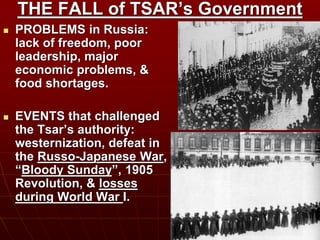
THE FALL of TSAR’s Government
 PROBLEMS in Russia:
lack of freedom, poor
leadership, major
economic problems, &
food shortages.
 EVENTS that challenged
the Tsar’s authority:
westernization, defeat in
the Russo-Japanese War,
“Bloody Sunday”, 1905
Revolution, & losses
during World War I.
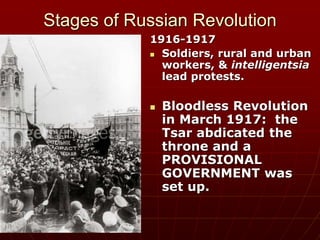
Stages of Russian Revolution
1916-1917
 Soldiers, rural and urban
workers, & intelligentsia
lead protests.
 Bloodless Revolution
in March 1917: the
Tsar abdicated the
throne and a
PROVISIONAL
GOVERNMENT was
set up.
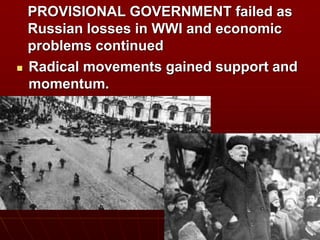
PROVISIONAL GOVERNMENT failed as
Russian losses in WWI and economic
problems continued
 Radical movements gained support and
momentum.
The BOLSHEVIK REVOLUTION
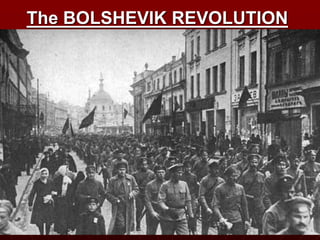
 1917 The Bolsheviks (one of the
radical communist groups) and their
leader, Vladmir LENIN, gained
enough support and power to seize
control of the government “on behalf
of the people”
The BOLSHEVIK REVOLUTION
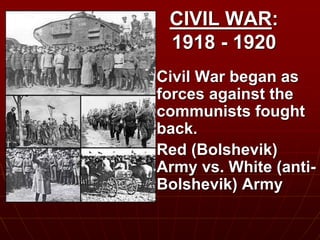
CIVIL WAR:
1918 - 1920
 Civil War began as
forces against the
communists fought
back.
 Red (Bolshevik)
Army vs. White (anti-
Bolshevik) Army
CIVIL WAR:
1918 - 1920
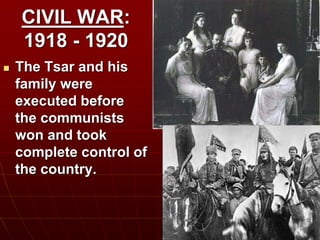
 The Tsar and his
family were
executed before
the communists
won and took
complete control of
the country.
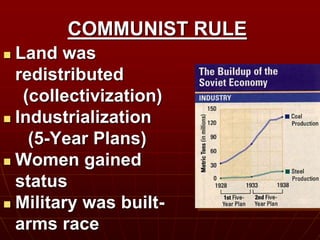
COMMUNIST RULE
 Land was
redistributed
(collectivization)
 Industrialization
(5-Year Plans)
 Women gained
status
 Military was built-
arms race
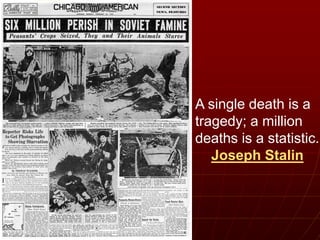
A single death is a
tragedy; a million
deaths is a statistic.
Joseph Stalin
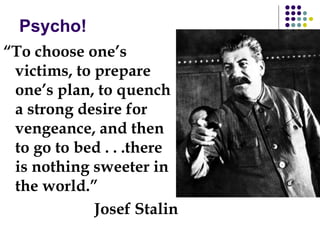
Psycho!
“To choose one’s
victims, to prepare
one’s plan, to quench
a strong desire for
vengeance, and then
to go to bed . . .there
is nothing sweeter in
the world.”
Josef Stalin
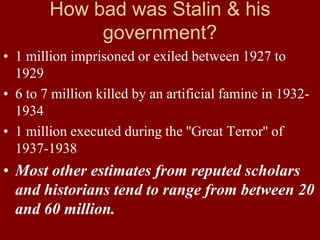
How bad was Stalin & his
government?
• 1 million imprisoned or exiled between 1927 to
1929
• 6 to 7 million killed by an artificial famine in 1932-
1934
• 1 million executed during the ''Great Terror'' of
1937-1938
• Most other estimates from reputed scholars
and historians tend to range from between 20
and 60 million.
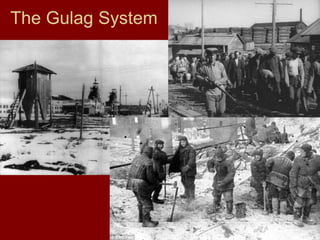
The Gulag System
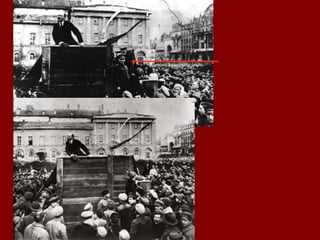
There’s Trotsky at a
Lenin speech.
Where’d he go?
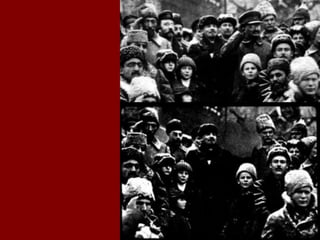
There’s Trotsky again
with Lenin.
Where’d he go?

USSR & Communism

  • 1.
    Communist Revolutions inRussia and China  Before the revolutions – monarchs were from a long lasting dynasty • QING – 1644-1912 • Romanov Tsars – 1300s to 1918  PROBLEMS – economic, social class tensions, rebellions, war  Revolution part 1 – Dynasty fell and a provisional government took over (semi-democratic)  Problems continued, Provisional government failed, radicals gained power  Civil War and Communist victory  1921-1991 Soviet Union  1949 - ? Peoples Republic of China
  • 2.
    Russian Revolution & CommunistRussia Russia = Soviet Union = USSR
  • 3.
    THE FALL ofTSAR’s Government  PROBLEMS in Russia: lack of freedom, poor leadership, major economic problems, & food shortages.  EVENTS that challenged the Tsar’s authority: westernization, defeat in the Russo-Japanese War, “Bloody Sunday”, 1905 Revolution, & losses during World War I.
  • 4.
    Stages of RussianRevolution 1916-1917  Soldiers, rural and urban workers, & intelligentsia lead protests.  Bloodless Revolution in March 1917: the Tsar abdicated the throne and a PROVISIONAL GOVERNMENT was set up.
  • 5.
    PROVISIONAL GOVERNMENT failedas Russian losses in WWI and economic problems continued  Radical movements gained support and momentum.
  • 6.
    The BOLSHEVIK REVOLUTION 1917 The Bolsheviks (one of the radical communist groups) and their leader, Vladmir LENIN, gained enough support and power to seize control of the government “on behalf of the people”
  • 7.
  • 8.
    CIVIL WAR: 1918 -1920  Civil War began as forces against the communists fought back.  Red (Bolshevik) Army vs. White (anti- Bolshevik) Army
  • 9.
    CIVIL WAR: 1918 -1920  The Tsar and his family were executed before the communists won and took complete control of the country.
  • 10.
    COMMUNIST RULE  Landwas redistributed (collectivization)  Industrialization (5-Year Plans)  Women gained status  Military was built- arms race
  • 13.
    A single deathis a tragedy; a million deaths is a statistic. Joseph Stalin
  • 14.
    Psycho! “To choose one’s victims,to prepare one’s plan, to quench a strong desire for vengeance, and then to go to bed . . .there is nothing sweeter in the world.” Josef Stalin
  • 15.
    How bad wasStalin & his government? • 1 million imprisoned or exiled between 1927 to 1929 • 6 to 7 million killed by an artificial famine in 1932- 1934 • 1 million executed during the ''Great Terror'' of 1937-1938 • Most other estimates from reputed scholars and historians tend to range from between 20 and 60 million.
  • 16.
  • 17.
    There’s Trotsky ata Lenin speech. Where’d he go?
  • 18.
    There’s Trotsky again withLenin. Where’d he go?