Russian Revolution
Opening Focus Assignments
 1/9 “Faults of WWI Peace Treaty”
 1/10 “WWI and changing values”
 1/11 “Views of the War”
 1/14 “Lost Generation”
 1/15 “Dawes Plan”
 1/18 “Path to Revolution”
Russian Government Before
Revolution
 Monarchy: The Czar (Tsar)
 Until 1905 the Tsar's powers were
unlimited.
 Russia had no constitution,
 no political party system to check the
Tsar's power
 A strong secret police which terrorized
the people.
Royal Background
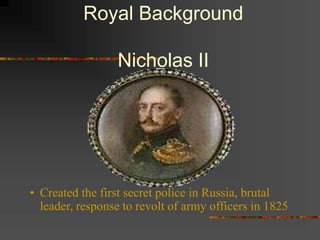
Nicholas II
• Created the first secret police in Russia, brutal
leader, response to revolt of army officers in 1825
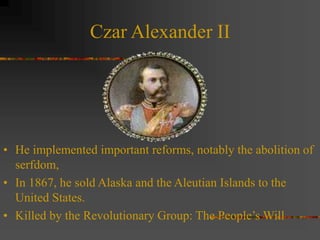
Czar Alexander II
• He implemented important reforms, notably the abolition of
serfdom,
• In 1867, he sold Alaska and the Aleutian Islands to the
United States.
• Killed by the Revolutionary Group: The People’s Will
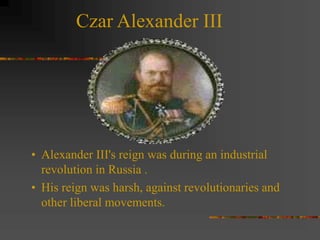
Czar Alexander III
• Alexander III's reign was during an industrial
revolution in Russia .
• His reign was harsh, against revolutionaries and
other liberal movements.
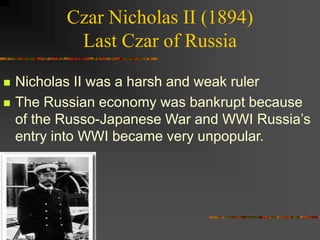
Czar Nicholas II (1894)
Last Czar of Russia
 Nicholas II was a harsh and weak ruler
 The Russian economy was bankrupt because
of the Russo-Japanese War and WWI Russia’s
entry into WWI became very unpopular.
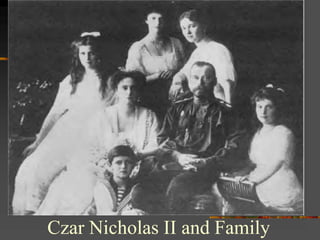
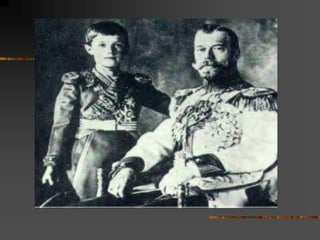
Czar Nicholas II and Family
Russo-Japanese War (1904)
Dispute over Manchuria with
Japan
Shook national confidence in their
progress and rule of Czar.
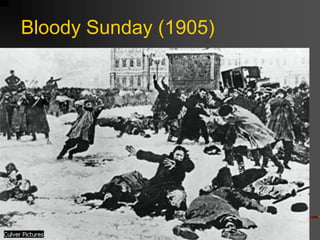
Bloody Sunday (1905)
Russia and World War I
 Russia declares war on Austria-
Hungary
 War becomes unpopular
 Rationing leads to starvation
 Nicholas II leaves St. Petersburg to war
front
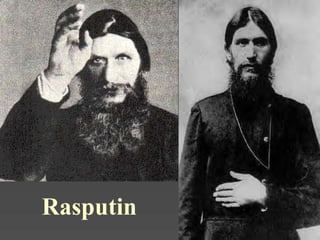
Rasputin
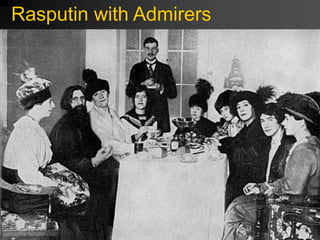
Rasputin with Admirers
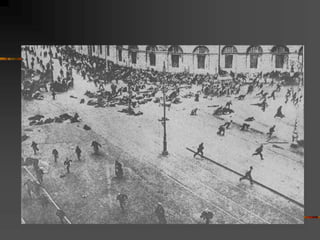
March Revolution (1917)
 1917- protests spread through St.
Petersburg and the Royal palace is
taken over.
 Czar abdicates
 Provisional government (Duma) takes
control lead by Alexander Keresnky
 Provisional government unpopular
after decision to stay in WWI
October (Bolshevik) Revolution-
1917
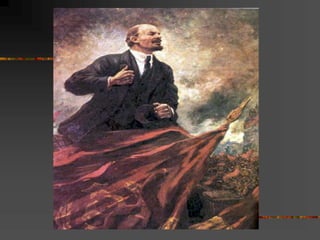
 Lead by VI Lenin “Peace, Land, and
Bread”
 Won support of people (especially
peasants)
1918
 1918 March The Bolsheviks accept the
peace of Brest-Litovsk, ending WWI with
Germany.
1919-1920
1919 White Armies (Royal and Menshevik
troops) attack the Reds (Bolsheviks) from
all directions.
 1920- Reds defeat Whites
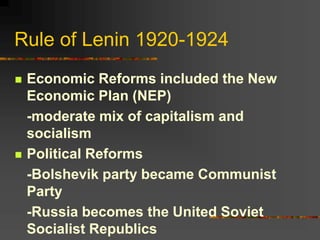
Rule of Lenin 1920-1924
 Economic Reforms included the New
Economic Plan (NEP)
-moderate mix of capitalism and
socialism
 Political Reforms
-Bolshevik party became Communist
Party
-Russia becomes the United Soviet
Socialist Republics
Communism
 A Form of Socialism
 Central Planning of the Economy by the State
 Gov’t (Communist Party) makes decisions
on individual jobs and pay
1924
 Lenin Dies
 Power Vaccuum
 Leon Trotsky vs. Joseph Stalin
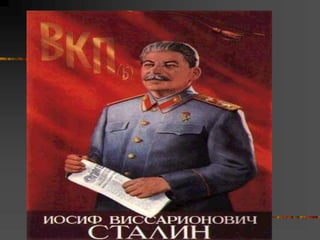
 Stalin takes control
 Now must decide how he will maintain
power
 Decides to create a totalitarian state
Characteristics of a Totalitarian
State
 Dictatorship- Absolute Authority
 Dynamic Leader- Vision for the nation
 State Control Over All Sectors of Society
 Business, Family Life, Labor, youth groups, housing,
religion, education, the arts
 State Control Over the Individual
 Obedience
 Denies basic liberties
 Organized Violence
 Uses force to crush opposition
Stalin’s Totalitarian State
 State Control of the Economy
 5 year plan, collective farms
 Police Terror
 Great Purge, crush opposition
 Religious Persecution
 Control of the individual
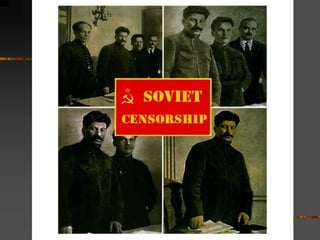
 Propaganda (socialist realism)
 Molding peoples minds
 Education
 Controlled by the government
russianrevolution.ppt

russianrevolution.ppt

  • 1.
  • 2.
    Opening Focus Assignments 1/9 “Faults of WWI Peace Treaty”  1/10 “WWI and changing values”  1/11 “Views of the War”  1/14 “Lost Generation”  1/15 “Dawes Plan”  1/18 “Path to Revolution”
  • 3.
    Russian Government Before Revolution Monarchy: The Czar (Tsar)  Until 1905 the Tsar's powers were unlimited.  Russia had no constitution,  no political party system to check the Tsar's power  A strong secret police which terrorized the people.
  • 4.
    Royal Background Nicholas II •Created the first secret police in Russia, brutal leader, response to revolt of army officers in 1825
  • 5.
    Czar Alexander II •He implemented important reforms, notably the abolition of serfdom, • In 1867, he sold Alaska and the Aleutian Islands to the United States. • Killed by the Revolutionary Group: The People’s Will
  • 6.
    Czar Alexander III •Alexander III's reign was during an industrial revolution in Russia . • His reign was harsh, against revolutionaries and other liberal movements.
  • 7.
    Czar Nicholas II(1894) Last Czar of Russia  Nicholas II was a harsh and weak ruler  The Russian economy was bankrupt because of the Russo-Japanese War and WWI Russia’s entry into WWI became very unpopular.
  • 8.
    Czar Nicholas IIand Family
  • 9.
    Russo-Japanese War (1904) Disputeover Manchuria with Japan Shook national confidence in their progress and rule of Czar.
  • 10.
  • 11.
    Russia and WorldWar I  Russia declares war on Austria- Hungary  War becomes unpopular  Rationing leads to starvation  Nicholas II leaves St. Petersburg to war front
  • 13.
  • 14.
  • 16.
    March Revolution (1917) 1917- protests spread through St. Petersburg and the Royal palace is taken over.  Czar abdicates  Provisional government (Duma) takes control lead by Alexander Keresnky  Provisional government unpopular after decision to stay in WWI
  • 17.
    October (Bolshevik) Revolution- 1917 Lead by VI Lenin “Peace, Land, and Bread”  Won support of people (especially peasants)
  • 19.
    1918  1918 MarchThe Bolsheviks accept the peace of Brest-Litovsk, ending WWI with Germany.
  • 20.
    1919-1920 1919 White Armies(Royal and Menshevik troops) attack the Reds (Bolsheviks) from all directions.  1920- Reds defeat Whites
  • 21.
    Rule of Lenin1920-1924  Economic Reforms included the New Economic Plan (NEP) -moderate mix of capitalism and socialism  Political Reforms -Bolshevik party became Communist Party -Russia becomes the United Soviet Socialist Republics
  • 23.
    Communism  A Formof Socialism  Central Planning of the Economy by the State  Gov’t (Communist Party) makes decisions on individual jobs and pay
  • 24.
    1924  Lenin Dies Power Vaccuum  Leon Trotsky vs. Joseph Stalin  Stalin takes control  Now must decide how he will maintain power  Decides to create a totalitarian state
  • 26.
    Characteristics of aTotalitarian State  Dictatorship- Absolute Authority  Dynamic Leader- Vision for the nation  State Control Over All Sectors of Society  Business, Family Life, Labor, youth groups, housing, religion, education, the arts  State Control Over the Individual  Obedience  Denies basic liberties  Organized Violence  Uses force to crush opposition
  • 27.
    Stalin’s Totalitarian State State Control of the Economy  5 year plan, collective farms  Police Terror  Great Purge, crush opposition  Religious Persecution  Control of the individual  Propaganda (socialist realism)  Molding peoples minds  Education  Controlled by the government