Search Engine OptimizationA Speed of Light Enterprises PresentationHigh search rankings  free web traffic  higher profits2011 Speed of Light Enterprises, some rights reserved. This document is licensed and protected by Creative Commons . It may be freely distributed with proper attribution for non-commercial uses only.
Search MarketingDefinitionsSearch Engine Marketing (SEM): the entire set of techniques and strategies used to direct more visitors from search engines to marketing web sites, including all of the tactics and strategies defined below.
Paid Placement: Text ads targeted to keyword search results on search engines, through programs such as Google AdWords and Yahoo Search "Precision Match," also sometimes referred to as "Paid Placement," "Pay-per-Click" (PPC) advertising and Cost-per-Click (CPC) advertising.
Search Engine Optimization (Organic): The practice of using a range of techniques, including augmenting HTML code, web page copy editing, site navigation, linking campaigns and more, in order to improve how well a site or page gets listed in search engines for particular search topics.
Search Engine Marketing (SEM) Service Provider: Agencies or individuals who assist companies with the various search engine marketing practices described above.Search Engine OptimizationSEO is the practice of using a range of techniques, including augmenting HTML code, web page copy editing, site navigation, linking campaigns and more, in order to improve how well a site or page ranks on the search results pages of search engines for particular search topics.
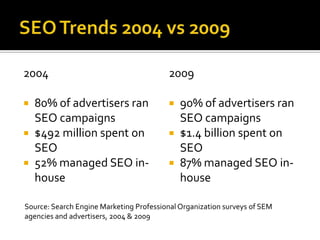
SEO Trends 2004 vs 2009200480% of advertisers ran SEO campaigns$492 million spent on SEO52% managed SEO in-house200990% of advertisers ran SEO campaigns$1.4 billion spent on SEO87% managed SEO in-houseSource: Search Engine Marketing Professional Organization surveys of SEM agencies and advertisers, 2004 & 2009
How Search Engines WorkEach search engine sends automated programs called “spiders” to crawl the web by following links looking for pagesEvery page they find, they index by caching a copy of the page, and evaluating it according to algorithmic formulae (usually proprietary)Every link they find, they follow (unless specifically asked not to)
How Search Engines RankEvery search engine has its own proprietary algorithmic formula(s)Google’s search algorithm is believed to contain over 200 elementsEach element is “weighted” and the relative weights are regularly fine-tuned
Some Google Ranking Elements	In no particular order and of unknown weight:Age of domainPage load timeSemantic hierarchy of keywordText emphasis of keywordFrequency of keywordKeyword in link text Page Rank of originating link
Google PageRankPageRank (PR) is a registered trade mark of Google, Inc. It refers to the calculated ranking score of any given page and is kept secretPR that can be detected is a highly simplified and untrustworthy variation of the PageRank scorePR can be used as a rough estimate of a web page’s Google score
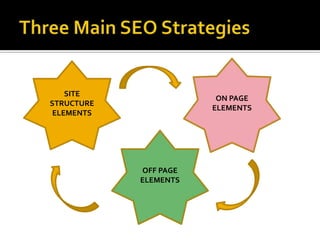
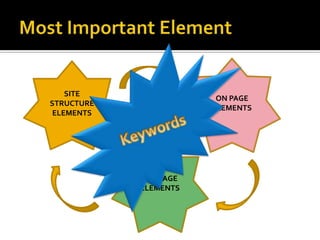
Three Main SEO StrategiesON PAGE ELEMENTSSITE STRUCTURE ELEMENTSOFF PAGE ELEMENTS
Site Structure ElementsContentSpiderability3 click rule< 100 links per pageLoad time and code placementURLs parsed by text readers
On Page ElementsTitlesMeta tagsMeta descriptionAlt tagsKeywords meta tagSemantic markupLink textTopic focus
Off Page ElementsLinksPaid linksReciprocal linksNatural linksSocial mediaLink bait
Most Important ElementKeywordsON PAGE ELEMENTSSITE STRUCTURE ELEMENTSOFF PAGE ELEMENTS
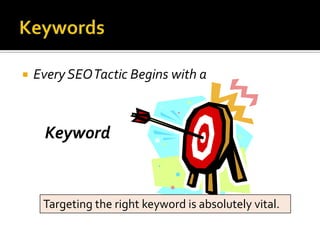
KeywordsEvery SEO Tactic Begins with aKeywordTargeting the right keyword is absolutely vital.
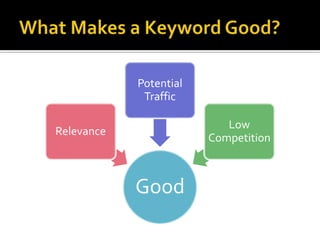
What Makes a Keyword Good?
Keyword Relevance	Good keywords describe the page content accurately and unambiguouslyGreat keywords describe the page content in exactly the same way that a typical searcher would
Keyword RelevanceWhich scenario is most likely to result in conversion to sale?10,000,000 people searching for “free mp3” are directed to a website that sells leather laptop shoulder bags30 people searching for “leather laptop shoulder bag” are sent to the same page
The Art of KeywordingEvery “useful” page should have one primary keywordand 3-5 secondary keywordsPrimary keyword should be the single most descriptive term describing the page content that is also most likely to drive valuable trafficKeywording is a five step process
5 Steps to Keywording SuccessView the page as a potential customer would and choose the single term you think they would use to find that pageExpand the keyword into as many variations as possibleTest the keyword set for traffic potentialTest the keyword set for competitivenessRinse and repeat
Keywording, Step 1Try to step outside yourself and think like a customer. Research your traffic logs to see what real people are using to find your siteResearch competitors to see what their customers are usingPick the one you think is best and write it down
Keywording, Step 2Next to the term you have already written, make a list of all the variations you can think of, but be sure they are all relevant to the pageUse a tool like Google AdWords Keyword Tool to expand the listRemove any terms that are irrelevant, ambiguous, or too general
Keywording, Step 3If you used Google AdWords Keyword Tool in Step 2, note the traffic data they supplied next to each keywordRemove any keywords that have no or very little real trafficChoose the top traffic generators for Step 4
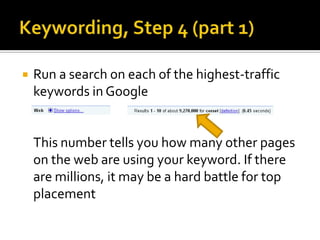
Keywording, Step 4 (part 1)Run a search on each of the highest-traffic keywords in Google	This number tells you how many other pages on the web are using your keyword. If there are millions, it may be a hard battle for top placement
Keywording, Step 4 (part 2)Look at the top 10 search results. Do all or most of them sell the same thing you do? Also look at the paid AdWords. Are there lots of ads and do they sell the same thing you do?	If so, you have a very competitive keyword.
Keywording, Step 5Using the first 4 steps, continue working with your keyword list until you have refined it down to one “great” keyword for every page.Note:	Your home page will likely be your best shot at branding. Product pages will probably work best with product names as keywords
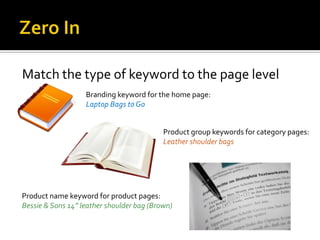
Zero InMatch the type of keyword to the page levelBranding keyword for the home page:Laptop Bags to GoProduct group keywords for category pages:Leather shoulder bagsProduct name keyword for product pages:Bessie & Sons 14” leather shoulder bag (Brown)
Using Your Keywords (where)Now you have keywords, where to put them?Page titleSemantic markup (<h1>, <h2>, etc)URLsMeta tagsWithin contentIn alt tagsIn internal link textIn external link text
Using Your Keywords (Do!)Do use the exact keyword as your page titleCreate awesome content around keywordsDo use slight variations as you salt keywords into semantic markup and page contentDo use simplified keywords in URL, either as page file name, or folder nameDo make your sites accessible to spidersDo use sitemaps
Using Your Keywords (Don’t!)Don’t buy links. Google really hates it.Don’t use hidden text or hidden links.Don’t use “cloaking” or anything sneaky.Don’t steal content. Not just a bad idea, but illegal, too.Don’t overdo it. No matter how well you rank, your customers are human beings, not spiders!
The only real trick to SEO is this:	A search engine is really just another demographic. Understand what that market segment needs, and provide it and your web business will prosper.
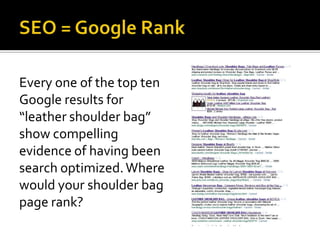
SEO = Google RankEvery one of the top ten Google results for “leather shoulder bag” show compelling evidence of having been search optimized. Where would your shoulder bag page rank?

Intro to search engine optimization

  • 1.
    Search Engine OptimizationASpeed of Light Enterprises PresentationHigh search rankings  free web traffic  higher profits2011 Speed of Light Enterprises, some rights reserved. This document is licensed and protected by Creative Commons . It may be freely distributed with proper attribution for non-commercial uses only.
  • 2.
    Search MarketingDefinitionsSearch EngineMarketing (SEM): the entire set of techniques and strategies used to direct more visitors from search engines to marketing web sites, including all of the tactics and strategies defined below.
  • 3.
    Paid Placement: Textads targeted to keyword search results on search engines, through programs such as Google AdWords and Yahoo Search "Precision Match," also sometimes referred to as "Paid Placement," "Pay-per-Click" (PPC) advertising and Cost-per-Click (CPC) advertising.
  • 4.
    Search Engine Optimization(Organic): The practice of using a range of techniques, including augmenting HTML code, web page copy editing, site navigation, linking campaigns and more, in order to improve how well a site or page gets listed in search engines for particular search topics.
  • 5.
    Search Engine Marketing(SEM) Service Provider: Agencies or individuals who assist companies with the various search engine marketing practices described above.Search Engine OptimizationSEO is the practice of using a range of techniques, including augmenting HTML code, web page copy editing, site navigation, linking campaigns and more, in order to improve how well a site or page ranks on the search results pages of search engines for particular search topics.
  • 6.
    SEO Trends 2004vs 2009200480% of advertisers ran SEO campaigns$492 million spent on SEO52% managed SEO in-house200990% of advertisers ran SEO campaigns$1.4 billion spent on SEO87% managed SEO in-houseSource: Search Engine Marketing Professional Organization surveys of SEM agencies and advertisers, 2004 & 2009
  • 7.
    How Search EnginesWorkEach search engine sends automated programs called “spiders” to crawl the web by following links looking for pagesEvery page they find, they index by caching a copy of the page, and evaluating it according to algorithmic formulae (usually proprietary)Every link they find, they follow (unless specifically asked not to)
  • 8.
    How Search EnginesRankEvery search engine has its own proprietary algorithmic formula(s)Google’s search algorithm is believed to contain over 200 elementsEach element is “weighted” and the relative weights are regularly fine-tuned
  • 9.
    Some Google RankingElements In no particular order and of unknown weight:Age of domainPage load timeSemantic hierarchy of keywordText emphasis of keywordFrequency of keywordKeyword in link text Page Rank of originating link
  • 10.
    Google PageRankPageRank (PR)is a registered trade mark of Google, Inc. It refers to the calculated ranking score of any given page and is kept secretPR that can be detected is a highly simplified and untrustworthy variation of the PageRank scorePR can be used as a rough estimate of a web page’s Google score
  • 11.
    Three Main SEOStrategiesON PAGE ELEMENTSSITE STRUCTURE ELEMENTSOFF PAGE ELEMENTS
  • 12.
    Site Structure ElementsContentSpiderability3click rule< 100 links per pageLoad time and code placementURLs parsed by text readers
  • 13.
    On Page ElementsTitlesMetatagsMeta descriptionAlt tagsKeywords meta tagSemantic markupLink textTopic focus
  • 14.
    Off Page ElementsLinksPaidlinksReciprocal linksNatural linksSocial mediaLink bait
  • 15.
    Most Important ElementKeywordsONPAGE ELEMENTSSITE STRUCTURE ELEMENTSOFF PAGE ELEMENTS
  • 16.
    KeywordsEvery SEO TacticBegins with aKeywordTargeting the right keyword is absolutely vital.
  • 17.
    What Makes aKeyword Good?
  • 18.
    Keyword Relevance Good keywordsdescribe the page content accurately and unambiguouslyGreat keywords describe the page content in exactly the same way that a typical searcher would
  • 19.
    Keyword RelevanceWhich scenariois most likely to result in conversion to sale?10,000,000 people searching for “free mp3” are directed to a website that sells leather laptop shoulder bags30 people searching for “leather laptop shoulder bag” are sent to the same page
  • 20.
    The Art ofKeywordingEvery “useful” page should have one primary keywordand 3-5 secondary keywordsPrimary keyword should be the single most descriptive term describing the page content that is also most likely to drive valuable trafficKeywording is a five step process
  • 21.
    5 Steps toKeywording SuccessView the page as a potential customer would and choose the single term you think they would use to find that pageExpand the keyword into as many variations as possibleTest the keyword set for traffic potentialTest the keyword set for competitivenessRinse and repeat
  • 22.
    Keywording, Step 1Tryto step outside yourself and think like a customer. Research your traffic logs to see what real people are using to find your siteResearch competitors to see what their customers are usingPick the one you think is best and write it down
  • 23.
    Keywording, Step 2Nextto the term you have already written, make a list of all the variations you can think of, but be sure they are all relevant to the pageUse a tool like Google AdWords Keyword Tool to expand the listRemove any terms that are irrelevant, ambiguous, or too general
  • 24.
    Keywording, Step 3Ifyou used Google AdWords Keyword Tool in Step 2, note the traffic data they supplied next to each keywordRemove any keywords that have no or very little real trafficChoose the top traffic generators for Step 4
  • 25.
    Keywording, Step 4(part 1)Run a search on each of the highest-traffic keywords in Google This number tells you how many other pages on the web are using your keyword. If there are millions, it may be a hard battle for top placement
  • 26.
    Keywording, Step 4(part 2)Look at the top 10 search results. Do all or most of them sell the same thing you do? Also look at the paid AdWords. Are there lots of ads and do they sell the same thing you do? If so, you have a very competitive keyword.
  • 27.
    Keywording, Step 5Usingthe first 4 steps, continue working with your keyword list until you have refined it down to one “great” keyword for every page.Note: Your home page will likely be your best shot at branding. Product pages will probably work best with product names as keywords
  • 28.
    Zero InMatch thetype of keyword to the page levelBranding keyword for the home page:Laptop Bags to GoProduct group keywords for category pages:Leather shoulder bagsProduct name keyword for product pages:Bessie & Sons 14” leather shoulder bag (Brown)
  • 29.
    Using Your Keywords(where)Now you have keywords, where to put them?Page titleSemantic markup (<h1>, <h2>, etc)URLsMeta tagsWithin contentIn alt tagsIn internal link textIn external link text
  • 30.
    Using Your Keywords(Do!)Do use the exact keyword as your page titleCreate awesome content around keywordsDo use slight variations as you salt keywords into semantic markup and page contentDo use simplified keywords in URL, either as page file name, or folder nameDo make your sites accessible to spidersDo use sitemaps
  • 31.
    Using Your Keywords(Don’t!)Don’t buy links. Google really hates it.Don’t use hidden text or hidden links.Don’t use “cloaking” or anything sneaky.Don’t steal content. Not just a bad idea, but illegal, too.Don’t overdo it. No matter how well you rank, your customers are human beings, not spiders!
  • 32.
    The only realtrick to SEO is this: A search engine is really just another demographic. Understand what that market segment needs, and provide it and your web business will prosper.
  • 33.
    SEO = GoogleRankEvery one of the top ten Google results for “leather shoulder bag” show compelling evidence of having been search optimized. Where would your shoulder bag page rank?