Enterprise Architecture Enterprise Architecture – why its needed now
2Introduction 	There are many, many presentations on what EA does, but few about why we need EA.
3Complexity of our IT EcosystemWhy is it increasingly more difficult, and costly to develop new solutions and maintain existing applications and services ?	Application development technology has improved, so it’s easier to build new --- if only we were operating in a “green field”, but we’re not. 	We are building solutions on our IT legacy which is a complex IT ecosystem, built up over 30 years or more.
4Emergence of Enterprise Architecture – Why Now ? 	An Industry Perspective  	It is clear by now, that a strategically coherent, well architected set of IT services, applications, infrastructure and databases does not emerge on it’s own accord. It needs direction, alignment and the right level of governance.
5Emergence of Enterprise Architecture ?   In order to understand why EA is emerging as a discipline, we have to understand where we’ve been in the last 30 years.
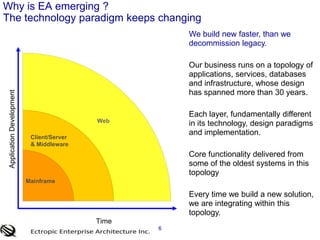
6Why is EA emerging ? The technology paradigm keeps changing We build new faster, than we decommission legacy. 	Our business runs on a topology of applications, services, databases and infrastructure, whose design has spanned more than 30 years.	Each layer, fundamentally different in its technology, design paradigms and implementation.  	Core functionality delivered from some of the oldest systems in this topology	Every time we build a new solution, we are integrating within this topology.
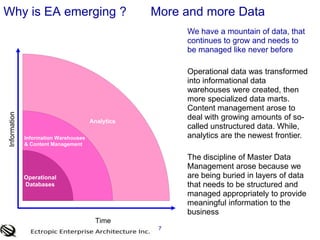
7Why is EA emerging ?       More and more Data We have a mountain of data, that continues to grow and needs to be managed like never before	Operational data was transformed into informational data warehouses were created, then more specialized data marts. Content management arose to deal with growing amounts of so-called unstructured data. While, analytics are the newest frontier. 	The discipline of Master Data Management arose because we are being buried in layers of data that needs to be structured and managed appropriately to provide meaningful information to the business
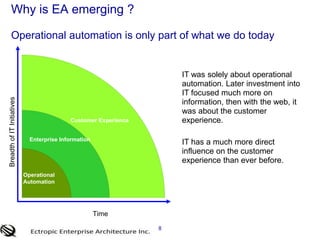
8Why is EA emerging ? Operational automation is only part of what we do today	IT was solely about operational automation. Later investment into IT focused much more on information, then with the web, it was about the customer experience. 	IT has a much more direct influence on the customer experience than ever before.
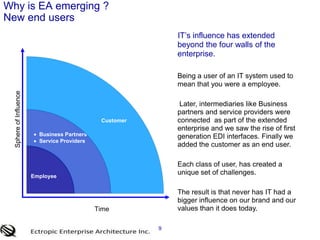
9Why is EA emerging ?  New end users IT’s influence has extended beyond the four walls of the enterprise.Being a user of an IT system used to mean that you were a employee.	 Later, intermediaries like Business partners and service providers were connected  as part of the extended enterprise and we saw the rise of first generation EDI interfaces. Finally we added the customer as an end user.   	Each class of user, has created a unique set of challenges. 	The result is that never has IT had a bigger influence on our brand and our values than it does today.
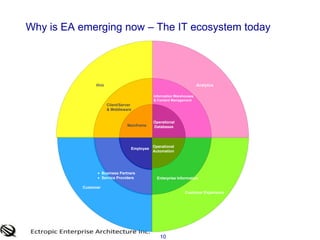
10Why is EA emerging now – The IT ecosystem today
11The lesson ...  The need for enterprise architecture has arisen, because of what we have created without it.
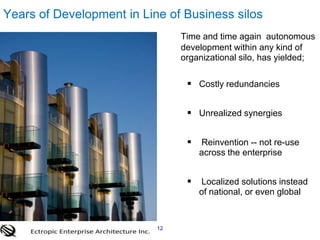
Years of Development in Line of Business silos12Conway’s law is as true now as it was in April,1968.“…organizations which design systems (defined broadly) are constrained to produce designs which are copies of the communication structures of these organizations”Time and time again  autonomous development within any kind of organizational silo, has yielded;Costly redundancies
Unrealized synergies
Reinvention -- not re-use across the enterprise
Localized solutions instead of national, or even global 13Years of Development in LOB organizational silos	The rise of middleware and the explosion of software technologies as well as the rate of change made IT in LOB silos inefficient. Each IT group was making its own decision, and the enterprise as a whole started paying the price. 	What resulted was each silo making its own selections around things like; Enterprise Content Management, Messaging, Workflow, rules engines and so on.  As a result, the enterprise which might have been better served by standardizing on one of each of these technologies found itself with many of each type. 	Further,  budgeting enterprise-scale technologies is made more difficult.
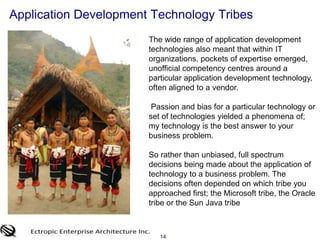
Application Development Technology Tribes 14The wide range of application development technologies also meant that within IT organizations, pockets of expertise emerged, unofficial competency centres around a particular application development technology, often aligned to a vendor.  Passion and bias for a particular technology or set of technologies yielded a phenomena of; my technology is the best answer to your business problem. So rather than unbiased, full spectrum decisions being made about the application of technology to a business problem. The decisions often depended on which tribe you approached first; the Microsoft tribe, the Oracle tribe or the Sun Java tribe
15Tactical Solutions have been preferred 	Budget and perceived time pressures to deliver short term results in a constrained environment combined with better development tools have yielded; High levels of proprietary code Low levels of re-useMore interim and remedial solutions, than strategicRate of new development has exceeded the rate of decommissioning Increased technical debt  - layer rather than replace
16Adding to our technical debt  	Every time we; Wrap rather than replace legacy Add technical complexity needlessly Add to our information stores rather than effectively managing what we already have. Fail to introduce enterprise scale technologies because of silo-ed budgets. Fail to make full-spectrum decisions about the application of our technologies. We increase the technical debt of the enterprise.
17The lesson... The way in which IT has done things in the past is not going to make things any better.
18		     SummaryEA has emerged as a discipline in its own right because;Efficiencies gained through initiatives that are;National or global in scope vs. regional Enterprise vs. single line of business initiatives Strategic vs. interim (tactical) focus
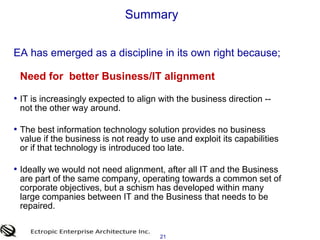
19Summary     EA has emerged as a discipline in its own right because;Rise in Complexity, Visibility and Importance of IT Solutions today are not standalone, they need to interoperate with  some aspects of a 30 year legacy of technology and design paradigms. Rising amounts of corporate data and the demand for more business informationBreadth of  IT initiatives; not just operational automation we are increasingly focused on our brand and the overall customer experience Extended reach of IT; its no longer just about employees. It’s the customer,  brokers, service providers and the employees.
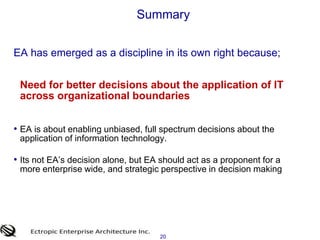
20SummaryEA has emerged as a discipline in its own right because;Need for better decisions about the application of IT across organizational boundariesEA is about enabling unbiased, full spectrum decisions about the application of information technology. Its not EA’s decision alone, but EA should act as a proponent for a more enterprise wide, and strategic perspective in decision making

Enterprise Architecture - Why it is needed, now

  • 1.
    Enterprise Architecture EnterpriseArchitecture – why its needed now
  • 2.
    2Introduction There aremany, many presentations on what EA does, but few about why we need EA.
  • 3.
    3Complexity of ourIT EcosystemWhy is it increasingly more difficult, and costly to develop new solutions and maintain existing applications and services ? Application development technology has improved, so it’s easier to build new --- if only we were operating in a “green field”, but we’re not. We are building solutions on our IT legacy which is a complex IT ecosystem, built up over 30 years or more.
  • 4.
    4Emergence of EnterpriseArchitecture – Why Now ? An Industry Perspective It is clear by now, that a strategically coherent, well architected set of IT services, applications, infrastructure and databases does not emerge on it’s own accord. It needs direction, alignment and the right level of governance.
  • 5.
    5Emergence of EnterpriseArchitecture ? In order to understand why EA is emerging as a discipline, we have to understand where we’ve been in the last 30 years.
  • 6.
    6Why is EAemerging ? The technology paradigm keeps changing We build new faster, than we decommission legacy. Our business runs on a topology of applications, services, databases and infrastructure, whose design has spanned more than 30 years. Each layer, fundamentally different in its technology, design paradigms and implementation. Core functionality delivered from some of the oldest systems in this topology Every time we build a new solution, we are integrating within this topology.
  • 7.
    7Why is EAemerging ? More and more Data We have a mountain of data, that continues to grow and needs to be managed like never before Operational data was transformed into informational data warehouses were created, then more specialized data marts. Content management arose to deal with growing amounts of so-called unstructured data. While, analytics are the newest frontier. The discipline of Master Data Management arose because we are being buried in layers of data that needs to be structured and managed appropriately to provide meaningful information to the business
  • 8.
    8Why is EAemerging ? Operational automation is only part of what we do today IT was solely about operational automation. Later investment into IT focused much more on information, then with the web, it was about the customer experience. IT has a much more direct influence on the customer experience than ever before.
  • 9.
    9Why is EAemerging ? New end users IT’s influence has extended beyond the four walls of the enterprise.Being a user of an IT system used to mean that you were a employee. Later, intermediaries like Business partners and service providers were connected as part of the extended enterprise and we saw the rise of first generation EDI interfaces. Finally we added the customer as an end user. Each class of user, has created a unique set of challenges. The result is that never has IT had a bigger influence on our brand and our values than it does today.
  • 10.
    10Why is EAemerging now – The IT ecosystem today
  • 11.
    11The lesson ... The need for enterprise architecture has arisen, because of what we have created without it.
  • 12.
    Years of Developmentin Line of Business silos12Conway’s law is as true now as it was in April,1968.“…organizations which design systems (defined broadly) are constrained to produce designs which are copies of the communication structures of these organizations”Time and time again autonomous development within any kind of organizational silo, has yielded;Costly redundancies
  • 13.
  • 14.
    Reinvention -- notre-use across the enterprise
  • 15.
    Localized solutions insteadof national, or even global 13Years of Development in LOB organizational silos The rise of middleware and the explosion of software technologies as well as the rate of change made IT in LOB silos inefficient. Each IT group was making its own decision, and the enterprise as a whole started paying the price. What resulted was each silo making its own selections around things like; Enterprise Content Management, Messaging, Workflow, rules engines and so on. As a result, the enterprise which might have been better served by standardizing on one of each of these technologies found itself with many of each type. Further, budgeting enterprise-scale technologies is made more difficult.
  • 16.
    Application Development TechnologyTribes 14The wide range of application development technologies also meant that within IT organizations, pockets of expertise emerged, unofficial competency centres around a particular application development technology, often aligned to a vendor. Passion and bias for a particular technology or set of technologies yielded a phenomena of; my technology is the best answer to your business problem. So rather than unbiased, full spectrum decisions being made about the application of technology to a business problem. The decisions often depended on which tribe you approached first; the Microsoft tribe, the Oracle tribe or the Sun Java tribe
  • 17.
    15Tactical Solutions havebeen preferred Budget and perceived time pressures to deliver short term results in a constrained environment combined with better development tools have yielded; High levels of proprietary code Low levels of re-useMore interim and remedial solutions, than strategicRate of new development has exceeded the rate of decommissioning Increased technical debt - layer rather than replace
  • 18.
    16Adding to ourtechnical debt Every time we; Wrap rather than replace legacy Add technical complexity needlessly Add to our information stores rather than effectively managing what we already have. Fail to introduce enterprise scale technologies because of silo-ed budgets. Fail to make full-spectrum decisions about the application of our technologies. We increase the technical debt of the enterprise.
  • 19.
    17The lesson... Theway in which IT has done things in the past is not going to make things any better.
  • 20.
    18 SummaryEA has emerged as a discipline in its own right because;Efficiencies gained through initiatives that are;National or global in scope vs. regional Enterprise vs. single line of business initiatives Strategic vs. interim (tactical) focus
  • 21.
    19Summary EA has emerged as a discipline in its own right because;Rise in Complexity, Visibility and Importance of IT Solutions today are not standalone, they need to interoperate with some aspects of a 30 year legacy of technology and design paradigms. Rising amounts of corporate data and the demand for more business informationBreadth of IT initiatives; not just operational automation we are increasingly focused on our brand and the overall customer experience Extended reach of IT; its no longer just about employees. It’s the customer, brokers, service providers and the employees.
  • 22.
    20SummaryEA has emergedas a discipline in its own right because;Need for better decisions about the application of IT across organizational boundariesEA is about enabling unbiased, full spectrum decisions about the application of information technology. Its not EA’s decision alone, but EA should act as a proponent for a more enterprise wide, and strategic perspective in decision making

Editor's Notes

  • #7 The complexity represented here arises because any new application or service added today, has to interoperate with components that exist in other layers.
  • #8 The discipline of Master Data Management arose because we are being buried in an layers of data, that needs to have a level of quality assurance applied to have real business value.
  • #9 IT used to be simple, it was about operational automation of tasks. The focus on the operational, shifted to the informational, then it was about the customer experience. Never has had IT, had this breadth.
  • #10 Architecting for the extended enterprise gets more complicated as we extend its boundaries.
  • #11 IT got very complex. Its reach has expanded on a number of levels.