Sculpture
Chapter 10
Sculpture
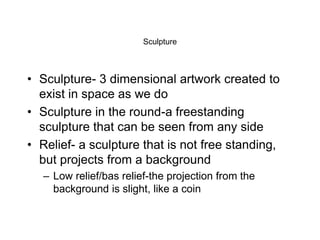
• Sculpture- 3 dimensional artwork created to
exist in space as we do
• Sculpture in the round-a freestanding
sculpture that can be seen from any side
• Relief- a sculpture that is not free standing,
but projects from a background
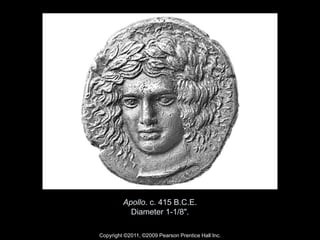
– Low relief/bas relief-the projection from the
background is slight, like a coin
Copyright ©2011, ©2009 Pearson Prentice Hall Inc.
Apollo. c. 415 B.C.E.
Diameter 1-1/8".
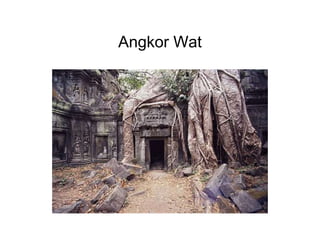
Angkor Wat
Copyright ©2011, ©2009 Pearson Prentice Hall Inc.
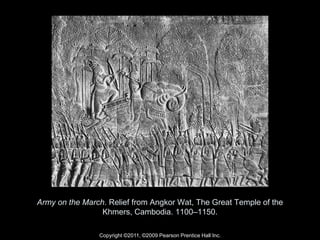
Army on the March. Relief from Angkor Wat, The Great Temple of the
Khmers, Cambodia. 1100–1150.
Angkor Wat
• Angkor wat- literally means city temple
• Originally built as a temple to the Hindu
god Vishnu
• Became a Buddhist temple
• Army on the March is a delicate low
relief carved in stone
• Notice the rhythm of the spears and it’s
contrast with the curving foliage
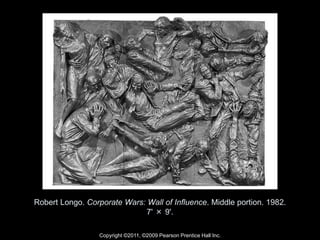
Corporate Wars: Wall of Influence
• By: Robert Longo
• High relief sculpture-more than half the
natural circumference of the modeled
form projects from the surface
• Figures are often undercut
Copyright ©2011, ©2009 Pearson Prentice Hall Inc.
Robert Longo. Corporate Wars: Wall of Influence. Middle portion. 1982.
7' × 9'.
Modeling
• Additive process-a pliable material,
such as wax, clay, plaster is built up and
pushed into a final form
• Armature-a stiff inner support that keeps
the material from sagging
Copyright ©2011, ©2009 Pearson Prentice Hall Inc.
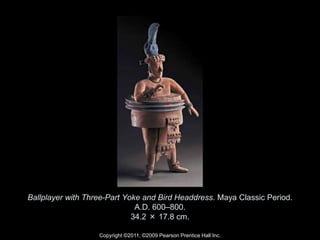
Ballplayer with Three-Part Yoke and Bird Headdress. Maya Classic Period.
A.D. 600–800.
34.2 × 17.8 cm.
Copyright ©2011, ©2009 Pearson Prentice Hall Inc.
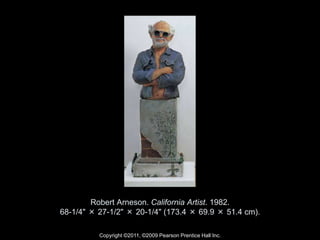
Robert Arneson. California Artist. 1982.
68-1/4" × 27-1/2" × 20-1/4" (173.4 × 69.9 × 51.4 cm).
Copyright ©2011, ©2009 Pearson Prentice Hall Inc.
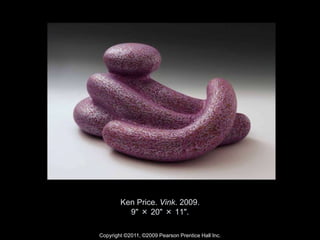
Ken Price. Vink. 2009.
9" × 20" × 11".
Casting
• Allows the artist to make the piece on a
pliable material like clay or wax and then
convert it into a permanent material like
bronze
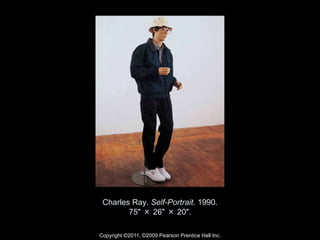
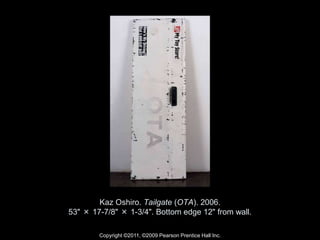
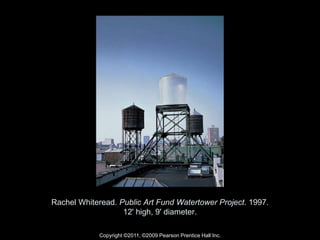
– Mold-a mold is made of the original work and then
the new material is poured into the mold
– Traditional a cast is made using metal, but now
there are new resins and plastics used to create
very realistic surfaces
Copyright ©2011, ©2009 Pearson Prentice Hall Inc.
Charles Ray. Self-Portrait. 1990.
75" × 26" × 20".
Copyright ©2011, ©2009 Pearson Prentice Hall Inc.
Kaz Oshiro. Tailgate (OTA). 2006.
53" × 17-7/8" × 1-3/4". Bottom edge 12" from wall.
Copyright ©2011, ©2009 Pearson Prentice Hall Inc.
Rachel Whiteread. Public Art Fund Watertower Project. 1997.
12' high, 9' diameter.
Carving
• Carving
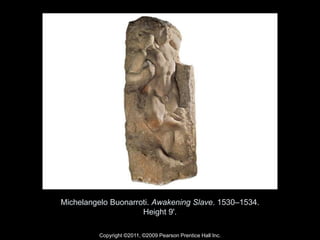
– Subtractive process-removing parts of the
original material to reveal the sculpture
– This type of sculpture is very unforgiving,
mistakes are hard or impossible to correct
– Different types of stone dictate different
types of carvings
Stones Wood
• Marble is a tradition material
that is soft and relatively stable,
but can be damaged in weather
• Granite is great for outdoors,
but is hard to carve fine detail
into because of it’s hardness
• Sandstone/limestone is easy to
carve but will be worn down by
weather
• Jade was used in China.
Beautiful but can crack easily
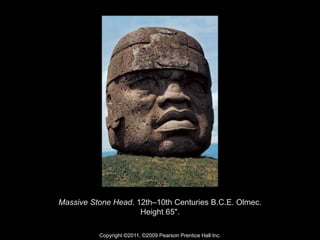
• Basalt is a rough stone used in
many Mexican Olmecs that is
hard to carve detail into
• Walnut and cypress
are strong woods
often preferred
• Joint block
construction-
different parts of the
sculpture are carved
separately and then
put together
Copyright ©2011, ©2009 Pearson Prentice Hall Inc.
Michelangelo Buonarroti. Awakening Slave. 1530–1534.
Height 9'.
Copyright ©2011, ©2009 Pearson Prentice Hall Inc.
Massive Stone Head. 12th–10th Centuries B.C.E. Olmec.
Height 65".
Copyright ©2011, ©2009 Pearson Prentice Hall Inc.
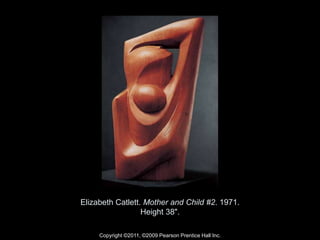
Elizabeth Catlett. Mother and Child #2. 1971.
Height 38".
Copyright ©2011, ©2009 Pearson Prentice Hall Inc.
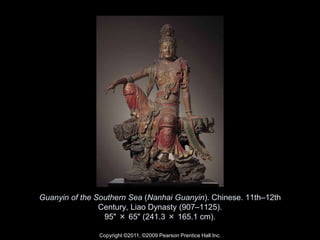
Guanyin of the Southern Sea (Nanhai Guanyin). Chinese. 11th–12th
Century, Liao Dynasty (907–1125).
95" × 65" (241.3 × 165.1 cm).
Constructing and Assembling
• In the past, the accepted forms of traditional
sculpture were modeling, carving and casting
• Assemblage and constructed pieces are,
made from multiple parts or materials and
assembled in a new way
– Ex: welding, nailing, gluing…
• Found object art-using old or abandoned
objects to create an artwork
Copyright ©2011, ©2009 Pearson Prentice Hall Inc.
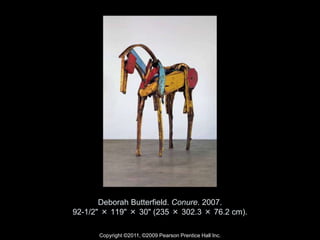
Deborah Butterfield. Conure. 2007.
92-1/2" × 119" × 30" (235 × 302.3 × 76.2 cm).
Copyright ©2011, ©2009 Pearson Prentice Hall Inc.
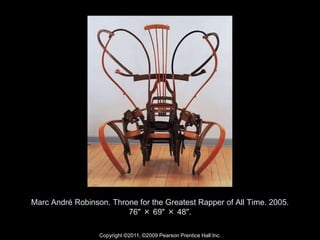
Marc André Robinson. Throne for the Greatest Rapper of All Time. 2005.
76" × 69" × 48".
Kinetic Sculpture
• Kinetic Sculpture-a sculpture that
moves
Mixed Media
• Mixed media-using multiple types of
materials to create one artwork
Copyright ©2011, ©2009 Pearson Prentice Hall Inc.
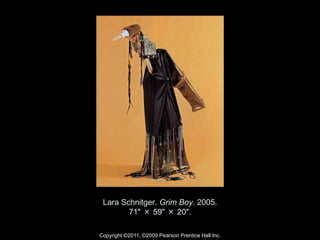
Lara Schnitger. Grim Boy. 2005.
71" × 59" × 20".
Copyright ©2011, ©2009 Pearson Prentice Hall Inc.
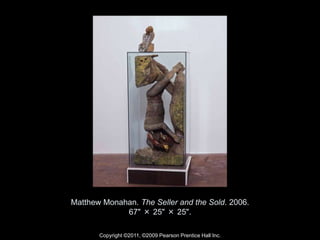
Matthew Monahan. The Seller and the Sold. 2006.
67" × 25" × 25".
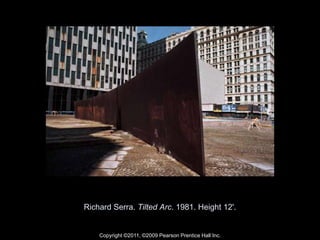
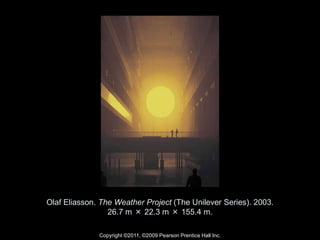
Installations and Site-Specific Art
• Installation- transforms a space into the
artwork
Copyright ©2011, ©2009 Pearson Prentice Hall Inc.
Richard Serra. Tilted Arc. 1981. Height 12'.
Copyright ©2011, ©2009 Pearson Prentice Hall Inc.
Olaf Eliasson. The Weather Project (The Unilever Series). 2003.
26.7 m × 22.3 m × 155.4 m.

chapter10artappreciation.ppt

  • 1.
  • 2.
    Sculpture • Sculpture- 3dimensional artwork created to exist in space as we do • Sculpture in the round-a freestanding sculpture that can be seen from any side • Relief- a sculpture that is not free standing, but projects from a background – Low relief/bas relief-the projection from the background is slight, like a coin
  • 3.
    Copyright ©2011, ©2009Pearson Prentice Hall Inc. Apollo. c. 415 B.C.E. Diameter 1-1/8".
  • 4.
  • 5.
    Copyright ©2011, ©2009Pearson Prentice Hall Inc. Army on the March. Relief from Angkor Wat, The Great Temple of the Khmers, Cambodia. 1100–1150.
  • 6.
    Angkor Wat • Angkorwat- literally means city temple • Originally built as a temple to the Hindu god Vishnu • Became a Buddhist temple • Army on the March is a delicate low relief carved in stone • Notice the rhythm of the spears and it’s contrast with the curving foliage
  • 7.
    Corporate Wars: Wallof Influence • By: Robert Longo • High relief sculpture-more than half the natural circumference of the modeled form projects from the surface • Figures are often undercut
  • 8.
    Copyright ©2011, ©2009Pearson Prentice Hall Inc. Robert Longo. Corporate Wars: Wall of Influence. Middle portion. 1982. 7' × 9'.
  • 9.
    Modeling • Additive process-apliable material, such as wax, clay, plaster is built up and pushed into a final form • Armature-a stiff inner support that keeps the material from sagging
  • 10.
    Copyright ©2011, ©2009Pearson Prentice Hall Inc. Ballplayer with Three-Part Yoke and Bird Headdress. Maya Classic Period. A.D. 600–800. 34.2 × 17.8 cm.
  • 11.
    Copyright ©2011, ©2009Pearson Prentice Hall Inc. Robert Arneson. California Artist. 1982. 68-1/4" × 27-1/2" × 20-1/4" (173.4 × 69.9 × 51.4 cm).
  • 12.
    Copyright ©2011, ©2009Pearson Prentice Hall Inc. Ken Price. Vink. 2009. 9" × 20" × 11".
  • 13.
    Casting • Allows theartist to make the piece on a pliable material like clay or wax and then convert it into a permanent material like bronze – Mold-a mold is made of the original work and then the new material is poured into the mold – Traditional a cast is made using metal, but now there are new resins and plastics used to create very realistic surfaces
  • 14.
    Copyright ©2011, ©2009Pearson Prentice Hall Inc. Charles Ray. Self-Portrait. 1990. 75" × 26" × 20".
  • 15.
    Copyright ©2011, ©2009Pearson Prentice Hall Inc. Kaz Oshiro. Tailgate (OTA). 2006. 53" × 17-7/8" × 1-3/4". Bottom edge 12" from wall.
  • 16.
    Copyright ©2011, ©2009Pearson Prentice Hall Inc. Rachel Whiteread. Public Art Fund Watertower Project. 1997. 12' high, 9' diameter.
  • 17.
    Carving • Carving – Subtractiveprocess-removing parts of the original material to reveal the sculpture – This type of sculpture is very unforgiving, mistakes are hard or impossible to correct – Different types of stone dictate different types of carvings
  • 18.
    Stones Wood • Marbleis a tradition material that is soft and relatively stable, but can be damaged in weather • Granite is great for outdoors, but is hard to carve fine detail into because of it’s hardness • Sandstone/limestone is easy to carve but will be worn down by weather • Jade was used in China. Beautiful but can crack easily • Basalt is a rough stone used in many Mexican Olmecs that is hard to carve detail into • Walnut and cypress are strong woods often preferred • Joint block construction- different parts of the sculpture are carved separately and then put together
  • 19.
    Copyright ©2011, ©2009Pearson Prentice Hall Inc. Michelangelo Buonarroti. Awakening Slave. 1530–1534. Height 9'.
  • 20.
    Copyright ©2011, ©2009Pearson Prentice Hall Inc. Massive Stone Head. 12th–10th Centuries B.C.E. Olmec. Height 65".
  • 21.
    Copyright ©2011, ©2009Pearson Prentice Hall Inc. Elizabeth Catlett. Mother and Child #2. 1971. Height 38".
  • 22.
    Copyright ©2011, ©2009Pearson Prentice Hall Inc. Guanyin of the Southern Sea (Nanhai Guanyin). Chinese. 11th–12th Century, Liao Dynasty (907–1125). 95" × 65" (241.3 × 165.1 cm).
  • 24.
    Constructing and Assembling •In the past, the accepted forms of traditional sculpture were modeling, carving and casting • Assemblage and constructed pieces are, made from multiple parts or materials and assembled in a new way – Ex: welding, nailing, gluing… • Found object art-using old or abandoned objects to create an artwork
  • 25.
    Copyright ©2011, ©2009Pearson Prentice Hall Inc. Deborah Butterfield. Conure. 2007. 92-1/2" × 119" × 30" (235 × 302.3 × 76.2 cm).
  • 26.
    Copyright ©2011, ©2009Pearson Prentice Hall Inc. Marc André Robinson. Throne for the Greatest Rapper of All Time. 2005. 76" × 69" × 48".
  • 27.
    Kinetic Sculpture • KineticSculpture-a sculpture that moves
  • 28.
    Mixed Media • Mixedmedia-using multiple types of materials to create one artwork
  • 29.
    Copyright ©2011, ©2009Pearson Prentice Hall Inc. Lara Schnitger. Grim Boy. 2005. 71" × 59" × 20".
  • 30.
    Copyright ©2011, ©2009Pearson Prentice Hall Inc. Matthew Monahan. The Seller and the Sold. 2006. 67" × 25" × 25".
  • 31.
    Installations and Site-SpecificArt • Installation- transforms a space into the artwork
  • 32.
    Copyright ©2011, ©2009Pearson Prentice Hall Inc. Richard Serra. Tilted Arc. 1981. Height 12'.
  • 33.
    Copyright ©2011, ©2009Pearson Prentice Hall Inc. Olaf Eliasson. The Weather Project (The Unilever Series). 2003. 26.7 m × 22.3 m × 155.4 m.

Editor's Notes

  • #4 Photograph: Hirmer Fotoarchiv, Munich Germany.
  • #6 Eliot Elisofon, Life Magazine © TimePix.
  • #9 Metro Pictures.
  • #11 Princeton University Art Museum. Museum purchase, Fowler McCormick, Class of 1921, Fund, in honor of Gillett G. Griffi
  • #12 San Francisco Museum of Modern Art, Gift of the Art Council. © Estate of Robert Arneson/Licensed by VAGA, New York, NY.
  • #13 L.A. Louver.
  • #15 Copyright © Charles Ray/Courtesy Matthew Marks Gallery, New York.
  • #16 Collection of Barry Sloane, Los Angeles. Courtesy of Rosamund Felsen Gallery, Santa Monica.
  • #17 Courtesy of the artist and Luhring Augustine and Environmental Justice Foundation (EFT).
  • #20 Nimatallah/Art Resource, N.Y.
  • #21 Werner Forman/Anthropology Museum, Mexico/Art Resource, N.Y.
  • #22 Photograph by Samella Lewis. © Elizabeth Catlett/ Licensed by VAGA, New York.
  • #23 The Nelson Atkins Museum of Art, Kansas City, Missouri. Purchase: William Rockhill Nelson Trust 34-10. Photograph: Jamison Miller.
  • #26 Courtesy L.A. Louver, Venice. © Deborah Butterfield/Licensed by VAGA, New York, NY.
  • #27 Salmatina Gallery.
  • #30 Anton Kern Gallery, New York.
  • #31 Modern Art.
  • #33 AP Photo/Mario Cabrera
  • #34 Photo: Jens Ziehe. Courtesy the artist; neugerriemschneider. Berlin: and Tanya Bonakdar Gallery, New York © Olafur Eliasson 2003.