Marx & Engels -
Communist Manifesto

   Introduction to Sociology
            2/15/12
History
History is the story
of class struggle
Bourgeois Society
   "The modern bourgeois society that has
sprouted from the ruins of feudal society has not
done away with class antagonisms. It has but
established new classes, new conditions of
oppression, new forms of struggle in place of the
old ones.
   Our epoch, the epoch of the bourgeoisie,
possesses, however, this distinctive feature: it has
simplified the class antagonisms: Society as a
whole is more and more splitting up into two great
hostile camps, into two great classes directly
facing each other: Bourgeoisie and Proletariat"
(page 474).
The Bourgeoisie and History
What makes the bourgeoisie "revolutionary"?
(page 475 and 476)
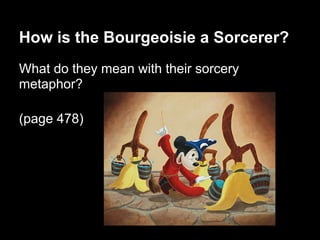
How is the Bourgeoisie a Sorcerer?
What do they mean with their sorcery
metaphor?

(page 478)
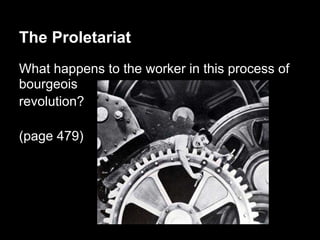
The Proletariat
What happens to the worker in this process of
bourgeois
revolution?

(page 479)
Proletariat as Grave-diggers?
"The advance of industry, whose involuntary
promoter is the bourgeoisie, replaces the
isolation of the laborers, due to competition, by
their revolutionary combination, due to
association. The development of Modern
Industry, therefore, cuts from under its feet the
very foundation on which the bourgeoisie
produces and appropriates products. What the
bourgeoisie, therefore, produces, above all, is
its own grave-diggers" (483).

Intro marx engels

  • 1.
    Marx & Engels- Communist Manifesto Introduction to Sociology 2/15/12
  • 2.
    History History is thestory of class struggle
  • 3.
    Bourgeois Society "The modern bourgeois society that has sprouted from the ruins of feudal society has not done away with class antagonisms. It has but established new classes, new conditions of oppression, new forms of struggle in place of the old ones. Our epoch, the epoch of the bourgeoisie, possesses, however, this distinctive feature: it has simplified the class antagonisms: Society as a whole is more and more splitting up into two great hostile camps, into two great classes directly facing each other: Bourgeoisie and Proletariat" (page 474).
  • 4.
    The Bourgeoisie andHistory What makes the bourgeoisie "revolutionary"? (page 475 and 476)
  • 5.
    How is theBourgeoisie a Sorcerer? What do they mean with their sorcery metaphor? (page 478)
  • 6.
    The Proletariat What happensto the worker in this process of bourgeois revolution? (page 479)
  • 7.
    Proletariat as Grave-diggers? "Theadvance of industry, whose involuntary promoter is the bourgeoisie, replaces the isolation of the laborers, due to competition, by their revolutionary combination, due to association. The development of Modern Industry, therefore, cuts from under its feet the very foundation on which the bourgeoisie produces and appropriates products. What the bourgeoisie, therefore, produces, above all, is its own grave-diggers" (483).