History as Class Struggle
Lecture 4 (2024/25)
Historiography I
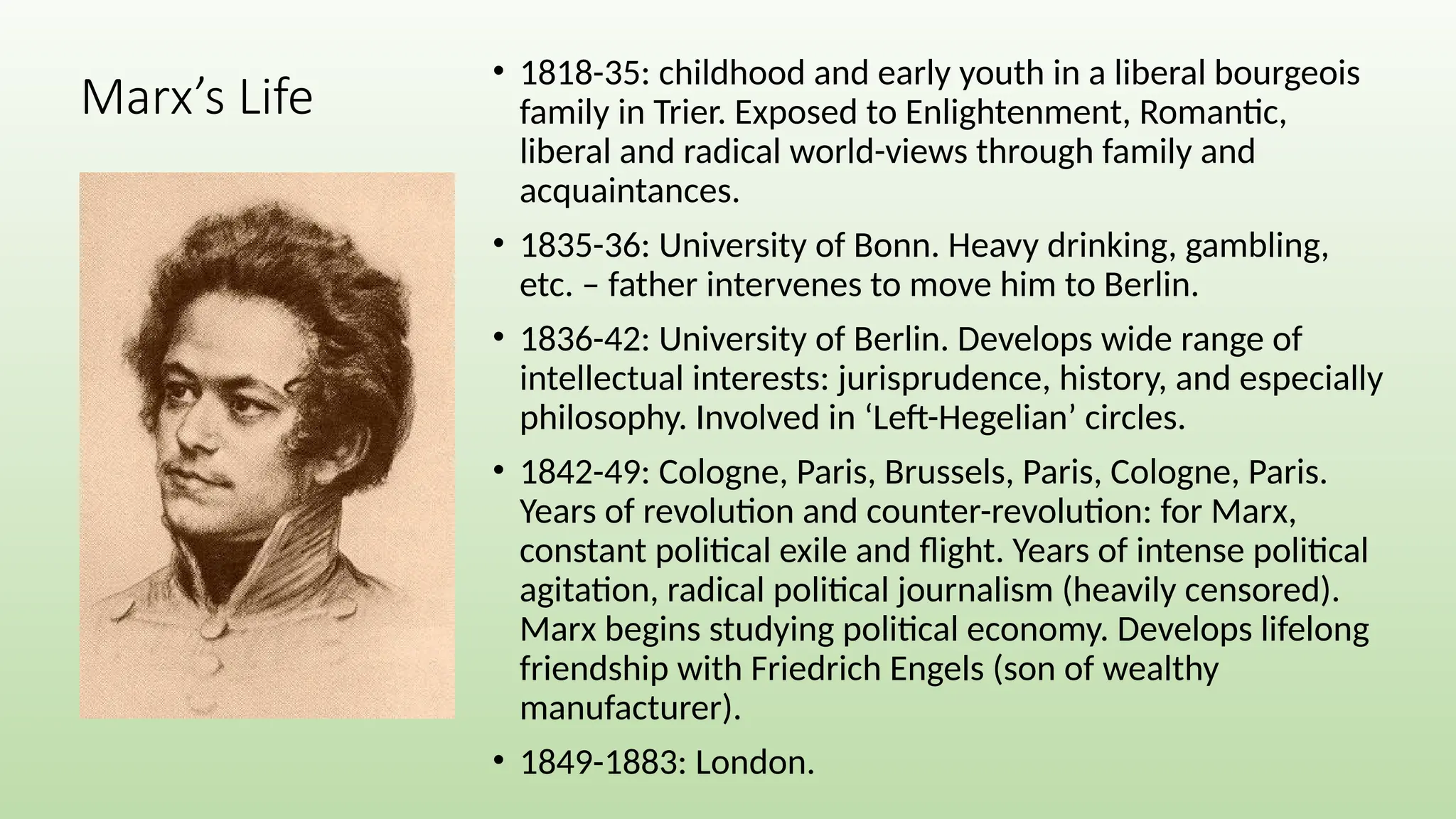
• 1818-35: childhood and early youth in a liberal bourgeois
family in Trier. Exposed to Enlightenment, Romantic,
liberal and radical world-views through family and
acquaintances.
• 1835-36: University of Bonn. Heavy drinking, gambling,
etc. – father intervenes to move him to Berlin.
• 1836-42: University of Berlin. Develops wide range of
intellectual interests: jurisprudence, history, and especially
philosophy. Involved in ‘Left-Hegelian’ circles.
• 1842-49: Cologne, Paris, Brussels, Paris, Cologne, Paris.
Years of revolution and counter-revolution: for Marx,
constant political exile and flight. Years of intense political
agitation, radical political journalism (heavily censored).
Marx begins studying political economy. Develops lifelong
friendship with Friedrich Engels (son of wealthy
manufacturer).
• 1849-1883: London.
Marx’s Life
• Romanticism
• Industrial Revolution – Creation of Proletariat
• Alienated from their work and thus themselves
• Democratic Revolutions (1789, 1830, 1848)
Further Context
Influences
• Significant influence of Enlightenment histories with their ‘stadial’ view of historical
progression (Ferguson etc.) – though with a twist
• English and Scottish political economy
• Adam Smith (1723-1790)
• David Ricardo (1772-1823)
• Utopian Socialism
• Henri de Saint-Simon (1760-1825)
• Charles Fourier (1772-1837)
• Robert Owen (1771-1858)
• German idealism:
• Immanuel Kant (1724-1804)
• Johann Gottlieb Fichte (1762-1814)
• Friedrich Wilhelm Joseph Schelling (1765-1854)
• Georg Wilhelm Friedrich Hegel (1770-1831)
1 Among the ‘Left’ Hegelians in Germany: In early phase, Marx is still
philosophical and metaphysical: He assumes man’s creative ‘potential’ and
sees history as the the gradual realization of it.
2 Like Hegel: History as dialectic (tension) between ‘real’ and ‘rational’. This
friction propels consciousness forward.
3 Hegel’s Endpoint  full consciousness, at one with Absolute Spirit and the
state. Man is reconciled with himself, society and nature. History driven by
‘ideas’.
Starting point: Inversion of Hegelian dialectics
“My dialectic method is not only different from the
Hegelian, but is its direct opposite. To Hegel, the life-
process of the human brain, i.e., the process of thinking,
which, under the name of 'the Idea,' he even transforms
into an independent subject, is the demiurgos of the real
world, and the real world is only the external,
phenomenal form of 'the Idea.' With me, on the contrary,
the ideal is nothing else than the material world
reflected by the human mind, and translated into forms
of thought.”
Karl Marx
Dialectics (very simple definition): develop in three
steps: Thesis – Antithesis – Synthesis (new quality)
Dialectical and Historical Materialism
• Dialectical Materialism
• Materialist ‘inversion’ of Hegelian dialectics: ‘standing Hegel the right way up’
– Dialectical Method lasting influence
• Critic of Capitalism
• Forces of production/relations of production = modes of production
• Historical materialism
• Existence determines Consciousness (Das Sein bestimmt das Bewußtsein) –
Thought is a product of material reality
• History driven by ‘material forces’ and as a series of class struggles
• History driven by technological innovations, which alter ‘productive forces’,
creating a struggle to redefine the social relations surrounding them
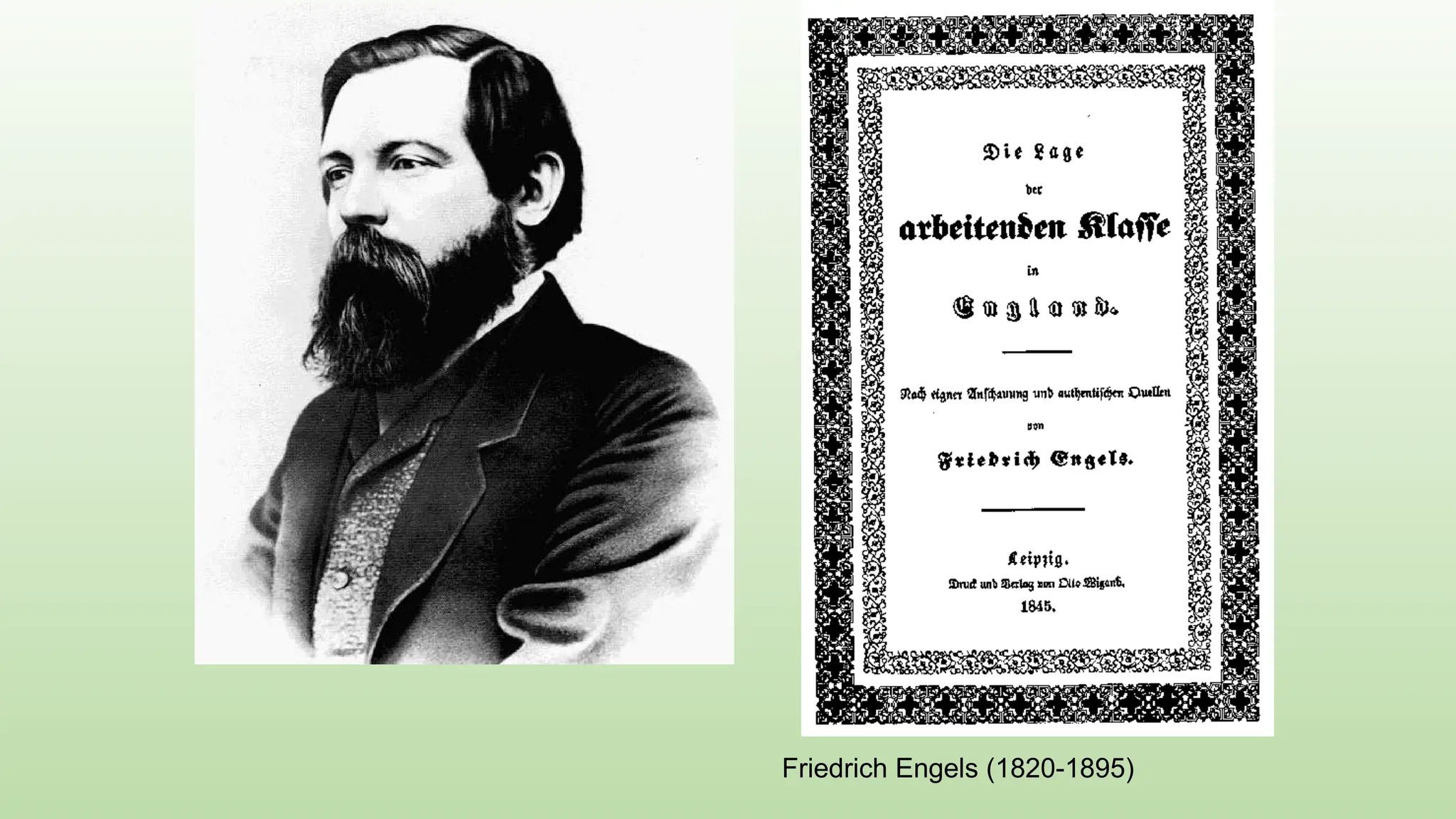
Friedrich Engels (1820-1895)
• From the product, which as soon as it is created, is taken away from
its producer.
• From his productive activity (work), which is experienced as a torment
– division of labour reduces him to small cog in production process.
• From his species-being (Gattungswesen – human nature), for humans
produce blindly and not in accordance with their truly human powers.
• From other human beings, as the cash nexus replaces mutual need
Key concepts: Alienation
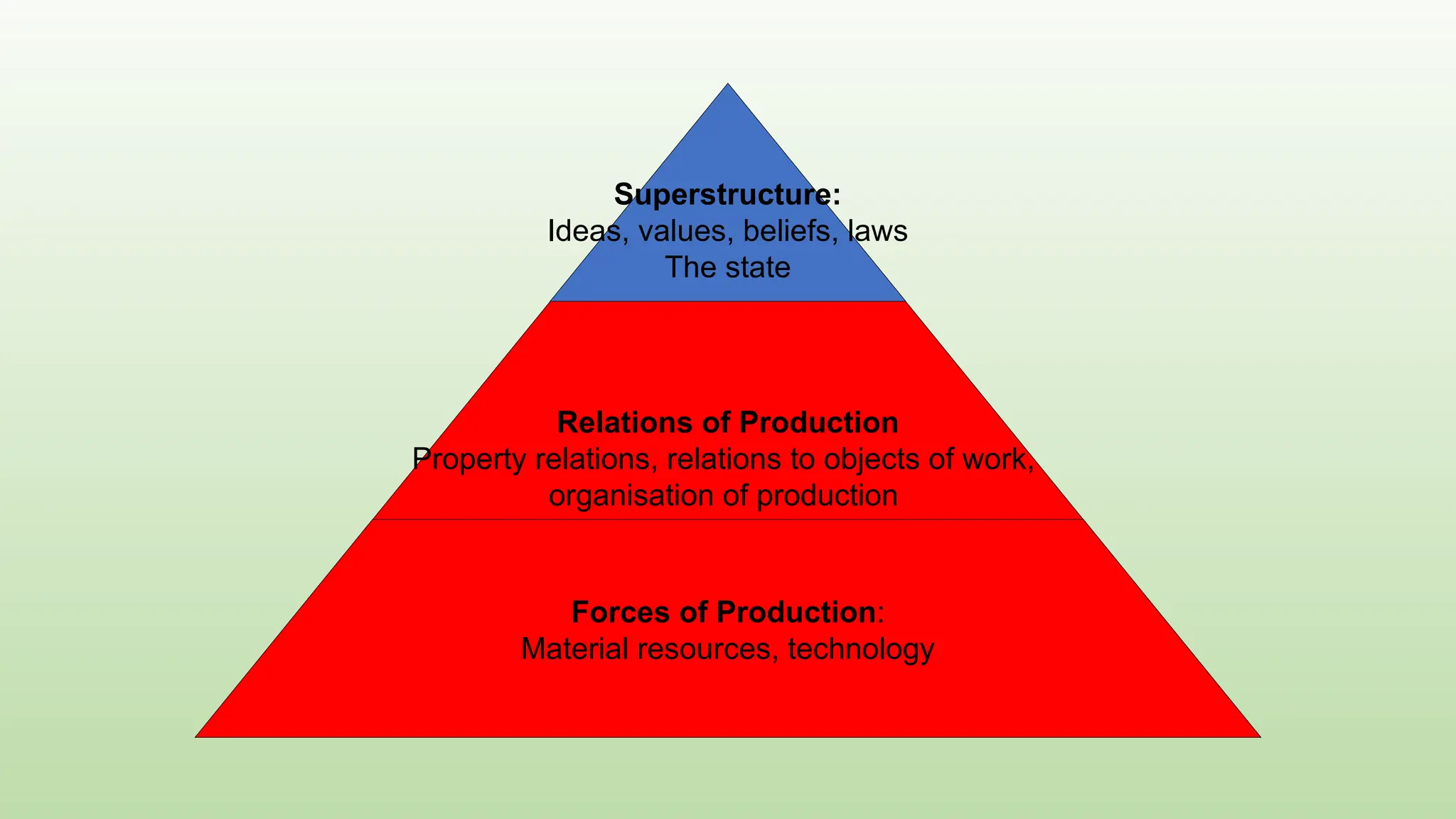
Superstructure:
Ideas, values, beliefs, laws
The state
Relations of Production
Property relations, relations to objects of work,
organisation of production
Forces of Production:
Material resources, technology
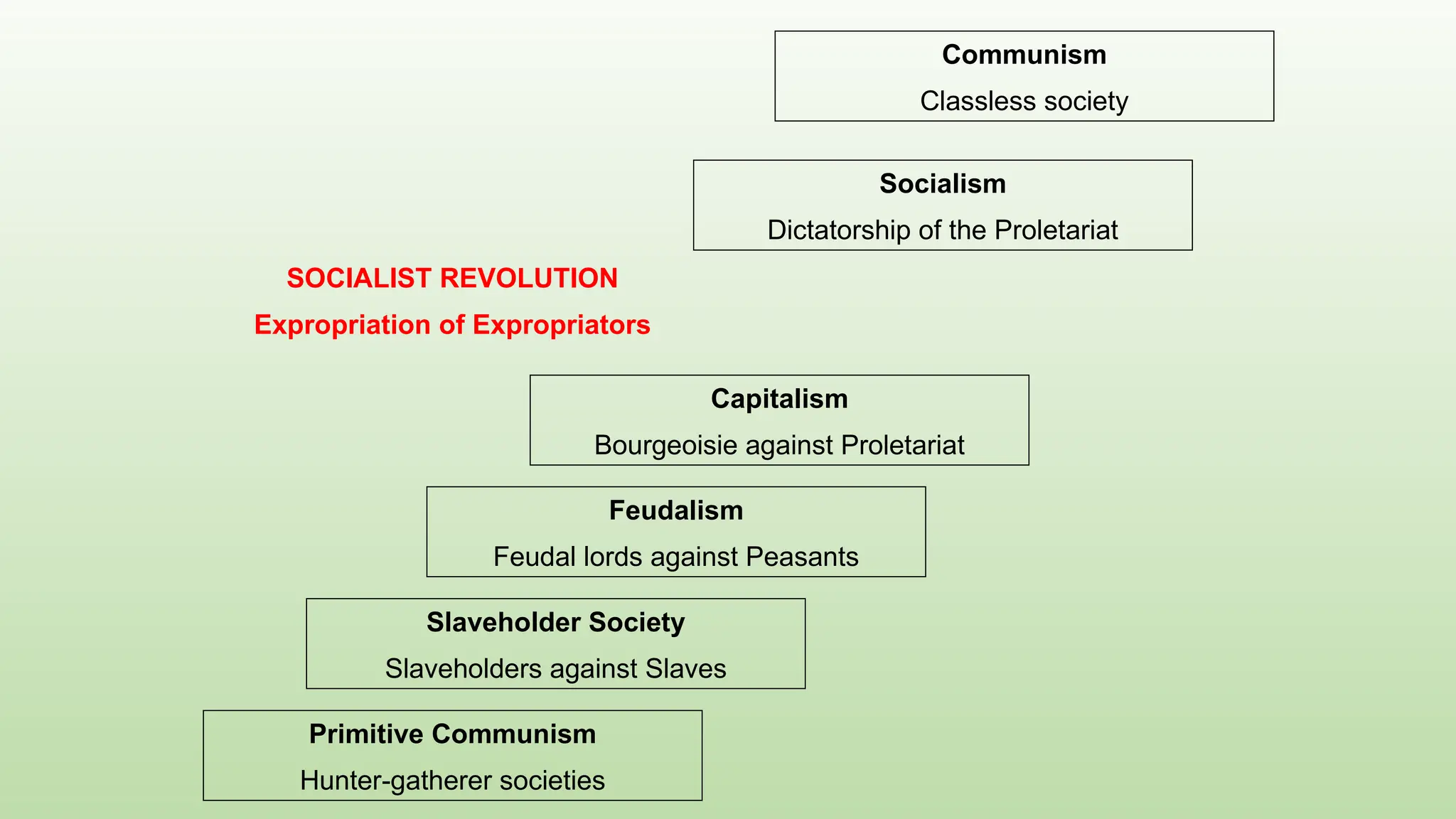
Primitive Communism
Hunter-gatherer societies
Slaveholder Society
Slaveholders against Slaves
Feudalism
Feudal lords against Peasants
Capitalism
Bourgeoisie against Proletariat
SOCIALIST REVOLUTION
Expropriation of Expropriators
Socialism
Dictatorship of the Proletariat
Communism
Classless society
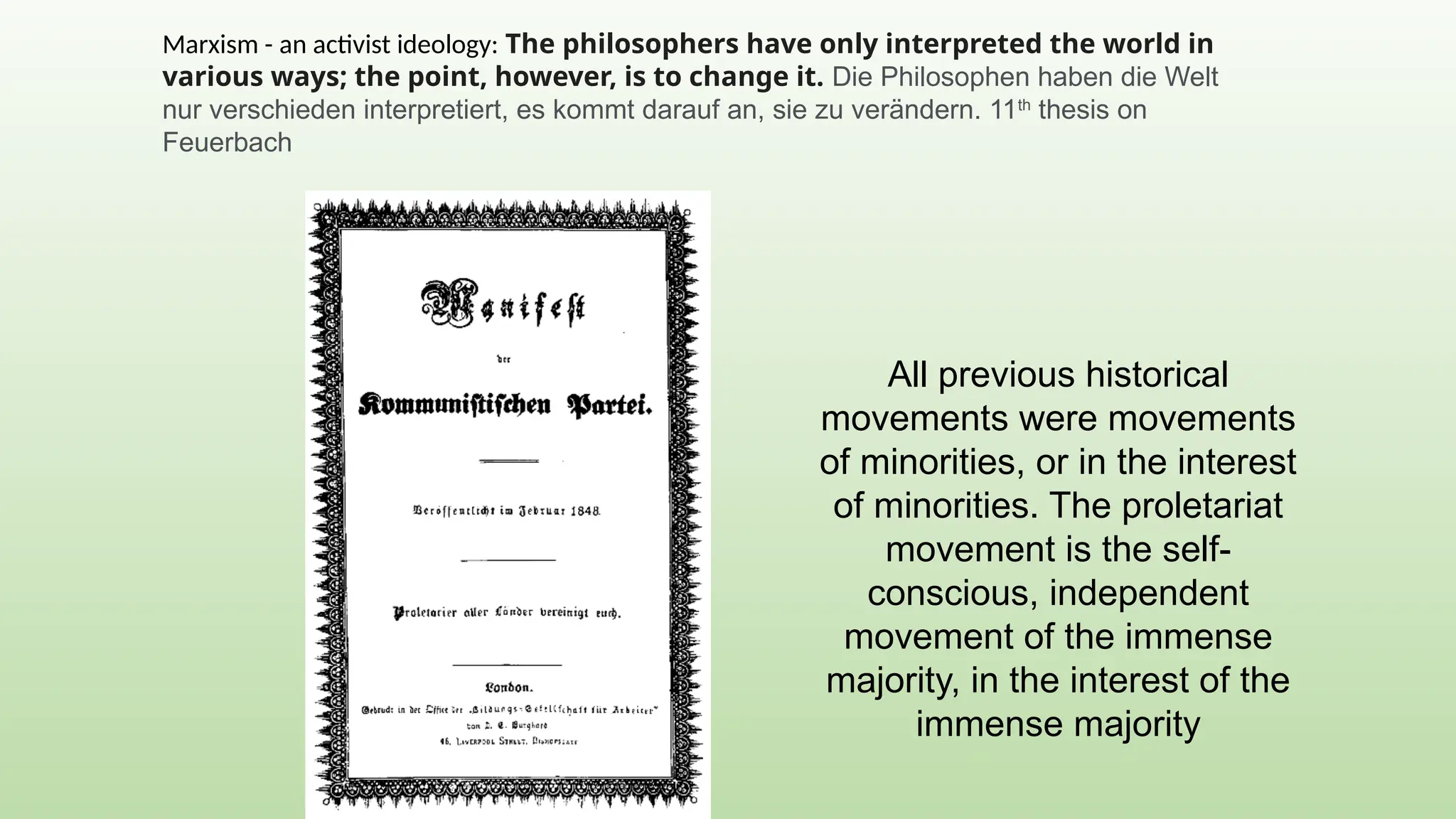
All previous historical
movements were movements
of minorities, or in the interest
of minorities. The proletariat
movement is the self-
conscious, independent
movement of the immense
majority, in the interest of the
immense majority
Marxism - an activist ideology: The philosophers have only interpreted the world in
various ways; the point, however, is to change it. Die Philosophen haben die Welt
nur verschieden interpretiert, es kommt darauf an, sie zu verändern. 11th
thesis on
Feuerbach
Communist Manifesto (Marx/Engels)
1848
• Bestselling book by Penguin Books
in 2015
• Next to Bible, most influential text
in history
• Profit = exploitation
• Need for working class
consciousness
• ‘Workers of the world, unite!’
• Revolution as key to historical
change
The immediate aim of the Communists
is the same as that of all other
proletarian parties: formation of the
proletariat into a class, overthrow of
the bourgeois supremacy, conquest of
political power by the proletariat.
(Communist Manifesto)
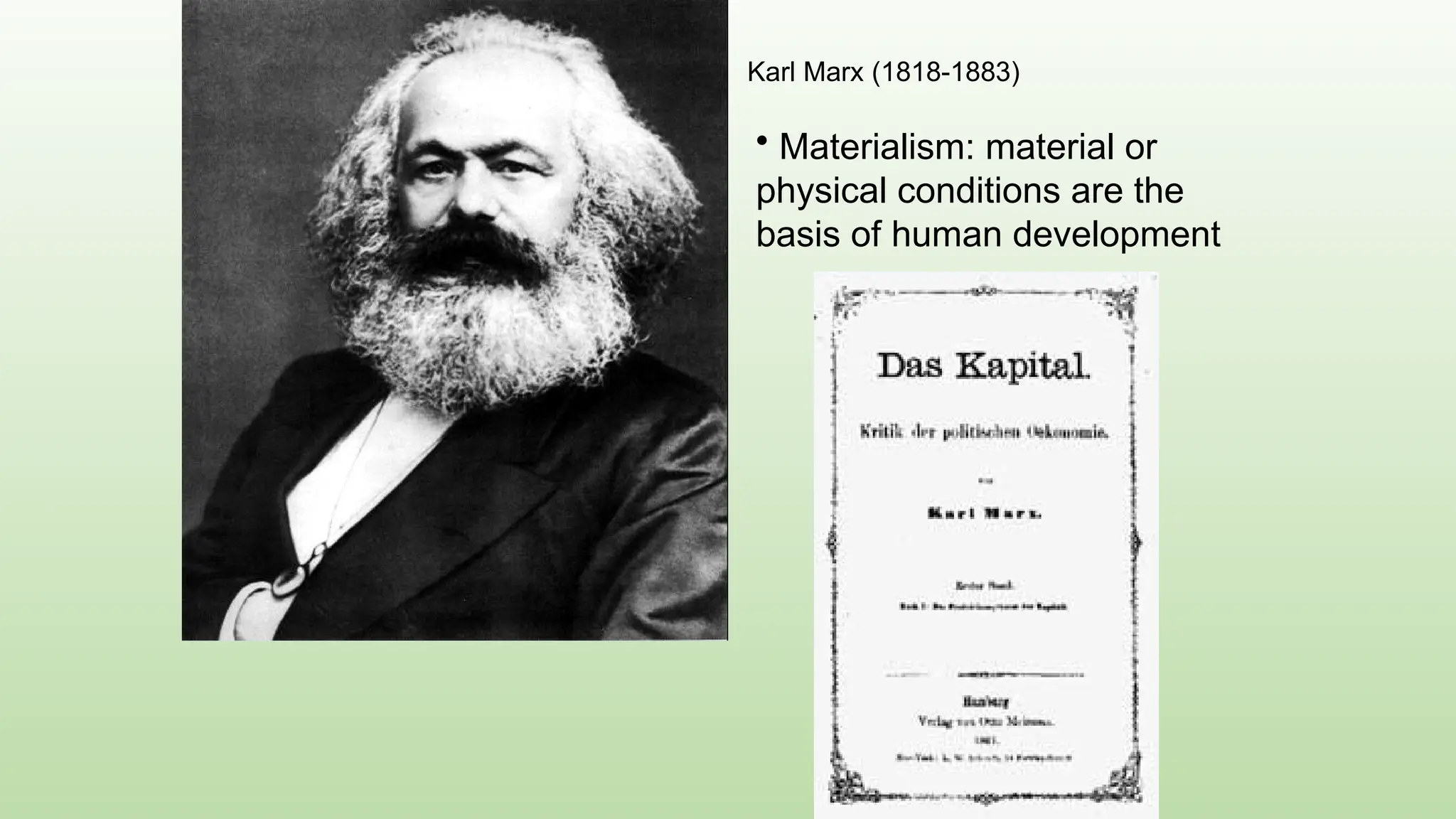
Karl Marx (1818-1883)
• Materialism: material or
physical conditions are the
basis of human development
The Analysis of Capitalist Society
• Limitless self-expansion of capital: at the base of capitalism as a social system.
Planetary scale of expansion.
• Sharp tension between ‘socialized’ forms of labour and ‘private’ appropriation of
wealth by capital – inequality in an age of abundance. Distinctive character of
capitalism: ‘formal’ freedom and equality masks profound forms of social power and
domination.
• Growing class consciousness, organization of both bourgeoisie and proletariat –
would produce what Marx hoped would be a decisive social struggle paving the way
for socialism, and overcoming human alienation.
• Necessity of social and political revolution based on working-class self-organization.
• Vagueness of proposals for the socialist and communist future (classless, stateless
society).
Owners and workers
• Owners exploit workers
• Workers are oppressed wage slaves
• Workers are indoctrinated by capitalist ideology and religion (false consciousness)
• ‘The worker becomes all the poorer the more wealth he produces, the more his
production increases in power and range.’ (Marx)
• ‘Of all the classes that stand face to face with the bourgeoisie today, the
proletariat alone is a really revolutionary class. The other classes decay and finally
disappear in the face of modern industry; the proletariat is its special and
essential product.’ (Communist Manifesto)
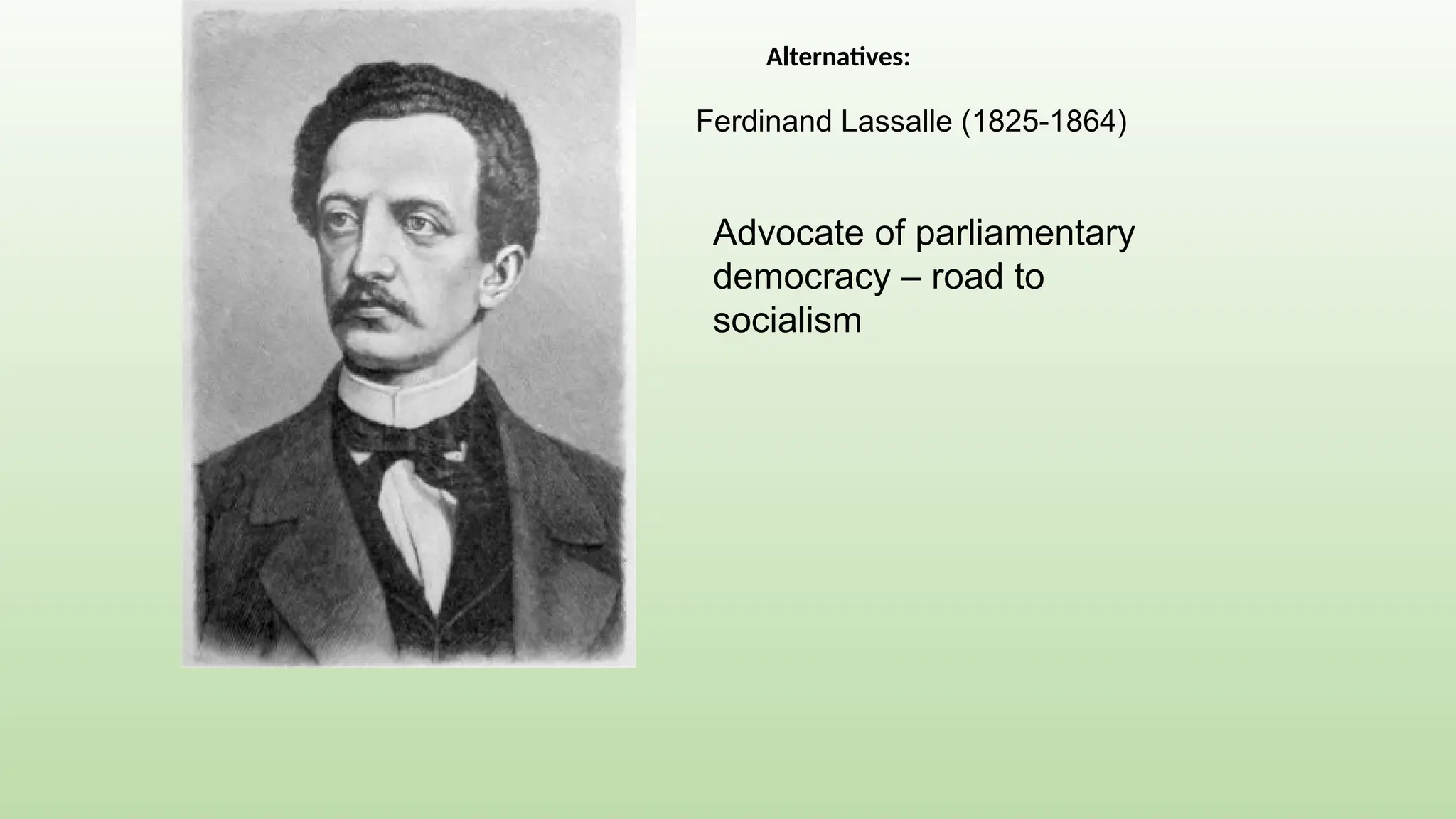
Ferdinand Lassalle (1825-1864)
Advocate of parliamentary
democracy – road to
socialism
Alternatives:
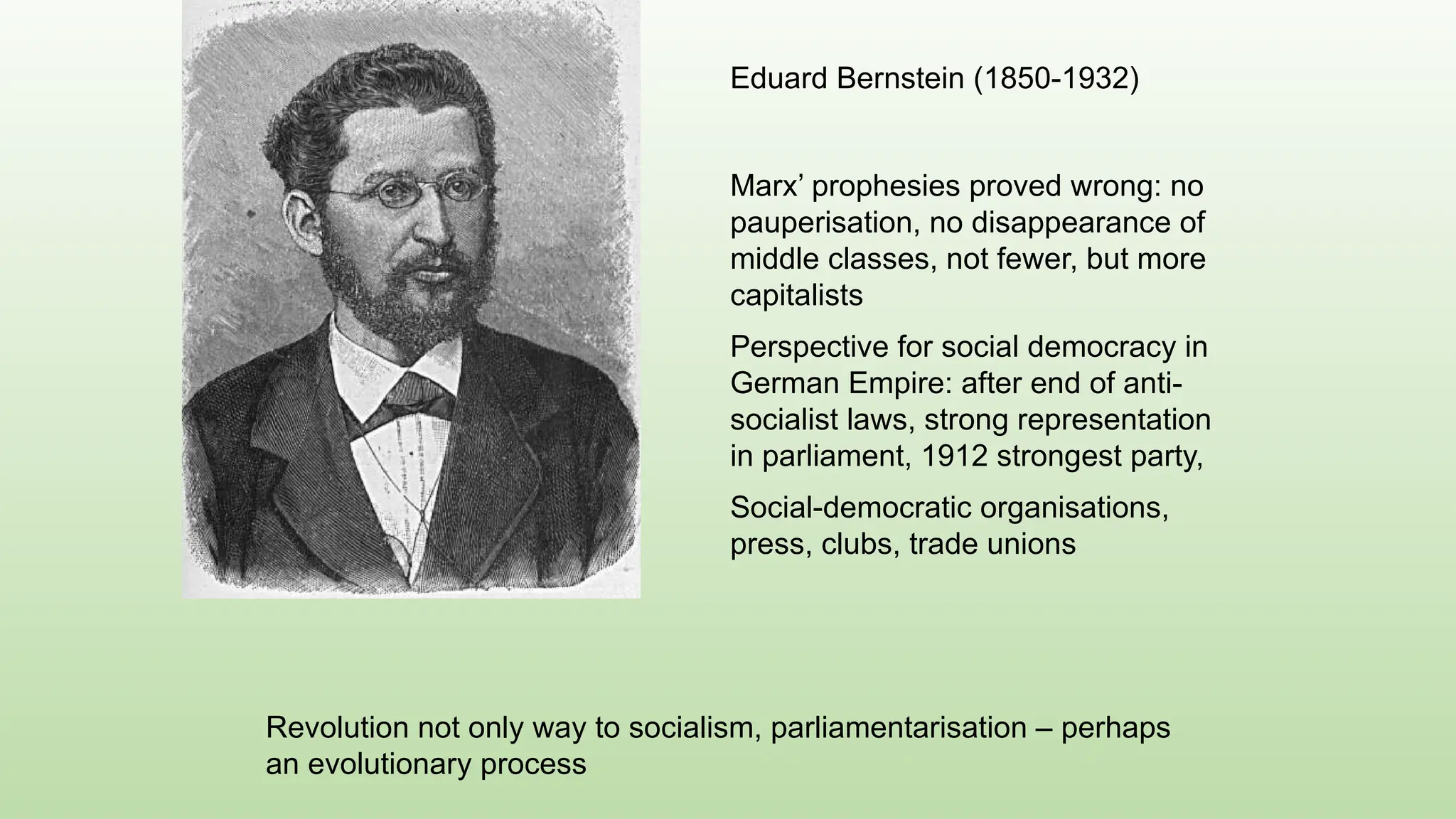
Eduard Bernstein (1850-1932)
Marx’ prophesies proved wrong: no
pauperisation, no disappearance of
middle classes, not fewer, but more
capitalists
Perspective for social democracy in
German Empire: after end of anti-
socialist laws, strong representation
in parliament, 1912 strongest party,
Social-democratic organisations,
press, clubs, trade unions
Revolution not only way to socialism, parliamentarisation – perhaps
an evolutionary process
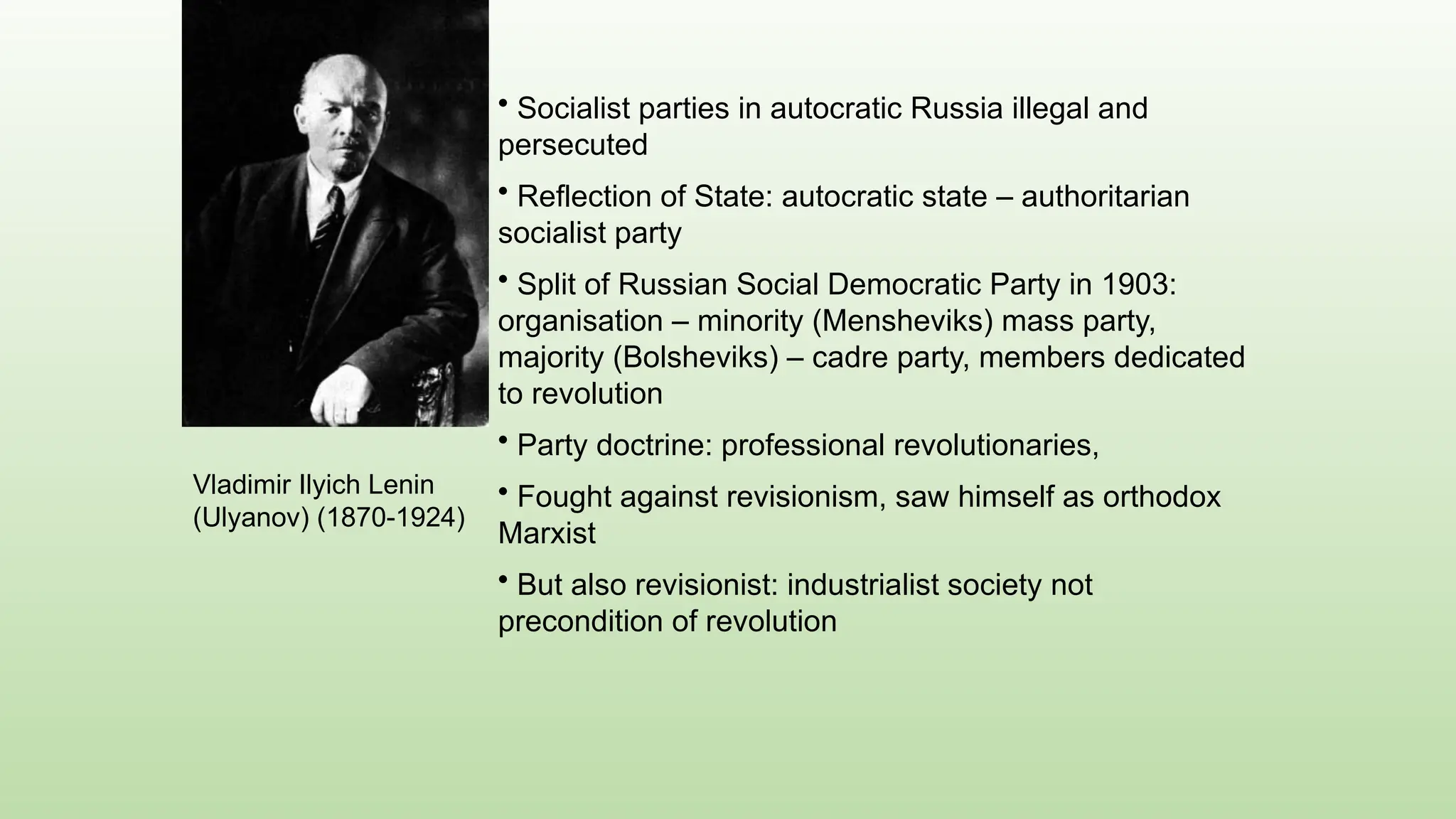
Vladimir Ilyich Lenin
(Ulyanov) (1870-1924)
• Socialist parties in autocratic Russia illegal and
persecuted
• Reflection of State: autocratic state – authoritarian
socialist party
• Split of Russian Social Democratic Party in 1903:
organisation – minority (Mensheviks) mass party,
majority (Bolsheviks) – cadre party, members dedicated
to revolution
• Party doctrine: professional revolutionaries,
• Fought against revisionism, saw himself as orthodox
Marxist
• But also revisionist: industrialist society not
precondition of revolution
Theory of Imperialism (Hobson, Luxemburg,
Hilferding and Lenin) and Marxism-Leninism
- limits to capital accumulation (the national
economy as a constraint)
- need for new overseas markets (cheap labour
and cheap raw materials)
- the corrupted ‘working class aristocracy’ in the
middle – complicit – revisionist Social democrats
- exploited workers and peasant in the colonies
Further Marxist Legacies
• Stalinist ‘distortions’ of Marxism
• Heterodox Marxists who contested notions of economic determinism and
historical inevitability: eg. Antonio Gramsci, Walter Benjamin, and many
others
• Hobsbawm
• Reading ‘history against the grain’/ ‘history from below’.
Morton/Hill/Thompson.
• Raphael Samuel: history as ‘the playground of the Communist
unconscious’.
• Tension between ‘mechanical’ and ‘creative’ interpretations of Marxism.
• Marxist theorist
• Imprisoned under Mussolini
• Prison Notebooks (1927-1935)
• Builds on Marx’s superstructure
• Cultural Hegemony
• The way the state creates ideological shackles to maintain its power and the dominance
of bourgeois-capitalist relations
• Accepts state/civil society distinction but sees coercion and manipulation in both
• Bourgeois regimes manufacture ‘consent’
• Marxists taking the cultural-historical turn in 1970s and 1980s will borrow from
Gramsci
Antonio Gramsci (1891-1937)
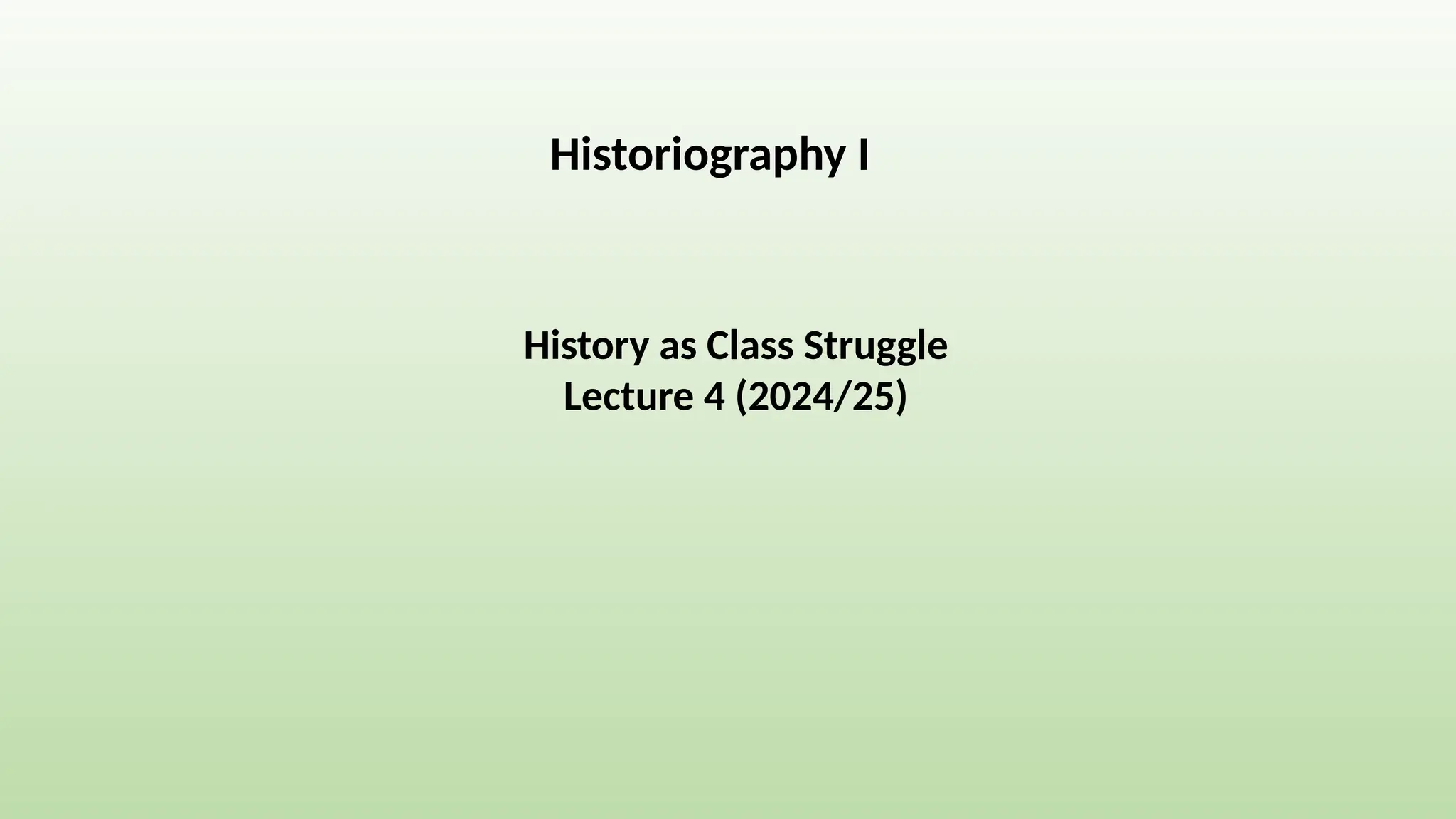
Highgate Cemetery,
London

Crafting-a-Winning-Research-Proposal.pdf

  • 1.
    History as ClassStruggle Lecture 4 (2024/25) Historiography I
  • 2.
    • 1818-35: childhoodand early youth in a liberal bourgeois family in Trier. Exposed to Enlightenment, Romantic, liberal and radical world-views through family and acquaintances. • 1835-36: University of Bonn. Heavy drinking, gambling, etc. – father intervenes to move him to Berlin. • 1836-42: University of Berlin. Develops wide range of intellectual interests: jurisprudence, history, and especially philosophy. Involved in ‘Left-Hegelian’ circles. • 1842-49: Cologne, Paris, Brussels, Paris, Cologne, Paris. Years of revolution and counter-revolution: for Marx, constant political exile and flight. Years of intense political agitation, radical political journalism (heavily censored). Marx begins studying political economy. Develops lifelong friendship with Friedrich Engels (son of wealthy manufacturer). • 1849-1883: London. Marx’s Life
  • 3.
    • Romanticism • IndustrialRevolution – Creation of Proletariat • Alienated from their work and thus themselves • Democratic Revolutions (1789, 1830, 1848) Further Context
  • 4.
    Influences • Significant influenceof Enlightenment histories with their ‘stadial’ view of historical progression (Ferguson etc.) – though with a twist • English and Scottish political economy • Adam Smith (1723-1790) • David Ricardo (1772-1823) • Utopian Socialism • Henri de Saint-Simon (1760-1825) • Charles Fourier (1772-1837) • Robert Owen (1771-1858) • German idealism: • Immanuel Kant (1724-1804) • Johann Gottlieb Fichte (1762-1814) • Friedrich Wilhelm Joseph Schelling (1765-1854) • Georg Wilhelm Friedrich Hegel (1770-1831)
  • 5.
    1 Among the‘Left’ Hegelians in Germany: In early phase, Marx is still philosophical and metaphysical: He assumes man’s creative ‘potential’ and sees history as the the gradual realization of it. 2 Like Hegel: History as dialectic (tension) between ‘real’ and ‘rational’. This friction propels consciousness forward. 3 Hegel’s Endpoint  full consciousness, at one with Absolute Spirit and the state. Man is reconciled with himself, society and nature. History driven by ‘ideas’. Starting point: Inversion of Hegelian dialectics
  • 6.
    “My dialectic methodis not only different from the Hegelian, but is its direct opposite. To Hegel, the life- process of the human brain, i.e., the process of thinking, which, under the name of 'the Idea,' he even transforms into an independent subject, is the demiurgos of the real world, and the real world is only the external, phenomenal form of 'the Idea.' With me, on the contrary, the ideal is nothing else than the material world reflected by the human mind, and translated into forms of thought.” Karl Marx Dialectics (very simple definition): develop in three steps: Thesis – Antithesis – Synthesis (new quality)
  • 7.
    Dialectical and HistoricalMaterialism • Dialectical Materialism • Materialist ‘inversion’ of Hegelian dialectics: ‘standing Hegel the right way up’ – Dialectical Method lasting influence • Critic of Capitalism • Forces of production/relations of production = modes of production • Historical materialism • Existence determines Consciousness (Das Sein bestimmt das Bewußtsein) – Thought is a product of material reality • History driven by ‘material forces’ and as a series of class struggles • History driven by technological innovations, which alter ‘productive forces’, creating a struggle to redefine the social relations surrounding them
  • 8.
  • 9.
    • From theproduct, which as soon as it is created, is taken away from its producer. • From his productive activity (work), which is experienced as a torment – division of labour reduces him to small cog in production process. • From his species-being (Gattungswesen – human nature), for humans produce blindly and not in accordance with their truly human powers. • From other human beings, as the cash nexus replaces mutual need Key concepts: Alienation
  • 10.
    Superstructure: Ideas, values, beliefs,laws The state Relations of Production Property relations, relations to objects of work, organisation of production Forces of Production: Material resources, technology
  • 11.
    Primitive Communism Hunter-gatherer societies SlaveholderSociety Slaveholders against Slaves Feudalism Feudal lords against Peasants Capitalism Bourgeoisie against Proletariat SOCIALIST REVOLUTION Expropriation of Expropriators Socialism Dictatorship of the Proletariat Communism Classless society
  • 12.
    All previous historical movementswere movements of minorities, or in the interest of minorities. The proletariat movement is the self- conscious, independent movement of the immense majority, in the interest of the immense majority Marxism - an activist ideology: The philosophers have only interpreted the world in various ways; the point, however, is to change it. Die Philosophen haben die Welt nur verschieden interpretiert, es kommt darauf an, sie zu verändern. 11th thesis on Feuerbach
  • 13.
    Communist Manifesto (Marx/Engels) 1848 •Bestselling book by Penguin Books in 2015 • Next to Bible, most influential text in history • Profit = exploitation • Need for working class consciousness • ‘Workers of the world, unite!’ • Revolution as key to historical change
  • 14.
    The immediate aimof the Communists is the same as that of all other proletarian parties: formation of the proletariat into a class, overthrow of the bourgeois supremacy, conquest of political power by the proletariat. (Communist Manifesto)
  • 15.
    Karl Marx (1818-1883) •Materialism: material or physical conditions are the basis of human development
  • 16.
    The Analysis ofCapitalist Society • Limitless self-expansion of capital: at the base of capitalism as a social system. Planetary scale of expansion. • Sharp tension between ‘socialized’ forms of labour and ‘private’ appropriation of wealth by capital – inequality in an age of abundance. Distinctive character of capitalism: ‘formal’ freedom and equality masks profound forms of social power and domination. • Growing class consciousness, organization of both bourgeoisie and proletariat – would produce what Marx hoped would be a decisive social struggle paving the way for socialism, and overcoming human alienation. • Necessity of social and political revolution based on working-class self-organization. • Vagueness of proposals for the socialist and communist future (classless, stateless society).
  • 17.
    Owners and workers •Owners exploit workers • Workers are oppressed wage slaves • Workers are indoctrinated by capitalist ideology and religion (false consciousness) • ‘The worker becomes all the poorer the more wealth he produces, the more his production increases in power and range.’ (Marx) • ‘Of all the classes that stand face to face with the bourgeoisie today, the proletariat alone is a really revolutionary class. The other classes decay and finally disappear in the face of modern industry; the proletariat is its special and essential product.’ (Communist Manifesto)
  • 18.
    Ferdinand Lassalle (1825-1864) Advocateof parliamentary democracy – road to socialism Alternatives:
  • 19.
    Eduard Bernstein (1850-1932) Marx’prophesies proved wrong: no pauperisation, no disappearance of middle classes, not fewer, but more capitalists Perspective for social democracy in German Empire: after end of anti- socialist laws, strong representation in parliament, 1912 strongest party, Social-democratic organisations, press, clubs, trade unions Revolution not only way to socialism, parliamentarisation – perhaps an evolutionary process
  • 20.
    Vladimir Ilyich Lenin (Ulyanov)(1870-1924) • Socialist parties in autocratic Russia illegal and persecuted • Reflection of State: autocratic state – authoritarian socialist party • Split of Russian Social Democratic Party in 1903: organisation – minority (Mensheviks) mass party, majority (Bolsheviks) – cadre party, members dedicated to revolution • Party doctrine: professional revolutionaries, • Fought against revisionism, saw himself as orthodox Marxist • But also revisionist: industrialist society not precondition of revolution
  • 21.
    Theory of Imperialism(Hobson, Luxemburg, Hilferding and Lenin) and Marxism-Leninism - limits to capital accumulation (the national economy as a constraint) - need for new overseas markets (cheap labour and cheap raw materials) - the corrupted ‘working class aristocracy’ in the middle – complicit – revisionist Social democrats - exploited workers and peasant in the colonies
  • 22.
    Further Marxist Legacies •Stalinist ‘distortions’ of Marxism • Heterodox Marxists who contested notions of economic determinism and historical inevitability: eg. Antonio Gramsci, Walter Benjamin, and many others • Hobsbawm • Reading ‘history against the grain’/ ‘history from below’. Morton/Hill/Thompson. • Raphael Samuel: history as ‘the playground of the Communist unconscious’. • Tension between ‘mechanical’ and ‘creative’ interpretations of Marxism.
  • 23.
    • Marxist theorist •Imprisoned under Mussolini • Prison Notebooks (1927-1935) • Builds on Marx’s superstructure • Cultural Hegemony • The way the state creates ideological shackles to maintain its power and the dominance of bourgeois-capitalist relations • Accepts state/civil society distinction but sees coercion and manipulation in both • Bourgeois regimes manufacture ‘consent’ • Marxists taking the cultural-historical turn in 1970s and 1980s will borrow from Gramsci Antonio Gramsci (1891-1937)
  • 24.