Chapter 4: Advanced SQL Database System Concepts, 5th Ed . ŠSilberschatz, Korth and Sudarshan See  www.db-book.com  for conditions on re-use
Chapter 4: Advanced SQL SQL Data Types and Schemas Integrity Constraints  Authorization Embedded SQL Dynamic SQL Functions and Procedural Constructs** Recursive Queries** Advanced SQL Features** 4.2 Database System Concepts, 5 th  Ed., July 2005
Built-in Data Types in SQL  date:  Dates, containing a (4 digit) year, month and date Example:  date  ‘2005-7-27’ time:   Time of day, in hours, minutes and seconds. Example:  time  ‘09:00:30’  time  ‘09:00:30.75’ timestamp : date plus time of day Example:  timestamp  ‘2005-7-27 09:00:30.75’ interval:  period of time Example: interval ‘1’ day Subtracting a date/time/timestamp value from another gives an interval value Interval values can be added to date/time/timestamp values 4.3 Database System Concepts, 5 th  Ed., July 2005
Build-in Data Types in SQL (Cont.) Can extract values of individual fields from date/time/timestamp Example:  extract  ( year from  r.starttime)  Can cast string types to date/time/timestamp  Example:  cast  <string-valued-expression>  as date Example:  cast  <string-valued-expression>  as time 4.4 Database System Concepts, 5 th  Ed., July 2005
User-Defined Types create type  construct in SQL creates user-defined type create type  Dollars  as numeric (12,2) final  create domain  construct in SQL-92 creates user-defined domain types create domain  person_name  char (20)  not null Types and domains are similar. Domains can have constraints, such as  not null , specified on them. 4.5 Database System Concepts, 5 th  Ed., July 2005
Domain Constraints Domain constraints  are the most elementary form of integrity constraint. They test values inserted in the database, and test queries to ensure that the comparisons make sense.  New domains can be created from existing data types Example:  create domain   Dollars   numeric (12, 2) create domain   Pounds   numeric (12,2) We cannot assign or compare a value of type Dollars to a value of type Pounds.  However, we can convert type as below ( cast   r . A   as   Pounds )  (Should also multiply by the dollar-to-pound conversion-rate) 4.6 Database System Concepts, 5 th  Ed., July 2005
Large-Object Types Large objects (photos, videos, CAD files, etc.) are stored as a  large object : blob : binary large object -- object is a large collection of uninterpreted binary data (whose interpretation is left to an application outside of the database system) clob : character large object -- object is a large collection of character data When a query returns a large object, a pointer is returned rather than the large object itself. 4.7 Database System Concepts, 5 th  Ed., July 2005
Integrity Constraints Integrity constraints guard against accidental damage to the database, by ensuring that authorized changes to the database do not result in a loss of data consistency.  A checking account must have a balance greater than $10,000.00 A salary of a bank employee must be at least $4.00 an hour A customer must have a (non-null) phone number 4.8 Database System Concepts, 5 th  Ed., July 2005
Constraints on a Single Relation  not null primary key unique check  ( P  ) ,  where  P  is a predicate 4.9 Database System Concepts, 5 th  Ed., July 2005
Not Null Constraint  Declare  branch_name  for  branch  is   not null   branch_name  char (15)  not null Declare the domain  Dollars  to be   not null   create domain  Dollars  numeric (12,2)   not null 4.10 Database System Concepts, 5 th  Ed., July 2005
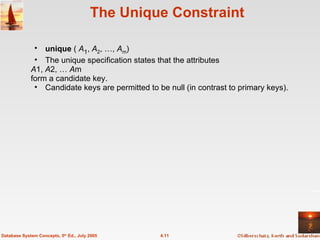
The Unique Constraint unique  (  A 1 ,  A 2 , …,  A m ) The unique specification states that the attributes A 1,  A 2, …  A m form a candidate key. Candidate keys are permitted to be null (in contrast to primary keys). 4.11 Database System Concepts, 5 th  Ed., July 2005
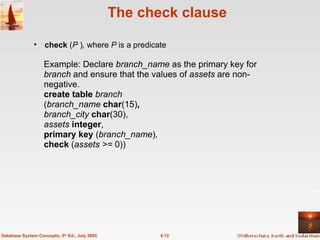
The check clause check  ( P  ) ,  where  P  is a predicate 4.12 Database System Concepts, 5 th  Ed., July 2005 Example: Declare  branch_name  as the primary key for  branch  and ensure that the values of  assets  are non-negative. create table  branch ( branch_name  char (15) , branch_city  char (30), assets  integer , primary key  ( branch_name ) , check  ( assets >=  0))
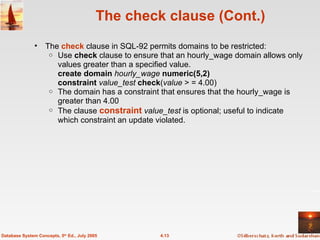
The check clause (Cont.) The  check   clause in SQL-92 permits domains to be restricted: Use  check  clause to ensure that an hourly_wage domain allows only values greater than a specified value. create domain  hourly_wage  numeric(5,2) constraint   value_test  check ( value  > = 4.00) The domain has a constraint that ensures that the hourly_wage is greater than 4.00 The clause  constraint   value_test  is optional; useful to indicate which constraint an update violated. 4.13 Database System Concepts, 5 th  Ed., July 2005
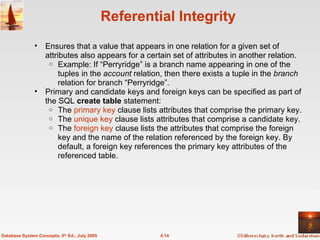
Referential Integrity Ensures that a value that appears in one relation for a given set of attributes also appears for a certain set of attributes in another relation. Example: If “Perryridge” is a branch name appearing in one of the tuples in the  account  relation, then there exists a tuple in the  branch  relation for branch “Perryridge”. Primary and candidate keys and foreign keys can be specified as part of the SQL  create table  statement: The  primary key  clause lists attributes that comprise the primary key. The  unique key  clause lists attributes that comprise a candidate key. The  foreign key  clause lists the attributes that comprise the foreign key and the name of the relation referenced by the foreign key. By default, a foreign key references the primary key attributes of the referenced table. 4.14 Database System Concepts, 5 th  Ed., July 2005
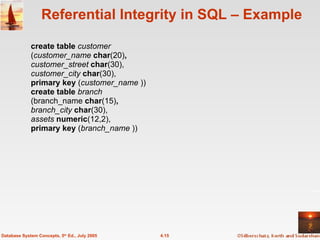
Referential Integrity in SQL – Example create table  customer ( customer_name  char (20) , customer_street  char (30), customer_city  char (30), primary key  ( customer_name  )) create table  branch (branch_name  char (15) , branch_city  char (30), assets  numeric (12,2), primary key   ( branch_name  )) 4.15 Database System Concepts, 5 th  Ed., July 2005
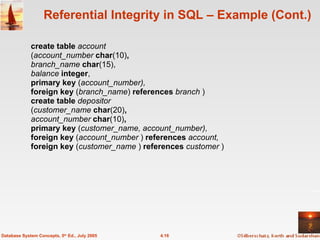
Referential Integrity in SQL – Example (Cont.) create table  account ( account_number  char (10) , branch_name  char (15), balance  integer , primary key  ( account_number),  foreign key  ( branch_name )   references  branch  ) create table  depositor ( customer_name   char (20) , account_number  char (10) , primary key   ( customer_name, account_number), foreign key   ( account_number  )  references  account, foreign key   ( customer_name  )   references  customer  ) 4.16 Database System Concepts, 5 th  Ed., July 2005
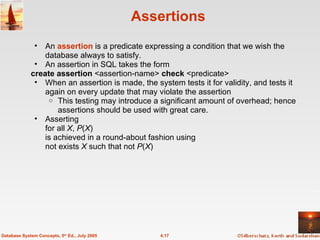
Assertions An  assertion   is a predicate expressing a condition that we wish the database always to satisfy. An assertion in SQL takes the form create assertion  <assertion-name>  check  <predicate> When an assertion is made, the system tests it for validity, and tests it again on every update that may violate the assertion This testing may introduce a significant amount of overhead; hence assertions should be used with great care. Asserting  for all  X ,  P ( X )  is achieved in a round-about fashion using  not exists  X  such that not  P ( X ) 4.17 Database System Concepts, 5 th  Ed., July 2005
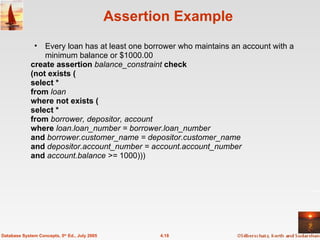
Assertion Example Every loan has at least one borrower who maintains an account with a minimum balance or $1000.00 create assertion  balance_constraint  check (not exists ( select *  from  loan where not exists (  select * from  borrower, depositor, account where  loan.loan_number = borrower.loan_number and  borrower.customer_name = depositor.customer_name and  depositor.account_number = account.account_number and  account.balance >=  1000))) 4.18 Database System Concepts, 5 th  Ed., July 2005
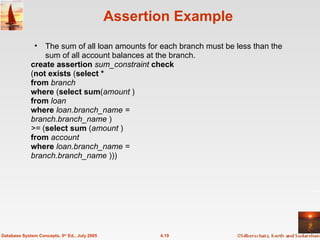
Assertion Example The sum of all loan amounts for each branch must be less than the sum of all account balances at the branch. create assertion  sum_constraint  check ( not exists  ( select *  from  branch where  ( select sum ( amount  ) from  loan where  loan.branch_name =  branch.branch_name  ) >=  ( select sum  ( amount  )   from  account where  loan.branch_name =  branch.branch_name  ))) 4.19 Database System Concepts, 5 th  Ed., July 2005
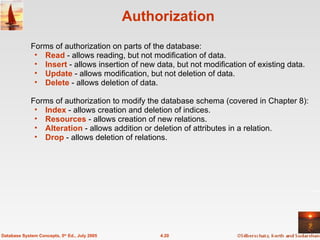
Authorization Forms of authorization on parts of the database: Read  - allows reading, but not modification of data. Insert  - allows insertion of new data, but not modification of existing data. Update  - allows modification, but not deletion of data. Delete  - allows deletion of data. Forms of authorization to modify the database schema (covered in Chapter 8): Index  - allows creation and deletion of indices. Resources  - allows creation of new relations. Alteration  - allows addition or deletion of attributes in a relation. Drop  - allows deletion of relations. 4.20 Database System Concepts, 5 th  Ed., July 2005
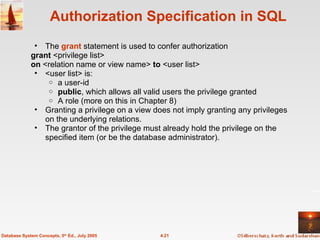
Authorization Specification in SQL The  grant  statement is used to confer authorization grant  <privilege list> on  <relation name or view name>  to  <user list> <user list> is: a user-id public , which allows all valid users the privilege granted A role (more on this in Chapter 8) Granting a privilege on a view does not imply granting any privileges on the underlying relations. The grantor of the privilege must already hold the privilege on the specified item (or be the database administrator). 4.21 Database System Concepts, 5 th  Ed., July 2005
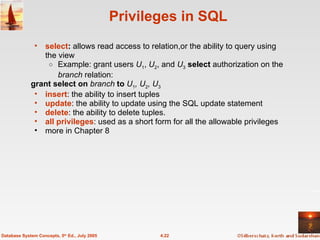
Privileges in SQL select :  allows read access to relation,or the ability to query using the view Example: grant users  U 1 ,  U 2 , and  U 3   select  authorization on the  branch  relation: grant select on  branch  to  U 1 , U 2 , U 3 insert : the ability to insert tuples update : the ability to update using the SQL update statement delete : the ability to delete tuples. all privileges : used as a short form for all the allowable privileges more in Chapter 8 4.22 Database System Concepts, 5 th  Ed., July 2005
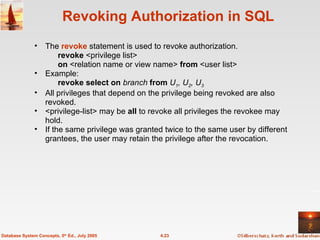
Revoking Authorization in SQL The  revoke   statement is used to revoke authorization. revoke  <privilege list> on  <relation name or view name>  from  <user list> Example: revoke select on  branch  from  U 1 , U 2 , U 3 All privileges that depend on the privilege being revoked are also revoked. <privilege-list> may be  all  to revoke all privileges the revokee may hold. If the same privilege was granted twice to the same user by different grantees, the user may retain the privilege after the revocation. 4.23 Database System Concepts, 5 th  Ed., July 2005
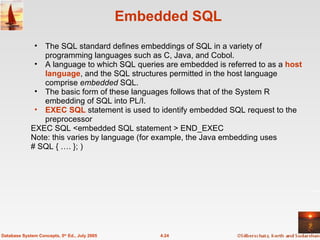
Embedded SQL The SQL standard defines embeddings of SQL in a variety of programming languages such as C, Java, and Cobol. A language to which SQL queries are embedded is referred to as a  host language , and the SQL structures permitted in the host language comprise  embedded  SQL. The basic form of these languages follows that of the System R embedding of SQL into PL/I. EXEC SQL  statement is used to identify embedded SQL request to the preprocessor EXEC SQL <embedded SQL statement > END_EXEC Note: this varies by language (for example, the Java embedding uses # SQL { …. }; )  4.24 Database System Concepts, 5 th  Ed., July 2005
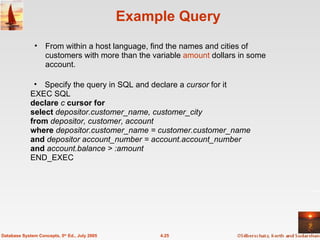
Example Query Specify the query in SQL and declare a  cursor  for it EXEC SQL declare  c  cursor for  select  depositor.customer_name, customer_city from  depositor, customer, account where  depositor.customer_name = customer.customer_name  and  depositor account_number = account.account_number and  account.balance > :amount END_EXEC 4.25 Database System Concepts, 5 th  Ed., July 2005 From within a host language, find the names and cities of customers with more than the variable  amount  dollars in some account.
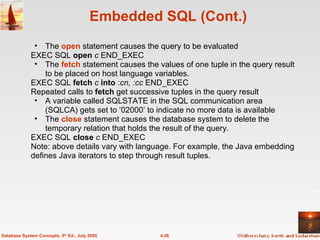
Embedded SQL (Cont.) The  open  statement causes the query to be evaluated EXEC SQL  open   c   END_EXEC The  fetch   statement causes the values of one tuple in the query result to be placed on host language variables. EXEC SQL  fetch  c  into  : cn, :cc  END_EXEC Repeated calls to  fetch  get successive tuples in the query result A variable called SQLSTATE in the SQL communication area (SQLCA) gets set to ‘02000’ to indicate no more data is available The  close  statement causes the database system to delete the temporary relation that holds the result of the query. EXEC SQL  close   c  END_EXEC Note: above details vary with language. For example, the Java embedding defines Java iterators to step through result tuples. 4.26 Database System Concepts, 5 th  Ed., July 2005
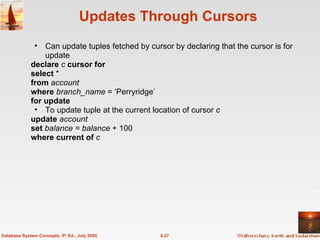
Updates Through Cursors 4.27 Database System Concepts, 5 th  Ed., July 2005 Can update tuples fetched by cursor by declaring that the cursor is for update declare  c  cursor for select  * from  account where   branch_name  = ‘Perryridge’ for update To update tuple at the current location of cursor  c update  account set   balance = balance  + 100 where current of  c
Dynamic SQL Allows programs to construct and submit SQL queries at run time. Example of the use of dynamic SQL from within a C program. char *  sqlprog = “ update  account  set  balance = balance *  1.05 where  account_number = ?” EXEC SQL  prepare  dynprog  from  :sqlprog; char  account  [10] = “A-101”; EXEC SQL  execute  dynprog  using  :account; The dynamic SQL program contains a ?, which is a place holder for a value that is provided when the SQL program is executed. 4.28 Database System Concepts, 5 th  Ed., July 2005
ODBC and JDBC API (application-program interface) for a program to interact with a database server Application makes calls to Connect with the database server Send SQL commands to the database server Fetch tuples of result one-by-one into program variables ODBC (Open Database Connectivity) works with C, C++, C#, and Visual Basic JDBC (Java Database Connectivity) works with Java 4.29 Database System Concepts, 5 th  Ed., July 2005
ODBC Open DataBase Connectivity(ODBC) standard  standard for application program to communicate with a database server. application program interface (API) to  open a connection with a database,  send queries and updates,  get back results. Applications such as GUI, spreadsheets, etc. can use ODBC 4.30 Database System Concepts, 5 th  Ed., July 2005
ODBC (Cont.) Each database system supporting ODBC provides a &quot;driver&quot; library that must be linked with the client program. When client program makes an ODBC API call, the code in the library communicates with the server to carry out the requested action, and fetch results. ODBC program first allocates an SQL environment, then a database connection handle. Opens database connection using SQLConnect(). Parameters for SQLConnect: connection handle, the server to which to connect the user identifier,  password  Must also specify types of arguments: SQL_NTS denotes previous argument is a null-terminated string. 4.31 Database System Concepts, 5 th  Ed., July 2005
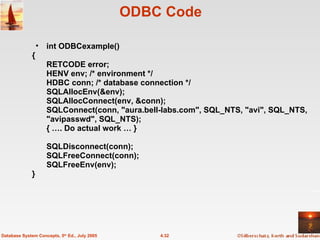
ODBC Code int ODBCexample() { RETCODE error; HENV env; /* environment */  HDBC conn; /* database connection */  SQLAllocEnv(&env); SQLAllocConnect(env, &conn); SQLConnect(conn, &quot;aura.bell-labs.com&quot;, SQL_NTS, &quot;avi&quot;, SQL_NTS, &quot;avipasswd&quot;, SQL_NTS);  { …. Do actual work … } SQLDisconnect(conn);  SQLFreeConnect(conn);  SQLFreeEnv(env);  } 4.32 Database System Concepts, 5 th  Ed., July 2005
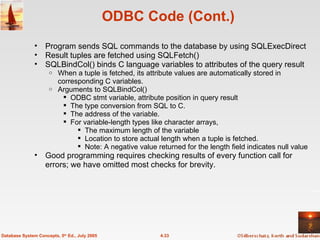
ODBC Code (Cont.) Program sends SQL commands to the database by using SQLExecDirect Result tuples are fetched using SQLFetch() SQLBindCol() binds C language variables to attributes of the query result   When a tuple is fetched, its attribute values are automatically stored in corresponding C variables. Arguments to SQLBindCol() ODBC stmt variable, attribute position in query result The type conversion from SQL to C.  The address of the variable.  For variable-length types like character arrays,  The maximum length of the variable  Location to store actual length when a tuple is fetched. Note: A negative value returned for the length field indicates null value Good programming requires checking results of every function call for errors; we have omitted most checks for brevity. 4.33 Database System Concepts, 5 th  Ed., July 2005
ODBC Code (Cont.) Main body of program char branchname[80]; float balance; int lenOut1, lenOut2; HSTMT stmt;  SQLAllocStmt(conn, &stmt); char * sqlquery = &quot;select branch_name, sum (balance)  from account group by branch_name&quot;; error = SQLExecDirect(stmt, sqlquery, SQL_NTS); if (error == SQL_SUCCESS) { SQLBindCol(stmt, 1, SQL_C_CHAR, branchname , 80, &lenOut1); SQLBindCol(stmt, 2, SQL_C_FLOAT, &balance, 0 , &lenOut2); while (SQLFetch(stmt) >= SQL_SUCCESS) { printf (&quot; %s %g\n&quot;, branchname, balance); } } SQLFreeStmt(stmt, SQL_DROP);  4.34 Database System Concepts, 5 th  Ed., July 2005
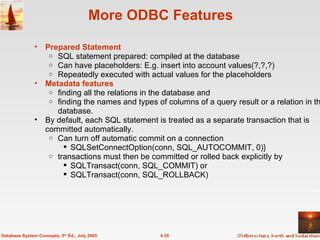
More ODBC Features Prepared Statement SQL statement prepared: compiled at the database Can have placeholders: E.g. insert into account values(?,?,?) Repeatedly executed with actual values for the placeholders Metadata features finding all the relations in the database and finding the names and types of columns of a query result or a relation in the database. By default, each SQL statement is treated as a separate transaction that is committed automatically. Can turn off automatic commit on a connection SQLSetConnectOption(conn, SQL_AUTOCOMMIT, 0)}  transactions must then be committed or rolled back explicitly by  SQLTransact(conn, SQL_COMMIT) or SQLTransact(conn, SQL_ROLLBACK) 4.35 Database System Concepts, 5 th  Ed., July 2005
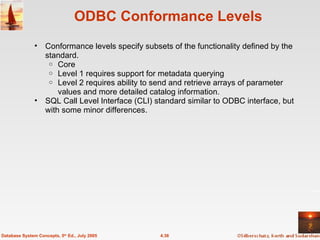
ODBC Conformance Levels Conformance levels specify subsets of the functionality defined by the standard. Core Level 1 requires support for metadata querying Level 2 requires ability to send and retrieve arrays of parameter values and more detailed catalog information. SQL Call Level Interface (CLI) standard similar to ODBC interface, but with some minor differences. 4.36 Database System Concepts, 5 th  Ed., July 2005
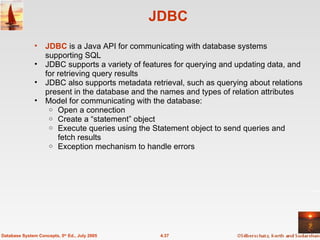
JDBC JDBC  is a Java API for communicating with database systems supporting SQL JDBC supports a variety of features for querying and updating data, and for retrieving query results JDBC also supports metadata retrieval, such as querying about relations present in the database and the names and types of relation attributes Model for communicating with the database: Open a connection Create a “statement” object Execute queries using the Statement object to send queries and fetch results Exception mechanism to handle errors 4.37 Database System Concepts, 5 th  Ed., July 2005
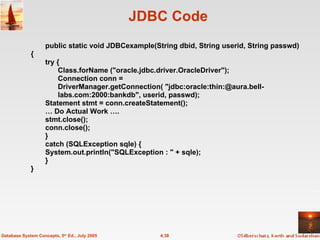
JDBC Code public static void JDBCexample(String dbid, String userid, String passwd)  {  try {  Class.forName (&quot;oracle.jdbc.driver.OracleDriver&quot;);  Connection conn = DriverManager.getConnection( &quot;jdbc:oracle:thin:@aura.bell-labs.com:2000:bankdb&quot;, userid, passwd);  Statement stmt = conn.createStatement();  …  Do Actual Work …. stmt.close();  conn.close();  }  catch (SQLException sqle) {  System.out.println(&quot;SQLException : &quot; + sqle);  }  } 4.38 Database System Concepts, 5 th  Ed., July 2005
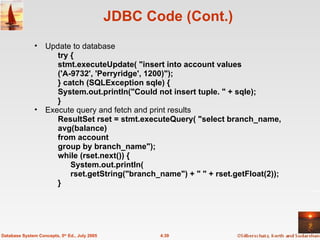
JDBC Code (Cont.) Update to database try {  stmt.executeUpdate( &quot;insert into account values ('A-9732', 'Perryridge', 1200)&quot;);  } catch (SQLException sqle) {  System.out.println(&quot;Could not insert tuple. &quot; + sqle); } Execute query and fetch and print results  ResultSet rset = stmt.executeQuery( &quot;select branch_name, avg(balance)  from account  group by branch_name&quot;); while (rset.next()) {  System.out.println( rset.getString(&quot;branch_name&quot;) + &quot; &quot; + rset.getFloat(2));  }  4.39 Database System Concepts, 5 th  Ed., July 2005
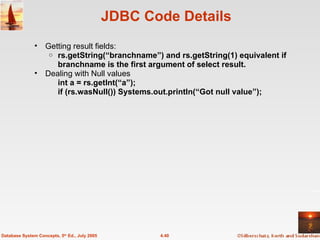
JDBC Code Details  Getting result fields: rs.getString(“branchname”) and rs.getString(1) equivalent if branchname is the first argument of select result. Dealing with Null values int a = rs.getInt(“a”); if (rs.wasNull()) Systems.out.println(“Got null value”); 4.40 Database System Concepts, 5 th  Ed., July 2005
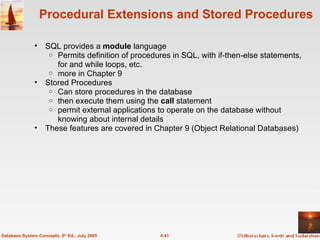
Procedural Extensions and Stored Procedures SQL provides a  module  language  Permits definition of procedures in SQL, with if-then-else statements, for and while loops, etc. more in Chapter 9 Stored Procedures Can store procedures in the database  then execute them using the  call  statement permit external applications to operate on the database without knowing about internal details These features are covered in Chapter 9 (Object Relational Databases) 4.41 Database System Concepts, 5 th  Ed., July 2005
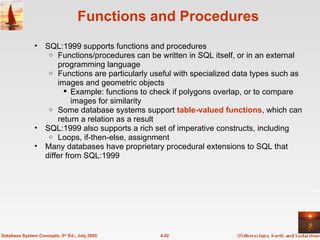
Functions and Procedures SQL:1999 supports functions and procedures Functions/procedures can be written in SQL itself, or in an external programming language Functions are particularly useful with specialized data types such as images and geometric objects Example: functions to check if polygons overlap, or to compare images for similarity Some database systems support  table-valued functions , which can return a relation as a result SQL:1999 also supports a rich set of imperative constructs, including Loops, if-then-else, assignment Many databases have proprietary procedural extensions to SQL that differ from SQL:1999 4.42 Database System Concepts, 5 th  Ed., July 2005
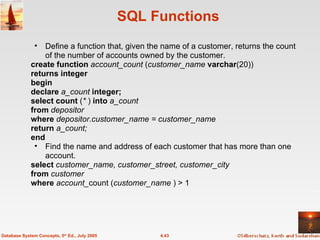
SQL Functions Define a function that, given the name of a customer, returns the count of the number of accounts owned by the customer. create function  account_count  ( customer_name  varchar (20)) returns integer begin declare  a_count  integer; select count  ( *  )  into  a_count from  depositor where  depositor.customer_name = customer_name return  a_count; end Find the name and address of each customer that has more than one account. select  customer_name, customer_street, customer_city from  customer where  account_ count ( customer_name  ) > 1 4.43 Database System Concepts, 5 th  Ed., July 2005
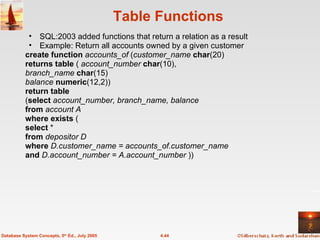
Table Functions SQL:2003 added functions that return a relation as a result Example: Return all accounts owned by a given customer create   function   accounts_of  ( customer_name   char (20) returns   table  (  account_number   char (10), branch_name   char (15) balance   numeric (12,2)) return   table ( select   account_number, branch_name, balance from   account A where   exists  ( select  * from   depositor D where   D.customer_name = accounts_of.customer_name and   D.account_number = A.account_number  )) 4.44 Database System Concepts, 5 th  Ed., July 2005
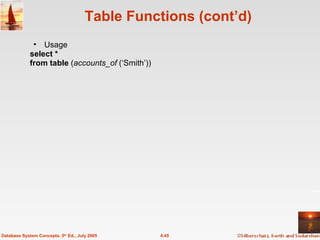
Table Functions (cont’d) Usage select * from table  ( accounts_of  (‘Smith’)) 4.45 Database System Concepts, 5 th  Ed., July 2005
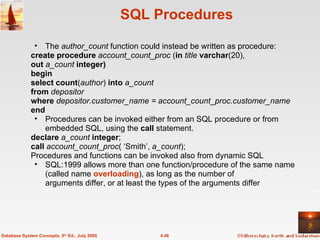
SQL Procedures The  author_count  function could instead be written as procedure: create procedure  account_count_proc  ( in  title  varchar (20),  out  a_count  integer) begin select count ( author )  into  a_count from  depositor where  depositor.customer_name = account_count_proc.customer_name end Procedures can be invoked either from an SQL procedure or from embedded SQL, using the  call  statement. declare  a_count  integer ; call  account_count_proc ( ‘Smith’,  a_count ); Procedures and functions can be invoked also from dynamic SQL SQL:1999 allows more than one function/procedure of the same name (called name  overloading ), as long as the number of  arguments differ, or at least the types of the arguments differ 4.46 Database System Concepts, 5 th  Ed., July 2005
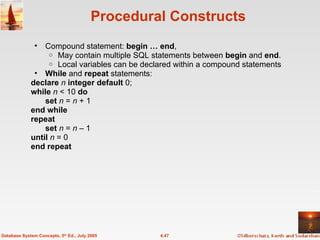
Procedural Constructs Compound statement:  begin … end ,  May contain multiple SQL statements between  begin  and  end . Local variables can be declared within a compound statements While  and  repeat  statements: declare  n  integer default  0; while  n  < 10  do set  n  =  n  + 1 end while repeat set  n  =  n  – 1 until  n  = 0 end repeat 4.47 Database System Concepts, 5 th  Ed., July 2005
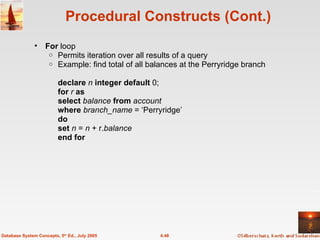
Procedural Constructs (Cont.) For  loop Permits iteration over all results of a query Example: find total of all balances at the Perryridge branch declare  n  integer default  0; for  r  as select  balance  from  account where  branch_name  = ‘Perryridge’ do set  n  =  n  + r. balance end for 4.48 Database System Concepts, 5 th  Ed., July 2005
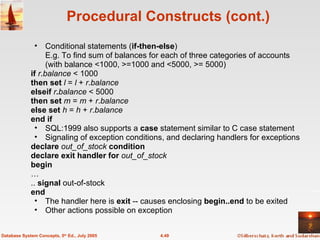
Procedural Constructs (cont.) Conditional statements ( if-then-else ) E.g. To find sum of balances for each of three categories of accounts (with balance <1000, >=1000 and <5000, >= 5000) if   r . balance  < 1000 then set  l  =  l  +  r . balance elseif  r . balance  < 5000 then set  m  =  m  +  r . balance else set  h  =  h  +  r . balance end if  SQL:1999 also supports a  case  statement similar to C case statement Signaling of exception conditions, and declaring handlers for exceptions declare  out_of_stock  condition declare exit handler for  out_of_stock begin … ..  signal  out-of-stock end The handler here is  exit  -- causes enclosing  begin..end  to be exited Other actions possible on exception 4.49 Database System Concepts, 5 th  Ed., July 2005
External Language Functions/Procedures SQL:1999 permits the use of functions and procedures written in other languages such as C or C++  Declaring external language procedures and functions create procedure  account_count_proc( in   customer_name  varchar (20), out  count  integer ) language  C external name  ’ /usr/avi/bin/account_count_proc’ create function  account_count( customer_name  varchar (20)) returns  integer language  C external name  ‘/usr/avi/bin/author_count’ 4.50 Database System Concepts, 5 th  Ed., July 2005
External Language Routines (Cont.) Benefits of external language functions/procedures:  more efficient for many operations, and more expressive power Drawbacks Code to implement function may need to be loaded into database system and executed in the database system’s address space risk of accidental corruption of database structures security risk, allowing users access to unauthorized data There are alternatives, which give good security at the cost of potentially worse performance Direct execution in the database system’s space is used when efficiency is more important than security 4.51 Database System Concepts, 5 th  Ed., July 2005
Security with External Language Routines To deal with security problems Use  sandbox  techniques that is use a safe language like Java, which cannot be used to access/damage other parts of the database code Or, run external language functions/procedures in a separate process, with no access to the database process’ memory Parameters and results communicated via inter-process communication Both have performance overheads Many database systems support both above approaches as well as direct executing in database system address space 4.52 Database System Concepts, 5 th  Ed., July 2005
Recursion in SQL SQL:1999 permits recursive view definition Example: find all employee-manager pairs, where the employee reports to the manager directly or indirectly (that is manager’s manager, manager’s manager’s manager, etc.) with recursive   empl  ( employee_name ,  manager_name  )  as  ( select   employee_name, manager_name   from   manager union select  manager. employee_name ,  empl . manager_name from   manager ,  empl where   manager . manager_name  =  empl . emp loye_name) select  *  from   empl This example view,  empl,  is called the  transitive closure  of the  manager  relation 4.53 Database System Concepts, 5 th  Ed., July 2005
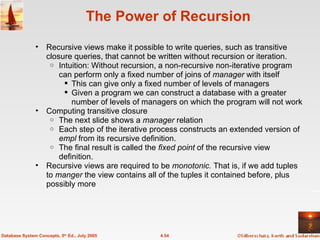
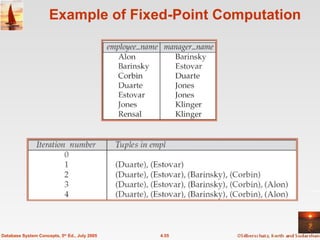
The Power of Recursion Recursive views make it possible to write queries, such as transitive closure queries, that cannot be written without recursion or iteration. Intuition: Without recursion, a non-recursive non-iterative program can perform only a fixed number of joins of  manager  with itself This can give only a fixed number of levels of managers Given a program we can construct a database with a greater number of levels of managers on which the program will not work Computing transitive closure The next slide shows a  manager  relation Each step of the iterative process constructs an extended version of  empl  from its recursive definition.  The final result is called the  fixed point  of the recursive view definition. Recursive views are required to be  monotonic.  That is, if we add tuples to  manger  the view contains all of the tuples it contained before, plus possibly more 4.54 Database System Concepts, 5 th  Ed., July 2005
Example of Fixed-Point Computation 4.55 Database System Concepts, 5 th  Ed., July 2005
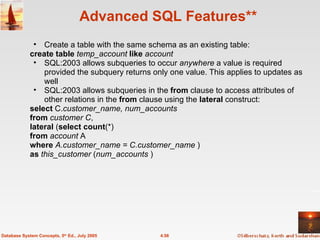
Advanced SQL Features** Create a table with the same schema as an existing table: create table   temp_account   like   account SQL:2003 allows subqueries to occur  anywhere  a value is required provided the subquery returns only one value. This applies to updates as well SQL:2003 allows subqueries in the  from  clause to access attributes of other relations in the  from  clause using the  lateral  construct: select  C. customer_name, num_accounts from   customer C ,  lateral  ( select   count (*)  from   account  A  where   A.customer_name = C.customer_name  ) as   this_customer  ( num_accounts  ) 4.56 Database System Concepts, 5 th  Ed., July 2005
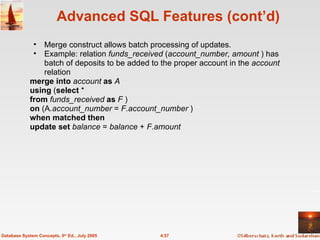
Advanced SQL Features (cont’d) Merge construct allows batch processing of updates. Example: relation  funds_received  ( account_number, amount  ) has batch of deposits to be added to the proper account in the  account  relation merge   into   account   as   A using  ( select  * from   funds_received   as   F  ) on  (A .account_number  =  F.account_number  ) when matched then update set   balance  =  balance  +  F.amount 4.57 Database System Concepts, 5 th  Ed., July 2005
End of Chapter Database System Concepts, 5th Ed . ŠSilberschatz, Korth and Sudarshan See  www.db-book.com  for conditions on re-use

ch4

  • 1.
    Chapter 4: AdvancedSQL Database System Concepts, 5th Ed . ŠSilberschatz, Korth and Sudarshan See www.db-book.com for conditions on re-use
  • 2.
    Chapter 4: AdvancedSQL SQL Data Types and Schemas Integrity Constraints Authorization Embedded SQL Dynamic SQL Functions and Procedural Constructs** Recursive Queries** Advanced SQL Features** 4.2 Database System Concepts, 5 th Ed., July 2005
  • 3.
    Built-in Data Typesin SQL date: Dates, containing a (4 digit) year, month and date Example: date ‘2005-7-27’ time: Time of day, in hours, minutes and seconds. Example: time ‘09:00:30’ time ‘09:00:30.75’ timestamp : date plus time of day Example: timestamp ‘2005-7-27 09:00:30.75’ interval: period of time Example: interval ‘1’ day Subtracting a date/time/timestamp value from another gives an interval value Interval values can be added to date/time/timestamp values 4.3 Database System Concepts, 5 th Ed., July 2005
  • 4.
    Build-in Data Typesin SQL (Cont.) Can extract values of individual fields from date/time/timestamp Example: extract ( year from r.starttime) Can cast string types to date/time/timestamp Example: cast <string-valued-expression> as date Example: cast <string-valued-expression> as time 4.4 Database System Concepts, 5 th Ed., July 2005
  • 5.
    User-Defined Types createtype construct in SQL creates user-defined type create type Dollars as numeric (12,2) final create domain construct in SQL-92 creates user-defined domain types create domain person_name char (20) not null Types and domains are similar. Domains can have constraints, such as not null , specified on them. 4.5 Database System Concepts, 5 th Ed., July 2005
  • 6.
    Domain Constraints Domainconstraints are the most elementary form of integrity constraint. They test values inserted in the database, and test queries to ensure that the comparisons make sense. New domains can be created from existing data types Example: create domain Dollars numeric (12, 2) create domain Pounds numeric (12,2) We cannot assign or compare a value of type Dollars to a value of type Pounds. However, we can convert type as below ( cast r . A as Pounds ) (Should also multiply by the dollar-to-pound conversion-rate) 4.6 Database System Concepts, 5 th Ed., July 2005
  • 7.
    Large-Object Types Largeobjects (photos, videos, CAD files, etc.) are stored as a large object : blob : binary large object -- object is a large collection of uninterpreted binary data (whose interpretation is left to an application outside of the database system) clob : character large object -- object is a large collection of character data When a query returns a large object, a pointer is returned rather than the large object itself. 4.7 Database System Concepts, 5 th Ed., July 2005
  • 8.
    Integrity Constraints Integrityconstraints guard against accidental damage to the database, by ensuring that authorized changes to the database do not result in a loss of data consistency. A checking account must have a balance greater than $10,000.00 A salary of a bank employee must be at least $4.00 an hour A customer must have a (non-null) phone number 4.8 Database System Concepts, 5 th Ed., July 2005
  • 9.
    Constraints on aSingle Relation not null primary key unique check ( P ) , where P is a predicate 4.9 Database System Concepts, 5 th Ed., July 2005
  • 10.
    Not Null Constraint Declare branch_name for branch is not null branch_name char (15) not null Declare the domain Dollars to be not null create domain Dollars numeric (12,2) not null 4.10 Database System Concepts, 5 th Ed., July 2005
  • 11.
    The Unique Constraintunique ( A 1 , A 2 , …, A m ) The unique specification states that the attributes A 1, A 2, … A m form a candidate key. Candidate keys are permitted to be null (in contrast to primary keys). 4.11 Database System Concepts, 5 th Ed., July 2005
  • 12.
    The check clausecheck ( P ) , where P is a predicate 4.12 Database System Concepts, 5 th Ed., July 2005 Example: Declare branch_name as the primary key for branch and ensure that the values of assets are non-negative. create table branch ( branch_name char (15) , branch_city char (30), assets integer , primary key ( branch_name ) , check ( assets >= 0))
  • 13.
    The check clause(Cont.) The check clause in SQL-92 permits domains to be restricted: Use check clause to ensure that an hourly_wage domain allows only values greater than a specified value. create domain hourly_wage numeric(5,2) constraint value_test check ( value > = 4.00) The domain has a constraint that ensures that the hourly_wage is greater than 4.00 The clause constraint value_test is optional; useful to indicate which constraint an update violated. 4.13 Database System Concepts, 5 th Ed., July 2005
  • 14.
    Referential Integrity Ensuresthat a value that appears in one relation for a given set of attributes also appears for a certain set of attributes in another relation. Example: If “Perryridge” is a branch name appearing in one of the tuples in the account relation, then there exists a tuple in the branch relation for branch “Perryridge”. Primary and candidate keys and foreign keys can be specified as part of the SQL create table statement: The primary key clause lists attributes that comprise the primary key. The unique key clause lists attributes that comprise a candidate key. The foreign key clause lists the attributes that comprise the foreign key and the name of the relation referenced by the foreign key. By default, a foreign key references the primary key attributes of the referenced table. 4.14 Database System Concepts, 5 th Ed., July 2005
  • 15.
    Referential Integrity inSQL – Example create table customer ( customer_name char (20) , customer_street char (30), customer_city char (30), primary key ( customer_name )) create table branch (branch_name char (15) , branch_city char (30), assets numeric (12,2), primary key ( branch_name )) 4.15 Database System Concepts, 5 th Ed., July 2005
  • 16.
    Referential Integrity inSQL – Example (Cont.) create table account ( account_number char (10) , branch_name char (15), balance integer , primary key ( account_number), foreign key ( branch_name ) references branch ) create table depositor ( customer_name char (20) , account_number char (10) , primary key ( customer_name, account_number), foreign key ( account_number ) references account, foreign key ( customer_name ) references customer ) 4.16 Database System Concepts, 5 th Ed., July 2005
  • 17.
    Assertions An assertion is a predicate expressing a condition that we wish the database always to satisfy. An assertion in SQL takes the form create assertion <assertion-name> check <predicate> When an assertion is made, the system tests it for validity, and tests it again on every update that may violate the assertion This testing may introduce a significant amount of overhead; hence assertions should be used with great care. Asserting for all X , P ( X ) is achieved in a round-about fashion using not exists X such that not P ( X ) 4.17 Database System Concepts, 5 th Ed., July 2005
  • 18.
    Assertion Example Everyloan has at least one borrower who maintains an account with a minimum balance or $1000.00 create assertion balance_constraint check (not exists ( select * from loan where not exists ( select * from borrower, depositor, account where loan.loan_number = borrower.loan_number and borrower.customer_name = depositor.customer_name and depositor.account_number = account.account_number and account.balance >= 1000))) 4.18 Database System Concepts, 5 th Ed., July 2005
  • 19.
    Assertion Example Thesum of all loan amounts for each branch must be less than the sum of all account balances at the branch. create assertion sum_constraint check ( not exists ( select * from branch where ( select sum ( amount ) from loan where loan.branch_name = branch.branch_name ) >= ( select sum ( amount ) from account where loan.branch_name = branch.branch_name ))) 4.19 Database System Concepts, 5 th Ed., July 2005
  • 20.
    Authorization Forms ofauthorization on parts of the database: Read - allows reading, but not modification of data. Insert - allows insertion of new data, but not modification of existing data. Update - allows modification, but not deletion of data. Delete - allows deletion of data. Forms of authorization to modify the database schema (covered in Chapter 8): Index - allows creation and deletion of indices. Resources - allows creation of new relations. Alteration - allows addition or deletion of attributes in a relation. Drop - allows deletion of relations. 4.20 Database System Concepts, 5 th Ed., July 2005
  • 21.
    Authorization Specification inSQL The grant statement is used to confer authorization grant <privilege list> on <relation name or view name> to <user list> <user list> is: a user-id public , which allows all valid users the privilege granted A role (more on this in Chapter 8) Granting a privilege on a view does not imply granting any privileges on the underlying relations. The grantor of the privilege must already hold the privilege on the specified item (or be the database administrator). 4.21 Database System Concepts, 5 th Ed., July 2005
  • 22.
    Privileges in SQLselect : allows read access to relation,or the ability to query using the view Example: grant users U 1 , U 2 , and U 3 select authorization on the branch relation: grant select on branch to U 1 , U 2 , U 3 insert : the ability to insert tuples update : the ability to update using the SQL update statement delete : the ability to delete tuples. all privileges : used as a short form for all the allowable privileges more in Chapter 8 4.22 Database System Concepts, 5 th Ed., July 2005
  • 23.
    Revoking Authorization inSQL The revoke statement is used to revoke authorization. revoke <privilege list> on <relation name or view name> from <user list> Example: revoke select on branch from U 1 , U 2 , U 3 All privileges that depend on the privilege being revoked are also revoked. <privilege-list> may be all to revoke all privileges the revokee may hold. If the same privilege was granted twice to the same user by different grantees, the user may retain the privilege after the revocation. 4.23 Database System Concepts, 5 th Ed., July 2005
  • 24.
    Embedded SQL TheSQL standard defines embeddings of SQL in a variety of programming languages such as C, Java, and Cobol. A language to which SQL queries are embedded is referred to as a host language , and the SQL structures permitted in the host language comprise embedded SQL. The basic form of these languages follows that of the System R embedding of SQL into PL/I. EXEC SQL statement is used to identify embedded SQL request to the preprocessor EXEC SQL <embedded SQL statement > END_EXEC Note: this varies by language (for example, the Java embedding uses # SQL { …. }; ) 4.24 Database System Concepts, 5 th Ed., July 2005
  • 25.
    Example Query Specifythe query in SQL and declare a cursor for it EXEC SQL declare c cursor for select depositor.customer_name, customer_city from depositor, customer, account where depositor.customer_name = customer.customer_name and depositor account_number = account.account_number and account.balance > :amount END_EXEC 4.25 Database System Concepts, 5 th Ed., July 2005 From within a host language, find the names and cities of customers with more than the variable amount dollars in some account.
  • 26.
    Embedded SQL (Cont.)The open statement causes the query to be evaluated EXEC SQL open c END_EXEC The fetch statement causes the values of one tuple in the query result to be placed on host language variables. EXEC SQL fetch c into : cn, :cc END_EXEC Repeated calls to fetch get successive tuples in the query result A variable called SQLSTATE in the SQL communication area (SQLCA) gets set to ‘02000’ to indicate no more data is available The close statement causes the database system to delete the temporary relation that holds the result of the query. EXEC SQL close c END_EXEC Note: above details vary with language. For example, the Java embedding defines Java iterators to step through result tuples. 4.26 Database System Concepts, 5 th Ed., July 2005
  • 27.
    Updates Through Cursors4.27 Database System Concepts, 5 th Ed., July 2005 Can update tuples fetched by cursor by declaring that the cursor is for update declare c cursor for select * from account where branch_name = ‘Perryridge’ for update To update tuple at the current location of cursor c update account set balance = balance + 100 where current of c
  • 28.
    Dynamic SQL Allowsprograms to construct and submit SQL queries at run time. Example of the use of dynamic SQL from within a C program. char * sqlprog = “ update account set balance = balance * 1.05 where account_number = ?” EXEC SQL prepare dynprog from :sqlprog; char account [10] = “A-101”; EXEC SQL execute dynprog using :account; The dynamic SQL program contains a ?, which is a place holder for a value that is provided when the SQL program is executed. 4.28 Database System Concepts, 5 th Ed., July 2005
  • 29.
    ODBC and JDBCAPI (application-program interface) for a program to interact with a database server Application makes calls to Connect with the database server Send SQL commands to the database server Fetch tuples of result one-by-one into program variables ODBC (Open Database Connectivity) works with C, C++, C#, and Visual Basic JDBC (Java Database Connectivity) works with Java 4.29 Database System Concepts, 5 th Ed., July 2005
  • 30.
    ODBC Open DataBaseConnectivity(ODBC) standard standard for application program to communicate with a database server. application program interface (API) to open a connection with a database, send queries and updates, get back results. Applications such as GUI, spreadsheets, etc. can use ODBC 4.30 Database System Concepts, 5 th Ed., July 2005
  • 31.
    ODBC (Cont.) Eachdatabase system supporting ODBC provides a &quot;driver&quot; library that must be linked with the client program. When client program makes an ODBC API call, the code in the library communicates with the server to carry out the requested action, and fetch results. ODBC program first allocates an SQL environment, then a database connection handle. Opens database connection using SQLConnect(). Parameters for SQLConnect: connection handle, the server to which to connect the user identifier, password Must also specify types of arguments: SQL_NTS denotes previous argument is a null-terminated string. 4.31 Database System Concepts, 5 th Ed., July 2005
  • 32.
    ODBC Code intODBCexample() { RETCODE error; HENV env; /* environment */ HDBC conn; /* database connection */ SQLAllocEnv(&env); SQLAllocConnect(env, &conn); SQLConnect(conn, &quot;aura.bell-labs.com&quot;, SQL_NTS, &quot;avi&quot;, SQL_NTS, &quot;avipasswd&quot;, SQL_NTS); { …. Do actual work … } SQLDisconnect(conn); SQLFreeConnect(conn); SQLFreeEnv(env); } 4.32 Database System Concepts, 5 th Ed., July 2005
  • 33.
    ODBC Code (Cont.)Program sends SQL commands to the database by using SQLExecDirect Result tuples are fetched using SQLFetch() SQLBindCol() binds C language variables to attributes of the query result When a tuple is fetched, its attribute values are automatically stored in corresponding C variables. Arguments to SQLBindCol() ODBC stmt variable, attribute position in query result The type conversion from SQL to C. The address of the variable. For variable-length types like character arrays, The maximum length of the variable Location to store actual length when a tuple is fetched. Note: A negative value returned for the length field indicates null value Good programming requires checking results of every function call for errors; we have omitted most checks for brevity. 4.33 Database System Concepts, 5 th Ed., July 2005
  • 34.
    ODBC Code (Cont.)Main body of program char branchname[80]; float balance; int lenOut1, lenOut2; HSTMT stmt; SQLAllocStmt(conn, &stmt); char * sqlquery = &quot;select branch_name, sum (balance) from account group by branch_name&quot;; error = SQLExecDirect(stmt, sqlquery, SQL_NTS); if (error == SQL_SUCCESS) { SQLBindCol(stmt, 1, SQL_C_CHAR, branchname , 80, &lenOut1); SQLBindCol(stmt, 2, SQL_C_FLOAT, &balance, 0 , &lenOut2); while (SQLFetch(stmt) >= SQL_SUCCESS) { printf (&quot; %s %g\n&quot;, branchname, balance); } } SQLFreeStmt(stmt, SQL_DROP); 4.34 Database System Concepts, 5 th Ed., July 2005
  • 35.
    More ODBC FeaturesPrepared Statement SQL statement prepared: compiled at the database Can have placeholders: E.g. insert into account values(?,?,?) Repeatedly executed with actual values for the placeholders Metadata features finding all the relations in the database and finding the names and types of columns of a query result or a relation in the database. By default, each SQL statement is treated as a separate transaction that is committed automatically. Can turn off automatic commit on a connection SQLSetConnectOption(conn, SQL_AUTOCOMMIT, 0)} transactions must then be committed or rolled back explicitly by SQLTransact(conn, SQL_COMMIT) or SQLTransact(conn, SQL_ROLLBACK) 4.35 Database System Concepts, 5 th Ed., July 2005
  • 36.
    ODBC Conformance LevelsConformance levels specify subsets of the functionality defined by the standard. Core Level 1 requires support for metadata querying Level 2 requires ability to send and retrieve arrays of parameter values and more detailed catalog information. SQL Call Level Interface (CLI) standard similar to ODBC interface, but with some minor differences. 4.36 Database System Concepts, 5 th Ed., July 2005
  • 37.
    JDBC JDBC is a Java API for communicating with database systems supporting SQL JDBC supports a variety of features for querying and updating data, and for retrieving query results JDBC also supports metadata retrieval, such as querying about relations present in the database and the names and types of relation attributes Model for communicating with the database: Open a connection Create a “statement” object Execute queries using the Statement object to send queries and fetch results Exception mechanism to handle errors 4.37 Database System Concepts, 5 th Ed., July 2005
  • 38.
    JDBC Code publicstatic void JDBCexample(String dbid, String userid, String passwd) { try { Class.forName (&quot;oracle.jdbc.driver.OracleDriver&quot;); Connection conn = DriverManager.getConnection( &quot;jdbc:oracle:thin:@aura.bell-labs.com:2000:bankdb&quot;, userid, passwd); Statement stmt = conn.createStatement(); … Do Actual Work …. stmt.close(); conn.close(); } catch (SQLException sqle) { System.out.println(&quot;SQLException : &quot; + sqle); } } 4.38 Database System Concepts, 5 th Ed., July 2005
  • 39.
    JDBC Code (Cont.)Update to database try { stmt.executeUpdate( &quot;insert into account values ('A-9732', 'Perryridge', 1200)&quot;); } catch (SQLException sqle) { System.out.println(&quot;Could not insert tuple. &quot; + sqle); } Execute query and fetch and print results ResultSet rset = stmt.executeQuery( &quot;select branch_name, avg(balance) from account group by branch_name&quot;); while (rset.next()) { System.out.println( rset.getString(&quot;branch_name&quot;) + &quot; &quot; + rset.getFloat(2)); } 4.39 Database System Concepts, 5 th Ed., July 2005
  • 40.
    JDBC Code Details Getting result fields: rs.getString(“branchname”) and rs.getString(1) equivalent if branchname is the first argument of select result. Dealing with Null values int a = rs.getInt(“a”); if (rs.wasNull()) Systems.out.println(“Got null value”); 4.40 Database System Concepts, 5 th Ed., July 2005
  • 41.
    Procedural Extensions andStored Procedures SQL provides a module language Permits definition of procedures in SQL, with if-then-else statements, for and while loops, etc. more in Chapter 9 Stored Procedures Can store procedures in the database then execute them using the call statement permit external applications to operate on the database without knowing about internal details These features are covered in Chapter 9 (Object Relational Databases) 4.41 Database System Concepts, 5 th Ed., July 2005
  • 42.
    Functions and ProceduresSQL:1999 supports functions and procedures Functions/procedures can be written in SQL itself, or in an external programming language Functions are particularly useful with specialized data types such as images and geometric objects Example: functions to check if polygons overlap, or to compare images for similarity Some database systems support table-valued functions , which can return a relation as a result SQL:1999 also supports a rich set of imperative constructs, including Loops, if-then-else, assignment Many databases have proprietary procedural extensions to SQL that differ from SQL:1999 4.42 Database System Concepts, 5 th Ed., July 2005
  • 43.
    SQL Functions Definea function that, given the name of a customer, returns the count of the number of accounts owned by the customer. create function account_count ( customer_name varchar (20)) returns integer begin declare a_count integer; select count ( * ) into a_count from depositor where depositor.customer_name = customer_name return a_count; end Find the name and address of each customer that has more than one account. select customer_name, customer_street, customer_city from customer where account_ count ( customer_name ) > 1 4.43 Database System Concepts, 5 th Ed., July 2005
  • 44.
    Table Functions SQL:2003added functions that return a relation as a result Example: Return all accounts owned by a given customer create function accounts_of ( customer_name char (20) returns table ( account_number char (10), branch_name char (15) balance numeric (12,2)) return table ( select account_number, branch_name, balance from account A where exists ( select * from depositor D where D.customer_name = accounts_of.customer_name and D.account_number = A.account_number )) 4.44 Database System Concepts, 5 th Ed., July 2005
  • 45.
    Table Functions (cont’d)Usage select * from table ( accounts_of (‘Smith’)) 4.45 Database System Concepts, 5 th Ed., July 2005
  • 46.
    SQL Procedures The author_count function could instead be written as procedure: create procedure account_count_proc ( in title varchar (20), out a_count integer) begin select count ( author ) into a_count from depositor where depositor.customer_name = account_count_proc.customer_name end Procedures can be invoked either from an SQL procedure or from embedded SQL, using the call statement. declare a_count integer ; call account_count_proc ( ‘Smith’, a_count ); Procedures and functions can be invoked also from dynamic SQL SQL:1999 allows more than one function/procedure of the same name (called name overloading ), as long as the number of arguments differ, or at least the types of the arguments differ 4.46 Database System Concepts, 5 th Ed., July 2005
  • 47.
    Procedural Constructs Compoundstatement: begin … end , May contain multiple SQL statements between begin and end . Local variables can be declared within a compound statements While and repeat statements: declare n integer default 0; while n < 10 do set n = n + 1 end while repeat set n = n – 1 until n = 0 end repeat 4.47 Database System Concepts, 5 th Ed., July 2005
  • 48.
    Procedural Constructs (Cont.)For loop Permits iteration over all results of a query Example: find total of all balances at the Perryridge branch declare n integer default 0; for r as select balance from account where branch_name = ‘Perryridge’ do set n = n + r. balance end for 4.48 Database System Concepts, 5 th Ed., July 2005
  • 49.
    Procedural Constructs (cont.)Conditional statements ( if-then-else ) E.g. To find sum of balances for each of three categories of accounts (with balance <1000, >=1000 and <5000, >= 5000) if r . balance < 1000 then set l = l + r . balance elseif r . balance < 5000 then set m = m + r . balance else set h = h + r . balance end if SQL:1999 also supports a case statement similar to C case statement Signaling of exception conditions, and declaring handlers for exceptions declare out_of_stock condition declare exit handler for out_of_stock begin … .. signal out-of-stock end The handler here is exit -- causes enclosing begin..end to be exited Other actions possible on exception 4.49 Database System Concepts, 5 th Ed., July 2005
  • 50.
    External Language Functions/ProceduresSQL:1999 permits the use of functions and procedures written in other languages such as C or C++ Declaring external language procedures and functions create procedure account_count_proc( in customer_name varchar (20), out count integer ) language C external name ’ /usr/avi/bin/account_count_proc’ create function account_count( customer_name varchar (20)) returns integer language C external name ‘/usr/avi/bin/author_count’ 4.50 Database System Concepts, 5 th Ed., July 2005
  • 51.
    External Language Routines(Cont.) Benefits of external language functions/procedures: more efficient for many operations, and more expressive power Drawbacks Code to implement function may need to be loaded into database system and executed in the database system’s address space risk of accidental corruption of database structures security risk, allowing users access to unauthorized data There are alternatives, which give good security at the cost of potentially worse performance Direct execution in the database system’s space is used when efficiency is more important than security 4.51 Database System Concepts, 5 th Ed., July 2005
  • 52.
    Security with ExternalLanguage Routines To deal with security problems Use sandbox techniques that is use a safe language like Java, which cannot be used to access/damage other parts of the database code Or, run external language functions/procedures in a separate process, with no access to the database process’ memory Parameters and results communicated via inter-process communication Both have performance overheads Many database systems support both above approaches as well as direct executing in database system address space 4.52 Database System Concepts, 5 th Ed., July 2005
  • 53.
    Recursion in SQLSQL:1999 permits recursive view definition Example: find all employee-manager pairs, where the employee reports to the manager directly or indirectly (that is manager’s manager, manager’s manager’s manager, etc.) with recursive empl ( employee_name , manager_name ) as ( select employee_name, manager_name from manager union select manager. employee_name , empl . manager_name from manager , empl where manager . manager_name = empl . emp loye_name) select * from empl This example view, empl, is called the transitive closure of the manager relation 4.53 Database System Concepts, 5 th Ed., July 2005
  • 54.
    The Power ofRecursion Recursive views make it possible to write queries, such as transitive closure queries, that cannot be written without recursion or iteration. Intuition: Without recursion, a non-recursive non-iterative program can perform only a fixed number of joins of manager with itself This can give only a fixed number of levels of managers Given a program we can construct a database with a greater number of levels of managers on which the program will not work Computing transitive closure The next slide shows a manager relation Each step of the iterative process constructs an extended version of empl from its recursive definition. The final result is called the fixed point of the recursive view definition. Recursive views are required to be monotonic. That is, if we add tuples to manger the view contains all of the tuples it contained before, plus possibly more 4.54 Database System Concepts, 5 th Ed., July 2005
  • 55.
    Example of Fixed-PointComputation 4.55 Database System Concepts, 5 th Ed., July 2005
  • 56.
    Advanced SQL Features**Create a table with the same schema as an existing table: create table temp_account like account SQL:2003 allows subqueries to occur anywhere a value is required provided the subquery returns only one value. This applies to updates as well SQL:2003 allows subqueries in the from clause to access attributes of other relations in the from clause using the lateral construct: select C. customer_name, num_accounts from customer C , lateral ( select count (*) from account A where A.customer_name = C.customer_name ) as this_customer ( num_accounts ) 4.56 Database System Concepts, 5 th Ed., July 2005
  • 57.
    Advanced SQL Features(cont’d) Merge construct allows batch processing of updates. Example: relation funds_received ( account_number, amount ) has batch of deposits to be added to the proper account in the account relation merge into account as A using ( select * from funds_received as F ) on (A .account_number = F.account_number ) when matched then update set balance = balance + F.amount 4.57 Database System Concepts, 5 th Ed., July 2005
  • 58.
    End of ChapterDatabase System Concepts, 5th Ed . ŠSilberschatz, Korth and Sudarshan See www.db-book.com for conditions on re-use