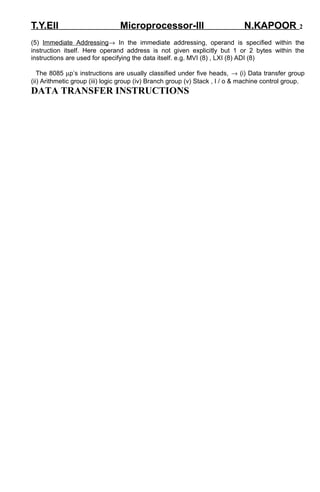
T.Y.EII Microprocessor-III N.KAPOOR 1 
Instructions: It is a binary pattern designed inside a mp to perform specific function. The entire 
group of instructions is called instruction set & determines what functions the mp can perform. 
The instruction may be one , two or three byte in length. The first byte indicates the operation to 
be performed & 2nd & 3rd if present contain either operand or the address of operand on which 
operation has to be performed. 
Instruction format : An instruction is a command to the mp to perform a given task on specified 
data. In instruction the 1st byte indicates the operation to be performed &   
called operation code 
( opcode ). The 2nd & 3rd byte if present, contain either operand or the address of operand on 
which operation is to be performed. 
Instruction word size : Instruction can be One word (1-byte ) , Two word (2-byte ) or Three word 
(3-byte ) . 
1-Byte instruction : A one byte instruction includes the opcode & operand in the same byte. 
e.g. (i) MOV C A ® 4FH ® copy the content of accumulator in register C 
Opcode 
ADD C ® 81 H ® add content of register C to accumulator. CMA ® 2FH , SUB B ® 90 H, INR 
A ® 3C , DCR A ® 3D 
2- Byte instruction :In a two byte instruction first byte specifies the opcode & second byte either 
operand or address. 
opcode operand/ add 
e.g. MVI R,data(8),MVI B data(8) [ 06 DATA] , SUI R data(8) , ANI data(8), ORI data(8),IN 
add(8) 
OUT add(8) 
3-Byte instruction : 1st byte specifies the . & 2nd & 3rd byte specifies 16-bit address. 2nd byte is 
lower order address & 3rd byte is higher order address. e.g. LDA add(16), STA add(16), LHLD 
add(16), JMP add(16) 
Op-code Format : In 8085 m p all operation registers & status flags are identified with a specific 
code. 
code Register code Register 
000 B 110 Memory related operations 
001 C 111 A 
010 D 00 BC 
011 E 01 DE 
100 H 10 HL 
101 L 11 AF or SP 
Addressing Modes® Each instruction specifies an operation to be performed on certain data. 
There are different techniques by which address of the data to be operated upon may be 
specified. These techniques are known as “ addressing modes”. The four modes of addressing 
in 8085 are -- (1) Implied Addressing ® (Inherent addressing) In implied addressing, no 
address is necessary because the location is implied in the instruction itself. e.g. (I) NOP-- No 
operation. (No address is necessary) (ii) STC -- Set carry flag. 
(2) Direct Addressing® In direct addressing the address of operand is explicitly specified within 
the instruction itself. All such instructions are 3-byte long. e.g. LDA add (16), STA add (16). 
(3) Register Addressing® When operands for any operation are in the general purpose 
register, only the registers need to be specified as the address of operands. Such addressing 
modes is called register addressing. These are 1 byte within that byte, operation code & 
register is specified. e.g. MOV A, B, ADD B. 
(4) Indirect Addressing® In this mode contents of specified registers are assumed to be 
address of operand instead of being the operand itself. In this case instead of specifying 
register, a register pair is specified to hold the 16-bit address of the operand. MOV A M- Move 
contents of memory location, pointed by HL-pair to the accumulator. JMP add (16).
T.Y.EII Microprocessor-III N.KAPOOR 2 
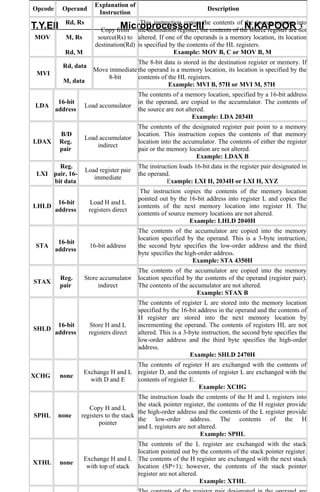
(5) Immediate Addressing® In the immediate addressing, operand is specified within the 
instruction itself. Here operand address is not given explicitly but 1 or 2 bytes within the 
instructions are used for specifying the data itself. e.g. MVI (8) , LXI (8) ADI (8) 
The 8085 mp’s instructions are usually classified under five heads, ® (i) Data transfer group 
(ii) Arithmetic group (iii) logic group (iv) Branch group (v) Stack , I / o & machine control group. 
DATA TRANSFER INSTRUCTIONS
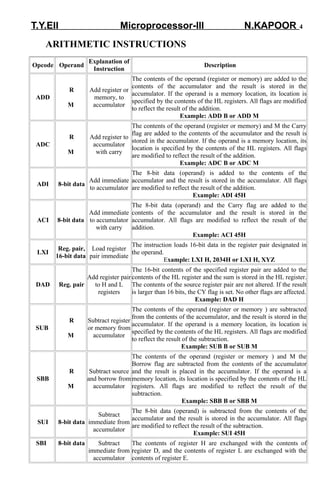
Opcode Operand Explanation of 
Instruction Description 
T.Y.EII Microprocessor-III N.KAPOOR 3 
MOV 
Rd, Rs 
M, Rs 
Rd, M 
Copy from 
source(Rs) to 
destination(Rd) 
This instruction copies the contents of the source register into 
the destination register; the contents of the source register are not 
altered. If one of the operands is a memory location, its location 
is specified by the contents of the HL registers. 
Example: MOV B, C or MOV B, M 
MVI 
Rd, data 
M, data 
Move immediate 
8-bit 
The 8-bit data is stored in the destination register or memory. If 
the operand is a memory location, its location is specified by the 
contents of the HL registers. 
Example: MVI B, 57H or MVI M, 57H 
LDA 16-bit 
address Load accumulator 
The contents of a memory location, specified by a 16-bit address 
in the operand, are copied to the accumulator. The contents of 
the source are not altered. 
Example: LDA 2034H 
LDAX 
B/D 
Reg. 
pair 
Load accumulator 
indirect 
The contents of the designated register pair point to a memory 
location. This instruction copies the contents of that memory 
location into the accumulator. The contents of either the register 
pair or the memory location are not altered. 
Example: LDAX B 
LXI 
Reg. 
pair, 16- 
bit data 
Load register pair 
immediate 
The instruction loads 16-bit data in the register pair designated in 
the operand. 
Example: LXI H, 2034H or LXI H, XYZ 
LHLD 16-bit 
address 
Load H and L 
registers direct 
The instruction copies the contents of the memory location 
pointed out by the 16-bit address into register L and copies the 
contents of the next memory location into register H. The 
contents of source memory locations are not altered. 
Example: LHLD 2040H 
STA 16-bit 
address 16-bit address 
The contents of the accumulator are copied into the memory 
location specified by the operand. This is a 3-byte instruction, 
the second byte specifies the low-order address and the third 
byte specifies the high-order address. 
Example: STA 4350H 
STAX Reg. 
pair 
Store accumulator 
indirect 
The contents of the accumulator are copied into the memory 
location specified by the contents of the operand (register pair). 
The contents of the accumulator are not altered. 
Example: STAX B 
SHLD 16-bit 
address 
Store H and L 
registers direct 
The contents of register L are stored into the memory location 
specified by the 16-bit address in the operand and the contents of 
H register are stored into the next memory location by 
incrementing the operand. The contents of registers HL are not 
altered. This is a 3-byte instruction, the second byte specifies the 
low-order address and the third byte specifies the high-order 
address. 
Example: SHLD 2470H 
XCHG none Exchange H and L 
with D and E 
The contents of register H are exchanged with the contents of 
register D, and the contents of register L are exchanged with the 
contents of register E. 
Example: XCHG 
SPHL none 
Copy H and L 
registers to the stack 
pointer 
The instruction loads the contents of the H and L registers into 
the stack pointer register, the contents of the H register provide 
the high-order address and the contents of the L register provide 
the low-order address. The contents of the H 
and L registers are not altered. 
Example: SPHL 
XTHL none Exchange H and L 
with top of stack 
The contents of the L register are exchanged with the stack 
location pointed out by the contents of the stack pointer register. 
The contents of the H register are exchanged with the next stack 
location (SP+1); however, the contents of the stack pointer 
register are not altered. 
Example: XTHL 
The contents of the register pair designated in the operand are
T.Y.EII Microprocessor-III N.KAPOOR 4 
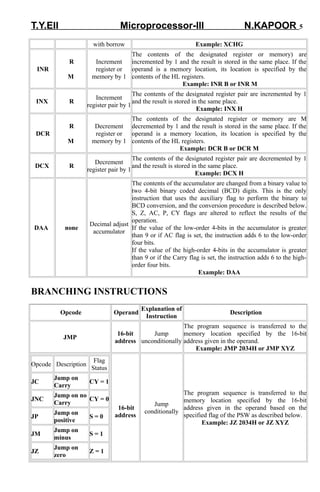
ARITHMETIC INSTRUCTIONS 
Opcode Operand Explanation of 
Instruction Description 
ADD 
R 
M 
Add register or 
memory, to 
accumulator 
The contents of the operand (register or memory) are added to the 
contents of the accumulator and the result is stored in the 
accumulator. If the operand is a memory location, its location is 
specified by the contents of the HL registers. All flags are modified 
to reflect the result of the addition. 
Example: ADD B or ADD M 
ADC 
R 
M 
Add register to 
accumulator 
with carry 
The contents of the operand (register or memory) and M the Carry 
flag are added to the contents of the accumulator and the result is 
stored in the accumulator. If the operand is a memory location, its 
location is specified by the contents of the HL registers. All flags 
are modified to reflect the result of the addition. 
Example: ADC B or ADC M 
ADI 8-bit data Add immediate 
to accumulator 
The 8-bit data (operand) is added to the contents of the 
accumulator and the result is stored in the accumulator. All flags 
are modified to reflect the result of the addition. 
Example: ADI 45H 
ACI 8-bit data 
Add immediate 
to accumulator 
with carry 
The 8-bit data (operand) and the Carry flag are added to the 
contents of the accumulator and the result is stored in the 
accumulator. All flags are modified to reflect the result of the 
addition. 
Example: ACI 45H 
LXI Reg. pair, 
16-bit data 
Load register 
pair immediate 
The instruction loads 16-bit data in the register pair designated in 
the operand. 
Example: LXI H, 2034H or LXI H, XYZ 
DAD Reg. pair 
Add register pair 
to H and L 
registers 
The 16-bit contents of the specified register pair are added to the 
contents of the HL register and the sum is stored in the HL register. 
The contents of the source register pair are not altered. If the result 
is larger than 16 bits, the CY flag is set. No other flags are affected. 
Example: DAD H 
SUB 
R 
M 
Subtract register 
or memory from 
accumulator 
The contents of the operand (register or memory ) are subtracted 
from the contents of the accumulator, and the result is stored in the 
accumulator. If the operand is a memory location, its location is 
specified by the contents of the HL registers. All flags are modified 
to reflect the result of the subtraction. 
Example: SUB B or SUB M 
SBB 
R 
M 
Subtract source 
and borrow from 
accumulator 
The contents of the operand (register or memory ) and M the 
Borrow flag are subtracted from the contents of the accumulator 
and the result is placed in the accumulator. If the operand is a 
memory location, its location is specified by the contents of the HL 
registers. All flags are modified to reflect the result of the 
subtraction. 
Example: SBB B or SBB M 
SUI 8-bit data 
Subtract 
immediate from 
accumulator 
The 8-bit data (operand) is subtracted from the contents of the 
accumulator and the result is stored in the accumulator. All flags 
are modified to reflect the result of the subtraction. 
Example: SUI 45H 
SBI 8-bit data Subtract 
immediate from 
accumulator 
The contents of register H are exchanged with the contents of 
register D, and the contents of register L are exchanged with the 
contents of register E.
T.Y.EII Microprocessor-III N.KAPOOR 5 
with borrow Example: XCHG 
INR 
R 
M 
Increment 
register or 
memory by 1 
The contents of the designated register or memory) are 
incremented by 1 and the result is stored in the same place. If the 
operand is a memory location, its location is specified by the 
contents of the HL registers. 
Example: INR B or INR M 
INX R Increment 
register pair by 1 
The contents of the designated register pair are incremented by 1 
and the result is stored in the same place. 
Example: INX H 
DCR 
R 
M 
Decrement 
register or 
memory by 1 
The contents of the designated register or memory are M 
decremented by 1 and the result is stored in the same place. If the 
operand is a memory location, its location is specified by the 
contents of the HL registers. 
Example: DCR B or DCR M 
DCX R Decrement 
register pair by 1 
The contents of the designated register pair are decremented by 1 
and the result is stored in the same place. 
Example: DCX H 
DAA none Decimal adjust 
accumulator 
The contents of the accumulator are changed from a binary value to 
two 4-bit binary coded decimal (BCD) digits. This is the only 
instruction that uses the auxiliary flag to perform the binary to 
BCD conversion, and the conversion procedure is described below. 
S, Z, AC, P, CY flags are altered to reflect the results of the 
operation. 
If the value of the low-order 4-bits in the accumulator is greater 
than 9 or if AC flag is set, the instruction adds 6 to the low-order 
four bits. 
If the value of the high-order 4-bits in the accumulator is greater 
than 9 or if the Carry flag is set, the instruction adds 6 to the high-order 
four bits. 
Example: DAA 
BRANCHING INSTRUCTIONS 
Opcode Operand Explanation of 
Instruction Description 
JMP 16-bit 
address 
Jump 
unconditionally 
The program sequence is transferred to the 
memory location specified by the 16-bit 
address given in the operand. 
Example: JMP 2034H or JMP XYZ 
Opcode Description Flag 
Status 
JC Jump on 
Carry CY = 1 
JNC Jump on no 
Carry CY = 0 
JP Jump on 
positive S = 0 
JM Jump on 
minus S = 1 
JZ Jump on 
zero Z = 1 
16-bit 
address 
Jump 
conditionally 
The program sequence is transferred to the 
memory location specified by the 16-bit 
address given in the operand based on the 
specified flag of the PSW as described below. 
Example: JZ 2034H or JZ XYZ
T.Y.EII Microprocessor-III N.KAPOOR 6 
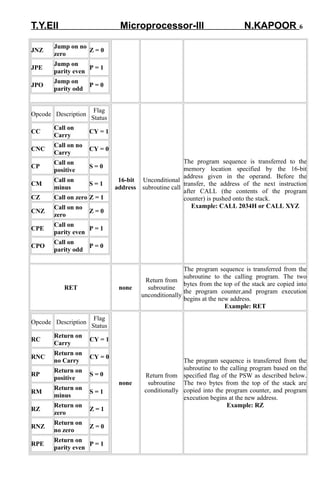
JNZ Jump on no 
zero Z = 0 
JPE Jump on 
parity even P = 1 
JPO Jump on 
parity odd P = 0 
Opcode Description Flag 
Status 
CC Call on 
Carry CY = 1 
CNC Call on no 
Carry CY = 0 
CP Call on 
positive S = 0 
CM Call on 
minus S = 1 
CZ Call on zero Z = 1 
CNZ Call on no 
zero Z = 0 
CPE Call on 
parity even P = 1 
CPO Call on 
parity odd P = 0 
16-bit 
address 
Unconditional 
subroutine call 
The program sequence is transferred to the 
memory location specified by the 16-bit 
address given in the operand. Before the 
transfer, the address of the next instruction 
after CALL (the contents of the program 
counter) is pushed onto the stack. 
Example: CALL 2034H or CALL XYZ 
RET none 
Return from 
subroutine 
unconditionally 
The program sequence is transferred from the 
subroutine to the calling program. The two 
bytes from the top of the stack are copied into 
the program counter,and program execution 
begins at the new address. 
Example: RET 
Opcode Description Flag 
Status 
RC Return on 
Carry CY = 1 
RNC Return on 
no Carry CY = 0 
RP Return on 
positive S = 0 
RM Return on 
minus S = 1 
RZ Return on 
zero Z = 1 
RNZ Return on 
no zero Z = 0 
RPE Return on 
parity even P = 1 
none 
Return from 
subroutine 
conditionally 
The program sequence is transferred from the 
subroutine to the calling program based on the 
specified flag of the PSW as described below. 
The two bytes from the top of the stack are 
copied into the program counter, and program 
execution begins at the new address. 
Example: RZ
T.Y.EII Microprocessor-III N.KAPOOR 7 
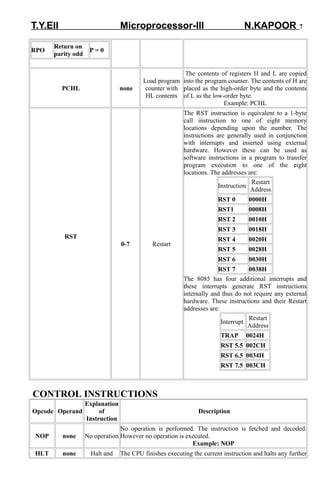
RPO Return on 
parity odd P = 0 
PCHL none 
Load program 
counter with 
HL contents 
The contents of registers H and L are copied 
into the program counter. The contents of H are 
placed as the high-order byte and the contents 
of L as the low-order byte. 
Example: PCHL 
RST 
0-7 Restart 
The RST instruction is equivalent to a 1-byte 
call instruction to one of eight memory 
locations depending upon the number. The 
instructions are generally used in conjunction 
with interrupts and inserted using external 
hardware. However these can be used as 
software instructions in a program to transfer 
program execution to one of the eight 
locations. The addresses are: 
Instruction Restart 
Address 
RST 0 0000H 
RST1 0008H 
RST 2 0010H 
RST 3 0018H 
RST 4 0020H 
RST 5 0028H 
RST 6 0030H 
RST 7 0038H 
The 8085 has four additional interrupts and 
these interrupts generate RST instructions 
internally and thus do not require any external 
hardware. These instructions and their Restart 
addresses are: 
Interrupt Restart 
Address 
TRAP 0024H 
RST 5.5 002CH 
RST 6.5 0034H 
RST 7.5 003CH 
CONTROL INSTRUCTIONS 
Explanation 
Opcode Operand 
of 
Instruction 
Description 
NOP none No operation 
No operation is performed. The instruction is fetched and decoded. 
However no operation is executed. 
Example: NOP 
HLT none Halt and The CPU finishes executing the current instruction and halts any further
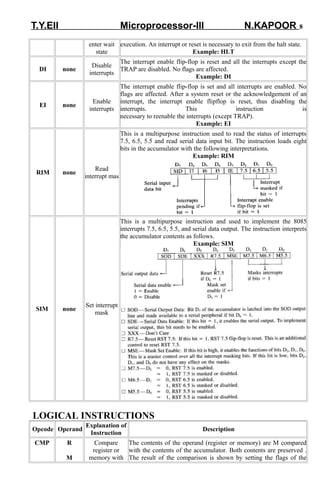
T.Y.EII Microprocessor-III N.KAPOOR 8 
enter wait 
state 
execution. An interrupt or reset is necessary to exit from the halt state. 
Example: HLT 
DI none Disable 
interrupts 
The interrupt enable flip-flop is reset and all the interrupts except the 
TRAP are disabled. No flags are affected. 
Example: DI 
EI none Enable 
interrupts 
The interrupt enable flip-flop is set and all interrupts are enabled. No 
flags are affected. After a system reset or the acknowledgement of an 
interrupt, the interrupt enable flipflop is reset, thus disabling the 
interrupts. This instruction is 
necessary to reenable the interrupts (except TRAP). 
Example: EI 
RIM none Read 
interrupt mas 
This is a multipurpose instruction used to read the status of interrupts 
7.5, 6.5, 5.5 and read serial data input bit. The instruction loads eight 
bits in the accumulator with the following interpretations. 
Example: RIM 
SIM none Set interrupt 
mask 
This is a multipurpose instruction and used to implement the 8085 
interrupts 7.5, 6.5, 5.5, and serial data output. The instruction interprets 
the accumulator contents as follows. 
Example: SIM 
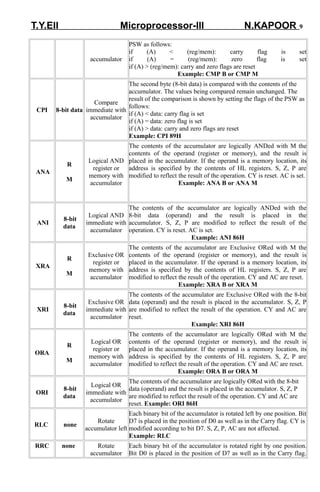
LOGICAL INSTRUCTIONS 
Opcode Operand Explanation of 
Instruction Description 
CMP R 
M 
Compare 
register or 
memory with 
The contents of the operand (register or memory) are M compared 
with the contents of the accumulator. Both contents are preserved . 
The result of the comparison is shown by setting the flags of the
T.Y.EII Microprocessor-III N.KAPOOR 9 
accumulator 
PSW as follows: 
if (A) < (reg/mem): carry flag is set 
if (A) = (reg/mem): zero flag is set 
if (A) > (reg/mem): carry and zero flags are reset 
Example: CMP B or CMP M 
CPI 8-bit data 
Compare 
immediate with 
accumulator 
The second byte (8-bit data) is compared with the contents of the 
accumulator. The values being compared remain unchanged. The 
result of the comparison is shown by setting the flags of the PSW as 
follows: 
if (A) < data: carry flag is set 
if (A) = data: zero flag is set 
if (A) > data: carry and zero flags are reset 
Example: CPI 89H 
ANA 
R 
M 
Logical AND 
register or 
memory with 
accumulator 
The contents of the accumulator are logically ANDed with M the 
contents of the operand (register or memory), and the result is 
placed in the accumulator. If the operand is a memory location, its 
address is specified by the contents of HL registers. S, Z, P are 
modified to reflect the result of the operation. CY is reset. AC is set. 
Example: ANA B or ANA M 
ANI 8-bit 
data 
Logical AND 
immediate with 
accumulator 
The contents of the accumulator are logically ANDed with the 
8-bit data (operand) and the result is placed in the 
accumulator. S, Z, P are modified to reflect the result of the 
operation. CY is reset. AC is set. 
Example: ANI 86H 
XRA 
R 
M 
Exclusive OR 
register or 
memory with 
accumulator 
The contents of the accumulator are Exclusive ORed with M the 
contents of the operand (register or memory), and the result is 
placed in the accumulator. If the operand is a memory location, its 
address is specified by the contents of HL registers. S, Z, P are 
modified to reflect the result of the operation. CY and AC are reset. 
Example: XRA B or XRA M 
XRI 8-bit 
data 
Exclusive OR 
immediate with 
accumulator 
The contents of the accumulator are Exclusive ORed with the 8-bit 
data (operand) and the result is placed in the accumulator. S, Z, P 
are modified to reflect the result of the operation. CY and AC are 
reset. 
Example: XRI 86H 
ORA 
R 
M 
Logical OR 
register or 
memory with 
accumulator 
The contents of the accumulator are logically ORed with M the 
contents of the operand (register or memory), and the result is 
placed in the accumulator. If the operand is a memory location, its 
address is specified by the contents of HL registers. S, Z, P are 
modified to reflect the result of the operation. CY and AC are reset. 
Example: ORA B or ORA M 
ORI 8-bit 
data 
Logical OR 
immediate with 
accumulator 
The contents of the accumulator are logically ORed with the 8-bit 
data (operand) and the result is placed in the accumulator. S, Z, P 
are modified to reflect the result of the operation. CY and AC are 
reset. Example: ORI 86H 
RLC none Rotate 
accumulator left 
Each binary bit of the accumulator is rotated left by one position. Bit 
D7 is placed in the position of D0 as well as in the Carry flag. CY is 
modified according to bit D7. S, Z, P, AC are not affected. 
Example: RLC 
RRC none Rotate 
accumulator 
Each binary bit of the accumulator is rotated right by one position. 
Bit D0 is placed in the position of D7 as well as in the Carry flag.
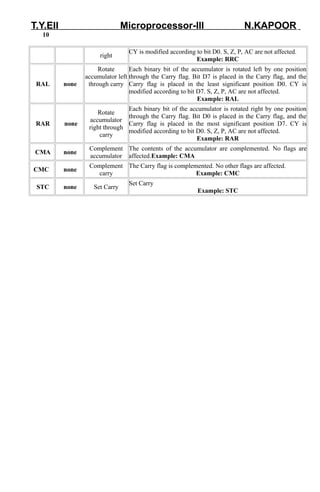
T.Y.EII Microprocessor-III N.KAPOOR 
10 
right CY is modified according to bit D0. S, Z, P, AC are not affected. 
Example: RRC 
RAL none 
Rotate 
accumulator left 
through carry 
Each binary bit of the accumulator is rotated left by one position 
through the Carry flag. Bit D7 is placed in the Carry flag, and the 
Carry flag is placed in the least significant position D0. CY is 
modified according to bit D7. S, Z, P, AC are not affected. 
Example: RAL 
RAR none 
Rotate 
accumulator 
right through 
carry 
Each binary bit of the accumulator is rotated right by one position 
through the Carry flag. Bit D0 is placed in the Carry flag, and the 
Carry flag is placed in the most significant position D7. CY is 
modified according to bit D0. S, Z, P, AC are not affected. 
Example: RAR 
CMA none Complement 
accumulator 
The contents of the accumulator are complemented. No flags are 
affected.Example: CMA 
CMC none Complement 
carry 
The Carry flag is complemented. No other flags are affected. 
Example: CMC 
STC none Set Carry Set Carry 
Example: STC

Microprocessor Basics CH-3

  • 1.
    T.Y.EII Microprocessor-III N.KAPOOR1 Instructions: It is a binary pattern designed inside a mp to perform specific function. The entire group of instructions is called instruction set & determines what functions the mp can perform. The instruction may be one , two or three byte in length. The first byte indicates the operation to be performed & 2nd & 3rd if present contain either operand or the address of operand on which operation has to be performed. Instruction format : An instruction is a command to the mp to perform a given task on specified data. In instruction the 1st byte indicates the operation to be performed & called operation code ( opcode ). The 2nd & 3rd byte if present, contain either operand or the address of operand on which operation is to be performed. Instruction word size : Instruction can be One word (1-byte ) , Two word (2-byte ) or Three word (3-byte ) . 1-Byte instruction : A one byte instruction includes the opcode & operand in the same byte. e.g. (i) MOV C A ® 4FH ® copy the content of accumulator in register C Opcode ADD C ® 81 H ® add content of register C to accumulator. CMA ® 2FH , SUB B ® 90 H, INR A ® 3C , DCR A ® 3D 2- Byte instruction :In a two byte instruction first byte specifies the opcode & second byte either operand or address. opcode operand/ add e.g. MVI R,data(8),MVI B data(8) [ 06 DATA] , SUI R data(8) , ANI data(8), ORI data(8),IN add(8) OUT add(8) 3-Byte instruction : 1st byte specifies the . & 2nd & 3rd byte specifies 16-bit address. 2nd byte is lower order address & 3rd byte is higher order address. e.g. LDA add(16), STA add(16), LHLD add(16), JMP add(16) Op-code Format : In 8085 m p all operation registers & status flags are identified with a specific code. code Register code Register 000 B 110 Memory related operations 001 C 111 A 010 D 00 BC 011 E 01 DE 100 H 10 HL 101 L 11 AF or SP Addressing Modes® Each instruction specifies an operation to be performed on certain data. There are different techniques by which address of the data to be operated upon may be specified. These techniques are known as “ addressing modes”. The four modes of addressing in 8085 are -- (1) Implied Addressing ® (Inherent addressing) In implied addressing, no address is necessary because the location is implied in the instruction itself. e.g. (I) NOP-- No operation. (No address is necessary) (ii) STC -- Set carry flag. (2) Direct Addressing® In direct addressing the address of operand is explicitly specified within the instruction itself. All such instructions are 3-byte long. e.g. LDA add (16), STA add (16). (3) Register Addressing® When operands for any operation are in the general purpose register, only the registers need to be specified as the address of operands. Such addressing modes is called register addressing. These are 1 byte within that byte, operation code & register is specified. e.g. MOV A, B, ADD B. (4) Indirect Addressing® In this mode contents of specified registers are assumed to be address of operand instead of being the operand itself. In this case instead of specifying register, a register pair is specified to hold the 16-bit address of the operand. MOV A M- Move contents of memory location, pointed by HL-pair to the accumulator. JMP add (16).
  • 2.
    T.Y.EII Microprocessor-III N.KAPOOR2 (5) Immediate Addressing® In the immediate addressing, operand is specified within the instruction itself. Here operand address is not given explicitly but 1 or 2 bytes within the instructions are used for specifying the data itself. e.g. MVI (8) , LXI (8) ADI (8) The 8085 mp’s instructions are usually classified under five heads, ® (i) Data transfer group (ii) Arithmetic group (iii) logic group (iv) Branch group (v) Stack , I / o & machine control group. DATA TRANSFER INSTRUCTIONS
  • 3.
    Opcode Operand Explanationof Instruction Description T.Y.EII Microprocessor-III N.KAPOOR 3 MOV Rd, Rs M, Rs Rd, M Copy from source(Rs) to destination(Rd) This instruction copies the contents of the source register into the destination register; the contents of the source register are not altered. If one of the operands is a memory location, its location is specified by the contents of the HL registers. Example: MOV B, C or MOV B, M MVI Rd, data M, data Move immediate 8-bit The 8-bit data is stored in the destination register or memory. If the operand is a memory location, its location is specified by the contents of the HL registers. Example: MVI B, 57H or MVI M, 57H LDA 16-bit address Load accumulator The contents of a memory location, specified by a 16-bit address in the operand, are copied to the accumulator. The contents of the source are not altered. Example: LDA 2034H LDAX B/D Reg. pair Load accumulator indirect The contents of the designated register pair point to a memory location. This instruction copies the contents of that memory location into the accumulator. The contents of either the register pair or the memory location are not altered. Example: LDAX B LXI Reg. pair, 16- bit data Load register pair immediate The instruction loads 16-bit data in the register pair designated in the operand. Example: LXI H, 2034H or LXI H, XYZ LHLD 16-bit address Load H and L registers direct The instruction copies the contents of the memory location pointed out by the 16-bit address into register L and copies the contents of the next memory location into register H. The contents of source memory locations are not altered. Example: LHLD 2040H STA 16-bit address 16-bit address The contents of the accumulator are copied into the memory location specified by the operand. This is a 3-byte instruction, the second byte specifies the low-order address and the third byte specifies the high-order address. Example: STA 4350H STAX Reg. pair Store accumulator indirect The contents of the accumulator are copied into the memory location specified by the contents of the operand (register pair). The contents of the accumulator are not altered. Example: STAX B SHLD 16-bit address Store H and L registers direct The contents of register L are stored into the memory location specified by the 16-bit address in the operand and the contents of H register are stored into the next memory location by incrementing the operand. The contents of registers HL are not altered. This is a 3-byte instruction, the second byte specifies the low-order address and the third byte specifies the high-order address. Example: SHLD 2470H XCHG none Exchange H and L with D and E The contents of register H are exchanged with the contents of register D, and the contents of register L are exchanged with the contents of register E. Example: XCHG SPHL none Copy H and L registers to the stack pointer The instruction loads the contents of the H and L registers into the stack pointer register, the contents of the H register provide the high-order address and the contents of the L register provide the low-order address. The contents of the H and L registers are not altered. Example: SPHL XTHL none Exchange H and L with top of stack The contents of the L register are exchanged with the stack location pointed out by the contents of the stack pointer register. The contents of the H register are exchanged with the next stack location (SP+1); however, the contents of the stack pointer register are not altered. Example: XTHL The contents of the register pair designated in the operand are
  • 4.
    T.Y.EII Microprocessor-III N.KAPOOR4 ARITHMETIC INSTRUCTIONS Opcode Operand Explanation of Instruction Description ADD R M Add register or memory, to accumulator The contents of the operand (register or memory) are added to the contents of the accumulator and the result is stored in the accumulator. If the operand is a memory location, its location is specified by the contents of the HL registers. All flags are modified to reflect the result of the addition. Example: ADD B or ADD M ADC R M Add register to accumulator with carry The contents of the operand (register or memory) and M the Carry flag are added to the contents of the accumulator and the result is stored in the accumulator. If the operand is a memory location, its location is specified by the contents of the HL registers. All flags are modified to reflect the result of the addition. Example: ADC B or ADC M ADI 8-bit data Add immediate to accumulator The 8-bit data (operand) is added to the contents of the accumulator and the result is stored in the accumulator. All flags are modified to reflect the result of the addition. Example: ADI 45H ACI 8-bit data Add immediate to accumulator with carry The 8-bit data (operand) and the Carry flag are added to the contents of the accumulator and the result is stored in the accumulator. All flags are modified to reflect the result of the addition. Example: ACI 45H LXI Reg. pair, 16-bit data Load register pair immediate The instruction loads 16-bit data in the register pair designated in the operand. Example: LXI H, 2034H or LXI H, XYZ DAD Reg. pair Add register pair to H and L registers The 16-bit contents of the specified register pair are added to the contents of the HL register and the sum is stored in the HL register. The contents of the source register pair are not altered. If the result is larger than 16 bits, the CY flag is set. No other flags are affected. Example: DAD H SUB R M Subtract register or memory from accumulator The contents of the operand (register or memory ) are subtracted from the contents of the accumulator, and the result is stored in the accumulator. If the operand is a memory location, its location is specified by the contents of the HL registers. All flags are modified to reflect the result of the subtraction. Example: SUB B or SUB M SBB R M Subtract source and borrow from accumulator The contents of the operand (register or memory ) and M the Borrow flag are subtracted from the contents of the accumulator and the result is placed in the accumulator. If the operand is a memory location, its location is specified by the contents of the HL registers. All flags are modified to reflect the result of the subtraction. Example: SBB B or SBB M SUI 8-bit data Subtract immediate from accumulator The 8-bit data (operand) is subtracted from the contents of the accumulator and the result is stored in the accumulator. All flags are modified to reflect the result of the subtraction. Example: SUI 45H SBI 8-bit data Subtract immediate from accumulator The contents of register H are exchanged with the contents of register D, and the contents of register L are exchanged with the contents of register E.
  • 5.
    T.Y.EII Microprocessor-III N.KAPOOR5 with borrow Example: XCHG INR R M Increment register or memory by 1 The contents of the designated register or memory) are incremented by 1 and the result is stored in the same place. If the operand is a memory location, its location is specified by the contents of the HL registers. Example: INR B or INR M INX R Increment register pair by 1 The contents of the designated register pair are incremented by 1 and the result is stored in the same place. Example: INX H DCR R M Decrement register or memory by 1 The contents of the designated register or memory are M decremented by 1 and the result is stored in the same place. If the operand is a memory location, its location is specified by the contents of the HL registers. Example: DCR B or DCR M DCX R Decrement register pair by 1 The contents of the designated register pair are decremented by 1 and the result is stored in the same place. Example: DCX H DAA none Decimal adjust accumulator The contents of the accumulator are changed from a binary value to two 4-bit binary coded decimal (BCD) digits. This is the only instruction that uses the auxiliary flag to perform the binary to BCD conversion, and the conversion procedure is described below. S, Z, AC, P, CY flags are altered to reflect the results of the operation. If the value of the low-order 4-bits in the accumulator is greater than 9 or if AC flag is set, the instruction adds 6 to the low-order four bits. If the value of the high-order 4-bits in the accumulator is greater than 9 or if the Carry flag is set, the instruction adds 6 to the high-order four bits. Example: DAA BRANCHING INSTRUCTIONS Opcode Operand Explanation of Instruction Description JMP 16-bit address Jump unconditionally The program sequence is transferred to the memory location specified by the 16-bit address given in the operand. Example: JMP 2034H or JMP XYZ Opcode Description Flag Status JC Jump on Carry CY = 1 JNC Jump on no Carry CY = 0 JP Jump on positive S = 0 JM Jump on minus S = 1 JZ Jump on zero Z = 1 16-bit address Jump conditionally The program sequence is transferred to the memory location specified by the 16-bit address given in the operand based on the specified flag of the PSW as described below. Example: JZ 2034H or JZ XYZ
  • 6.
    T.Y.EII Microprocessor-III N.KAPOOR6 JNZ Jump on no zero Z = 0 JPE Jump on parity even P = 1 JPO Jump on parity odd P = 0 Opcode Description Flag Status CC Call on Carry CY = 1 CNC Call on no Carry CY = 0 CP Call on positive S = 0 CM Call on minus S = 1 CZ Call on zero Z = 1 CNZ Call on no zero Z = 0 CPE Call on parity even P = 1 CPO Call on parity odd P = 0 16-bit address Unconditional subroutine call The program sequence is transferred to the memory location specified by the 16-bit address given in the operand. Before the transfer, the address of the next instruction after CALL (the contents of the program counter) is pushed onto the stack. Example: CALL 2034H or CALL XYZ RET none Return from subroutine unconditionally The program sequence is transferred from the subroutine to the calling program. The two bytes from the top of the stack are copied into the program counter,and program execution begins at the new address. Example: RET Opcode Description Flag Status RC Return on Carry CY = 1 RNC Return on no Carry CY = 0 RP Return on positive S = 0 RM Return on minus S = 1 RZ Return on zero Z = 1 RNZ Return on no zero Z = 0 RPE Return on parity even P = 1 none Return from subroutine conditionally The program sequence is transferred from the subroutine to the calling program based on the specified flag of the PSW as described below. The two bytes from the top of the stack are copied into the program counter, and program execution begins at the new address. Example: RZ
  • 7.
    T.Y.EII Microprocessor-III N.KAPOOR7 RPO Return on parity odd P = 0 PCHL none Load program counter with HL contents The contents of registers H and L are copied into the program counter. The contents of H are placed as the high-order byte and the contents of L as the low-order byte. Example: PCHL RST 0-7 Restart The RST instruction is equivalent to a 1-byte call instruction to one of eight memory locations depending upon the number. The instructions are generally used in conjunction with interrupts and inserted using external hardware. However these can be used as software instructions in a program to transfer program execution to one of the eight locations. The addresses are: Instruction Restart Address RST 0 0000H RST1 0008H RST 2 0010H RST 3 0018H RST 4 0020H RST 5 0028H RST 6 0030H RST 7 0038H The 8085 has four additional interrupts and these interrupts generate RST instructions internally and thus do not require any external hardware. These instructions and their Restart addresses are: Interrupt Restart Address TRAP 0024H RST 5.5 002CH RST 6.5 0034H RST 7.5 003CH CONTROL INSTRUCTIONS Explanation Opcode Operand of Instruction Description NOP none No operation No operation is performed. The instruction is fetched and decoded. However no operation is executed. Example: NOP HLT none Halt and The CPU finishes executing the current instruction and halts any further
  • 8.
    T.Y.EII Microprocessor-III N.KAPOOR8 enter wait state execution. An interrupt or reset is necessary to exit from the halt state. Example: HLT DI none Disable interrupts The interrupt enable flip-flop is reset and all the interrupts except the TRAP are disabled. No flags are affected. Example: DI EI none Enable interrupts The interrupt enable flip-flop is set and all interrupts are enabled. No flags are affected. After a system reset or the acknowledgement of an interrupt, the interrupt enable flipflop is reset, thus disabling the interrupts. This instruction is necessary to reenable the interrupts (except TRAP). Example: EI RIM none Read interrupt mas This is a multipurpose instruction used to read the status of interrupts 7.5, 6.5, 5.5 and read serial data input bit. The instruction loads eight bits in the accumulator with the following interpretations. Example: RIM SIM none Set interrupt mask This is a multipurpose instruction and used to implement the 8085 interrupts 7.5, 6.5, 5.5, and serial data output. The instruction interprets the accumulator contents as follows. Example: SIM LOGICAL INSTRUCTIONS Opcode Operand Explanation of Instruction Description CMP R M Compare register or memory with The contents of the operand (register or memory) are M compared with the contents of the accumulator. Both contents are preserved . The result of the comparison is shown by setting the flags of the
  • 9.
    T.Y.EII Microprocessor-III N.KAPOOR9 accumulator PSW as follows: if (A) < (reg/mem): carry flag is set if (A) = (reg/mem): zero flag is set if (A) > (reg/mem): carry and zero flags are reset Example: CMP B or CMP M CPI 8-bit data Compare immediate with accumulator The second byte (8-bit data) is compared with the contents of the accumulator. The values being compared remain unchanged. The result of the comparison is shown by setting the flags of the PSW as follows: if (A) < data: carry flag is set if (A) = data: zero flag is set if (A) > data: carry and zero flags are reset Example: CPI 89H ANA R M Logical AND register or memory with accumulator The contents of the accumulator are logically ANDed with M the contents of the operand (register or memory), and the result is placed in the accumulator. If the operand is a memory location, its address is specified by the contents of HL registers. S, Z, P are modified to reflect the result of the operation. CY is reset. AC is set. Example: ANA B or ANA M ANI 8-bit data Logical AND immediate with accumulator The contents of the accumulator are logically ANDed with the 8-bit data (operand) and the result is placed in the accumulator. S, Z, P are modified to reflect the result of the operation. CY is reset. AC is set. Example: ANI 86H XRA R M Exclusive OR register or memory with accumulator The contents of the accumulator are Exclusive ORed with M the contents of the operand (register or memory), and the result is placed in the accumulator. If the operand is a memory location, its address is specified by the contents of HL registers. S, Z, P are modified to reflect the result of the operation. CY and AC are reset. Example: XRA B or XRA M XRI 8-bit data Exclusive OR immediate with accumulator The contents of the accumulator are Exclusive ORed with the 8-bit data (operand) and the result is placed in the accumulator. S, Z, P are modified to reflect the result of the operation. CY and AC are reset. Example: XRI 86H ORA R M Logical OR register or memory with accumulator The contents of the accumulator are logically ORed with M the contents of the operand (register or memory), and the result is placed in the accumulator. If the operand is a memory location, its address is specified by the contents of HL registers. S, Z, P are modified to reflect the result of the operation. CY and AC are reset. Example: ORA B or ORA M ORI 8-bit data Logical OR immediate with accumulator The contents of the accumulator are logically ORed with the 8-bit data (operand) and the result is placed in the accumulator. S, Z, P are modified to reflect the result of the operation. CY and AC are reset. Example: ORI 86H RLC none Rotate accumulator left Each binary bit of the accumulator is rotated left by one position. Bit D7 is placed in the position of D0 as well as in the Carry flag. CY is modified according to bit D7. S, Z, P, AC are not affected. Example: RLC RRC none Rotate accumulator Each binary bit of the accumulator is rotated right by one position. Bit D0 is placed in the position of D7 as well as in the Carry flag.
  • 10.
    T.Y.EII Microprocessor-III N.KAPOOR 10 right CY is modified according to bit D0. S, Z, P, AC are not affected. Example: RRC RAL none Rotate accumulator left through carry Each binary bit of the accumulator is rotated left by one position through the Carry flag. Bit D7 is placed in the Carry flag, and the Carry flag is placed in the least significant position D0. CY is modified according to bit D7. S, Z, P, AC are not affected. Example: RAL RAR none Rotate accumulator right through carry Each binary bit of the accumulator is rotated right by one position through the Carry flag. Bit D0 is placed in the Carry flag, and the Carry flag is placed in the most significant position D7. CY is modified according to bit D0. S, Z, P, AC are not affected. Example: RAR CMA none Complement accumulator The contents of the accumulator are complemented. No flags are affected.Example: CMA CMC none Complement carry The Carry flag is complemented. No other flags are affected. Example: CMC STC none Set Carry Set Carry Example: STC