Is the NEED of TODAY
Dr. Sharda Jain
Gynaecologist to focuss on
*12 gm Haemoglobin
at Delivery
* Which Oral preparation in IDA
Anemia Free India
2018 AMB
Anemia +Kuposhan in vulnerable groups
6X6X6
strategy
Six target
beneficiaries
Six
interventions
Six
institutional
mechanisms
Important Highlights
• Prophylactic Iron and Folic Acid Supplementation in all six target age groups.
• Intensified year-round Behaviour Change Communication (BCC) Campaign for:(a)
improving compliance to IFA and deworming, (b) enhancing appropriate infant and young child
feeding practices, (c) encouraging increase in intake of iron-rich food through diet and/or
fortified foods (d) ensuring delayed cord clamping .
• Testing and treatment of anaemia, using digital methods and point of care treatment, with
special focus on pregnant women and school-going adolescents.
• Addressing non-nutritional causes of anaemia
in endemic pockets with special focus on malaria, hemoglobinopathies and fluorosis
Important Highlights
• Management of moderate to severe anaemia in pregnant women
undertaken by administration of IV Iron FCM / Sucrose/Blood
transfusion.
• Providing incentives to the ANM for identification and follow-up of
pregnant women with severe anaemia in high priority districts (HPDs).
• Training and orientation of all Doctors /Medical Officers and front line-
workers on newer Maternal Health and Anaemia Mukt Bharat guidelines.
• Field level awareness by ASHAs through community mobilization
activities and IEC and BCC activities
Following 2021 National Family Health
Survey 2019-2021 INTENSIFIED
ANAEMIA : its prevalence across age and
gender group has increased.
Aneamia has increased by 2-9% among
children -67, Adol-59
Pregnant -52 ,women-57 and men-25/31
National Family health survey 5 (NFHS-5)
2021
The largest spike is seen in
children between
6months and 59 months,
67.1 % are Anaemic ,
DELHI -69 %
In rural India , 68.3%
children are Anaemic ,
while the urban India
its stands at 64.2 %
according to NFHS-5
The Second highest increase in
adolescent girls
15 and 19YEARS ,
59% in NFHS 5.
rural areas (60.1 %)
V/S urban areas (56.5%)
All womenbetween the ages of
15 and 49 years reported a four % increase
in incidence of Anaemia
57%
PREGNANCY : The % of
pregnant women between
the ages of 15 and 49 years
who are anemic
 52.2%
2019 – 21
MEN , between the ages of 15 and 49 – up to 25%
younger men , between 15 and 19 increase to 31%
WHO. The global prevalence of anaemia in 2011. Geneva: World Health Organization;2015.
Anemia affects around 2 billion children and women globally
INDIA USP
:anaemia/
Malnutrition
Anemia: A Global Burden
Work performance
Child development
School PerformanceIQ
Child mortality
Maternal mortality
Perinatal mortality
Other factors
A new conceptual model of IDA and its effects.
Tissue Iron
Deficiency (mild)
Moderate&
Severe
Anemia
DEFINITION OF ANAEMIA
Greek word – LACK OF BLOOD
• Decrease in no. of RBC’s, or
• Decrease in Hb, or
• Decrease in oxygen carrying capacity of Hb molecule
• BRAIN -20% of total oxygen
weakness
&
fatigue
• SYMPTOMS AND SIGNS WHICH
WE IGNORE DARK KNUCKES
• IMPLICATION ON MOTHER AND FETUS
ARE WELL KNOWN TO OUR OBSTETRICIAN AND GYNAECOLOGIST
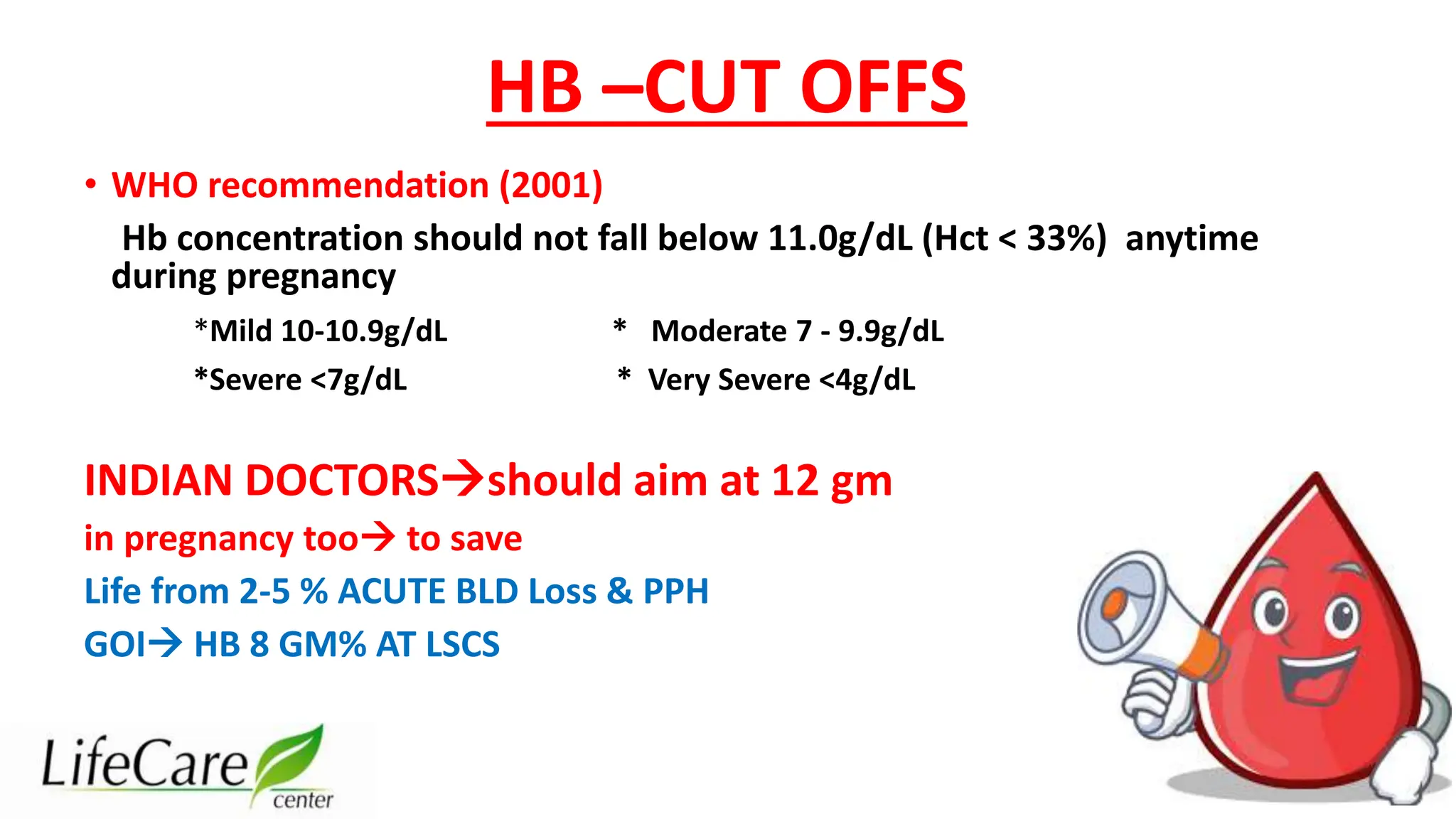
HB –CUT OFFS
• WHO recommendation (2001)
Hb concentration should not fall below 11.0g/dL (Hct < 33%) anytime
during pregnancy
*Mild 10-10.9g/dL * Moderate 7 - 9.9g/dL
*Severe <7g/dL * Very Severe <4g/dL
INDIAN DOCTORSshould aim at 12 gm
in pregnancy too to save
Life from 2-5 % ACUTE BLD Loss & PPH
GOI HB 8 GM% AT LSCS
18- 20% Direct , another 20% Indirect deaths
Nothing is more expensive than a missed opportunity! –TOTREAT
just bcz of our callous Attitude & NO Policy of RED FLAG Aproach
ANEMIA DEATHS : UNCHANGED FOR 5 DECADES
Anaemia
Death
Beyond numbers!
For every maternal death, there are 30 more who ‘almost died’.
TREND IN LAST 70 YEARS
1964 90%
2000 88 %
2021 52 %
Source: India Development and Participation by Jean Dreze and Amartya Sen, OUP 2002
ANAEMIA IN PREGNANCY - 2002
National Family Health survey 4 MoHFW 2021
Anemia in Women: Declined in most states from NFHS-3 to
NFHS-4,but still remains high
Anaemia among Children and Adults NFHS 4 (2015-16) NFHS 5(2)
Urban (%) Rural (%) Total (%) Total (%)
Non-pregnant women age 15-49 years
(<12.0 g/dl)
51.0 54.3 53.2 57.2
Pregnant women age 15-49 years
(<11.0 g/dl)
45.7 52.1 50.4 52..2
All women age 15-49 years 50.8 54.2 54.1 59.1
National Family Health Survey - 5 (2021) data
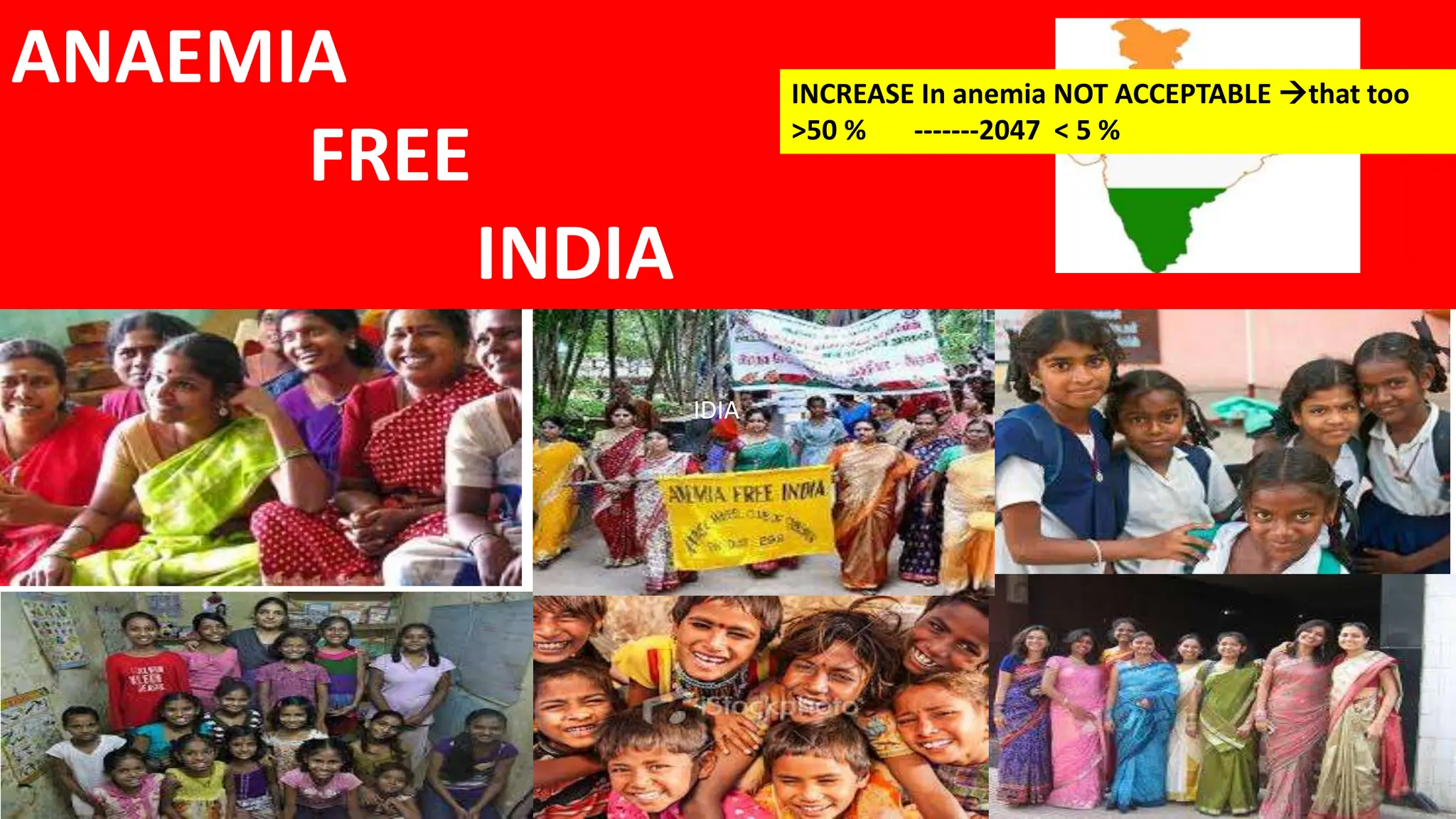
ANAEMIA
FREE
INDIA
IDIA
INCREASE In anemia NOT ACCEPTABLE that too
>50 % -------2047 < 5 %
Diagnosis of Iron Deficiency Anemia
There is long list of causes of IDA
Physiological
- INFANCY
- ADOLESCENCE IN GIRLS
- PREGNANCY
- Regular blood donation
- Being an elite athlete
Blood Loss
- Digestive tract :Malignancy, IBD, Ulcers
- Gynecological loss
- Surgery
- Hematuria, Epistaxis, Hemoptysis
- Hemodialysis
Malabsorption
- Gastrectomy
- H. Pylori
- Gut resection, atrophic gastritis,
- Bypass gastric surgery
- Proton pump inhibitors,H2 antagonists
-Parasite infestation
IDA associated with chronic diseases
- Chronic heart failure
- Cancer
- Chronic kidney disease
- Rheumatoid arthritis
- Obesity
- Inflammatory bowel diseases
Lancet 2016; 387: 907–16
REVIVE PB Smear + Don,t forget hemolytic
• Complete Blood Count with peripheral smear examination
(Type of Anemia ) macro/micro/normo/dimorphic /hemolytic
/pancytopenia.
it is good to do digital HB
& counsel on Rx before
patients leaves the clinic
CBC PARAMETERS
PARAMETER UNITS NORMAL RANGE
HEMOGLOBIN gm/dl 11.5 -15.0
TOTAL LEUCOCYTE COUNT cu/mm 4000 -10500
DLC P_L_E_M_B_ %
R.B.C.COUNT million/cum 4.5 – 6.0
PLATELET COUNT lakhs/cum 1.50 -4.00
P.C.V. % 37 – 47
M.C.V. fl 78 – 94
M.C.H. pg 27 – 32
RDW H% 10 – 15
M.C.H.C. g/dl(%) 32 – 38
ESR mm/1st hr 00 – 15
PERIPHERAL SMEAR
IDA VERSUS THALASEMIA
MENTZER’S INDEX
MCV/ RBC
< 14 THALASEMMIA
> 14 IDA
CBC PARAMETERS IDA THALASSEMIA
RBC count < 5 million/ml >5 million /ml
RDW >14 <14
Mentzer’s Index >14 <14
MCV
MCH
MCHC NORMAL
Approach to a pregnant woman presenting with IDA
Stable Patient
History, examination and investigations to find out the severity
type, and cause of anemia CBC with P/S, serum iron studies,
serum folate vit B12, HPLC, KFT, LFT, urine routine and
microscopy, stool examination.
USG for fetal biometry and growth
CAUSES OF CHRONIC ANEMIA Nutritional anemia Pernicious
anemia Hemoglobinopathies ,Intrinsic red blood cell deficiency,
Metabolic disorders, Infections Chronic blood loss,
Malabsorption syndromes
Treat according to the severity. cause of anemia and the
gestational age
Unstable patient
Approach to a pregnant woman presenting with ANEMIA
Comprehensive history, general physical examination, systemic examination, per abdomen
examination, per speculum and per vaginam , indicated. Relevant investigations CBC with P/S, KFT.
LFT, Serum electrolytes, Urine examination. and culture, USG abdomen and pelvis
Early pregnancy Late pregnancy
Hemorrhagic shock
Acute ruptured ectopic pregnancy
Abortion complications
Molar pregnancy
Ruptured corpus luteum cyst
Nonhemorrhagic shock
Septic shock
Pyelonephritis
Neurogenic shock
Ovarian torsion
Cardiogenic shock
Heart disease
Anaphylactic shock
Hemorrhagic shock
Abruptio placentae
Placenta pravia
Uterine rupture
Broad ligament hematoma
Nonhemorrhagic shock
Septic shock:
Chorioamnionitis
Pyelonephritis
Neurogenic shock
Ovarian torsion
Cardiogenic shock
Heart disease
Anaphylactic shock
Treatment according to the cause
Management Of
Anaemia in Pregnancy
Hb ≥ 11 g%
Hb < 11 g%
CBC *, **,***
Prophylactic IFA
(60 mg+0.5 mg) 1 tab OD
* MCV< 80 MCH< 27
Mentzer index < 13 (MCV/RBC count)
do HPLC to R/O Thalassemia
** MCV> 100 do serum Vit B12 and
folic acid add supplements accordingly
Start therapeutic IFA
(60 mg+0.5 mg) 1 tab BD with
counselling on how to take iron
and calcium tabs
Dietary counselling
Investigate
CBC with PS
If Hb< 10 g/dl Serum Ferritin, Vit
B12, Folic acid (if available)
Repeat Hb after 1 month
Hb improves by
≥ 1 g/dl
Hb < 1 g/dl or
no increase
Continue oral
iron therapy and
repeat Hb after
1 month
Serum Ferritin < 15
Microcytic
hypochromic
Mentzer index > 13
Hb ≥ 11 g%
Consider parenteral
Iron therapy Iron
sucrose/ FCM
Serum Ferritin < 15
Other deficiencies
Vit B12 < 200
Folic acid < 4
Add Inj vit B12 1000 µg
IM and Tab 1000 µg BD ±
Tab Folic acid 5 mg OD
Serum Ferritin > 15
Other deficiencies
Vit B12 < 200
Folic acid < 4
Consider parenteral Iron
therapy and add Inj vit B12
1000 µg IM and Tab 1000 µg
BD ± Tab Folic acid 5 mg OD
Hb ≥ 11 g%
Continue oral iron
therapy for 3 mths.
Repeat Hb as per
protocol
Repeat Hb after
4 weeks
Continue oral iron
therapy for 3 mths.
Repeat Hb as per
protocol
Hb estimation at registration, 28-30 wks. and 36 wks. of pregnancy
RED FLAG SIGN
• GET CBC / HB-PCV  3 TIMES IN PREGNANCY
• HB AT 20 WEEKS  10 gmOR LESS  INJECTABLE IRON THERAPY
• REFACTORY ANEMIA  THINK B12
 EXCLUDE THALASSEMIA
<10gm at 20 wks injectable FCM
(red flag )
Consider parenteral Iron therapy
If no improvment &
Serum Ferritin > 15 + Other deficiencies is noted
Vit B12 < 200
Folic acid < 4
Hb < 10 g%
Add Inj vit B12 1000 µg IM or Tab 1000 µg BD or NASAL B2
± Tab Folic acid 5 mg OD
Continue oral iron therapy for 3 mths
Repeat Hb as per protocol
LEARN TT OF ANAPHYLAXIS
2ND PART
Is the NEED of TODAY
Dr. Sharda Jain
Gynaecologist to focus
** Which Oral preparation in IDA
Anemia Free India
Management Of IDA With Oral Iron Therapy +
others
FERROUS SULPHATE
IS GREAT
DOCTORS in GOVT Sector  Must emphasize that
GOI Supply of Iron is NO INFERIOR to market tab.
WHICH IRON confuses Doctors
in Private Practice -as market is
flooded with >300 preparations
EXPERTS
Must settle this confusion
too
47
Absorption from Ferrous Ascorbate can be as high
as 70 % in Iron deficiency anemia patients
Key:
iron-depleted stores (IDS),
normal Fe status (NIS),
Fe deficiency without anemia (IDWA),
Fe deficiency anemia (IDA)
Biol Trace Elem Res. 2013 Dec;155(3):322-6. doi: 10.1007/s12011-013-9797-2. Epub 2013 Aug 27.
My Experience :GOVT supply is great
Ferrous Ascorbate is good
49
Study On Ferrous Ascorbate - PRIDE Study
 Significantly more patients became non-anemic by treatment with ferrous ascorbate (93.33%) than with
carbonyl iron (46.66%).
 Ferrous ascorbate replenished ferritin stores to a greater extent than carbonyl iron.
Hb increase of 5 g/dl vs. 2.8 g/dl in 60 days
IJOG 2005; 8(4):23-30
Study On Ferrous Ascorbate - PRIDE Study
50
Rapid rise in Hb % by 5.03 within 60 days
IJOG 2005; 8(4):23-30
51
Study on Ferrous Ascorbate – HERS Trial
N = 1461
The results show that at a dose of 1 tablet daily was effective in treating anemia, with rapid
increase in hemoglobin (mean: 2.37 g/ dl; 95%C.I.: 2.25 - 2.49) within 45 days, and was well
tolerated. The maximum increase of 3.60g/dl (95%C.I.: 3.07-4.13) was observed in those
with baseline hemoglobin less than 6g/dl.
Max 3.6 g/dl rise in 45 days
HERS study Group. IJGO 2005
Right Ratio For More Benefits
Right Ratio Of Iron And Ascorbic Acid Is Necessary To Form Stable Ferrous Ascorbate Complex Yielding
High Efficacy And Favourable Tolerability
Lets Compare Other Iron Salts With
Ferrous Ascorbate
Reported % Absorption Elemental Iron
Deworming
•Anthelminthic medication in pregnant women with
anaemia after 12 weeks of pregnancy
•Drug of choice is single dose Mebendazole 100mg BD
for 3 days
OR Albendazole 400mg
WHO
COUNCELLING ON DIET
WHAT TO TAKE WHAT NOT TO TAKE MEDICATION TIMING DEWORMING
DO NOT FORGET
SOYABIN
PEANUTS
PROTEIN PREP -40%
SOURCES OF IRON
Green leafy vegetables
Legumes, Nuts
Jaggery , Dried Fruits
Meat , Liver ,
Poultry , Fish
SOURCES OF FOLIC ACID
Green leafy vegetables
Legumes, Nuts
Milk , Fruits
Meat , Liver , Eggs
DIET --- IRON AND PROTEINS
Food Fortification
Arise Awake !
And Stop not untill
the goal is reached
Anemia Free India Gynaecologist  to focuss on *12gm Haemoglobin at Delivery Is the NEED  of TODAY : Dr Sharda Jain

Anemia Free India Gynaecologist to focuss on *12gm Haemoglobin at Delivery Is the NEED of TODAY : Dr Sharda Jain

  • 1.
    Is the NEEDof TODAY Dr. Sharda Jain Gynaecologist to focuss on *12 gm Haemoglobin at Delivery * Which Oral preparation in IDA Anemia Free India
  • 2.
    2018 AMB Anemia +Kuposhanin vulnerable groups 6X6X6 strategy Six target beneficiaries Six interventions Six institutional mechanisms
  • 3.
    Important Highlights • ProphylacticIron and Folic Acid Supplementation in all six target age groups. • Intensified year-round Behaviour Change Communication (BCC) Campaign for:(a) improving compliance to IFA and deworming, (b) enhancing appropriate infant and young child feeding practices, (c) encouraging increase in intake of iron-rich food through diet and/or fortified foods (d) ensuring delayed cord clamping . • Testing and treatment of anaemia, using digital methods and point of care treatment, with special focus on pregnant women and school-going adolescents. • Addressing non-nutritional causes of anaemia in endemic pockets with special focus on malaria, hemoglobinopathies and fluorosis
  • 4.
    Important Highlights • Managementof moderate to severe anaemia in pregnant women undertaken by administration of IV Iron FCM / Sucrose/Blood transfusion. • Providing incentives to the ANM for identification and follow-up of pregnant women with severe anaemia in high priority districts (HPDs). • Training and orientation of all Doctors /Medical Officers and front line- workers on newer Maternal Health and Anaemia Mukt Bharat guidelines. • Field level awareness by ASHAs through community mobilization activities and IEC and BCC activities
  • 5.
    Following 2021 NationalFamily Health Survey 2019-2021 INTENSIFIED
  • 6.
    ANAEMIA : itsprevalence across age and gender group has increased. Aneamia has increased by 2-9% among children -67, Adol-59 Pregnant -52 ,women-57 and men-25/31 National Family health survey 5 (NFHS-5) 2021
  • 7.
    The largest spikeis seen in children between 6months and 59 months, 67.1 % are Anaemic , DELHI -69 %
  • 8.
    In rural India, 68.3% children are Anaemic , while the urban India its stands at 64.2 % according to NFHS-5
  • 9.
    The Second highestincrease in adolescent girls 15 and 19YEARS , 59% in NFHS 5. rural areas (60.1 %) V/S urban areas (56.5%)
  • 10.
    All womenbetween theages of 15 and 49 years reported a four % increase in incidence of Anaemia 57%
  • 11.
    PREGNANCY : The% of pregnant women between the ages of 15 and 49 years who are anemic  52.2% 2019 – 21
  • 12.
    MEN , betweenthe ages of 15 and 49 – up to 25% younger men , between 15 and 19 increase to 31%
  • 13.
    WHO. The globalprevalence of anaemia in 2011. Geneva: World Health Organization;2015. Anemia affects around 2 billion children and women globally INDIA USP :anaemia/ Malnutrition Anemia: A Global Burden
  • 14.
    Work performance Child development SchoolPerformanceIQ Child mortality Maternal mortality Perinatal mortality Other factors A new conceptual model of IDA and its effects. Tissue Iron Deficiency (mild) Moderate& Severe Anemia
  • 15.
    DEFINITION OF ANAEMIA Greekword – LACK OF BLOOD • Decrease in no. of RBC’s, or • Decrease in Hb, or • Decrease in oxygen carrying capacity of Hb molecule • BRAIN -20% of total oxygen
  • 16.
  • 17.
    • SYMPTOMS ANDSIGNS WHICH WE IGNORE DARK KNUCKES • IMPLICATION ON MOTHER AND FETUS ARE WELL KNOWN TO OUR OBSTETRICIAN AND GYNAECOLOGIST
  • 19.
    HB –CUT OFFS •WHO recommendation (2001) Hb concentration should not fall below 11.0g/dL (Hct < 33%) anytime during pregnancy *Mild 10-10.9g/dL * Moderate 7 - 9.9g/dL *Severe <7g/dL * Very Severe <4g/dL INDIAN DOCTORSshould aim at 12 gm in pregnancy too to save Life from 2-5 % ACUTE BLD Loss & PPH GOI HB 8 GM% AT LSCS
  • 20.
    18- 20% Direct, another 20% Indirect deaths Nothing is more expensive than a missed opportunity! –TOTREAT just bcz of our callous Attitude & NO Policy of RED FLAG Aproach ANEMIA DEATHS : UNCHANGED FOR 5 DECADES
  • 21.
    Anaemia Death Beyond numbers! For everymaternal death, there are 30 more who ‘almost died’.
  • 22.
    TREND IN LAST70 YEARS 1964 90% 2000 88 % 2021 52 %
  • 23.
    Source: India Developmentand Participation by Jean Dreze and Amartya Sen, OUP 2002 ANAEMIA IN PREGNANCY - 2002
  • 24.
    National Family Healthsurvey 4 MoHFW 2021 Anemia in Women: Declined in most states from NFHS-3 to NFHS-4,but still remains high Anaemia among Children and Adults NFHS 4 (2015-16) NFHS 5(2) Urban (%) Rural (%) Total (%) Total (%) Non-pregnant women age 15-49 years (<12.0 g/dl) 51.0 54.3 53.2 57.2 Pregnant women age 15-49 years (<11.0 g/dl) 45.7 52.1 50.4 52..2 All women age 15-49 years 50.8 54.2 54.1 59.1 National Family Health Survey - 5 (2021) data
  • 25.
    ANAEMIA FREE INDIA IDIA INCREASE In anemiaNOT ACCEPTABLE that too >50 % -------2047 < 5 %
  • 26.
    Diagnosis of IronDeficiency Anemia
  • 27.
    There is longlist of causes of IDA Physiological - INFANCY - ADOLESCENCE IN GIRLS - PREGNANCY - Regular blood donation - Being an elite athlete Blood Loss - Digestive tract :Malignancy, IBD, Ulcers - Gynecological loss - Surgery - Hematuria, Epistaxis, Hemoptysis - Hemodialysis Malabsorption - Gastrectomy - H. Pylori - Gut resection, atrophic gastritis, - Bypass gastric surgery - Proton pump inhibitors,H2 antagonists -Parasite infestation IDA associated with chronic diseases - Chronic heart failure - Cancer - Chronic kidney disease - Rheumatoid arthritis - Obesity - Inflammatory bowel diseases Lancet 2016; 387: 907–16
  • 29.
    REVIVE PB Smear+ Don,t forget hemolytic • Complete Blood Count with peripheral smear examination (Type of Anemia ) macro/micro/normo/dimorphic /hemolytic /pancytopenia. it is good to do digital HB & counsel on Rx before patients leaves the clinic
  • 30.
    CBC PARAMETERS PARAMETER UNITSNORMAL RANGE HEMOGLOBIN gm/dl 11.5 -15.0 TOTAL LEUCOCYTE COUNT cu/mm 4000 -10500 DLC P_L_E_M_B_ % R.B.C.COUNT million/cum 4.5 – 6.0 PLATELET COUNT lakhs/cum 1.50 -4.00 P.C.V. % 37 – 47 M.C.V. fl 78 – 94 M.C.H. pg 27 – 32 RDW H% 10 – 15 M.C.H.C. g/dl(%) 32 – 38 ESR mm/1st hr 00 – 15 PERIPHERAL SMEAR
  • 31.
    IDA VERSUS THALASEMIA MENTZER’SINDEX MCV/ RBC < 14 THALASEMMIA > 14 IDA
  • 32.
    CBC PARAMETERS IDATHALASSEMIA RBC count < 5 million/ml >5 million /ml RDW >14 <14 Mentzer’s Index >14 <14 MCV MCH MCHC NORMAL
  • 33.
    Approach to apregnant woman presenting with IDA Stable Patient History, examination and investigations to find out the severity type, and cause of anemia CBC with P/S, serum iron studies, serum folate vit B12, HPLC, KFT, LFT, urine routine and microscopy, stool examination. USG for fetal biometry and growth CAUSES OF CHRONIC ANEMIA Nutritional anemia Pernicious anemia Hemoglobinopathies ,Intrinsic red blood cell deficiency, Metabolic disorders, Infections Chronic blood loss, Malabsorption syndromes Treat according to the severity. cause of anemia and the gestational age
  • 34.
    Unstable patient Approach toa pregnant woman presenting with ANEMIA Comprehensive history, general physical examination, systemic examination, per abdomen examination, per speculum and per vaginam , indicated. Relevant investigations CBC with P/S, KFT. LFT, Serum electrolytes, Urine examination. and culture, USG abdomen and pelvis Early pregnancy Late pregnancy Hemorrhagic shock Acute ruptured ectopic pregnancy Abortion complications Molar pregnancy Ruptured corpus luteum cyst Nonhemorrhagic shock Septic shock Pyelonephritis Neurogenic shock Ovarian torsion Cardiogenic shock Heart disease Anaphylactic shock Hemorrhagic shock Abruptio placentae Placenta pravia Uterine rupture Broad ligament hematoma Nonhemorrhagic shock Septic shock: Chorioamnionitis Pyelonephritis Neurogenic shock Ovarian torsion Cardiogenic shock Heart disease Anaphylactic shock Treatment according to the cause
  • 35.
  • 36.
    Hb ≥ 11g% Hb < 11 g% CBC *, **,*** Prophylactic IFA (60 mg+0.5 mg) 1 tab OD * MCV< 80 MCH< 27 Mentzer index < 13 (MCV/RBC count) do HPLC to R/O Thalassemia ** MCV> 100 do serum Vit B12 and folic acid add supplements accordingly Start therapeutic IFA (60 mg+0.5 mg) 1 tab BD with counselling on how to take iron and calcium tabs Dietary counselling Investigate CBC with PS If Hb< 10 g/dl Serum Ferritin, Vit B12, Folic acid (if available) Repeat Hb after 1 month Hb improves by ≥ 1 g/dl Hb < 1 g/dl or no increase Continue oral iron therapy and repeat Hb after 1 month Serum Ferritin < 15 Microcytic hypochromic Mentzer index > 13 Hb ≥ 11 g% Consider parenteral Iron therapy Iron sucrose/ FCM Serum Ferritin < 15 Other deficiencies Vit B12 < 200 Folic acid < 4 Add Inj vit B12 1000 µg IM and Tab 1000 µg BD ± Tab Folic acid 5 mg OD Serum Ferritin > 15 Other deficiencies Vit B12 < 200 Folic acid < 4 Consider parenteral Iron therapy and add Inj vit B12 1000 µg IM and Tab 1000 µg BD ± Tab Folic acid 5 mg OD Hb ≥ 11 g% Continue oral iron therapy for 3 mths. Repeat Hb as per protocol Repeat Hb after 4 weeks Continue oral iron therapy for 3 mths. Repeat Hb as per protocol Hb estimation at registration, 28-30 wks. and 36 wks. of pregnancy
  • 37.
    RED FLAG SIGN •GET CBC / HB-PCV  3 TIMES IN PREGNANCY • HB AT 20 WEEKS  10 gmOR LESS  INJECTABLE IRON THERAPY • REFACTORY ANEMIA  THINK B12  EXCLUDE THALASSEMIA
  • 38.
    <10gm at 20wks injectable FCM (red flag )
  • 39.
    Consider parenteral Irontherapy If no improvment & Serum Ferritin > 15 + Other deficiencies is noted Vit B12 < 200 Folic acid < 4 Hb < 10 g% Add Inj vit B12 1000 µg IM or Tab 1000 µg BD or NASAL B2 ± Tab Folic acid 5 mg OD Continue oral iron therapy for 3 mths Repeat Hb as per protocol
  • 40.
    LEARN TT OFANAPHYLAXIS
  • 41.
  • 42.
    Is the NEEDof TODAY Dr. Sharda Jain Gynaecologist to focus ** Which Oral preparation in IDA Anemia Free India
  • 43.
    Management Of IDAWith Oral Iron Therapy + others
  • 44.
  • 45.
    DOCTORS in GOVTSector  Must emphasize that GOI Supply of Iron is NO INFERIOR to market tab.
  • 46.
    WHICH IRON confusesDoctors in Private Practice -as market is flooded with >300 preparations EXPERTS Must settle this confusion too
  • 47.
    47 Absorption from FerrousAscorbate can be as high as 70 % in Iron deficiency anemia patients Key: iron-depleted stores (IDS), normal Fe status (NIS), Fe deficiency without anemia (IDWA), Fe deficiency anemia (IDA) Biol Trace Elem Res. 2013 Dec;155(3):322-6. doi: 10.1007/s12011-013-9797-2. Epub 2013 Aug 27.
  • 48.
    My Experience :GOVTsupply is great Ferrous Ascorbate is good
  • 49.
    49 Study On FerrousAscorbate - PRIDE Study  Significantly more patients became non-anemic by treatment with ferrous ascorbate (93.33%) than with carbonyl iron (46.66%).  Ferrous ascorbate replenished ferritin stores to a greater extent than carbonyl iron. Hb increase of 5 g/dl vs. 2.8 g/dl in 60 days IJOG 2005; 8(4):23-30
  • 50.
    Study On FerrousAscorbate - PRIDE Study 50 Rapid rise in Hb % by 5.03 within 60 days IJOG 2005; 8(4):23-30
  • 51.
    51 Study on FerrousAscorbate – HERS Trial N = 1461 The results show that at a dose of 1 tablet daily was effective in treating anemia, with rapid increase in hemoglobin (mean: 2.37 g/ dl; 95%C.I.: 2.25 - 2.49) within 45 days, and was well tolerated. The maximum increase of 3.60g/dl (95%C.I.: 3.07-4.13) was observed in those with baseline hemoglobin less than 6g/dl. Max 3.6 g/dl rise in 45 days HERS study Group. IJGO 2005
  • 52.
    Right Ratio ForMore Benefits Right Ratio Of Iron And Ascorbic Acid Is Necessary To Form Stable Ferrous Ascorbate Complex Yielding High Efficacy And Favourable Tolerability
  • 53.
    Lets Compare OtherIron Salts With Ferrous Ascorbate
  • 54.
    Reported % AbsorptionElemental Iron
  • 55.
  • 56.
    •Anthelminthic medication inpregnant women with anaemia after 12 weeks of pregnancy •Drug of choice is single dose Mebendazole 100mg BD for 3 days OR Albendazole 400mg WHO
  • 57.
    COUNCELLING ON DIET WHATTO TAKE WHAT NOT TO TAKE MEDICATION TIMING DEWORMING
  • 61.
  • 62.
    SOURCES OF IRON Greenleafy vegetables Legumes, Nuts Jaggery , Dried Fruits Meat , Liver , Poultry , Fish SOURCES OF FOLIC ACID Green leafy vegetables Legumes, Nuts Milk , Fruits Meat , Liver , Eggs
  • 63.
    DIET --- IRONAND PROTEINS
  • 64.
  • 68.
    Arise Awake ! AndStop not untill the goal is reached