Optimizing Clinical Outcome in IUI
DR PARUL KATIYAR
SENIOR CONSULTANT
IVF AND REPRODUCTIVE MEDICINE
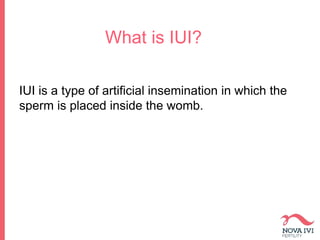
What is IUI?
IUI is a type of artificial insemination in which the
sperm is placed inside the womb.
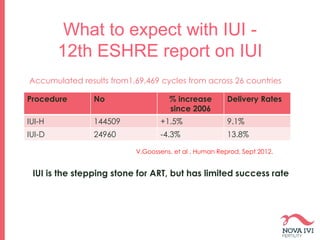
What to expect with IUI -
12th ESHRE report on IUI
Procedure No % increase
since 2006
Delivery Rates
IUI-H 144509 +1.5% 9.1%
IUI-D 24960 -4.3% 13.8%
V.Goossens, et al , Human Reprod, Sept 2012.
IUI is the stepping stone for ART, but has limited success rate
Accumulated results from1,69,469 cycles from across 26 countries
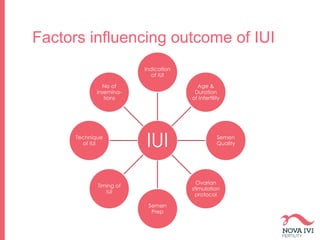
Factors influencing outcome of IUI
IUI
Indication
of IUI
Age &
Duration
of Infertility
Semen
Quality
Ovarian
stimulation
protocol
Semen
Prep
Timing of
IUI
Technique
of IUI
No of
insemina-
tions
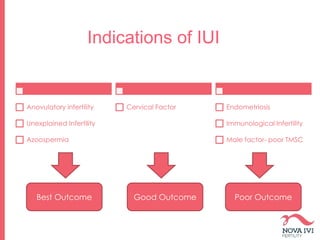
Indications of IUI
Best Outcome
Anovulatory infertility
Unexplained Infertility
Azoospermia
Good Outcome
Cervical Factor
Poor Outcome
Endometriosis
Immunological Infertility
Male factor- poor TMSC
Best Outcome Good Outcome Poor Outcome
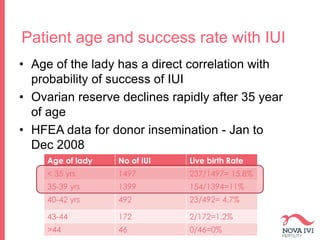
Patient age and success rate with IUI
• Age of the lady has a direct correlation with
probability of success of IUI
• Ovarian reserve declines rapidly after 35 year
of age
• HFEA data for donor insemination - Jan to
Dec 2008
Age of lady No of IUI Live birth Rate
< 35 yrs 1497 237/1497= 15.8%
35-39 yrs 1399 154/1394=11%
40-42 yrs 492 23/492= 4.7%
43-44 172 2/172=1.2%
>44 46 0/46=0%
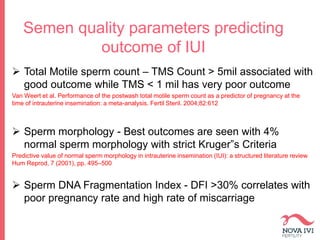
Semen quality parameters predicting
outcome of IUI
 Total Motile sperm count – TMS Count > 5mil associated with
good outcome while TMS < 1 mil has very poor outcome
Van Weert et al. Performance of the postwash total motile sperm count as a predictor of pregnancy at the
time of intrauterine insemination: a meta-analysis. Fertil Steril. 2004;82:612
 Sperm morphology - Best outcomes are seen with 4%
normal sperm morphology with strict Kruger”s Criteria
Predictive value of normal sperm morphology in intrauterine insemination (IUI): a structured literature review
Hum Reprod, 7 (2001), pp. 495–500
 Sperm DNA Fragmentation Index - DFI >30% correlates with
poor pregnancy rate and high rate of miscarriage
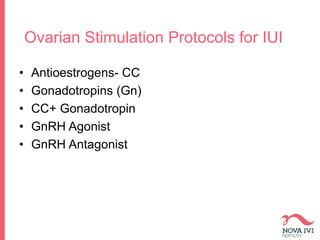
Ovarian Stimulation Protocols for IUI
• Antioestrogens- CC
• Gonadotropins (Gn)
• CC+ Gonadotropin
• GnRH Agonist
• GnRH Antagonist
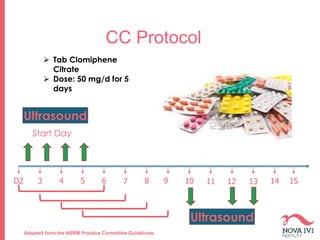
CC Protocol
Ultrasound
D2 3 4 5 6 7 8 9 10 11 12 13 14 15
 Tab Clomiphene
Citrate
 Dose: 50 mg/d for 5
days
Start Day
Ultrasound
Adapted form the ASRM Practice Committee Guidelines
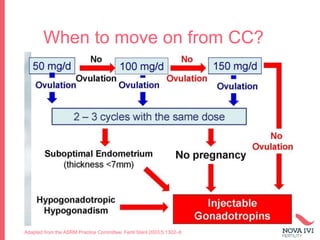
When to move on from CC?
Adapted from the ASRM Practice Committee. Fertil Steril 2003;5:1302–8
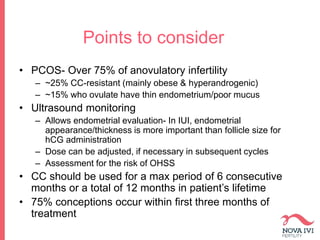
Points to consider
• PCOS- Over 75% of anovulatory infertility
– ~25% CC-resistant (mainly obese & hyperandrogenic)
– ~15% who ovulate have thin endometrium/poor mucus
• Ultrasound monitoring
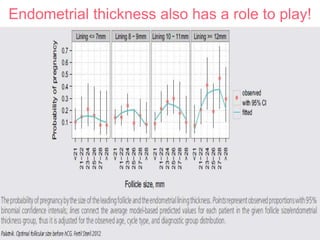
– Allows endometrial evaluation- In IUI, endometrial
appearance/thickness is more important than follicle size for
hCG administration
– Dose can be adjusted, if necessary in subsequent cycles
– Assessment for the risk of OHSS
• CC should be used for a max period of 6 consecutive
months or a total of 12 months in patient’s lifetime
• 75% conceptions occur within first three months of
treatment
Endometrial thickness also has a role to play!
Gonadotropin Protocols
• Most effective drug for ovarian stimulation for
IUI1
• Similar efficacy for uFSH vs rFSH vs HMG1
• Daily regimes better than alternate day2
• Three protocols
– Low dose step up protocol
– Conventional step up protocol
– Step down protocol
1Cantineau et al. Cochrane Database of Systematic Reviews 2007. DOI: 10.1002/14651858.CD005356.pub2
2Ragni et al. Human Reproduction 2004;19(1):54-8
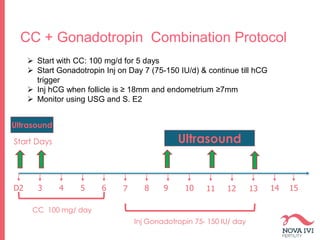
CC + Gonadotropin Combination Protocol
Ultrasound
D2 3 4 5 6 7 8 9 10 11 12 13 14 15
Start Days Ultrasound
 Start with CC: 100 mg/d for 5 days
 Start Gonadotropin Inj on Day 7 (75-150 IU/d) & continue till hCG
trigger
 Inj hCG when follicle is ≥ 18mm and endometrium ≥7mm
 Monitor using USG and S. E2
CC 100 mg/ day
Inj Gonadotropin 75- 150 IU/ day
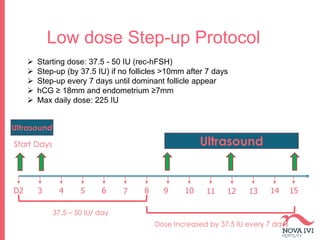
Low dose Step-up Protocol
Ultrasound
D2 3 4 5 6 7 8 9 10 11 12 13 14 15
Start Days Ultrasound
 Starting dose: 37.5 - 50 IU (rec-hFSH)
 Step-up (by 37.5 IU) if no follicles >10mm after 7 days
 Step-up every 7 days until dominant follicle appear
 hCG ≥ 18mm and endometrium ≥7mm
 Max daily dose: 225 IU
37.5 – 50 IU/ day
Dose Increased by 37.5 IU every 7 days
Points to consider
• Be patient! It may take 10 days or more for a
dominant follicle to appear during the first
treatment cycle with low-dose gonadotropin
• Start with low dose (37.5 IU- 5o IU)
– Little documented evidence of any benefit of higher
dose in improving pregnancy rate
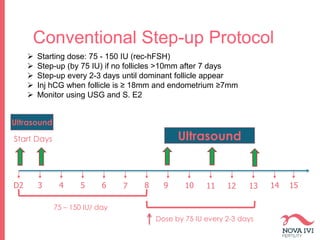
Conventional Step-up Protocol
Ultrasound
D2 3 4 5 6 7 8 9 10 11 12 13 14 15
Start Days Ultrasound
 Starting dose: 75 - 150 IU (rec-hFSH)
 Step-up (by 75 IU) if no follicles >10mm after 7 days
 Step-up every 2-3 days until dominant follicle appear
 Inj hCG when follicle is ≥ 18mm and endometrium ≥7mm
 Monitor using USG and S. E2
75 – 150 IU/ day
Dose by 75 IU every 2-3 days
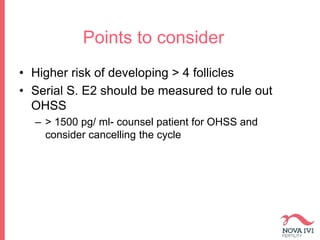
Points to consider
• Higher risk of developing > 4 follicles
• Serial S. E2 should be measured to rule out
OHSS
– > 1500 pg/ ml- counsel patient for OHSS and
consider cancelling the cycle
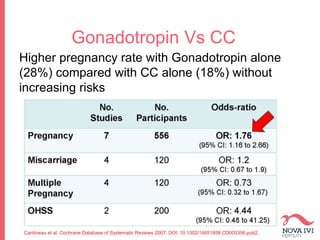
Gonadotropin Vs CC
Higher pregnancy rate with Gonadotropin alone
(28%) compared with CC alone (18%) without
increasing risks
Cantineau et al. Cochrane Database of Systematic Reviews 2007. DOI: 10.1002/14651858.CD005356.pub2.
Points to Consider
• Lower dose of Gonadotropin required for
stimulation
• Effective only in cases responsive to CC
• Pregnancy rates comparable to Gonadotropin
only protocols
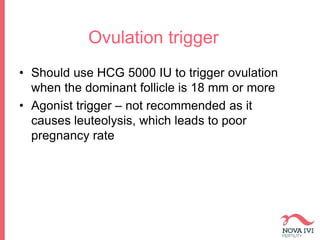
Ovulation trigger
• Should use HCG 5000 IU to trigger ovulation
when the dominant follicle is 18 mm or more
• Agonist trigger – not recommended as it
causes leuteolysis, which leads to poor
pregnancy rate
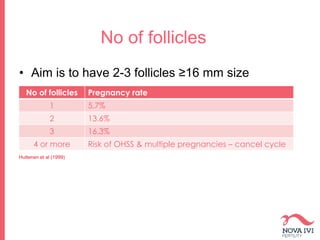
No of follicles
• Aim is to have 2-3 follicles ≥16 mm size
No of follicles Pregnancy rate
1 5.7%
2 13.6%
3 16.3%
4 or more Risk of OHSS & multiple pregnancies – cancel cycle
Huttenen et al (1999)
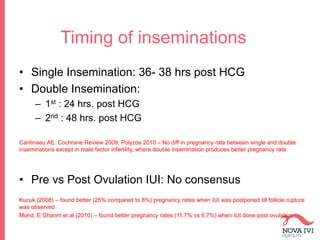
Timing of inseminations
• Single Insemination: 36- 38 hrs post HCG
• Double Insemination:
– 1st : 24 hrs. post HCG
– 2nd : 48 hrs. post HCG
Cantinaeu AE. Cochrane Review 2009, Polyzos 2010 – No diff in pregnancy rate between single and double
inseminations except in male factor infertility, where double insemination produces better pregnancy rate
• Pre vs Post Ovulation IUI: No consensus
Kucuk (2008) – found better (25% compared to 8%) pregnancy rates when IUI was postponed till follicle rupture
was observed
Mohd. E Ghanm et al (2010) – found better pregnancy rates (11.7% vs 6.7%) when IUI done post ovulation
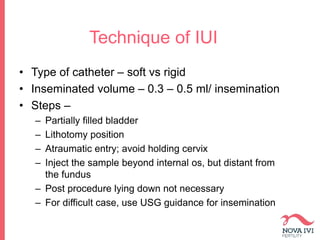
Technique of IUI
• Type of catheter – soft vs rigid
• Inseminated volume – 0.3 – 0.5 ml/ insemination
• Steps –
– Partially filled bladder
– Lithotomy position
– Atraumatic entry; avoid holding cervix
– Inject the sample beyond internal os, but distant from
the fundus
– Post procedure lying down not necessary
– For difficult case, use USG guidance for insemination
How many cycles?
• Its long been proven that there is no point in
attempting more than 3-4 cycles of IUI
Take home messages
• IUI should be offered to younger age couples with
shorter duration of infertility
• Semen parameters should be assessed before
putting a couple for IUI
• There is no point in repeating IUI beyond 3 - 4
well planned attempts
• Mild induction protocols should be preferred
• Patient education on what to expect before
starting treatment helps set correct expectations

Optimizing clinical outcome of IUI

  • 1.
    Optimizing Clinical Outcomein IUI DR PARUL KATIYAR SENIOR CONSULTANT IVF AND REPRODUCTIVE MEDICINE
  • 2.
    What is IUI? IUIis a type of artificial insemination in which the sperm is placed inside the womb.
  • 3.
    What to expectwith IUI - 12th ESHRE report on IUI Procedure No % increase since 2006 Delivery Rates IUI-H 144509 +1.5% 9.1% IUI-D 24960 -4.3% 13.8% V.Goossens, et al , Human Reprod, Sept 2012. IUI is the stepping stone for ART, but has limited success rate Accumulated results from1,69,469 cycles from across 26 countries
  • 4.
    Factors influencing outcomeof IUI IUI Indication of IUI Age & Duration of Infertility Semen Quality Ovarian stimulation protocol Semen Prep Timing of IUI Technique of IUI No of insemina- tions
  • 5.
    Indications of IUI BestOutcome Anovulatory infertility Unexplained Infertility Azoospermia Good Outcome Cervical Factor Poor Outcome Endometriosis Immunological Infertility Male factor- poor TMSC Best Outcome Good Outcome Poor Outcome
  • 6.
    Patient age andsuccess rate with IUI • Age of the lady has a direct correlation with probability of success of IUI • Ovarian reserve declines rapidly after 35 year of age • HFEA data for donor insemination - Jan to Dec 2008 Age of lady No of IUI Live birth Rate < 35 yrs 1497 237/1497= 15.8% 35-39 yrs 1399 154/1394=11% 40-42 yrs 492 23/492= 4.7% 43-44 172 2/172=1.2% >44 46 0/46=0%
  • 7.
    Semen quality parameterspredicting outcome of IUI  Total Motile sperm count – TMS Count > 5mil associated with good outcome while TMS < 1 mil has very poor outcome Van Weert et al. Performance of the postwash total motile sperm count as a predictor of pregnancy at the time of intrauterine insemination: a meta-analysis. Fertil Steril. 2004;82:612  Sperm morphology - Best outcomes are seen with 4% normal sperm morphology with strict Kruger”s Criteria Predictive value of normal sperm morphology in intrauterine insemination (IUI): a structured literature review Hum Reprod, 7 (2001), pp. 495–500  Sperm DNA Fragmentation Index - DFI >30% correlates with poor pregnancy rate and high rate of miscarriage
  • 8.
    Ovarian Stimulation Protocolsfor IUI • Antioestrogens- CC • Gonadotropins (Gn) • CC+ Gonadotropin • GnRH Agonist • GnRH Antagonist
  • 9.
    CC Protocol Ultrasound D2 34 5 6 7 8 9 10 11 12 13 14 15  Tab Clomiphene Citrate  Dose: 50 mg/d for 5 days Start Day Ultrasound Adapted form the ASRM Practice Committee Guidelines
  • 10.
    When to moveon from CC? Adapted from the ASRM Practice Committee. Fertil Steril 2003;5:1302–8
  • 11.
    Points to consider •PCOS- Over 75% of anovulatory infertility – ~25% CC-resistant (mainly obese & hyperandrogenic) – ~15% who ovulate have thin endometrium/poor mucus • Ultrasound monitoring – Allows endometrial evaluation- In IUI, endometrial appearance/thickness is more important than follicle size for hCG administration – Dose can be adjusted, if necessary in subsequent cycles – Assessment for the risk of OHSS • CC should be used for a max period of 6 consecutive months or a total of 12 months in patient’s lifetime • 75% conceptions occur within first three months of treatment
  • 12.
    Endometrial thickness alsohas a role to play!
  • 13.
    Gonadotropin Protocols • Mosteffective drug for ovarian stimulation for IUI1 • Similar efficacy for uFSH vs rFSH vs HMG1 • Daily regimes better than alternate day2 • Three protocols – Low dose step up protocol – Conventional step up protocol – Step down protocol 1Cantineau et al. Cochrane Database of Systematic Reviews 2007. DOI: 10.1002/14651858.CD005356.pub2 2Ragni et al. Human Reproduction 2004;19(1):54-8
  • 14.
    CC + GonadotropinCombination Protocol Ultrasound D2 3 4 5 6 7 8 9 10 11 12 13 14 15 Start Days Ultrasound  Start with CC: 100 mg/d for 5 days  Start Gonadotropin Inj on Day 7 (75-150 IU/d) & continue till hCG trigger  Inj hCG when follicle is ≥ 18mm and endometrium ≥7mm  Monitor using USG and S. E2 CC 100 mg/ day Inj Gonadotropin 75- 150 IU/ day
  • 15.
    Low dose Step-upProtocol Ultrasound D2 3 4 5 6 7 8 9 10 11 12 13 14 15 Start Days Ultrasound  Starting dose: 37.5 - 50 IU (rec-hFSH)  Step-up (by 37.5 IU) if no follicles >10mm after 7 days  Step-up every 7 days until dominant follicle appear  hCG ≥ 18mm and endometrium ≥7mm  Max daily dose: 225 IU 37.5 – 50 IU/ day Dose Increased by 37.5 IU every 7 days
  • 16.
    Points to consider •Be patient! It may take 10 days or more for a dominant follicle to appear during the first treatment cycle with low-dose gonadotropin • Start with low dose (37.5 IU- 5o IU) – Little documented evidence of any benefit of higher dose in improving pregnancy rate
  • 17.
    Conventional Step-up Protocol Ultrasound D23 4 5 6 7 8 9 10 11 12 13 14 15 Start Days Ultrasound  Starting dose: 75 - 150 IU (rec-hFSH)  Step-up (by 75 IU) if no follicles >10mm after 7 days  Step-up every 2-3 days until dominant follicle appear  Inj hCG when follicle is ≥ 18mm and endometrium ≥7mm  Monitor using USG and S. E2 75 – 150 IU/ day Dose by 75 IU every 2-3 days
  • 18.
    Points to consider •Higher risk of developing > 4 follicles • Serial S. E2 should be measured to rule out OHSS – > 1500 pg/ ml- counsel patient for OHSS and consider cancelling the cycle
  • 19.
    Gonadotropin Vs CC Higherpregnancy rate with Gonadotropin alone (28%) compared with CC alone (18%) without increasing risks Cantineau et al. Cochrane Database of Systematic Reviews 2007. DOI: 10.1002/14651858.CD005356.pub2.
  • 20.
    Points to Consider •Lower dose of Gonadotropin required for stimulation • Effective only in cases responsive to CC • Pregnancy rates comparable to Gonadotropin only protocols
  • 21.
    Ovulation trigger • Shoulduse HCG 5000 IU to trigger ovulation when the dominant follicle is 18 mm or more • Agonist trigger – not recommended as it causes leuteolysis, which leads to poor pregnancy rate
  • 22.
    No of follicles •Aim is to have 2-3 follicles ≥16 mm size No of follicles Pregnancy rate 1 5.7% 2 13.6% 3 16.3% 4 or more Risk of OHSS & multiple pregnancies – cancel cycle Huttenen et al (1999)
  • 23.
    Timing of inseminations •Single Insemination: 36- 38 hrs post HCG • Double Insemination: – 1st : 24 hrs. post HCG – 2nd : 48 hrs. post HCG Cantinaeu AE. Cochrane Review 2009, Polyzos 2010 – No diff in pregnancy rate between single and double inseminations except in male factor infertility, where double insemination produces better pregnancy rate • Pre vs Post Ovulation IUI: No consensus Kucuk (2008) – found better (25% compared to 8%) pregnancy rates when IUI was postponed till follicle rupture was observed Mohd. E Ghanm et al (2010) – found better pregnancy rates (11.7% vs 6.7%) when IUI done post ovulation
  • 24.
    Technique of IUI •Type of catheter – soft vs rigid • Inseminated volume – 0.3 – 0.5 ml/ insemination • Steps – – Partially filled bladder – Lithotomy position – Atraumatic entry; avoid holding cervix – Inject the sample beyond internal os, but distant from the fundus – Post procedure lying down not necessary – For difficult case, use USG guidance for insemination
  • 25.
    How many cycles? •Its long been proven that there is no point in attempting more than 3-4 cycles of IUI
  • 26.
    Take home messages •IUI should be offered to younger age couples with shorter duration of infertility • Semen parameters should be assessed before putting a couple for IUI • There is no point in repeating IUI beyond 3 - 4 well planned attempts • Mild induction protocols should be preferred • Patient education on what to expect before starting treatment helps set correct expectations