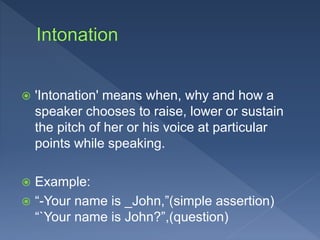
 'Intonation' means when, why and how a
speaker chooses to raise, lower or sustain
the pitch of her or his voice at particular
points while speaking.
 Example:
 “-Your name is _John,”(simple assertion)
“`Your name is John?”,(question)
 It is a part of super segmental phonology.
 Intonation is a term used to refer to the
distinctive use of different patterns of pitch
that carry meaningful information
 Listening somebody speaking without paying
attention to the words: the melody you hear
is the intonation.
 It is necessary that the rises and falls must
be linguistically significant.
 And speaker does have control over his
pitch.
 For instance, due to the irregular movement
of speaker, he may have sudden rises and
falls in speech which cannot be controlled.
The difference in pitch is not significant
 Tone is the major pitch movement within the
tone unit. Theoverall behavior of pitch is “tone”
choice of pitch movement.
 The meaning component deriving from tone
does not attach to the word level only but to the
complete tone unit.
 The communication value of prominence and
tone choice depends on interaction between
listener and speaker.
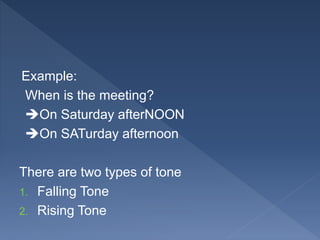
Example:
When is the meeting?
On Saturday afterNOON
On SATurday afternoon
There are two types of tone
1. Falling Tone
2. Rising Tone
 These glides falling and rising occurs with in
connected speech.
 In single word, it occurs with in syllables.
 English is not tone language because
different tones make no difference in
meanings.
 But chinese is a tone language.
θæŋk ju


Intonation

  • 2.
     'Intonation' meanswhen, why and how a speaker chooses to raise, lower or sustain the pitch of her or his voice at particular points while speaking.  Example:  “-Your name is _John,”(simple assertion) “`Your name is John?”,(question)
  • 3.
     It isa part of super segmental phonology.  Intonation is a term used to refer to the distinctive use of different patterns of pitch that carry meaningful information  Listening somebody speaking without paying attention to the words: the melody you hear is the intonation.
  • 4.
     It isnecessary that the rises and falls must be linguistically significant.  And speaker does have control over his pitch.  For instance, due to the irregular movement of speaker, he may have sudden rises and falls in speech which cannot be controlled. The difference in pitch is not significant
  • 5.
     Tone isthe major pitch movement within the tone unit. Theoverall behavior of pitch is “tone” choice of pitch movement.  The meaning component deriving from tone does not attach to the word level only but to the complete tone unit.  The communication value of prominence and tone choice depends on interaction between listener and speaker.
  • 6.
    Example: When is themeeting? On Saturday afterNOON On SATurday afternoon There are two types of tone 1. Falling Tone 2. Rising Tone
  • 7.
     These glidesfalling and rising occurs with in connected speech.  In single word, it occurs with in syllables.  English is not tone language because different tones make no difference in meanings.  But chinese is a tone language.
  • 8.