INTONATION   Presented To: SIR SOHAIL FALAK SHER Presented By: Muhammad Sajid us Salam Mphil Linguistics The Islamia University Bahawalpur [email_address]
INTONATION Introduction  Linguistics is concerned primarily with the spoken word. Language is first and foremost a spoken thing not a written one. Its appeal is to ear not to the eye. Even, presently, there are some languages, which have no written script. For efficient communication and for proper understanding of the message it is essential to have an understanding of intonation.  The study of intonation went through many changes in the twentieth century.  The most intensive development began during the 1940.  In United States the theory that evolved was based on ‘pitch phonemes’ (Pike. 1945).  It was developed in 1951 and then by Haliday (1967) and consequently a good introduction to the theoretical issues is Cruttenden (1997).  We can divide language into languages which are toned and those which are not, English falls into second category, that is, it is not a tone language.
Stress: Stress is the degree of force with which a sound or syllable or a word is uttered. Pitch: The rate of the vibration of the vocal folds.
Tone languages   All the languages in the world use consonants and vowels to build morphemes, which in turn join together to form words.  Thus the English word ‘me’ is made up of a nasal consonant followed by a high vowel.  If we change the consonant to a/b/ we would get a different word, ‘be’, and if we change the vowel to a low vowel, we would also get a different words, ‘ma’.  We may pronounce the word ‘ma’ with various pitch patterns, depending on the occasion. We may pronounce it with high pitch if we are emphatic, we may say it with a rising pitch in a question etc.
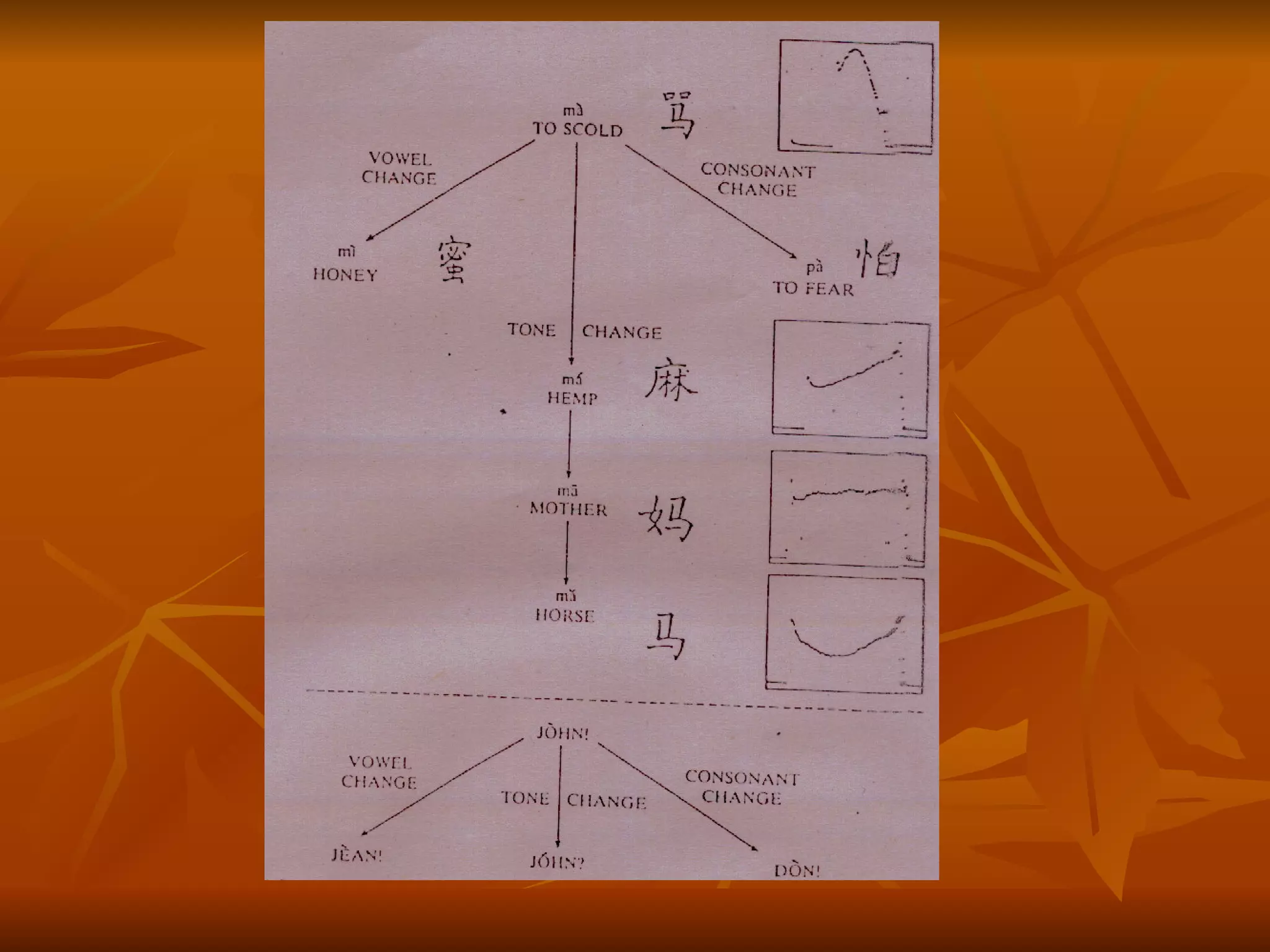
But these different pitch patterns do not alter the word in the way that changing a consonant or changing a vowel does.  These different pitch patterns that do not change but merely add to the basic meaning of words are called intonation.  Yet there are some languages in the world that use pitch patterns to build morphemes in the same way consonant and vowels are used. The best known such language is Chinese, as illustrated in the figure below  (Wang 1973).
 
As the figure shows, the syllable ‘ma’ when pronounced with a falling pitch patterns means, ‘to scold’.  When pronounced with a rising pattern, the meaning is ‘hemp’, when pronounced with a high level pattern, the meaning is ‘mother’ as in some dialects of English, and lastly, when pronounced with a low dipping pattern, the meaning is ‘horse’.  When pitch patterns are used in this lexical capacity i.e. to build word and morphemes much as consonants and vowels do, they are called tones.  And languages that use tones in this way are called tone languages.  English is not tone language because different tones make no difference in meanings.  However, it certainly gives different meanings when different parts/syllables of the same words are stressed.
Tone – unit and the structure of tone unit: Tone: Tone is the overall behaviour of pitch.  Pitch:  Pitch is frequency of vibration of vocal cords.  Tone unit: For the purpose of analyzing intonation, a unit greater than syllable one syllable. Usually tone – unit is always composed of more than one syllable.
Analysis of Utterances to Understand Tone – Unit   One syllable utterance  You This is one tone unit.  Note: Underlined syllable carry tone.  Three Syllable Utterance  Is it  you? This is one tone unit.  Note: the underlined syllable have more prominence.
The Structure of Tone Unit  The structure of tone unit comprises of: Tonic syllable  (TS) Head  (H) Pre-Head  (PH) Tail  (T)
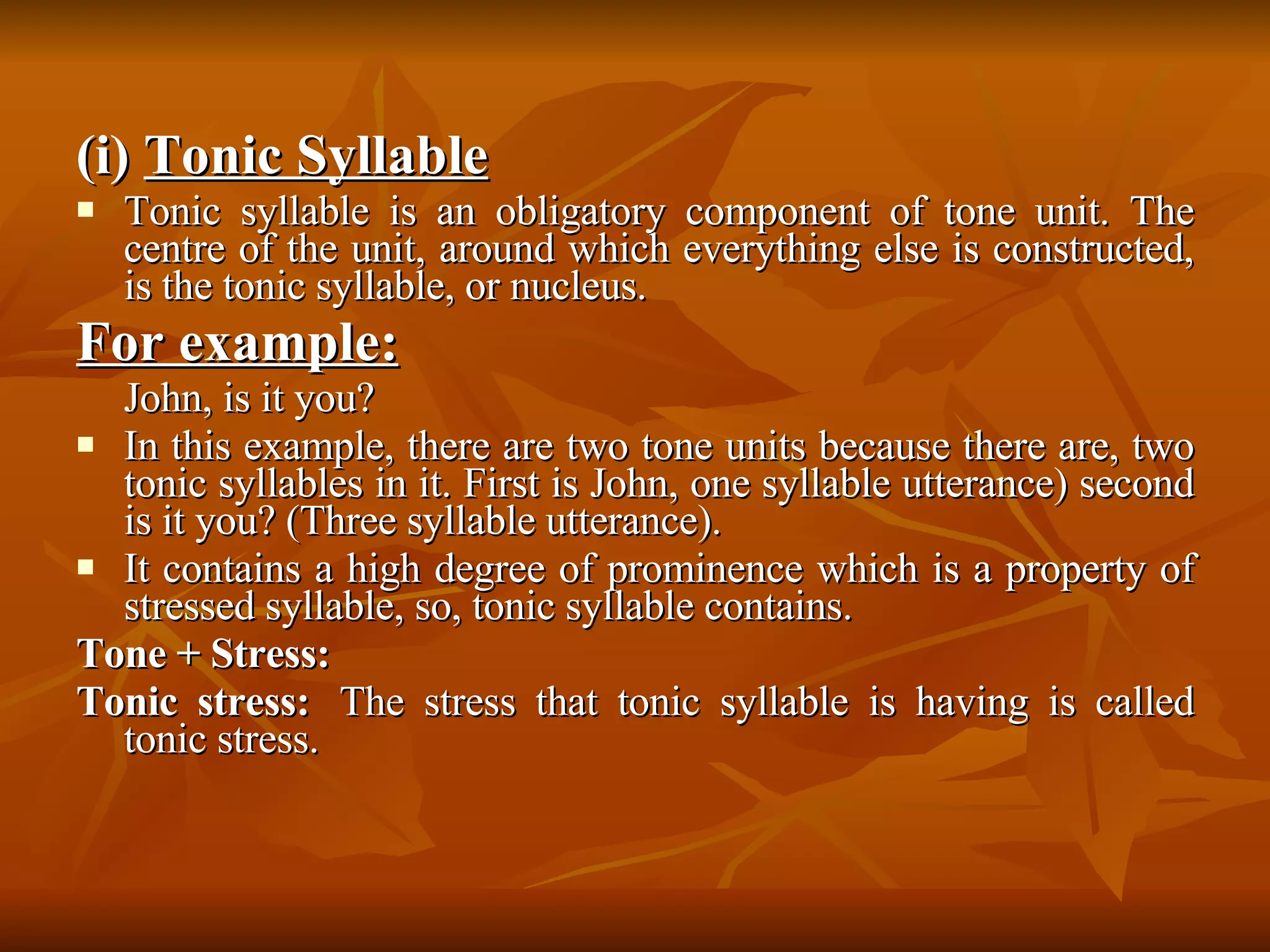
(i)  Tonic Syllable   Tonic syllable is an obligatory component of tone unit. The centre of the unit, around which everything else is constructed, is the tonic syllable, or nucleus. For example: John, is it you? In this example, there are two tone units because there are, two tonic syllables in it. First is John, one syllable utterance) second is it you? (Three syllable utterance).  It contains a high degree of prominence which is a property of stressed syllable, so, tonic syllable contains.  Tone + Stress: Tonic stress: The stress that tonic syllable is having is called tonic stress.
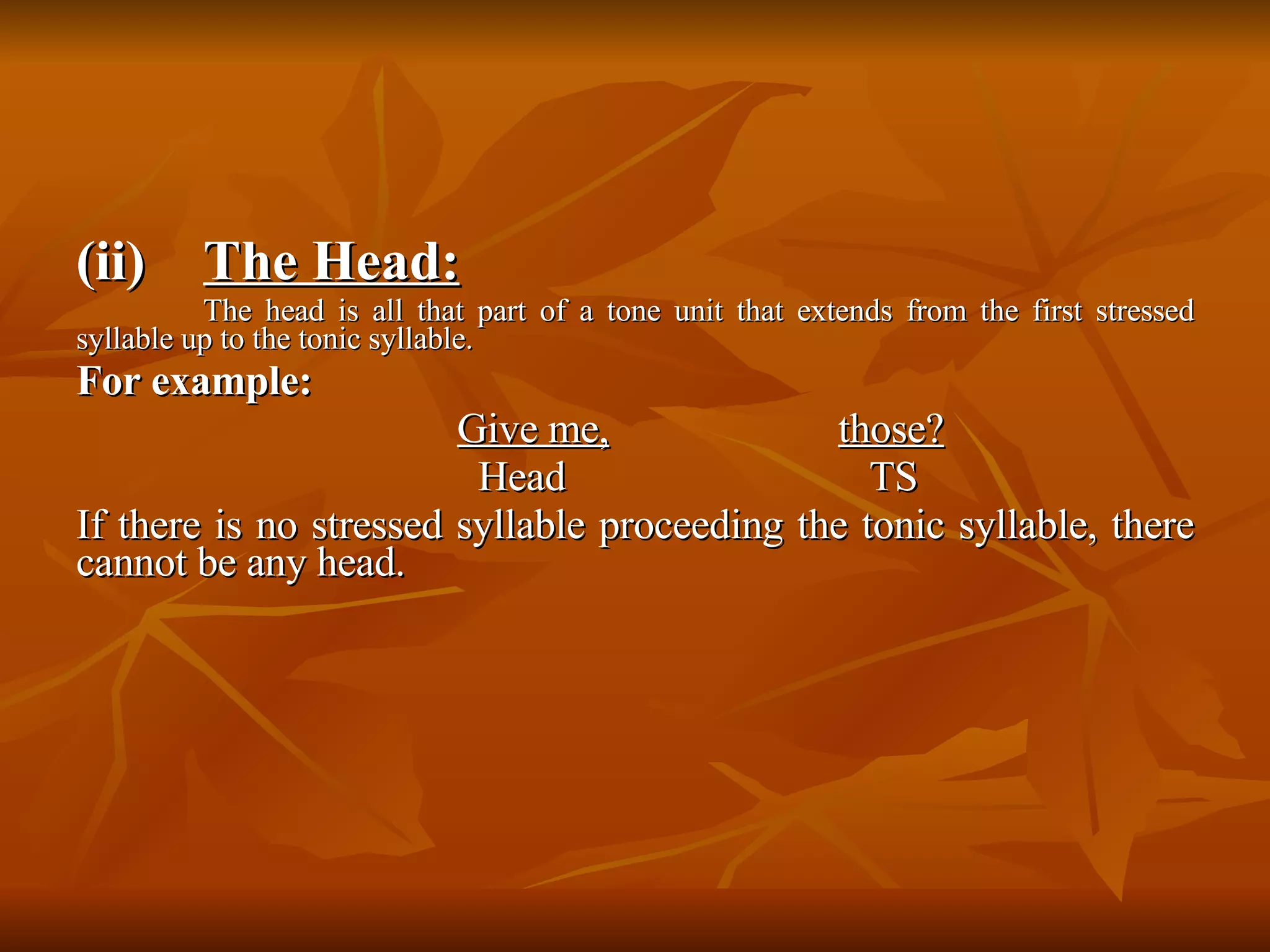
(ii) The Head: The head is all that part of a tone unit that extends from the first stressed syllable up to the tonic syllable.  For example: Give me,   those?   Head      TS If there is no stressed syllable proceeding the tonic syllable, there cannot be any head.
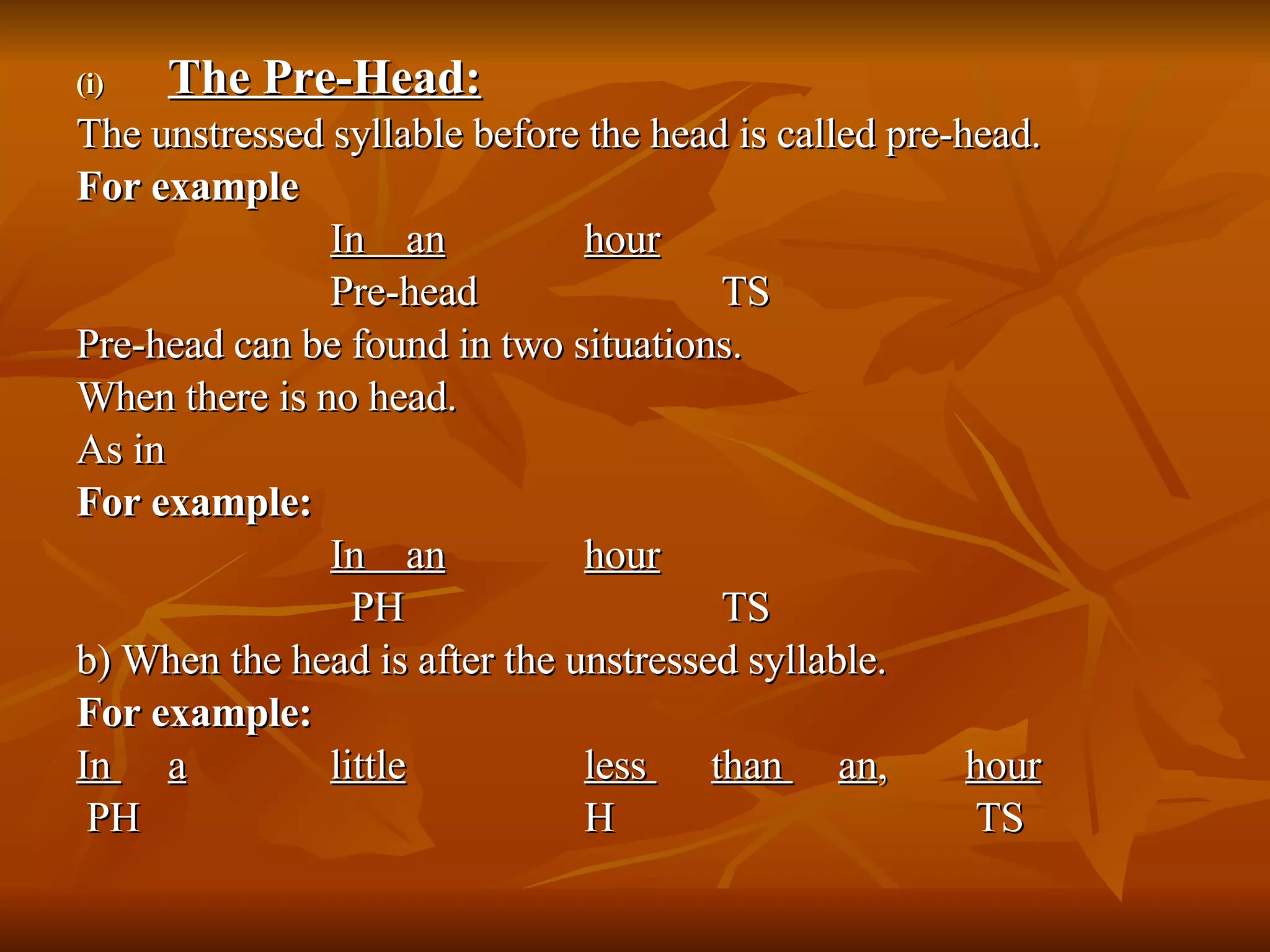
The Pre-Head: The unstressed syllable before the head is called pre-head.  For example In  an   hour Pre-head  TS Pre-head can be found in two situations.  When there is no head.  As in For example: In  an   hour   PH    TS b) When the head is after the unstressed syllable.  For example:  In  a   little less  than  an ,  hour   PH    H  TS
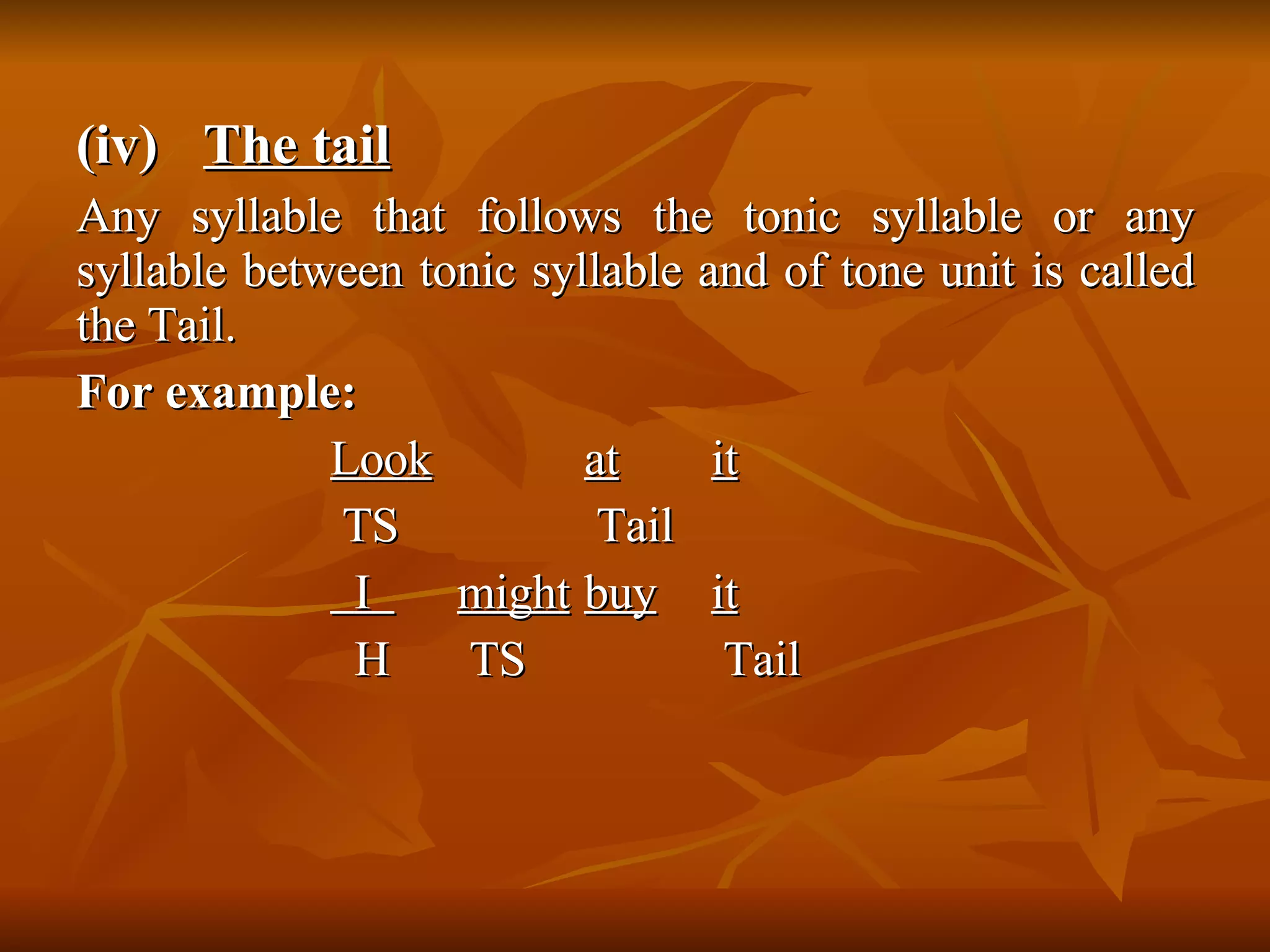
(iv) The tail Any syllable that follows the tonic syllable or any syllable between tonic syllable and of tone unit is called the Tail.  For example: Look at it   TS  Tail    I  might   buy it   H  TS  Tail
Kinds of Tones and their function  Linguistics are not in complete agreement about the precise number of tones which are used by speakers of English some distinguish as many as eight, others work with four or five. The following tones are the ones most usually encountered.  Fall  Rise – fall  Fall – rise  Rise  Level
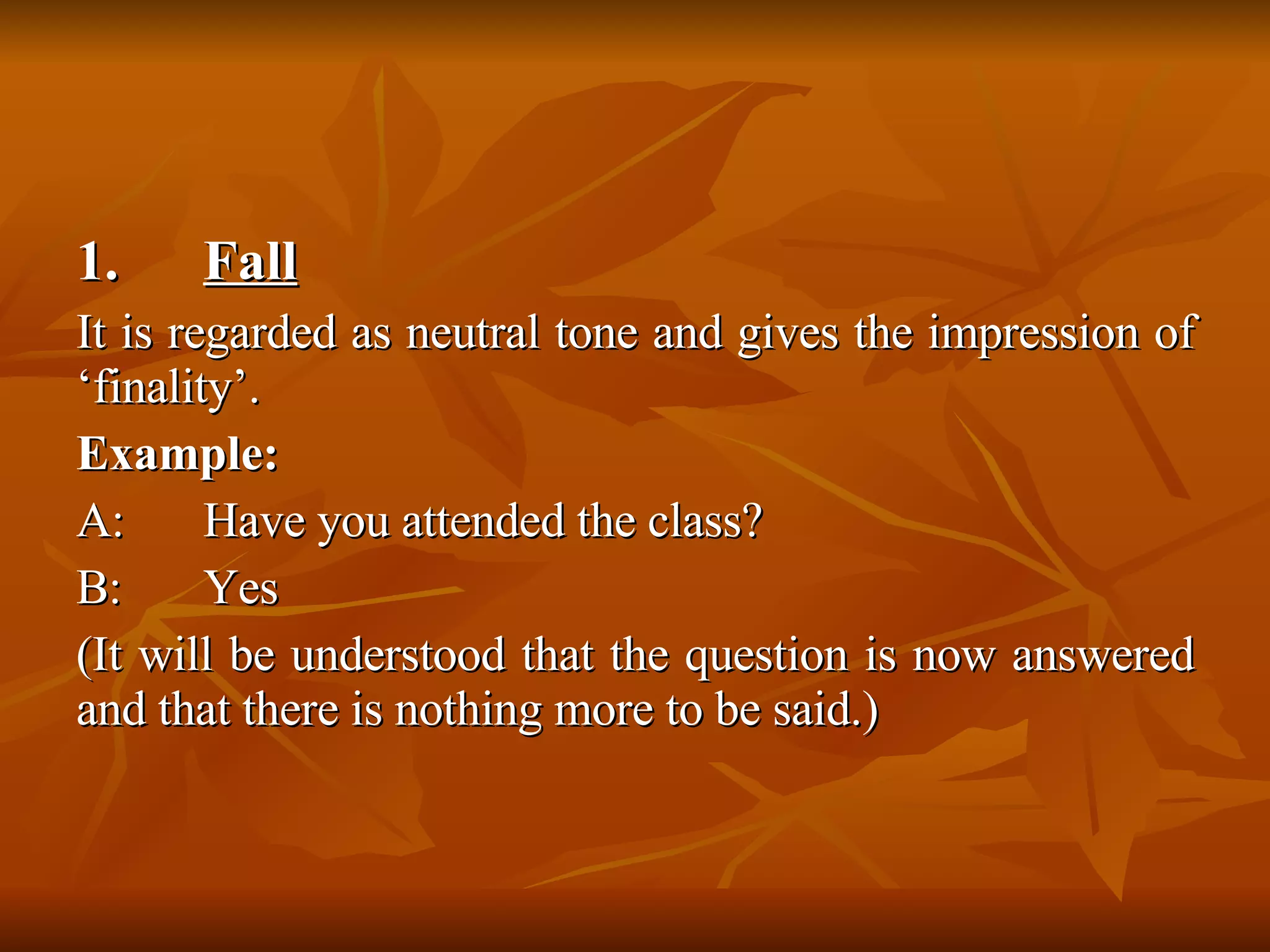
1.  Fall   It is regarded as neutral tone and gives the impression of ‘finality’. Example: A: Have you attended the class? B: Yes  (It will be understood that the question is now answered and that there is nothing more to be said.)
2.  Rise This tone conveys an impression that something more is to follow.  For example: A: (wishing to attract B’S attention.) Excuse me.  B: Yes  (B’S reply is, perhaps, equivalent to what do you want?) A: Do you know John Smith? B: Yes  (Inviting A to continue with what she intends to say about John Smith. The response with a fall would make it difficult for A to continue).
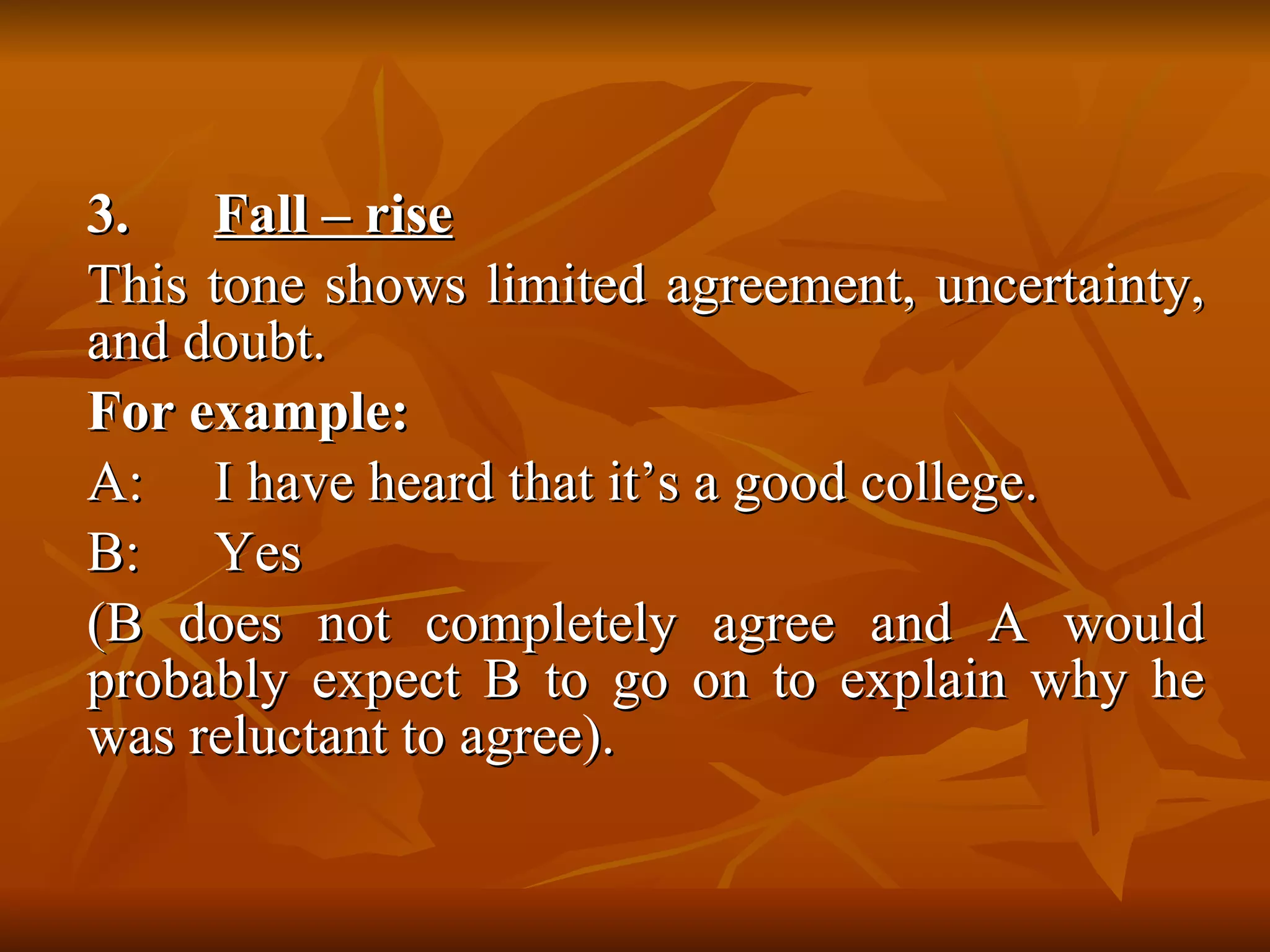
3.  Fall – rise   This tone shows limited agreement, uncertainty, and doubt. For example: A: I have heard that it’s a good college.  B: Yes  (B does not completely agree and A would probably expect B to go on to explain why he was reluctant to agree).
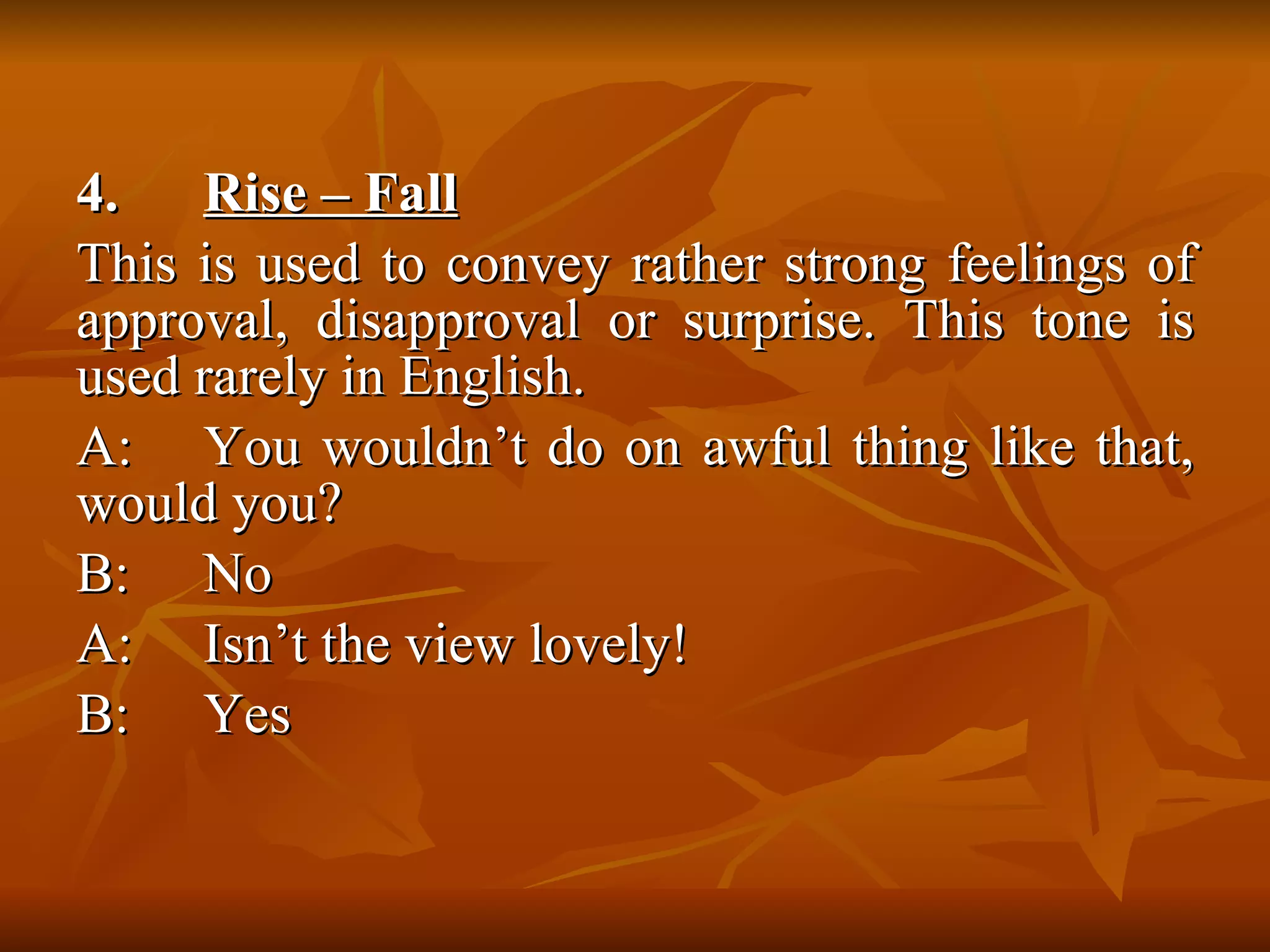
4.  Rise – Fall   This is used to convey rather strong feelings of approval, disapproval or surprise. This tone is used rarely in English.  A: You wouldn’t do on awful thing like that, would you? B: No A: Isn’t the view lovely! B: Yes
5.  Level   This tone is neutral and uninterested.  High level  Yes  No  Low level  Yes  No It is used in English language in a restricted context. It almost always conveys a feeling of routine, uninteresting or boring.  For example: A teacher calling names of the pupils from a register.
Uses of Tones   The tone-units and kinds of tone – units have already been discussed. Now we will try to establish a correlation between the various types of sentences (tone – units or tone groups) and the tones with which they are generally said. Thus, we will see which types of tones are used to say which type of tone units.
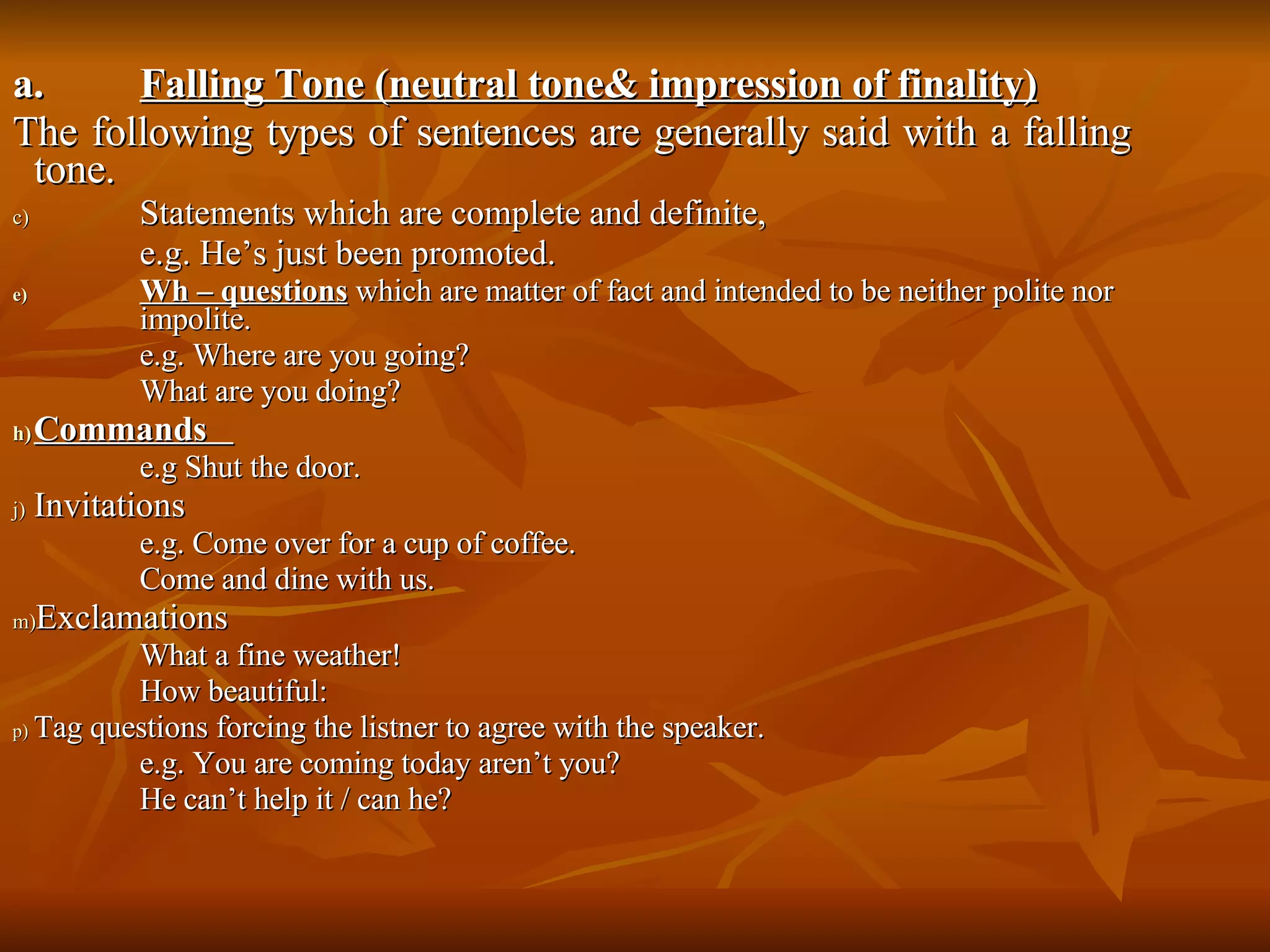
a.  Falling Tone (neutral tone& impression of finality) The following types of sentences are generally said with a falling tone.  Statements which are complete and definite,  e.g. He’s just been promoted.  Wh – questions  which are matter of fact and intended to be neither polite nor  impolite. e.g. Where are you going? What are you doing? Commands  e.g Shut the door. Invitations  e.g. Come over for a cup of coffee.  Come and dine with us.  Exclamations  What a fine weather! How beautiful: Tag questions forcing the listner to agree with the speaker.  e.g. You are coming today aren’t you? He can’t help it / can he?
Rising Tone  (something more is to follow) The rising tone is used with the following tone – groups: Yes / No type questions e.g. Was he present yesterday? Statements intended to be a questions.  e.g. you won’t come? He isn’t going.  Non – terminal tone group.  e.g. if you don’t come in time …………. (I’ll have) Terminal tone group said as an after thought.  e.g. you’re going away/I suppose.
Request  e.g. pass me the dish, please.  Command intended to sound like a request.  e.g. close the door,  Don’t be late.  Wh – questions showing politeness friendliness, warmth, personal interest.  e.g. How are you? What is your name, child?  Repetition questions which repeats some one else’s question or wants him to repeat some information.  e.g. what did I say?
Incomplete statement leading to a following tone group. Statement intended to be a ‘correction’ of the information received.  e.g (he has three sons) He has four Statement intended to be a warning reproach or to express concern.  e.g you, mustn’t go like this (warning) Be careful (concern) Imperative meant to be a pleading request.  e.g don’t get on my nerve Statement which shows a kind of reservation on the part of the speaker.  He’s good (I can’t trust him) I can do it tomorrow (but not today) c. Falling-Rising Tone (limited agreement uncertainity and doubt) The following tone groups are generally said with the falling-rising tone:
d.  Rising-Falling Tone (strong feelings of approval, disapproval or surprise) The following tone groups are said with the rising-falling tone: Statement showing enthusiastic agreement.  e.g Yes, of course Question showing suspicion, indignation incredulity, or mockery.  e.g what has he been doing? (Suspicion) Will he be able to do it? (Mocking, suspicion) Imperative expression petulance, haughtiness e.g Go and break your head (haughtiness) Exclamation expressing sarcasm, irony.  e.g How good for you (sarcasm) oh, really (sarcasm)
Intonation  No completely satisfactory definition can be given for this term but give a rough idea  J. Sethi  defines it as: Different pitches of the voice combine to form patterns of pitch variation, or tones, which together constitute the intonation of the language.  The intonation of the language’ thus’ refers to the rise and fall of the pitch of the voice when we speak. One of the most important tasks in analyzing intonation is to listen to speaker’s pitch and recognize the tone.  Speakers are said select from a choice of tones according to how they want the utterance to be heard.  Tone is carried by the tonic syllable whereas intonation is carried by the tone unit. A tone unit is consisted of  Pre-head, head, tonic syllable, and a tail.  (PH) (H)  TS  (T)
CONCLUSION So to conclude the whole discussion the importance of intonation has been veiled of. A learner who learns a new language has not only to grasp the grammar of that language but also the intonation pattern to prove himself a good communicator.  In the twentieth century, it was for a long time hoped that scientific study of intonation would make it possible to state what the function of each different aspect of intonation was, and that foreign learner could then be taught rules to enable them to use intonation in the way that native speakers use it. Few people now believe this to be possible. But it is certainly possible to produce a few general rules. However these rules are certainly not adequate as a complete practical guide to how to use English intonation. But at least by learning something there must be some improvement and a better performance.

Intonation

  • 1.
    INTONATION Presented To: SIR SOHAIL FALAK SHER Presented By: Muhammad Sajid us Salam Mphil Linguistics The Islamia University Bahawalpur [email_address]
  • 2.
    INTONATION Introduction Linguistics is concerned primarily with the spoken word. Language is first and foremost a spoken thing not a written one. Its appeal is to ear not to the eye. Even, presently, there are some languages, which have no written script. For efficient communication and for proper understanding of the message it is essential to have an understanding of intonation. The study of intonation went through many changes in the twentieth century. The most intensive development began during the 1940. In United States the theory that evolved was based on ‘pitch phonemes’ (Pike. 1945). It was developed in 1951 and then by Haliday (1967) and consequently a good introduction to the theoretical issues is Cruttenden (1997). We can divide language into languages which are toned and those which are not, English falls into second category, that is, it is not a tone language.
  • 3.
    Stress: Stress isthe degree of force with which a sound or syllable or a word is uttered. Pitch: The rate of the vibration of the vocal folds.
  • 4.
    Tone languages All the languages in the world use consonants and vowels to build morphemes, which in turn join together to form words. Thus the English word ‘me’ is made up of a nasal consonant followed by a high vowel. If we change the consonant to a/b/ we would get a different word, ‘be’, and if we change the vowel to a low vowel, we would also get a different words, ‘ma’. We may pronounce the word ‘ma’ with various pitch patterns, depending on the occasion. We may pronounce it with high pitch if we are emphatic, we may say it with a rising pitch in a question etc.
  • 5.
    But these differentpitch patterns do not alter the word in the way that changing a consonant or changing a vowel does. These different pitch patterns that do not change but merely add to the basic meaning of words are called intonation. Yet there are some languages in the world that use pitch patterns to build morphemes in the same way consonant and vowels are used. The best known such language is Chinese, as illustrated in the figure below (Wang 1973).
  • 6.
  • 7.
    As the figureshows, the syllable ‘ma’ when pronounced with a falling pitch patterns means, ‘to scold’. When pronounced with a rising pattern, the meaning is ‘hemp’, when pronounced with a high level pattern, the meaning is ‘mother’ as in some dialects of English, and lastly, when pronounced with a low dipping pattern, the meaning is ‘horse’. When pitch patterns are used in this lexical capacity i.e. to build word and morphemes much as consonants and vowels do, they are called tones. And languages that use tones in this way are called tone languages. English is not tone language because different tones make no difference in meanings. However, it certainly gives different meanings when different parts/syllables of the same words are stressed.
  • 8.
    Tone – unitand the structure of tone unit: Tone: Tone is the overall behaviour of pitch. Pitch: Pitch is frequency of vibration of vocal cords. Tone unit: For the purpose of analyzing intonation, a unit greater than syllable one syllable. Usually tone – unit is always composed of more than one syllable.
  • 9.
    Analysis of Utterancesto Understand Tone – Unit One syllable utterance You This is one tone unit. Note: Underlined syllable carry tone. Three Syllable Utterance Is it you? This is one tone unit. Note: the underlined syllable have more prominence.
  • 10.
    The Structure ofTone Unit The structure of tone unit comprises of: Tonic syllable (TS) Head (H) Pre-Head (PH) Tail (T)
  • 11.
    (i) TonicSyllable Tonic syllable is an obligatory component of tone unit. The centre of the unit, around which everything else is constructed, is the tonic syllable, or nucleus. For example: John, is it you? In this example, there are two tone units because there are, two tonic syllables in it. First is John, one syllable utterance) second is it you? (Three syllable utterance). It contains a high degree of prominence which is a property of stressed syllable, so, tonic syllable contains. Tone + Stress: Tonic stress: The stress that tonic syllable is having is called tonic stress.
  • 12.
    (ii) The Head:The head is all that part of a tone unit that extends from the first stressed syllable up to the tonic syllable. For example: Give me, those? Head TS If there is no stressed syllable proceeding the tonic syllable, there cannot be any head.
  • 13.
    The Pre-Head: Theunstressed syllable before the head is called pre-head. For example In an hour Pre-head TS Pre-head can be found in two situations. When there is no head. As in For example: In an hour PH TS b) When the head is after the unstressed syllable. For example: In a little less than an , hour PH H TS
  • 14.
    (iv) The tailAny syllable that follows the tonic syllable or any syllable between tonic syllable and of tone unit is called the Tail. For example: Look at it TS Tail I might buy it H TS Tail
  • 15.
    Kinds of Tonesand their function Linguistics are not in complete agreement about the precise number of tones which are used by speakers of English some distinguish as many as eight, others work with four or five. The following tones are the ones most usually encountered. Fall Rise – fall Fall – rise Rise Level
  • 16.
    1. Fall It is regarded as neutral tone and gives the impression of ‘finality’. Example: A: Have you attended the class? B: Yes (It will be understood that the question is now answered and that there is nothing more to be said.)
  • 17.
    2. RiseThis tone conveys an impression that something more is to follow. For example: A: (wishing to attract B’S attention.) Excuse me. B: Yes (B’S reply is, perhaps, equivalent to what do you want?) A: Do you know John Smith? B: Yes (Inviting A to continue with what she intends to say about John Smith. The response with a fall would make it difficult for A to continue).
  • 18.
    3. Fall– rise This tone shows limited agreement, uncertainty, and doubt. For example: A: I have heard that it’s a good college. B: Yes (B does not completely agree and A would probably expect B to go on to explain why he was reluctant to agree).
  • 19.
    4. Rise– Fall This is used to convey rather strong feelings of approval, disapproval or surprise. This tone is used rarely in English. A: You wouldn’t do on awful thing like that, would you? B: No A: Isn’t the view lovely! B: Yes
  • 20.
    5. Level This tone is neutral and uninterested. High level Yes No Low level Yes No It is used in English language in a restricted context. It almost always conveys a feeling of routine, uninteresting or boring. For example: A teacher calling names of the pupils from a register.
  • 21.
    Uses of Tones The tone-units and kinds of tone – units have already been discussed. Now we will try to establish a correlation between the various types of sentences (tone – units or tone groups) and the tones with which they are generally said. Thus, we will see which types of tones are used to say which type of tone units.
  • 22.
    a. FallingTone (neutral tone& impression of finality) The following types of sentences are generally said with a falling tone. Statements which are complete and definite, e.g. He’s just been promoted. Wh – questions which are matter of fact and intended to be neither polite nor impolite. e.g. Where are you going? What are you doing? Commands e.g Shut the door. Invitations e.g. Come over for a cup of coffee. Come and dine with us. Exclamations What a fine weather! How beautiful: Tag questions forcing the listner to agree with the speaker. e.g. You are coming today aren’t you? He can’t help it / can he?
  • 23.
    Rising Tone (something more is to follow) The rising tone is used with the following tone – groups: Yes / No type questions e.g. Was he present yesterday? Statements intended to be a questions. e.g. you won’t come? He isn’t going. Non – terminal tone group. e.g. if you don’t come in time …………. (I’ll have) Terminal tone group said as an after thought. e.g. you’re going away/I suppose.
  • 24.
    Request e.g.pass me the dish, please. Command intended to sound like a request. e.g. close the door, Don’t be late. Wh – questions showing politeness friendliness, warmth, personal interest. e.g. How are you? What is your name, child? Repetition questions which repeats some one else’s question or wants him to repeat some information. e.g. what did I say?
  • 25.
    Incomplete statement leadingto a following tone group. Statement intended to be a ‘correction’ of the information received. e.g (he has three sons) He has four Statement intended to be a warning reproach or to express concern. e.g you, mustn’t go like this (warning) Be careful (concern) Imperative meant to be a pleading request. e.g don’t get on my nerve Statement which shows a kind of reservation on the part of the speaker. He’s good (I can’t trust him) I can do it tomorrow (but not today) c. Falling-Rising Tone (limited agreement uncertainity and doubt) The following tone groups are generally said with the falling-rising tone:
  • 26.
    d. Rising-FallingTone (strong feelings of approval, disapproval or surprise) The following tone groups are said with the rising-falling tone: Statement showing enthusiastic agreement. e.g Yes, of course Question showing suspicion, indignation incredulity, or mockery. e.g what has he been doing? (Suspicion) Will he be able to do it? (Mocking, suspicion) Imperative expression petulance, haughtiness e.g Go and break your head (haughtiness) Exclamation expressing sarcasm, irony. e.g How good for you (sarcasm) oh, really (sarcasm)
  • 27.
    Intonation Nocompletely satisfactory definition can be given for this term but give a rough idea J. Sethi defines it as: Different pitches of the voice combine to form patterns of pitch variation, or tones, which together constitute the intonation of the language. The intonation of the language’ thus’ refers to the rise and fall of the pitch of the voice when we speak. One of the most important tasks in analyzing intonation is to listen to speaker’s pitch and recognize the tone. Speakers are said select from a choice of tones according to how they want the utterance to be heard. Tone is carried by the tonic syllable whereas intonation is carried by the tone unit. A tone unit is consisted of Pre-head, head, tonic syllable, and a tail. (PH) (H) TS (T)
  • 28.
    CONCLUSION So toconclude the whole discussion the importance of intonation has been veiled of. A learner who learns a new language has not only to grasp the grammar of that language but also the intonation pattern to prove himself a good communicator. In the twentieth century, it was for a long time hoped that scientific study of intonation would make it possible to state what the function of each different aspect of intonation was, and that foreign learner could then be taught rules to enable them to use intonation in the way that native speakers use it. Few people now believe this to be possible. But it is certainly possible to produce a few general rules. However these rules are certainly not adequate as a complete practical guide to how to use English intonation. But at least by learning something there must be some improvement and a better performance.