Verbal and
Nonverbal
Communication
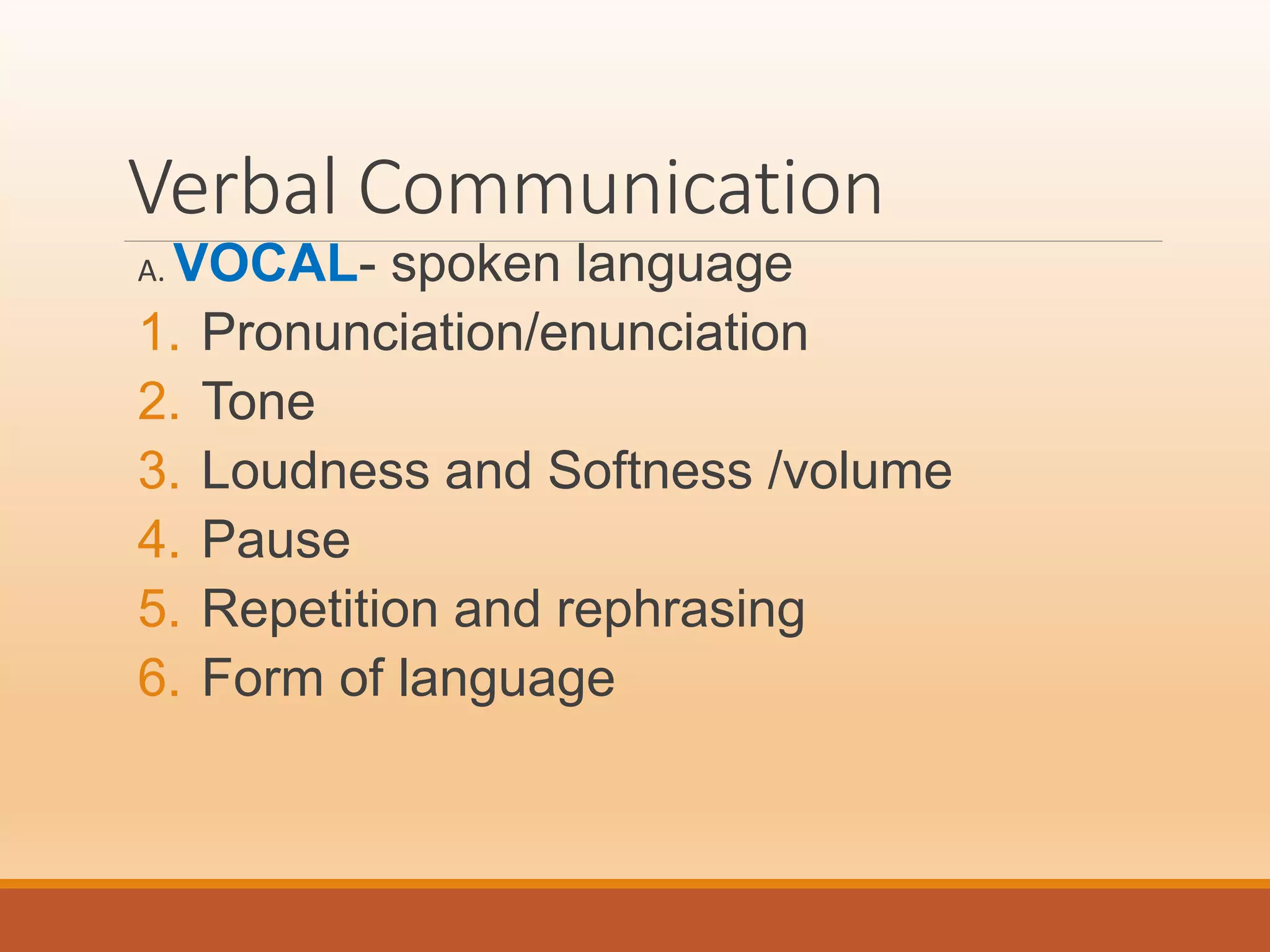
Verbal Communication
A. VOCAL- spoken language
1. Pronunciation/enunciation
2. Tone
3. Loudness and Softness /volume
4. Pause
5. Repetition and rephrasing
6. Form of language
Verbal Communication
B. NONVOCAL
1. sign language
2.finger spelling
3. Braille
SEMIOTICS( Semiology)- theory
or study of signs
Verbal Communication
3 Types of Signs:
1. Symbol- stands in place of an object.
◦Ex. Flag-patriotism, national pride
◦Cross, water
◦Person- Mother Theresa-compassion
◦Word or Phrase- “Allaho Akbar”
Verbal Communication
2. Index- also called natural signs- the
relationship between the word and
what it signifies is natural.
◦Ex. Smoke- fire
3. Icon- representation of an object
that produces mental image of the
object represented.
Non-Verbal Communication
I. VOCAL- Paralanguage( the science behind our
tone)
3 ELEMENTS:
◦Speed- speech pace
◦Pitch-indicates the lowness and highness of
voice
◦Volume- power of loudness of your voice
II. NONVOCAL
Nonverbal Communication
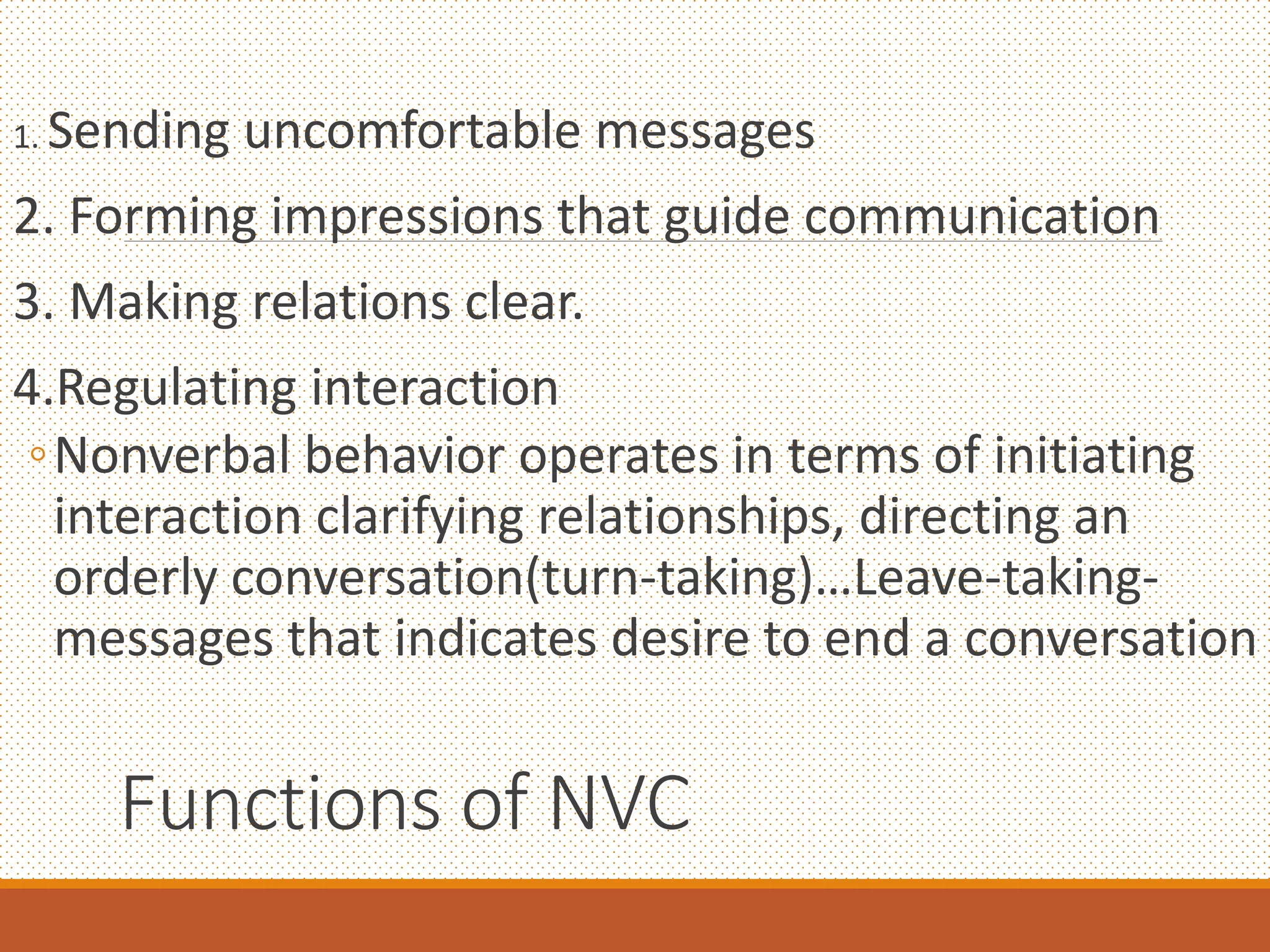
Functions of NVC
1. Sending uncomfortable messages
2. Forming impressions that guide communication
3. Making relations clear.
4.Regulating interaction
◦Nonverbal behavior operates in terms of initiating
interaction clarifying relationships, directing an
orderly conversation(turn-taking)…Leave-taking-
messages that indicates desire to end a conversation
Attributes of Effective Communication
Bulan and De Leon(2002)
◦1. clear, accurate, simple, understandable, and not
redundant.
2. Direct and Conversational. Use of short words.
e.g. phone- telephone; Use personal pronoun to
help identify with your listeners. i.e., "I dream of",
"We will survive,” or “Our World”.
3. Use shorter sentence length. Use simple but
graphic words.
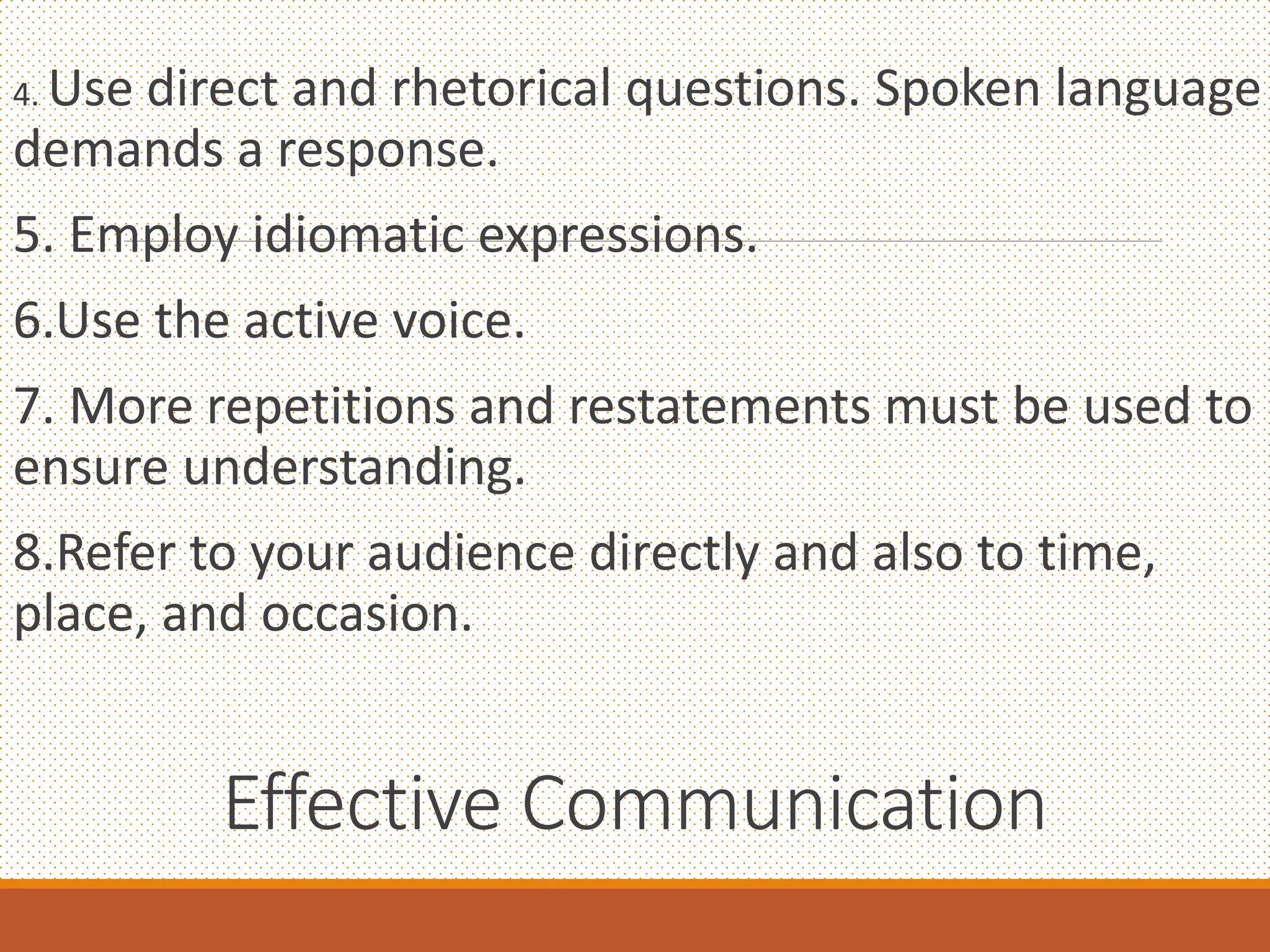
Effective Communication
4. Use direct and rhetorical questions. Spoken language
demands a response.
5. Employ idiomatic expressions.
6.Use the active voice.
7. More repetitions and restatements must be used to
ensure understanding.
8.Refer to your audience directly and also to time,
place, and occasion.
9. It is vivid as it appeals to the senses of sight, touch,
hearing, smell, and taste.
Effective oral language must be appropriate to the
audience, occasion, speech purpose, and speaker’s
personality:
A. Audience
◦Field of experience of your audience
B. Occasion- is it solemn or humurous?
◦Is it formal or casual?
Effective Communication
C. Purpose –Informative discourse is characterized by
the accuracy of vocabulary, explanation of technical
terms, and concreteness of language. Persuasive
discourse focuses on feelings, changing emotions, and
attitudes.
D. Speaker- it should reflect your character, attitudes,
intellectual background, and social background.
Culture and Communication
Communication shapes culture, and
culture shapes communication
CULTURE
◦refers to the complex collection of knowledge,
folklore, language, rules, rituals, habits, lifestyles,
attitudes, beliefs, and customs that link and give a
common identity to a particular people at a specific
point in time.
◦is defined by the way people communicate, interact,
how information is shared and how decisions are
made.
Culture and Communication
Culture is basically a social group’s system of
meanings.( German, Ehninger, and Monroe,2001)
3 Dimensions of Social Life
1.Culture as Lived- culture as we live it defined by
demographics such as gender, sexual orientation,
ethnic background, age, nationality, educational
background, disability, and socio-economic status
Culture and Communication
2. Culture as Taught
◦Reflects social values and orientations
a. Ideology-refers to a set of political beliefs or
a set of ideas that characterize a particular
culture.
b. Hegemony-
The great
scholar Stuart Hall
(1985) said
“hegemony is
dominance and
subordination in the
field of relation
structures by
power”
Hegemony
Ex. Relationships between socio-economic
classes( rich and poor) or sexes (male and
female) are maintained by acceptance of
one’s status and sometimes even by direct
force.
3. Culture as Performed
◦refers to how we communicate with each
other.
◦refers to cultural rules and social roles. Ideas,
attitudes, values, and social character are
incorporated in communication acts through
the process of embodiment.
Reenactment- you behave according to culture’s
rules.
Intercultural Communication
◦Refers to situated communication among
persons of different cultural and linguistic
background.
Hindrances in the exchange of ideas:
a. Knowledge
b. Skills
c. Attitudes
Conducting Intercultural
Communication properly
A. Be conscious of your own culture.
B. Be open- minded towards other
cultures.
C. Immerse yourself in the practices of
other cultures.
Source
https://www.skillsyouneed.com/ips/nonverbal-communication.html

Verbal and nonverbal communication

  • 1.
  • 2.
    Verbal Communication A. VOCAL-spoken language 1. Pronunciation/enunciation 2. Tone 3. Loudness and Softness /volume 4. Pause 5. Repetition and rephrasing 6. Form of language
  • 3.
    Verbal Communication B. NONVOCAL 1.sign language 2.finger spelling 3. Braille SEMIOTICS( Semiology)- theory or study of signs
  • 4.
    Verbal Communication 3 Typesof Signs: 1. Symbol- stands in place of an object. ◦Ex. Flag-patriotism, national pride ◦Cross, water ◦Person- Mother Theresa-compassion ◦Word or Phrase- “Allaho Akbar”
  • 5.
    Verbal Communication 2. Index-also called natural signs- the relationship between the word and what it signifies is natural. ◦Ex. Smoke- fire 3. Icon- representation of an object that produces mental image of the object represented.
  • 6.
    Non-Verbal Communication I. VOCAL-Paralanguage( the science behind our tone) 3 ELEMENTS: ◦Speed- speech pace ◦Pitch-indicates the lowness and highness of voice ◦Volume- power of loudness of your voice II. NONVOCAL
  • 7.
  • 11.
    Functions of NVC 1.Sending uncomfortable messages 2. Forming impressions that guide communication 3. Making relations clear. 4.Regulating interaction ◦Nonverbal behavior operates in terms of initiating interaction clarifying relationships, directing an orderly conversation(turn-taking)…Leave-taking- messages that indicates desire to end a conversation
  • 12.
    Attributes of EffectiveCommunication Bulan and De Leon(2002) ◦1. clear, accurate, simple, understandable, and not redundant. 2. Direct and Conversational. Use of short words. e.g. phone- telephone; Use personal pronoun to help identify with your listeners. i.e., "I dream of", "We will survive,” or “Our World”. 3. Use shorter sentence length. Use simple but graphic words.
  • 13.
    Effective Communication 4. Usedirect and rhetorical questions. Spoken language demands a response. 5. Employ idiomatic expressions. 6.Use the active voice. 7. More repetitions and restatements must be used to ensure understanding. 8.Refer to your audience directly and also to time, place, and occasion.
  • 14.
    9. It isvivid as it appeals to the senses of sight, touch, hearing, smell, and taste. Effective oral language must be appropriate to the audience, occasion, speech purpose, and speaker’s personality: A. Audience ◦Field of experience of your audience B. Occasion- is it solemn or humurous? ◦Is it formal or casual?
  • 15.
    Effective Communication C. Purpose–Informative discourse is characterized by the accuracy of vocabulary, explanation of technical terms, and concreteness of language. Persuasive discourse focuses on feelings, changing emotions, and attitudes. D. Speaker- it should reflect your character, attitudes, intellectual background, and social background.
  • 16.
    Culture and Communication Communicationshapes culture, and culture shapes communication
  • 17.
    CULTURE ◦refers to thecomplex collection of knowledge, folklore, language, rules, rituals, habits, lifestyles, attitudes, beliefs, and customs that link and give a common identity to a particular people at a specific point in time. ◦is defined by the way people communicate, interact, how information is shared and how decisions are made.
  • 18.
    Culture and Communication Cultureis basically a social group’s system of meanings.( German, Ehninger, and Monroe,2001) 3 Dimensions of Social Life 1.Culture as Lived- culture as we live it defined by demographics such as gender, sexual orientation, ethnic background, age, nationality, educational background, disability, and socio-economic status
  • 19.
    Culture and Communication 2.Culture as Taught ◦Reflects social values and orientations a. Ideology-refers to a set of political beliefs or a set of ideas that characterize a particular culture.
  • 20.
    b. Hegemony- The great scholarStuart Hall (1985) said “hegemony is dominance and subordination in the field of relation structures by power”
  • 21.
    Hegemony Ex. Relationships betweensocio-economic classes( rich and poor) or sexes (male and female) are maintained by acceptance of one’s status and sometimes even by direct force.
  • 22.
    3. Culture asPerformed ◦refers to how we communicate with each other. ◦refers to cultural rules and social roles. Ideas, attitudes, values, and social character are incorporated in communication acts through the process of embodiment. Reenactment- you behave according to culture’s rules.
  • 23.
    Intercultural Communication ◦Refers tosituated communication among persons of different cultural and linguistic background. Hindrances in the exchange of ideas: a. Knowledge b. Skills c. Attitudes
  • 24.
    Conducting Intercultural Communication properly A.Be conscious of your own culture. B. Be open- minded towards other cultures. C. Immerse yourself in the practices of other cultures.
  • 25.