Group 1:
Dan Manalo
Shanielle Dannah Ibanez
Burwill Paciteng
Clarisse Tenorio
Why do Chinese dislike milk and milk products?
Why would the Japanese die willingly in a
banzai charge that seems senseless to the
Americans?
Why do some nations trace their lineage
through the father, others through the mother,
still others through both parents?
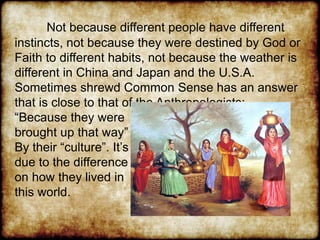
Not because different people have different
instincts, not because they were destined by God or
Faith to different habits, not because the weather is
different in China and Japan and the U.S.A.
Sometimes shrewd Common Sense has an answer
that is close to that of the Anthropologists:
“Because they were
brought up that way”
By their “culture”. It’s
due to the difference
on how they lived in
this world.
WHAT IS ANTHROPOLOGY?
Anthropology, by definition is the study of infinite
curiosity about human beings.
 The term comes from the Greek word anthropos
for “man, human” and logos for “study”.
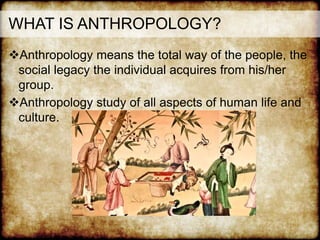
Anthropology means the total way of the people, the
social legacy the individual acquires from his/her
group.
Anthropology study of all aspects of human life and
culture.
WHAT IS ANTHROPOLOGY?
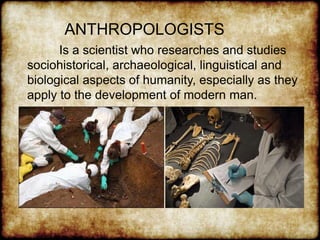
ANTHROPOLOGISTS
Is a scientist who researches and studies
sociohistorical, archaeological, linguistical and
biological aspects of humanity, especially as they
apply to the development of modern man.
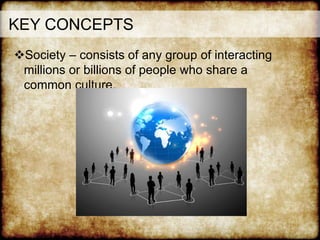
KEY CONCEPTS
Society – consists of any group of interacting
millions or billions of people who share a
common culture.
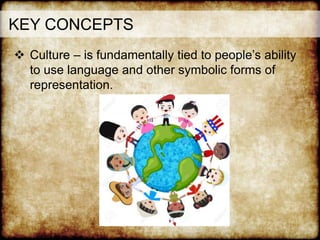
KEY CONCEPTS
 Culture – is fundamentally tied to people’s ability
to use language and other symbolic forms of
representation.
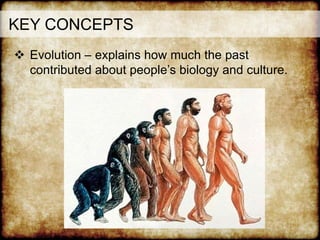
KEY CONCEPTS
 Evolution – explains how much the past
contributed about people’s biology and culture.
FIELDS OF ANTHROPOLOGY
Cultural Anthropology
- Involves the study of how people living in present-
day society and their culture and also studies how
people make their living, how people interact with
each other, what beliefs people hold, and what
institutions organize society.
FIELDS OF ANTHROPOLOGY
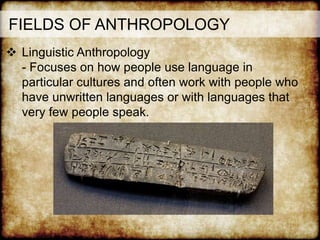
 Linguistic Anthropology
- Focuses on how people use language in
particular cultures and often work with people who
have unwritten languages or with languages that
very few people speak.
FIELDS OF ANTHROPOLOGY
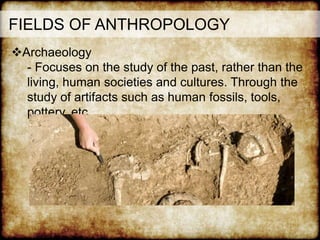
Archaeology
- Focuses on the study of the past, rather than the
living, human societies and cultures. Through the
study of artifacts such as human fossils, tools,
pottery, etc.
FIELDS OF ANTHROPOLOGY
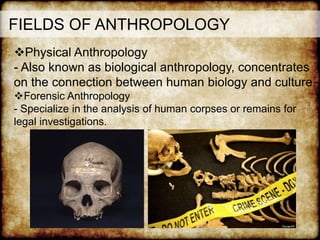
Physical Anthropology
- Also known as biological anthropology, concentrates
on the connection between human biology and culture.
Forensic Anthropology
- Specialize in the analysis of human corpses or remains for
legal investigations.
ANTHROPOLOGY AND OTHER SOCIAL
SCIENCES
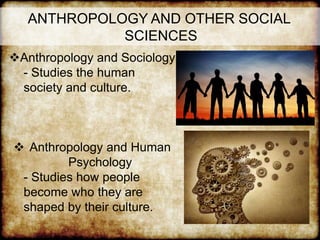
Anthropology and Sociology
- Studies the human
society and culture.
 Anthropology and Human
Psychology
- Studies how people
become who they are
shaped by their culture.
ANTHROPOLOGY AND OTHER SOCIAL
SCIENCES
Anthropology and History
- Study historical documents
to learn more of the past of
living people
Anthropology and Economics
- Focus on how aspects of
economics and politics relate
to other aspects of culture.
Understanding human diversity
Making Comparisons
Talks about using comparisons to see the
uniqueness of one’s self and culture.
Examining many Perspectives
Studies the connection of Human Ecology,
Biology, and culture in a holistic approach.
Avoiding Cultural Bias
Ethnocentrism where the belief of one’s culture is
superior to the other.
HISTORY OF ANTHROPOLOGY
CONTRIBUTORS DATE CONTRIBUTIONS
HERODOTUS 400 BC First thinker to write widely on
concepts that would later
become anthropology
IBN KHALDUN 14TH
CENTURY
AD
Examined the environmental,
sociological, psychological,
and economic factors that
affected the development and
the rise and fall of
civilizations.
BIBLICAL SCHOLARS 5TH-15TH
CENTURY
AD
Dominated European thinking
on questions of human
origins and cultural
developments which they
believe as the Creations of
God.
EUROPEAN
EXPLORERS
15TH
CENTURY
AD
Provided vivid descriptions of
the exotic cultures they
encountered on their
journeys on Asia, Africa, and
what are now the America.
THINKERS-HUME,
LOCKE, ROUSSEAU
17TH AND
18TH
CENTURY
AD
Wrote a number of
humanistic works on the
nature of human kind. They
based their works on
philosophical reasons rather
than religious authority.
THE BEGINNINGS OF MODERN
ANTHROPOLOGY
 EVOLUTIONARY THEORY
Charles Darwin argued that plants and animal
species evolved through time under the process called
Natural Selection.
 ANTHROPOLOGICAL EVOLUTIONARY THEORIES
Lewis Henry Morgan argued that European
civilization was the pinnacle of human evolutionary progress,
representing humanity’s highest biological, moral and
technological advancement.
Sir Edward Taylor attempted to describe the
developments of particular kinds of customs and beliefs
found across many cultures.
THE BEGINNINGS OF MODERN
ANTHROPOLOGY
 CULTURAL EVOLUTION, COLONIALISM, AND SOCIAL
DARWINISM
The colonial nations of Europe used ethnocentric
theories of cultural evolution to justify the expansion of their
empires. This application of evolutionary theory to control the
social and political policy became known as Social
Darwinism.
NEW DIRECTIONS IN THEORY AND
RESEARCH
 INFLUENCE OF BOAS
Franz Boas advocated the theories that there is no
pure race and that no race is superior to the other.
Emile Durkheim is the father of the school of
anthropology called Functionalism which analyze how cultural
institutions kept a society working in order.
 CULTURAL MATERIALISM AND ECOLOGY
Julian Steward, Roy Rappaport, and Marvin Harris
began to study how culture and social institutions relate to
peoples technology, economy and natural environment. This
approach is later known as Cultural Materialism.
NEW DIRECTIONS IN THEORY AND
RESEARCH
 SYMBOLIC ANTHROPOLOGIST
Clifford Geertz and Victor Turner looked for the
meanings of particular cultural symbols and rituals within
cultures themselves, an approach known as Symbolic
Anthropology.
ANTHROPOLOGY TODAY
Anthropology had become a very diverse
field with numerous areas of specialization. New
research agendas have also emerged and several
new trends in the world’s culture have dramatically
changed anthropology.
In addition, the world faces problems of
poverty, violence and environmental degradation.
In response to these trends, many anthropologist
has shifted their studies to urban culture and the
workings of global culture. Much new research
examines the international exchange of ideas,
beliefs, and cultural practices.
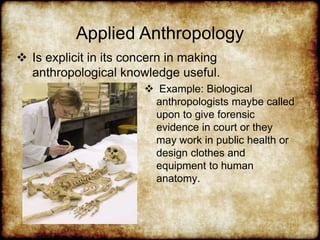
Applied Anthropology
 Is explicit in its concern in making
anthropological knowledge useful.
 Example: Biological
anthropologists maybe called
upon to give forensic
evidence in court or they
may work in public health or
design clothes and
equipment to human
anatomy.
REFERENCES
• Classic Edition Sources Anthropology Edited
Elvio Angeloni Pasadena City College
• Anthropology Twelfth Edition Carol R. Ember
Human Relations Area Files, Melvin Ember
Human Relations Area Files, Peter N. Peregrine,
Lawrence University.
• Sociology and Anthropology by Ms. Miriam Grace
Aquino and Mrs. Elna Lopez

Anthropology

  • 1.
    Group 1: Dan Manalo ShanielleDannah Ibanez Burwill Paciteng Clarisse Tenorio
  • 2.
    Why do Chinesedislike milk and milk products? Why would the Japanese die willingly in a banzai charge that seems senseless to the Americans? Why do some nations trace their lineage through the father, others through the mother, still others through both parents?
  • 3.
    Not because differentpeople have different instincts, not because they were destined by God or Faith to different habits, not because the weather is different in China and Japan and the U.S.A. Sometimes shrewd Common Sense has an answer that is close to that of the Anthropologists: “Because they were brought up that way” By their “culture”. It’s due to the difference on how they lived in this world.
  • 4.
    WHAT IS ANTHROPOLOGY? Anthropology,by definition is the study of infinite curiosity about human beings.  The term comes from the Greek word anthropos for “man, human” and logos for “study”.
  • 5.
    Anthropology means thetotal way of the people, the social legacy the individual acquires from his/her group. Anthropology study of all aspects of human life and culture. WHAT IS ANTHROPOLOGY?
  • 6.
    ANTHROPOLOGISTS Is a scientistwho researches and studies sociohistorical, archaeological, linguistical and biological aspects of humanity, especially as they apply to the development of modern man.
  • 7.
    KEY CONCEPTS Society –consists of any group of interacting millions or billions of people who share a common culture.
  • 8.
    KEY CONCEPTS  Culture– is fundamentally tied to people’s ability to use language and other symbolic forms of representation.
  • 9.
    KEY CONCEPTS  Evolution– explains how much the past contributed about people’s biology and culture.
  • 10.
    FIELDS OF ANTHROPOLOGY CulturalAnthropology - Involves the study of how people living in present- day society and their culture and also studies how people make their living, how people interact with each other, what beliefs people hold, and what institutions organize society.
  • 11.
    FIELDS OF ANTHROPOLOGY Linguistic Anthropology - Focuses on how people use language in particular cultures and often work with people who have unwritten languages or with languages that very few people speak.
  • 12.
    FIELDS OF ANTHROPOLOGY Archaeology -Focuses on the study of the past, rather than the living, human societies and cultures. Through the study of artifacts such as human fossils, tools, pottery, etc.
  • 13.
    FIELDS OF ANTHROPOLOGY PhysicalAnthropology - Also known as biological anthropology, concentrates on the connection between human biology and culture. Forensic Anthropology - Specialize in the analysis of human corpses or remains for legal investigations.
  • 14.
    ANTHROPOLOGY AND OTHERSOCIAL SCIENCES Anthropology and Sociology - Studies the human society and culture.  Anthropology and Human Psychology - Studies how people become who they are shaped by their culture.
  • 15.
    ANTHROPOLOGY AND OTHERSOCIAL SCIENCES Anthropology and History - Study historical documents to learn more of the past of living people Anthropology and Economics - Focus on how aspects of economics and politics relate to other aspects of culture.
  • 16.
    Understanding human diversity MakingComparisons Talks about using comparisons to see the uniqueness of one’s self and culture. Examining many Perspectives Studies the connection of Human Ecology, Biology, and culture in a holistic approach. Avoiding Cultural Bias Ethnocentrism where the belief of one’s culture is superior to the other.
  • 17.
    HISTORY OF ANTHROPOLOGY CONTRIBUTORSDATE CONTRIBUTIONS HERODOTUS 400 BC First thinker to write widely on concepts that would later become anthropology IBN KHALDUN 14TH CENTURY AD Examined the environmental, sociological, psychological, and economic factors that affected the development and the rise and fall of civilizations.
  • 18.
    BIBLICAL SCHOLARS 5TH-15TH CENTURY AD DominatedEuropean thinking on questions of human origins and cultural developments which they believe as the Creations of God. EUROPEAN EXPLORERS 15TH CENTURY AD Provided vivid descriptions of the exotic cultures they encountered on their journeys on Asia, Africa, and what are now the America. THINKERS-HUME, LOCKE, ROUSSEAU 17TH AND 18TH CENTURY AD Wrote a number of humanistic works on the nature of human kind. They based their works on philosophical reasons rather than religious authority.
  • 19.
    THE BEGINNINGS OFMODERN ANTHROPOLOGY  EVOLUTIONARY THEORY Charles Darwin argued that plants and animal species evolved through time under the process called Natural Selection.  ANTHROPOLOGICAL EVOLUTIONARY THEORIES Lewis Henry Morgan argued that European civilization was the pinnacle of human evolutionary progress, representing humanity’s highest biological, moral and technological advancement. Sir Edward Taylor attempted to describe the developments of particular kinds of customs and beliefs found across many cultures.
  • 20.
    THE BEGINNINGS OFMODERN ANTHROPOLOGY  CULTURAL EVOLUTION, COLONIALISM, AND SOCIAL DARWINISM The colonial nations of Europe used ethnocentric theories of cultural evolution to justify the expansion of their empires. This application of evolutionary theory to control the social and political policy became known as Social Darwinism.
  • 21.
    NEW DIRECTIONS INTHEORY AND RESEARCH  INFLUENCE OF BOAS Franz Boas advocated the theories that there is no pure race and that no race is superior to the other. Emile Durkheim is the father of the school of anthropology called Functionalism which analyze how cultural institutions kept a society working in order.  CULTURAL MATERIALISM AND ECOLOGY Julian Steward, Roy Rappaport, and Marvin Harris began to study how culture and social institutions relate to peoples technology, economy and natural environment. This approach is later known as Cultural Materialism.
  • 22.
    NEW DIRECTIONS INTHEORY AND RESEARCH  SYMBOLIC ANTHROPOLOGIST Clifford Geertz and Victor Turner looked for the meanings of particular cultural symbols and rituals within cultures themselves, an approach known as Symbolic Anthropology.
  • 23.
    ANTHROPOLOGY TODAY Anthropology hadbecome a very diverse field with numerous areas of specialization. New research agendas have also emerged and several new trends in the world’s culture have dramatically changed anthropology. In addition, the world faces problems of poverty, violence and environmental degradation. In response to these trends, many anthropologist has shifted their studies to urban culture and the workings of global culture. Much new research examines the international exchange of ideas, beliefs, and cultural practices.
  • 24.
    Applied Anthropology  Isexplicit in its concern in making anthropological knowledge useful.  Example: Biological anthropologists maybe called upon to give forensic evidence in court or they may work in public health or design clothes and equipment to human anatomy.
  • 25.
    REFERENCES • Classic EditionSources Anthropology Edited Elvio Angeloni Pasadena City College • Anthropology Twelfth Edition Carol R. Ember Human Relations Area Files, Melvin Ember Human Relations Area Files, Peter N. Peregrine, Lawrence University. • Sociology and Anthropology by Ms. Miriam Grace Aquino and Mrs. Elna Lopez