INTERVIEWING FOR INFORMATION AND EMPLOYMENT.
REMEMBER……. CHANCE FAVORS ONLY THE MIND THAT IS PREPARED. “ I KEEP SIX HONEST SERVING MEN,THEY TAUGHT ME ALL I KNOW. THEIR NAMES ARE: WHAT AND WHY WHEN AND HOW WHERE AND WHO. RUDYARD KIPLING.
DEF: INTERVIEW  An interview is a goal oriented interpersonal communication between an interviewer and a respondent. According to websters dictionary: Interview is a dynamic communication context with a purpose or goal.
Types of interviews. 1.Employment interviews:These provide general information to potential applicants before a job actually exists.ultimately it seeks to determine whether a particular applicant is suitable for the job. 2.Performance appraisal interviews: These provide job related feedback to employees.Areas of improvement are identified and new goals are set.
3.Counseling interviews:These provide guidance and assistance to employees. They sometimes involve very personal and emotional issues such as family problems,drinking….. 4.Disciplinary interviews:They become necessary when there are disruptive problems that must be curtailed. ie:chronic absenteeism,insubordination.
Persuasive interviews: They primarily seek to induce somebody to adopt a new idea,product or service generally associated with selling.
PLANNING THE INTERVIEW There are 6 strategies in planning a interview: 1.State the purpose. 2.Get information about the other party. 3.Decide the structure (directive or non-directive). 4.Consider the possible questions(closed ended or open ended.) 5. Plan the physical setting. 6.Anticipate problems.
WHAT ARE INTERVIEW APPROACHES???? 1. DIRECT APPROACH: An approach in which the interviewer determines the purpose of the interview and exerts control over the types of questions and the pace of the interview. 2. INDIRECT APPROACH: An approach in which an interviewer shares control of the pace,content and focus of the interview with the respondent. 3.COMBINATION APPROACH: A mixture of indirect and direct approaches when freedom of expression is called for but pertinent facts and information are needed.
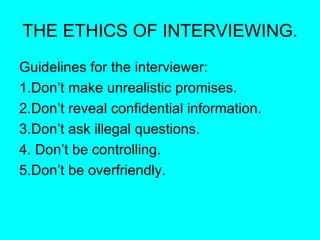
THE ETHICS OF INTERVIEWING. Guidelines for the interviewer: 1.Don’t make unrealistic promises. 2.Don’t reveal confidential information. 3.Don’t ask illegal questions. 4. Don’t be controlling. 5.Don’t be overfriendly.
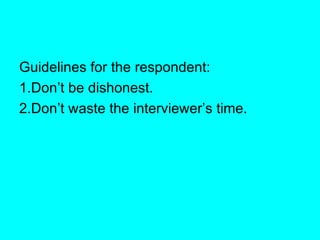
Guidelines for the respondent: 1.Don’t be dishonest. 2.Don’t waste the interviewer’s time.

Interviews

  • 1.
  • 2.
    REMEMBER……. CHANCE FAVORSONLY THE MIND THAT IS PREPARED. “ I KEEP SIX HONEST SERVING MEN,THEY TAUGHT ME ALL I KNOW. THEIR NAMES ARE: WHAT AND WHY WHEN AND HOW WHERE AND WHO. RUDYARD KIPLING.
  • 3.
    DEF: INTERVIEW An interview is a goal oriented interpersonal communication between an interviewer and a respondent. According to websters dictionary: Interview is a dynamic communication context with a purpose or goal.
  • 4.
    Types of interviews.1.Employment interviews:These provide general information to potential applicants before a job actually exists.ultimately it seeks to determine whether a particular applicant is suitable for the job. 2.Performance appraisal interviews: These provide job related feedback to employees.Areas of improvement are identified and new goals are set.
  • 5.
    3.Counseling interviews:These provideguidance and assistance to employees. They sometimes involve very personal and emotional issues such as family problems,drinking….. 4.Disciplinary interviews:They become necessary when there are disruptive problems that must be curtailed. ie:chronic absenteeism,insubordination.
  • 6.
    Persuasive interviews: Theyprimarily seek to induce somebody to adopt a new idea,product or service generally associated with selling.
  • 7.
    PLANNING THE INTERVIEWThere are 6 strategies in planning a interview: 1.State the purpose. 2.Get information about the other party. 3.Decide the structure (directive or non-directive). 4.Consider the possible questions(closed ended or open ended.) 5. Plan the physical setting. 6.Anticipate problems.
  • 8.
    WHAT ARE INTERVIEWAPPROACHES???? 1. DIRECT APPROACH: An approach in which the interviewer determines the purpose of the interview and exerts control over the types of questions and the pace of the interview. 2. INDIRECT APPROACH: An approach in which an interviewer shares control of the pace,content and focus of the interview with the respondent. 3.COMBINATION APPROACH: A mixture of indirect and direct approaches when freedom of expression is called for but pertinent facts and information are needed.
  • 9.
    THE ETHICS OFINTERVIEWING. Guidelines for the interviewer: 1.Don’t make unrealistic promises. 2.Don’t reveal confidential information. 3.Don’t ask illegal questions. 4. Don’t be controlling. 5.Don’t be overfriendly.
  • 10.
    Guidelines for therespondent: 1.Don’t be dishonest. 2.Don’t waste the interviewer’s time.