Human Resources
March 2017
INTERVIEWING
SKILLS
1
Agenda
• Introductions
• Understanding job requirements
• Key interview preparation techniques
• What to expect during a selection panel
• Interview follow up
2
Understanding Job Requirements
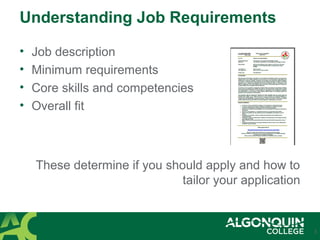
• Job description
• Minimum requirements
• Core skills and competencies
• Overall fit
These determine if you should apply and how to
tailor your application
3
Application Preparation
• Cover letter
• Resume presentation and length
• Accomplishments to highlight
• Other relevant information
• Preparing references
4
5
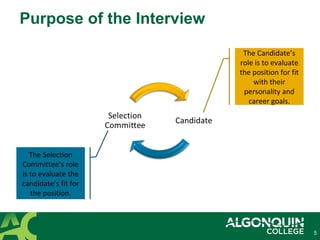
Purpose of the Interview
The Candidate’s
role is to evaluate
the position for fit
with their
personality and
career goals.
The Selection
Committee’s role
is to evaluate the
candidate’s fit for
the position.
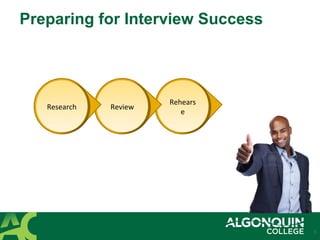
Preparing for Interview Success
6
Rehears
e
Rehears
e
ReviewReviewResearchResearch
Research
Research the job
• review the College website
• examine the specific department’s profile
• browse the Strategic Plan
• study the position description or job fact sheet
• read the job posting
• Professor of the 21st Century
You will want to be able to answer the following:
• how did you prepare for today’s interview
• how does the department fit into your career plan
• how does the position help the department reach
business plan goals
7
Review
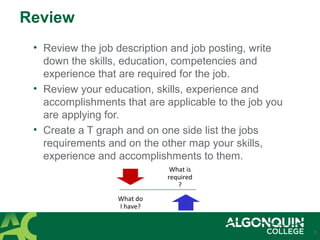
• Review the job description and job posting, write
down the skills, education, competencies and
experience that are required for the job.
• Review your education, skills, experience and
accomplishments that are applicable to the job you
are applying for.
• Create a T graph and on one side list the jobs
requirements and on the other map your skills,
experience and accomplishments to them.
8
What is
required
?
What do
I have?
Rehearse
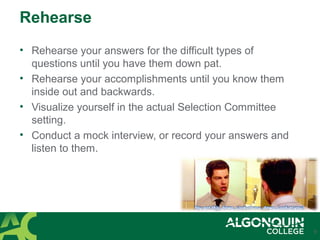
• Rehearse your answers for the difficult types of
questions until you have them down pat.
• Rehearse your accomplishments until you know them
inside out and backwards.
• Visualize yourself in the actual Selection Committee
setting.
• Conduct a mock interview, or record your answers and
listen to them.
9
10
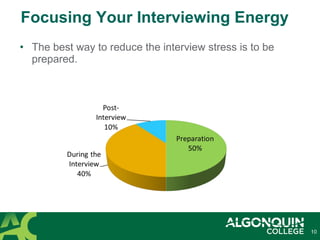
Focusing Your Interviewing Energy
• The best way to reduce the interview stress is to be
prepared.
Selection Panels
Insights from the HR Trenches
•Members of a selection panel – min. 3 – max. ?
•Guidance provided to panel members
•What we look for
•Screening applications in/out
•Evaluation
•Follow up process
11
12
Type of Interview Questions
• General
• Situational / Scenario
• Behavioural
13
General Questions
• Direct, straightforward questions
- “Tell us about yourself.”
- “What skills do you have that are related to this
position?”
- “How does this role fit into your career path?”
• Always make your response relevant to the job you are
seeking
• Share information – keep it concise
• Scenario questions use a problem solving approach
to determine your analytical skills and critical thinking
abilities.
• These are “what if" type questions and are presented
in the form of case examples or problem situations.
• You will be asked to imagine yourself experiencing a
situation and will then be evaluated on how you
would handle that situation.
14
Situational Questions
• Based on the premise that the best way to predict
future behavior is to consider past behavior.
• Focuses the panel on actions and behaviors, rather
than subjective impressions.
• You will be asked to give a specific example of how
you did behaved in the past in a specific situation.
• You will be asked to provide details.
• PREPARE!!!
15
Behavioural Questions
16
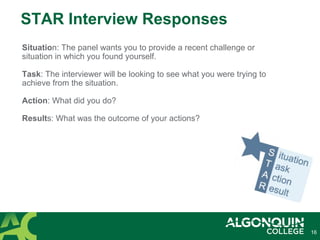
STAR Interview Responses
Situation: The panel wants you to provide a recent challenge or
situation in which you found yourself.
Task: The interviewer will be looking to see what you were trying to
achieve from the situation.
Action: What did you do?
Results: What was the outcome of your actions?
Best Practice Interview Tips
• Stay professional
• Eye contact, shake hands with committee members, be aware of
your body language
• Take your time before you respond to the question - silence is ok
• It’s ok to ask for clarification, for a question to be repeated or to
go back to a question.
• Be specific in your answer (difference between “I” and “we”)
• Pay attention how the panel is reacting to your responses.
When interviewing with people you know, assume they know
nothing about you.
17
18
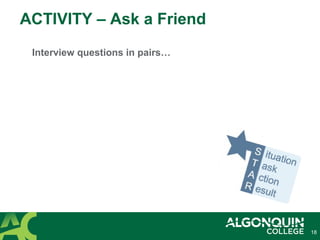
ACTIVITY – Ask a Friend
Interview questions in pairs…
Be Prepared:
“Do you have any questions for the hiring committee?”
• Demonstrate the research you’ve done
• Are very interested in the position
• Are confident and able to assert yourself
appropriately.
19
After the Interview
• Write down some notes on the questions asked
and where you thought you did well or poorly.
• Send a “thank you” e-mail to the interviewer(s).
• If you don't get the job, consider calling the hiring
manager for some feedback about the interview.
• Don't get discouraged! Interviews are about both
parties finding the right fit for the job. Better
interview skills can be developed through
preparation and practice.
20
Survey Please
21
QUESTIONS
22

Interviewing Skills Workshop

  • 1.
  • 2.
    Agenda • Introductions • Understandingjob requirements • Key interview preparation techniques • What to expect during a selection panel • Interview follow up 2
  • 3.
    Understanding Job Requirements •Job description • Minimum requirements • Core skills and competencies • Overall fit These determine if you should apply and how to tailor your application 3
  • 4.
    Application Preparation • Coverletter • Resume presentation and length • Accomplishments to highlight • Other relevant information • Preparing references 4
  • 5.
    5 Purpose of theInterview The Candidate’s role is to evaluate the position for fit with their personality and career goals. The Selection Committee’s role is to evaluate the candidate’s fit for the position.
  • 6.
    Preparing for InterviewSuccess 6 Rehears e Rehears e ReviewReviewResearchResearch
  • 7.
    Research Research the job •review the College website • examine the specific department’s profile • browse the Strategic Plan • study the position description or job fact sheet • read the job posting • Professor of the 21st Century You will want to be able to answer the following: • how did you prepare for today’s interview • how does the department fit into your career plan • how does the position help the department reach business plan goals 7
  • 8.
    Review • Review thejob description and job posting, write down the skills, education, competencies and experience that are required for the job. • Review your education, skills, experience and accomplishments that are applicable to the job you are applying for. • Create a T graph and on one side list the jobs requirements and on the other map your skills, experience and accomplishments to them. 8 What is required ? What do I have?
  • 9.
    Rehearse • Rehearse youranswers for the difficult types of questions until you have them down pat. • Rehearse your accomplishments until you know them inside out and backwards. • Visualize yourself in the actual Selection Committee setting. • Conduct a mock interview, or record your answers and listen to them. 9
  • 10.
    10 Focusing Your InterviewingEnergy • The best way to reduce the interview stress is to be prepared.
  • 11.
    Selection Panels Insights fromthe HR Trenches •Members of a selection panel – min. 3 – max. ? •Guidance provided to panel members •What we look for •Screening applications in/out •Evaluation •Follow up process 11
  • 12.
    12 Type of InterviewQuestions • General • Situational / Scenario • Behavioural
  • 13.
    13 General Questions • Direct,straightforward questions - “Tell us about yourself.” - “What skills do you have that are related to this position?” - “How does this role fit into your career path?” • Always make your response relevant to the job you are seeking • Share information – keep it concise
  • 14.
    • Scenario questionsuse a problem solving approach to determine your analytical skills and critical thinking abilities. • These are “what if" type questions and are presented in the form of case examples or problem situations. • You will be asked to imagine yourself experiencing a situation and will then be evaluated on how you would handle that situation. 14 Situational Questions
  • 15.
    • Based onthe premise that the best way to predict future behavior is to consider past behavior. • Focuses the panel on actions and behaviors, rather than subjective impressions. • You will be asked to give a specific example of how you did behaved in the past in a specific situation. • You will be asked to provide details. • PREPARE!!! 15 Behavioural Questions
  • 16.
    16 STAR Interview Responses Situation:The panel wants you to provide a recent challenge or situation in which you found yourself. Task: The interviewer will be looking to see what you were trying to achieve from the situation. Action: What did you do? Results: What was the outcome of your actions?
  • 17.
    Best Practice InterviewTips • Stay professional • Eye contact, shake hands with committee members, be aware of your body language • Take your time before you respond to the question - silence is ok • It’s ok to ask for clarification, for a question to be repeated or to go back to a question. • Be specific in your answer (difference between “I” and “we”) • Pay attention how the panel is reacting to your responses. When interviewing with people you know, assume they know nothing about you. 17
  • 18.
    18 ACTIVITY – Aska Friend Interview questions in pairs…
  • 19.
    Be Prepared: “Do youhave any questions for the hiring committee?” • Demonstrate the research you’ve done • Are very interested in the position • Are confident and able to assert yourself appropriately. 19
  • 20.
    After the Interview •Write down some notes on the questions asked and where you thought you did well or poorly. • Send a “thank you” e-mail to the interviewer(s). • If you don't get the job, consider calling the hiring manager for some feedback about the interview. • Don't get discouraged! Interviews are about both parties finding the right fit for the job. Better interview skills can be developed through preparation and practice. 20
  • 21.
  • 22.

Editor's Notes

  • #3 Helen 9:05-9:15 AM Welcome – intro (brief) Agenda for the session Round Table Please tell us your name, department and one thing you are hoping to learn or take away from today’s session
  • #4 Helen – 9:15 to 9:20 The key to a successful application above all else: Ensuring you are qualified and meet the minimum requirements of the job Reviewing the applicable job descriptions PDFs (Support) JFSs (Administrative) Collective Bargaining Agreement (Academic)
  • #5 Andrea – 9:20 to 9:25 AM Cover Letter – Required? No unless explicit in the posting requirements. However advantageous always to make the effort Chronological Length - CV is accepted and often very long References – always have this ready going into an interview situation, prepare
  • #6 Andrea – 9:25 - 9:50 AM (6 slides) The interview is one of the most important phases of the job search process. Your resume and cover letter are simply tools to get you to the interviewing stage. If you are invited for an interview, be proud of yourself and take this opportunity seriously. We receive thousands of applications each year for hundreds of postings. If you’ve been offered an interview, you’ve already made progress. The interview is your opportunity to convince an employer that you are the right person for the job.
  • #7 Andrea – 9:25 - 9:50 AM (6 slides) Setting yourself up for interview success is simple – it’s all in the preparation. Three steps: Research/Review/Rehearse
  • #8 Andrea – 9:25 - 9:50 AM (6 slides) Research the job… review the College website examine the specific department’s profile browse the Strategic Plan study the position description or job fact sheet read the job posting Professor of the 21st Century You will want to be able to answer the following: how did you prepare for today’s interview how does the department fit into the plan how does the position help the department reach plan goals
  • #9 Andrea – 9:25 - 9:50 AM (6 slides) Review the job description and job posting, write down the skills, education, competencies and experience that are required for the job. Review your education, skills, experience and accomplishments that are applicable to the job you are applying for. Create a T graph and on one side list the jobs requirements and on the other map your skills, experience and accomplishments to them.
  • #10 Andrea – 9:25 - 9:50 AM (6 slides)
  • #11 Andrea – 9:25 - 9:50 AM (6 slides)
  • #12 Helen – 5 minutes 9:50 to 9:55 AM ****Be clear about distinction of “what we look for” versus “what we screen in/out basis of”
  • #13 Helen 9:55 to 10:20 (5 slides) There are a variety of types of interview questions that you can expect. General Situational Behavioural
  • #14 Helen 9:55 to 10:20 (5slides) Summarize approximately four areas: education, experience, skills, and personal attributes. These questions are determine your alignment with the job in question (e.g. "What skills do you have that relate to this position?") The information you provide should be clear, specific and speak to either technical or soft skills. Demonstrate you have performed a self-assessment
  • #15 Helen 9:55 to 10:20 (5 slides) Hypothetical questions
  • #16 Helen 9:55 to 10:20 (5 slides) The hardest type of question to answer – but also the hardest type of question for a panel to ask.
  • #17 Helen 9:55 to 10:20 (5 slides) STAR answers are based around behavioural interview questions. The interviewer is searching for specific examples - you will need to include details such as dates and outcomes. Preparation is key to performing under pressure. Anticipating the areas that the panel may cover off.
  • #18 Helen 10:20 – 10:30 Be friendly to everyone, but not their friend – stay professional. The interview starts from the minute you arrive at the office and ends when you leave the premises - be polite to everyone! Be aware of your own body language - your posture, eye contact with all panel members at some point. Take time before you respond to the question to think through your answer. Silence is ok. Ask for clarification or for the question to be repeated, if you need to. There’s nothing wrong if you truly don’t understand why the panel is asking this question or what they’re looking for. It could be that it’s not a well worded question. Best to be up front and provide the kind of info we’re looking for rather than go completely down the wrong path. Same if you are truly stumped and need to leave a question and then go back to it later. Just remember to return to the question – the panel will not always do that for you. And in that case you’ll lose out on valuable points. Be specific in your answer (try using “I” instead of “we”). Pay attention to visual cues… if the committee has put down their pens or are glancing at each other, it’s time to move on. When interviewing with people you know, assume they know nothing about you. POINTS!!!
  • #19 Andrea – 15 minutes 10:30 to 10:45 AM Give group 10 minutes for quick exercise STAR answers are based around behavioural interview questions. The interviewer is searching for specific examples - you will need to include details such as dates and outcomes
  • #20 Andrea – wrap up 5 minutes 10:45 to 10:50 AM
  • #21 Did we cover off all the requested info from beginning of workshop?