INTERVIEWING FOR
EMPLOYMENT AND
FOLLOWING UP
The Last Group
Group Members
 Ayushman
 Nikesh
 Erna
 Karuna
 Supriya
 Bilab
 Prashant
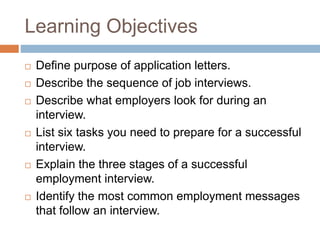
Learning Objectives
 Define purpose of application letters.
 Describe the sequence of job interviews.
 Describe what employers look for during an
interview.
 List six tasks you need to prepare for a successful
interview.
 Explain the three stages of a successful
employment interview.
 Identify the most common employment messages
that follow an interview.
Writing Application Letters and
Other Messages
 Application Letters
• Solicited Application Letters
• Unsolicited Application Letters
 Application Follow Ups
Tips for Effective Application
Letters
• Be specific
• Never mention salary
• Keep it short
• Show some personality
• Aim for high quality
AIDA Approach
 Opening Paragraph – Getting attention
 Middle Paragraph – Building interest and
increasing desire
 Closing Paragraph – Motivating action
Application Follow Ups
 Gives a chance to update the application letter
with other recent job related information.
 Demonstrates sincerity, persistency and
commitment.
The Interviewing Process
 The Typical Sequence of Interviews
 Common Types of Interviews
 Interview Media
 What Employers Look For in an Interview
 Pre-employment Testing
The Typical Sequence of
Interviews
 Screening stage
 Selection stage
 Final stage
Common Types of Interviews
 Structured interview
 Open ended interview
 Group interview
 Stress interview
 Situational interview
 Behavioral interview
 Working interview
Interview Media
 Telephone interview
 Email interview
 Computer based interview
 Video interview
What Employers Look For in an
Interview
 Integrity Tests
 Personality Tests
 Job Skills Tests
 Substance Tests
 Background Checks
Preparing For A Job Interview
 Learn About The Organization
 Think About The Questions
 Bolster Your Confidence
 Polish Your Interview Styles
 Plan to Look Good
 Be Ready When You Arrive
Interviewing for Success
 The Warm Up
 The Question and Answer Stage
• Dealing with questions
• Listening to the interviewer
• Fielding discriminatory questions
 The Close
• Concluding gracefully
• Discussing salary
 Interview Notes
Following Up After The
Interview
 Thank You Message
 Message of Inquiry
 Request for a Time Extension
 Letter of Acceptance
 Letter Declining a Job Offer
 Letters of Resignation
The statistics on how we make
an impression:
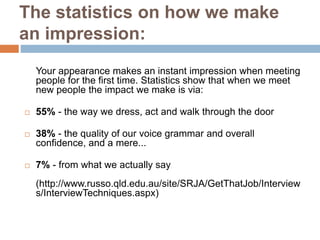
Your appearance makes an instant impression when meeting
people for the first time. Statistics show that when we meet
new people the impact we make is via:
 55% - the way we dress, act and walk through the door
 38% - the quality of our voice grammar and overall
confidence, and a mere...
 7% - from what we actually say
(http://www.russo.qld.edu.au/site/SRJA/GetThatJob/Interview
s/InterviewTechniques.aspx)
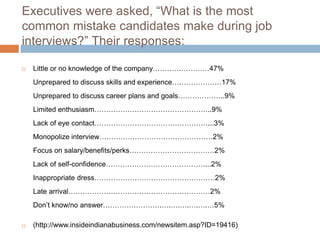
Executives were asked, “What is the most
common mistake candidates make during job
interviews?” Their responses:
 Little or no knowledge of the company……………………47%
Unprepared to discuss skills and experience…………………17%
Unprepared to discuss career plans and goals………………..9%
Limited enthusiasm…………………………………………..9%
Lack of eye contact…………………………………………...3%
Monopolize interview…………………………………………2%
Focus on salary/benefits/perks………………………………2%
Lack of self-confidence……………………………………...2%
Inappropriate dress……………………………………………2%
Late arrival……………………………………………………2%
Don’t know/no answer…………………….….….….….….…5%
 (http://www.insideindianabusiness.com/newsitem.asp?ID=19416)
THANK YOU!!!!

Interviewing for Employment and Following Up

  • 1.
  • 2.
    Group Members  Ayushman Nikesh  Erna  Karuna  Supriya  Bilab  Prashant
  • 3.
    Learning Objectives  Definepurpose of application letters.  Describe the sequence of job interviews.  Describe what employers look for during an interview.  List six tasks you need to prepare for a successful interview.  Explain the three stages of a successful employment interview.  Identify the most common employment messages that follow an interview.
  • 4.
    Writing Application Lettersand Other Messages  Application Letters • Solicited Application Letters • Unsolicited Application Letters  Application Follow Ups
  • 5.
    Tips for EffectiveApplication Letters • Be specific • Never mention salary • Keep it short • Show some personality • Aim for high quality
  • 6.
    AIDA Approach  OpeningParagraph – Getting attention  Middle Paragraph – Building interest and increasing desire  Closing Paragraph – Motivating action
  • 7.
    Application Follow Ups Gives a chance to update the application letter with other recent job related information.  Demonstrates sincerity, persistency and commitment.
  • 8.
    The Interviewing Process The Typical Sequence of Interviews  Common Types of Interviews  Interview Media  What Employers Look For in an Interview  Pre-employment Testing
  • 9.
    The Typical Sequenceof Interviews  Screening stage  Selection stage  Final stage
  • 10.
    Common Types ofInterviews  Structured interview  Open ended interview  Group interview  Stress interview  Situational interview  Behavioral interview  Working interview
  • 11.
    Interview Media  Telephoneinterview  Email interview  Computer based interview  Video interview
  • 12.
    What Employers LookFor in an Interview  Integrity Tests  Personality Tests  Job Skills Tests  Substance Tests  Background Checks
  • 13.
    Preparing For AJob Interview  Learn About The Organization  Think About The Questions  Bolster Your Confidence  Polish Your Interview Styles  Plan to Look Good  Be Ready When You Arrive
  • 14.
    Interviewing for Success The Warm Up  The Question and Answer Stage • Dealing with questions • Listening to the interviewer • Fielding discriminatory questions  The Close • Concluding gracefully • Discussing salary  Interview Notes
  • 15.
    Following Up AfterThe Interview  Thank You Message  Message of Inquiry  Request for a Time Extension  Letter of Acceptance  Letter Declining a Job Offer  Letters of Resignation
  • 16.
    The statistics onhow we make an impression: Your appearance makes an instant impression when meeting people for the first time. Statistics show that when we meet new people the impact we make is via:  55% - the way we dress, act and walk through the door  38% - the quality of our voice grammar and overall confidence, and a mere...  7% - from what we actually say (http://www.russo.qld.edu.au/site/SRJA/GetThatJob/Interview s/InterviewTechniques.aspx)
  • 17.
    Executives were asked,“What is the most common mistake candidates make during job interviews?” Their responses:  Little or no knowledge of the company……………………47% Unprepared to discuss skills and experience…………………17% Unprepared to discuss career plans and goals………………..9% Limited enthusiasm…………………………………………..9% Lack of eye contact…………………………………………...3% Monopolize interview…………………………………………2% Focus on salary/benefits/perks………………………………2% Lack of self-confidence……………………………………...2% Inappropriate dress……………………………………………2% Late arrival……………………………………………………2% Don’t know/no answer…………………….….….….….….…5%  (http://www.insideindianabusiness.com/newsitem.asp?ID=19416)
  • 18.

Editor's Notes

  • #18 The national survey includes responses from 150 senior executives -- including those from human resources, finance and marketing departments -- with the nation’s 1,000 largest companies. It was conducted by an independent research firm and developed by Accountemps, the world’s first and largest specialized staffing service for temporary accounting, finance and bookkeeping professionals.