NIETZSCHE
Escape and Ecstasy
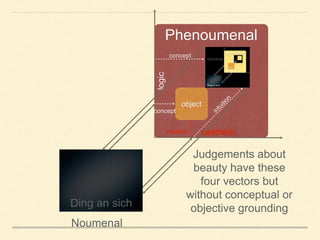
Phenoumenal
logic
aesthetic
object
concept
intuition
Ding an sich
concept Noumenal
Judgements about
beauty have these
four vectors but
without conceptual or
objective grounding
Noumenal
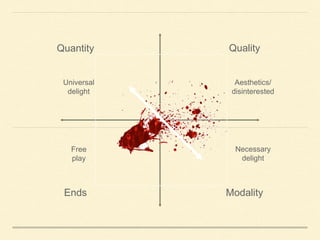
QualityQuantity
Ends Modality
Necessary
delight
Free
play
Universal
delight
Aesthetics/
disinterested
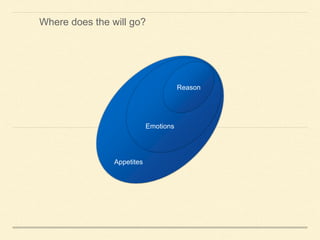
Reason
Emotions
Appetites
Where does the will go?
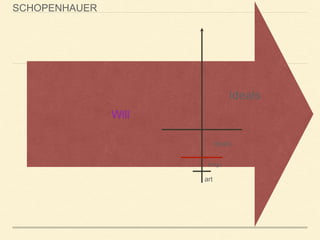
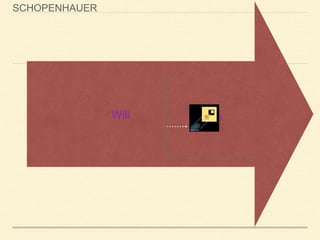
SCHOPENHAUER
Will
ideals
things
Ideals
art
SCHOPENHAUER
Will Ideals
Will Ideals
will
will
will
will
Ideals
Ideals
Ideals
Ideals
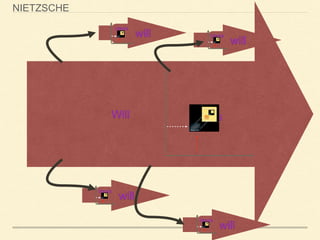
NIETZSCHE
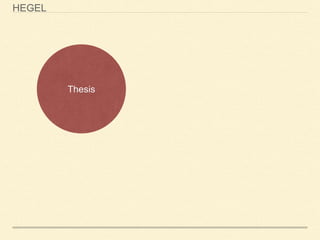
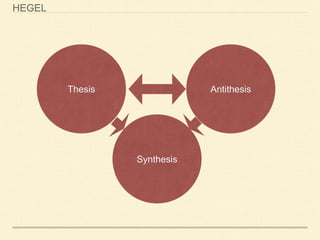
Thesis
HEGEL
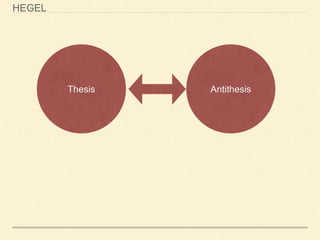
Thesis Antithesis
HEGEL
Thesis Antithesis
Synthesis
HEGEL
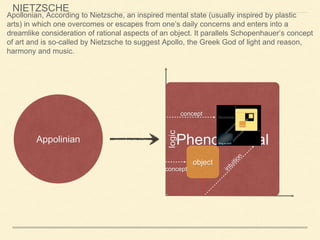
Appolinian
Apollonian, According to Nietzsche, an inspired mental state (usually inspired by plastic
arts) in which one overcomes or escapes from one’s daily concerns and enters into a
dreamlike consideration of rational aspects of an object. It parallels Schopenhauer’s concept
of art and is so-called by Nietzsche to suggest Apollo, the Greek God of light and reason,
harmony and music.
Phenoumenal
logic
object
concept
concept Noumenal
NIETZSCHE
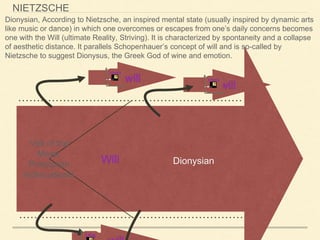
Will
will
will
Dionysian
Dionysian, According to Nietzsche, an inspired mental state (usually inspired by dynamic arts
like music or dance) in which one overcomes or escapes from one’s daily concerns becomes
one with the Will (ultimate Reality, Striving). It is characterized by spontaneity and a collapse
of aesthetic distance. It parallels Schopenhauer’s concept of will and is so-called by
Nietzsche to suggest Dionysus, the Greek God of wine and emotion.
Ideals
Ideals
Ide
Veil of the
Maya:
Principium
Indiviuationis
NIETZSCHE
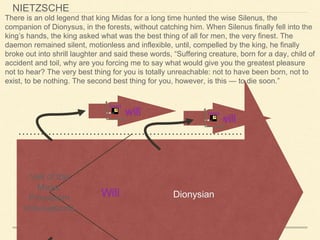
Will
will
will
Dionysian
There is an old legend that king Midas for a long time hunted the wise Silenus, the
companion of Dionysus, in the forests, without catching him. When Silenus finally fell into the
king’s hands, the king asked what was the best thing of all for men, the very finest. The
daemon remained silent, motionless and inflexible, until, compelled by the king, he finally
broke out into shrill laughter and said these words, “Suffering creature, born for a day, child of
accident and toil, why are you forcing me to say what would give you the greatest pleasure
not to hear? The very best thing for you is totally unreachable: not to have been born, not to
exist, to be nothing. The second best thing for you, however, is this — to die soon.”
Ideals
Ideals
Veil of the
Maya:
Principium
Indiviuationis
NIETZSCHE
Will
will
will
Dionysian
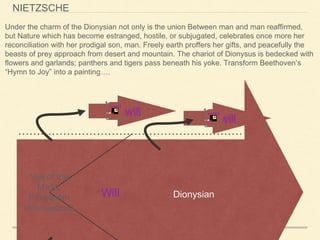
Under the charm of the Dionysian not only is the union Between man and man reaffirmed,
but Nature which has become estranged, hostile, or subjugated, celebrates once more her
reconciliation with her prodigal son, man. Freely earth proffers her gifts, and peacefully the
beasts of prey approach from desert and mountain. The chariot of Dionysus is bedecked with
flowers and garlands; panthers and tigers pass beneath his yoke. Transform Beethoven’s
“Hymn to Joy” into a painting….
Ideals
Ideals
Veil of the
Maya:
Principium
Indiviuationis
NIETZSCHE
Appolinian Dionysian
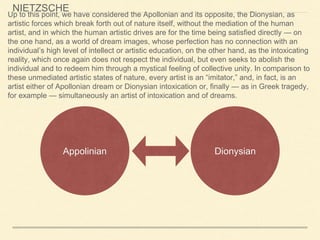
Up to this point, we have considered the Apollonian and its opposite, the Dionysian, as
artistic forces which break forth out of nature itself, without the mediation of the human
artist, and in which the human artistic drives are for the time being satisfied directly — on
the one hand, as a world of dream images, whose perfection has no connection with an
individual’s high level of intellect or artistic education, on the other hand, as the intoxicating
reality, which once again does not respect the individual, but even seeks to abolish the
individual and to redeem him through a mystical feeling of collective unity. In comparison to
these unmediated artistic states of nature, every artist is an “imitator,” and, in fact, is an
artist either of Apollonian dream or Dionysian intoxication or, finally — as in Greek tragedy,
for example — simultaneously an artist of intoxication and of dreams.
NIETZSCHE
Appolinian Dionysian
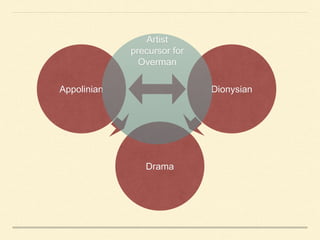
Drama
Artist
precursor for
Overman
Appolinian Dionysian
Drama
Artist
precursor for
Overman
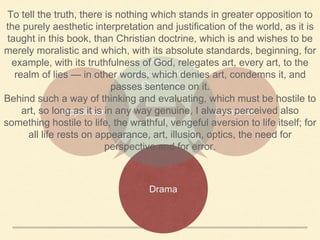
To tell the truth, there is nothing which stands in greater opposition to
the purely aesthetic interpretation and justification of the world, as it is
taught in this book, than Christian doctrine, which is and wishes to be
merely moralistic and which, with its absolute standards, beginning, for
example, with its truthfulness of God, relegates art, every art, to the
realm of lies — in other words, which denies art, condemns it, and
passes sentence on it.
Behind such a way of thinking and evaluating, which must be hostile to
art, so long as it is in any way genuine, I always perceived also
something hostile to life, the wrathful, vengeful aversion to life itself; for
all life rests on appearance, art, illusion, optics, the need for
perspective and for error.
Appolinian Dionysian
Drama
Artist
precursor for
Overman
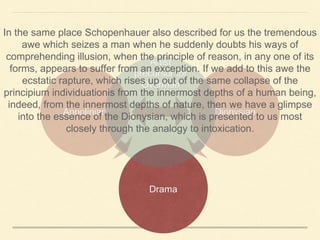
In the same place Schopenhauer also described for us the tremendous
awe which seizes a man when he suddenly doubts his ways of
comprehending illusion, when the principle of reason, in any one of its
forms, appears to suffer from an exception. If we add to this awe the
ecstatic rapture, which rises up out of the same collapse of the
principium individuationis from the innermost depths of a human being,
indeed, from the innermost depths of nature, then we have a glimpse
into the essence of the Dionysian, which is presented to us most
closely through the analogy to intoxication.
And so concerning Apollo one could endorse, in an eccentric way, what
Schopenhauer says of the man trapped in the veil of Maja: “As on the
stormy sea which extends without limit on all sides, howling
mountainous waves rise up and sink and a sailor sits in a row boat,
trusting the weak craft, so, in the midst of a world of torments, the
solitary man sits peacefully, supported by and trusting in the principium
individuationis [principle of individuation]” (World as Will and Idea,
I.1.3).1 In fact, we could say of Apollo that the imperturbable trust in
that principle and the calm sitting still of the man caught up in it
attained its loftiest expression in him, and we may even designate
Apollo himself as the marvellous divine image of the principium
individuationis, from whose gestures and gaze all the joy and wisdom
of “illusion,” together with its beauty, speak to us.

Nietszche

  • 1.
  • 2.
    Phenoumenal logic aesthetic object concept intuition Ding an sich conceptNoumenal Judgements about beauty have these four vectors but without conceptual or objective grounding Noumenal
  • 3.
  • 4.
  • 5.
  • 6.
  • 7.
  • 8.
  • 9.
  • 10.
  • 11.
    Appolinian Apollonian, According toNietzsche, an inspired mental state (usually inspired by plastic arts) in which one overcomes or escapes from one’s daily concerns and enters into a dreamlike consideration of rational aspects of an object. It parallels Schopenhauer’s concept of art and is so-called by Nietzsche to suggest Apollo, the Greek God of light and reason, harmony and music. Phenoumenal logic object concept concept Noumenal NIETZSCHE
  • 12.
    Will will will Dionysian Dionysian, According toNietzsche, an inspired mental state (usually inspired by dynamic arts like music or dance) in which one overcomes or escapes from one’s daily concerns becomes one with the Will (ultimate Reality, Striving). It is characterized by spontaneity and a collapse of aesthetic distance. It parallels Schopenhauer’s concept of will and is so-called by Nietzsche to suggest Dionysus, the Greek God of wine and emotion. Ideals Ideals Ide Veil of the Maya: Principium Indiviuationis NIETZSCHE
  • 13.
    Will will will Dionysian There is anold legend that king Midas for a long time hunted the wise Silenus, the companion of Dionysus, in the forests, without catching him. When Silenus finally fell into the king’s hands, the king asked what was the best thing of all for men, the very finest. The daemon remained silent, motionless and inflexible, until, compelled by the king, he finally broke out into shrill laughter and said these words, “Suffering creature, born for a day, child of accident and toil, why are you forcing me to say what would give you the greatest pleasure not to hear? The very best thing for you is totally unreachable: not to have been born, not to exist, to be nothing. The second best thing for you, however, is this — to die soon.” Ideals Ideals Veil of the Maya: Principium Indiviuationis NIETZSCHE
  • 14.
    Will will will Dionysian Under the charmof the Dionysian not only is the union Between man and man reaffirmed, but Nature which has become estranged, hostile, or subjugated, celebrates once more her reconciliation with her prodigal son, man. Freely earth proffers her gifts, and peacefully the beasts of prey approach from desert and mountain. The chariot of Dionysus is bedecked with flowers and garlands; panthers and tigers pass beneath his yoke. Transform Beethoven’s “Hymn to Joy” into a painting…. Ideals Ideals Veil of the Maya: Principium Indiviuationis NIETZSCHE
  • 15.
    Appolinian Dionysian Up tothis point, we have considered the Apollonian and its opposite, the Dionysian, as artistic forces which break forth out of nature itself, without the mediation of the human artist, and in which the human artistic drives are for the time being satisfied directly — on the one hand, as a world of dream images, whose perfection has no connection with an individual’s high level of intellect or artistic education, on the other hand, as the intoxicating reality, which once again does not respect the individual, but even seeks to abolish the individual and to redeem him through a mystical feeling of collective unity. In comparison to these unmediated artistic states of nature, every artist is an “imitator,” and, in fact, is an artist either of Apollonian dream or Dionysian intoxication or, finally — as in Greek tragedy, for example — simultaneously an artist of intoxication and of dreams. NIETZSCHE
  • 16.
  • 17.
    Appolinian Dionysian Drama Artist precursor for Overman Totell the truth, there is nothing which stands in greater opposition to the purely aesthetic interpretation and justification of the world, as it is taught in this book, than Christian doctrine, which is and wishes to be merely moralistic and which, with its absolute standards, beginning, for example, with its truthfulness of God, relegates art, every art, to the realm of lies — in other words, which denies art, condemns it, and passes sentence on it. Behind such a way of thinking and evaluating, which must be hostile to art, so long as it is in any way genuine, I always perceived also something hostile to life, the wrathful, vengeful aversion to life itself; for all life rests on appearance, art, illusion, optics, the need for perspective and for error.
  • 18.
    Appolinian Dionysian Drama Artist precursor for Overman Inthe same place Schopenhauer also described for us the tremendous awe which seizes a man when he suddenly doubts his ways of comprehending illusion, when the principle of reason, in any one of its forms, appears to suffer from an exception. If we add to this awe the ecstatic rapture, which rises up out of the same collapse of the principium individuationis from the innermost depths of a human being, indeed, from the innermost depths of nature, then we have a glimpse into the essence of the Dionysian, which is presented to us most closely through the analogy to intoxication.
  • 19.
    And so concerningApollo one could endorse, in an eccentric way, what Schopenhauer says of the man trapped in the veil of Maja: “As on the stormy sea which extends without limit on all sides, howling mountainous waves rise up and sink and a sailor sits in a row boat, trusting the weak craft, so, in the midst of a world of torments, the solitary man sits peacefully, supported by and trusting in the principium individuationis [principle of individuation]” (World as Will and Idea, I.1.3).1 In fact, we could say of Apollo that the imperturbable trust in that principle and the calm sitting still of the man caught up in it attained its loftiest expression in him, and we may even designate Apollo himself as the marvellous divine image of the principium individuationis, from whose gestures and gaze all the joy and wisdom of “illusion,” together with its beauty, speak to us.