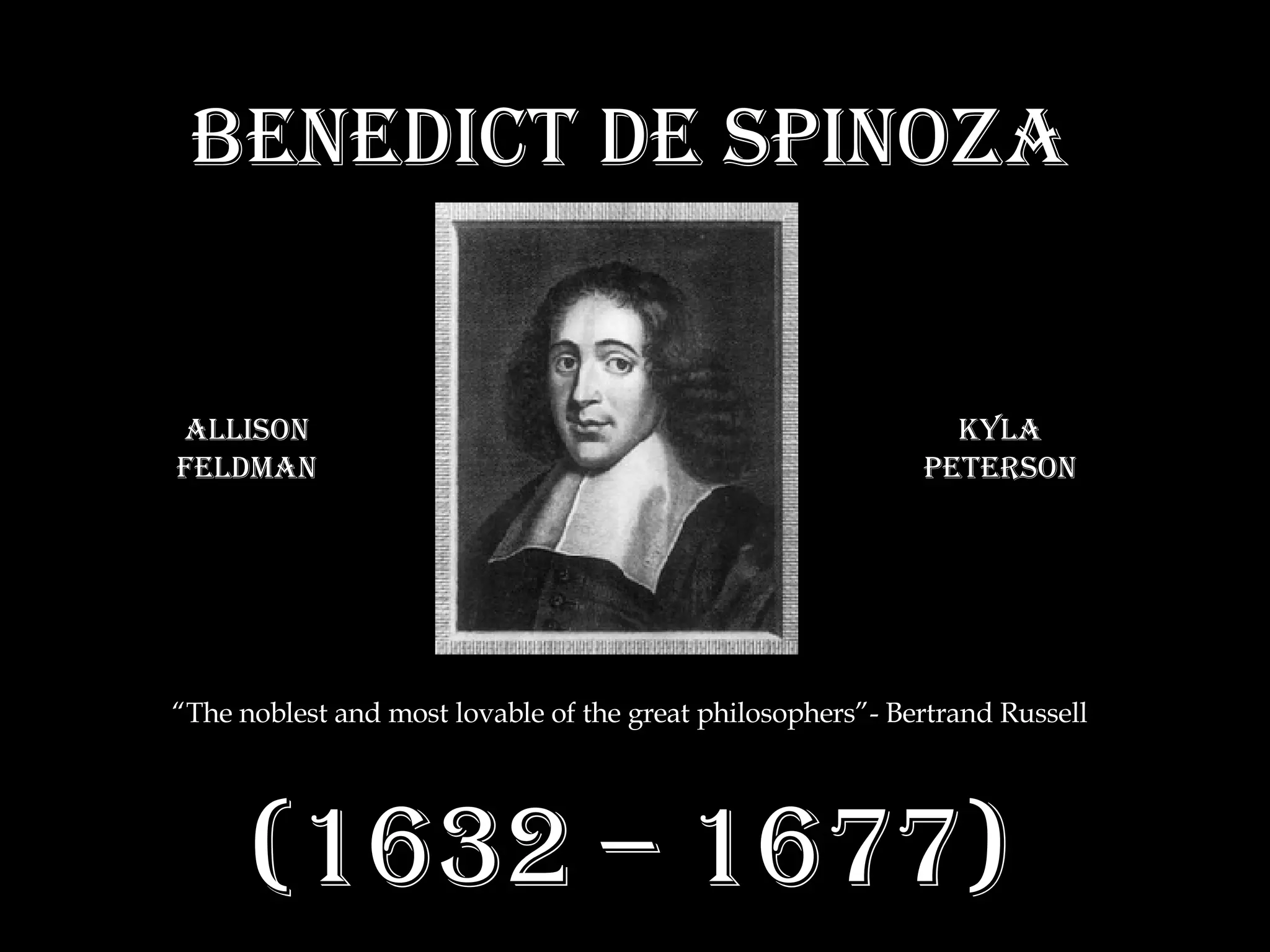
Benedict De Spinoza (1632 – 1677) Benedict De Spinoza (1632 – 1677) Allison Feldman Kyla Peterson “ The noblest and most lovable of the great philosophers”- Bertrand Russell
Background Born Jewish in 1632 Attended Talmud Torah School and studied religion Became an ex-Jesuit (which caused strained relationships with his community) Excommunicated from the synagogue by Eldeks Wrote  Treatise on the Emendation of the Intellect Attempted to formulate a philosophical method that would allow the mind to form clear and distinct ideas that are necessary for its perfection
Beliefs Pantheistic monist- of the belief that no dualism existed between god and the world The “Spinozistic God” neither loves nor hates His work  Ethics  said the guiding goal of a man is self-preservation; it is an instinct which we feel in the emotion of desire All is overlaid with reason which we might use to override our passions; reason distinguishes humans from the “lower brutes” When an individual acts out of the “norm” (he does an “evil” act), he does it because he doesn’t know any better; the only remedy is to teach or to punish him
Validity/ Connections Personally, we believe in Spinoza’s ideals. We don’t believe that there is a God that “defies all” and “rules the world.” People, not gods, make their own decisions and destinies. In addition, the “Spinozistic God” neither loves nor hates. We agree; no one should be treated better or worse because of the way they look, act, or think. Success and happiness should result from skill and persistence, not simply because someone is wealthy or beautiful. “ Reason overrides our passions.” Even if we want something, we must think if it is the best decision. For example, if someone wanted to buy a sports car on impulse, he or she must instead weigh the options and think of the consequences.

Spinoza[1]

  • 1.
    Benedict De Spinoza(1632 – 1677) Benedict De Spinoza (1632 – 1677) Allison Feldman Kyla Peterson “ The noblest and most lovable of the great philosophers”- Bertrand Russell
  • 2.
    Background Born Jewishin 1632 Attended Talmud Torah School and studied religion Became an ex-Jesuit (which caused strained relationships with his community) Excommunicated from the synagogue by Eldeks Wrote Treatise on the Emendation of the Intellect Attempted to formulate a philosophical method that would allow the mind to form clear and distinct ideas that are necessary for its perfection
  • 3.
    Beliefs Pantheistic monist-of the belief that no dualism existed between god and the world The “Spinozistic God” neither loves nor hates His work Ethics said the guiding goal of a man is self-preservation; it is an instinct which we feel in the emotion of desire All is overlaid with reason which we might use to override our passions; reason distinguishes humans from the “lower brutes” When an individual acts out of the “norm” (he does an “evil” act), he does it because he doesn’t know any better; the only remedy is to teach or to punish him
  • 4.
    Validity/ Connections Personally,we believe in Spinoza’s ideals. We don’t believe that there is a God that “defies all” and “rules the world.” People, not gods, make their own decisions and destinies. In addition, the “Spinozistic God” neither loves nor hates. We agree; no one should be treated better or worse because of the way they look, act, or think. Success and happiness should result from skill and persistence, not simply because someone is wealthy or beautiful. “ Reason overrides our passions.” Even if we want something, we must think if it is the best decision. For example, if someone wanted to buy a sports car on impulse, he or she must instead weigh the options and think of the consequences.