Art
Meaning & Being
esse est percipi (To be is to be perceived)
                      —Berkeley

       To be is to be the value of a variable.
                       —Quine

 To see something as art requires something the eye
cannot descry — an atmosphere of artistic theory, a
   knowledge of the history of art: an artworld.
                      —Danto
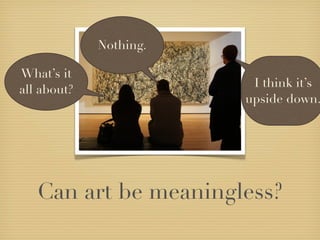
Nothing.

What’s it
                         I think it’s
all about?
                        upside down.


   Can art be meaningless?
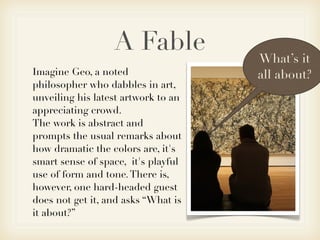
A Fable            What’s it
Imagine Geo, a noted                 all about?
philosopher who dabbles in art,
unveiling his latest artwork to an
appreciating crowd.
The work is abstract and
prompts the usual remarks about
how dramatic the colors are, it's
smart sense of space, it's playful
use of form and tone. There is,
however, one hard-headed guest
does not get it, and asks “What is
it about?”
A Fable
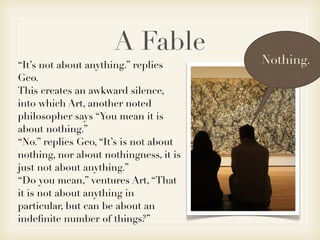
“It’s not about anything.” replies      Nothing.
Geo.
This creates an awkward silence,
into which Art, another noted
philosopher says “You mean it is
about nothing.”
“No.” replies Geo, “It’s is not about
nothing, nor about nothingness, it is
just not about anything.”
“Do you mean,” ventures Art, “That
it is not about anything in
particular, but can be about an
indefinite number of things?”
A Fable
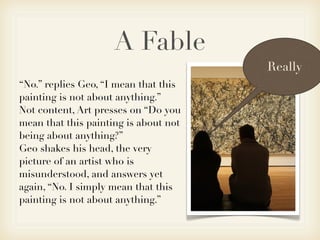
                                       Really
“No.” replies Geo, “I mean that this
painting is not about anything.”
Not content, Art presses on “Do you
mean that this painting is about not
being about anything?”
Geo shakes his head, the very
picture of an artist who is
misunderstood, and answers yet
again, “No. I simply mean that this
painting is not about anything.”
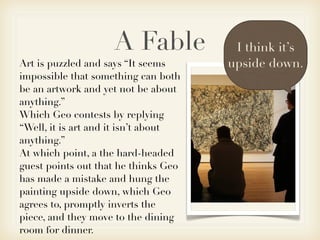
A Fable            I think it’s
Art is puzzled and says “It seems     upside down.
impossible that something can both
be an artwork and yet not be about
anything.”
Which Geo contests by replying
“Well, it is art and it isn’t about
anything.”
At which point, a the hard-headed
guest points out that he thinks Geo
has made a mistake and hung the
painting upside down, which Geo
agrees to, promptly inverts the
piece, and they move to the dining
room for dinner.
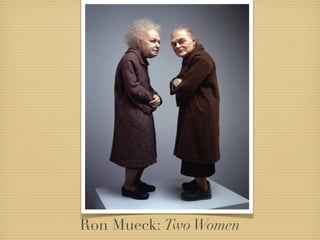
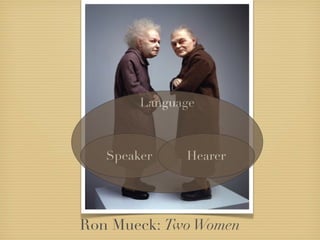
Ron Mueck: Two Women
Language


   Speaker    Hearer


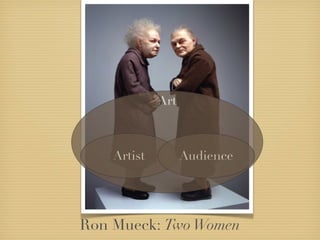
Ron Mueck: Two Women
Art


    Artist         Audience


Ron Mueck: Two Women
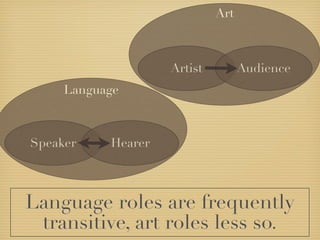
Art


                    Artist         Audience
     Language


Speaker    Hearer


Language roles are frequently
 transitive, art roles less so.
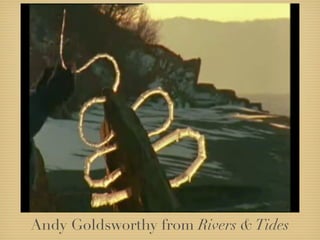
Andy Goldsworthy from Rivers & Tides
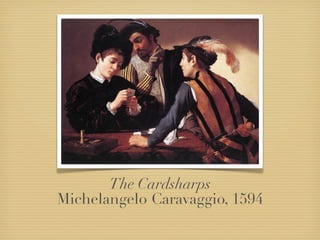
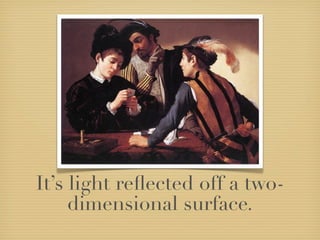
The Cardsharps
Michelangelo Caravaggio, 1594
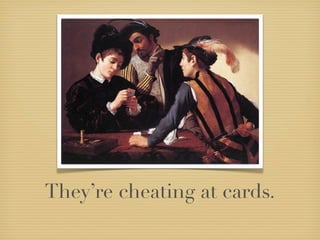
They’re cheating at cards.
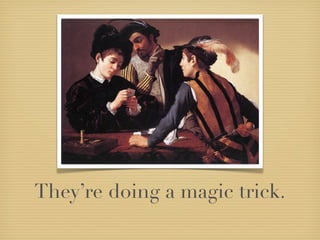
They’re doing a magic trick.
It’s light reflected off a two-
     dimensional surface.
I shall now think of pairs of predicates related to each
other as "opposites," conceding straight off the vagueness
of this demode term. Contradictory predicates are not
opposites, since one of each of them must apply to every
object in the universe, and neither of a pair of opposites
need apply to some objects in the universe. An object must
first be of a certain kind before either of a pair of opposites
applies to it, and then at most and at least one of the
opposites must apply to it. So opposites are not contraries,
for contraries may both be false of some objects in the
universe, but opposites cannot both be false; for of some
objects, neither of a pair of opposites sensibly applies,
unless the object is of the right sort. Then, if the object is
of the required kind, the opposites behave as
contradictories.
                           —Arthur Danto, The Artworld
To see something as art requires something the eye cannot
decry-an atmosphere of artistic theory, a knowledge of the
history of art: an artworld.


                          —Arthur Danto, The Artworld
If F and non-F are opposites,an object o must be of a
certain kind K before either of these sensibly applies; but if
o is a member of K, then o either is F or non-F, to the
exclusion of the other. The class of pairs of opposites that
sensibly apply to the (ô)Ko I shall designate as the class of
K-relevant predicates. And a necessary condition for an
object to be of a kind K is that at least one pair of K-
relevant opposites be sensibly applicable to it. But, in fact,
if an object is of kind K, at least and at most one of each K-
relevant pair of opposites applies to it.


                           —Arthur Danto, The Artworld
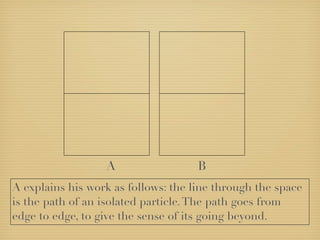
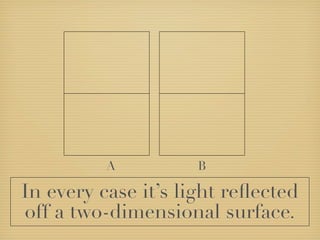
A                  B
A explains his work as follows: the line through the space
is the path of an isolated particle. The path goes from
edge to edge, to give the sense of its going beyond.
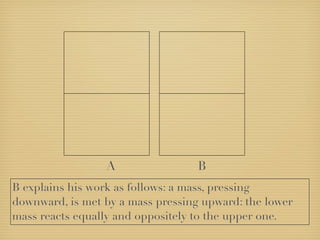
A                 B
B explains his work as follows: a mass, pressing
downward, is met by a mass pressing upward: the lower
mass reacts equally and oppositely to the upper one.
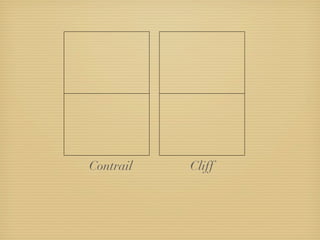
Contrail   Cliff
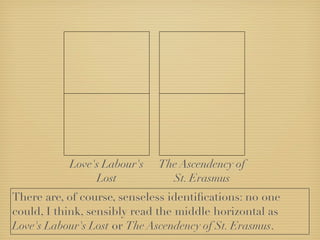
Love's Labour's   The Ascendency of
                Lost           St. Erasmus
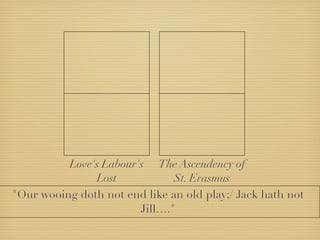
There are, of course, senseless identifications: no one
could, I think, sensibly read the middle horizontal as
Love's Labour's Lost or The Ascendency of St. Erasmus.
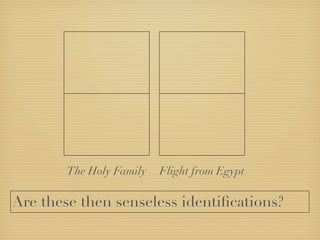
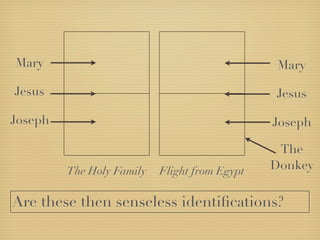
The Holy Family   Flight from Egypt

Are these then senseless identifications?
Mary                                            Mary

Jesus                                          Jesus

Joseph                                         Joseph

                                                The
         The Holy Family   Flight from Egypt   Donkey

Are these then senseless identifications?
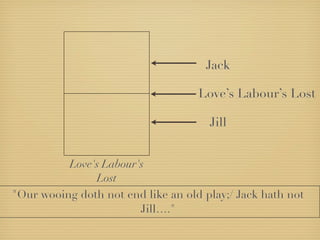
Love's Labour's The Ascendency of
               Lost            St. Erasmus
"Our wooing doth not end like an old play;/ Jack hath not
                        Jill…."
Jack

                                    Love’s Labour’s Lost

                                      Jill


          Love's Labour's
               Lost
"Our wooing doth not end like an old play;/ Jack hath not
                        Jill…."
A          B

In every case it’s light reflected
off a two-dimensional surface.
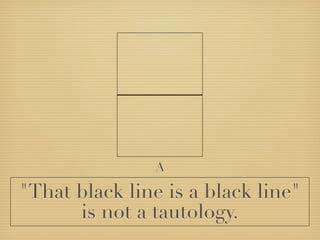
A

"That black line is a black line"
      is not a tautology.
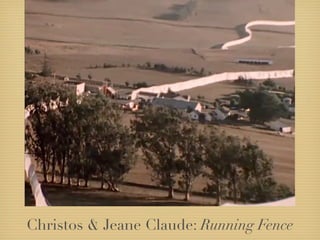
Christos & Jeane Claude: Running Fence

Phil art.Danto

  • 1.
  • 2.
    esse est percipi(To be is to be perceived) —Berkeley To be is to be the value of a variable. —Quine To see something as art requires something the eye cannot descry — an atmosphere of artistic theory, a knowledge of the history of art: an artworld. —Danto
  • 3.
    Nothing. What’s it I think it’s all about? upside down. Can art be meaningless?
  • 4.
    A Fable What’s it Imagine Geo, a noted all about? philosopher who dabbles in art, unveiling his latest artwork to an appreciating crowd. The work is abstract and prompts the usual remarks about how dramatic the colors are, it's smart sense of space, it's playful use of form and tone. There is, however, one hard-headed guest does not get it, and asks “What is it about?”
  • 5.
    A Fable “It’s notabout anything.” replies Nothing. Geo. This creates an awkward silence, into which Art, another noted philosopher says “You mean it is about nothing.” “No.” replies Geo, “It’s is not about nothing, nor about nothingness, it is just not about anything.” “Do you mean,” ventures Art, “That it is not about anything in particular, but can be about an indefinite number of things?”
  • 6.
    A Fable Really “No.” replies Geo, “I mean that this painting is not about anything.” Not content, Art presses on “Do you mean that this painting is about not being about anything?” Geo shakes his head, the very picture of an artist who is misunderstood, and answers yet again, “No. I simply mean that this painting is not about anything.”
  • 7.
    A Fable I think it’s Art is puzzled and says “It seems upside down. impossible that something can both be an artwork and yet not be about anything.” Which Geo contests by replying “Well, it is art and it isn’t about anything.” At which point, a the hard-headed guest points out that he thinks Geo has made a mistake and hung the painting upside down, which Geo agrees to, promptly inverts the piece, and they move to the dining room for dinner.
  • 8.
  • 9.
    Language Speaker Hearer Ron Mueck: Two Women
  • 10.
    Art Artist Audience Ron Mueck: Two Women
  • 11.
    Art Artist Audience Language Speaker Hearer Language roles are frequently transitive, art roles less so.
  • 12.
    Andy Goldsworthy fromRivers & Tides
  • 13.
    Andy Goldsworthy fromRivers & Tides
  • 14.
  • 15.
  • 16.
    They’re doing amagic trick.
  • 17.
    It’s light reflectedoff a two- dimensional surface.
  • 18.
    I shall nowthink of pairs of predicates related to each other as "opposites," conceding straight off the vagueness of this demode term. Contradictory predicates are not opposites, since one of each of them must apply to every object in the universe, and neither of a pair of opposites need apply to some objects in the universe. An object must first be of a certain kind before either of a pair of opposites applies to it, and then at most and at least one of the opposites must apply to it. So opposites are not contraries, for contraries may both be false of some objects in the universe, but opposites cannot both be false; for of some objects, neither of a pair of opposites sensibly applies, unless the object is of the right sort. Then, if the object is of the required kind, the opposites behave as contradictories. —Arthur Danto, The Artworld
  • 19.
    To see somethingas art requires something the eye cannot decry-an atmosphere of artistic theory, a knowledge of the history of art: an artworld. —Arthur Danto, The Artworld
  • 20.
    If F andnon-F are opposites,an object o must be of a certain kind K before either of these sensibly applies; but if o is a member of K, then o either is F or non-F, to the exclusion of the other. The class of pairs of opposites that sensibly apply to the (ô)Ko I shall designate as the class of K-relevant predicates. And a necessary condition for an object to be of a kind K is that at least one pair of K- relevant opposites be sensibly applicable to it. But, in fact, if an object is of kind K, at least and at most one of each K- relevant pair of opposites applies to it. —Arthur Danto, The Artworld
  • 21.
    A B A explains his work as follows: the line through the space is the path of an isolated particle. The path goes from edge to edge, to give the sense of its going beyond.
  • 22.
    A B B explains his work as follows: a mass, pressing downward, is met by a mass pressing upward: the lower mass reacts equally and oppositely to the upper one.
  • 23.
    Contrail Cliff
  • 24.
    Love's Labour's The Ascendency of Lost St. Erasmus There are, of course, senseless identifications: no one could, I think, sensibly read the middle horizontal as Love's Labour's Lost or The Ascendency of St. Erasmus.
  • 25.
    The Holy Family Flight from Egypt Are these then senseless identifications?
  • 26.
    Mary Mary Jesus Jesus Joseph Joseph The The Holy Family Flight from Egypt Donkey Are these then senseless identifications?
  • 27.
    Love's Labour's TheAscendency of Lost St. Erasmus "Our wooing doth not end like an old play;/ Jack hath not Jill…."
  • 28.
    Jack Love’s Labour’s Lost Jill Love's Labour's Lost "Our wooing doth not end like an old play;/ Jack hath not Jill…."
  • 29.
    A B In every case it’s light reflected off a two-dimensional surface.
  • 30.
    A "That black lineis a black line" is not a tautology.
  • 31.
    Christos & JeaneClaude: Running Fence
  • 32.
    Christos & JeaneClaude: Running Fence