INTERPERSONAL SKILLS FOR
EFFECTIVE RELATIONSHIPS
By
Nwakerendu Ike
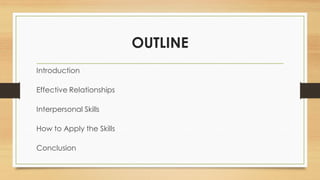
OUTLINE
Introduction
Effective Relationships
Interpersonal Skills
How to Apply the Skills
Conclusion
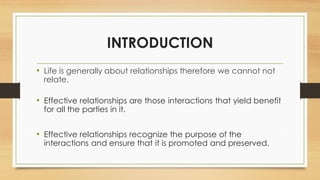
INTRODUCTION
• Life is generally about relationships therefore we cannot not
relate.
• Effective relationships are those interactions that yield benefit
for all the parties in it.
• Effective relationships recognize the purpose of the
interactions and ensure that it is promoted and preserved.
EFFECTIVE RELATIONSHIPS
• Effective relationships recognize the strengths and weaknesses of the
parties involved and manage both for the benefit of the relationship
• Effective relationships thrive in mutual trust and understanding
• Communication is the vehicle for effective relationships, at work, at home,
everywhere
• Interactions in our various levels of relationships are often marred by
schisms, quarrels and conflicts.
• Understanding the sources of human behaviours and learning relevant
skills would enable us relate with little or no schisms.
INTERPERSONAL SKILLS
• Interpersonal skills are the life skills we use every day to communicate and interact
with other people, both individually and in groups. They are abilities we acquire
for the purpose of problem solving in our interaction with others.
• People who have worked on developing strong interpersonal skills are usually
more successful in both their professional and personal lives.
• It is believed that employers often seek to hire staff with 'strong interpersonal skills'
- they want people who will work well in a team and be able to communicate
effectively with colleagues, customers and clients.
INTERPERSONAL SKILLS
• Interpersonal skills are not just important in the workplace, our
personal and social lives can also benefit from better interpersonal
skills.
• People with good interpersonal skills are usually perceived as
optimistic, calm, confident and charismatic
• Through awareness of how you interact with others - and with
practice - you can improve your interpersonal skills.
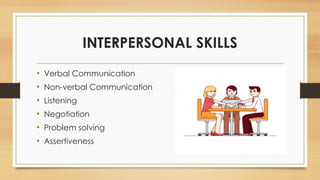
INTERPERSONAL SKILLS
• Verbal Communication
• Non-verbal Communication
• Listening
• Negotiation
• Problem solving
• Assertiveness
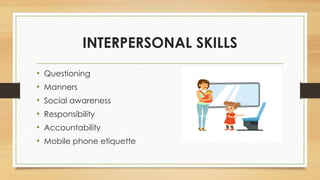
INTERPERSONAL SKILLS
• Questioning
• Manners
• Social awareness
• Responsibility
• Accountability
• Mobile phone etiquette
HOW TO APPLY THE SKILLS
• Learn to Listen, not just hear
• Choose Your Words
• Confirm clarity through questioning
and feedback
• Understand barriers to communication
and avoid them
• Relax and avoid communicating in a
tensed mood
• Be positive and cheerful; don’t be
negative and grumpy
• Empathize; don’t be high-handed
HOW TO APPLY THE SKILLS
• Recognise, manage and reduce stress in
yourself and others.
• Be assertive, it helps in negotiation; avoid
being passive and aggressive
• Learn from your past mistakes and
successes
• Enjoy working in groups; it is often
required in social and professional circles
• Acknowledge other people’s
accomplishments, express your
sympathy.
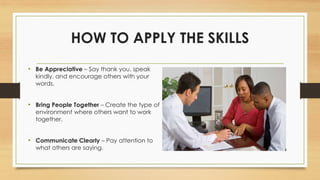
HOW TO APPLY THE SKILLS
• Be Appreciative – Say thank you, speak
kindly, and encourage others with your
words.
• Bring People Together – Create the type of
environment where others want to work
together.
• Communicate Clearly – Pay attention to
what others are saying.
Conclusion
• Interpersonal skills are essential for effective relationships.
Paying attention to these skills while building technical
skills is necessary for over all success.
• Deliberately cultivate the skills and apply them in daily
interactions
Thank You

Interpersonal skills for effective relationships

  • 1.
    INTERPERSONAL SKILLS FOR EFFECTIVERELATIONSHIPS By Nwakerendu Ike
  • 2.
  • 3.
    INTRODUCTION • Life isgenerally about relationships therefore we cannot not relate. • Effective relationships are those interactions that yield benefit for all the parties in it. • Effective relationships recognize the purpose of the interactions and ensure that it is promoted and preserved.
  • 4.
    EFFECTIVE RELATIONSHIPS • Effectiverelationships recognize the strengths and weaknesses of the parties involved and manage both for the benefit of the relationship • Effective relationships thrive in mutual trust and understanding • Communication is the vehicle for effective relationships, at work, at home, everywhere • Interactions in our various levels of relationships are often marred by schisms, quarrels and conflicts. • Understanding the sources of human behaviours and learning relevant skills would enable us relate with little or no schisms.
  • 5.
    INTERPERSONAL SKILLS • Interpersonalskills are the life skills we use every day to communicate and interact with other people, both individually and in groups. They are abilities we acquire for the purpose of problem solving in our interaction with others. • People who have worked on developing strong interpersonal skills are usually more successful in both their professional and personal lives. • It is believed that employers often seek to hire staff with 'strong interpersonal skills' - they want people who will work well in a team and be able to communicate effectively with colleagues, customers and clients.
  • 6.
    INTERPERSONAL SKILLS • Interpersonalskills are not just important in the workplace, our personal and social lives can also benefit from better interpersonal skills. • People with good interpersonal skills are usually perceived as optimistic, calm, confident and charismatic • Through awareness of how you interact with others - and with practice - you can improve your interpersonal skills.
  • 7.
    INTERPERSONAL SKILLS • VerbalCommunication • Non-verbal Communication • Listening • Negotiation • Problem solving • Assertiveness
  • 8.
    INTERPERSONAL SKILLS • Questioning •Manners • Social awareness • Responsibility • Accountability • Mobile phone etiquette
  • 9.
    HOW TO APPLYTHE SKILLS • Learn to Listen, not just hear • Choose Your Words • Confirm clarity through questioning and feedback • Understand barriers to communication and avoid them • Relax and avoid communicating in a tensed mood • Be positive and cheerful; don’t be negative and grumpy • Empathize; don’t be high-handed
  • 10.
    HOW TO APPLYTHE SKILLS • Recognise, manage and reduce stress in yourself and others. • Be assertive, it helps in negotiation; avoid being passive and aggressive • Learn from your past mistakes and successes • Enjoy working in groups; it is often required in social and professional circles • Acknowledge other people’s accomplishments, express your sympathy.
  • 11.
    HOW TO APPLYTHE SKILLS • Be Appreciative – Say thank you, speak kindly, and encourage others with your words. • Bring People Together – Create the type of environment where others want to work together. • Communicate Clearly – Pay attention to what others are saying.
  • 12.
    Conclusion • Interpersonal skillsare essential for effective relationships. Paying attention to these skills while building technical skills is necessary for over all success. • Deliberately cultivate the skills and apply them in daily interactions
  • 13.