Interpersonal Behavior in the Workplace
Chapter Seven
© Copyright Prentice-Hall 2004
2
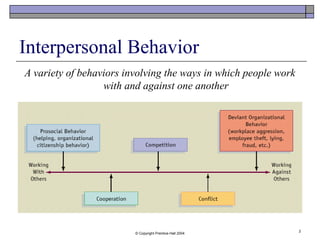
Interpersonal Behavior
A variety of behaviors involving the ways in which people work
with and against one another
© Copyright Prentice-Hall 2004
3
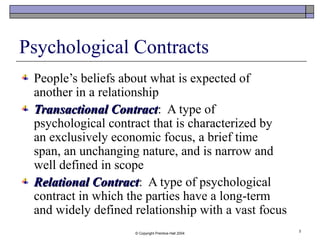
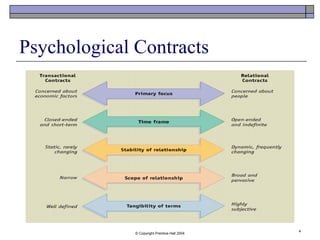
Psychological Contracts
People’s beliefs about what is expected of
another in a relationship
Transactional ContractTransactional Contract: A type of
psychological contract that is characterized by
an exclusively economic focus, a brief time
span, an unchanging nature, and is narrow and
well defined in scope
Relational ContractRelational Contract: A type of psychological
contract in which the parties have a long-term
and widely defined relationship with a vast focus
© Copyright Prentice-Hall 2004
4
Psychological Contracts
© Copyright Prentice-Hall 2004
5
Trust
A person’s degree of confidence in the words
and actions of another
Calculus-Based TrustCalculus-Based Trust: A form of trust based
on deterrence, whenever people believe that
another will behave as promised out of fear of
getting punished for doing otherwise
Identification-Based TrustIdentification-Based Trust: A form of trust
based on accepting the wants and desires of
another person
© Copyright Prentice-Hall 2004
6
Developing Trust
How trust developsHow trust develops:
 Some people tend to be more trusting than others
 People develop reputations for being trustworthy
How to promote trustHow to promote trust:
 Always meet deadlines
 Follow through as promised
 Spend time sharing personal values and goals
© Copyright Prentice-Hall 2004
7
Prosocial Behavior
Prosocial behaviorProsocial behavior can be defined as acts
that benefit others in organizations
Organizational Citizenship BehaviorOrganizational Citizenship Behavior (OCB)
can be defined as acts that exceed the formal
requirements of one’s job
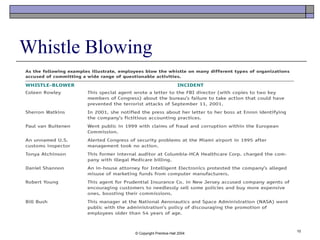
Whistle-blowingWhistle-blowing is the disclosure by
employees of illegal, immoral, or illegitimate
practices by employers to people or
organizations able to effect action
© Copyright Prentice-Hall 2004
8
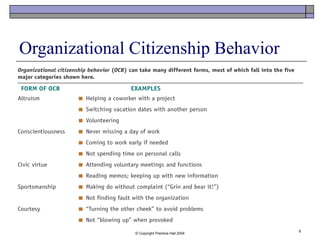
Organizational Citizenship Behavior
© Copyright Prentice-Hall 2004
9
Organizational Citizenship Behavior
 The more people believe they are treated fairly by the
organization:
 The more they trust its management
 The more willing they are to go the extra mile to help out when
needed
 Although the effects of OCB may be indirect and difficult to
measure, they can be very profound
 To promote OCB:
 Go out of your way to help others
 Be an example of conscientiousness
 Make voluntary functions fun
 Demonstrate courtesy and good sportsmanship
© Copyright Prentice-Hall 2004
10
Whistle Blowing
© Copyright Prentice-Hall 2004
11
Cooperation and Competition
 Cooperation can be defined as those situations in which
two or more individuals, teams or organizations work
together toward some common goal
 Factors that contribute to cooperation:
 Reciprocity principle: the tendency for people to treat others the
way they have been treated in the past
 Personal orientation: some people tend to be more cooperative,
by nature, than others
 Organizational reward systems
 Competition can be defined as a pattern of behavior in
which each person, group, or organization seeks to
maximize its own gains, often at the expense of others
© Copyright Prentice-Hall 2004
12
Levels of Cooperation/Assertiveness
 Collaboration: cooperation and
assertiveness
 Accommodating: cooperation and
unassertive
 Compromising: between cooperative and
assertive
 Forcing: assertive and uncooperative
(conflict/competition)
 Avoiding: unassertive and uncooperative
© Copyright Prentice-Hall 2004
13
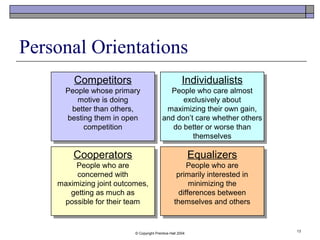
Personal Orientations
Competitors
People whose primary
motive is doing
better than others,
besting them in open
competition
Competitors
People whose primary
motive is doing
better than others,
besting them in open
competition
Individualists
People who care almost
exclusively about
maximizing their own gain,
and don’t care whether others
do better or worse than
themselves
Individualists
People who care almost
exclusively about
maximizing their own gain,
and don’t care whether others
do better or worse than
themselves
Cooperators
People who are
concerned with
maximizing joint outcomes,
getting as much as
possible for their team
Cooperators
People who are
concerned with
maximizing joint outcomes,
getting as much as
possible for their team
Equalizers
People who are
primarily interested in
minimizing the
differences between
themselves and others
Equalizers
People who are
primarily interested in
minimizing the
differences between
themselves and others
© Copyright Prentice-Hall 2004
14
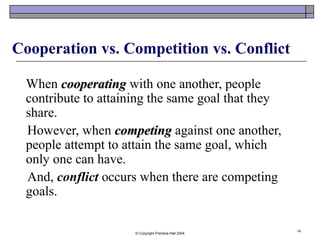
Cooperation vs. Competition vs. Conflict
When cooperatingcooperating with one another, people
contribute to attaining the same goal that they
share.
However, when competingcompeting against one another,
people attempt to attain the same goal, which
only one can have.
And, conflict occurs when there are competing
goals.
© Copyright Prentice-Hall 2004
15
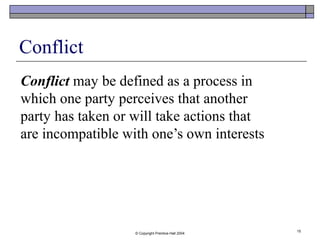
Conflict
Conflict may be defined as a process in
which one party perceives that another
party has taken or will take actions that
are incompatible with one’s own interests
© Copyright Prentice-Hall 2004
16
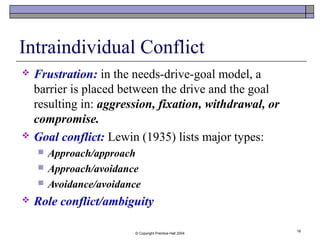
Intraindividual Conflict
 Frustration: in the needs-drive-goal model, a
barrier is placed between the drive and the goal
resulting in: aggression, fixation, withdrawal, or
compromise.
 Goal conflict: Lewin (1935) lists major types:
 Approach/approach
 Approach/avoidance
 Avoidance/avoidance
 Role conflict/ambiguity
© Copyright Prentice-Hall 2004
17
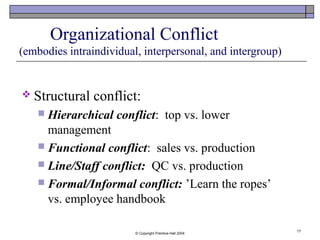
Organizational Conflict
(embodies intraindividual, interpersonal, and intergroup)
 Structural conflict:
 Hierarchical conflict: top vs. lower
management
 Functional conflict: sales vs. production
 Line/Staff conflict: QC vs. production
 Formal/Informal conflict: ’Learn the ropes’
vs. employee handbook
© Copyright Prentice-Hall 2004
18
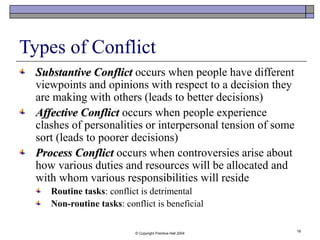
Types of Conflict
Substantive ConflictSubstantive Conflict occurs when people have different
viewpoints and opinions with respect to a decision they
are making with others (leads to better decisions)
Affective ConflictAffective Conflict occurs when people experience
clashes of personalities or interpersonal tension of some
sort (leads to poorer decisions)
Process ConflictProcess Conflict occurs when controversies arise about
how various duties and resources will be allocated and
with whom various responsibilities will reside
Routine tasks: conflict is detrimental
Non-routine tasks: conflict is beneficial
© Copyright Prentice-Hall 2004
19
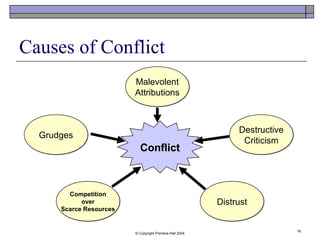
Causes of Conflict
ConflictConflict
GrudgesGrudges
Malevolent
Attributions
Malevolent
Attributions
Destructive
Criticism
Destructive
Criticism
DistrustDistrust
Competition
over
Scarce Resources
Competition
over
Scarce Resources
© Copyright Prentice-Hall 2004
20
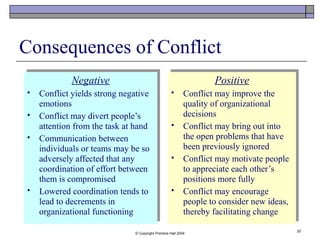
Consequences of Conflict
Negative
 Conflict yields strong negative
emotions
 Conflict may divert people’s
attention from the task at hand
 Communication between
individuals or teams may be so
adversely affected that any
coordination of effort between
them is compromised
 Lowered coordination tends to
lead to decrements in
organizational functioning
Negative
 Conflict yields strong negative
emotions
 Conflict may divert people’s
attention from the task at hand
 Communication between
individuals or teams may be so
adversely affected that any
coordination of effort between
them is compromised
 Lowered coordination tends to
lead to decrements in
organizational functioning
Positive
 Conflict may improve the
quality of organizational
decisions
 Conflict may bring out into
the open problems that have
been previously ignored
 Conflict may motivate people
to appreciate each other’s
positions more fully
 Conflict may encourage
people to consider new ideas,
thereby facilitating change
Positive
 Conflict may improve the
quality of organizational
decisions
 Conflict may bring out into
the open problems that have
been previously ignored
 Conflict may motivate people
to appreciate each other’s
positions more fully
 Conflict may encourage
people to consider new ideas,
thereby facilitating change
© Copyright Prentice-Hall 2004
21
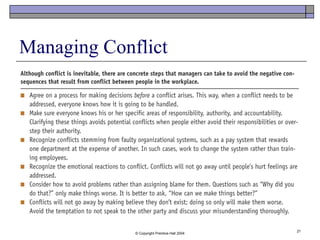
Managing Conflict
© Copyright Prentice-Hall 2004
22
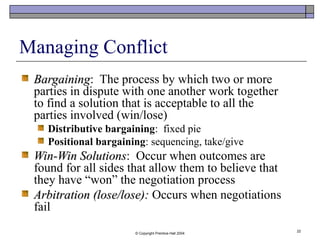
Managing Conflict
BargainingBargaining: The process by which two or more
parties in dispute with one another work together
to find a solution that is acceptable to all the
parties involved (win/lose)
Distributive bargaining: fixed pie
Positional bargaining: sequencing, take/give
Win-Win SolutionsWin-Win Solutions: Occur when outcomes are
found for all sides that allow them to believe that
they have “won” the negotiation process
Arbitration (lose/lose):Arbitration (lose/lose): Occurs when negotiations
fail
© Copyright Prentice-Hall 2004
23
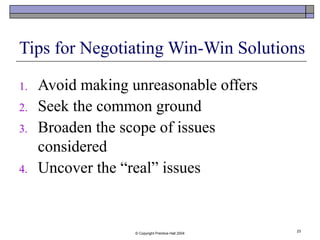
Tips for Negotiating Win-Win Solutions
1. Avoid making unreasonable offers
2. Seek the common ground
3. Broaden the scope of issues
considered
4. Uncover the “real” issues
© Copyright Prentice-Hall 2004
24
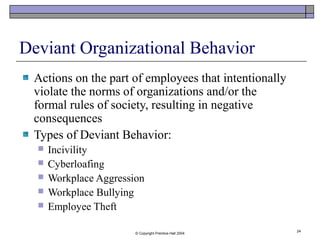
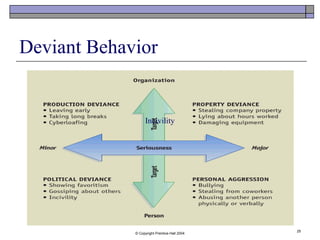
Deviant Organizational Behavior
Actions on the part of employees that intentionally
violate the norms of organizations and/or the
formal rules of society, resulting in negative
consequences
Types of Deviant Behavior:
 Incivility
 Cyberloafing
 Workplace Aggression
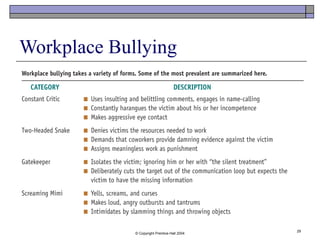
 Workplace Bullying
 Employee Theft
© Copyright Prentice-Hall 2004
25
Deviant Behavior
Incivility
© Copyright Prentice-Hall 2004
26
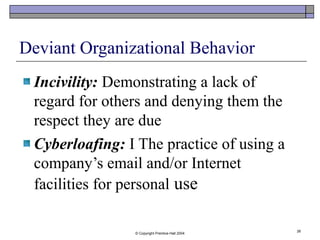
Deviant Organizational Behavior
Incivility: Demonstrating a lack of
regard for others and denying them the
respect they are due
Cyberloafing: I The practice of using a
company’s email and/or Internet
facilities for personal use
© Copyright Prentice-Hall 2004
27
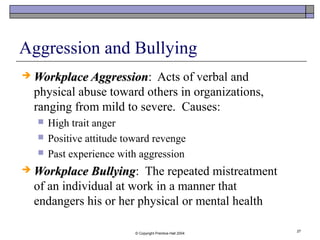
Aggression and Bullying
 Workplace AggressionWorkplace Aggression: Acts of verbal and
physical abuse toward others in organizations,
ranging from mild to severe. Causes:
 High trait anger
 Positive attitude toward revenge
 Past experience with aggression
 Workplace BullyingWorkplace Bullying: The repeated mistreatment
of an individual at work in a manner that
endangers his or her physical or mental health
© Copyright Prentice-Hall 2004
28
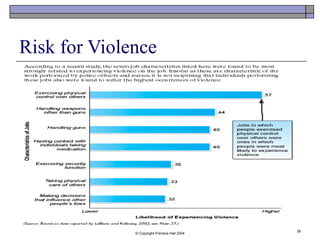
Risk for Violence
© Copyright Prentice-Hall 2004
29
Workplace Bullying
© Copyright Prentice-Hall 2004
30
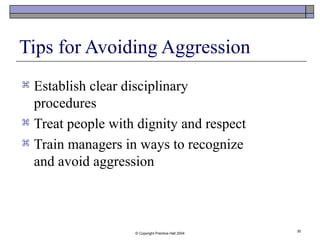
Tips for Avoiding Aggression
 Establish clear disciplinary
procedures
 Treat people with dignity and respect
 Train managers in ways to recognize
and avoid aggression
© Copyright Prentice-Hall 2004
31
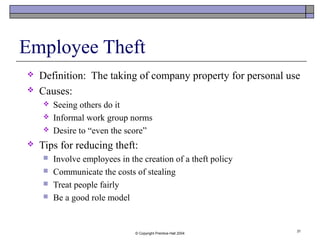
Employee Theft
 Definition: The taking of company property for personal use
 Causes:
 Seeing others do it
 Informal work group norms
 Desire to “even the score”
 Tips for reducing theft:
 Involve employees in the creation of a theft policy
 Communicate the costs of stealing
 Treat people fairly
 Be a good role model
© Copyright Prentice-Hall 2004
32
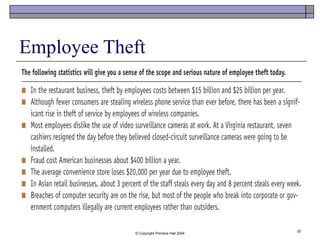
Employee Theft

interpersonal behavior

  • 1.
    Interpersonal Behavior inthe Workplace Chapter Seven
  • 2.
    © Copyright Prentice-Hall2004 2 Interpersonal Behavior A variety of behaviors involving the ways in which people work with and against one another
  • 3.
    © Copyright Prentice-Hall2004 3 Psychological Contracts People’s beliefs about what is expected of another in a relationship Transactional ContractTransactional Contract: A type of psychological contract that is characterized by an exclusively economic focus, a brief time span, an unchanging nature, and is narrow and well defined in scope Relational ContractRelational Contract: A type of psychological contract in which the parties have a long-term and widely defined relationship with a vast focus
  • 4.
    © Copyright Prentice-Hall2004 4 Psychological Contracts
  • 5.
    © Copyright Prentice-Hall2004 5 Trust A person’s degree of confidence in the words and actions of another Calculus-Based TrustCalculus-Based Trust: A form of trust based on deterrence, whenever people believe that another will behave as promised out of fear of getting punished for doing otherwise Identification-Based TrustIdentification-Based Trust: A form of trust based on accepting the wants and desires of another person
  • 6.
    © Copyright Prentice-Hall2004 6 Developing Trust How trust developsHow trust develops:  Some people tend to be more trusting than others  People develop reputations for being trustworthy How to promote trustHow to promote trust:  Always meet deadlines  Follow through as promised  Spend time sharing personal values and goals
  • 7.
    © Copyright Prentice-Hall2004 7 Prosocial Behavior Prosocial behaviorProsocial behavior can be defined as acts that benefit others in organizations Organizational Citizenship BehaviorOrganizational Citizenship Behavior (OCB) can be defined as acts that exceed the formal requirements of one’s job Whistle-blowingWhistle-blowing is the disclosure by employees of illegal, immoral, or illegitimate practices by employers to people or organizations able to effect action
  • 8.
    © Copyright Prentice-Hall2004 8 Organizational Citizenship Behavior
  • 9.
    © Copyright Prentice-Hall2004 9 Organizational Citizenship Behavior  The more people believe they are treated fairly by the organization:  The more they trust its management  The more willing they are to go the extra mile to help out when needed  Although the effects of OCB may be indirect and difficult to measure, they can be very profound  To promote OCB:  Go out of your way to help others  Be an example of conscientiousness  Make voluntary functions fun  Demonstrate courtesy and good sportsmanship
  • 10.
    © Copyright Prentice-Hall2004 10 Whistle Blowing
  • 11.
    © Copyright Prentice-Hall2004 11 Cooperation and Competition  Cooperation can be defined as those situations in which two or more individuals, teams or organizations work together toward some common goal  Factors that contribute to cooperation:  Reciprocity principle: the tendency for people to treat others the way they have been treated in the past  Personal orientation: some people tend to be more cooperative, by nature, than others  Organizational reward systems  Competition can be defined as a pattern of behavior in which each person, group, or organization seeks to maximize its own gains, often at the expense of others
  • 12.
    © Copyright Prentice-Hall2004 12 Levels of Cooperation/Assertiveness  Collaboration: cooperation and assertiveness  Accommodating: cooperation and unassertive  Compromising: between cooperative and assertive  Forcing: assertive and uncooperative (conflict/competition)  Avoiding: unassertive and uncooperative
  • 13.
    © Copyright Prentice-Hall2004 13 Personal Orientations Competitors People whose primary motive is doing better than others, besting them in open competition Competitors People whose primary motive is doing better than others, besting them in open competition Individualists People who care almost exclusively about maximizing their own gain, and don’t care whether others do better or worse than themselves Individualists People who care almost exclusively about maximizing their own gain, and don’t care whether others do better or worse than themselves Cooperators People who are concerned with maximizing joint outcomes, getting as much as possible for their team Cooperators People who are concerned with maximizing joint outcomes, getting as much as possible for their team Equalizers People who are primarily interested in minimizing the differences between themselves and others Equalizers People who are primarily interested in minimizing the differences between themselves and others
  • 14.
    © Copyright Prentice-Hall2004 14 Cooperation vs. Competition vs. Conflict When cooperatingcooperating with one another, people contribute to attaining the same goal that they share. However, when competingcompeting against one another, people attempt to attain the same goal, which only one can have. And, conflict occurs when there are competing goals.
  • 15.
    © Copyright Prentice-Hall2004 15 Conflict Conflict may be defined as a process in which one party perceives that another party has taken or will take actions that are incompatible with one’s own interests
  • 16.
    © Copyright Prentice-Hall2004 16 Intraindividual Conflict  Frustration: in the needs-drive-goal model, a barrier is placed between the drive and the goal resulting in: aggression, fixation, withdrawal, or compromise.  Goal conflict: Lewin (1935) lists major types:  Approach/approach  Approach/avoidance  Avoidance/avoidance  Role conflict/ambiguity
  • 17.
    © Copyright Prentice-Hall2004 17 Organizational Conflict (embodies intraindividual, interpersonal, and intergroup)  Structural conflict:  Hierarchical conflict: top vs. lower management  Functional conflict: sales vs. production  Line/Staff conflict: QC vs. production  Formal/Informal conflict: ’Learn the ropes’ vs. employee handbook
  • 18.
    © Copyright Prentice-Hall2004 18 Types of Conflict Substantive ConflictSubstantive Conflict occurs when people have different viewpoints and opinions with respect to a decision they are making with others (leads to better decisions) Affective ConflictAffective Conflict occurs when people experience clashes of personalities or interpersonal tension of some sort (leads to poorer decisions) Process ConflictProcess Conflict occurs when controversies arise about how various duties and resources will be allocated and with whom various responsibilities will reside Routine tasks: conflict is detrimental Non-routine tasks: conflict is beneficial
  • 19.
    © Copyright Prentice-Hall2004 19 Causes of Conflict ConflictConflict GrudgesGrudges Malevolent Attributions Malevolent Attributions Destructive Criticism Destructive Criticism DistrustDistrust Competition over Scarce Resources Competition over Scarce Resources
  • 20.
    © Copyright Prentice-Hall2004 20 Consequences of Conflict Negative  Conflict yields strong negative emotions  Conflict may divert people’s attention from the task at hand  Communication between individuals or teams may be so adversely affected that any coordination of effort between them is compromised  Lowered coordination tends to lead to decrements in organizational functioning Negative  Conflict yields strong negative emotions  Conflict may divert people’s attention from the task at hand  Communication between individuals or teams may be so adversely affected that any coordination of effort between them is compromised  Lowered coordination tends to lead to decrements in organizational functioning Positive  Conflict may improve the quality of organizational decisions  Conflict may bring out into the open problems that have been previously ignored  Conflict may motivate people to appreciate each other’s positions more fully  Conflict may encourage people to consider new ideas, thereby facilitating change Positive  Conflict may improve the quality of organizational decisions  Conflict may bring out into the open problems that have been previously ignored  Conflict may motivate people to appreciate each other’s positions more fully  Conflict may encourage people to consider new ideas, thereby facilitating change
  • 21.
    © Copyright Prentice-Hall2004 21 Managing Conflict
  • 22.
    © Copyright Prentice-Hall2004 22 Managing Conflict BargainingBargaining: The process by which two or more parties in dispute with one another work together to find a solution that is acceptable to all the parties involved (win/lose) Distributive bargaining: fixed pie Positional bargaining: sequencing, take/give Win-Win SolutionsWin-Win Solutions: Occur when outcomes are found for all sides that allow them to believe that they have “won” the negotiation process Arbitration (lose/lose):Arbitration (lose/lose): Occurs when negotiations fail
  • 23.
    © Copyright Prentice-Hall2004 23 Tips for Negotiating Win-Win Solutions 1. Avoid making unreasonable offers 2. Seek the common ground 3. Broaden the scope of issues considered 4. Uncover the “real” issues
  • 24.
    © Copyright Prentice-Hall2004 24 Deviant Organizational Behavior Actions on the part of employees that intentionally violate the norms of organizations and/or the formal rules of society, resulting in negative consequences Types of Deviant Behavior:  Incivility  Cyberloafing  Workplace Aggression  Workplace Bullying  Employee Theft
  • 25.
    © Copyright Prentice-Hall2004 25 Deviant Behavior Incivility
  • 26.
    © Copyright Prentice-Hall2004 26 Deviant Organizational Behavior Incivility: Demonstrating a lack of regard for others and denying them the respect they are due Cyberloafing: I The practice of using a company’s email and/or Internet facilities for personal use
  • 27.
    © Copyright Prentice-Hall2004 27 Aggression and Bullying  Workplace AggressionWorkplace Aggression: Acts of verbal and physical abuse toward others in organizations, ranging from mild to severe. Causes:  High trait anger  Positive attitude toward revenge  Past experience with aggression  Workplace BullyingWorkplace Bullying: The repeated mistreatment of an individual at work in a manner that endangers his or her physical or mental health
  • 28.
    © Copyright Prentice-Hall2004 28 Risk for Violence
  • 29.
    © Copyright Prentice-Hall2004 29 Workplace Bullying
  • 30.
    © Copyright Prentice-Hall2004 30 Tips for Avoiding Aggression  Establish clear disciplinary procedures  Treat people with dignity and respect  Train managers in ways to recognize and avoid aggression
  • 31.
    © Copyright Prentice-Hall2004 31 Employee Theft  Definition: The taking of company property for personal use  Causes:  Seeing others do it  Informal work group norms  Desire to “even the score”  Tips for reducing theft:  Involve employees in the creation of a theft policy  Communicate the costs of stealing  Treat people fairly  Be a good role model
  • 32.
    © Copyright Prentice-Hall2004 32 Employee Theft