TCP/IP Protocol Suite 1
Chapter 1Chapter 1
Objectives
Upon completion you will be able to:
IntroductionIntroduction
• Understand how the Internet came into being
• Understand the meaning of the terms protocol and standard
• Understand the various organizations involved in the standards
• Understand the different levels of Internet service providers
• Understand the groups involved in Internet administration
TCP/IP Protocol Suite 2
1.1 A Brief History
A network is a group of connected, communicating devices. AnA network is a group of connected, communicating devices. An internetinternet
is two or more networks that can communicate with each other. Theis two or more networks that can communicate with each other. The
most notable internet is called themost notable internet is called the InternetInternet. Millions of people are users.. Millions of people are users.
Yet this extraordinary communication system only came into being inYet this extraordinary communication system only came into being in
1969.1969.
The topics discussed in this section include:The topics discussed in this section include:
ARPANETARPANET
Birth of the InternetBirth of the Internet
Transmission Control Protocol / Internetworking ProtocolTransmission Control Protocol / Internetworking Protocol
MILNETMILNET
CSNET, NSFNET & ANSNETCSNET, NSFNET & ANSNET
The Internet TodayThe Internet Today
Time LineTime Line
Growth of the InternetGrowth of the Internet
TCP/IP Protocol Suite 3
Figure 1.1 Internet today
TCP/IP Protocol Suite 4
1.2 Protocols and Standards
In this section, we define two widely used terms: protocols andIn this section, we define two widely used terms: protocols and
standards. First, we define protocol, which is synonymous with “rule.”standards. First, we define protocol, which is synonymous with “rule.”
Then we discuss standards, which are agreed-upon rules.Then we discuss standards, which are agreed-upon rules.
The topics discussed in this section include:The topics discussed in this section include:
ProtocolsProtocols
StandardsStandards
TCP/IP Protocol Suite 5
1.3 Standards Organizations
Standards are developed through the cooperation of standards creationStandards are developed through the cooperation of standards creation
committees, forums, and government regulatory agencies.committees, forums, and government regulatory agencies.
The topics discussed in this section include:The topics discussed in this section include:
Standards Creation CommitteesStandards Creation Committees
ForumsForums
Regulatory AgenciesRegulatory Agencies
TCP/IP Protocol Suite 6
1.4 Internet Standards
An Internet standard is a thoroughly tested specification. There is aAn Internet standard is a thoroughly tested specification. There is a
strict procedure by which a specification attains Internet standard status.strict procedure by which a specification attains Internet standard status.
A specification begins as an Internet draft, working document with noA specification begins as an Internet draft, working document with no
official status and a six-month lifetime. A draft may be published as aofficial status and a six-month lifetime. A draft may be published as a
Request for Comment (RFC).Request for Comment (RFC).
The topics discussed in this section include:The topics discussed in this section include:
Maturity LevelsMaturity Levels
Requirement LevelsRequirement Levels
TCP/IP Protocol Suite 7
Figure 1.2 Maturity levels of an RFC
TCP/IP Protocol Suite 8
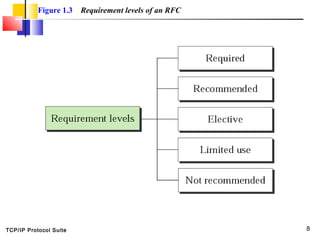
Figure 1.3 Requirement levels of an RFC
TCP/IP Protocol Suite 9
1.5 Internet Administration
The Internet has evolved and gained a broader user base with significantThe Internet has evolved and gained a broader user base with significant
commercial activity. Various groups that coordinate Internet issues havecommercial activity. Various groups that coordinate Internet issues have
guided this growth and development.guided this growth and development.
The topics discussed in this section include:The topics discussed in this section include:
Internet Society (ISOC)Internet Society (ISOC)
Internet Architecture Board (IAB)Internet Architecture Board (IAB)
Internet Engineering Task Force (IETF)Internet Engineering Task Force (IETF)
Internet Research Task Force (IRTF)Internet Research Task Force (IRTF)
Internet Assigned Numbers Authority (IANA)Internet Assigned Numbers Authority (IANA)
Names and Numbers (ICANN)Names and Numbers (ICANN)
Network Information Center (NIC)Network Information Center (NIC)
TCP/IP Protocol Suite 10
Figure 1.4 Internet administration

Chap 01 intro

  • 1.
    TCP/IP Protocol Suite1 Chapter 1Chapter 1 Objectives Upon completion you will be able to: IntroductionIntroduction • Understand how the Internet came into being • Understand the meaning of the terms protocol and standard • Understand the various organizations involved in the standards • Understand the different levels of Internet service providers • Understand the groups involved in Internet administration
  • 2.
    TCP/IP Protocol Suite2 1.1 A Brief History A network is a group of connected, communicating devices. AnA network is a group of connected, communicating devices. An internetinternet is two or more networks that can communicate with each other. Theis two or more networks that can communicate with each other. The most notable internet is called themost notable internet is called the InternetInternet. Millions of people are users.. Millions of people are users. Yet this extraordinary communication system only came into being inYet this extraordinary communication system only came into being in 1969.1969. The topics discussed in this section include:The topics discussed in this section include: ARPANETARPANET Birth of the InternetBirth of the Internet Transmission Control Protocol / Internetworking ProtocolTransmission Control Protocol / Internetworking Protocol MILNETMILNET CSNET, NSFNET & ANSNETCSNET, NSFNET & ANSNET The Internet TodayThe Internet Today Time LineTime Line Growth of the InternetGrowth of the Internet
  • 3.
    TCP/IP Protocol Suite3 Figure 1.1 Internet today
  • 4.
    TCP/IP Protocol Suite4 1.2 Protocols and Standards In this section, we define two widely used terms: protocols andIn this section, we define two widely used terms: protocols and standards. First, we define protocol, which is synonymous with “rule.”standards. First, we define protocol, which is synonymous with “rule.” Then we discuss standards, which are agreed-upon rules.Then we discuss standards, which are agreed-upon rules. The topics discussed in this section include:The topics discussed in this section include: ProtocolsProtocols StandardsStandards
  • 5.
    TCP/IP Protocol Suite5 1.3 Standards Organizations Standards are developed through the cooperation of standards creationStandards are developed through the cooperation of standards creation committees, forums, and government regulatory agencies.committees, forums, and government regulatory agencies. The topics discussed in this section include:The topics discussed in this section include: Standards Creation CommitteesStandards Creation Committees ForumsForums Regulatory AgenciesRegulatory Agencies
  • 6.
    TCP/IP Protocol Suite6 1.4 Internet Standards An Internet standard is a thoroughly tested specification. There is aAn Internet standard is a thoroughly tested specification. There is a strict procedure by which a specification attains Internet standard status.strict procedure by which a specification attains Internet standard status. A specification begins as an Internet draft, working document with noA specification begins as an Internet draft, working document with no official status and a six-month lifetime. A draft may be published as aofficial status and a six-month lifetime. A draft may be published as a Request for Comment (RFC).Request for Comment (RFC). The topics discussed in this section include:The topics discussed in this section include: Maturity LevelsMaturity Levels Requirement LevelsRequirement Levels
  • 7.
    TCP/IP Protocol Suite7 Figure 1.2 Maturity levels of an RFC
  • 8.
    TCP/IP Protocol Suite8 Figure 1.3 Requirement levels of an RFC
  • 9.
    TCP/IP Protocol Suite9 1.5 Internet Administration The Internet has evolved and gained a broader user base with significantThe Internet has evolved and gained a broader user base with significant commercial activity. Various groups that coordinate Internet issues havecommercial activity. Various groups that coordinate Internet issues have guided this growth and development.guided this growth and development. The topics discussed in this section include:The topics discussed in this section include: Internet Society (ISOC)Internet Society (ISOC) Internet Architecture Board (IAB)Internet Architecture Board (IAB) Internet Engineering Task Force (IETF)Internet Engineering Task Force (IETF) Internet Research Task Force (IRTF)Internet Research Task Force (IRTF) Internet Assigned Numbers Authority (IANA)Internet Assigned Numbers Authority (IANA) Names and Numbers (ICANN)Names and Numbers (ICANN) Network Information Center (NIC)Network Information Center (NIC)
  • 10.
    TCP/IP Protocol Suite10 Figure 1.4 Internet administration