INTERNET SERVICE
    PROVIDERS

  SURYA PRAKASH TIWARI
       ROLL NO. 12
INTRODUCTION
•An Internet service provider (ISP), also sometimes
referred to as an Internet access provider (IAP), is a
company that offers its customers access to the
Internet.
•The ISP connects to its customers using a data
transmission technology appropriate for delivering
Internet Protocol packets or frames, such as dial-up,
DSL, cable modem, wireless or dedicated high-speed
interconnects
End User to ISP Connection
   ISP employ many technologies for
  users to connect to their network such
  as-
 Dial-up
 DSL ( Digital Subscriber Line)
 broadband wireless
 Integrated Services Digital Network
  (ISDN)
ISP Interconnection
    Just as their customers pay them
  for Internet access, ISPs themselves
  pay upstream ISPs for Internet
  access.
    An upstream ISP usually has a
  larger network than the contracting
  ISP and/or is able to provide the
  contracting ISP with access to parts of
  the Internet the contracting ISP by
  itself has no access to.
Peering
  ISPs may engage in peering, where
 multiple ISPs interconnect at peering
 points or Internet exchange points
 (IXs), allowing routing of data between
 each network, without charging one
 another for the data transmitted—data
 that would otherwise have passed
 through a third upstream ISP, incurring
 charges from the upstream ISP.
Types of ISP
 Types of ISP-
 Virtual ISP
 Free ISP
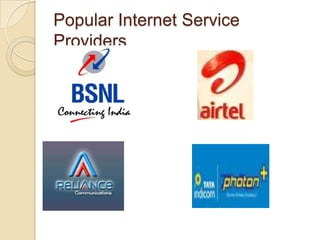
Popular Internet Service
Providers
CONCLUSION
  Internet service is bound to be
 improved in terms of cost and speed
 with the entry of new industrial giants
 in the field.
   But the true benefit of Internet service
 will be when even the remote parts of
 World will be able to access the
 quality Internet, only then World will be
 truly connected.
Isp

Isp

  • 1.
    INTERNET SERVICE PROVIDERS SURYA PRAKASH TIWARI ROLL NO. 12
  • 2.
    INTRODUCTION •An Internet serviceprovider (ISP), also sometimes referred to as an Internet access provider (IAP), is a company that offers its customers access to the Internet. •The ISP connects to its customers using a data transmission technology appropriate for delivering Internet Protocol packets or frames, such as dial-up, DSL, cable modem, wireless or dedicated high-speed interconnects
  • 3.
    End User toISP Connection ISP employ many technologies for users to connect to their network such as-  Dial-up  DSL ( Digital Subscriber Line)  broadband wireless  Integrated Services Digital Network (ISDN)
  • 4.
    ISP Interconnection  Just as their customers pay them for Internet access, ISPs themselves pay upstream ISPs for Internet access.  An upstream ISP usually has a larger network than the contracting ISP and/or is able to provide the contracting ISP with access to parts of the Internet the contracting ISP by itself has no access to.
  • 5.
    Peering ISPsmay engage in peering, where multiple ISPs interconnect at peering points or Internet exchange points (IXs), allowing routing of data between each network, without charging one another for the data transmitted—data that would otherwise have passed through a third upstream ISP, incurring charges from the upstream ISP.
  • 6.
    Types of ISP Types of ISP-  Virtual ISP  Free ISP
  • 7.
  • 8.
    CONCLUSION Internetservice is bound to be improved in terms of cost and speed with the entry of new industrial giants in the field. But the true benefit of Internet service will be when even the remote parts of World will be able to access the quality Internet, only then World will be truly connected.