Internet	
  Measurements	
  Tools	
  
and	
  their	
  usefulness	
  
Gaurab	
  Raj	
  Upadhaya	
  
Limelight	
  Networks	
  
Internet	
  Measurements	
  
•  There	
  is	
  a	
  lot	
  of	
  measurements	
  for	
  various	
  
purposes	
  on	
  the	
  Internet	
  
–  Reachability	
  and	
  Latency	
  Measurements	
  
–  RouAng	
  Table	
  measurements	
  
–  RouAng	
  stability	
  measurements	
  
–  IPv6	
  /	
  DNSSec	
  /	
  $VAR	
  measurement	
  

•  These	
  measurements	
  may	
  serve	
  various	
  purpose	
  
–  We’ll	
  look	
  at	
  some	
  common	
  ones	
  and	
  how	
  Network	
  
engineers	
  can	
  uAlize	
  them.	
  	
  
Measurement	
  Models	
  
•  There	
  are	
  a	
  lot	
  of	
  one-­‐off	
  measurements,	
  we	
  won’t	
  dwell	
  into	
  
those.	
  	
  
•  ConAnuous	
  measurements	
  can	
  be	
  categorized	
  in	
  three	
  main	
  groups	
  
–  Academic	
  Study	
  

•  CAIDA	
  (www.caida.org)	
  
•  Planet	
  Lab	
  
•  Lots	
  of	
  others	
  smaller	
  ones	
  out	
  there	
  

–  Community/Industry	
  Run	
  
• 
• 
• 
• 
• 

RIPE	
  LABS	
  (ATLAS,	
  TTM,	
  DNSMON	
  et	
  al)	
  
CIDR-­‐REPORT	
  (and	
  BGP	
  Stability	
  Report	
  )	
  
Routeviews	
  (www.route-­‐views.org)	
  
Looking	
  Glasses	
  
HE	
  BGP	
  Toolkit	
  (bgp.he.net)	


–  Commercially	
  run	
  
•  Renesys	
  
•  Arbor	
  	
  
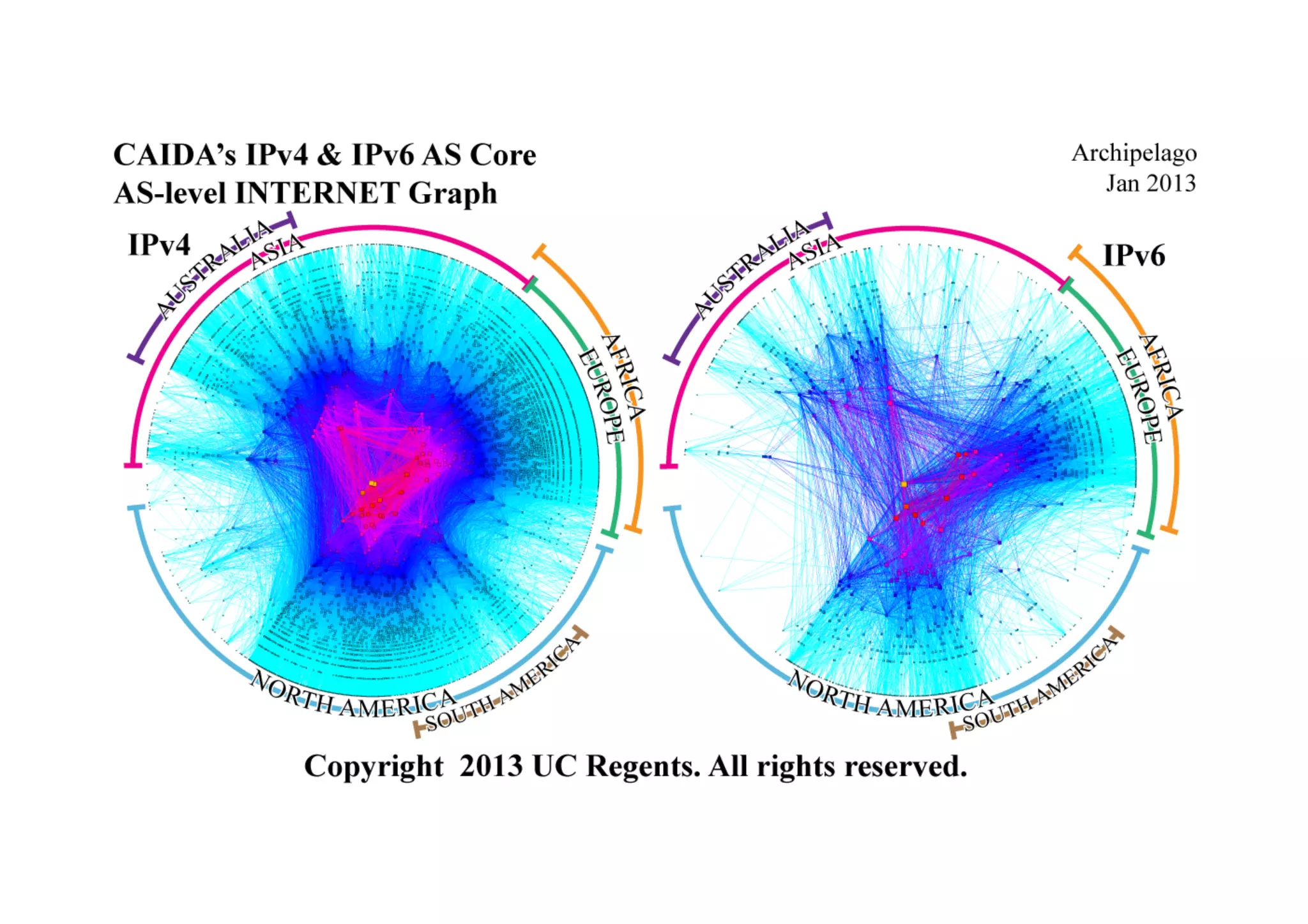
CAIDA	
  ARK	
  
•  CAIDA:	
  The	
  CooperaAve	
  AssociaAon	
  for	
  
Internet	
  Data	
  Analysis	
  (www.caida.org)	
  
•  CAIDA	
  ARK	
  is	
  short	
  form	
  of	
  the	
  Archipelago	
  
Measurement	
  Infrastructure	
  	
  
•  Measures	
  path	
  and	
  latency	
  to	
  ipv4/v6	
  address	
  
space	
  visible	
  on	
  the	
  global	
  rouAng	
  table.	
  
•  ARK	
  data	
  is	
  used	
  in	
  lots	
  of	
  modeling	
  and	
  
research.	
  E.g	
  AS-­‐RANK	
  
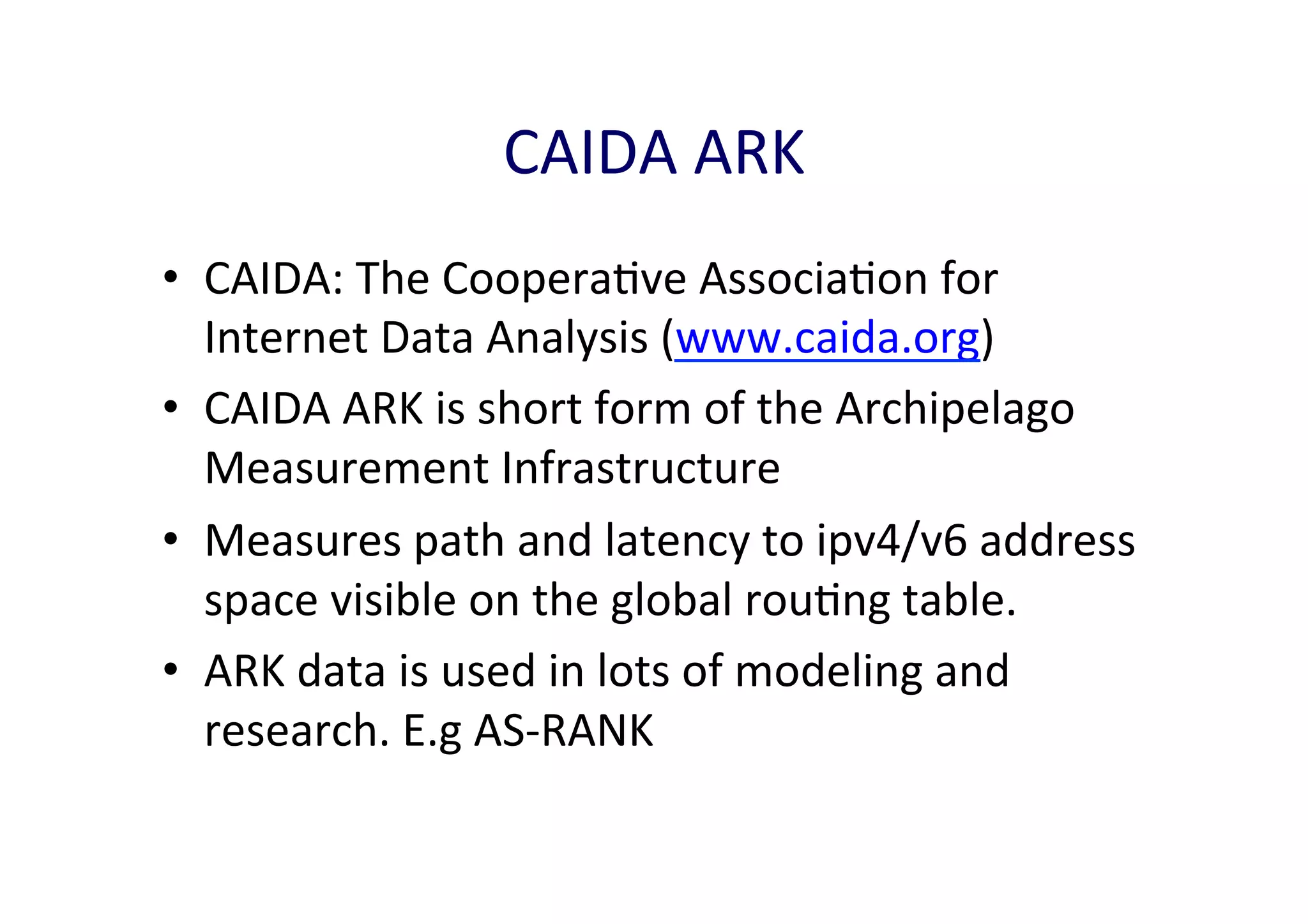
Reachability Report for v4/v6 from Equinix SG1 Singapore
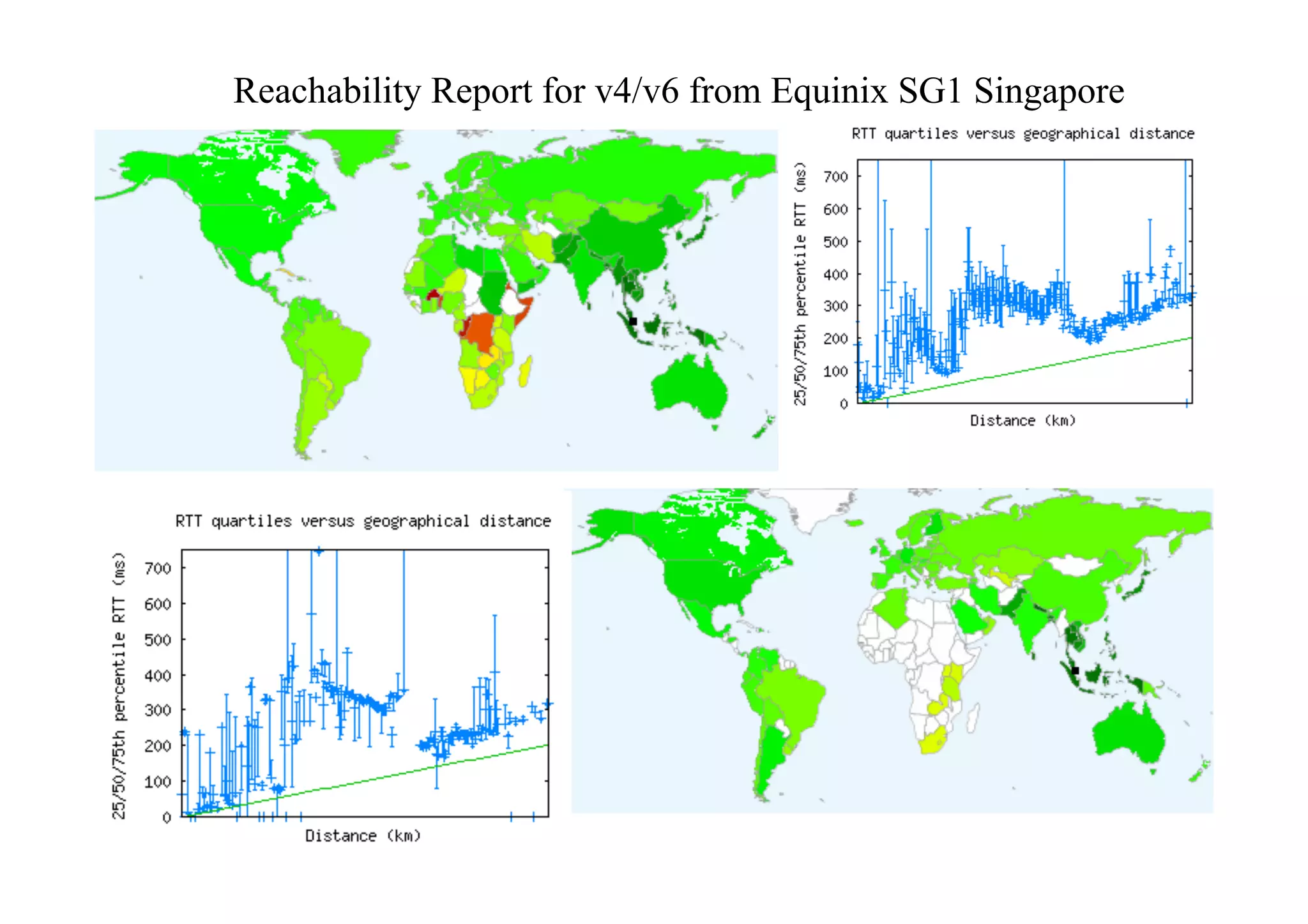
Connectivity from the Nepal Research and Education Network
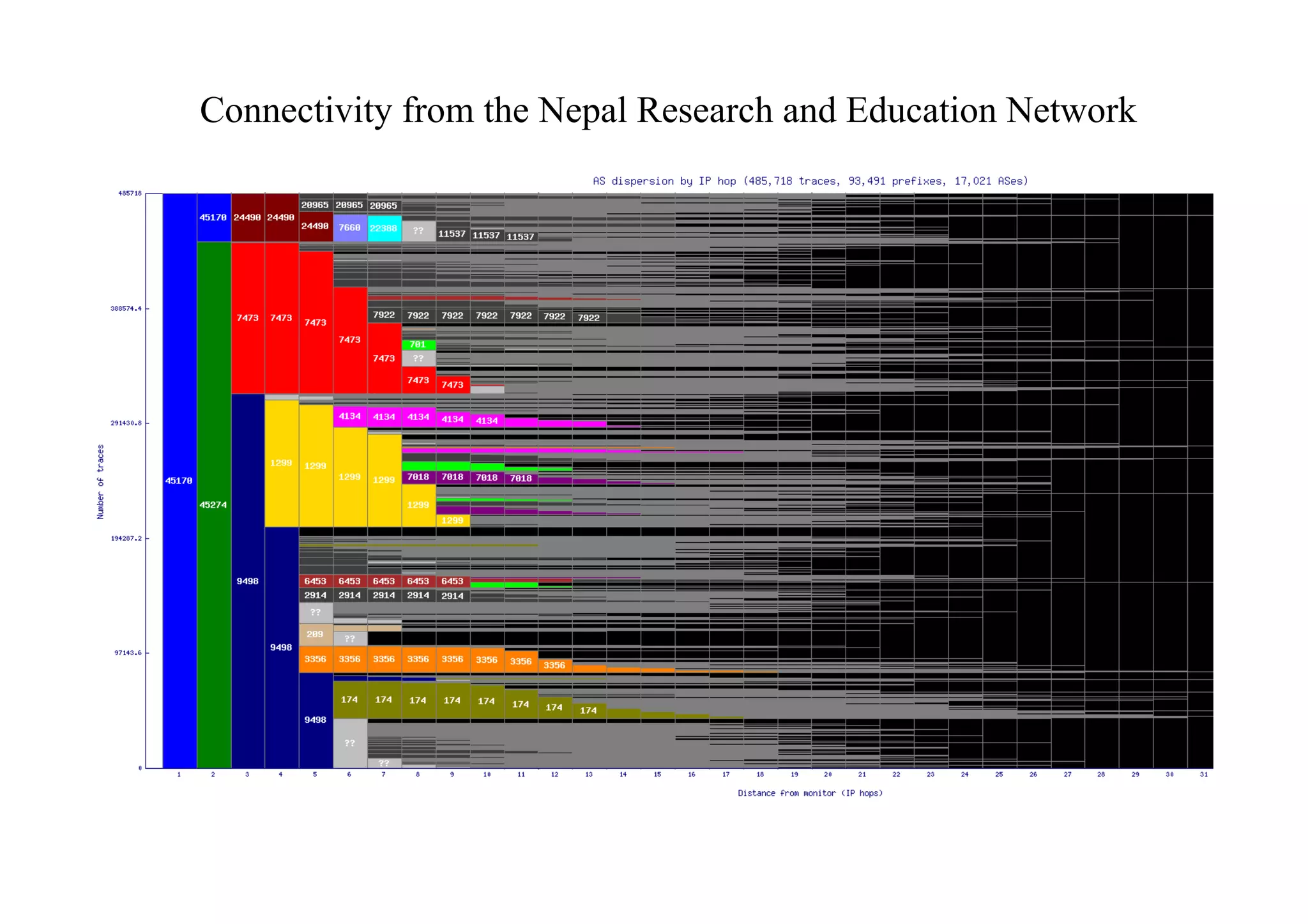
Locations of the
CAIDA ARK
Measurement Nodes

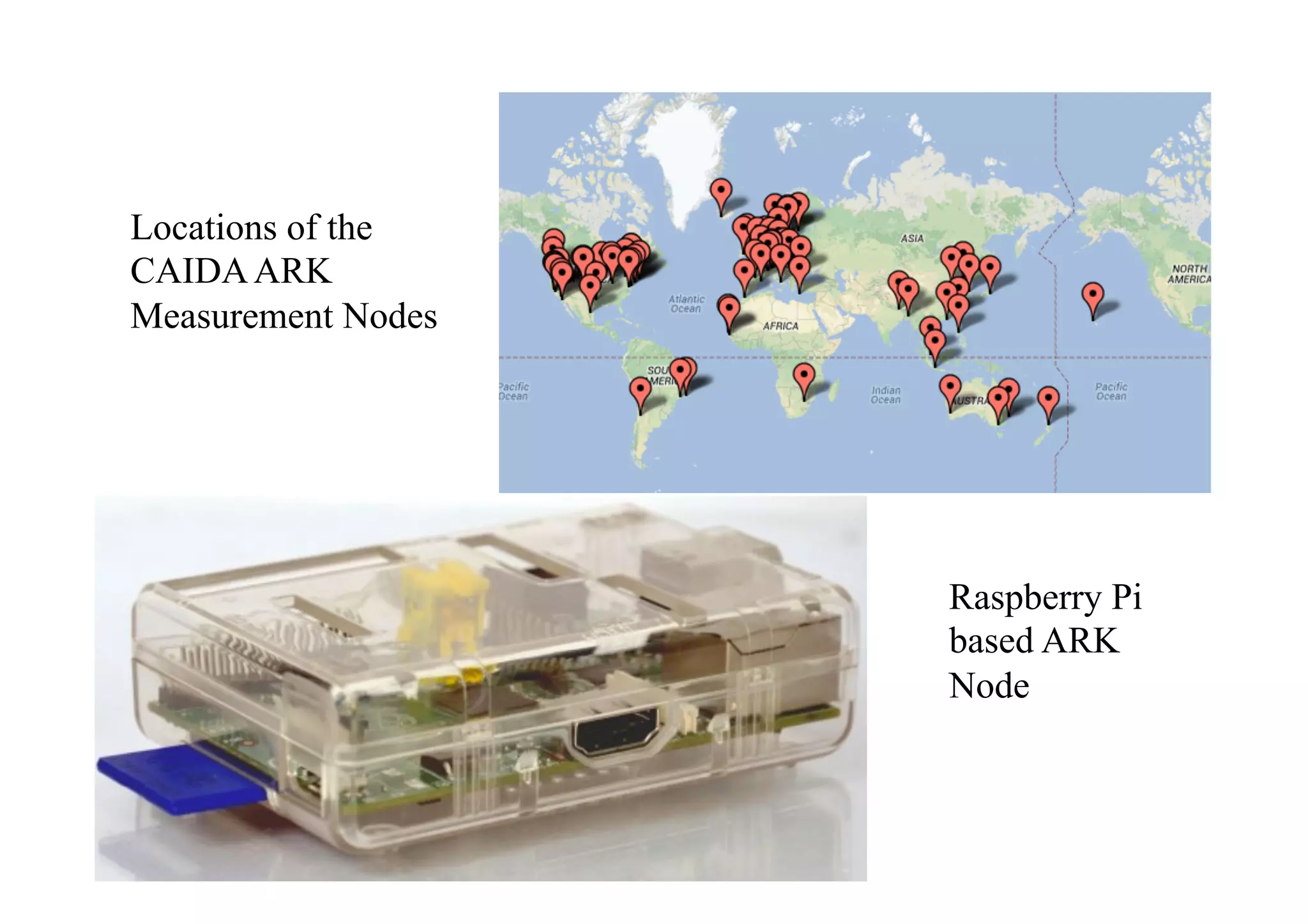
Raspberry Pi
based ARK
Node
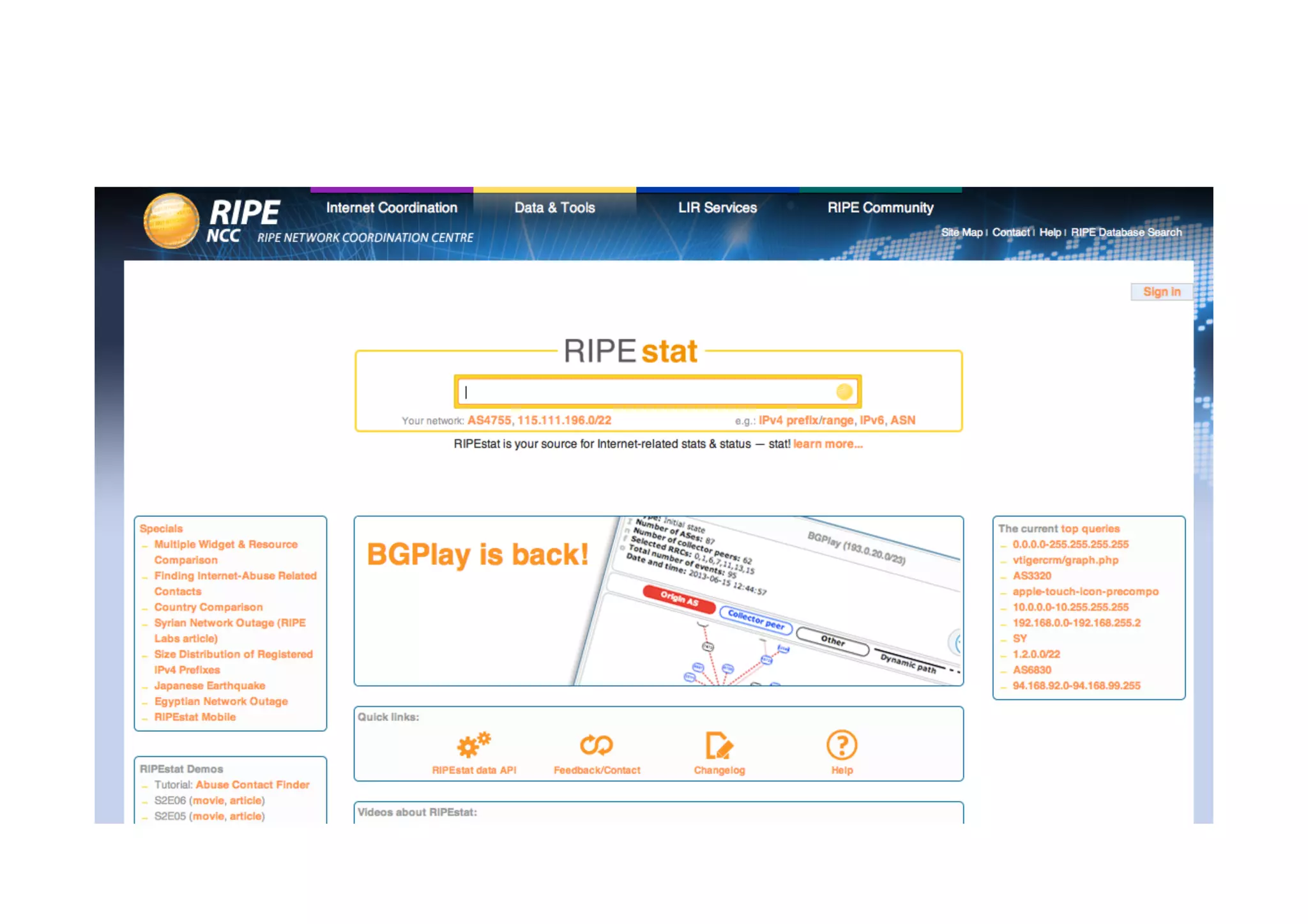
RIPE	
  	
  
•  RIPE	
  NCC	
  –	
  the	
  Regional	
  Internet	
  Registry	
  has	
  a	
  long	
  history	
  
of	
  running	
  measurements	
  
•  All	
  the	
  RIPE	
  data	
  is	
  available	
  through	
  hp://stat.ripe.net	
  
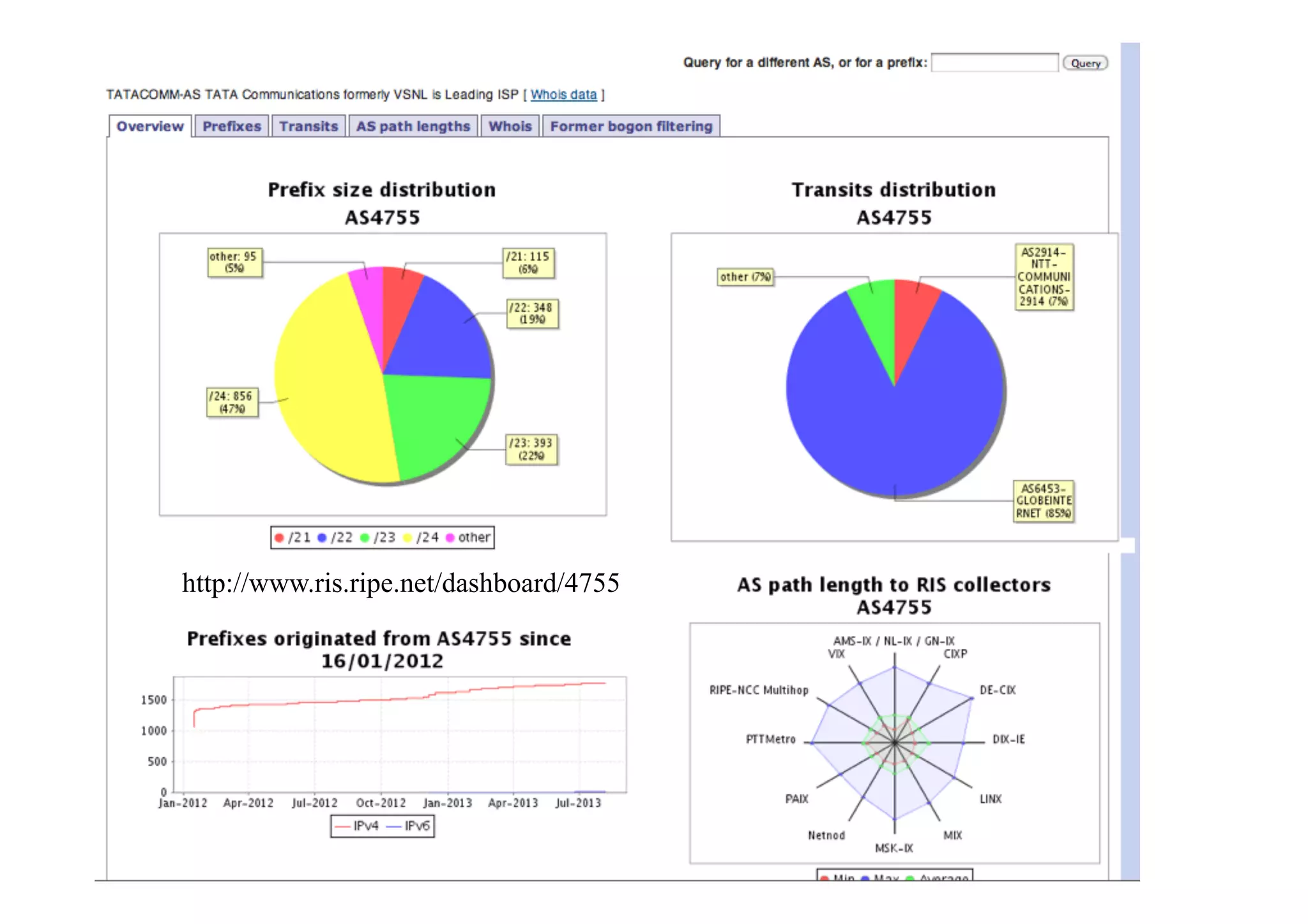
–  RouAng	
  InformaAon	
  Service	
  (RIS)	
  
•  Collects	
  BGP	
  Data	
  
•  hp://www.ripe.net/ris	
  

–  DNSMon	
  

•  Monitors	
  criAcal	
  DNS	
  Servers	
  	
  
•  hp://dnsmon.ripe.net	
  

–  Test	
  Traffic	
  Measurement	
  (TTM)	
  

•  Measures	
  latency	
  and	
  path,	
  stores	
  trace-­‐routes	
  between	
  all	
  TTM	
  
nodes	
  
•  Gradually	
  being	
  replaced	
  by	
  RIPE	
  ATLAS	


http://www.ris.ripe.net/dashboard/4755
RIPE	
  ATLAS	
  
•  New	
  RIPE	
  Measurements	
  are	
  using	
  RIPE	
  ATLAS	
  
•  A	
  lot	
  of	
  stuff	
  is	
  reported	
  by	
  RIPE	
  Labs	
  
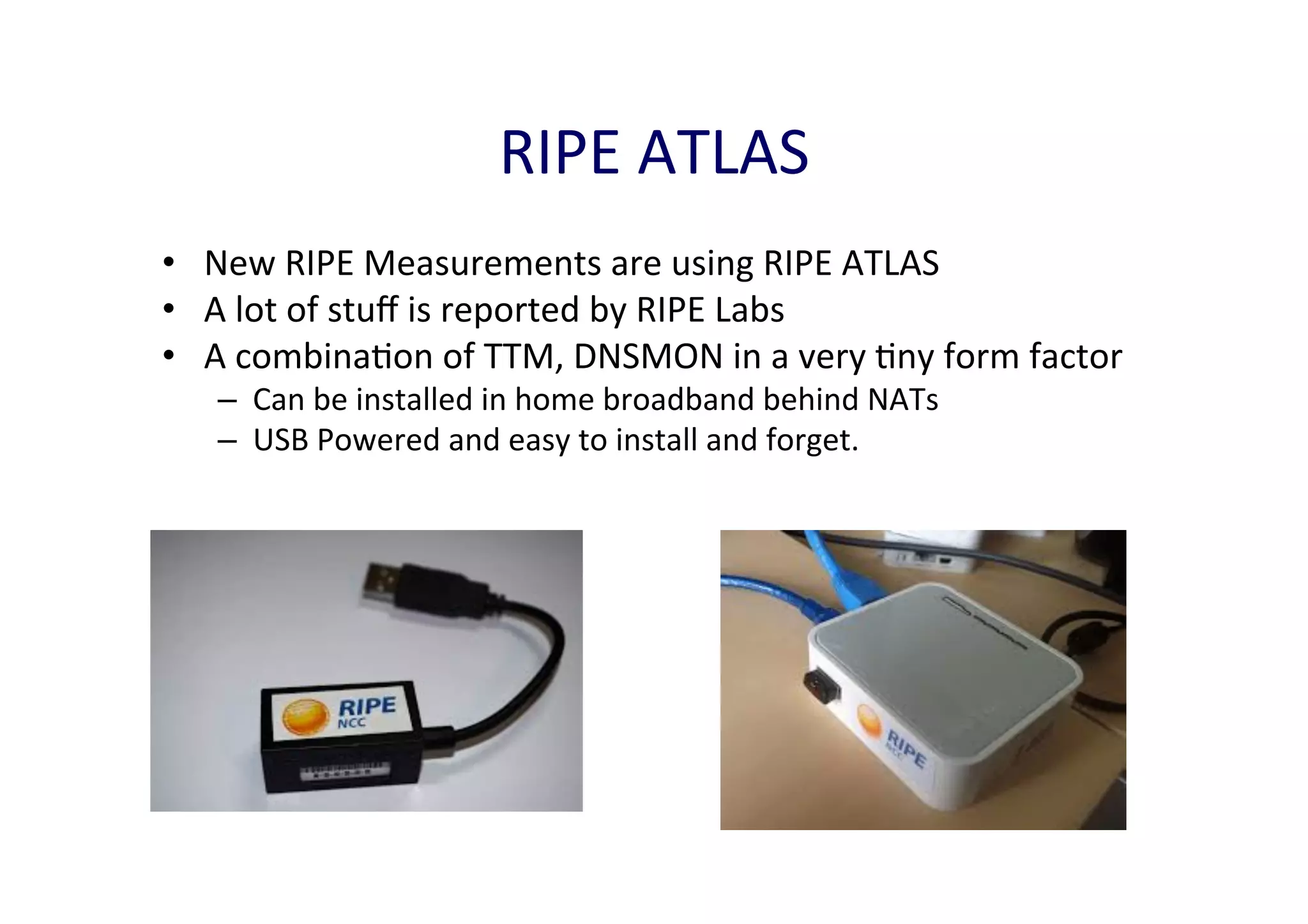
•  A	
  combinaAon	
  of	
  TTM,	
  DNSMON	
  in	
  a	
  very	
  Any	
  form	
  factor	
  	
  
–  Can	
  be	
  installed	
  in	
  home	
  broadband	
  behind	
  NATs	
  
–  USB	
  Powered	
  and	
  easy	
  to	
  install	
  and	
  forget.	
  	
  
RIPE	
  ATLAS	
  
•  RIPE	
  ATLAS	
  does	
  a	
  pre-­‐defined	
  set	
  of	
  
measurements	
  
–  ICMP	
  Ping	
  /Trace	
  with	
  v4/v6	
  to	
  parAcipaAng	
  root	
  
servers	
  
–  To	
  selected	
  other	
  AuthoritaAve	
  servers	
  

•  User	
  Defined	
  Measurements	
  
–  If	
  you	
  host	
  a	
  RIPE	
  ATLAS	
  probe,	
  you	
  get	
  credits	
  
–  You	
  can	
  use	
  your	
  credit	
  to	
  run	
  your	
  own	
  
measurements	
  (one	
  off	
  or	
  ongoing).	
  	
  
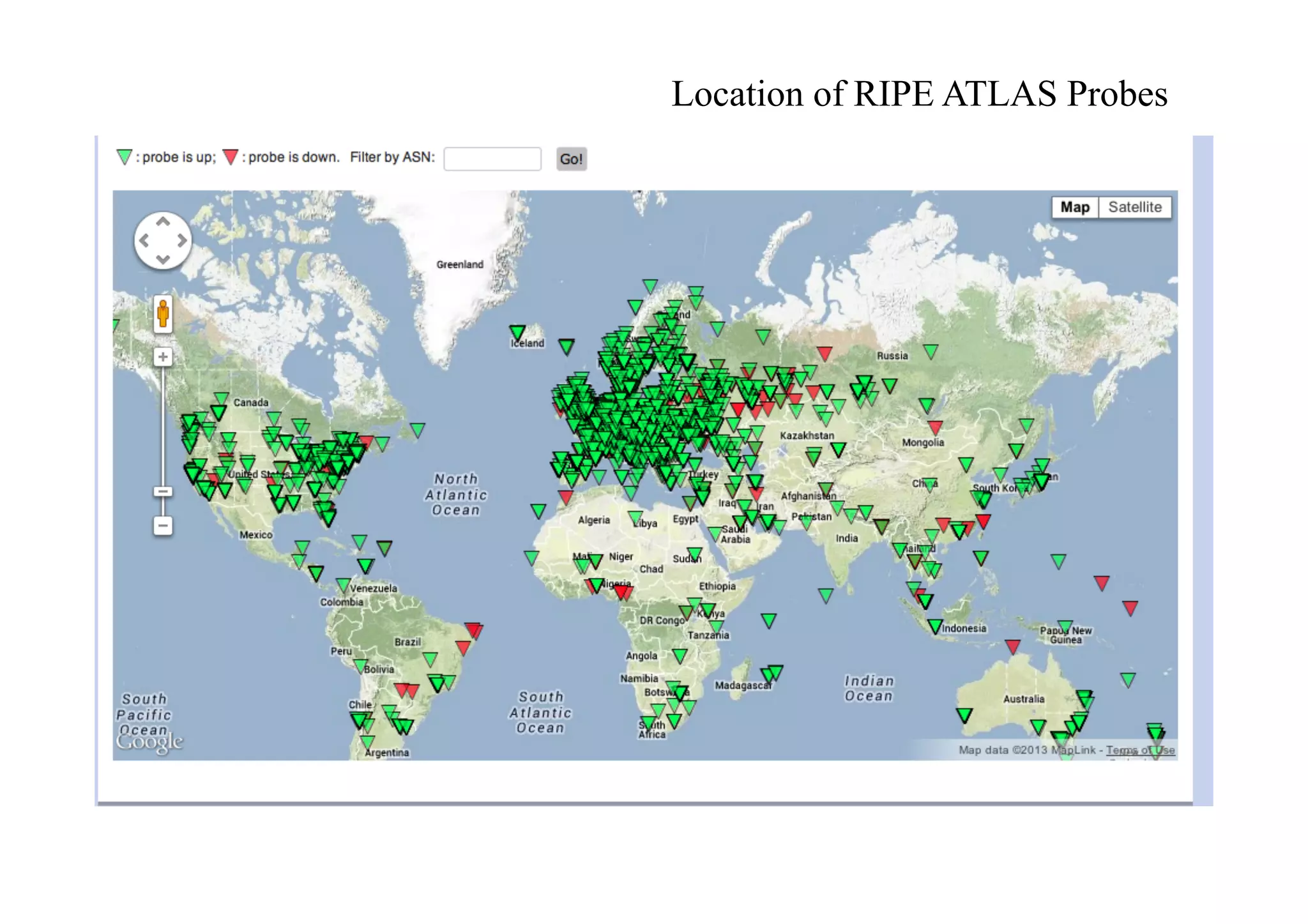
Location of RIPE ATLAS Probes
CIDR	
  	
  Report	
  
•  CIDR	
  report	
  is	
  at	
  www.cidr-­‐report.org	
  
•  Original	
  Concept:	
  Tony	
  Bates,	
  Revised	
  by:	
  Philip	
  Smith,	
  
Further	
  Revised:	
  Geoff	
  Huston	
  
•  If	
  you	
  don’t	
  get	
  a	
  copy	
  of	
  it	
  every	
  week,	
  you	
  probably	
  are	
  
not	
  on	
  the	
  right	
  mailing	
  lists	
  J	
  

–  The	
  weekly	
  reports	
  on	
  BGP	
  RouAng	
  Tables	
  reports	
  on	
  
de-­‐aggregaAon	
  	
  
–  A	
  second	
  report	
  on	
  BGP	
  updates	
  reports	
  on	
  the	
  
number	
  of	
  BGP	
  Updates	
  received	
  

•  The	
  Website	
  is	
  something	
  you	
  should	
  bookmark	
  
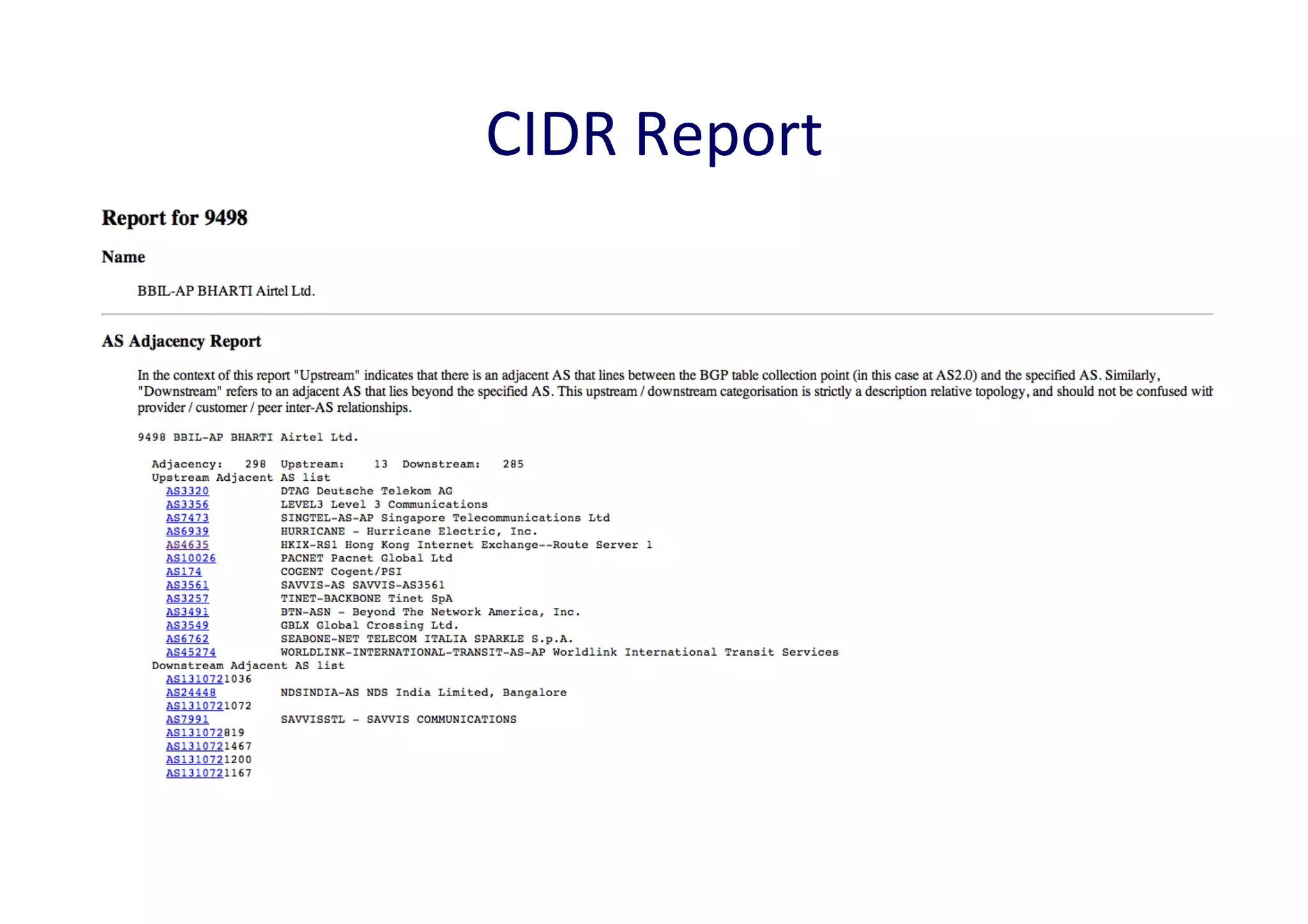
CIDR	
  Report	
  	
  
Route-­‐Views	
  and	
  BGPlay	
  
•  Routeviews	
  is	
  at	
  www.routeviews.org	
  
•  Operated	
  by	
  the	
  University	
  of	
  Oregon	
  Route	
  Views	
  Project	
  
•  While	
  the	
  Route	
  Views	
  project	
  was	
  originally	
  moAvated	
  by	
  
interest	
  on	
  the	
  part	
  of	
  operators	
  in	
  determining	
  how	
  the	
  
global	
  rouAng	
  system	
  viewed	
  their	
  prefixes	
  and/or	
  AS	
  space,	
  
there	
  have	
  been	
  many	
  other	
  interesAng	
  uses	
  of	
  this	
  Route	
  
Views	
  data.	
  (from	
  routeviews.org)	
  

•  Route	
  Views	
  collector	
  Peers	
  with	
  very	
  large	
  
number	
  of	
  ASNs	
  either	
  directly	
  at	
  IXPs	
  or	
  through	
  
eBGP	
  mulAhop.	
  	
  
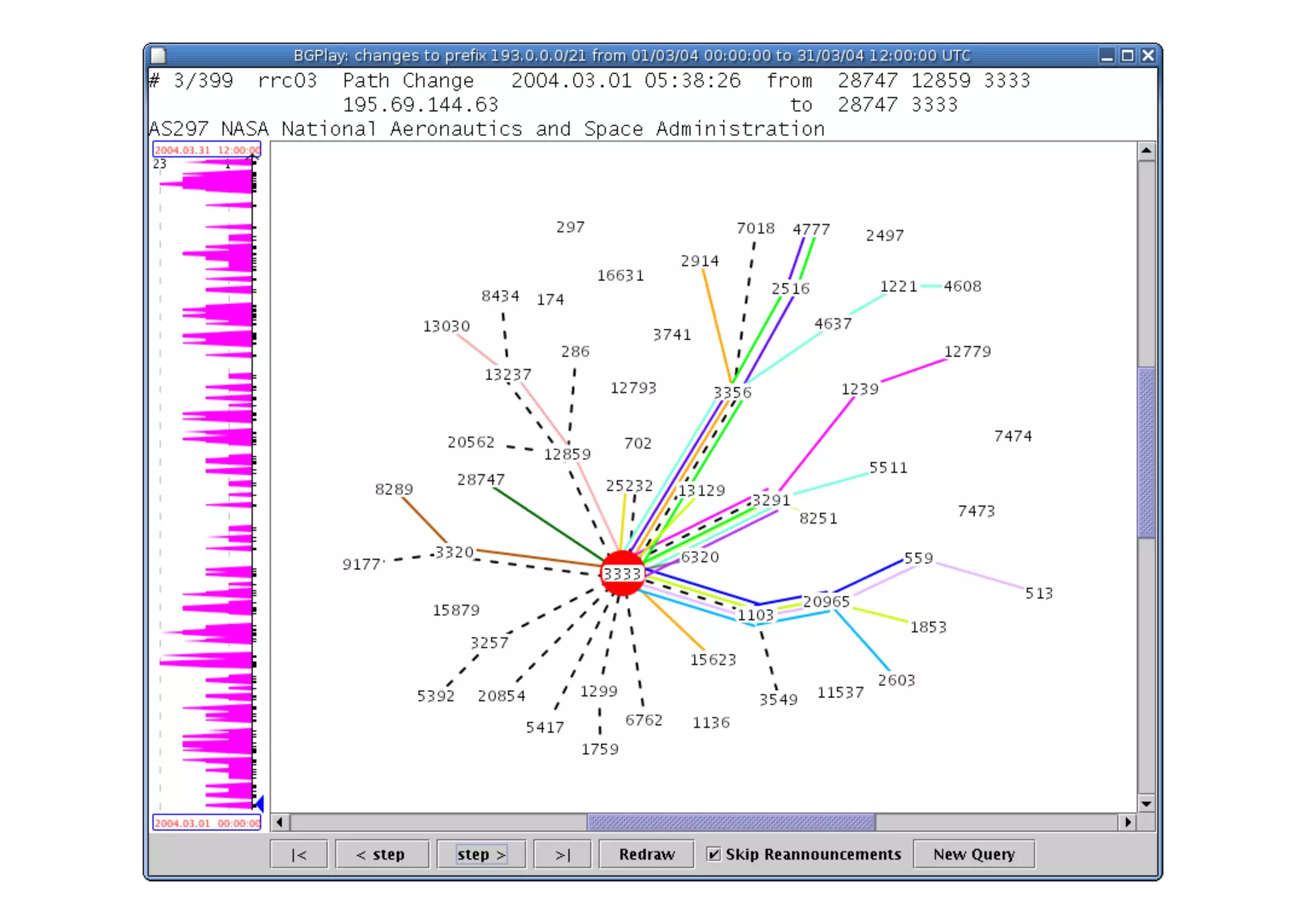
•  BGP	
  visualizaAon	
  tool	
  BGPlay	
  uses	
  Routeviews	
  
MulA	
  Network	
  Looking	
  Glasses	
  
•  Packet	
  Clearing	
  House	
  route-­‐collector	
  AS3856	
  peers	
  at	
  
a	
  large	
  number	
  IXPs	
  and	
  looking	
  glass	
  is	
  available	
  at	
  
hp://lg.pch.net	
  	
  
•  Many	
  of	
  the	
  IXPs	
  have	
  visible	
  looking	
  glasses	
  on	
  their	
  
websites.	
  	
  
–  HKIX	
  :	
  hp://www.hkix.net/hkix/hkixlg.htm	
  
–  LINX	
  :	
  hps://www.linx.net/pubtools/looking-­‐glass.html	
  
–  NIXI	
  :	
  hp://www.nixi.in/lookingglass.php	


•  There	
  is	
  a	
  list	
  available	
  at	
  www.traceroute.org	
  (but	
  not	
  
all	
  of	
  them	
  are	
  current).	
  	
  
•  Historical	
  archives	
  of	
  the	
  data	
  is	
  also	
  available	
  on	
  
request	
  from	
  most	
  of	
  these.	
  	
  
More	
  Resources	
  
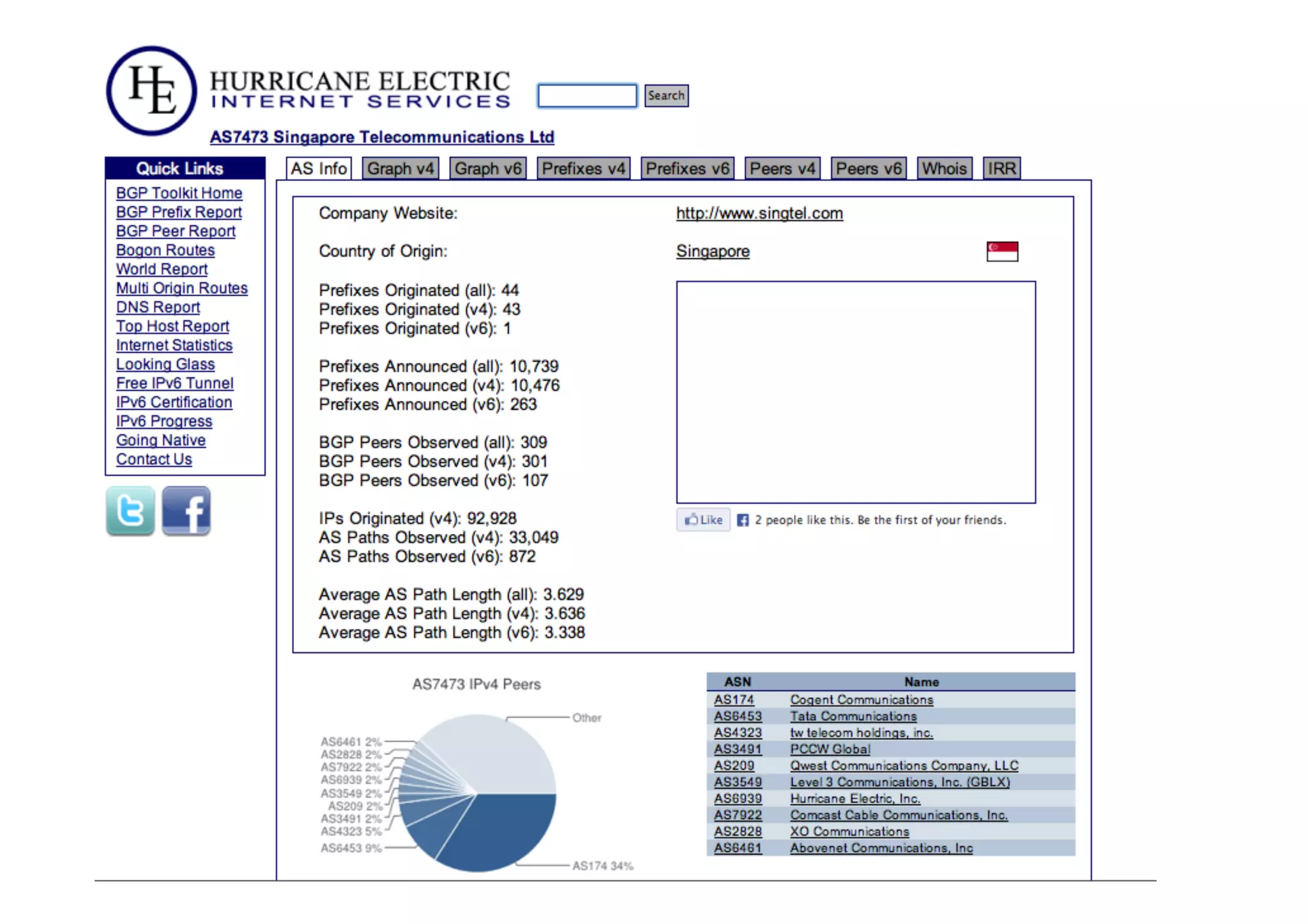
•  Hurricane	
  Electric	
  BGP	
  Toolkit.	
  hp://bgp.he.net/	


–  Uses	
  HE	
  internal	
  BGP	
  data,	
  and	
  data	
  from	
  routeviews,	
  and	
  
other	
  sources	
  
–  It’s	
  the	
  packaging	
  that	
  is	
  immensely	
  useful	
  with	
  the	
  HE	
  
BGP	
  toolkit.	


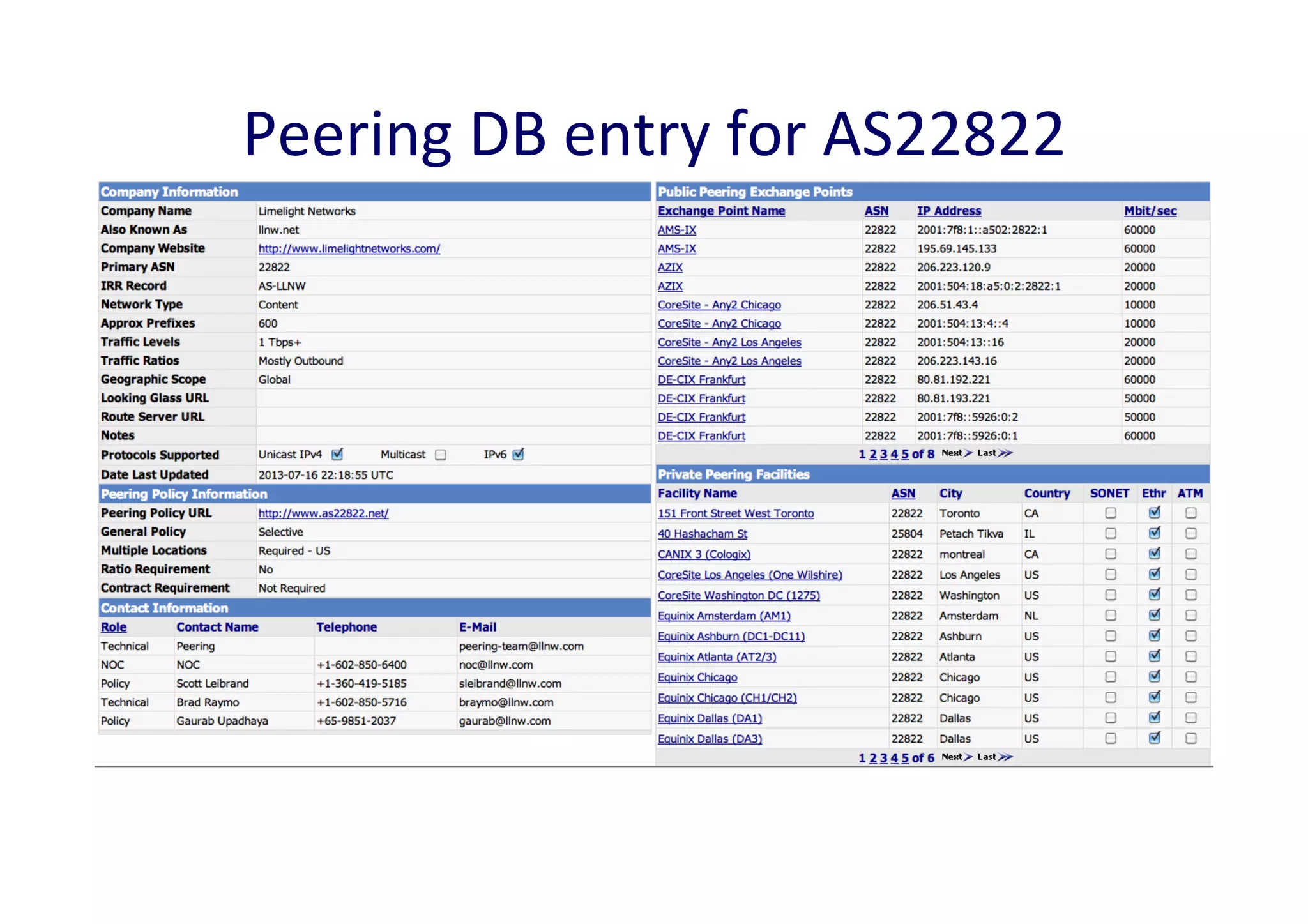
•  Peering	
  DB	
  (www.peeringdb.com)	
  :	
  For	
  the	
  peering	
  co-­‐
ordinators	
  by	
  the	
  peering	
  co-­‐ordinators	
  
–  Lists	
  the	
  Network	
  ASNs,	
  	
  
–  IX	
  it’s	
  present	
  at,	
  	
  
–  the	
  colocaAon	
  faciliAes	
  for	
  private	
  peering,	
  
–  Peering	
  Policies	
  	
  
–  Contact	
  Addresses	
  
Peering	
  DB	
  entry	
  for	
  AS22822	
  
Common	
  Use	
  Cases	
  
•  RouAng	
  Trouble	
  	
  
–  Put	
  the	
  IP	
  addresses	
  in	
  the	
  HE	
  BGP	
  Toolkit	
  and	
  you’ll	
  
get	
  the	
  associated	
  ASNs	
  and	
  upstream	
  
–  Check	
  to	
  see	
  if	
  there	
  has	
  been	
  any	
  topology	
  changes	
  
on	
  the	
  source	
  and	
  desAnaAon	
  ASN	
  in	
  BGPlay	
  	
  
–  Cross	
  verify	
  it	
  through	
  ARK	
  or	
  CIDR-­‐REPORT	
  
–  Use	
  your	
  RIPE	
  ATLAS	
  access	
  to	
  run	
  trace	
  from	
  other	
  
locaAons	
  around	
  the	
  world	
  
–  RouAng	
  Trouble	
  may	
  originate	
  inside	
  your	
  networks	
  
as	
  well,	
  so	
  it’s	
  useful	
  to	
  see	
  your	
  own	
  routes	
  as	
  seen	
  
by	
  route-­‐views	
  or	
  other	
  looking	
  glass.	
  	
  
Network	
  Expansion	
  
•  When	
  you	
  need	
  to	
  expand	
  to	
  locaAons	
  outside	
  of	
  your	
  
primary	
  operaAons	
  area,	
  how	
  can	
  the	
  data	
  help	
  

–  CAIDA	
  Data	
  can	
  show	
  you	
  where	
  the	
  ‘hubs’	
  are	
  near	
  you.	
  	
  
–  Peering	
  DB	
  can	
  tell	
  you	
  where	
  the	
  largest	
  number	
  of	
  
networks	
  are,	
  and	
  which	
  colocaAon	
  points	
  are	
  the	
  most	
  
dense	
  in	
  the	
  city	
  you	
  are	
  looking	
  at.	
  
–  Peering	
  DB	
  will	
  also	
  tell	
  you	
  the	
  peering	
  policy	
  of	
  the	
  ASNs	
  
you	
  are	
  interested	
  in	
  peering	
  with.	
  In	
  many	
  cases	
  e-­‐mailing	
  
in	
  advance	
  asking	
  for	
  peering	
  potenAal	
  is	
  acceptable.	
  	
  
–  The	
  PCH/IX/HE	
  looking	
  glass	
  tells	
  you	
  which	
  routes	
  are	
  
easily	
  available.	
  	
  
–  These	
  tools	
  help	
  you	
  narrow	
  down	
  your	
  opAons	
  before	
  
you	
  start	
  looking	
  at	
  commercials.	
  	
  
HosAng	
  Probes	
  /	
  ContribuAng	
  Data	
  
•  CAIDA	
  ARK	
  footprint	
  is	
  prey	
  small,	
  but	
  sAll	
  
prefers	
  a	
  public	
  IP.	
  If	
  you	
  like	
  to	
  host	
  one,	
  talk	
  to	
  
me	
  (and	
  I’ll	
  put	
  you	
  in	
  touch)	
  
•  RIPE	
  ATLAS	
  is	
  available	
  by	
  request	
  on	
  their	
  
website.	
  RIPE	
  Staff	
  also	
  hands	
  them	
  out	
  at	
  
different	
  NOG	
  conferences,	
  so	
  do	
  APNIC	
  staff.	
  	
  
•  Routeviews	
  is	
  at	
  IXPs	
  only,	
  but	
  as	
  an	
  network,	
  do	
  
eBGP	
  MulA-­‐hop	
  peer	
  with	
  them.	
  
–  Internet	
  RouAng	
  data	
  is	
  publicly	
  visible,	
  so	
  you	
  don’t	
  
loose	
  by	
  sharing	
  directly,	
  but	
  contribute	
  to	
  the	
  
richness	
  of	
  it.	
  	
  
Conclusion	
  
•  Internet	
  Measurement	
  tools	
  and	
  acAviAes	
  are	
  
not	
  just	
  for	
  academic	
  purpose,	
  but	
  helps	
  in	
  
operaAonal	
  troubleshooAng	
  
•  Large	
  datasets	
  can	
  help	
  in	
  modeling	
  and	
  
planning	
  exercises.	
  	
  
•  Publicly	
  available	
  resources	
  makes	
  Internet	
  a	
  
nicer	
  place	
  
Thank	
  you!	


Feedback	
  welcome:	
  
gaurab@llnw.com	
  

Internet Measurement Tools & Their Usefulness by Gaurab Raj Upadhaya

  • 1.
    Internet  Measurements  Tools   and  their  usefulness   Gaurab  Raj  Upadhaya   Limelight  Networks  
  • 2.
    Internet  Measurements   • There  is  a  lot  of  measurements  for  various   purposes  on  the  Internet   –  Reachability  and  Latency  Measurements   –  RouAng  Table  measurements   –  RouAng  stability  measurements   –  IPv6  /  DNSSec  /  $VAR  measurement   •  These  measurements  may  serve  various  purpose   –  We’ll  look  at  some  common  ones  and  how  Network   engineers  can  uAlize  them.    
  • 3.
    Measurement  Models   • There  are  a  lot  of  one-­‐off  measurements,  we  won’t  dwell  into   those.     •  ConAnuous  measurements  can  be  categorized  in  three  main  groups   –  Academic  Study   •  CAIDA  (www.caida.org)   •  Planet  Lab   •  Lots  of  others  smaller  ones  out  there   –  Community/Industry  Run   •  •  •  •  •  RIPE  LABS  (ATLAS,  TTM,  DNSMON  et  al)   CIDR-­‐REPORT  (and  BGP  Stability  Report  )   Routeviews  (www.route-­‐views.org)   Looking  Glasses   HE  BGP  Toolkit  (bgp.he.net)     –  Commercially  run   •  Renesys   •  Arbor    
  • 5.
    CAIDA  ARK   • CAIDA:  The  CooperaAve  AssociaAon  for   Internet  Data  Analysis  (www.caida.org)   •  CAIDA  ARK  is  short  form  of  the  Archipelago   Measurement  Infrastructure     •  Measures  path  and  latency  to  ipv4/v6  address   space  visible  on  the  global  rouAng  table.   •  ARK  data  is  used  in  lots  of  modeling  and   research.  E.g  AS-­‐RANK  
  • 6.
    Reachability Report forv4/v6 from Equinix SG1 Singapore
  • 7.
    Connectivity from theNepal Research and Education Network
  • 8.
    Locations of the CAIDAARK Measurement Nodes Raspberry Pi based ARK Node
  • 9.
    RIPE     • RIPE  NCC  –  the  Regional  Internet  Registry  has  a  long  history   of  running  measurements   •  All  the  RIPE  data  is  available  through  hp://stat.ripe.net   –  RouAng  InformaAon  Service  (RIS)   •  Collects  BGP  Data   •  hp://www.ripe.net/ris   –  DNSMon   •  Monitors  criAcal  DNS  Servers     •  hp://dnsmon.ripe.net   –  Test  Traffic  Measurement  (TTM)   •  Measures  latency  and  path,  stores  trace-­‐routes  between  all  TTM   nodes   •  Gradually  being  replaced  by  RIPE  ATLAS    
  • 11.
  • 12.
    RIPE  ATLAS   • New  RIPE  Measurements  are  using  RIPE  ATLAS   •  A  lot  of  stuff  is  reported  by  RIPE  Labs   •  A  combinaAon  of  TTM,  DNSMON  in  a  very  Any  form  factor     –  Can  be  installed  in  home  broadband  behind  NATs   –  USB  Powered  and  easy  to  install  and  forget.    
  • 13.
    RIPE  ATLAS   • RIPE  ATLAS  does  a  pre-­‐defined  set  of   measurements   –  ICMP  Ping  /Trace  with  v4/v6  to  parAcipaAng  root   servers   –  To  selected  other  AuthoritaAve  servers   •  User  Defined  Measurements   –  If  you  host  a  RIPE  ATLAS  probe,  you  get  credits   –  You  can  use  your  credit  to  run  your  own   measurements  (one  off  or  ongoing).    
  • 14.
    Location of RIPEATLAS Probes
  • 15.
    CIDR    Report   •  CIDR  report  is  at  www.cidr-­‐report.org   •  Original  Concept:  Tony  Bates,  Revised  by:  Philip  Smith,   Further  Revised:  Geoff  Huston   •  If  you  don’t  get  a  copy  of  it  every  week,  you  probably  are   not  on  the  right  mailing  lists  J   –  The  weekly  reports  on  BGP  RouAng  Tables  reports  on   de-­‐aggregaAon     –  A  second  report  on  BGP  updates  reports  on  the   number  of  BGP  Updates  received   •  The  Website  is  something  you  should  bookmark  
  • 16.
  • 18.
    Route-­‐Views  and  BGPlay   •  Routeviews  is  at  www.routeviews.org   •  Operated  by  the  University  of  Oregon  Route  Views  Project   •  While  the  Route  Views  project  was  originally  moAvated  by   interest  on  the  part  of  operators  in  determining  how  the   global  rouAng  system  viewed  their  prefixes  and/or  AS  space,   there  have  been  many  other  interesAng  uses  of  this  Route   Views  data.  (from  routeviews.org)   •  Route  Views  collector  Peers  with  very  large   number  of  ASNs  either  directly  at  IXPs  or  through   eBGP  mulAhop.     •  BGP  visualizaAon  tool  BGPlay  uses  Routeviews  
  • 20.
    MulA  Network  Looking  Glasses   •  Packet  Clearing  House  route-­‐collector  AS3856  peers  at   a  large  number  IXPs  and  looking  glass  is  available  at   hp://lg.pch.net     •  Many  of  the  IXPs  have  visible  looking  glasses  on  their   websites.     –  HKIX  :  hp://www.hkix.net/hkix/hkixlg.htm   –  LINX  :  hps://www.linx.net/pubtools/looking-­‐glass.html   –  NIXI  :  hp://www.nixi.in/lookingglass.php     •  There  is  a  list  available  at  www.traceroute.org  (but  not   all  of  them  are  current).     •  Historical  archives  of  the  data  is  also  available  on   request  from  most  of  these.    
  • 21.
    More  Resources   • Hurricane  Electric  BGP  Toolkit.  hp://bgp.he.net/     –  Uses  HE  internal  BGP  data,  and  data  from  routeviews,  and   other  sources   –  It’s  the  packaging  that  is  immensely  useful  with  the  HE   BGP  toolkit.     •  Peering  DB  (www.peeringdb.com)  :  For  the  peering  co-­‐ ordinators  by  the  peering  co-­‐ordinators   –  Lists  the  Network  ASNs,     –  IX  it’s  present  at,     –  the  colocaAon  faciliAes  for  private  peering,   –  Peering  Policies     –  Contact  Addresses  
  • 23.
    Peering  DB  entry  for  AS22822  
  • 24.
    Common  Use  Cases   •  RouAng  Trouble     –  Put  the  IP  addresses  in  the  HE  BGP  Toolkit  and  you’ll   get  the  associated  ASNs  and  upstream   –  Check  to  see  if  there  has  been  any  topology  changes   on  the  source  and  desAnaAon  ASN  in  BGPlay     –  Cross  verify  it  through  ARK  or  CIDR-­‐REPORT   –  Use  your  RIPE  ATLAS  access  to  run  trace  from  other   locaAons  around  the  world   –  RouAng  Trouble  may  originate  inside  your  networks   as  well,  so  it’s  useful  to  see  your  own  routes  as  seen   by  route-­‐views  or  other  looking  glass.    
  • 25.
    Network  Expansion   • When  you  need  to  expand  to  locaAons  outside  of  your   primary  operaAons  area,  how  can  the  data  help   –  CAIDA  Data  can  show  you  where  the  ‘hubs’  are  near  you.     –  Peering  DB  can  tell  you  where  the  largest  number  of   networks  are,  and  which  colocaAon  points  are  the  most   dense  in  the  city  you  are  looking  at.   –  Peering  DB  will  also  tell  you  the  peering  policy  of  the  ASNs   you  are  interested  in  peering  with.  In  many  cases  e-­‐mailing   in  advance  asking  for  peering  potenAal  is  acceptable.     –  The  PCH/IX/HE  looking  glass  tells  you  which  routes  are   easily  available.     –  These  tools  help  you  narrow  down  your  opAons  before   you  start  looking  at  commercials.    
  • 26.
    HosAng  Probes  /  ContribuAng  Data   •  CAIDA  ARK  footprint  is  prey  small,  but  sAll   prefers  a  public  IP.  If  you  like  to  host  one,  talk  to   me  (and  I’ll  put  you  in  touch)   •  RIPE  ATLAS  is  available  by  request  on  their   website.  RIPE  Staff  also  hands  them  out  at   different  NOG  conferences,  so  do  APNIC  staff.     •  Routeviews  is  at  IXPs  only,  but  as  an  network,  do   eBGP  MulA-­‐hop  peer  with  them.   –  Internet  RouAng  data  is  publicly  visible,  so  you  don’t   loose  by  sharing  directly,  but  contribute  to  the   richness  of  it.    
  • 27.
    Conclusion   •  Internet  Measurement  tools  and  acAviAes  are   not  just  for  academic  purpose,  but  helps  in   operaAonal  troubleshooAng   •  Large  datasets  can  help  in  modeling  and   planning  exercises.     •  Publicly  available  resources  makes  Internet  a   nicer  place  
  • 28.
    Thank  you!     Feedback  welcome:   gaurab@llnw.com