1
MIS, Chapter 11
©2011 Course Technology, a part of Cengage Learning
Unit 4
ENTERPRISE SYSTEMS
2
MIS, Chapter 11
©2011 Course Technology, a part of Cengage Learning
Chapter 11 Enterprise Systems
Supply Chain Management
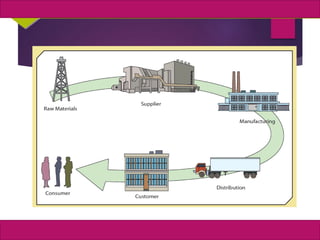
 Supply chain
 Integrated network
 Consisting of an organization, its suppliers, transportation
companies, and brokers
 Used to deliver goods and services to customers
 Exist in both service and manufacturing organizations
3
MIS, Chapter 11
©2011 Course Technology, a part of Cengage Learning
Exhibit 11.1 A Supply Chain Configuration
4
MIS, Chapter 11
©2011 Course Technology, a part of Cengage Learning
Chapter 11 Enterprise Systems
Supply Chain Management
(cont’d.)
 Supply chain management (SCM)
 Process of working with suppliers and other partners in the
supply chain to improve procedures for delivering products
and services
 Coordinates:
 Procuring materials
 Transforming materials into intermediate and finished products or
services
 Distributing finished products or services to customers
5
MIS, Chapter 11
©2011 Course Technology, a part of Cengage Learning
Chapter 11 Enterprise Systems
Supply Chain Management
(cont’d.)
 In manufacturing firm, information in an SCM system
flows between the following areas:
 Product flow
 Information flow
 Finances flow
 Four key decisions in supply chain management:
 Location
 Inventory
 Production
 Transportation
6
MIS, Chapter 11
©2011 Course Technology, a part of Cengage Learning
Chapter 11 Enterprise Systems
Supply Chain Management
(cont’d.)
 Vendors offer comprehensive solutions:
 SAP
 Oracle
 JDA Software
 Manhattan associates
7
MIS, Chapter 11
©2011 Course Technology, a part of Cengage Learning
Chapter 11 Enterprise Systems
Dell Computer’s Supply Chain
 Modified its supply chain from a “push” to a “pull”
manufacturing process
 Also known as “built to order (BTO)”
 Main sales channel is direct sales to customers
 Dell has been able to reduce costs by eliminating
intermediaries and shortening delivery time
8
MIS, Chapter 11
©2011 Course Technology, a part of Cengage Learning
Chapter 11 Enterprise Systems
SCM Technologies
 Information technologies and the Internet play a major
role in implementing an SCM system
 Electronic Data Interchange (EDI)
 Enables business partners to send and receive information
on business transactions
 Expedites delivering accurate information
 Lowers the cost of transmitting documents
 Advantage of being platform independent and easy to use
9
MIS, Chapter 11
©2011 Course Technology, a part of Cengage Learning
Chapter 11 Enterprise Systems
SCM Technologies (cont’d.)
 Using EDI has some drawbacks
 Uses the X.25 standard
 Beneficial when more companies are in the EDI network
 Often was not affordable for small suppliers and distributors
 Open EDI
 Based on XML
 Traditional EDI has declined in popularity
10
MIS, Chapter 11
©2011 Course Technology, a part of Cengage Learning
Chapter 11 Enterprise Systems
Internet-Enabled SCM
 Improves information sharing throughout the supply
chain
 Can improve the following SCM activities:
 Purchasing/procurement
 Inventory management
 Transportation
 Order processing
 Customer service
 Production scheduling
11
MIS, Chapter 11
©2011 Course Technology, a part of Cengage Learning
Chapter 11 Enterprise Systems
E-marketplaces
 Third-party exchange
 Provides a platform for buyers and sellers to interact with
each other and trade more efficiently online
 Benefits
 Increases efficiency and effectiveness in the supply chain
 Provides opportunities for sellers and buyers to establish
new trading partnerships
 Provides a single platform for prices, availability, and stock
levels that’s accessible to all participants
12
MIS, Chapter 11
©2011 Course Technology, a part of Cengage Learning
Chapter 11 Enterprise Systems
E-marketplaces (cont’d.)
 Solves time constraint problems for international trade and
makes it possible to conduct business around the clock
 Makes it easy to compare prices and products from a single
source instead of spending time contacting each seller
 Reduces marketing costs more than traditional sales
channels can
13
MIS, Chapter 11
©2011 Course Technology, a part of Cengage Learning
Chapter 11 Enterprise Systems
E-marketplaces (cont’d.)
 E-distributor
 Marketplace owned and operated by a third party that
provides an electronic catalog of product
 Maintenance, repair, and operations (MROs) services
 Includes services from different vendors
 E-distributor coordinates them into one package for customers
 Example of a horizontal market
14
MIS, Chapter 11
©2011 Course Technology, a part of Cengage Learning
Chapter 11 Enterprise Systems
Online Auctions
 Bring traditional auctions to customers around the globe
 Make it possible to sell far more goods and services than at a
traditional auction
 Brokerage business model
 Reverse auctions
 Invite sellers to submit bids for products and services
15
MIS, Chapter 11
©2011 Course Technology, a part of Cengage Learning
Chapter 11 Enterprise Systems
Collaborative Planning, Forecasting,
and Replenishment
 Coordinate supply chain members through point-of-sale
(POS) data sharing and joint planning
 Any data collected is shared with all members of the
supply chain
 Coordinating the supply chain can be difficult
 CPFR ensures that inventory and sales data are shared
across the supply chain
 So that everyone knows the exact sales and inventory levels
16
MIS, Chapter 11
©2011 Course Technology, a part of Cengage Learning
Chapter 11 Enterprise Systems
Collaborative Planning, Forecasting,
and Replenishment (cont’d.)
 Costs for each partner are shared or minimized
 Unforeseen problems can crop up
17
MIS, Chapter 11
©2011 Course Technology, a part of Cengage Learning
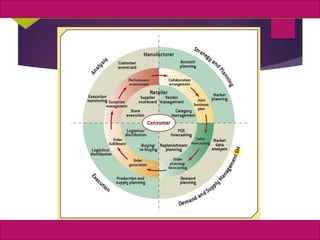
Exhibit 11.2 The CPFR Process
18
MIS, Chapter 11
©2011 Course Technology, a part of Cengage Learning
Chapter 11 Enterprise Systems
Customer Relationship
Management
 CRM
 Consists of the processes a company uses to track and
organize its contacts with customers
 Main goal of a CRM system
 Improve services offered to customers
 Use customer contact information for targeted marketing
 Marketing strategies in a CRM system
 Focus on long-term relationships with customers instead of
transactions
19
MIS, Chapter 11
©2011 Course Technology, a part of Cengage Learning
Chapter 11 Enterprise Systems
Customer Relationship
Management (cont’d.)
 Identifies segments of customers
 Improves products and services to meet customers’
needs
 Improves customer retention
 Identifies a company’s most profitable (and loyal)
customers
 Helps organizations make better use of data, information,
and knowledge to understand customers
20
MIS, Chapter 11
©2011 Course Technology, a part of Cengage Learning
Chapter 11 Enterprise Systems
Customer Relationship
Management (cont’d.)
 Gives organizations more complete pictures of their
customers
 Integrates demographic and other external data with
customers’ transaction data to better understand customer
behavior
 Pays external agencies for additional data about you that
might be public or semiprivate
21
MIS, Chapter 11
©2011 Course Technology, a part of Cengage Learning
Chapter 11 Enterprise Systems
Customer Relationship
Management (cont’d.)
 With a CRM system, organizations can:
 Provide services and products that meet customers’ needs
 Offer better customer service through multiple channels
 Increase cross-selling and upselling
 Help sales personnel close deals faster by offering data on
customers’ backgrounds
 Retain existing customers and attract new ones
22
MIS, Chapter 11
©2011 Course Technology, a part of Cengage Learning
Chapter 11 Enterprise Systems
Customer Relationship
Management (cont’d.)
 CRM systems include:
 Sales automation
 Order processing
 Marketing automation
 Customer support
 Knowledge management
 Personalization technology
23
MIS, Chapter 11
©2011 Course Technology, a part of Cengage Learning
Chapter 11 Enterprise Systems
CRM in Action
 Time Warner Cable Business Class
 CRM system from Salesforce.com
 Analyze business data, improve the accuracy of forecasts,
improve problem solving, and monitor sales and business
activities
 Important features of the system include:
 Dashboards, features for “drilling down,” Web-based
knowledge base for employees and customers, and Web log
for sales personnel communication
 Has increased productivity by 10%
24
MIS, Chapter 11
©2011 Course Technology, a part of Cengage Learning
Chapter 11 Enterprise Systems
CRM Applications
 On-premise CRM or Web-based CRM (SaaS)
 Several software packages are available for setting up a
CRM system:
 Amdocs CRM, Optima Technologies ExSellence, Infor CRM,
SAP mySAP, Oracle PeopleSoft CRM, and Oracle Siebel
25
MIS, Chapter 11
©2011 Course Technology, a part of Cengage Learning
Chapter 11 Enterprise Systems
CRM Applications (cont’d.)
 Features:
 Salesforce automation
 eCRM or Web-based CRM
 Survey management
 Automated customer service
26
MIS, Chapter 11
©2011 Course Technology, a part of Cengage Learning
Chapter 11 Enterprise Systems
Personalization Technology
 Personalization
 Satisfies customers’ needs, builds customer relationships,
and increases profits
 Designs goods and services that meet customers’
preferences better
 Customization
 Allows customers to modify the standard offering
 Such as selecting a different home page to be displayed each
time you open your Web browser
27
MIS, Chapter 11
©2011 Course Technology, a part of Cengage Learning
Chapter 11 Enterprise Systems
Personalization Technology
(cont’d.)
 Using personalization requires gathering a lot of
information about customers’ preferences and shopping
patterns
 Amazon
 Known for using personalization to recommend products to
customers
 Nordstrom.com
 Suggests shoes or a tie that go with the suit or a similar suit
in the same category
28
MIS, Chapter 11
©2011 Course Technology, a part of Cengage Learning
Chapter 11 Enterprise Systems
Personalization Technology
(cont’d.)
 Apple iTunes
 Other songs that listeners like you purchased are suggested
 Google account holders
 Personalized search results that are reordered based on their
searching histories
29
MIS, Chapter 11
©2011 Course Technology, a part of Cengage Learning
Chapter 11 Enterprise Systems
Personalization Technology
(cont’d.)
 Implement a personalization system
 Internet, databases, data warehouse/data marts, data-mining
tools, mobile networks, and collaborative filtering
 Collaborative filtering (CF)
 Searches for specific information or patterns, using input
from multiple business partners and data sources
30
MIS, Chapter 11
©2011 Course Technology, a part of Cengage Learning
Chapter 11 Enterprise Systems
Knowledge Management
 Improve CRM systems by identifying, storing, and
disseminating “know-how”—facts about how to perform
tasks
 Knowledge is an asset
 Should be shared throughout an organization to generate
business intelligence and maintain a competitive advantage
in the marketplace
 Knowledge is more than information and data
 Also contextual
31
MIS, Chapter 11
©2011 Course Technology, a part of Cengage Learning
Chapter 11 Enterprise Systems
Knowledge Management (cont’d.)
 Knowledge repository
 Stores knowledge of experts
 Example: knowledge base of typical customer complaints
and solutions
 Motivates employees to share knowledge
 Offer reward
 Simple knowledge management system
 Using groupware
 Other tools and technologies include:
 DBMSs, data-mining tools, decision support systems
32
MIS, Chapter 11
©2011 Course Technology, a part of Cengage Learning
Chapter 11 Enterprise Systems
Knowledge Management (cont’d.)
 Knowledge management system should help an
organization to:
 Promote innovation by encouraging free exchange of ideas
 Improve customer service by reducing response time
 Increase revenue by reducing the delivery time for products
and services
 Improve employee retention rates by rewarding employees
for their knowledge
33
MIS, Chapter 11
©2011 Course Technology, a part of Cengage Learning
Chapter 11 Enterprise Systems
Enterprise Resource Planning
 Integrated system
 Collects and processes data
 Manages and coordinates resources, information, and
functions
 Many components, including:
 Hardware, software, procedures, and input from all functional
areas
34
MIS, Chapter 11
©2011 Course Technology, a part of Cengage Learning
Chapter 11 Enterprise Systems
Enterprise Resource Planning
(cont’d.)
 Well-designed ERP system benefits:
 Increased availability and timeliness of information
 Increased data accuracy and improved response time
 Improved customer satisfaction
 Improved employee satisfaction
 Improved planning and scheduling
 Improved supplier relationship
 Improved reliability of information
 Reduction in inventory costs
 Reduction in labor costs
 Reduction in order-to-fulfillment time
35
MIS, Chapter 11
©2011 Course Technology, a part of Cengage Learning
Chapter 11 Enterprise Systems
Enterprise Resource Planning
(cont’d.)
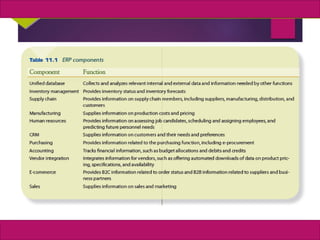
 ERP systems are available as modules
 Organization can purchase only the components it needs
 Keeps costs down for organizations
 More than 40 vendors offer ERP software
36
MIS, Chapter 11
©2011 Course Technology, a part of Cengage Learning
Chapter 11 Enterprise Systems
37
MIS, Chapter 11
©2011 Course Technology, a part of Cengage Learning
Table 11.1 ERP Components
38
MIS, Chapter 11
©2011 Course Technology, a part of Cengage Learning
Chapter 11 Enterprise Systems
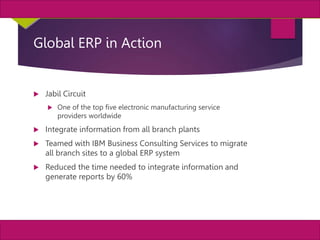
Global ERP in Action
 Jabil Circuit
 One of the top five electronic manufacturing service
providers worldwide
 Integrate information from all branch plants
 Teamed with IBM Business Consulting Services to migrate
all branch sites to a global ERP system
 Reduced the time needed to integrate information and
generate reports by 60%
39
MIS, Chapter 11
©2011 Course Technology, a part of Cengage Learning
Chapter 11 Enterprise Systems
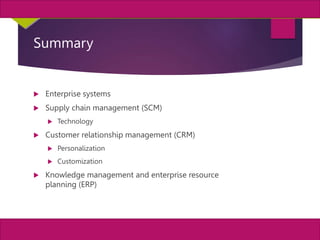
Summary
 Enterprise systems
 Supply chain management (SCM)
 Technology
 Customer relationship management (CRM)
 Personalization
 Customization
 Knowledge management and enterprise resource
planning (ERP)

ERP U4 LSCM.ppt

  • 1.
    1 MIS, Chapter 11 ©2011Course Technology, a part of Cengage Learning Unit 4 ENTERPRISE SYSTEMS
  • 2.
    2 MIS, Chapter 11 ©2011Course Technology, a part of Cengage Learning Chapter 11 Enterprise Systems Supply Chain Management  Supply chain  Integrated network  Consisting of an organization, its suppliers, transportation companies, and brokers  Used to deliver goods and services to customers  Exist in both service and manufacturing organizations
  • 3.
    3 MIS, Chapter 11 ©2011Course Technology, a part of Cengage Learning Exhibit 11.1 A Supply Chain Configuration
  • 4.
    4 MIS, Chapter 11 ©2011Course Technology, a part of Cengage Learning Chapter 11 Enterprise Systems Supply Chain Management (cont’d.)  Supply chain management (SCM)  Process of working with suppliers and other partners in the supply chain to improve procedures for delivering products and services  Coordinates:  Procuring materials  Transforming materials into intermediate and finished products or services  Distributing finished products or services to customers
  • 5.
    5 MIS, Chapter 11 ©2011Course Technology, a part of Cengage Learning Chapter 11 Enterprise Systems Supply Chain Management (cont’d.)  In manufacturing firm, information in an SCM system flows between the following areas:  Product flow  Information flow  Finances flow  Four key decisions in supply chain management:  Location  Inventory  Production  Transportation
  • 6.
    6 MIS, Chapter 11 ©2011Course Technology, a part of Cengage Learning Chapter 11 Enterprise Systems Supply Chain Management (cont’d.)  Vendors offer comprehensive solutions:  SAP  Oracle  JDA Software  Manhattan associates
  • 7.
    7 MIS, Chapter 11 ©2011Course Technology, a part of Cengage Learning Chapter 11 Enterprise Systems Dell Computer’s Supply Chain  Modified its supply chain from a “push” to a “pull” manufacturing process  Also known as “built to order (BTO)”  Main sales channel is direct sales to customers  Dell has been able to reduce costs by eliminating intermediaries and shortening delivery time
  • 8.
    8 MIS, Chapter 11 ©2011Course Technology, a part of Cengage Learning Chapter 11 Enterprise Systems SCM Technologies  Information technologies and the Internet play a major role in implementing an SCM system  Electronic Data Interchange (EDI)  Enables business partners to send and receive information on business transactions  Expedites delivering accurate information  Lowers the cost of transmitting documents  Advantage of being platform independent and easy to use
  • 9.
    9 MIS, Chapter 11 ©2011Course Technology, a part of Cengage Learning Chapter 11 Enterprise Systems SCM Technologies (cont’d.)  Using EDI has some drawbacks  Uses the X.25 standard  Beneficial when more companies are in the EDI network  Often was not affordable for small suppliers and distributors  Open EDI  Based on XML  Traditional EDI has declined in popularity
  • 10.
    10 MIS, Chapter 11 ©2011Course Technology, a part of Cengage Learning Chapter 11 Enterprise Systems Internet-Enabled SCM  Improves information sharing throughout the supply chain  Can improve the following SCM activities:  Purchasing/procurement  Inventory management  Transportation  Order processing  Customer service  Production scheduling
  • 11.
    11 MIS, Chapter 11 ©2011Course Technology, a part of Cengage Learning Chapter 11 Enterprise Systems E-marketplaces  Third-party exchange  Provides a platform for buyers and sellers to interact with each other and trade more efficiently online  Benefits  Increases efficiency and effectiveness in the supply chain  Provides opportunities for sellers and buyers to establish new trading partnerships  Provides a single platform for prices, availability, and stock levels that’s accessible to all participants
  • 12.
    12 MIS, Chapter 11 ©2011Course Technology, a part of Cengage Learning Chapter 11 Enterprise Systems E-marketplaces (cont’d.)  Solves time constraint problems for international trade and makes it possible to conduct business around the clock  Makes it easy to compare prices and products from a single source instead of spending time contacting each seller  Reduces marketing costs more than traditional sales channels can
  • 13.
    13 MIS, Chapter 11 ©2011Course Technology, a part of Cengage Learning Chapter 11 Enterprise Systems E-marketplaces (cont’d.)  E-distributor  Marketplace owned and operated by a third party that provides an electronic catalog of product  Maintenance, repair, and operations (MROs) services  Includes services from different vendors  E-distributor coordinates them into one package for customers  Example of a horizontal market
  • 14.
    14 MIS, Chapter 11 ©2011Course Technology, a part of Cengage Learning Chapter 11 Enterprise Systems Online Auctions  Bring traditional auctions to customers around the globe  Make it possible to sell far more goods and services than at a traditional auction  Brokerage business model  Reverse auctions  Invite sellers to submit bids for products and services
  • 15.
    15 MIS, Chapter 11 ©2011Course Technology, a part of Cengage Learning Chapter 11 Enterprise Systems Collaborative Planning, Forecasting, and Replenishment  Coordinate supply chain members through point-of-sale (POS) data sharing and joint planning  Any data collected is shared with all members of the supply chain  Coordinating the supply chain can be difficult  CPFR ensures that inventory and sales data are shared across the supply chain  So that everyone knows the exact sales and inventory levels
  • 16.
    16 MIS, Chapter 11 ©2011Course Technology, a part of Cengage Learning Chapter 11 Enterprise Systems Collaborative Planning, Forecasting, and Replenishment (cont’d.)  Costs for each partner are shared or minimized  Unforeseen problems can crop up
  • 17.
    17 MIS, Chapter 11 ©2011Course Technology, a part of Cengage Learning Exhibit 11.2 The CPFR Process
  • 18.
    18 MIS, Chapter 11 ©2011Course Technology, a part of Cengage Learning Chapter 11 Enterprise Systems Customer Relationship Management  CRM  Consists of the processes a company uses to track and organize its contacts with customers  Main goal of a CRM system  Improve services offered to customers  Use customer contact information for targeted marketing  Marketing strategies in a CRM system  Focus on long-term relationships with customers instead of transactions
  • 19.
    19 MIS, Chapter 11 ©2011Course Technology, a part of Cengage Learning Chapter 11 Enterprise Systems Customer Relationship Management (cont’d.)  Identifies segments of customers  Improves products and services to meet customers’ needs  Improves customer retention  Identifies a company’s most profitable (and loyal) customers  Helps organizations make better use of data, information, and knowledge to understand customers
  • 20.
    20 MIS, Chapter 11 ©2011Course Technology, a part of Cengage Learning Chapter 11 Enterprise Systems Customer Relationship Management (cont’d.)  Gives organizations more complete pictures of their customers  Integrates demographic and other external data with customers’ transaction data to better understand customer behavior  Pays external agencies for additional data about you that might be public or semiprivate
  • 21.
    21 MIS, Chapter 11 ©2011Course Technology, a part of Cengage Learning Chapter 11 Enterprise Systems Customer Relationship Management (cont’d.)  With a CRM system, organizations can:  Provide services and products that meet customers’ needs  Offer better customer service through multiple channels  Increase cross-selling and upselling  Help sales personnel close deals faster by offering data on customers’ backgrounds  Retain existing customers and attract new ones
  • 22.
    22 MIS, Chapter 11 ©2011Course Technology, a part of Cengage Learning Chapter 11 Enterprise Systems Customer Relationship Management (cont’d.)  CRM systems include:  Sales automation  Order processing  Marketing automation  Customer support  Knowledge management  Personalization technology
  • 23.
    23 MIS, Chapter 11 ©2011Course Technology, a part of Cengage Learning Chapter 11 Enterprise Systems CRM in Action  Time Warner Cable Business Class  CRM system from Salesforce.com  Analyze business data, improve the accuracy of forecasts, improve problem solving, and monitor sales and business activities  Important features of the system include:  Dashboards, features for “drilling down,” Web-based knowledge base for employees and customers, and Web log for sales personnel communication  Has increased productivity by 10%
  • 24.
    24 MIS, Chapter 11 ©2011Course Technology, a part of Cengage Learning Chapter 11 Enterprise Systems CRM Applications  On-premise CRM or Web-based CRM (SaaS)  Several software packages are available for setting up a CRM system:  Amdocs CRM, Optima Technologies ExSellence, Infor CRM, SAP mySAP, Oracle PeopleSoft CRM, and Oracle Siebel
  • 25.
    25 MIS, Chapter 11 ©2011Course Technology, a part of Cengage Learning Chapter 11 Enterprise Systems CRM Applications (cont’d.)  Features:  Salesforce automation  eCRM or Web-based CRM  Survey management  Automated customer service
  • 26.
    26 MIS, Chapter 11 ©2011Course Technology, a part of Cengage Learning Chapter 11 Enterprise Systems Personalization Technology  Personalization  Satisfies customers’ needs, builds customer relationships, and increases profits  Designs goods and services that meet customers’ preferences better  Customization  Allows customers to modify the standard offering  Such as selecting a different home page to be displayed each time you open your Web browser
  • 27.
    27 MIS, Chapter 11 ©2011Course Technology, a part of Cengage Learning Chapter 11 Enterprise Systems Personalization Technology (cont’d.)  Using personalization requires gathering a lot of information about customers’ preferences and shopping patterns  Amazon  Known for using personalization to recommend products to customers  Nordstrom.com  Suggests shoes or a tie that go with the suit or a similar suit in the same category
  • 28.
    28 MIS, Chapter 11 ©2011Course Technology, a part of Cengage Learning Chapter 11 Enterprise Systems Personalization Technology (cont’d.)  Apple iTunes  Other songs that listeners like you purchased are suggested  Google account holders  Personalized search results that are reordered based on their searching histories
  • 29.
    29 MIS, Chapter 11 ©2011Course Technology, a part of Cengage Learning Chapter 11 Enterprise Systems Personalization Technology (cont’d.)  Implement a personalization system  Internet, databases, data warehouse/data marts, data-mining tools, mobile networks, and collaborative filtering  Collaborative filtering (CF)  Searches for specific information or patterns, using input from multiple business partners and data sources
  • 30.
    30 MIS, Chapter 11 ©2011Course Technology, a part of Cengage Learning Chapter 11 Enterprise Systems Knowledge Management  Improve CRM systems by identifying, storing, and disseminating “know-how”—facts about how to perform tasks  Knowledge is an asset  Should be shared throughout an organization to generate business intelligence and maintain a competitive advantage in the marketplace  Knowledge is more than information and data  Also contextual
  • 31.
    31 MIS, Chapter 11 ©2011Course Technology, a part of Cengage Learning Chapter 11 Enterprise Systems Knowledge Management (cont’d.)  Knowledge repository  Stores knowledge of experts  Example: knowledge base of typical customer complaints and solutions  Motivates employees to share knowledge  Offer reward  Simple knowledge management system  Using groupware  Other tools and technologies include:  DBMSs, data-mining tools, decision support systems
  • 32.
    32 MIS, Chapter 11 ©2011Course Technology, a part of Cengage Learning Chapter 11 Enterprise Systems Knowledge Management (cont’d.)  Knowledge management system should help an organization to:  Promote innovation by encouraging free exchange of ideas  Improve customer service by reducing response time  Increase revenue by reducing the delivery time for products and services  Improve employee retention rates by rewarding employees for their knowledge
  • 33.
    33 MIS, Chapter 11 ©2011Course Technology, a part of Cengage Learning Chapter 11 Enterprise Systems Enterprise Resource Planning  Integrated system  Collects and processes data  Manages and coordinates resources, information, and functions  Many components, including:  Hardware, software, procedures, and input from all functional areas
  • 34.
    34 MIS, Chapter 11 ©2011Course Technology, a part of Cengage Learning Chapter 11 Enterprise Systems Enterprise Resource Planning (cont’d.)  Well-designed ERP system benefits:  Increased availability and timeliness of information  Increased data accuracy and improved response time  Improved customer satisfaction  Improved employee satisfaction  Improved planning and scheduling  Improved supplier relationship  Improved reliability of information  Reduction in inventory costs  Reduction in labor costs  Reduction in order-to-fulfillment time
  • 35.
    35 MIS, Chapter 11 ©2011Course Technology, a part of Cengage Learning Chapter 11 Enterprise Systems Enterprise Resource Planning (cont’d.)  ERP systems are available as modules  Organization can purchase only the components it needs  Keeps costs down for organizations  More than 40 vendors offer ERP software
  • 36.
    36 MIS, Chapter 11 ©2011Course Technology, a part of Cengage Learning Chapter 11 Enterprise Systems
  • 37.
    37 MIS, Chapter 11 ©2011Course Technology, a part of Cengage Learning Table 11.1 ERP Components
  • 38.
    38 MIS, Chapter 11 ©2011Course Technology, a part of Cengage Learning Chapter 11 Enterprise Systems Global ERP in Action  Jabil Circuit  One of the top five electronic manufacturing service providers worldwide  Integrate information from all branch plants  Teamed with IBM Business Consulting Services to migrate all branch sites to a global ERP system  Reduced the time needed to integrate information and generate reports by 60%
  • 39.
    39 MIS, Chapter 11 ©2011Course Technology, a part of Cengage Learning Chapter 11 Enterprise Systems Summary  Enterprise systems  Supply chain management (SCM)  Technology  Customer relationship management (CRM)  Personalization  Customization  Knowledge management and enterprise resource planning (ERP)