Inventory Management
60 - 60
617
Inventory Management
•The main aim of inventory management is to ensure
that organizations hold inventories at the lowest cost
possible while at the same time achieving the
objective of ensuring that the company has adequate
and uninterrupted supplies to enhance continuity of
operations.
•Inventory management can reduce costs, improve
quality of service, enhance product availability and
ultimately ensure customer satisfaction.
Inventory management
• It is defined as scientific method of finding
out how much stock should be maintained in
order to meet the production demands and
be able to provide right type of the material
at the right time , in right quantities and at
competitive prices.
Objectives of Inventory Management
•Inventory Management objectives are as follows:
•(i) Optimum levels of inventory,
•(ii) Lowest Inventory costs,
•(iii) Ensuring Lead time for product delivery,
•(iv) Customer satisfaction,
•(v) Customer loyalty and
•(vi) Repeat purchases by customers.
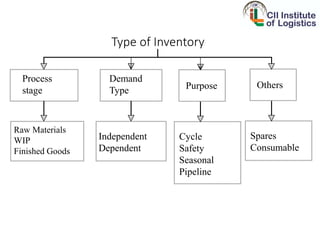
Type of Inventory
Process
stage
Demand
Type
Others
Raw Materials
WIP
Finished Goods
Independent
Dependent
Spares
Consumable
Purpose
Cycle
Safety
Seasonal
Pipeline
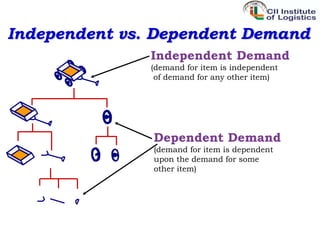
Independent Demand
(demand for item is independent
of demand for any other item)
Dependent Demand
(demand for item is dependent
upon the demand for some
other item)
Independent vs. Dependent Demand
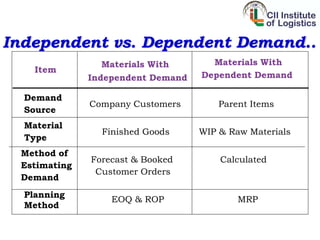
Independent vs. Dependent Demand..
Item
Materials With
Independent Demand
Materials With
Dependent Demand
Demand
Source
Company Customers Parent Items
Material
Type
Finished Goods WIP & Raw Materials
Method of
Estimating
Demand
Forecast & Booked
Customer Orders
Calculated
Planning
Method
EOQ & ROP MRP
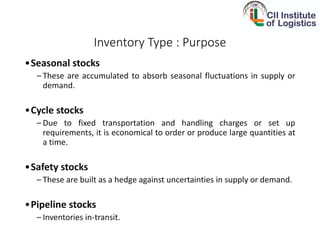
Inventory Type : Purpose
•Seasonal stocks
– These are accumulated to absorb seasonal fluctuations in supply or
demand.
•Cycle stocks
– Due to fixed transportation and handling charges or set up
requirements, it is economical to order or produce large quantities at
a time.
•Safety stocks
– These are built as a hedge against uncertainties in supply or demand.
•Pipeline stocks
– Inventories in-transit.
Optimum Levels of Inventory
• The organisation should maintain an optimum levels of inventory.
• In case of high inventory levels, stock holding costs will be more and
the employees will also not be able to easily trace the goods, even
though the goods may be physically available.
• If there is stock outs, the company will loose profits and also customers.
• When inventory management is carried out efficiently, it ensures that
the materials needed are available in right quality, right quantity and
right time.
Inventory control
“It means control over materials lying in the stores
“It refer to the regulation of the stock and the flow of
materials and components in an efficient, effective and
economical manner to meet the need of manufacturing
department.”
“Inventory control refers to the process whereby the
investment in a material and parts carried in stock is regulated
within predetermined limits set in accordance with the inventory
policy established by the management”
Aims of inventory control
• Never run out of stock of any material .
• Never build up very large inventory .
• Never send out too many small orders for more as such small order turn
out to be very costly.
Objective of inventory control
1. To reduce the minimum idle time due to shortage of materials
and spare parts .
2. To offer maximum service and satisfaction of customers.
3. To minimize as much as possible capital investment and cost of
storage .
4. To provide a scientific basis for planning inventory requirement
.
5. To hold reasonable inventories in order to avoid losses from
inventory obsolescence.
6. To maintain reasonable safety stock
7. To maintain necessary inventory record
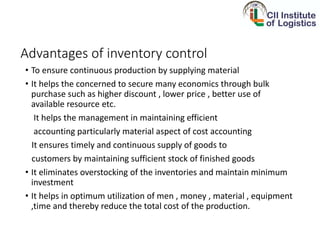
Advantages of inventory control
• To ensure continuous production by supplying material
• It helps the concerned to secure many economics through bulk
purchase such as higher discount , lower price , better use of
available resource etc.
It helps the management in maintaining efficient
accounting particularly material aspect of cost accounting
It ensures timely and continuous supply of goods to
customers by maintaining sufficient stock of finished goods
• It eliminates overstocking of the inventories and maintain minimum
investment
• It helps in optimum utilization of men , money , material , equipment
,time and thereby reduce the total cost of the production.
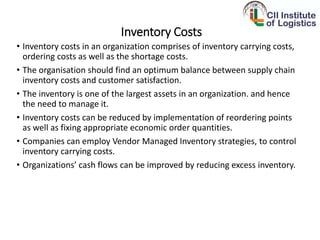
Inventory Costs
• Inventory costs in an organization comprises of inventory carrying costs,
ordering costs as well as the shortage costs.
• The organisation should find an optimum balance between supply chain
inventory costs and customer satisfaction.
• The inventory is one of the largest assets in an organization. and hence
the need to manage it.
• Inventory costs can be reduced by implementation of reordering points
as well as fixing appropriate economic order quantities.
• Companies can employ Vendor Managed Inventory strategies, to control
inventory carrying costs.
• Organizations’ cash flows can be improved by reducing excess inventory.
Lead Time
•Customers want products with shorter lead times and
as soon as possible as they order them.
•To reduce lead times, all concerned are required to
respond quickly to the customers’ needs.
•Customers will be more satisfied if their suppliers are
able to meet and fulfil their orders within the required
time.
•The company may keep buffer stocks to meet the
needs of customers.
•The company can enter into long-term relationships
with their suppliers to secure sustainability in supplies.
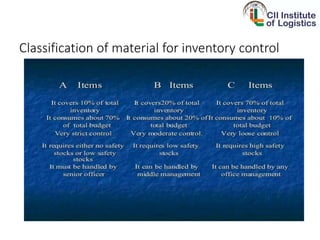
Classification of material for inventory control
• V-E-D Classification V- Item without which the activity will come to
the halt E- Items which are likely to cause disruption of the normal
activity. D- In the absence of which the hospital work does not get
hampered.
• H-M-L classification Based on the unit value of items.
• F-S-N Classification Takes into account distribution handling pattern
of items from store
• S-O-S classification
• S-D-E Classification: Based on lead-time analysis & availability. S-
Scarce D-Difficult E-Eassy
• G-O-L-F Classification: G- Government O- Ordinary L- Local F-
Foreign
• X-Y-Z Classification: Based on the value of inventory stored.
Customer Satisfaction
•Customer satisfaction refers to the quality of
the products, services, price performance
ratios, as well as, when a company meets and
exceeds the requirements of the customer.
•Manufacturing organizations identify customer
satisfaction in terms of on-time delivery, as well
as, meeting customer specification needs.
Customer Loyalty
• Customer loyalty is the act of customers buying current brands
repeatedly, as opposed to choosing those of competitors.
• Manufacturers need to provide customer satisfaction before and after a
purchase, since this is likely to lead to customer brand loyalty.
• Customer loyalty requires that the manufacturing companies deliver the
products as per the customers’ expectations.
• Customers often judge the quality of the services that they receive using
their perceived expectations which often lead to customer satisfaction
and loyalty.
Repeat Purchases
• Customer loyalty is often manifested in repeat purchases.
• Satisfied customers are likely to adapt a behaviour of increase in
purchases, as well as, a continuous purchase from the firm.
• Provision of customer purchase satisfaction before and after a purchase
results in repeat purchases.
• Provision of customer purchase satisfaction requires the company to
provide quality products, fair pricing and flexibility.
• Post purchase customer satisfaction requires the company to provide in-
time repair services and efficient operations of reverse logistics.
Customer Service
•Good customer service can be ensured by the
following:
•Delivering products to customers faster and with
greater accuracy.
•Tracking shipments to ensure they reach their
destination safely.
•Maintaining optimal inventory levels so that the
company always have what customers want in stock.
Customer Service (Contd.)
• Good inventory management saves time by eliminating time-consuming
processes, lowers costs by reducing inventory levels to their optimal
amounts, and boosts productivity by empowering employees to
accomplish complex inventory management tasks.
• All three of these strengths help a company to build relationships of trust
with the customers.
• If a company consistently fulfil the promises and exceed expectations,
the customers will be much more likely to keep coming back to the
company and even refer their friends to the company.
Tomorrow
• Transportation

617 inv mgt.pptx

  • 1.
  • 2.
    Inventory Management •The mainaim of inventory management is to ensure that organizations hold inventories at the lowest cost possible while at the same time achieving the objective of ensuring that the company has adequate and uninterrupted supplies to enhance continuity of operations. •Inventory management can reduce costs, improve quality of service, enhance product availability and ultimately ensure customer satisfaction.
  • 3.
    Inventory management • Itis defined as scientific method of finding out how much stock should be maintained in order to meet the production demands and be able to provide right type of the material at the right time , in right quantities and at competitive prices.
  • 4.
    Objectives of InventoryManagement •Inventory Management objectives are as follows: •(i) Optimum levels of inventory, •(ii) Lowest Inventory costs, •(iii) Ensuring Lead time for product delivery, •(iv) Customer satisfaction, •(v) Customer loyalty and •(vi) Repeat purchases by customers.
  • 5.
    Type of Inventory Process stage Demand Type Others RawMaterials WIP Finished Goods Independent Dependent Spares Consumable Purpose Cycle Safety Seasonal Pipeline
  • 6.
    Independent Demand (demand foritem is independent of demand for any other item) Dependent Demand (demand for item is dependent upon the demand for some other item) Independent vs. Dependent Demand
  • 7.
    Independent vs. DependentDemand.. Item Materials With Independent Demand Materials With Dependent Demand Demand Source Company Customers Parent Items Material Type Finished Goods WIP & Raw Materials Method of Estimating Demand Forecast & Booked Customer Orders Calculated Planning Method EOQ & ROP MRP
  • 8.
    Inventory Type :Purpose •Seasonal stocks – These are accumulated to absorb seasonal fluctuations in supply or demand. •Cycle stocks – Due to fixed transportation and handling charges or set up requirements, it is economical to order or produce large quantities at a time. •Safety stocks – These are built as a hedge against uncertainties in supply or demand. •Pipeline stocks – Inventories in-transit.
  • 9.
    Optimum Levels ofInventory • The organisation should maintain an optimum levels of inventory. • In case of high inventory levels, stock holding costs will be more and the employees will also not be able to easily trace the goods, even though the goods may be physically available. • If there is stock outs, the company will loose profits and also customers. • When inventory management is carried out efficiently, it ensures that the materials needed are available in right quality, right quantity and right time.
  • 10.
    Inventory control “It meanscontrol over materials lying in the stores “It refer to the regulation of the stock and the flow of materials and components in an efficient, effective and economical manner to meet the need of manufacturing department.” “Inventory control refers to the process whereby the investment in a material and parts carried in stock is regulated within predetermined limits set in accordance with the inventory policy established by the management”
  • 11.
    Aims of inventorycontrol • Never run out of stock of any material . • Never build up very large inventory . • Never send out too many small orders for more as such small order turn out to be very costly.
  • 12.
    Objective of inventorycontrol 1. To reduce the minimum idle time due to shortage of materials and spare parts . 2. To offer maximum service and satisfaction of customers. 3. To minimize as much as possible capital investment and cost of storage . 4. To provide a scientific basis for planning inventory requirement . 5. To hold reasonable inventories in order to avoid losses from inventory obsolescence. 6. To maintain reasonable safety stock 7. To maintain necessary inventory record
  • 13.
    Advantages of inventorycontrol • To ensure continuous production by supplying material • It helps the concerned to secure many economics through bulk purchase such as higher discount , lower price , better use of available resource etc. It helps the management in maintaining efficient accounting particularly material aspect of cost accounting It ensures timely and continuous supply of goods to customers by maintaining sufficient stock of finished goods • It eliminates overstocking of the inventories and maintain minimum investment • It helps in optimum utilization of men , money , material , equipment ,time and thereby reduce the total cost of the production.
  • 14.
    Inventory Costs • Inventorycosts in an organization comprises of inventory carrying costs, ordering costs as well as the shortage costs. • The organisation should find an optimum balance between supply chain inventory costs and customer satisfaction. • The inventory is one of the largest assets in an organization. and hence the need to manage it. • Inventory costs can be reduced by implementation of reordering points as well as fixing appropriate economic order quantities. • Companies can employ Vendor Managed Inventory strategies, to control inventory carrying costs. • Organizations’ cash flows can be improved by reducing excess inventory.
  • 15.
    Lead Time •Customers wantproducts with shorter lead times and as soon as possible as they order them. •To reduce lead times, all concerned are required to respond quickly to the customers’ needs. •Customers will be more satisfied if their suppliers are able to meet and fulfil their orders within the required time. •The company may keep buffer stocks to meet the needs of customers. •The company can enter into long-term relationships with their suppliers to secure sustainability in supplies.
  • 16.
    Classification of materialfor inventory control
  • 17.
    • V-E-D ClassificationV- Item without which the activity will come to the halt E- Items which are likely to cause disruption of the normal activity. D- In the absence of which the hospital work does not get hampered. • H-M-L classification Based on the unit value of items. • F-S-N Classification Takes into account distribution handling pattern of items from store • S-O-S classification • S-D-E Classification: Based on lead-time analysis & availability. S- Scarce D-Difficult E-Eassy • G-O-L-F Classification: G- Government O- Ordinary L- Local F- Foreign • X-Y-Z Classification: Based on the value of inventory stored.
  • 18.
    Customer Satisfaction •Customer satisfactionrefers to the quality of the products, services, price performance ratios, as well as, when a company meets and exceeds the requirements of the customer. •Manufacturing organizations identify customer satisfaction in terms of on-time delivery, as well as, meeting customer specification needs.
  • 19.
    Customer Loyalty • Customerloyalty is the act of customers buying current brands repeatedly, as opposed to choosing those of competitors. • Manufacturers need to provide customer satisfaction before and after a purchase, since this is likely to lead to customer brand loyalty. • Customer loyalty requires that the manufacturing companies deliver the products as per the customers’ expectations. • Customers often judge the quality of the services that they receive using their perceived expectations which often lead to customer satisfaction and loyalty.
  • 20.
    Repeat Purchases • Customerloyalty is often manifested in repeat purchases. • Satisfied customers are likely to adapt a behaviour of increase in purchases, as well as, a continuous purchase from the firm. • Provision of customer purchase satisfaction before and after a purchase results in repeat purchases. • Provision of customer purchase satisfaction requires the company to provide quality products, fair pricing and flexibility. • Post purchase customer satisfaction requires the company to provide in- time repair services and efficient operations of reverse logistics.
  • 21.
    Customer Service •Good customerservice can be ensured by the following: •Delivering products to customers faster and with greater accuracy. •Tracking shipments to ensure they reach their destination safely. •Maintaining optimal inventory levels so that the company always have what customers want in stock.
  • 22.
    Customer Service (Contd.) •Good inventory management saves time by eliminating time-consuming processes, lowers costs by reducing inventory levels to their optimal amounts, and boosts productivity by empowering employees to accomplish complex inventory management tasks. • All three of these strengths help a company to build relationships of trust with the customers. • If a company consistently fulfil the promises and exceed expectations, the customers will be much more likely to keep coming back to the company and even refer their friends to the company.
  • 23.