THE LAW OF ARMED CONFLICT IN
Kareem Kawa Kareem
LOAC DEFINE
• It is that branch of international law which seeks to limit the effects of armed
conflict by protecting persons who are not participating in hostilities, and by
restricting and regulating the means and methods of warfare available
to combatants.
• The LOAC arises from a desire among civilized nations to prevent
unnecessary suffering and destruction while not impeding the effective
waging of war. A part of public international law, LOAC regulates the conduct
of armed hostilities. It also aims to protect civilians, prisoners of war, the
wounded, sick, and shipwrecked. LOAC applies to international armed
conflicts and in the conduct of military operations and related activities in
armed conflict, however such conflicts are characterized.
TYPES OF ARMED CONFLICTS:
• international armed conflicts, opposing two or more States.
• non-international armed conflicts, between governmental forces
and non-governmental armed groups, or between such groups
only.
PURPOSE OF THIS LAW
• it aims to limit the effects of war on the civilians and civilian objects.
• Key message:
1- Do not attack people who no longer take part in hostilities.
2- Do not use weapons that make no distinction between combatants and civilians or
weapons & methods of warfare which cause unnecessary suffering and/or damages.
GENERAL LEGAL FRAMEWORK
• 1864: First Geneva Convention
• 1907: Hague Conventions
• 1949: Four Geneva Conventions ( Wounded and Sick in Armed Forces in the Field (I),
Wounded and Sick in Armed Forces in the Field (II), Treatment of Prisoners of War
(III), Protection of civilian Persons in Time of War (IV).
• 1977: Two additional Protocols (Protection of Victims of International Armed
Conflicts (AP I), Protection of Victims of Non-International Armed Conflicts (AP II).
• 2005: Third additional Protocol (Adoption of an Additional Distinctive Emblem
(APIII) Weapons Conventions (chemical weapons, landmines, cluster munitions);
Customary International Humanitarian Law
WHY SHOULD IRAQI SOLDIERS LEARN LOAC?
• 1) Law of Iraq.
• 2) Professional Soldiers vs. Criminals.
• 3) Honor and Pride.
• 4) Military Efficiency.
• 5) Support from Coalition.
• 6) Facilitates restoration of peace.
PRINCIPLES
•Three important LOAC principles govern armed
conflict:
•Military necessity.
•Distinction.
•Proportionality.
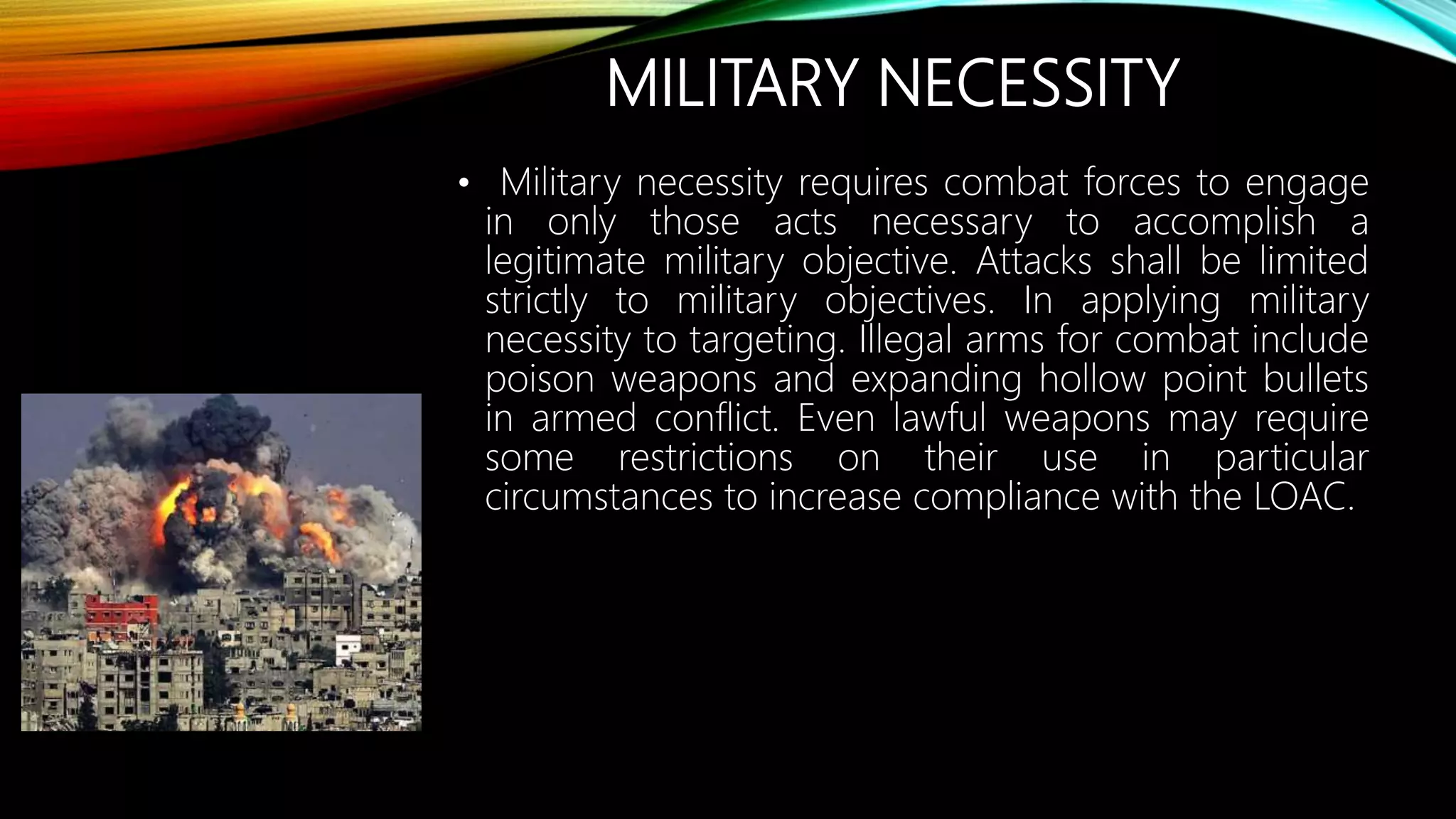
MILITARY NECESSITY
• Military necessity requires combat forces to engage
in only those acts necessary to accomplish a
legitimate military objective. Attacks shall be limited
strictly to military objectives. In applying military
necessity to targeting. Illegal arms for combat include
poison weapons and expanding hollow point bullets
in armed conflict. Even lawful weapons may require
some restrictions on their use in particular
circumstances to increase compliance with the LOAC.
DISTINCTION
• You must always clearly distinguish between
combatants and civilians or the civilian population as
such. Combatants may of course be attacked unless
they are out of action, i.e. they are hors de combat.
Civilians are protected from attack but lose that
protection whenever they take a direct part in
hostilities for the time of their participation. Similarly,
you must always distinguish between military
objectives which can be attacked and civilian objects
which must be respected. The word “object” covers
all kinds of objects, whether public or private, fixed or
portable.
VIDEO
PROPORTIONALITY
• When military objectives are attacked,
civilians and civilian objects must be spared
from incidental or collateral damage to the
maximum extent possible. Incidental damage
must not be excessive in relation to the direct
and concrete military advantage you
anticipate from your operations. Excessive
use of force quite clearly violates the law of
armed conflict.
VIDEO
THE 10 SOLDIER’S RULES
• 1. Soldiers fight only enemy fighters that take part in the fighting.
• 2. Soldiers do not harm enemies who surrender. Disarm them and turn them over to your
superior.
• 3. Soldiers do not kill or torture personnel in their custody.
• 4. Soldiers collect and care for the wounded, whether friend or foe.
• 5. Soldiers do not attack civilians and civilian objects.
• 6. Soldiers use no more force than the mission requires.
• 7. Soldiers treat all persons humanely.
• 8. Soldiers do not steal. Soldiers respect private property and possessions.
• 9. Soldiers should do their best to prevent violations of LOAC.
• 10. Soldiers report all violations of LOAC to their superiors.
References
• https://www.icrc.org/eng/assets/files/other/law1_final.pdf
• Duxbury, A. (2007), Drawing Lines in the Sand- Characterizing conflicts for the purposes
of teaching International humanitarian law, Melbourne Journal of International law,
volume 8: 1-14
• Sassoli, M. (2006), Transnational armed groups and international humanitarian
law, Harvard University, 6:1-50
•
Stewart, G.S. (2003), Towards a single definition of armed conflict in international
humanitarian law: A critique of internationalized armed conflict, 85(850):313-350
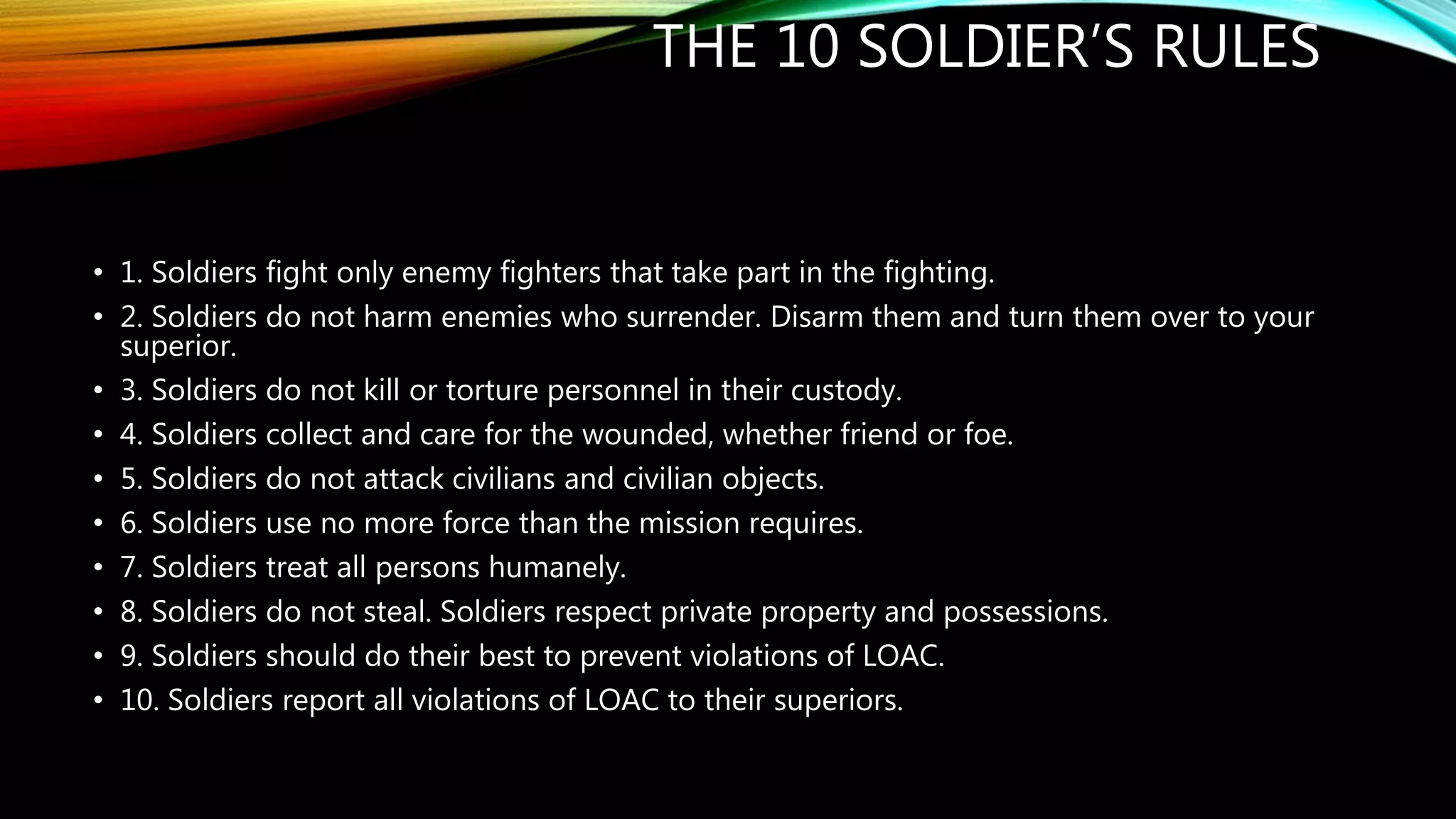
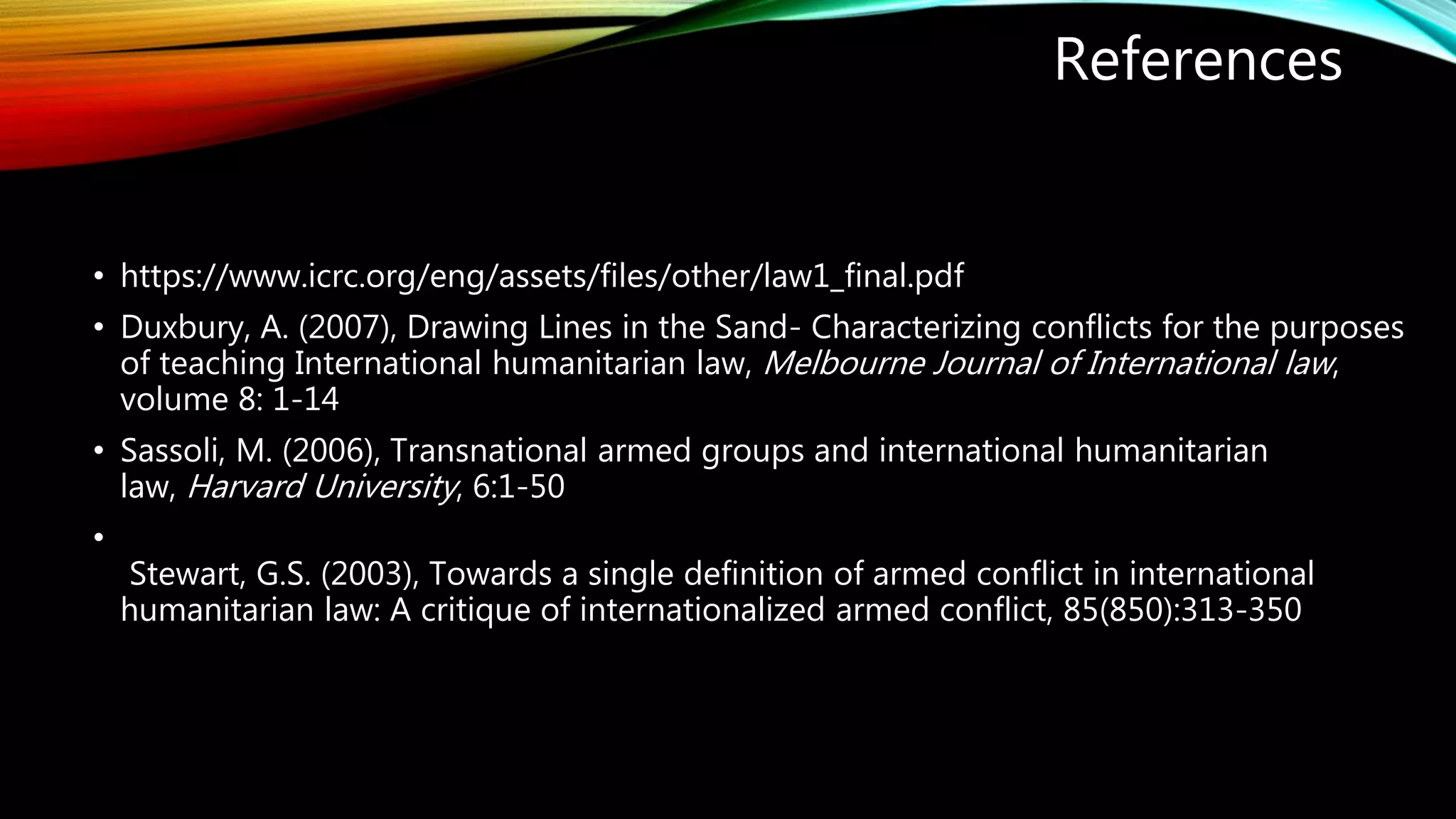
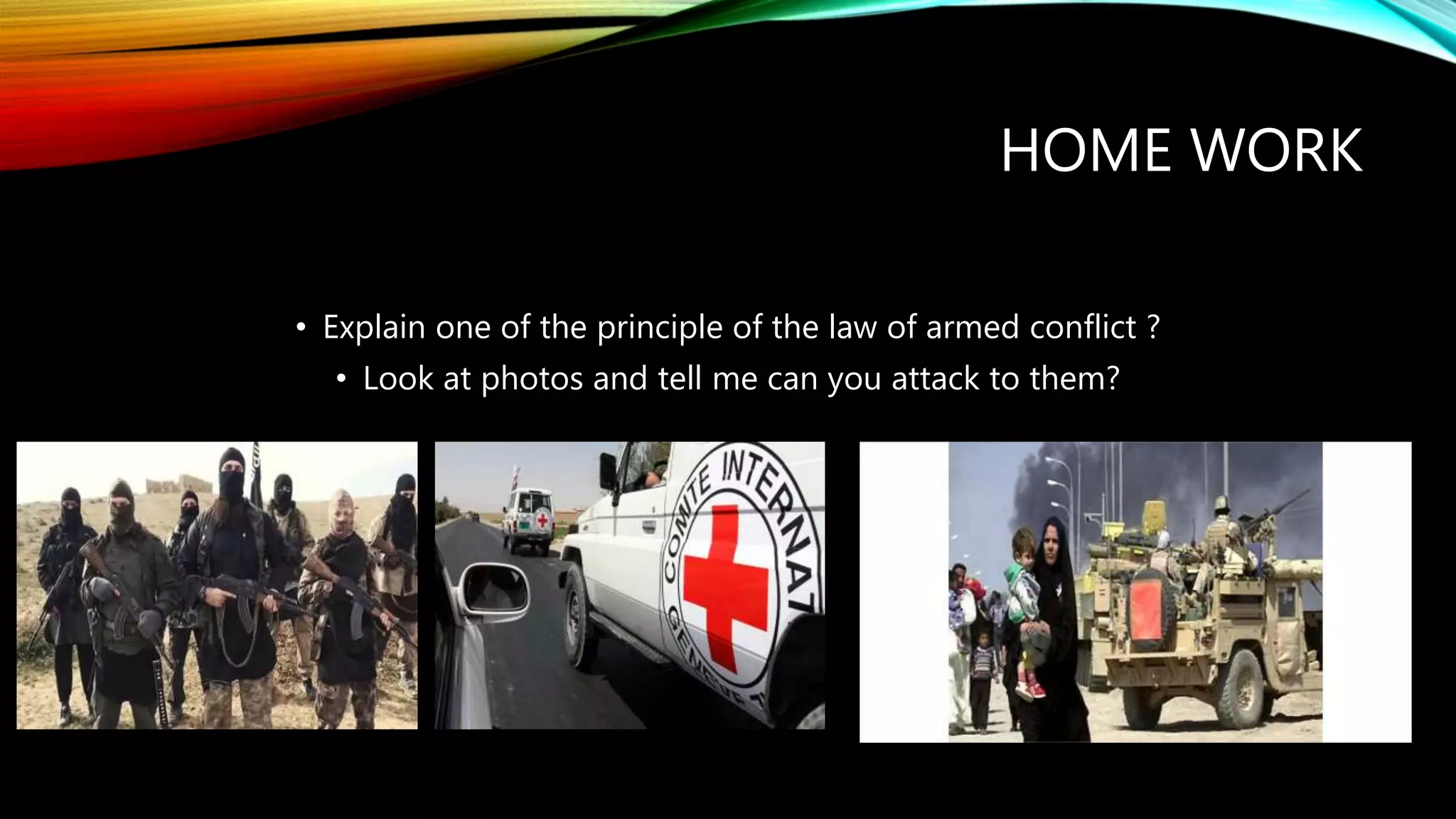
HOME WORK
• Explain one of the principle of the law of armed conflict ?
• Look at photos and tell me can you attack to them?
THANK YOU
THE GENEVA CONVENTIONS OF
1949
• Some of the most important LOAC rules come from
the Geneva Conventions of 1949. The Geneva
Conventions consist of four separate international
treaties. These treaties aim to protect combatants and
noncombatants from unnecessary suffering who may
become wounded, sick, shipwrecked, or POWs during
hostilities. They also seek to protect civilians and
private property. The four treaties govern the
treatment of wounded and sick forces, POWs, and
civilians during war or armed conflict.

Law of Armed Conflicts

  • 1.
    THE LAW OFARMED CONFLICT IN Kareem Kawa Kareem
  • 2.
    LOAC DEFINE • Itis that branch of international law which seeks to limit the effects of armed conflict by protecting persons who are not participating in hostilities, and by restricting and regulating the means and methods of warfare available to combatants. • The LOAC arises from a desire among civilized nations to prevent unnecessary suffering and destruction while not impeding the effective waging of war. A part of public international law, LOAC regulates the conduct of armed hostilities. It also aims to protect civilians, prisoners of war, the wounded, sick, and shipwrecked. LOAC applies to international armed conflicts and in the conduct of military operations and related activities in armed conflict, however such conflicts are characterized.
  • 3.
    TYPES OF ARMEDCONFLICTS: • international armed conflicts, opposing two or more States. • non-international armed conflicts, between governmental forces and non-governmental armed groups, or between such groups only.
  • 4.
    PURPOSE OF THISLAW • it aims to limit the effects of war on the civilians and civilian objects. • Key message: 1- Do not attack people who no longer take part in hostilities. 2- Do not use weapons that make no distinction between combatants and civilians or weapons & methods of warfare which cause unnecessary suffering and/or damages.
  • 5.
    GENERAL LEGAL FRAMEWORK •1864: First Geneva Convention • 1907: Hague Conventions • 1949: Four Geneva Conventions ( Wounded and Sick in Armed Forces in the Field (I), Wounded and Sick in Armed Forces in the Field (II), Treatment of Prisoners of War (III), Protection of civilian Persons in Time of War (IV). • 1977: Two additional Protocols (Protection of Victims of International Armed Conflicts (AP I), Protection of Victims of Non-International Armed Conflicts (AP II). • 2005: Third additional Protocol (Adoption of an Additional Distinctive Emblem (APIII) Weapons Conventions (chemical weapons, landmines, cluster munitions); Customary International Humanitarian Law
  • 6.
    WHY SHOULD IRAQISOLDIERS LEARN LOAC? • 1) Law of Iraq. • 2) Professional Soldiers vs. Criminals. • 3) Honor and Pride. • 4) Military Efficiency. • 5) Support from Coalition. • 6) Facilitates restoration of peace.
  • 7.
    PRINCIPLES •Three important LOACprinciples govern armed conflict: •Military necessity. •Distinction. •Proportionality.
  • 8.
    MILITARY NECESSITY • Militarynecessity requires combat forces to engage in only those acts necessary to accomplish a legitimate military objective. Attacks shall be limited strictly to military objectives. In applying military necessity to targeting. Illegal arms for combat include poison weapons and expanding hollow point bullets in armed conflict. Even lawful weapons may require some restrictions on their use in particular circumstances to increase compliance with the LOAC.
  • 9.
    DISTINCTION • You mustalways clearly distinguish between combatants and civilians or the civilian population as such. Combatants may of course be attacked unless they are out of action, i.e. they are hors de combat. Civilians are protected from attack but lose that protection whenever they take a direct part in hostilities for the time of their participation. Similarly, you must always distinguish between military objectives which can be attacked and civilian objects which must be respected. The word “object” covers all kinds of objects, whether public or private, fixed or portable.
  • 10.
  • 11.
    PROPORTIONALITY • When militaryobjectives are attacked, civilians and civilian objects must be spared from incidental or collateral damage to the maximum extent possible. Incidental damage must not be excessive in relation to the direct and concrete military advantage you anticipate from your operations. Excessive use of force quite clearly violates the law of armed conflict.
  • 12.
  • 13.
    THE 10 SOLDIER’SRULES • 1. Soldiers fight only enemy fighters that take part in the fighting. • 2. Soldiers do not harm enemies who surrender. Disarm them and turn them over to your superior. • 3. Soldiers do not kill or torture personnel in their custody. • 4. Soldiers collect and care for the wounded, whether friend or foe. • 5. Soldiers do not attack civilians and civilian objects. • 6. Soldiers use no more force than the mission requires. • 7. Soldiers treat all persons humanely. • 8. Soldiers do not steal. Soldiers respect private property and possessions. • 9. Soldiers should do their best to prevent violations of LOAC. • 10. Soldiers report all violations of LOAC to their superiors.
  • 14.
    References • https://www.icrc.org/eng/assets/files/other/law1_final.pdf • Duxbury,A. (2007), Drawing Lines in the Sand- Characterizing conflicts for the purposes of teaching International humanitarian law, Melbourne Journal of International law, volume 8: 1-14 • Sassoli, M. (2006), Transnational armed groups and international humanitarian law, Harvard University, 6:1-50 • Stewart, G.S. (2003), Towards a single definition of armed conflict in international humanitarian law: A critique of internationalized armed conflict, 85(850):313-350
  • 15.
    HOME WORK • Explainone of the principle of the law of armed conflict ? • Look at photos and tell me can you attack to them?
  • 16.
  • 17.
    THE GENEVA CONVENTIONSOF 1949 • Some of the most important LOAC rules come from the Geneva Conventions of 1949. The Geneva Conventions consist of four separate international treaties. These treaties aim to protect combatants and noncombatants from unnecessary suffering who may become wounded, sick, shipwrecked, or POWs during hostilities. They also seek to protect civilians and private property. The four treaties govern the treatment of wounded and sick forces, POWs, and civilians during war or armed conflict.