CENTRAL PROCESSING UNIT.

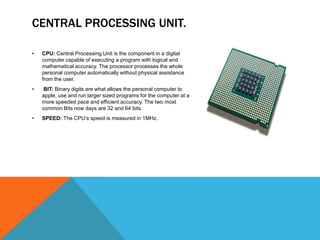
•   CPU: Central Processing Unit is the component in a digital
    computer capable of executing a program with logical and
    mathematical accuracy. The processor processes the whole
    personal computer automatically without physical assistance
    from the user.
•    BIT: Binary digits are what allows the personal computer to
    apple, use and run larger sized programs for the computer at a
    more speeded pace and efficient accuracy. The two most
    common Bits now days are 32 and 64 bits.
•   SPEED: The CPU’s speed is measured in 1MHz.
MEMORY.
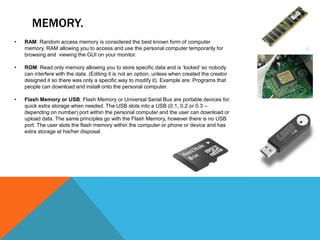
•   RAM: Random access memory is considered the best known form of computer
    memory. RAM allowing you to access and use the personal computer temporarily for
    browsing and viewing the GUI on your monitor.

•   ROM: Read only memory allowing you to store specific data and is ‘locked’ so nobody
    can interfere with the data. (Editing it is not an option, unless when created the creator
    designed it so there was only a specific way to modify it). Example are: Programs that
    people can download and install onto the personal computer.

•   Flash Memory or USB: Flash Memory or Universal Serial Bus are portable devices for
    quick extra storage when needed. The USB slots into a USB (0.1, 0.2 or 0.3 –
    depending on number) port within the personal computer and the user can download or
    upload data. The same principles go with the Flash Memory, however there is no USB
    port. The user slots the flash memory within the computer or phone or device and has
    extra storage at his/her disposal.
ADAPTER CARDS/EXPANSION CARDS.
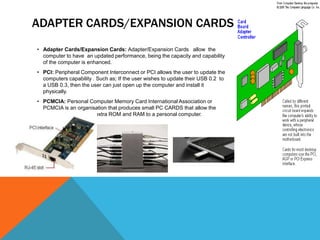
• Adapter Cards/Expansion Cards: Adapter/Expansion Cards allow the
  computer to have an updated performance, being the capacity and capability
  of the computer is enhanced.
• PCI: Peripheral Component Interconnect or PCI allows the user to update the
  computers capability . Such as; If the user wishes to update their USB 0.2 to
  a USB 0.3, then the user can just open up the computer and install it
  physically.
• PCMCIA: Personal Computer Memory Card International Association or
  PCMCIA is an organisation that produces small PC CARDS that allow the
  user to add additional/extra ROM and RAM to a personal computer.
STORAGE DEVICES?
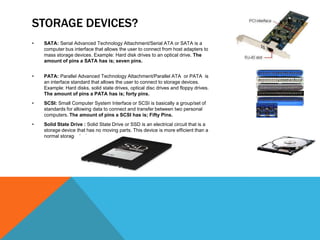
•   SATA: Serial Advanced Technology Attachment/Serial ATA or SATA is a
    computer bus interface that allows the user to connect from host adapters to
    mass storage devices. Example: Hard disk drives to an optical drive. The
    amount of pins a SATA has is; seven pins.


•   PATA: Parallel Advanced Technology Attachment/Parallel ATA or PATA is
    an interface standard that allows the user to connect to storage devices.
    Example: Hard disks, solid state drives, optical disc drives and floppy drives.
    The amount of pins a PATA has is; forty pins.
•   SCSI: Small Computer System Interface or SCSI is basically a group/set of
    standards for allowing data to connect and transfer between two personal
    computers. The amount of pins a SCSI has is; Fifty Pins.
•   Solid State Drive : Solid State Drive or SSD is an electrical circuit that is a
    storage device that has no moving parts. This device is more efficient than a
    normal storage device.
INPUT AND OUTPUT DEVICES?

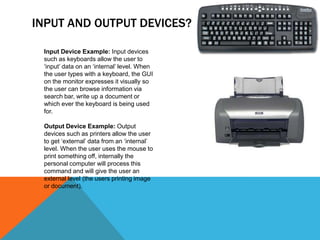
 Input Device Example: Input devices
 such as keyboards allow the user to
 ‘input’ data on an ‘internal’ level. When
 the user types with a keyboard, the GUI
 on the monitor expresses it visually so
 the user can browse information via
 search bar, write up a document or
 which ever the keyboard is being used
 for.

 Output Device Example: Output
 devices such as printers allow the user
 to get ‘external’ data from an ‘internal’
 level. When the user uses the mouse to
 print something off, internally the
 personal computer will process this
 command and will give the user an
 external level (the users printing image
 or document).
Internal components   technical - cisco - corey bush

Internal components technical - cisco - corey bush

  • 2.
    CENTRAL PROCESSING UNIT. • CPU: Central Processing Unit is the component in a digital computer capable of executing a program with logical and mathematical accuracy. The processor processes the whole personal computer automatically without physical assistance from the user. • BIT: Binary digits are what allows the personal computer to apple, use and run larger sized programs for the computer at a more speeded pace and efficient accuracy. The two most common Bits now days are 32 and 64 bits. • SPEED: The CPU’s speed is measured in 1MHz.
  • 3.
    MEMORY. • RAM: Random access memory is considered the best known form of computer memory. RAM allowing you to access and use the personal computer temporarily for browsing and viewing the GUI on your monitor. • ROM: Read only memory allowing you to store specific data and is ‘locked’ so nobody can interfere with the data. (Editing it is not an option, unless when created the creator designed it so there was only a specific way to modify it). Example are: Programs that people can download and install onto the personal computer. • Flash Memory or USB: Flash Memory or Universal Serial Bus are portable devices for quick extra storage when needed. The USB slots into a USB (0.1, 0.2 or 0.3 – depending on number) port within the personal computer and the user can download or upload data. The same principles go with the Flash Memory, however there is no USB port. The user slots the flash memory within the computer or phone or device and has extra storage at his/her disposal.
  • 4.
    ADAPTER CARDS/EXPANSION CARDS. •Adapter Cards/Expansion Cards: Adapter/Expansion Cards allow the computer to have an updated performance, being the capacity and capability of the computer is enhanced. • PCI: Peripheral Component Interconnect or PCI allows the user to update the computers capability . Such as; If the user wishes to update their USB 0.2 to a USB 0.3, then the user can just open up the computer and install it physically. • PCMCIA: Personal Computer Memory Card International Association or PCMCIA is an organisation that produces small PC CARDS that allow the user to add additional/extra ROM and RAM to a personal computer.
  • 5.
    STORAGE DEVICES? • SATA: Serial Advanced Technology Attachment/Serial ATA or SATA is a computer bus interface that allows the user to connect from host adapters to mass storage devices. Example: Hard disk drives to an optical drive. The amount of pins a SATA has is; seven pins. • PATA: Parallel Advanced Technology Attachment/Parallel ATA or PATA is an interface standard that allows the user to connect to storage devices. Example: Hard disks, solid state drives, optical disc drives and floppy drives. The amount of pins a PATA has is; forty pins. • SCSI: Small Computer System Interface or SCSI is basically a group/set of standards for allowing data to connect and transfer between two personal computers. The amount of pins a SCSI has is; Fifty Pins. • Solid State Drive : Solid State Drive or SSD is an electrical circuit that is a storage device that has no moving parts. This device is more efficient than a normal storage device.
  • 6.
    INPUT AND OUTPUTDEVICES? Input Device Example: Input devices such as keyboards allow the user to ‘input’ data on an ‘internal’ level. When the user types with a keyboard, the GUI on the monitor expresses it visually so the user can browse information via search bar, write up a document or which ever the keyboard is being used for. Output Device Example: Output devices such as printers allow the user to get ‘external’ data from an ‘internal’ level. When the user uses the mouse to print something off, internally the personal computer will process this command and will give the user an external level (the users printing image or document).