The Role of Internal Audit in the Prevention
and Detection of Fraud
CPE PIN Code: 8232
Abdelmonem Hany Gabr, CIA, CRMA, CFSA
Internal Audit Manager
Ahli United Bank, Egypt
Presented By:
Abdelmonem Hany Gabr, CIA, CRMA, CFSA, CICA
Internal Audit Manager
Ahli United Bank − Egypt
The Role of Internal Audit in the
Prevention and Detection of
Fraud
Our Objectives for Today
• Understand governance and its tools.
• Become familiar with theThree Lines
of Defense theory.
• Understand the nature of internal
audit and its related standards
regarding fraud.
• Increase the awareness of the
importance of internal audit with
regards to fraud.
• Discover new tips for internal auditors.
Agenda
• Corporate Governance
• Three Lines of Defense
• FraudTriangle
• 2014 Report to the Nations – Figures & Indicators
• A Recent Fraud Case
• InternalAudit Role in Fraud Detection and Deterrence
• InternalAudit Role in Fraud Awareness
• InternalAudit Role in Fraud RiskAssessment
• Assessing the Effectiveness of a Fraud Program
• Internal audit role in fraud investigations
• InternalAudit Standards &Tips for InternalAuditors
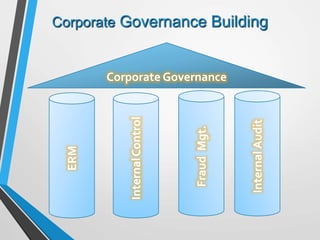
Corporate Governance Building
Corporate GovernanceERM
InternalControl
FraudMgt.
InternalAudit
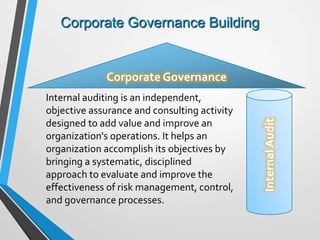
Corporate Governance Building
Corporate Governance
InternalAudit
Internal auditing is an independent,
objective assurance and consulting activity
designed to add value and improve an
organization's operations. It helps an
organization accomplish its objectives by
bringing a systematic, disciplined
approach to evaluate and improve the
effectiveness of risk management, control,
and governance processes.
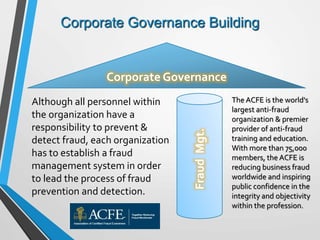
Corporate Governance Building
Corporate Governance
FraudMgt.
Although all personnel within
the organization have a
responsibility to prevent &
detect fraud, each organization
has to establish a fraud
management system in order
to lead the process of fraud
prevention and detection.
The ACFE is the world's
largest anti-fraud
organization & premier
provider of anti-fraud
training and education.
With more than 75,000
members, the ACFE is
reducing business fraud
worldwide and inspiring
public confidence in the
integrity and objectivity
within the profession.
Corporate Governance Building
Corporate Governance
InternalControl
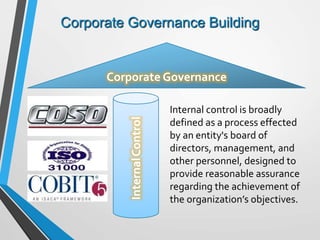
Internal control is broadly
defined as a process effected
by an entity's board of
directors, management, and
other personnel, designed to
provide reasonable assurance
regarding the achievement of
the organization’s objectives.
Corporate Governance Building
Corporate GovernanceERM
Enterprise risk management is a process
effected by an entity’s board of directors,
management, and other personnel. It is
applied in a strategy setting and across the
enterprise and designed to identify
potential events that might affect the
entity, to manage risk to be within its risk
appetite, and to provide reasonable
assurance regarding the achievement of the
entity’s objectives.
Three Lines of Defence
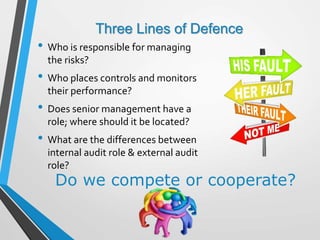
• Who is responsible for managing
the risks?
• Who places controls and monitors
their performance?
• Does senior management have a
role; where should it be located?
• What are the differences between
internal audit role & external audit
role?
Do we compete or cooperate?
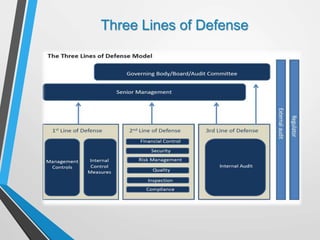
Three Lines of Defense
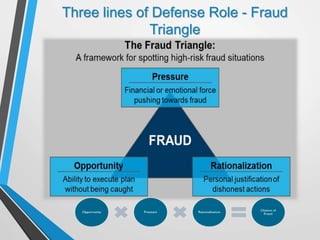
Three lines of Defense Role - Fraud
Triangle
5/7/2016
2014 Report to the Nations
Figures & Indicators
14
15
2014 Report to the Nations
Figures & Indicators
2014 Report to the Nations
Figures & Indicators
16
2014 Report to the Nations
Figures & Indicators
17
2014 Report to the Nations
Figures & Indicators
18
A Recent Fraud Case
What Are Internal Audit Roles in Fraud
Management?
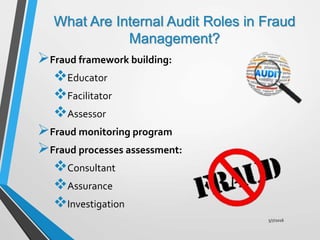
Fraud framework building:
Educator
Facilitator
Assessor
Fraud monitoring program
Fraud processes assessment:
Consultant
Assurance
Investigation
5/7/2016
Internal Audit Role in Fraud Program
Educator
• The senior management & board of directors
have the ultimate responsibility to spread the
fraud risk culture & awareness throughout the
organization.
• Internal audit may contribute to any fraud
training sessions organized by the
management.
• Internal audit should ensure that contribution
in such sessions will not impair or seem to
impair the independence & objectivity of the
internal audit function.
• Internal audit might include the review of the
fraud awareness activity in the assignments.
Internal Audit Role in Fraud Program
Facilitator
• While the responsibility of fraud management remains
with senior management, the internal audit might play a
facilitator role in the fraud workshops.
• As a facilitator, you are requested to encourage the
interaction between individuals to enhance the
generation of ideas.
• Internal audit should not make any input to the
discussions and ideas generated.
• The facilitator collecting the ideas generated and
submitted to the management.
• The internal audit should clarify that its role is to
facilitate the project and that it has no ownership of
responsibilities.
Internal Audit Role in Fraud Program
Assessor
• Once the fraud program is structured, the
internal audit may assess the
effectiveness of its design.
• Internal audit may recommend control
procedures/criteria to enhance the
program and to fill the gaps analyzed.
• Internal audit should not recommend any
specific controls or workflow for the fraud
program.
• Internal audit should not decline
management’s request to assess the
program unless the required technical
skills are not maintained by internal audit.
Fraud Risk Assessment
5/7/2016
Internal Audit Role in Fraud Risk
Assessment
• Any organization should perform a fraud risk assessment
as part of assessing the risk exposure.
• The process of assessing the fraud risk follows the same
techniques of other risk assessment models.
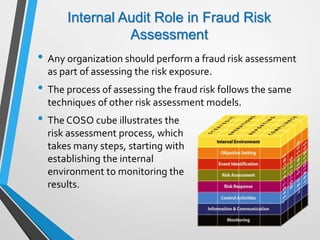
5/7/2016
• The COSO cube illustrates the
risk assessment process, which
takes many steps, starting with
establishing the internal
environment to monitoring the
results.
Internal Audit Role in Assessing
Effectiveness of the Fraud Program
• Internal audit has to include fraud risks in the scope of
each assurance assignment.
• Moreover, internal audit should schedule an assurance
assignment to examine the effectiveness of the fraud
program.
• The scope & objectives of such an assignment depends
on the maturity of the organization’s fraud program,
which varies from initialization to optimization.
• The evaluation of the fraud risk assessment should take
place to assess the design of the fraud program.
Internal Audit Role in Assessing
Effectiveness of Fraud Program
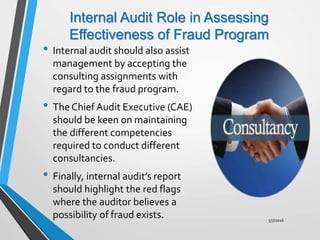
• Internal audit should also assist
management by accepting the
consulting assignments with
regard to the fraud program.
• The Chief Audit Executive (CAE)
should be keen on maintaining
the different competencies
required to conduct different
consultancies.
• Finally, internal audit’s report
should highlight the red flags
where the auditor believes a
possibility of fraud exists. 5/7/2016
Internal Audit Roles in Fraud Investigations
• The CAE has to determine the
level of involvement in an
investigation.
• The involvement level depends
on the nature of the fraud and
the availability of internal audit
professionals with related
competencies.
• The CAE should continuously
enhance the competencies and
capabilities of internal audit
individuals through training and
professional development.
5/7/2016
Internal Audit Role in Fraud Investigations
• The internal audit role in fraud
investigation should be
communicated clearly to senior
management & the board of
directors.
• The CAE has to prepare a formal
document (Internal Audit
Charter), which determines the
purpose, authority &
responsibility in general.
• The Charter should include also
the role of internal audit with
regard to the fraud investigation.
Internal Audit Standards
1210 - Proficiency
• Internal auditors must possess the knowledge,
skills, and other competencies needed to perform
their individual responsibilities.The internal audit
activity collectively must possess or obtain the
knowledge, skills, and other competencies needed
to perform its responsibilities.
1210.A2
• Internal auditors must have sufficient knowledge to evaluate the
risk of fraud and the manner in which it is managed by the
organization, but are not expected have the expertise of a person
whose primary responsibility is detecting and investigating fraud.
Internal Audit Standards
1220 – Due Professional Care
• Internal auditors must apply the care and skill expected of a
reasonably prudent and competent internal auditor. Due
professional care does not imply infallibility.
1220.A1
Internal auditors must exercise due professional care by
considering the:
• Extent of work needed to achieve the engagement’s objectives;
• Relative complexity, materiality, or significance of matters to
which assurance procedures are applied;
• Adequacy and effectiveness of governance, risk management,
and control processes;
• Probability of significant errors, fraud, or noncompliance; and
• Cost of assurance in relation to potential benefits.
Internal Audit Standards
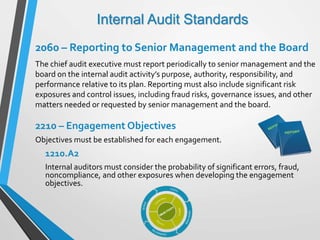
2060 – Reporting to Senior Management and the Board
The chief audit executive must report periodically to senior management and the
board on the internal audit activity’s purpose, authority, responsibility, and
performance relative to its plan. Reporting must also include significant risk
exposures and control issues, including fraud risks, governance issues, and other
matters needed or requested by senior management and the board.
2210 – Engagement Objectives
Objectives must be established for each engagement.
1210.A2
Internal auditors must consider the probability of significant errors, fraud,
noncompliance, and other exposures when developing the engagement
objectives.
Internal Audit Standards
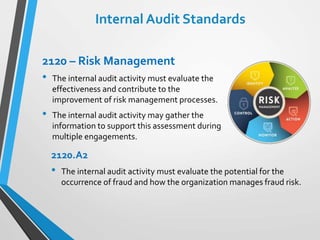
2120 – Risk Management
• The internal audit activity must evaluate the
effectiveness and contribute to the
improvement of risk management processes.
• The internal audit activity may gather the
information to support this assessment during
multiple engagements.
2120.A2
• The internal audit activity must evaluate the potential for the
occurrence of fraud and how the organization manages fraud risk.
Tips for Internal Auditors
• Do not use the word fraud unless the investigation is over and the
fraud is confirmed.
• Internal audit is not authorized to initiate a fraud investigation; this is
a management decision.
• Internal audit has no direct responsibility to detect or prevent fraud
during assignments.
• Internal audit has a responsibility to detect and highlight the fraud
indicator (raise the red flag).
Tips for Internal Auditors
• The internal audit’s objective is to add value to the organization’s
operations through assessing the governance, risk management
and internal control.
• Any suspicion of a fraud occurrence should be reported to the
internal audit’s superior, and more information should be
obtained before raising the red flag.
• The internal auditor may require the assistance of a forensic
auditor, or someone with non-audit experience, such as an
attorney.
5/7/2016
The Role of Internal Audit in the Prevention
and Detection of Fraud
CPE PIN Code: 8232
Abdelmonem Hany Gabr, CIA, CRMA, CFSA
Internal Audit Manager
Ahli United Bank, Egypt

12C_Abdelmonem Gabr_MB

  • 1.
    The Role ofInternal Audit in the Prevention and Detection of Fraud CPE PIN Code: 8232 Abdelmonem Hany Gabr, CIA, CRMA, CFSA Internal Audit Manager Ahli United Bank, Egypt
  • 2.
    Presented By: Abdelmonem HanyGabr, CIA, CRMA, CFSA, CICA Internal Audit Manager Ahli United Bank − Egypt The Role of Internal Audit in the Prevention and Detection of Fraud
  • 3.
    Our Objectives forToday • Understand governance and its tools. • Become familiar with theThree Lines of Defense theory. • Understand the nature of internal audit and its related standards regarding fraud. • Increase the awareness of the importance of internal audit with regards to fraud. • Discover new tips for internal auditors.
  • 4.
    Agenda • Corporate Governance •Three Lines of Defense • FraudTriangle • 2014 Report to the Nations – Figures & Indicators • A Recent Fraud Case • InternalAudit Role in Fraud Detection and Deterrence • InternalAudit Role in Fraud Awareness • InternalAudit Role in Fraud RiskAssessment • Assessing the Effectiveness of a Fraud Program • Internal audit role in fraud investigations • InternalAudit Standards &Tips for InternalAuditors
  • 5.
    Corporate Governance Building CorporateGovernanceERM InternalControl FraudMgt. InternalAudit
  • 6.
    Corporate Governance Building CorporateGovernance InternalAudit Internal auditing is an independent, objective assurance and consulting activity designed to add value and improve an organization's operations. It helps an organization accomplish its objectives by bringing a systematic, disciplined approach to evaluate and improve the effectiveness of risk management, control, and governance processes.
  • 7.
    Corporate Governance Building CorporateGovernance FraudMgt. Although all personnel within the organization have a responsibility to prevent & detect fraud, each organization has to establish a fraud management system in order to lead the process of fraud prevention and detection. The ACFE is the world's largest anti-fraud organization & premier provider of anti-fraud training and education. With more than 75,000 members, the ACFE is reducing business fraud worldwide and inspiring public confidence in the integrity and objectivity within the profession.
  • 8.
    Corporate Governance Building CorporateGovernance InternalControl Internal control is broadly defined as a process effected by an entity's board of directors, management, and other personnel, designed to provide reasonable assurance regarding the achievement of the organization’s objectives.
  • 9.
    Corporate Governance Building CorporateGovernanceERM Enterprise risk management is a process effected by an entity’s board of directors, management, and other personnel. It is applied in a strategy setting and across the enterprise and designed to identify potential events that might affect the entity, to manage risk to be within its risk appetite, and to provide reasonable assurance regarding the achievement of the entity’s objectives.
  • 10.
    Three Lines ofDefence • Who is responsible for managing the risks? • Who places controls and monitors their performance? • Does senior management have a role; where should it be located? • What are the differences between internal audit role & external audit role? Do we compete or cooperate?
  • 11.
  • 12.
    Three lines ofDefense Role - Fraud Triangle
  • 13.
  • 14.
    2014 Report tothe Nations Figures & Indicators 14
  • 15.
    15 2014 Report tothe Nations Figures & Indicators
  • 16.
    2014 Report tothe Nations Figures & Indicators 16
  • 17.
    2014 Report tothe Nations Figures & Indicators 17
  • 18.
    2014 Report tothe Nations Figures & Indicators 18
  • 19.
  • 20.
    What Are InternalAudit Roles in Fraud Management? Fraud framework building: Educator Facilitator Assessor Fraud monitoring program Fraud processes assessment: Consultant Assurance Investigation 5/7/2016
  • 21.
    Internal Audit Rolein Fraud Program Educator • The senior management & board of directors have the ultimate responsibility to spread the fraud risk culture & awareness throughout the organization. • Internal audit may contribute to any fraud training sessions organized by the management. • Internal audit should ensure that contribution in such sessions will not impair or seem to impair the independence & objectivity of the internal audit function. • Internal audit might include the review of the fraud awareness activity in the assignments.
  • 22.
    Internal Audit Rolein Fraud Program Facilitator • While the responsibility of fraud management remains with senior management, the internal audit might play a facilitator role in the fraud workshops. • As a facilitator, you are requested to encourage the interaction between individuals to enhance the generation of ideas. • Internal audit should not make any input to the discussions and ideas generated. • The facilitator collecting the ideas generated and submitted to the management. • The internal audit should clarify that its role is to facilitate the project and that it has no ownership of responsibilities.
  • 23.
    Internal Audit Rolein Fraud Program Assessor • Once the fraud program is structured, the internal audit may assess the effectiveness of its design. • Internal audit may recommend control procedures/criteria to enhance the program and to fill the gaps analyzed. • Internal audit should not recommend any specific controls or workflow for the fraud program. • Internal audit should not decline management’s request to assess the program unless the required technical skills are not maintained by internal audit.
  • 24.
  • 25.
    Internal Audit Rolein Fraud Risk Assessment • Any organization should perform a fraud risk assessment as part of assessing the risk exposure. • The process of assessing the fraud risk follows the same techniques of other risk assessment models. 5/7/2016 • The COSO cube illustrates the risk assessment process, which takes many steps, starting with establishing the internal environment to monitoring the results.
  • 26.
    Internal Audit Rolein Assessing Effectiveness of the Fraud Program • Internal audit has to include fraud risks in the scope of each assurance assignment. • Moreover, internal audit should schedule an assurance assignment to examine the effectiveness of the fraud program. • The scope & objectives of such an assignment depends on the maturity of the organization’s fraud program, which varies from initialization to optimization. • The evaluation of the fraud risk assessment should take place to assess the design of the fraud program.
  • 27.
    Internal Audit Rolein Assessing Effectiveness of Fraud Program • Internal audit should also assist management by accepting the consulting assignments with regard to the fraud program. • The Chief Audit Executive (CAE) should be keen on maintaining the different competencies required to conduct different consultancies. • Finally, internal audit’s report should highlight the red flags where the auditor believes a possibility of fraud exists. 5/7/2016
  • 28.
    Internal Audit Rolesin Fraud Investigations • The CAE has to determine the level of involvement in an investigation. • The involvement level depends on the nature of the fraud and the availability of internal audit professionals with related competencies. • The CAE should continuously enhance the competencies and capabilities of internal audit individuals through training and professional development. 5/7/2016
  • 29.
    Internal Audit Rolein Fraud Investigations • The internal audit role in fraud investigation should be communicated clearly to senior management & the board of directors. • The CAE has to prepare a formal document (Internal Audit Charter), which determines the purpose, authority & responsibility in general. • The Charter should include also the role of internal audit with regard to the fraud investigation.

  • 30.
    Internal Audit Standards 1210- Proficiency • Internal auditors must possess the knowledge, skills, and other competencies needed to perform their individual responsibilities.The internal audit activity collectively must possess or obtain the knowledge, skills, and other competencies needed to perform its responsibilities. 1210.A2 • Internal auditors must have sufficient knowledge to evaluate the risk of fraud and the manner in which it is managed by the organization, but are not expected have the expertise of a person whose primary responsibility is detecting and investigating fraud.
  • 31.
    Internal Audit Standards 1220– Due Professional Care • Internal auditors must apply the care and skill expected of a reasonably prudent and competent internal auditor. Due professional care does not imply infallibility. 1220.A1 Internal auditors must exercise due professional care by considering the: • Extent of work needed to achieve the engagement’s objectives; • Relative complexity, materiality, or significance of matters to which assurance procedures are applied; • Adequacy and effectiveness of governance, risk management, and control processes; • Probability of significant errors, fraud, or noncompliance; and • Cost of assurance in relation to potential benefits.
  • 32.
    Internal Audit Standards 2060– Reporting to Senior Management and the Board The chief audit executive must report periodically to senior management and the board on the internal audit activity’s purpose, authority, responsibility, and performance relative to its plan. Reporting must also include significant risk exposures and control issues, including fraud risks, governance issues, and other matters needed or requested by senior management and the board. 2210 – Engagement Objectives Objectives must be established for each engagement. 1210.A2 Internal auditors must consider the probability of significant errors, fraud, noncompliance, and other exposures when developing the engagement objectives.
  • 33.
    Internal Audit Standards 2120– Risk Management • The internal audit activity must evaluate the effectiveness and contribute to the improvement of risk management processes. • The internal audit activity may gather the information to support this assessment during multiple engagements. 2120.A2 • The internal audit activity must evaluate the potential for the occurrence of fraud and how the organization manages fraud risk.
  • 34.
    Tips for InternalAuditors • Do not use the word fraud unless the investigation is over and the fraud is confirmed. • Internal audit is not authorized to initiate a fraud investigation; this is a management decision. • Internal audit has no direct responsibility to detect or prevent fraud during assignments. • Internal audit has a responsibility to detect and highlight the fraud indicator (raise the red flag).
  • 35.
    Tips for InternalAuditors • The internal audit’s objective is to add value to the organization’s operations through assessing the governance, risk management and internal control. • Any suspicion of a fraud occurrence should be reported to the internal audit’s superior, and more information should be obtained before raising the red flag. • The internal auditor may require the assistance of a forensic auditor, or someone with non-audit experience, such as an attorney.
  • 36.
  • 37.
    The Role ofInternal Audit in the Prevention and Detection of Fraud CPE PIN Code: 8232 Abdelmonem Hany Gabr, CIA, CRMA, CFSA Internal Audit Manager Ahli United Bank, Egypt

Editor's Notes

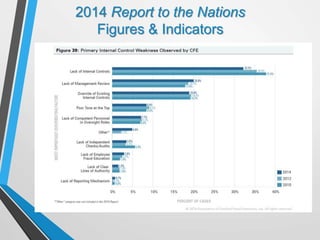
  • #15 We asked survey respondents what they thought were the primary internal control weaknesses that contributed to the frauds they had investigated. As noted in Figure 39, in nearly one-third of the cases, the victim organization lacked the appropriate internal controls to prevent the fraud, which reinforces the importance of targeted anti-fraud controls. A lack of controls played an even bigger role in those cases affecting small businesses; this was attributed as the primary weakness at more than 41% of cases at organizations with fewer than 100 employees. Additionally, according to the CFEs who participated in our study, one-fifth of the reported cases could have been prevented if managers had done a sufficient job of reviewing transactions, accounts or processes.
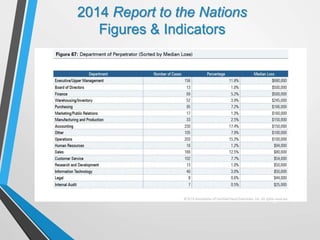
  • #16 Sorting departments based on median loss shows that the largest frauds are committed by executives and upper management (see Figure 67). This is not surprising because this group tends to have the highest authority within an organization. Among the seven departments that each accounted for at least 5% of cases, the finance department caused the second-highest median loss, followed by purchasing, accounting, operations, sales and customer service.
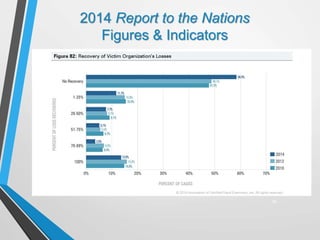
  • #17 Although the process of recovering the losses from a fraud can go on for years after a fraud examination is complete, we asked respondents to provide the percentage of the loss that the victim organization had recovered at the time of the survey. “No recovery” has been the most common response in past surveys, and this year we saw a substantial increase in this number. In 58% of cases reported in 2014, the victim organizations have seen no losses recovered, compared to 49% in 2012. At the time of our survey, only 14% of victim organizations had made a full recovery.
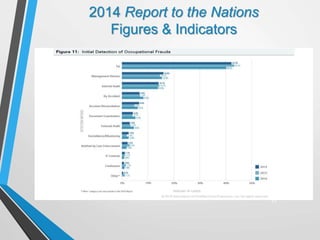
  • #18 As Figure 11 demonstrates, tips are consistently the most common detection method for cases of occupational fraud by a significant margin, which has been an observed trend since we first began tracking this data in 2002. Management review and internal audit follow tips, which was also true for the 2010 and 2012 Reports.
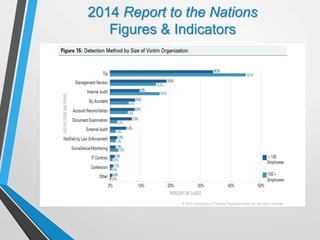
  • #19 Large and small organizations often allocate resources differently for anti-fraud measures (see Figure 27), and the distribution of detection methods at these two types of organizations also varies. Small organizations (those with fewer than 100 employees) differed most from large organizations in the percentage of cases detected by tip (34.2% and 45.1%, respectively) and internal audit (9.8% and 16.5%); these findings are not surprising, given that small organizations are much less likely to have hotlines or internal audit departments (see Figure 27).