Syntax Directed Definitions-IntermediateCode
Generation-Representation and Implementation -
Types And Declarations –Type Checking –Control
Flow Statements-Back Patching –Procedures.
3.
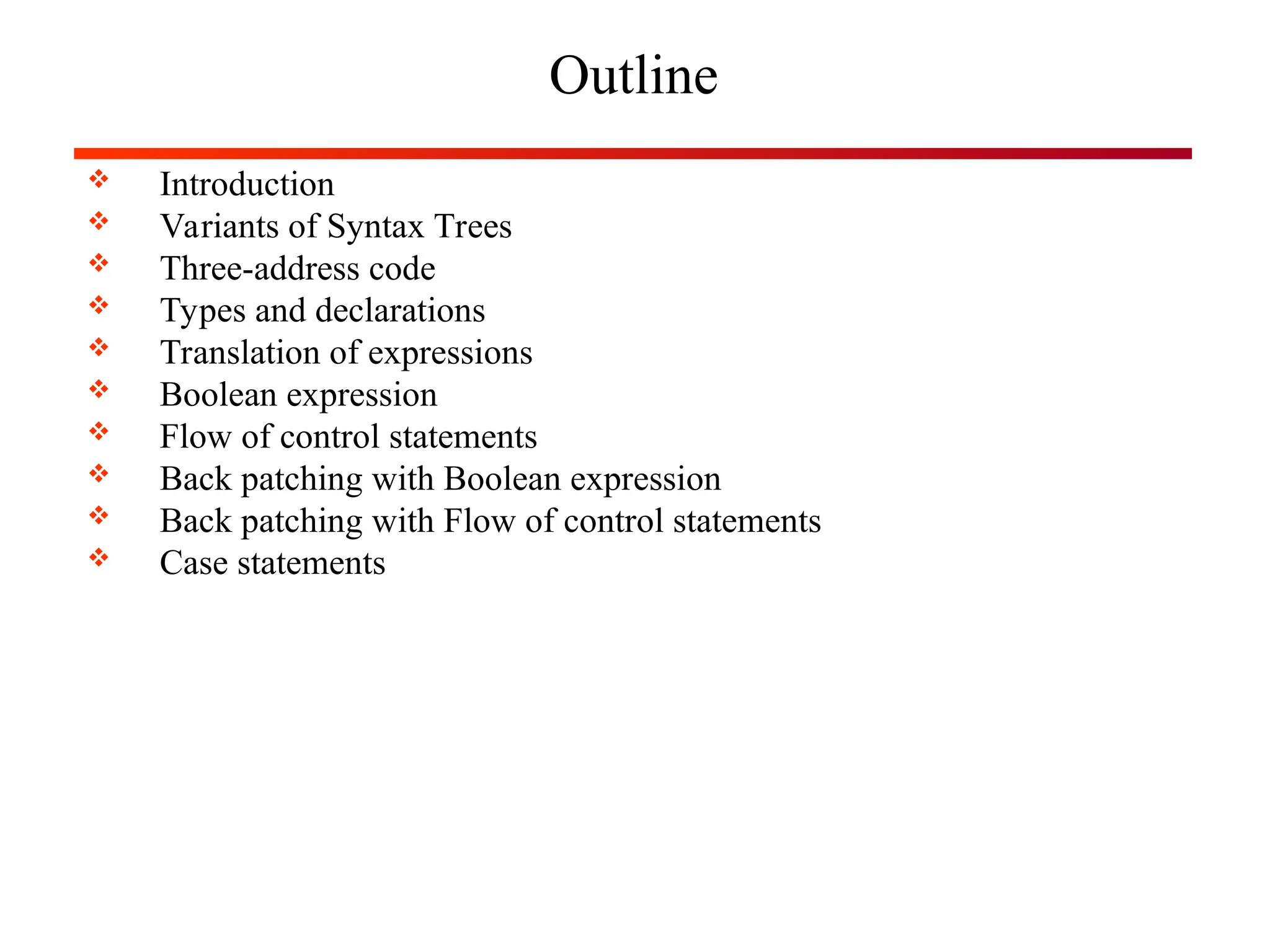
Outline
Introduction
Variantsof Syntax Trees
Three-address code
Types and declarations
Translation of expressions
Boolean expression
Flow of control statements
Back patching with Boolean expression
Back patching with Flow of control statements
Case statements
4.
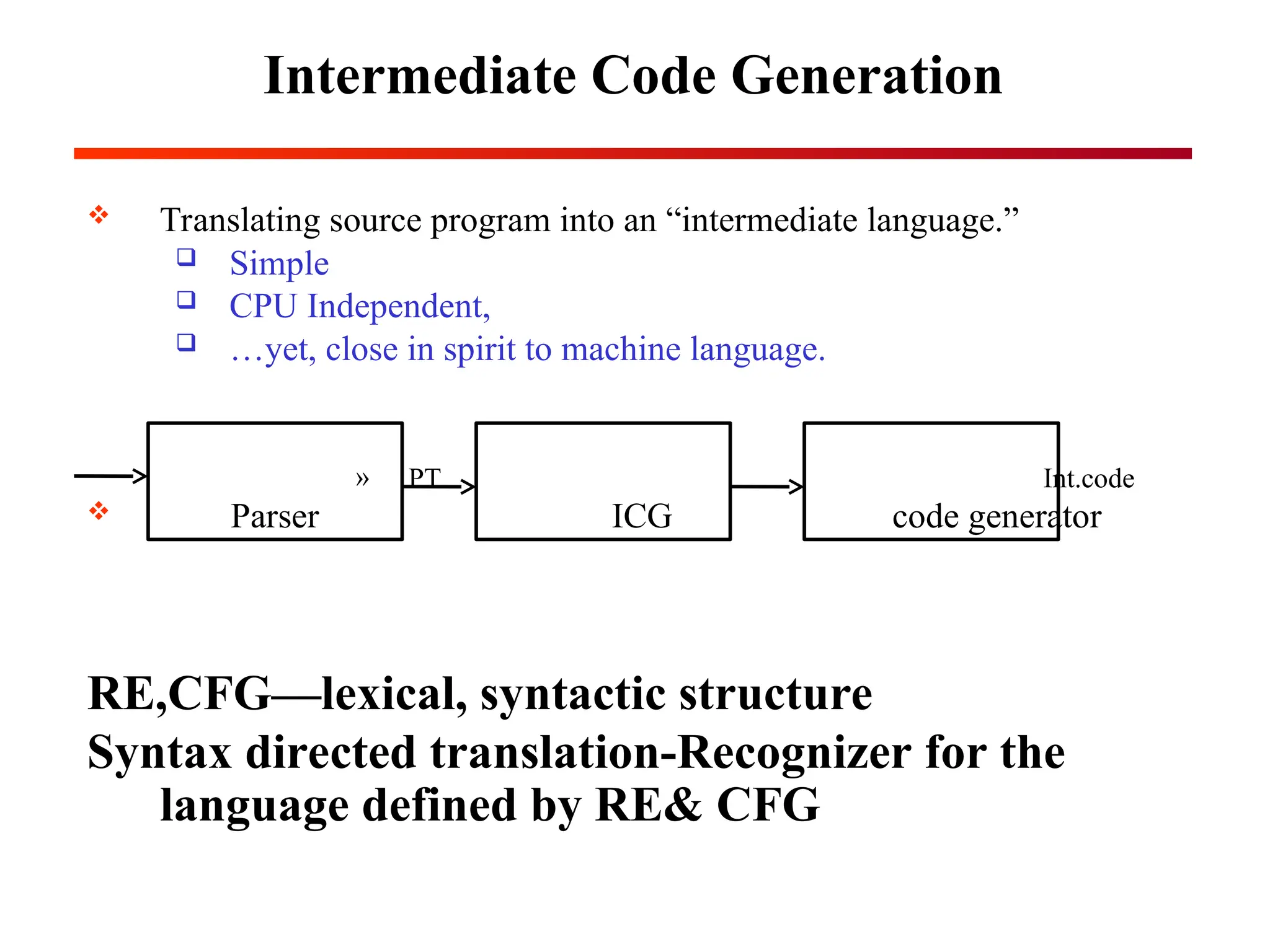
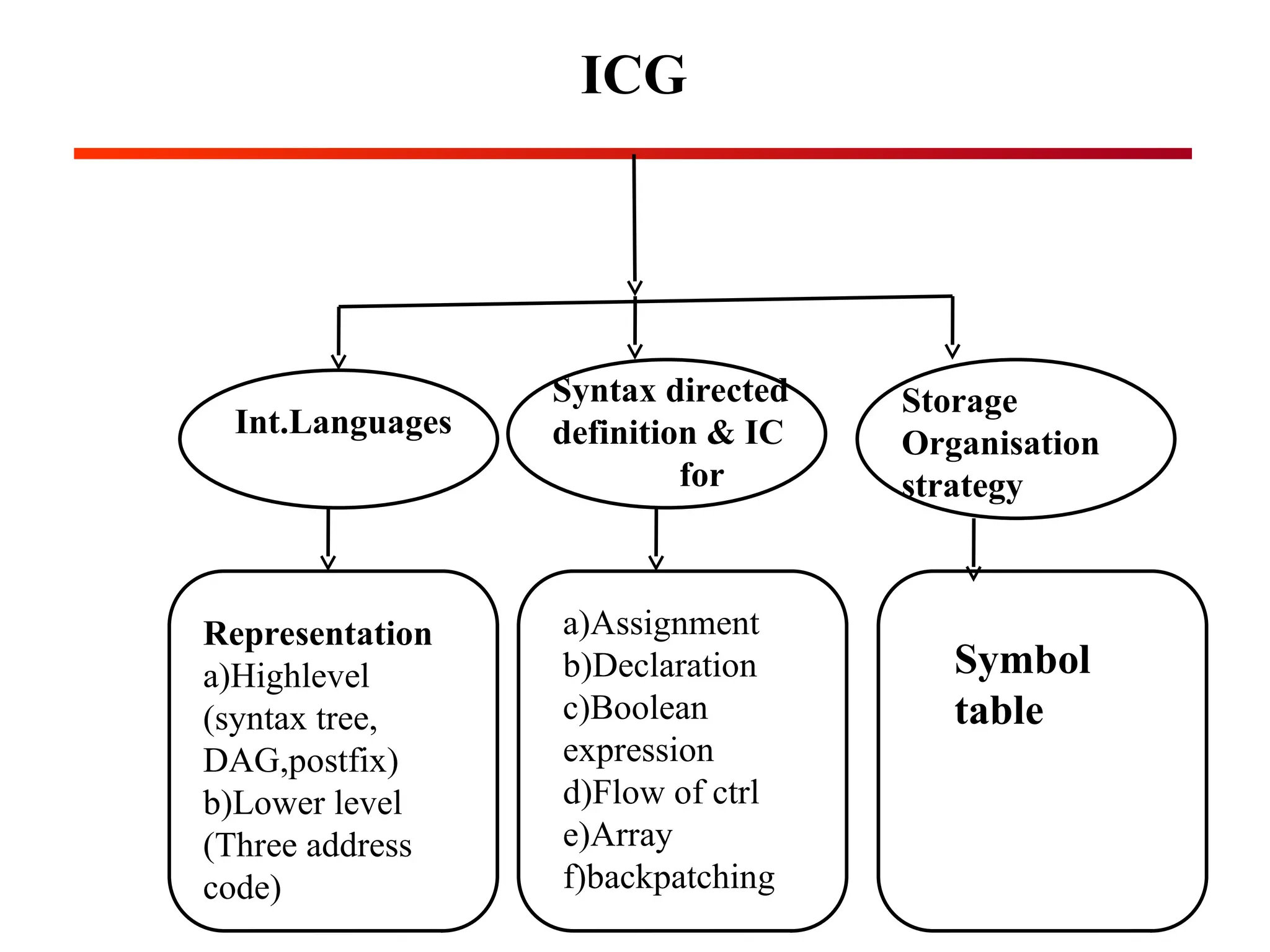
Intermediate Code Generation
Translating source program into an “intermediate language.”
Simple
CPU Independent,
…yet, close in spirit to machine language.
» PT Int.code
Parser ICG code generator
RE,CFG—lexical, syntactic structure
Syntax directed translation-Recognizer for the
language defined by RE& CFG
5.
ICG
Benefits
1. Retargeting isfacilitated
2. Machine independent Code Optimization can be
applied.
3. Int.code closer to Target program
4. Coversion from Source program to Intermediate
code generation and further phase construction will
be easy
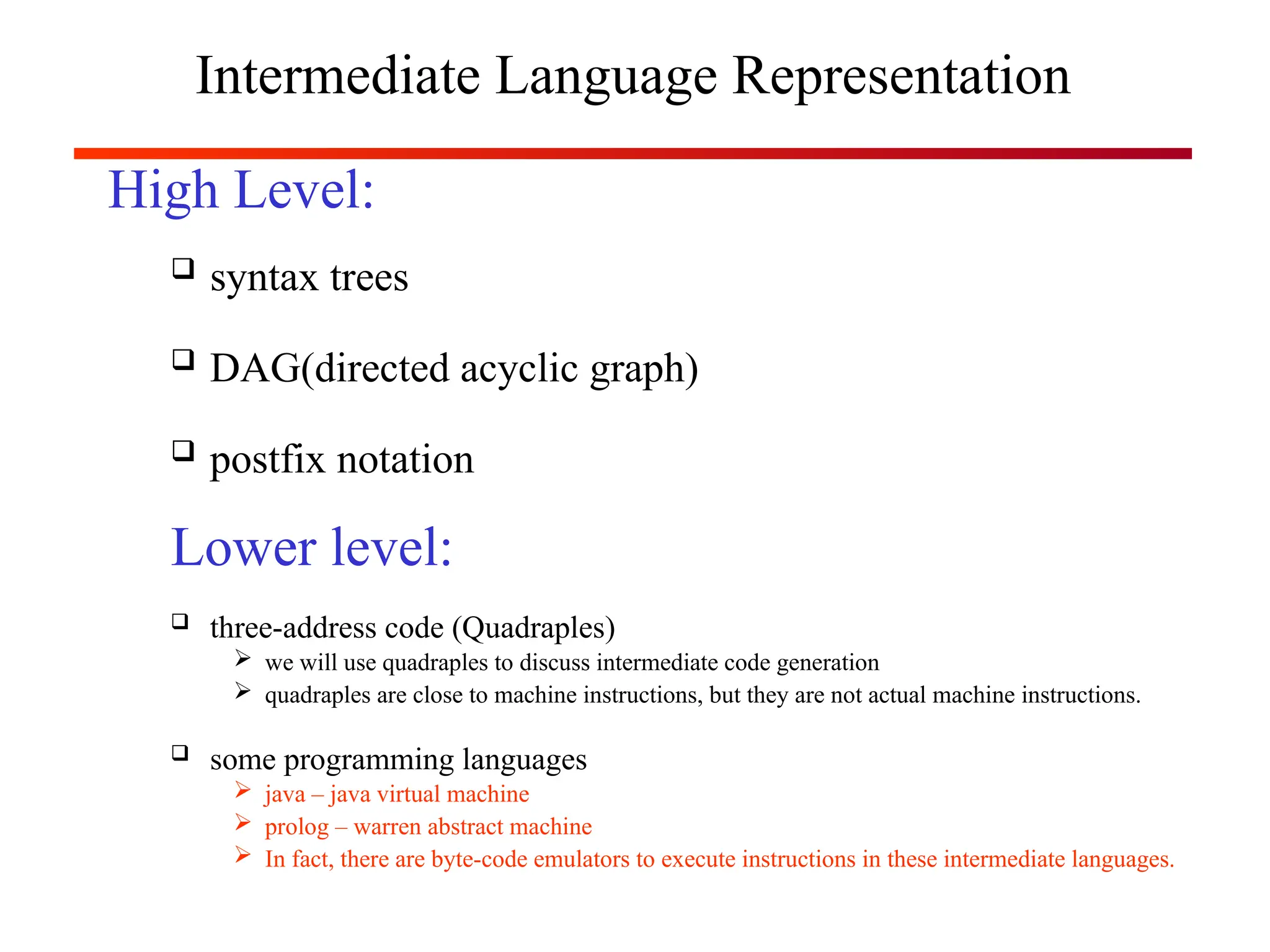
Intermediate Language Representation
HighLevel:
syntax trees
DAG(directed acyclic graph)
postfix notation
Lower level:
three-address code (Quadraples)
we will use quadraples to discuss intermediate code generation
quadraples are close to machine instructions, but they are not actual machine instructions.
some programming languages
java – java virtual machine
prolog – warren abstract machine
In fact, there are byte-code emulators to execute instructions in these intermediate languages.
8.
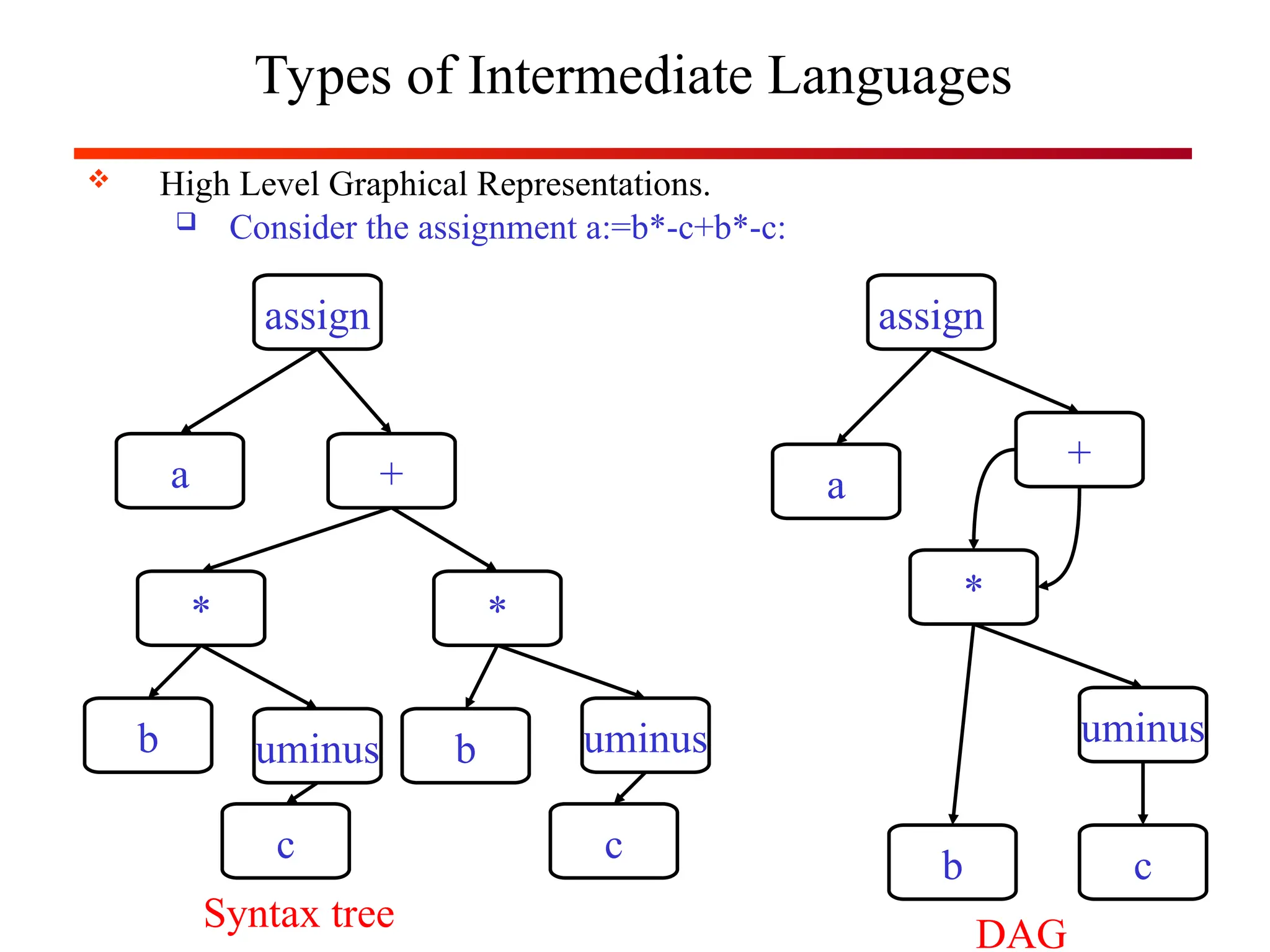
Types of IntermediateLanguages
High Level Graphical Representations.
Consider the assignment a:=b*-c+b*-c:
assign
a +
* *
uminus uminus
b
c c
b
assign
a
+
*
uminus
b c
Syntax tree DAG
9.
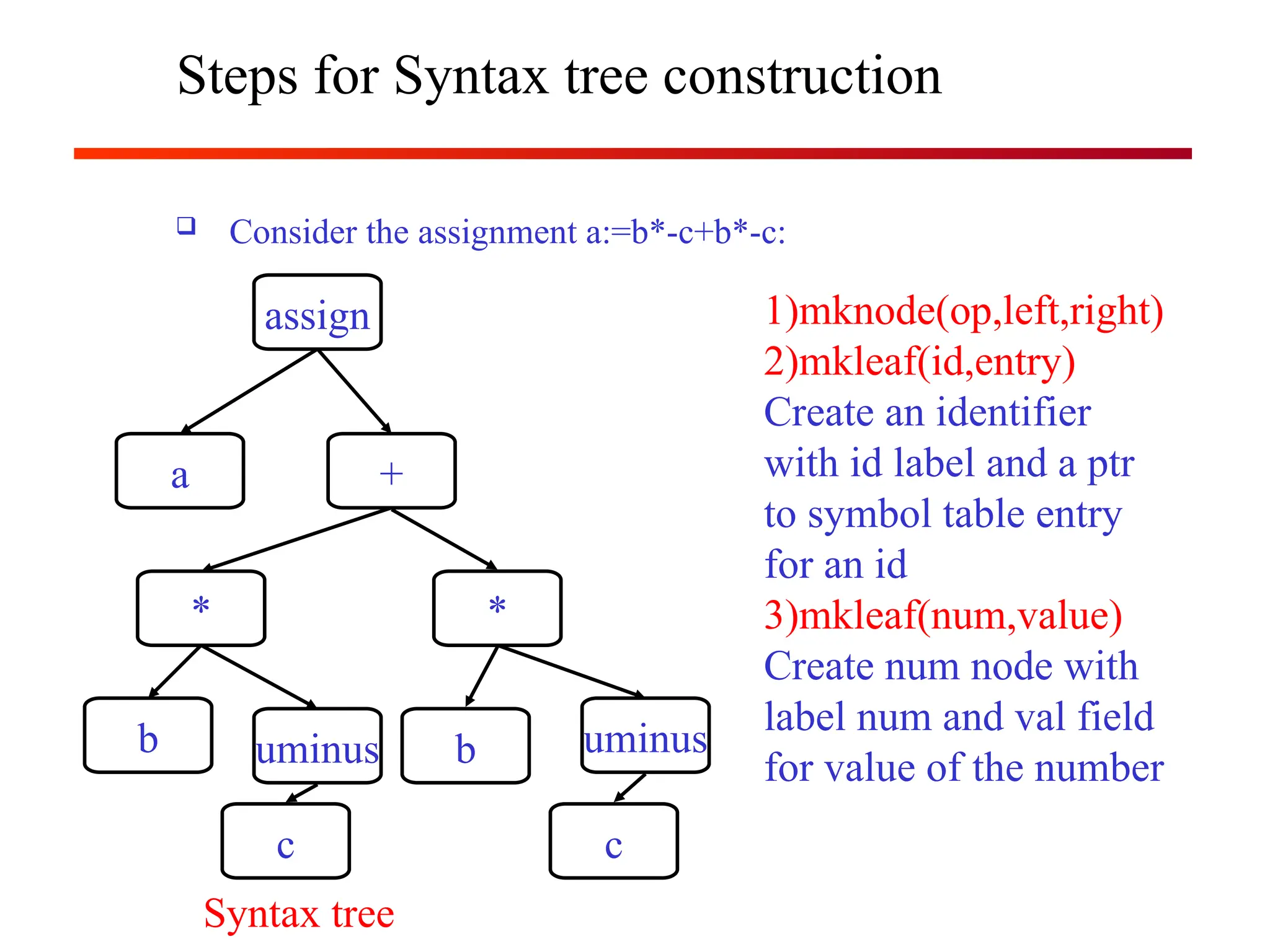
Steps for Syntaxtree construction
Consider the assignment a:=b*-c+b*-c:
assign
a +
* *
uminus uminus
b
c c
b
Syntax tree
1)mknode(op,left,right)
2)mkleaf(id,entry)
Create an identifier
with id label and a ptr
to symbol table entry
for an id
3)mkleaf(num,value)
Create num node with
label num and val field
for value of the number
10.
Steps for Syntaxtree construction
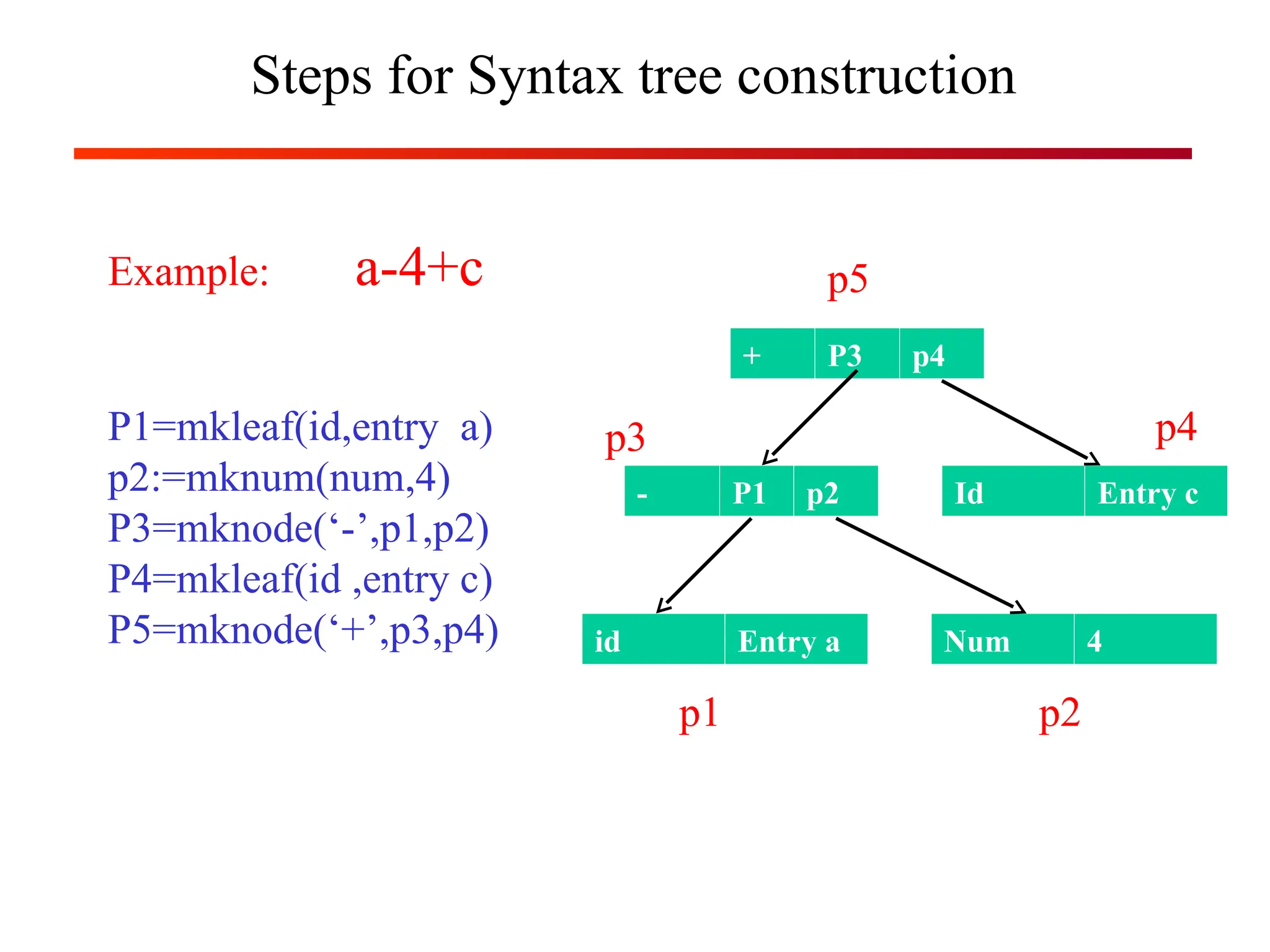
Example: a-4+c
P1=mkleaf(id,entry a)
p2:=mknum(num,4)
P3=mknode(‘-’,p1,p2)
P4=mkleaf(id ,entry c)
P5=mknode(‘+’,p3,p4)
+ P3 p4
- P1 p2 Id Entry c
Num 4
id Entry a
p1 p2
p3 p4
p5
11.
Steps for DAGconstruction
assign
a
+
*
uminus
b c
DAG
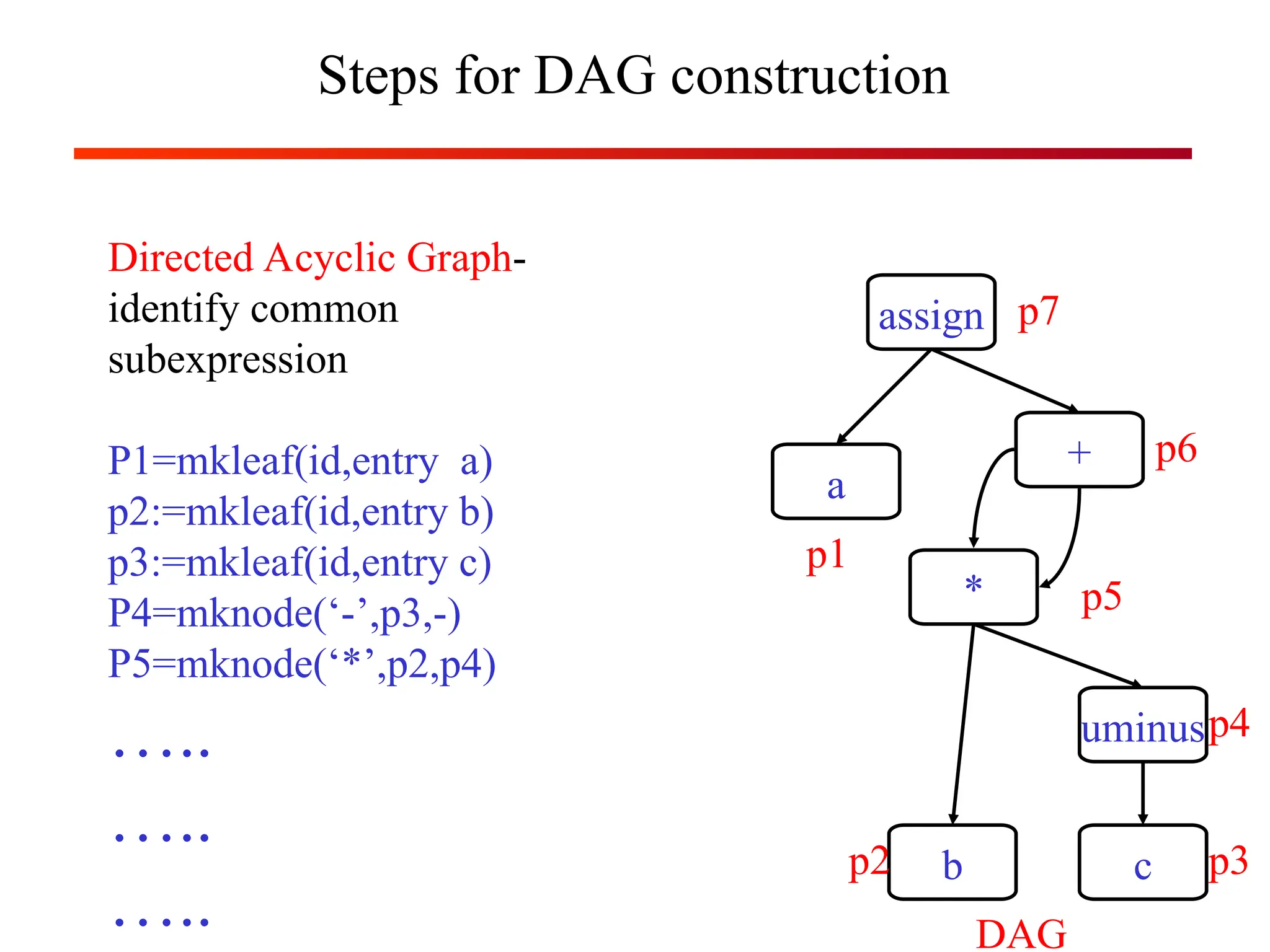
Directed Acyclic Graph-
identify common
subexpression
P1=mkleaf(id,entry a)
p2:=mkleaf(id,entry b)
p3:=mkleaf(id,entry c)
P4=mknode(‘-’,p3,-)
P5=mknode(‘*’,p2,p4)
…..
…..
…..
p1
p2 p3
p4
p5
p6
p7
12.
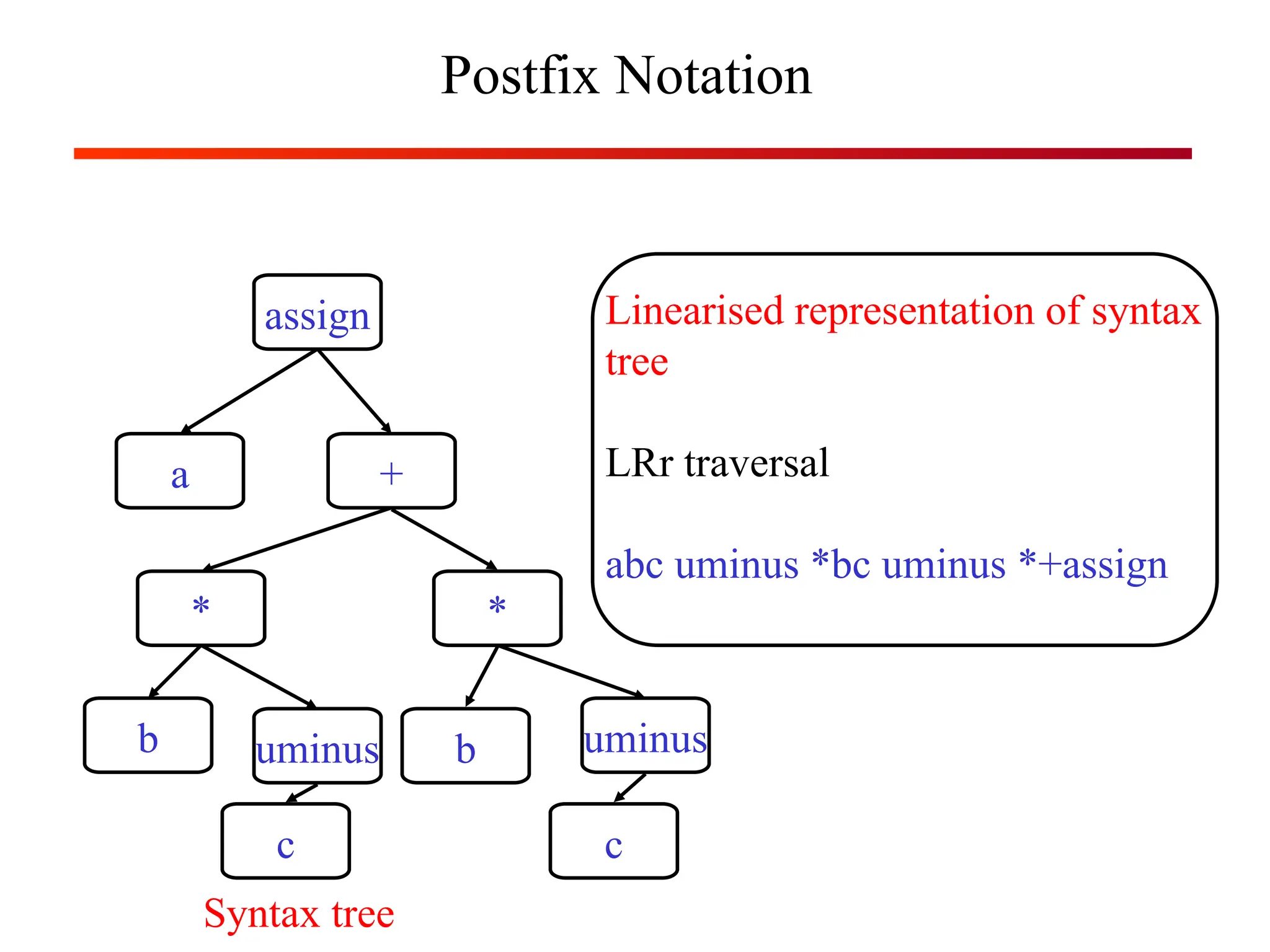
Postfix Notation
assign
a +
**
uminus uminus
b
c c
b
Syntax tree
Linearised representation of syntax
tree
LRr traversal
abc uminus *bc uminus *+assign
13.
Three address code-lowerlevel representation
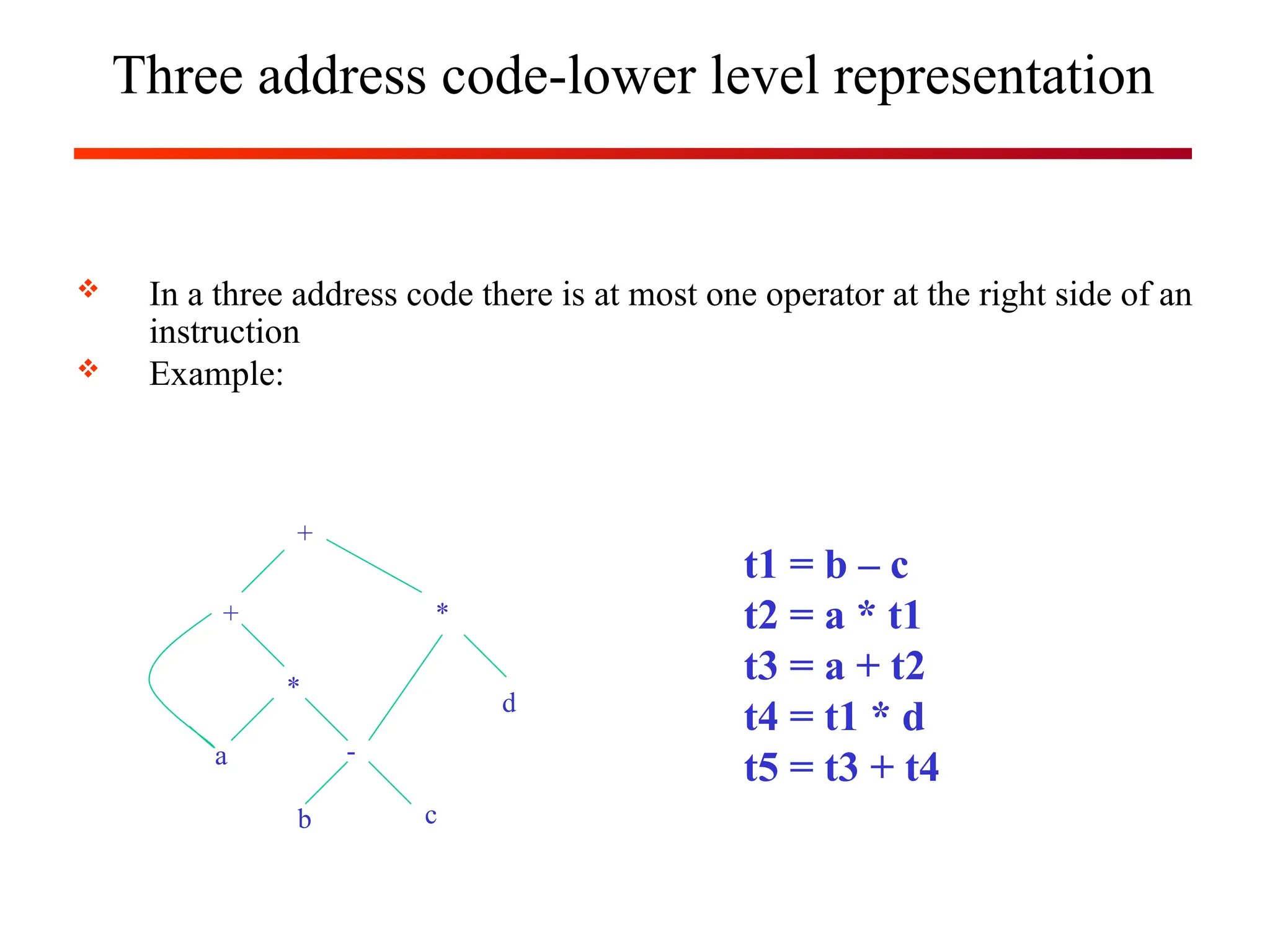
In a three address code there is at most one operator at the right side of an
instruction
Example:
+
+ *
*
-
b c
a
d
t1 = b – c
t2 = a * t1
t3 = a + t2
t4 = t1 * d
t5 = t3 + t4
14.
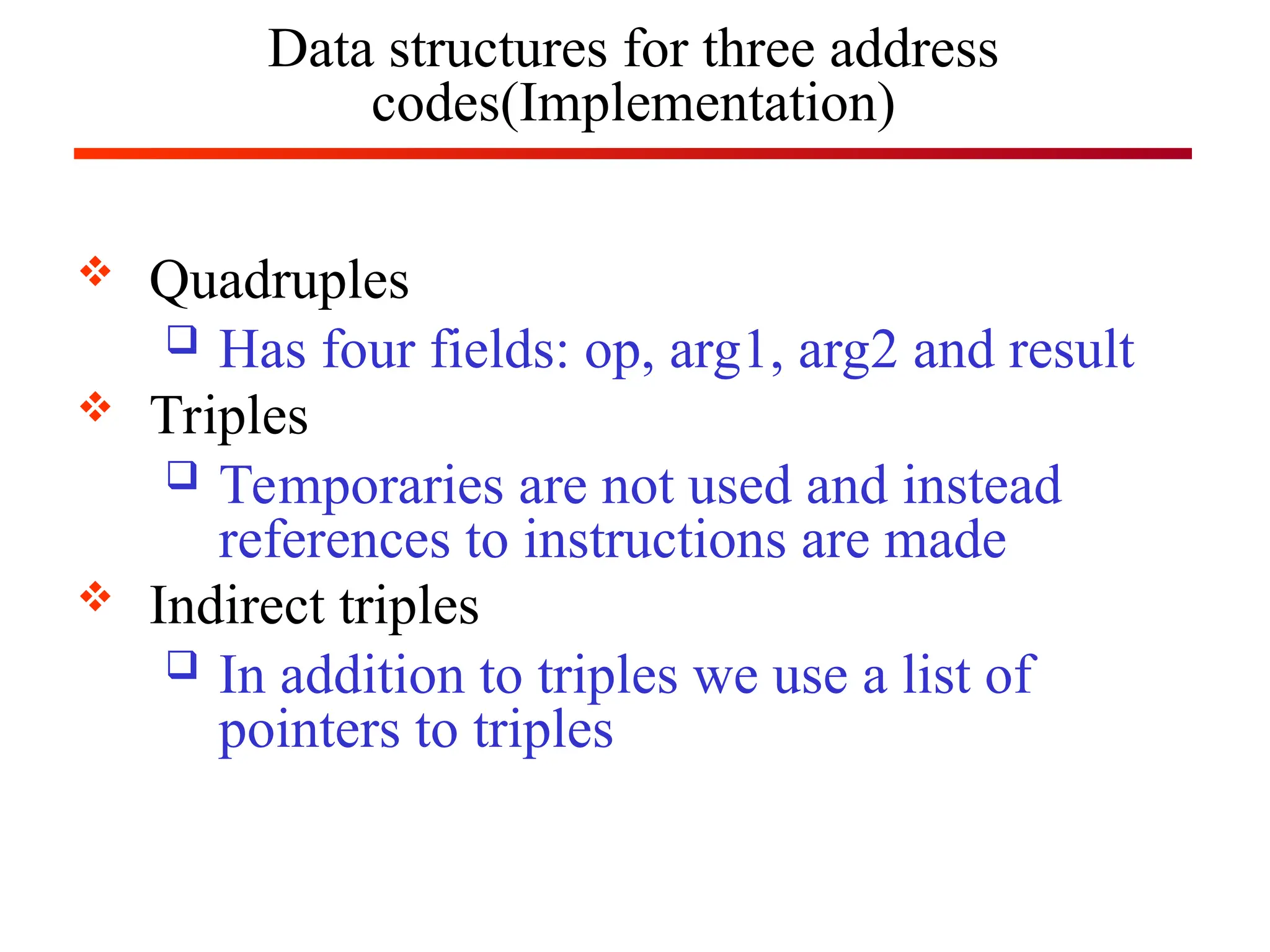
Data structures forthree address
codes(Implementation)
Quadruples
Has four fields: op, arg1, arg2 and result
Triples
Temporaries are not used and instead
references to instructions are made
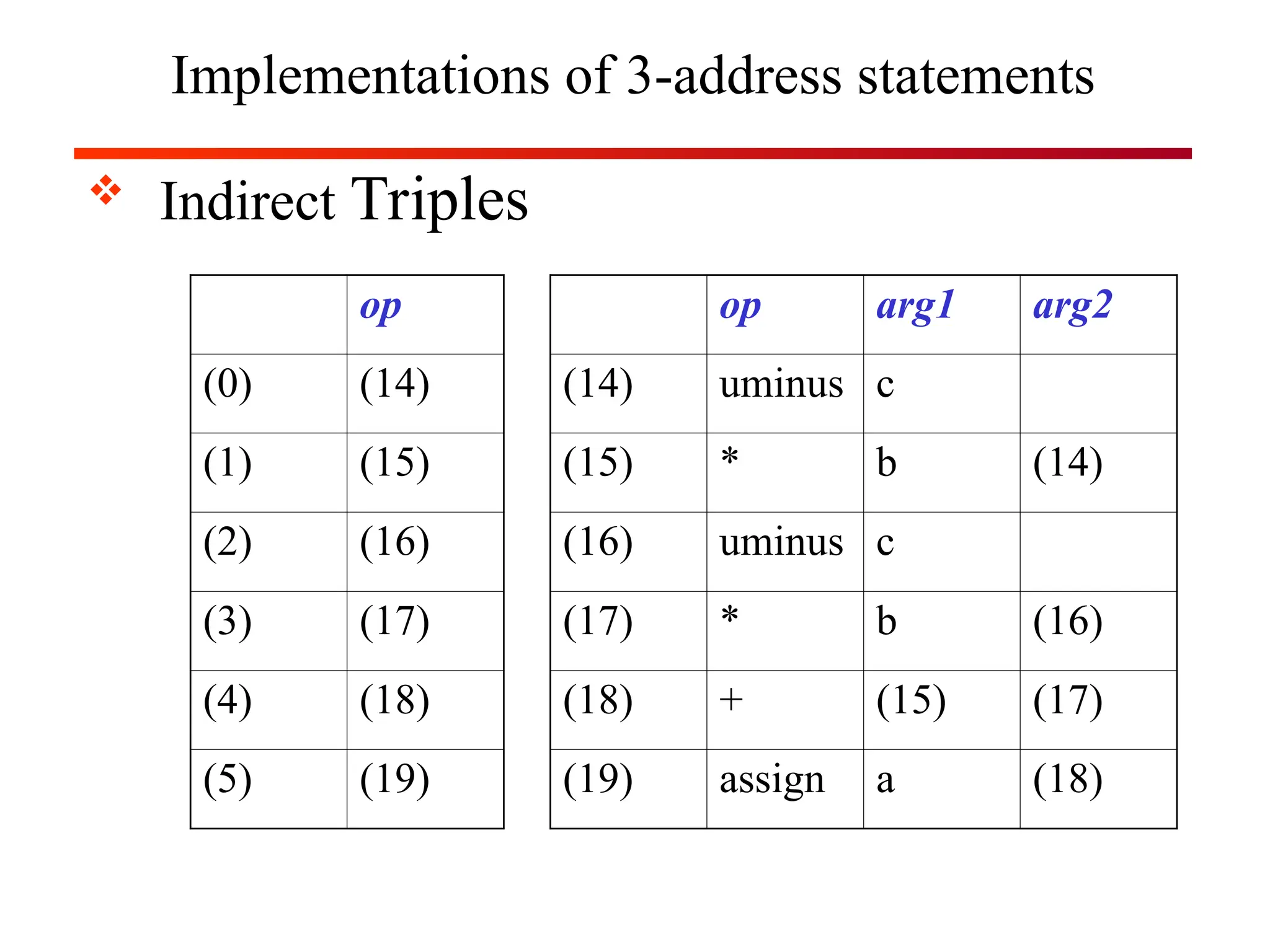
Indirect triples
In addition to triples we use a list of
pointers to triples
15.
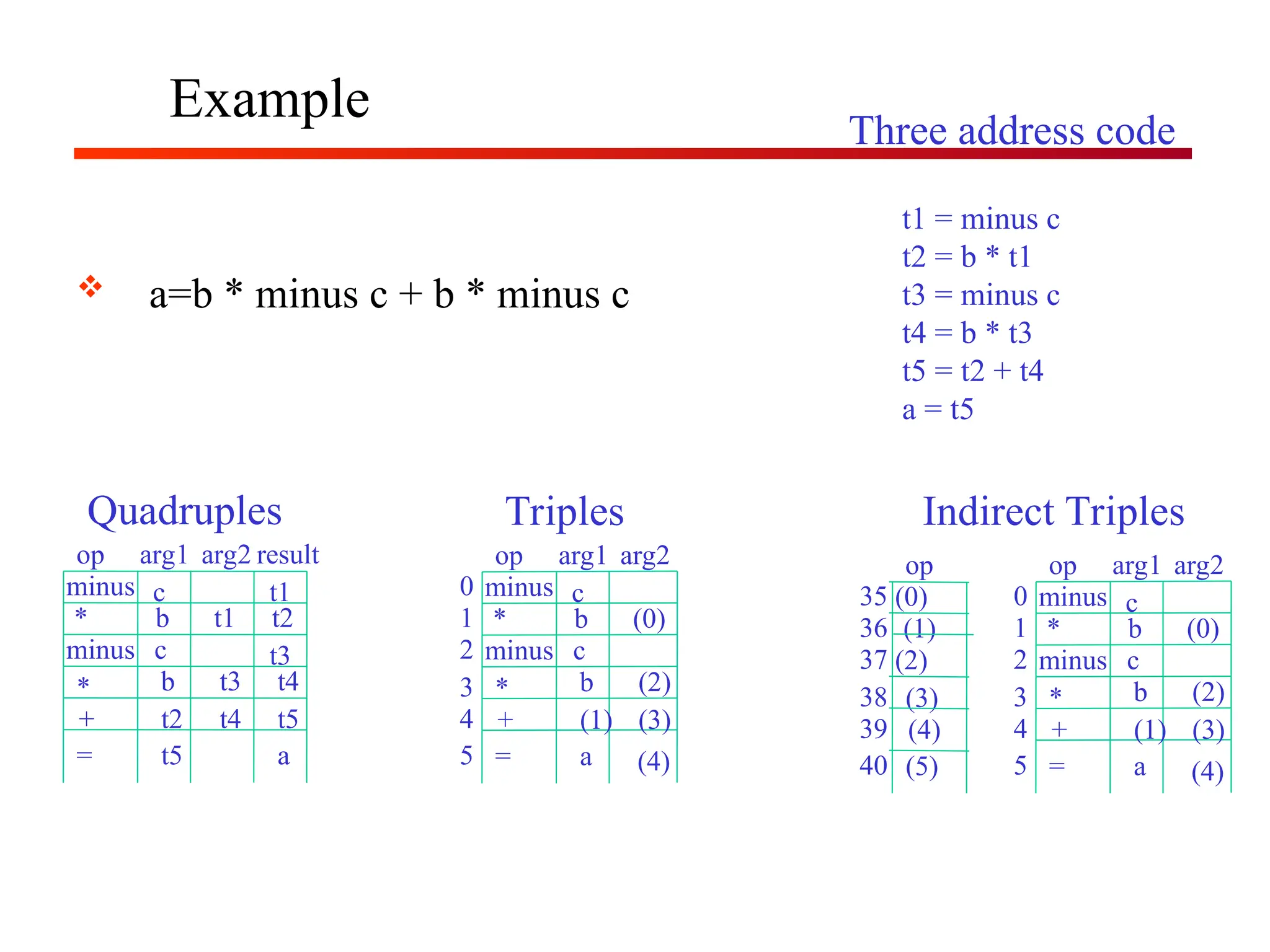
Example
a=b *minus c + b * minus c
t1 = minus c
t2 = b * t1
t3 = minus c
t4 = b * t3
t5 = t2 + t4
a = t5
Three address code
minus
*
minus c t3
*
+
=
c t1
b t2
t1
b t4
t3
t2 t5
t4
t5 a
arg1 result
arg2
op
Quadruples
minus
*
minus c
*
+
=
c
b (0)
b (2)
(1) (3)
a
arg1 arg2
op
Triples
(4)
0
1
2
3
4
5
minus
*
minus c
*
+
=
c
b (0)
b (2)
(1) (3)
a
arg1 arg2
op
Indirect Triples
(4)
0
1
2
3
4
5
(0)
(1)
(2)
(3)
(4)
(5)
op
35
36
37
38
39
40
16.
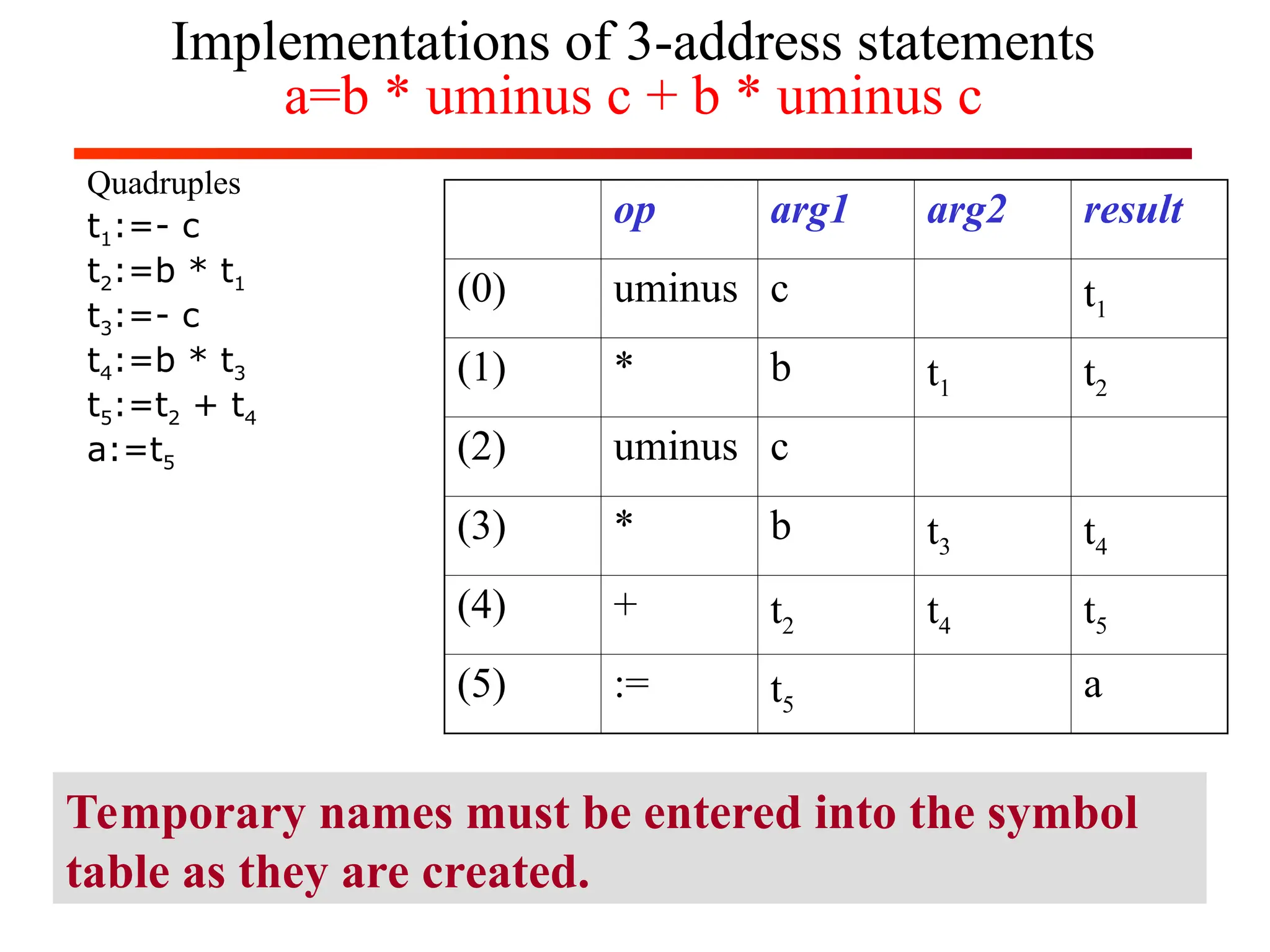
Implementations of 3-addressstatements
a=b * uminus c + b * uminus c
Quadruples
t1:=- c
t2:=b * t1
t3:=- c
t4:=b * t3
t5:=t2 + t4
a:=t5
op arg1 arg2 result
(0) uminus c t1
(1) * b t1 t2
(2) uminus c
(3) * b t3 t4
(4) + t2 t4 t5
(5) := t5
a
Temporary names must be entered into the symbol
table as they are created.
17.
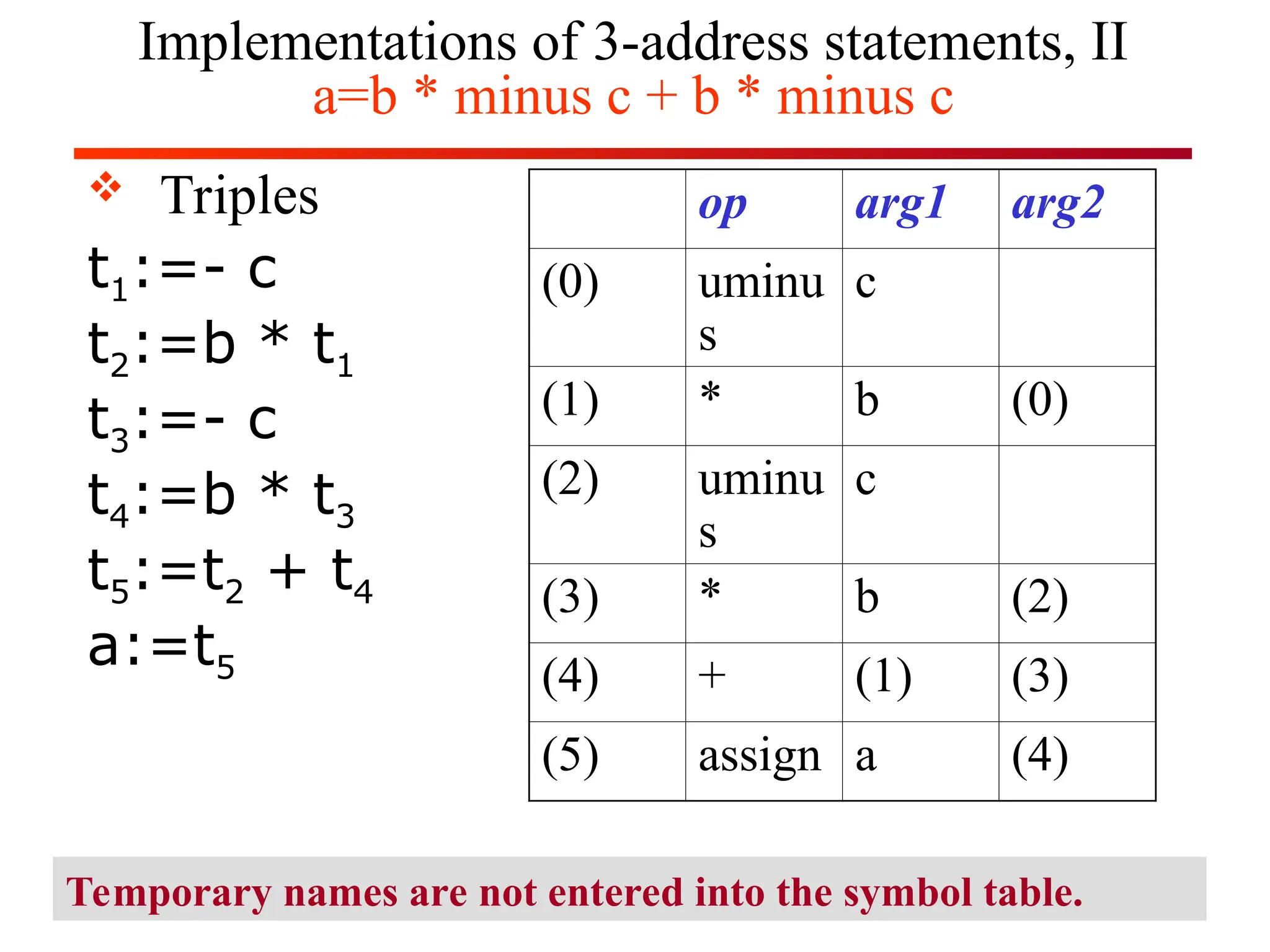
Implementations of 3-addressstatements, II
a=b * minus c + b * minus c
Triples
t1:=- c
t2:=b * t1
t3:=- c
t4:=b * t3
t5:=t2 + t4
a:=t5
op arg1 arg2
(0) uminu
s
c
(1) * b (0)
(2) uminu
s
c
(3) * b (2)
(4) + (1) (3)
(5) assign a (4)
Temporary names are not entered into the symbol table.
18.
Implementations of 3-addressstatements
Indirect Triples
op arg1 arg2
(14) uminus c
(15) * b (14)
(16) uminus c
(17) * b (16)
(18) + (15) (17)
(19) assign a (18)
op
(0) (14)
(1) (15)
(2) (16)
(3) (17)
(4) (18)
(5) (19)
19.
Other types of3-address statements
e.g. ternary operations like
x[i]:=y x:=y[i]
require two or more entries. e.g.
op arg1 arg2
(0) [ ] = x i
(1) assign (0) y
op arg1 arg2
(0) [ ] = y i
(1) assign x (0)
20.
Types of Three-AddressStatements.
Assignment Statement: x:=y op z
Assignment instruction: x:=op z
Copy Statement: x:=z
Unconditional Jump: goto L
Conditional Jump: if x relop y goto L
Stack Operations: Push/pop
More Advanced:
Procedure:
param x1
param x2
…
param xn
call p,n
Index Assignments:
x:=y[i]
x[i]:=y
Address and Pointer Assignments:
x:=&y
x:=*y
*x:=y
21.
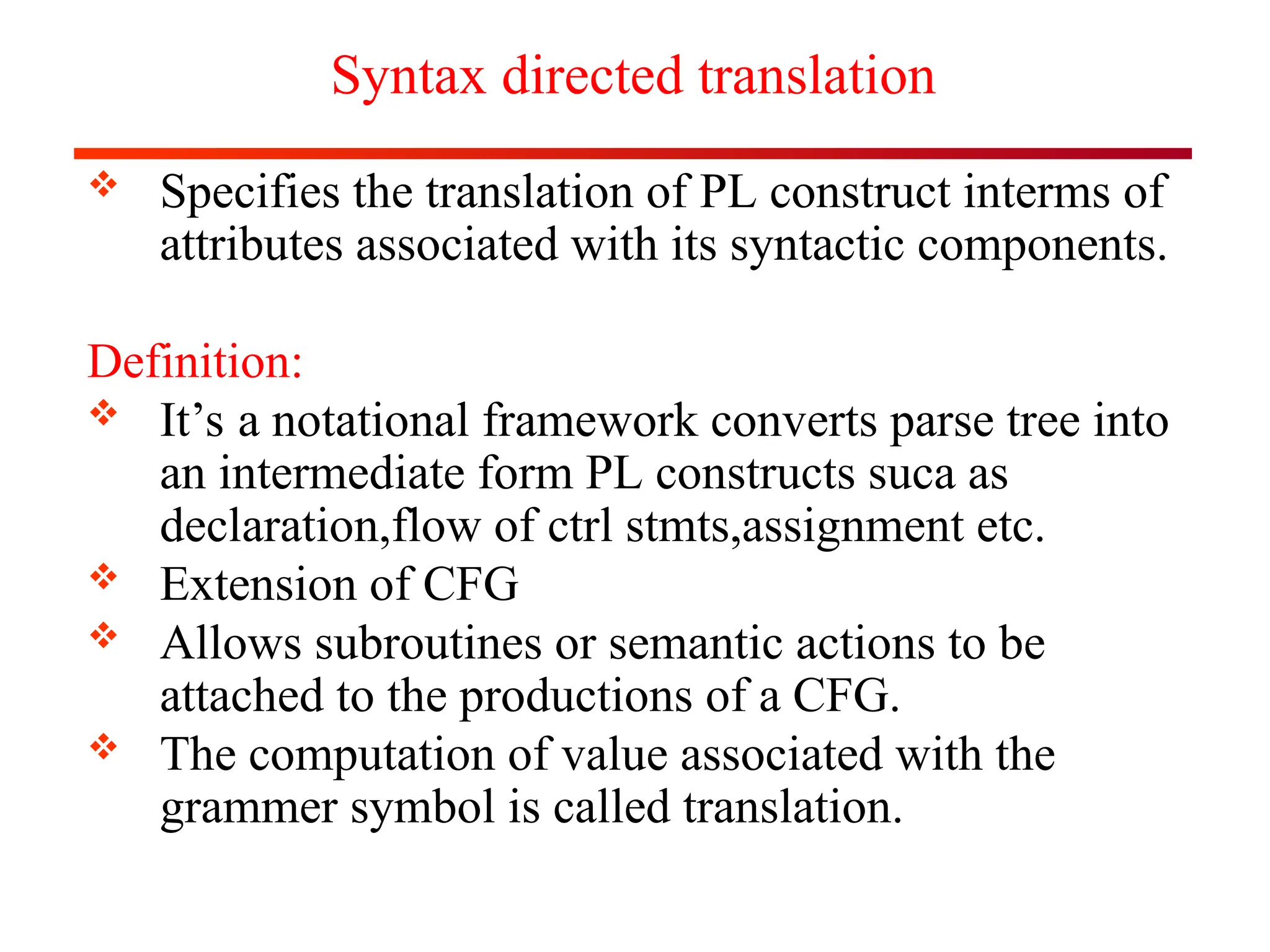
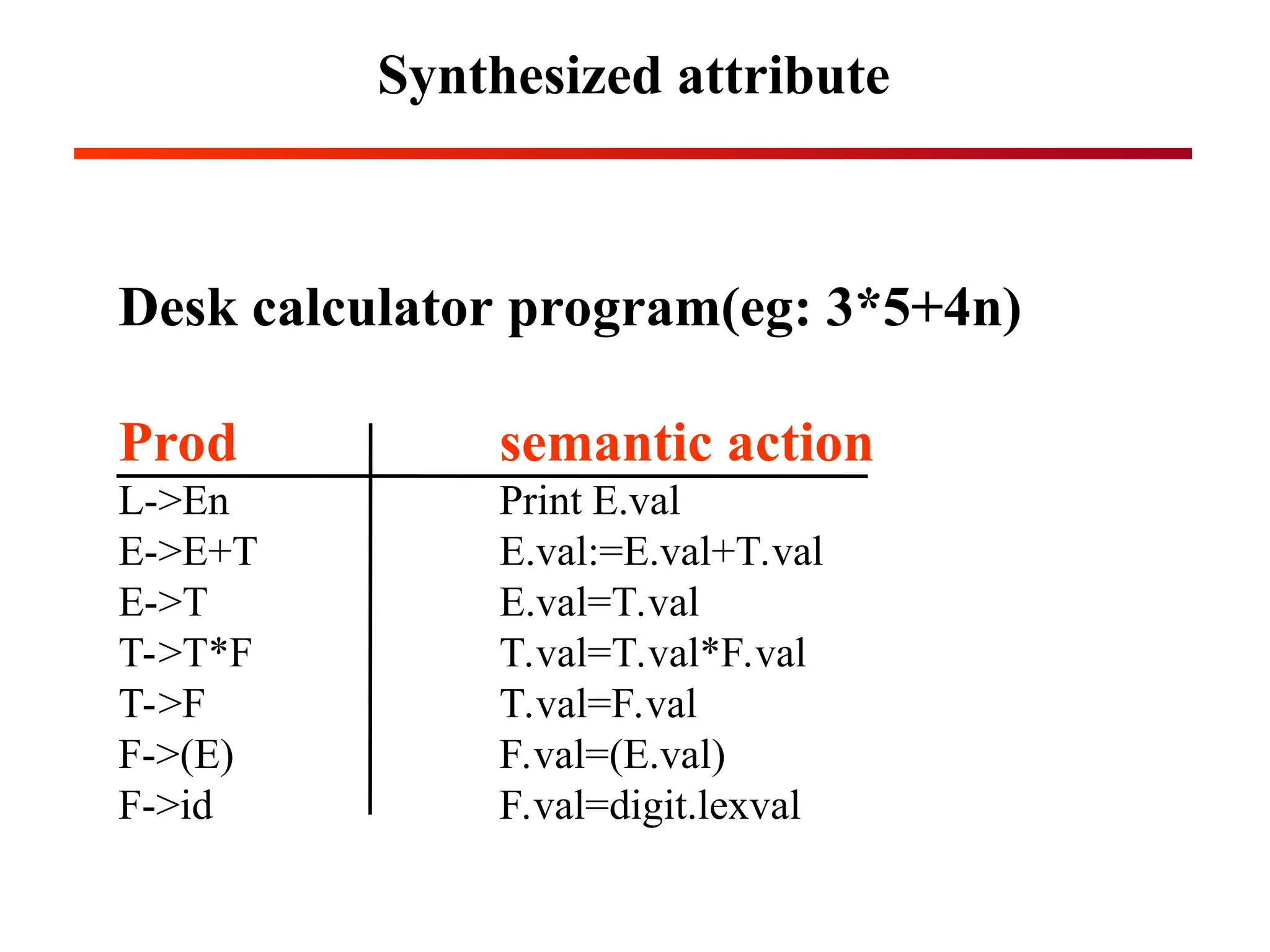
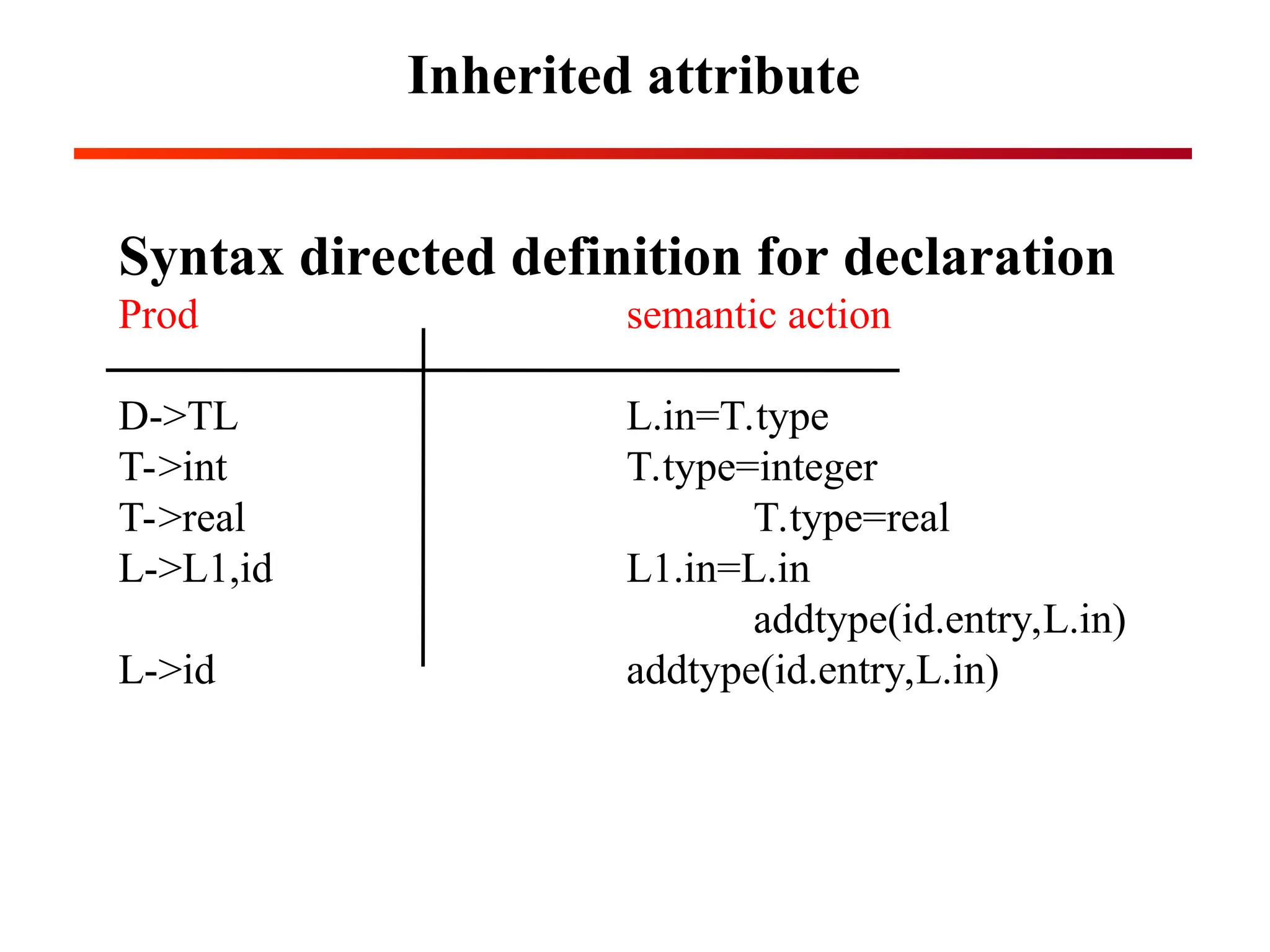
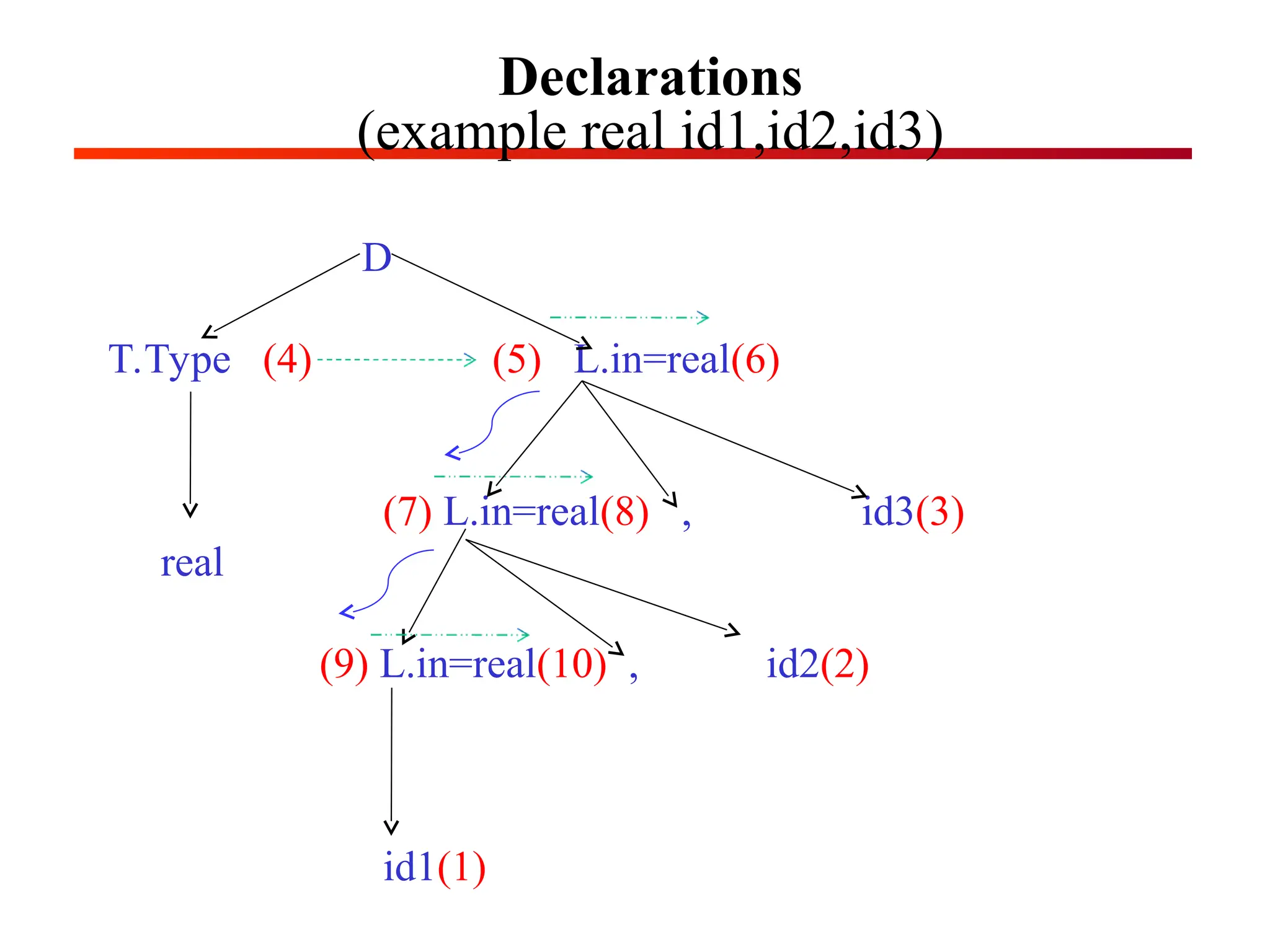
Syntax directed translation
Specifies the translation of PL construct interms of
attributes associated with its syntactic components.
Definition:
It’s a notational framework converts parse tree into
an intermediate form PL constructs suca as
declaration,flow of ctrl stmts,assignment etc.
Extension of CFG
Allows subroutines or semantic actions to be
attached to the productions of a CFG.
The computation of value associated with the
grammer symbol is called translation.
22.
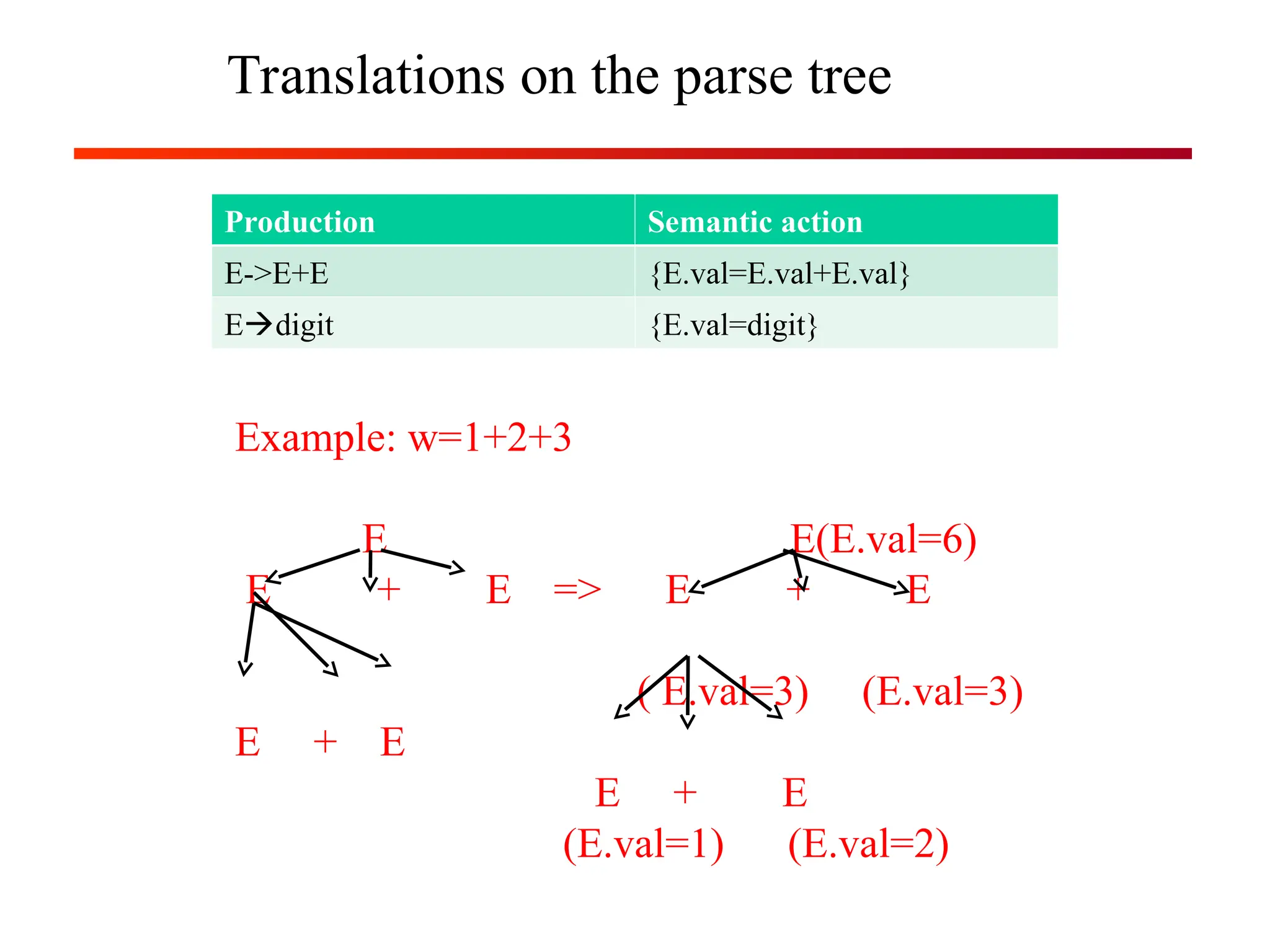
Translations on theparse tree
Production Semantic action
E->E+E {E.val=E.val+E.val}
Edigit {E.val=digit}
Example: w=1+2+3
E E(E.val=6)
E + E => E + E
( E.val=3) (E.val=3)
E + E
E + E
(E.val=1) (E.val=2)
![Other types of 3-address statements
e.g. ternary operations like
x[i]:=y x:=y[i]
require two or more entries. e.g.
op arg1 arg2
(0) [ ] = x i
(1) assign (0) y
op arg1 arg2
(0) [ ] = y i
(1) assign x (0)](https://image.slidesharecdn.com/u4-p1-250712155955-2a4a865f/75/u4-p1-syntax-directed-translation-and-ppt-19-2048.jpg)
![Types of Three-Address Statements.
Assignment Statement: x:=y op z
Assignment instruction: x:=op z
Copy Statement: x:=z
Unconditional Jump: goto L
Conditional Jump: if x relop y goto L
Stack Operations: Push/pop
More Advanced:
Procedure:
param x1
param x2
…
param xn
call p,n
Index Assignments:
x:=y[i]
x[i]:=y
Address and Pointer Assignments:
x:=&y
x:=*y
*x:=y](https://image.slidesharecdn.com/u4-p1-250712155955-2a4a865f/75/u4-p1-syntax-directed-translation-and-ppt-20-2048.jpg)