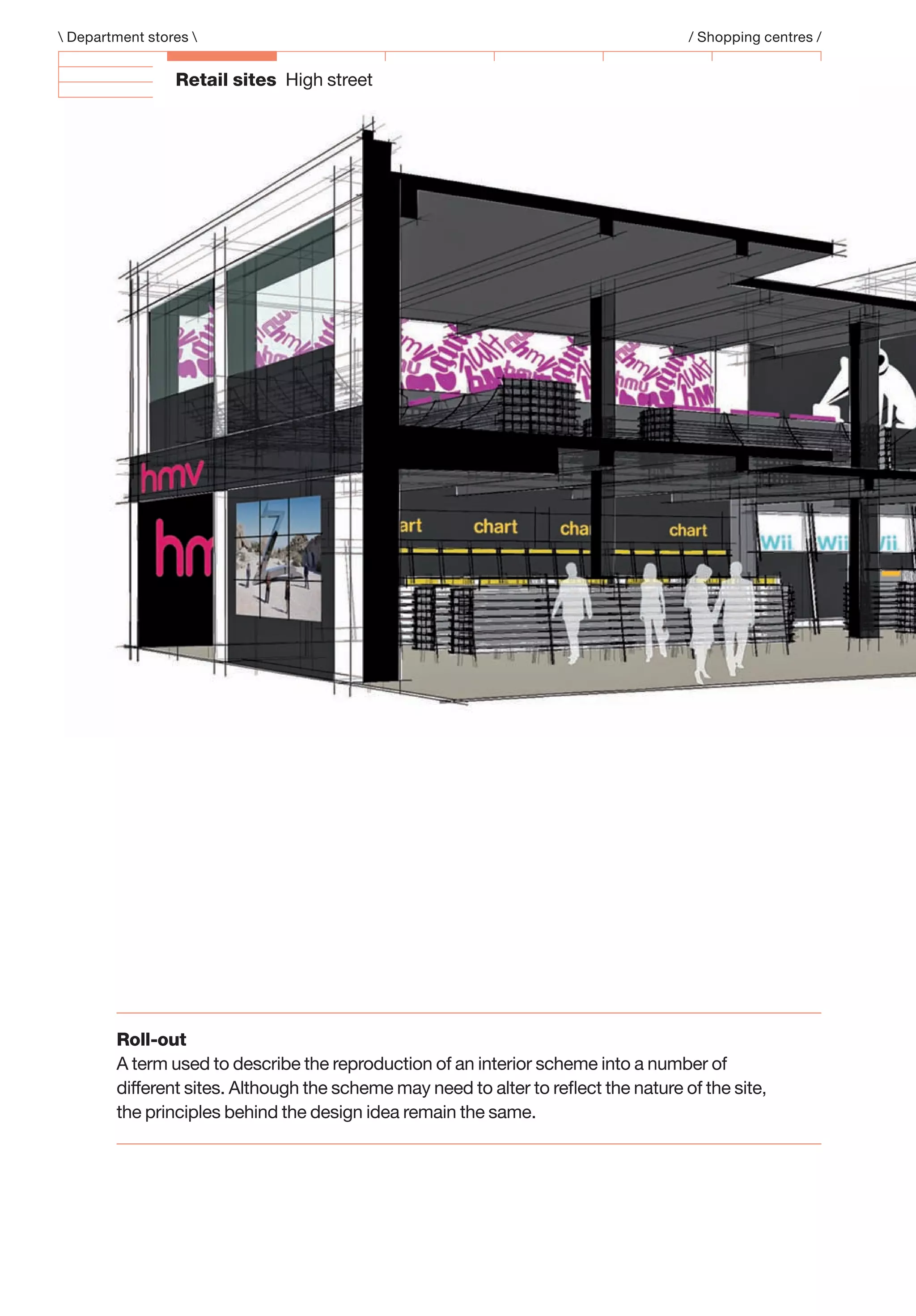
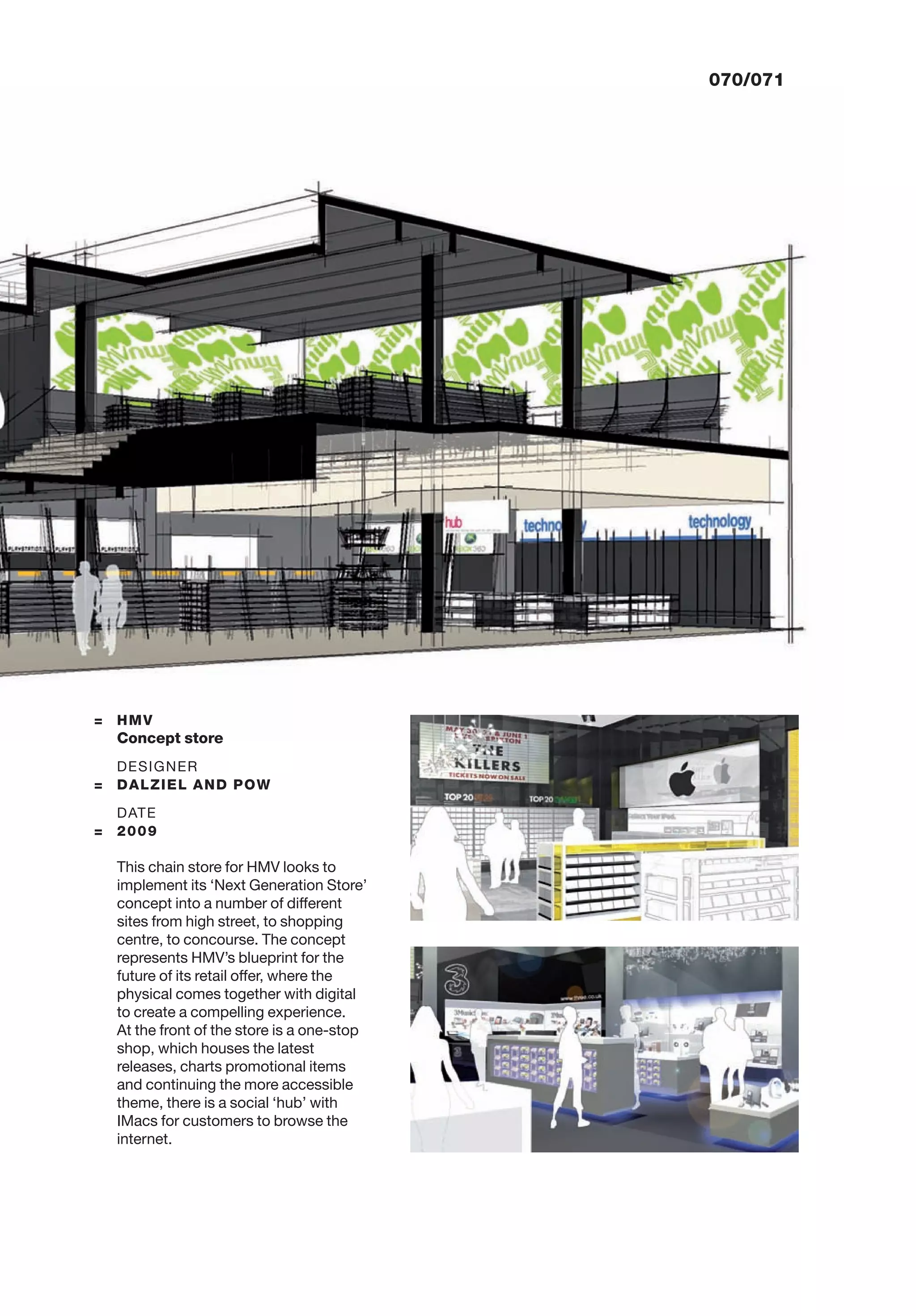
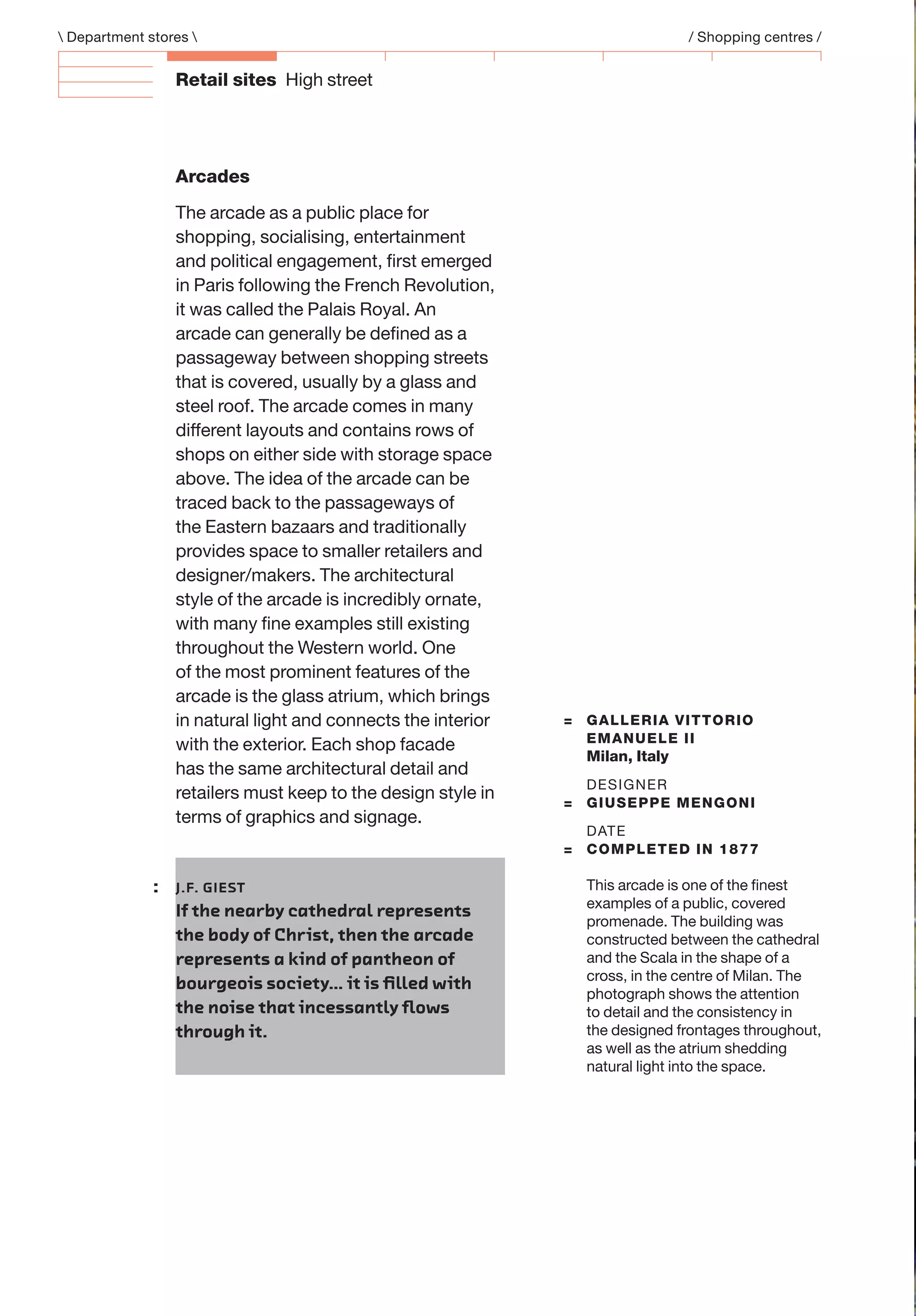
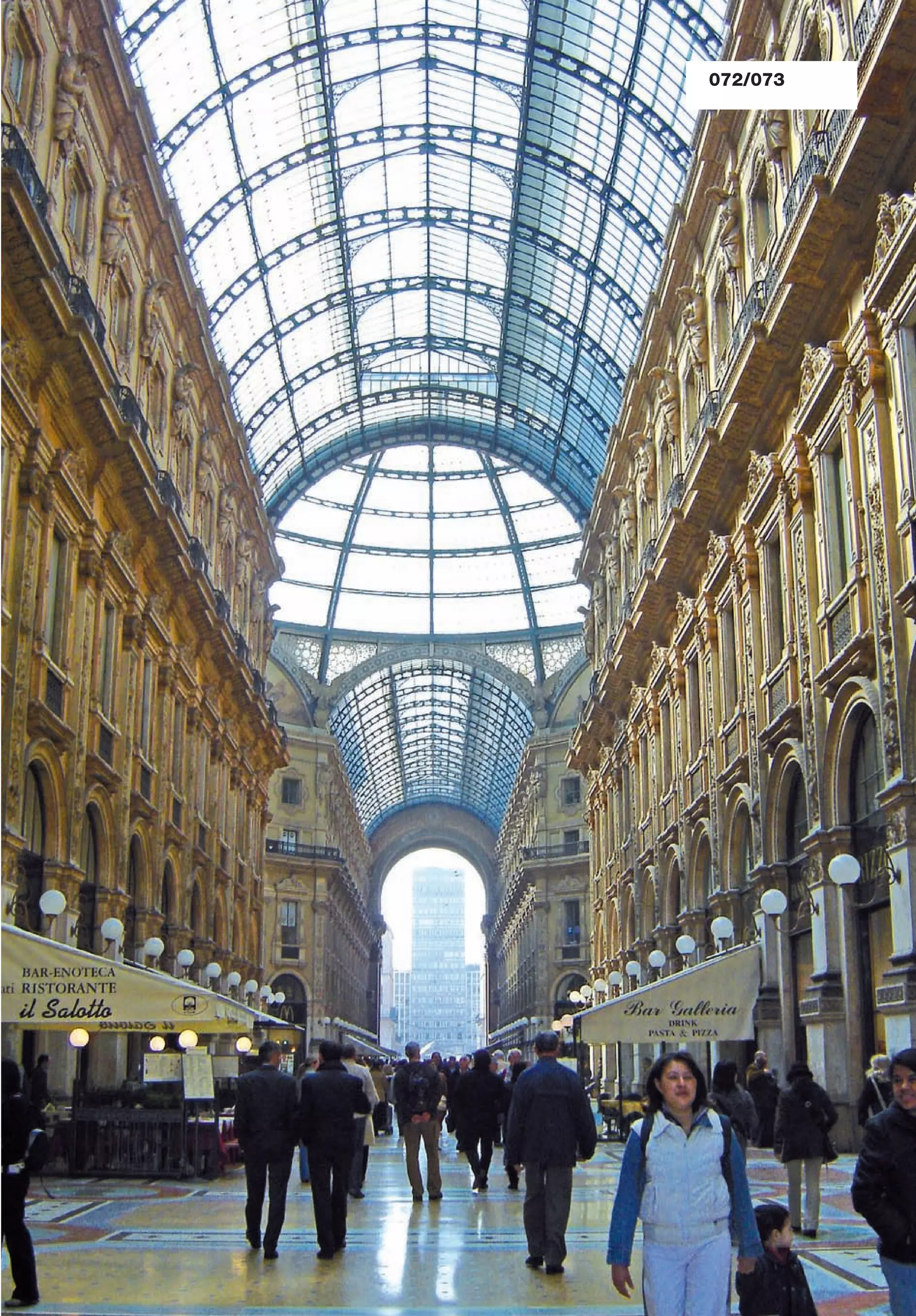
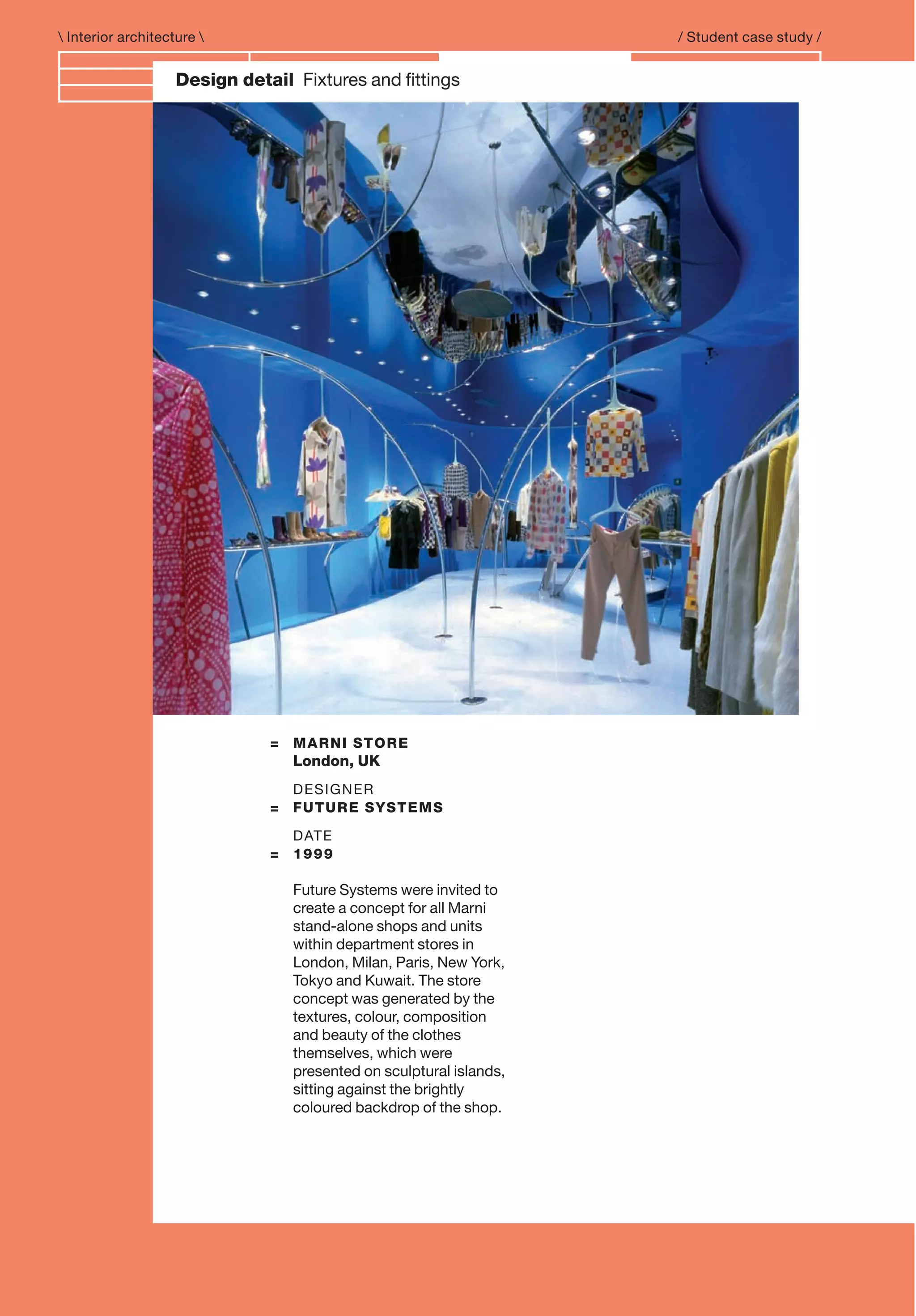
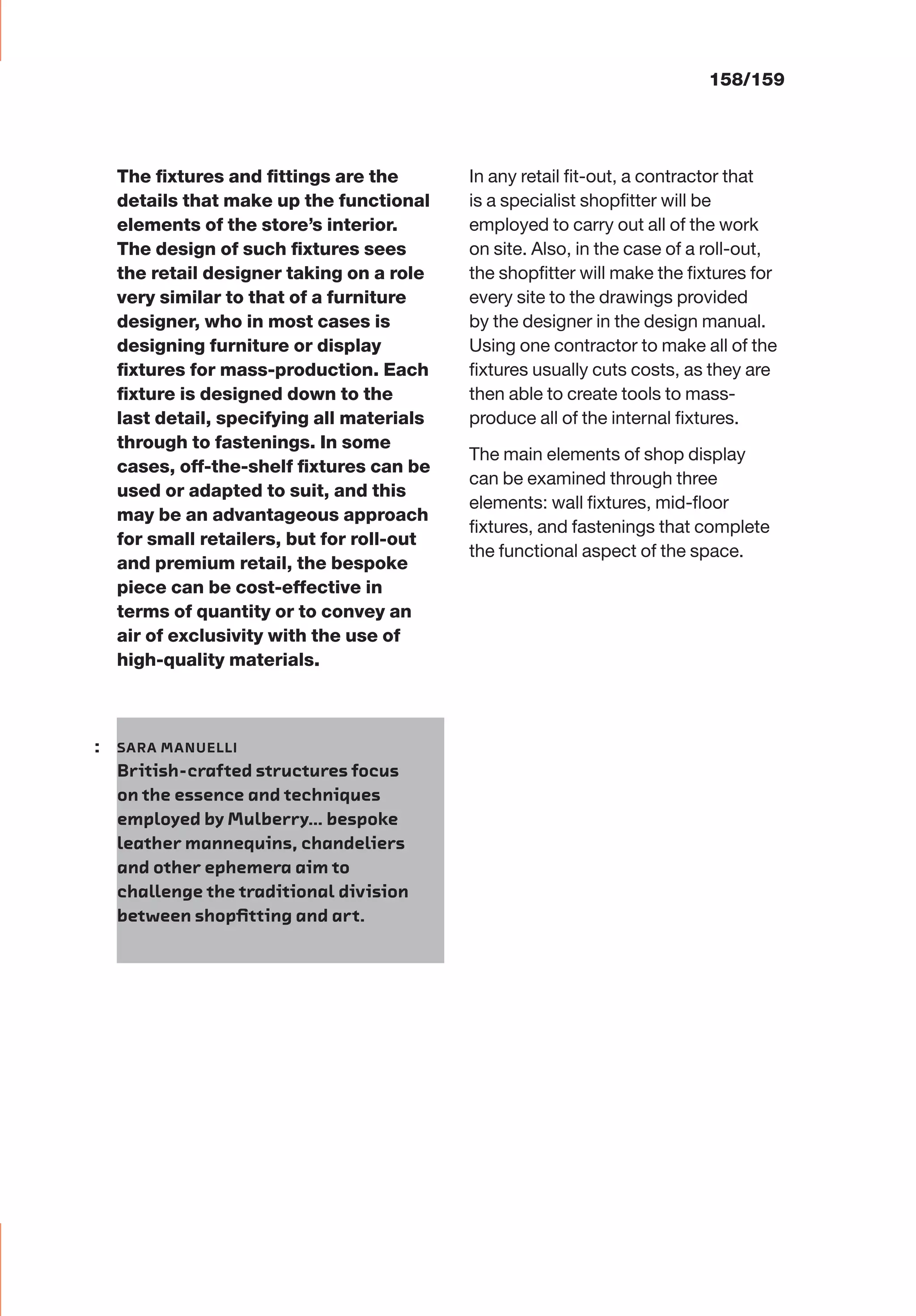
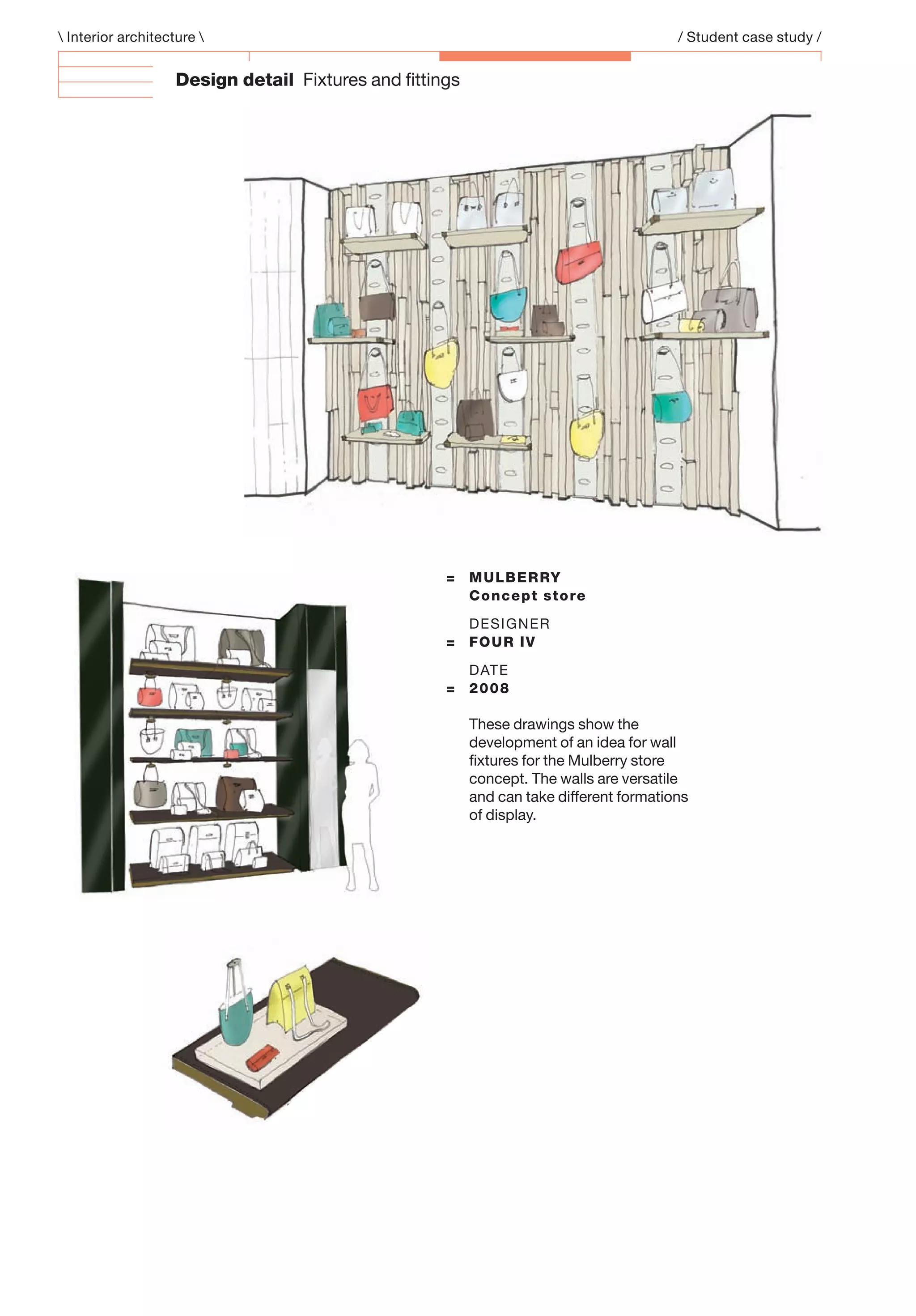
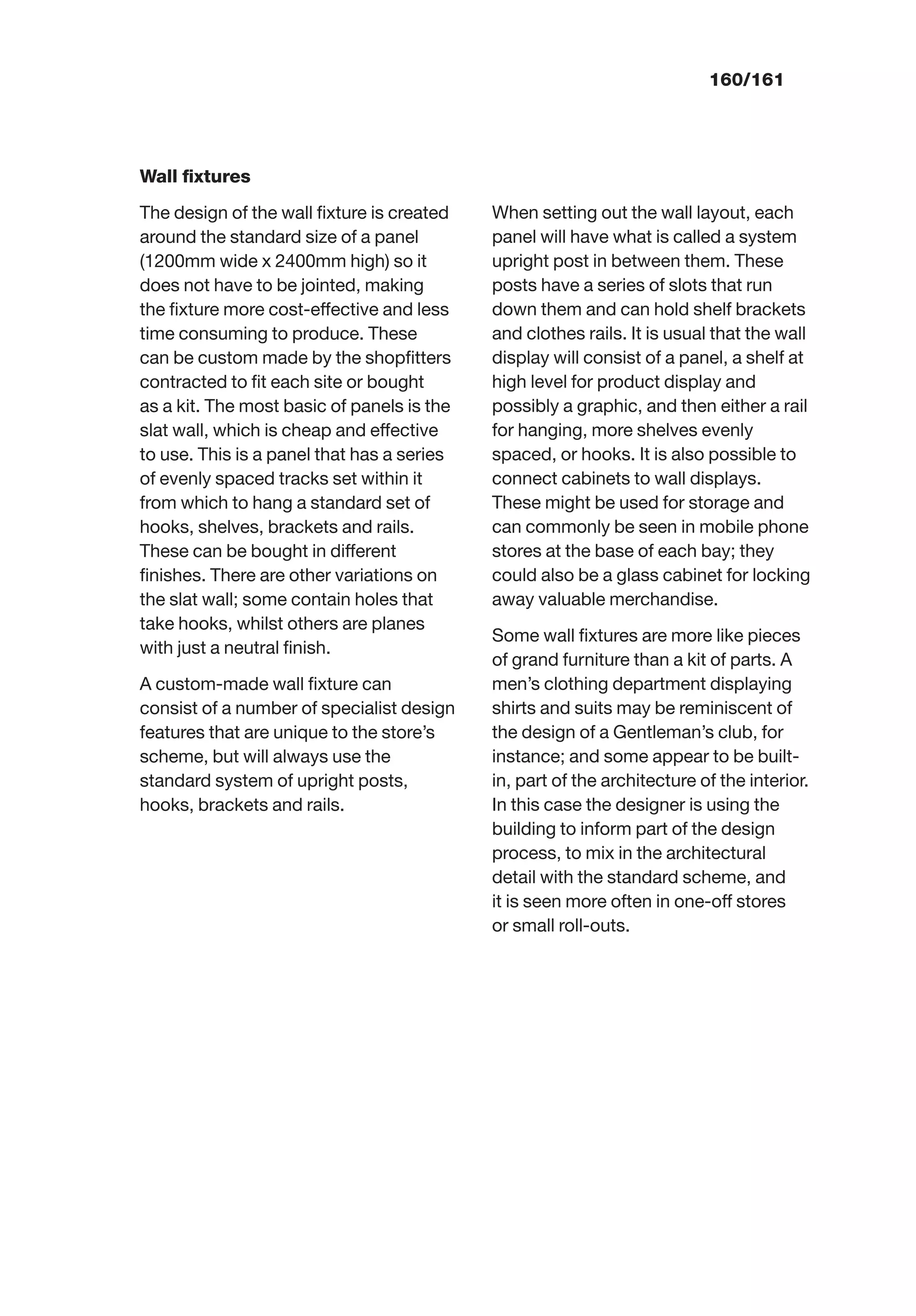
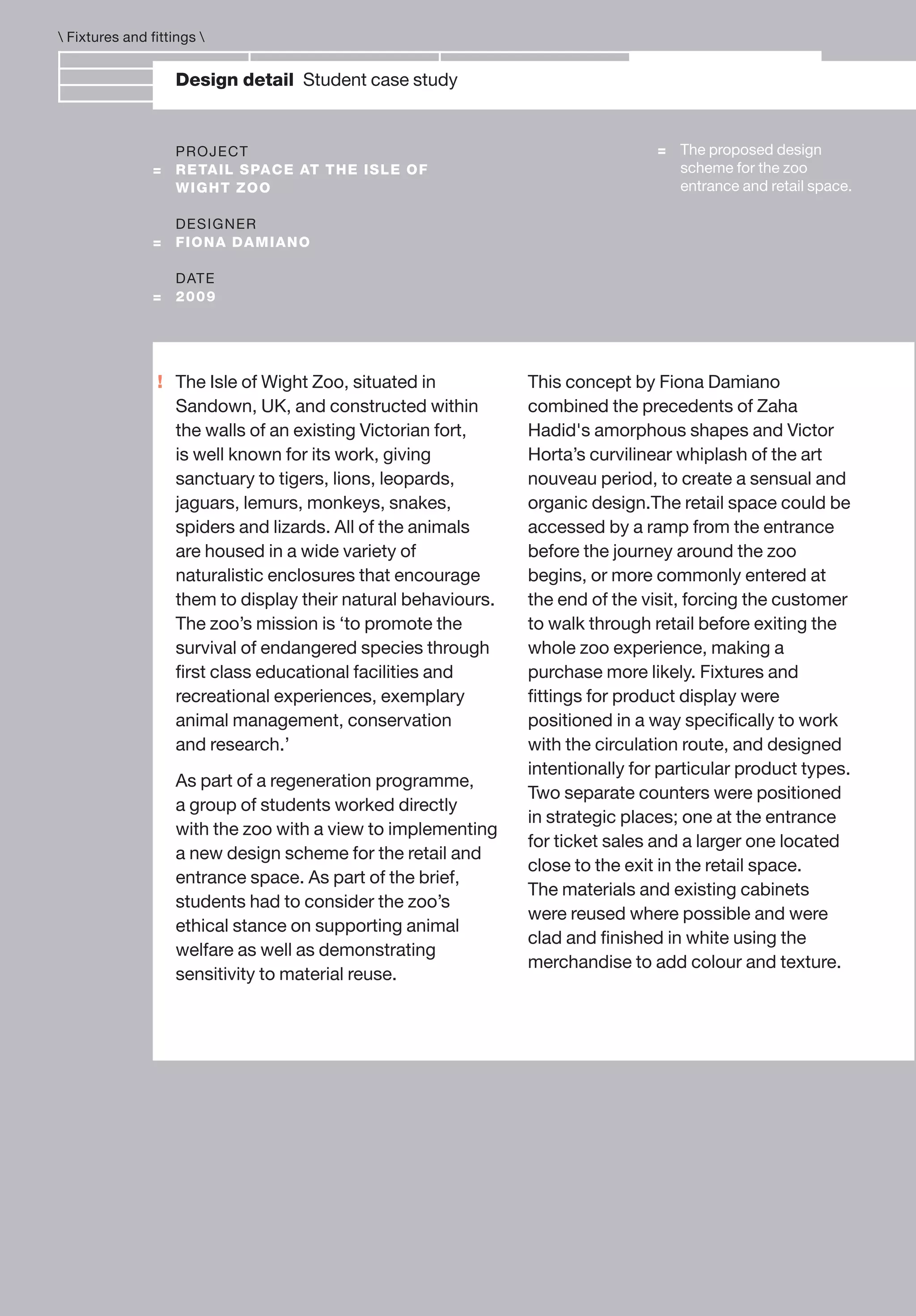
retail
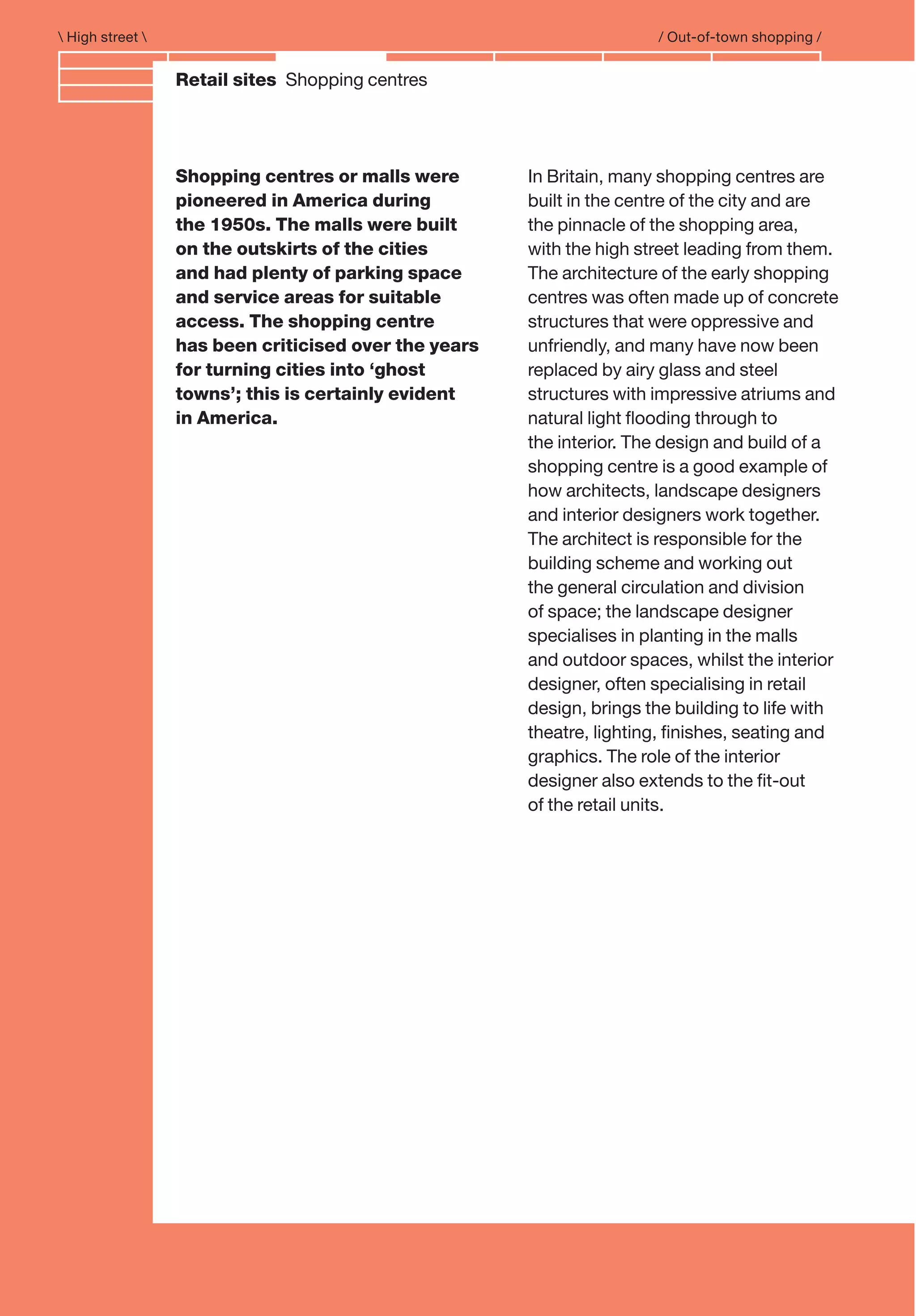
design
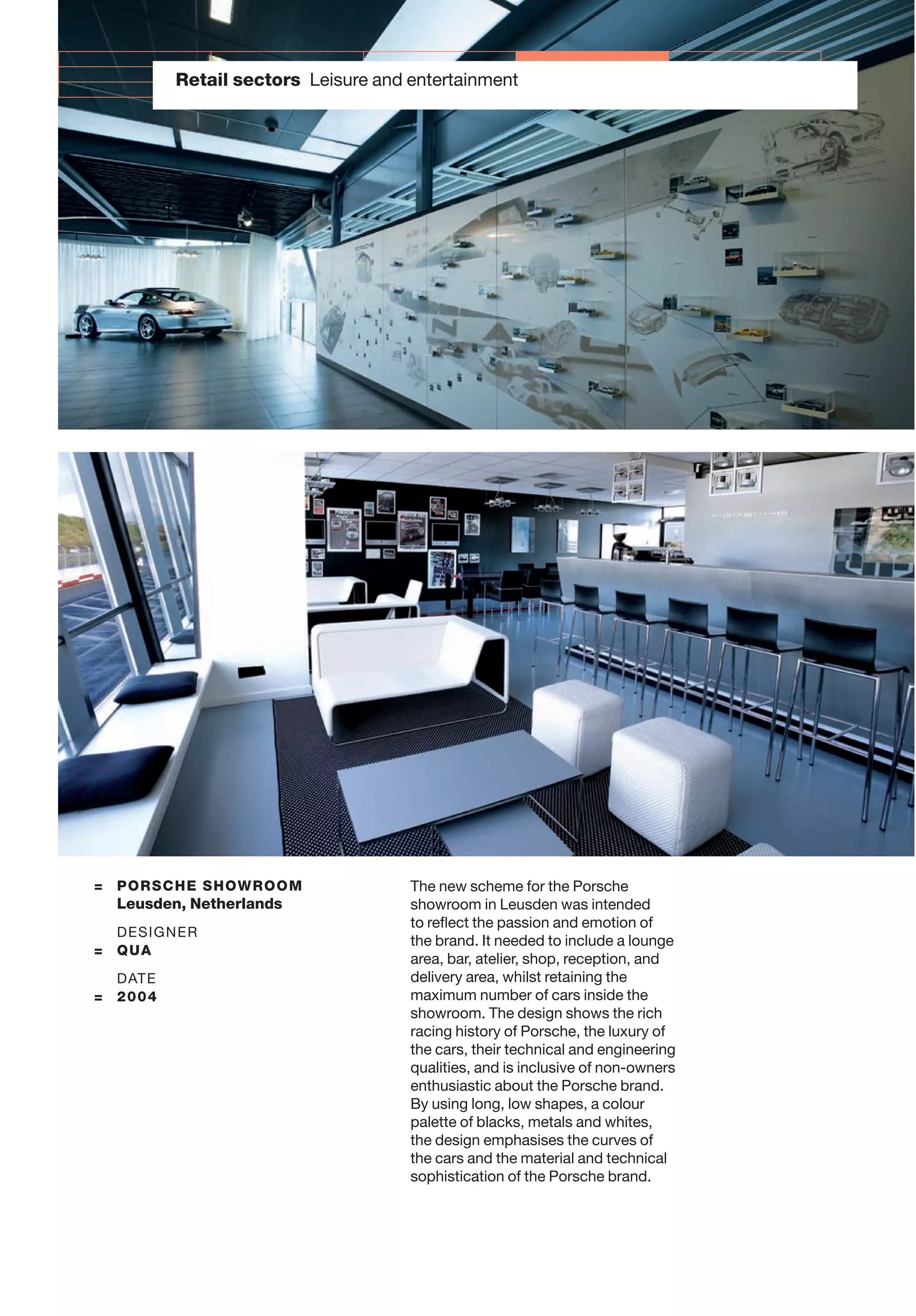
BASICS
01
Lynne Mesher
interior design
n
the art or process of
designing spaces to be
used for the sale of goods
to the public
BASICS
Interior Design Lynne Mesher
retail
design
= AN AVA BOOK
Published by AVA Publishing SA
Rue des Fontenailles 16
Case Postale
1000 Lausanne 6
Switzerland
T +41 786 005 109
E enquiries@avabooks.ch
Distributed by Thames & Hudson (ex-North America)
181a High Holborn
London WC1V 7QX
United Kingdom
T +44 20 7845 5000
F +44 20 7845 5055
E sales@thameshudson.co.uk
www.thamesandhudson.com
Distributed in the USA and Canada by
Ingram Publisher Services Inc.
1 Ingram Blvd.
La Vergne TN 37086
USA
T +1 866 400 5351
F +1 800 838 1149
E customer.service@ingrampublisherservices.com
English Language Support Office
AVA Publishing (UK) Ltd.
T +44 1903 204 455
E enquiries@avabooks.ch
Copyright © AVA Publishing SA 2010
All rights reserved. No part of this publication may be reproduced,
stored in a retrieval system or transmitted in any form or by any means,
electronic, mechanical, photocopying, recording or otherwise, without
permission of the copyright holder.
ISBN 978-2-940411-22-1
10 9 8 7 6 5 4 3 2 1
Design by
Dechant Grafische Arbeiten, Vienna
Production by AVA Book Production Pte. Ltd., Singapore
T +65 6334 8173
F +65 6259 9830
E production@avabooks.com.sg
All reasonable attempts have been made to trace, clear and credit the
copyright holders of the images reproduced in this book. However, if any
credits have been inadvertently omitted, the publisher will endeavour to
incorporate amendments in future editions.
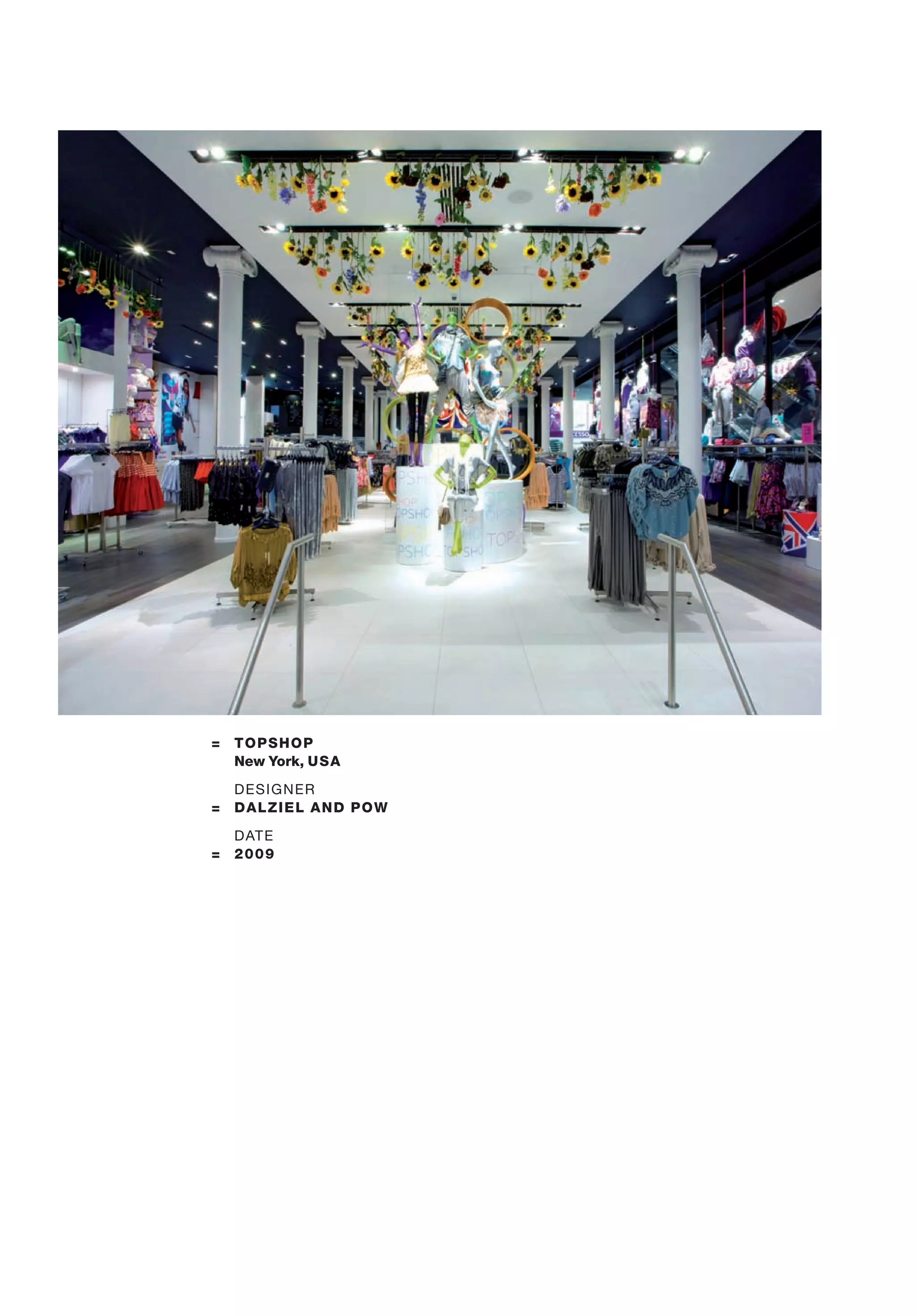
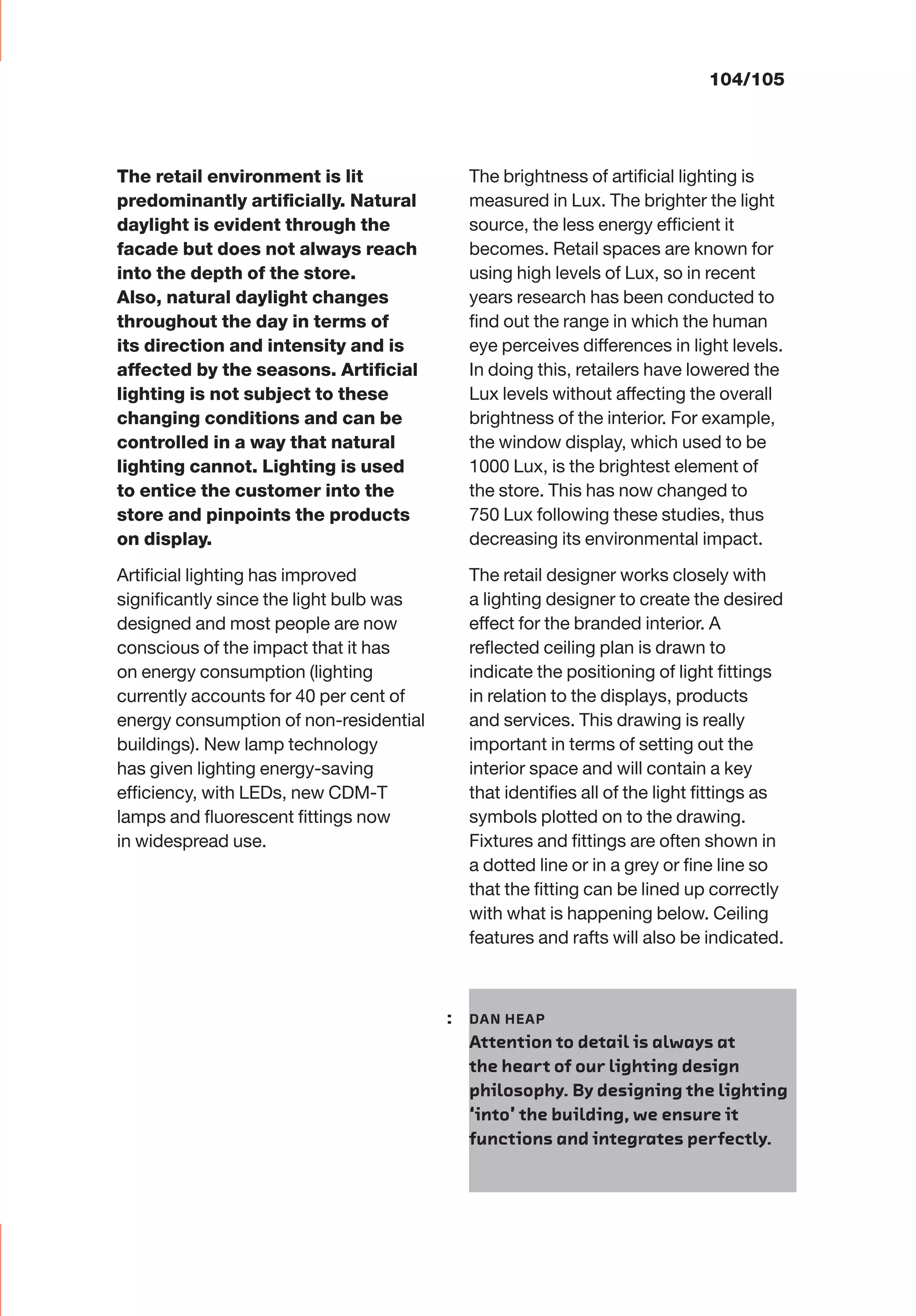
= TOPSHOP
New York, USA
DESIGNER
= DALZIEL AND POW
DATE
= 2009
Basics Interior Design Retail Design Table of contents
006 Introduction
008 How to get
the most out
of this book
01 Branding
and identity
012 What is
branding?
018 Developing
a brand
024 Selling
the brand
032 Student
case study
02 Retail
sectors
036 Food
042 Fashion
050 Home
054 Leisure and
entertainment
060 Student
case study
03 Retail
sites
064 Department
stores
068 High street
074 Shopping centres
078 Out-of-town
shopping
082 The concourse
086 Alternative
venues
088 Student
case study
036/037
04 The retail
environment
092 Retail and
sustainability
096 Materials
104 Lighting
110 Climate
and sound
114 Student
case study
05 Methods of
organising
space
118 Principles
of retail
organisation
126 Merchandising
130 Service and
ancillary space
138 Student
case study
06 Design
detail
142 The shop
façade
152 Interior
architecture
158 Fixtures
and fittings
166 Student
case study
168 Conclusion
170 Bibliography
171 Quote sources
172 Glossary
174 Acknowledgements
175 Picture credits
177 Working with ethics
Introduction
/ How to get the most out of this book /
006/007
The aim of this book is to examine the
processes and strategies of designing
space for retail.
Shopping is an activity that is part of
our everyday lives. Whether we are
shopping to feed ourselves, clothe
ourselves or simply out of enjoyment,
the places we choose to shop say
something about our lifestyle, culture
and interests. We create a relationship
with the retail environment we feel
comfortable with and reject spaces
that do not match our image.
The design of shops is an ever-changing
cycle, following fashion trends and
consumer aspirations. Retail spaces
are at the forefront of contemporary
interior design because they are
updated regularly to stay competitive
and appealing. Some of the most
innovative and interactive interiors
can be seen in the retail sector.
Designing retail interiors is complex,
beginning with the analysis of a brand
and identity. The aim of the designer is
to entice, excite and enthral the consumer
by creating an experience to which they
can relate.
This book thoroughly guides you through
each step of the retail design process,
providing strategies that can produce
a successful retail space and a design
that is appropriate for the brand, product,
consumer and retailer. This will be seen
through images and drawings from
practice, as well as student project work.
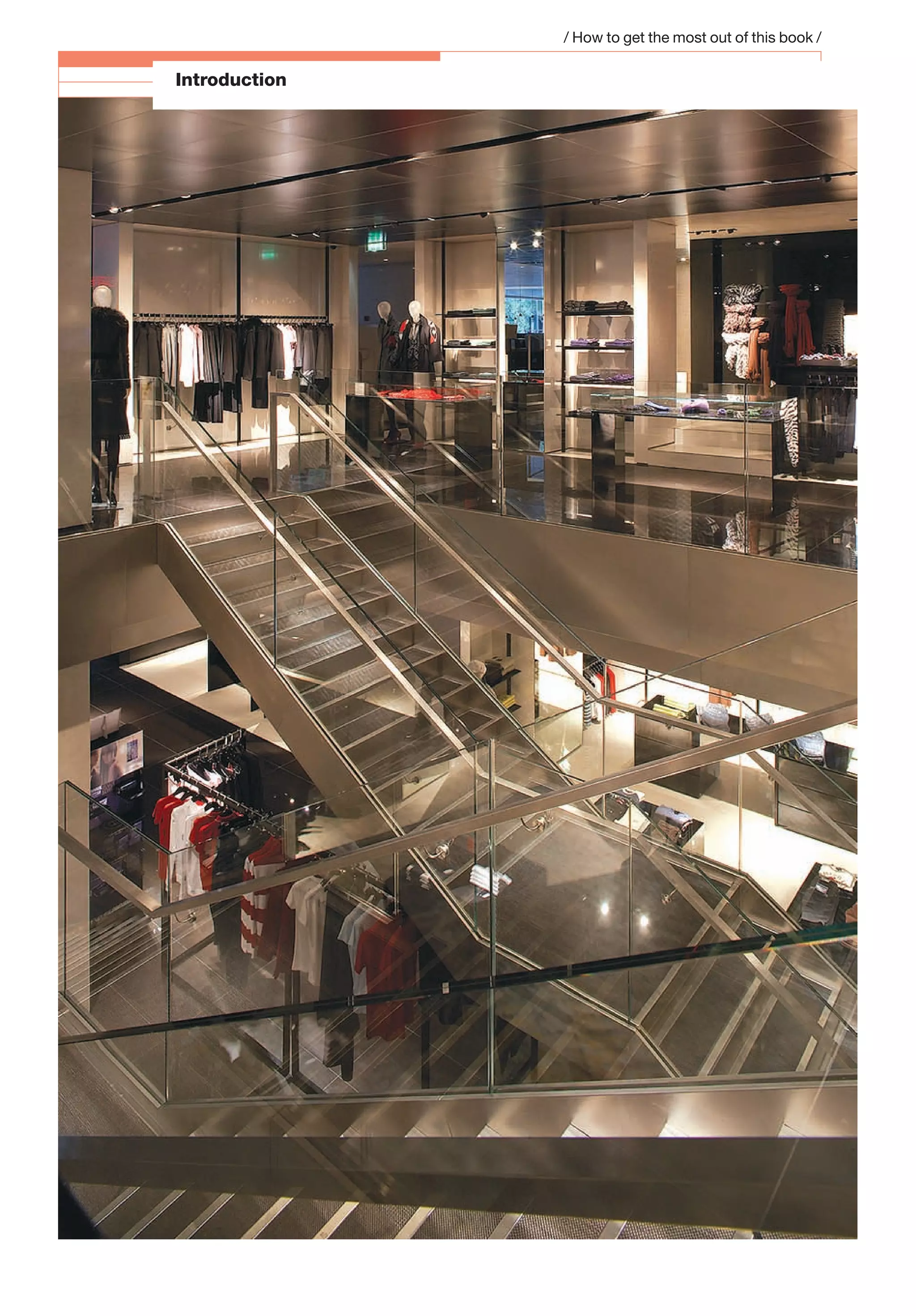
= CLUB 21,
EMPORIO ARMANI
DESIGNER
= FOUR IV
DATE
= 2006
Designing space for retail is
a complex and ever-changing
process. It is hoped that this
book will take the reader on
a journey through the retail
space, exploring the strategies
and relationships to be found
at each step of the way.
?
Retail sectors Leisure and entertainment
The leisure and entertainment
sector has grown significantly in
the last ten years. Whether the
activity is based around a destination
or a product purchase, the chances
are the interior space will encapsulate
a brand. An outing to the cinema,
museum or theatre will each give an
opportunity to buy into the experience
through a shop, bar or café.
The leisure sector includes sport – as an
activity or apparel; technology – sound,
audio and gaming; travel – modes of
transport and travel agency; and finance –
the services of banks and building societies.
Banks are now abandoning the high street
and going online.
Sport
In recent years, the sports industry
has taken on the idea of enforcing their
global brand identity through store
image. Retail spaces within the sports
sector are sparse in products and are
exhibition-like in the way that the
participator moves around the space
and interacts with displays. The graphic
language is prominent throughout and
a theme demonstrating youth and
physicality encapsulates the brand
message.
Sports brand Nike has opened a series
of Nike Towns around the world, each
Town taking its interior influence from
the surrounding city. In 2002, Reebok
also opened its world headquarters in
Boston, USA. The Reebok brand is
encapsulated in its headquarters and is
reinforced in every aspect of Reebok
design – from the apparel to the shop
floor – on every high street.
= REEBOK FLASH
STORE
New York, USA
DESIGNER
= FORMAVISION
DATE
= 2002
Recently, Reebok
re-invented itself in a
new consumer offer.
The Reebok Flash Store
opened in New York for
a limited period in the
CV2 Contemporary Art
Gallery, selling retro and
limited edition footwear.
Formavision, whose
trademark is to use art
as part of their interior
scheme, designed the
space.
054/055
 Home 
FORM AND FUNCTION
Interior designers and architects differ widely in
their views of how far the function of a space
should affect its design. Form and function are
discussed in greater detail in the AVA title, Basics
Interior Architecture: Form + Structure.
How to get the most out of this book
This book introduces different aspects of
retail design, via dedicated chapters for
each topic. Using a variety of examples
from both students and professionals,
the processes and strategies involved in
designing space for retail are examined,
analysed and debated.
 Introduction 
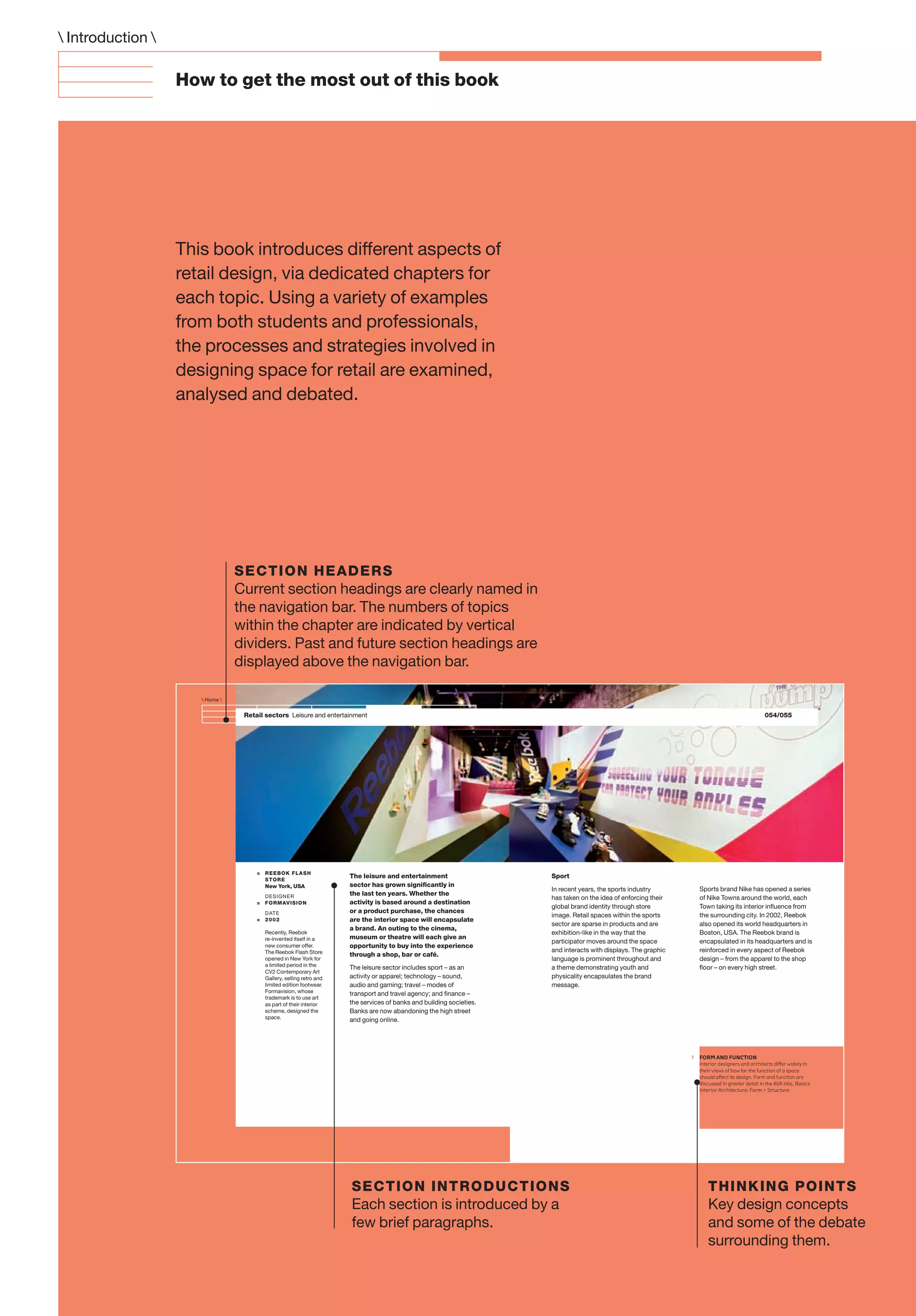
SECTION HEADERS
Current section headings are clearly named in
the navigation bar. The numbers of topics
within the chapter are indicated by vertical
dividers. Past and future section headings are
displayed above the navigation bar.
SECTION INTRODUCTIONS
Each section is introduced by a
few brief paragraphs.
THINKING POINTS
Key design concepts
and some of the debate
surrounding them.
!
Retail sectors Fashion
Chain stores
These are retail outlets sharing the same brand and management across locations.
 Food  / Home /
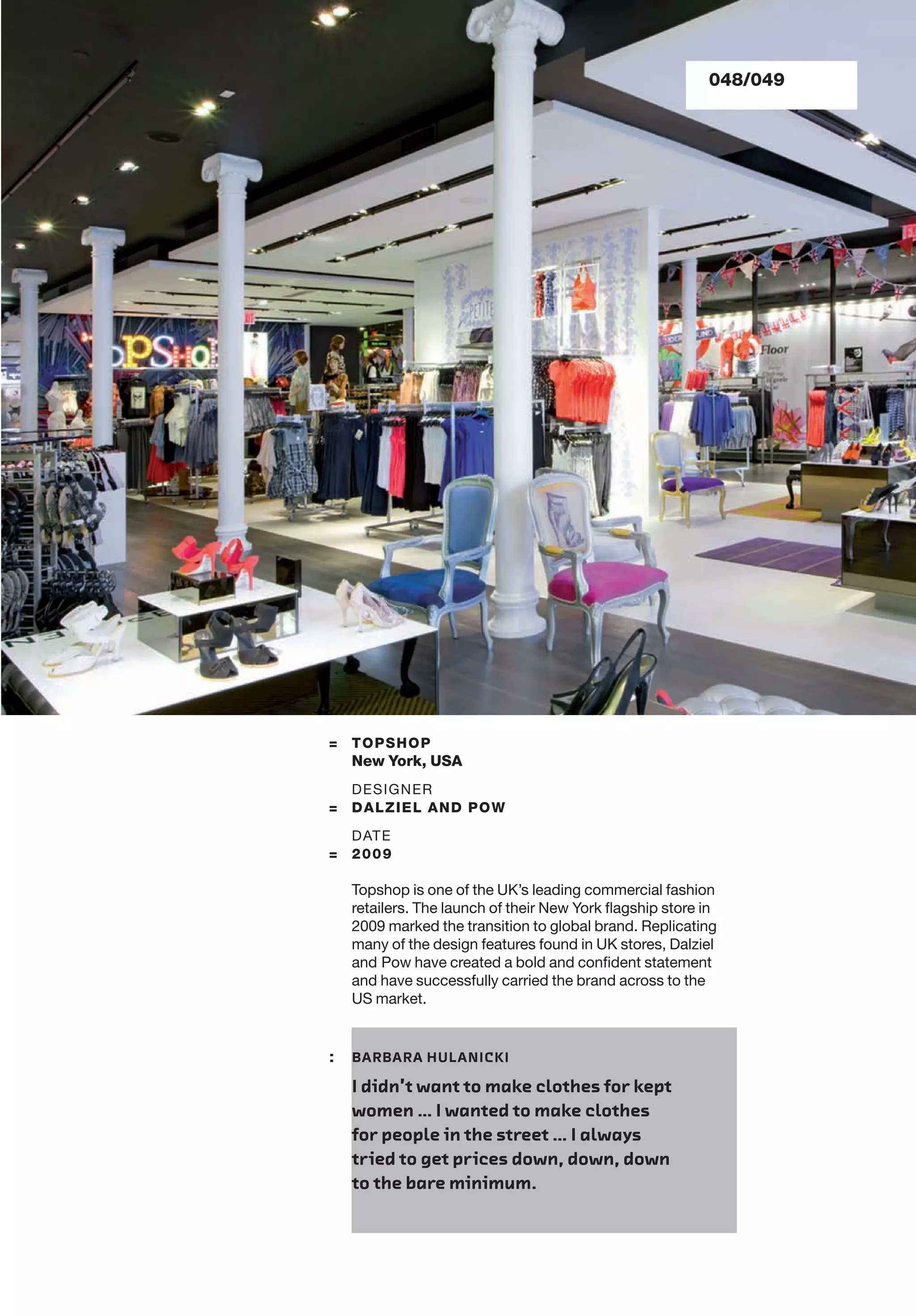
= TOPSHOP
New York, USA
DESIGNER
= DALZIEL AND POW
DATE
= 2009
Topshop is one of the UK’s leading commercial fashion
retailers. The launch of their New York flagship store in
2009 marked the transition to global brand. Replicating
many of the design features found in UK stores, Dalziel
and Pow have created a bold and confident statement
and have successfully carried the brand across to the
US market.
Commercial fashion
Barbara Hulanicki invented the concept
of mainstream fashion stores when she
opened Biba in London, UK, in 1964.
Today, commercial fashion is
dominated by chain stores with
numerous identical shops in major
towns and cities. The offer is available
from every high street and is affordable
to the masses. These shops often
take reference from premium fashion
brands in terms of both clothing
collections and interiors. They are
frequently changed to evolve with
consumer expectations and because
of the high level of activity, the interior
finish becomes easily tired and dated.
The interiors are varied, using materials,
lighting and graphics to create an
illusion. Retail designers work with
marketing experts to focus the store’s
identity and relationship to the brand.
In a heavily saturated market, being
competitive in style and price is the
key to success.
: BARBARA HULANICKI
I didn’t want to make clothes for kept
women … I wanted to make clothes
for people in the street … I always
tried to get prices down, down, down
to the bare minimum.
048/049
Retail sites Student case study
PROJECT
= FENDER CHAIN STORE
CONCEPT
DESIGNER
= FAHIROOL
ADZHAR MUHAMAD
DATE
= 2009
= Guitars and other instruments are
displayed to their best effect on the
ground floor so that customers can
come straight into the retail space
from the street.
This project takes on the regeneration
of an existing Regency-style building
and converts it into a concept store for
instrument manufacturer Fender. In order
to understand an existing building and to
read its interior structure, research into
the building’s style and histories must take
place. Secondly, the geometries and
structure of the building and the ways in
which the building is affected by its
context must be analysed. Once this
information is collected and condensed,
the interior can be designed effectively.
The resulting interior focuses on material
qualities to enhance the acoustics of the
space, and the vertical circulation focuses
on a central stair that weaves organically
through the building.
 Alternative venues 
= The vertical circulation focuses
on the central staircase.
= Material qualities enhance the
acoustics of the space. Seating
takes its concept from the form
of sound waves.
? Imagine that you have been
given an existing building in
which to implement a retail
interior.
1 What do you need to understand
about the building in order to
design a successful intervention?
2 What types of analysis would
you need to undertake at the
beginning of the design process?
3 How could you enhance an
existing building through the
interior scheme?
4 What specialists would you
work with to collect the
building’s data?
5 What areas of the building
might be affected by planning
and building regulations?
088/089
008/009
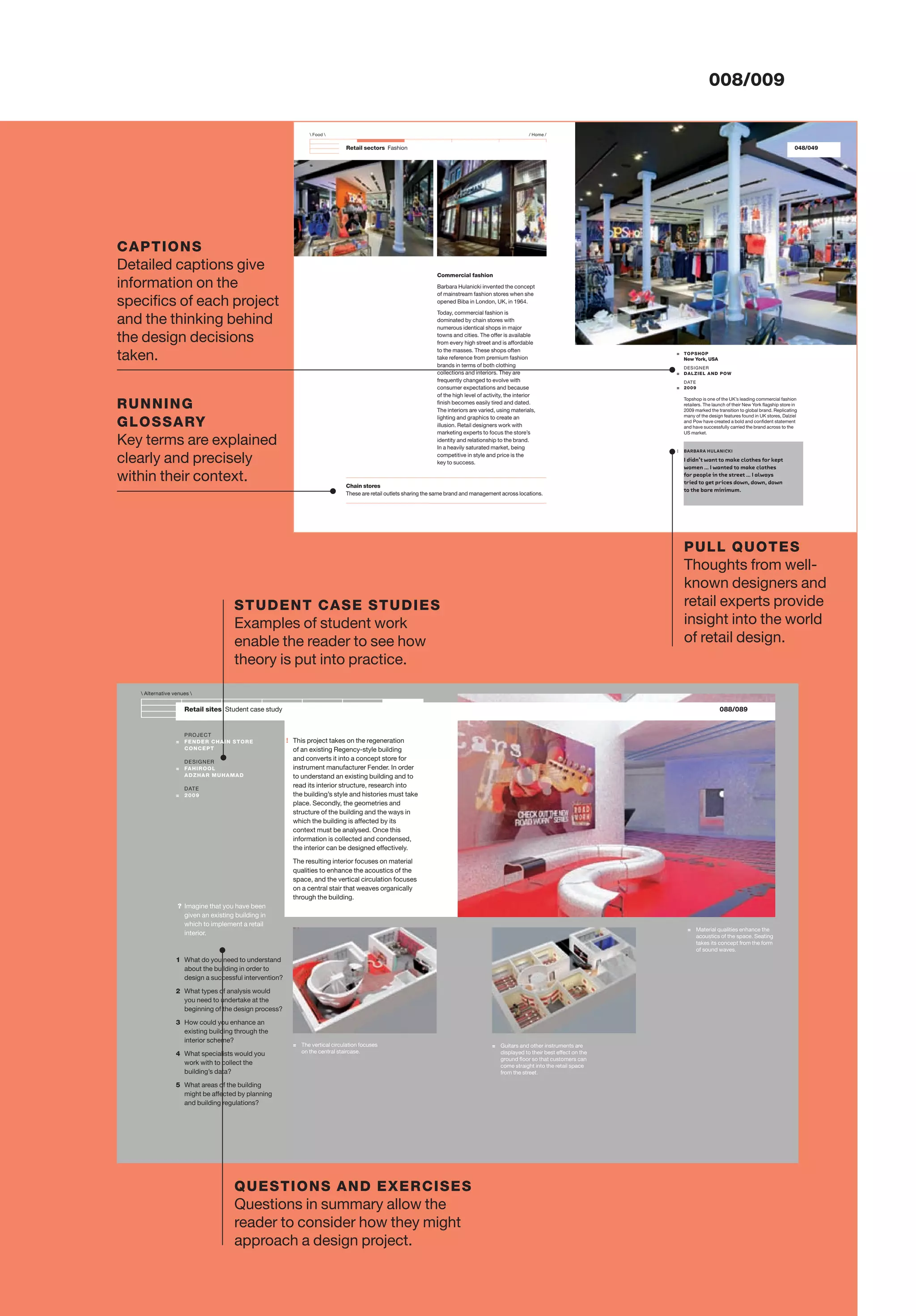
CAPTIONS
Detailed captions give
information on the
specifics of each project
and the thinking behind
the design decisions
taken.
RUNNING
GLOSSARY
Key terms are explained
clearly and precisely
within their context.
PULL QUOTES
Thoughts from well-
known designers and
retail experts provide
insight into the world
of retail design.
STUDENT CASE STUDIES
Examples of student work
enable the reader to see how
theory is put into practice.
QUESTIONS AND EXERCISES
Questions in summary allow the
reader to consider how they might
approach a design project.
Branding and identity
/ Retail sectors /
Branding is an approach used to market
products and services under a particular name.
We can all identify with brands that are familiar
to us and part of our everyday life. But how
does a brand translate from two dimensions
into the volume of an interior space? The
answer is somewhat complex and forms the
basis of the design process; understanding
a brand is one of the most important aspects
of the retail designer’s role. In most interior
design, understanding a building is the starting
point and subject of investigation. In retail,
however, the brand is the starting point and
the building or site often comes later.
THIS CHAPTER explores the notion of branding
and examines how branding principles can be
interpreted into an interior scheme. Different
mechanisms for defining a brand are set out
and examples of retail types are showcased to
explain ways of appealing to consumer markets
and trends through the interior.
010/011
Branding and IdentityBranding and identity What is branding?
/ Developing a brand /
The concept of branding
is intrinsically linked with
advertising, marketing and
playing on the subconscious
aspirations of the consumer.
A brand can be a product,
a person or a logo – anything
that can be bought and sold,
as an idea or artefact, can
be branded.
Branding is a global culture fuelled
by consumerism and the need
for people to categorise their
lifestyles, likes and dislikes through
buying into particular products.
It is evident that brands possess
values that distinguish them from
their competitors. It is interesting
to consider why we buy a branded
product over a supermarket named
equivalent at half the price. What
makes us believe that the contents
of the tin are of a better quality?
Some brands have crossed
boundaries in becoming the name
associated with the product. For
instance, an MP3 player is most
commonly called an iPod, at a bar
we ask for coke (Coca Cola) rather
than Pepsi. The power of the brand
is evident in our everyday lives
and our language is cluttered with
brand references.
No brand can appeal to everyone.
Through marketing and advertising,
the image of the brand is identified
and sold to the public. The brand
can be defined by analysing its core
values through understanding the
product, communicating it to the
right consumer audience and
understanding that audience, and
finally matching the product to the
physical environment.
In retail terms, the store is built around
the concept of the brand and the
products sold within it. The interior
emulates the aspirations of the brand
values and qualities to enhance the
relationship between the space and
the message. Everything about the
brand must be consistent – from
the associated colour and graphic
style to the product range, whether
diverse or focused, and the interior.
This consistency makes the
message stronger and re-affirms
the brand’s worth.
012/013
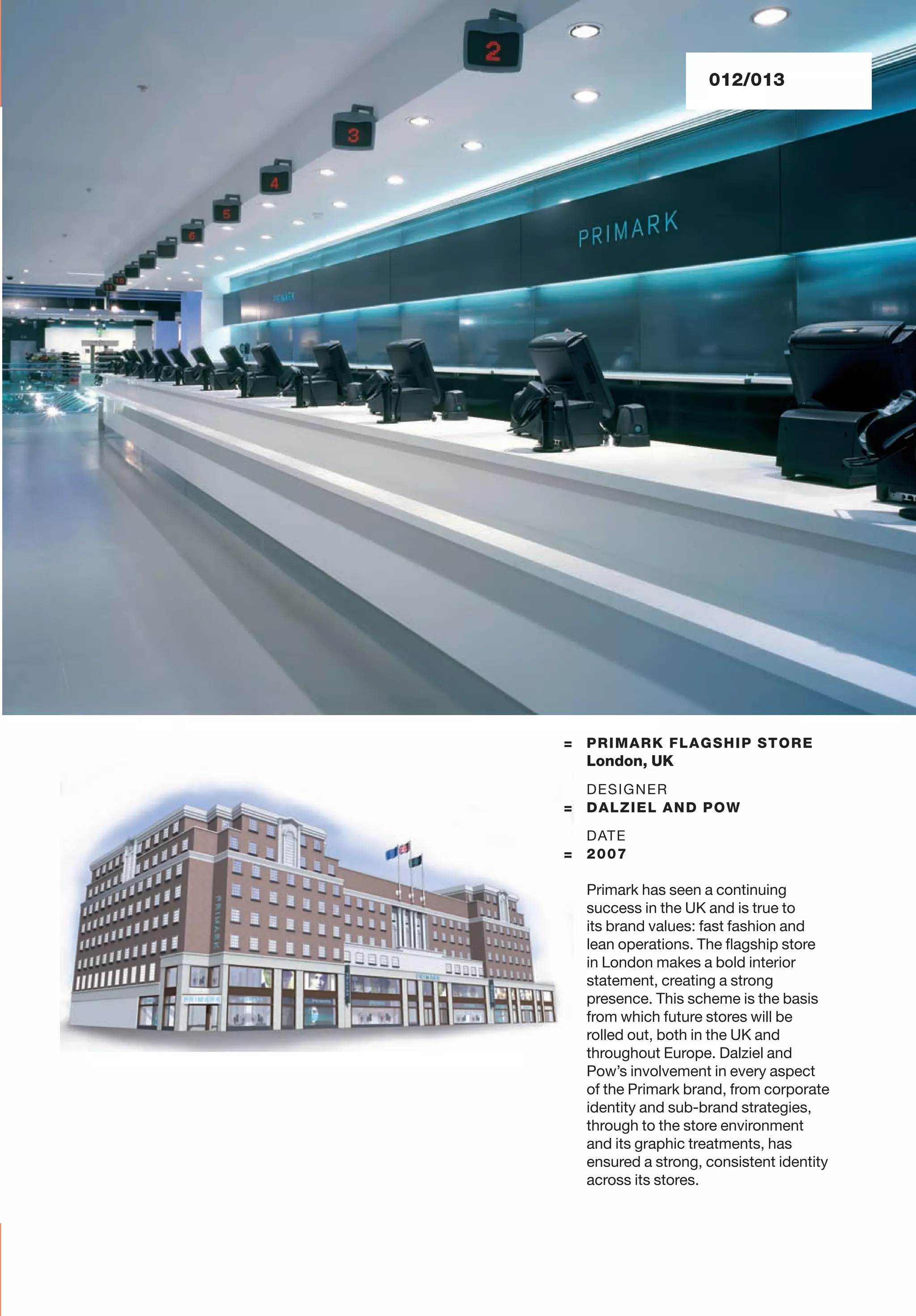
= PRIMARK FLAGSHIP STORE
London, UK
DESIGNER
= DALZIEL AND POW
DATE
= 2007
Primark has seen a continuing
success in the UK and is true to
its brand values: fast fashion and
lean operations. The flagship store
in London makes a bold interior
statement, creating a strong
presence. This scheme is the basis
from which future stores will be
rolled out, both in the UK and
throughout Europe. Dalziel and
Pow’s involvement in every aspect
of the Primark brand, from corporate
identity and sub-brand strategies,
through to the store environment
and its graphic treatments, has
ensured a strong, consistent identity
across its stores.
A BBranding and identity What is branding?
Evolution of branding
The earliest examples of branding can be
traced back as far as the 1880s when logos
began to appear on food packages such
as Campbell’s soup, Coca Cola and Lyle’s
Golden Syrup. The use of branding began
as a catch-phrase or image attached to a
product. It wasn’t until the late 1940s that
organisations began to adjust the laws of
advertising to describe their business and
function, rather than products, and the term
‘brand identity’ became mainstream in
corporate language.
The concept of branding really took off in
the 1980s, following the recession and
the downturn in profits and productivity of
some of the world’s largest manufacturers.
For the first time, production could be
moved overseas, to places such as China
and India, for a fraction of the cost, due
to a reform in the law governing labour
and trade. Prior to this, masterminding
the manufacturing process was the core
business strategy; this slowly began to be
replaced by developing the brand essence.
In the 1990s, big-brand names favoured
cutting the prices of their products to
spending money on advertising due to
the market downturn, with detrimental
consequences. Many did not survive the
aftermath of the recession and Wall Street
predicted the ‘death of the brand’. Those
who stayed true to their brand values and
marketing strategy did survive and are still
major players in the retail sector today.
/ Developing a brand /
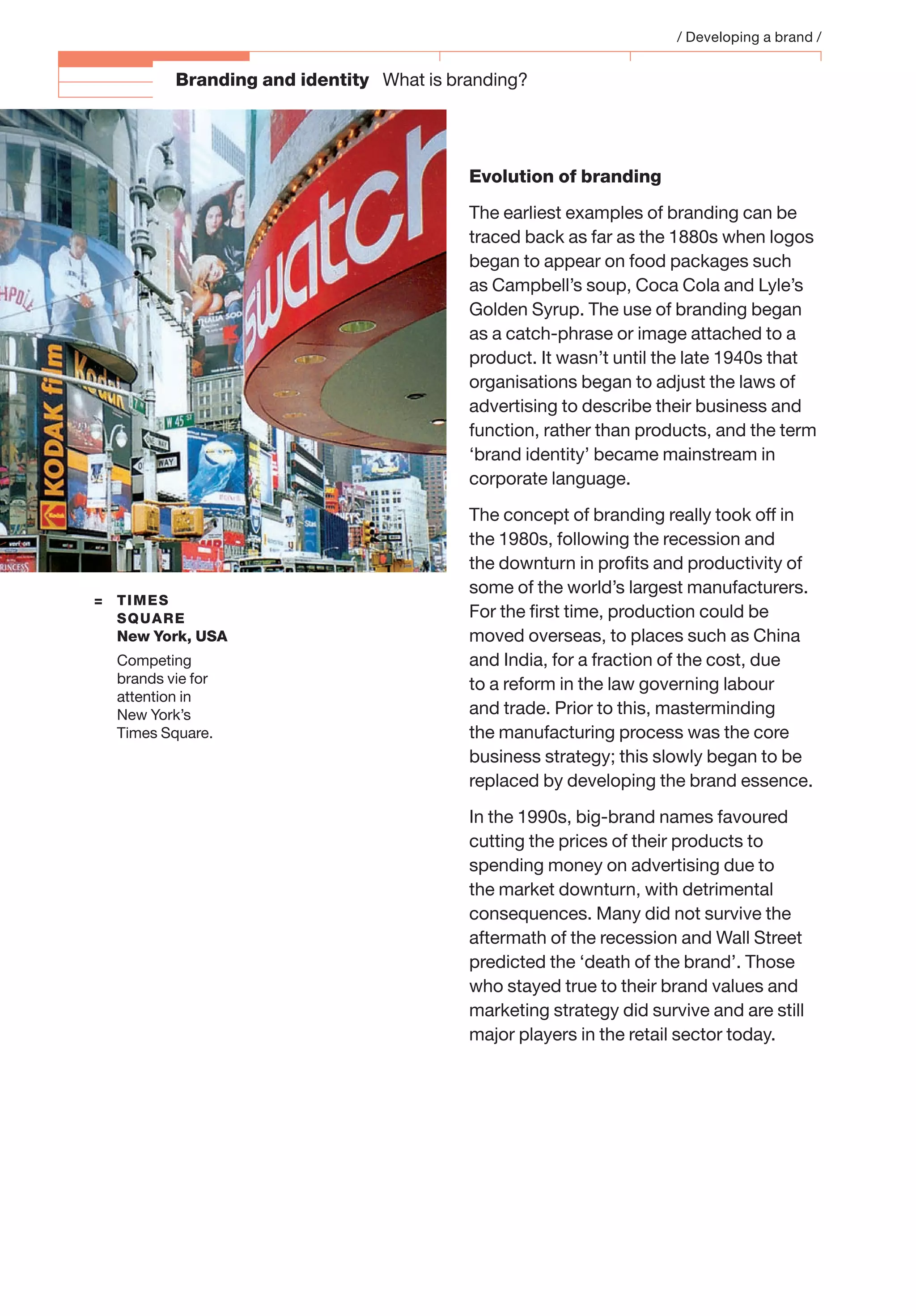
= TIMES
SQUARE
New York, USA
Competing
brands vie for
attention in
New York’s
Times Square.
014/015
Principles of branding
Every brand image is formed by
defining the main principles behind
its meaning. As well as considering
the product and its environment, it is
important to maintain a vision of how
to establish a brand and how it stands
alongside its competitors. As already
discussed, those brands that stay
true to their brand values are able to
survive and conquer in a ferociously
competitive world. For example, is the
brand a market leader or follower?
Does the brand aspire to stand alone
or does it welcome the influx of other
brands? Does the brand have a wide
or narrow focus in terms of product
diversity? Is the brand global or local?
Does the brand have longevity or is it
frequently changed? These principles
begin to question and inform the
organisation’s mission statement and
are at the core of the brand’s strategy.
The principles of a brand can be
examined under the following
headings:
Essence The essence identifies
what is at the heart of the business
and the nature of the work. These
are the most important features of
the organisation.
Values The term ‘brand values’
can be explored through what
the organisation’s morals and
standards are and how they
manifest themselves in the brand.
Image The brand image is one
of the most important aspects
of brand development and is
paramount in showing the essence
and values of the organisation to
the world through visual means.
Big ideas The big ideas
demonstrate what the brand
sets out to achieve.
Cash generator Behind every
brand is the ambition to make
money. It is fundamental to know
how this will happen.
Strange attractor The success
of many brands is in the unknown
and the additional offers that can
be made under a brand. It is
important to question what else
people use/need the brand for.
Culture Who is the
market/consumer/user and what
does it feel like to be part of this
culture?
: PHIL KNIGHT, NIKE
Nike is ‘a sports company’;
its mission is not to sell
shoes but to ‘enhance
people’s lives through sports
and fitness’ and to keep
‘the magic of sports alive’.
Branding and identity What is branding?
/ Developing a brand /
: WALLY OLINS
… to be really effective you have to
be able to sense the brand. You may
even be able to touch it and feel it.
So that it manifests the core idea.
016/017
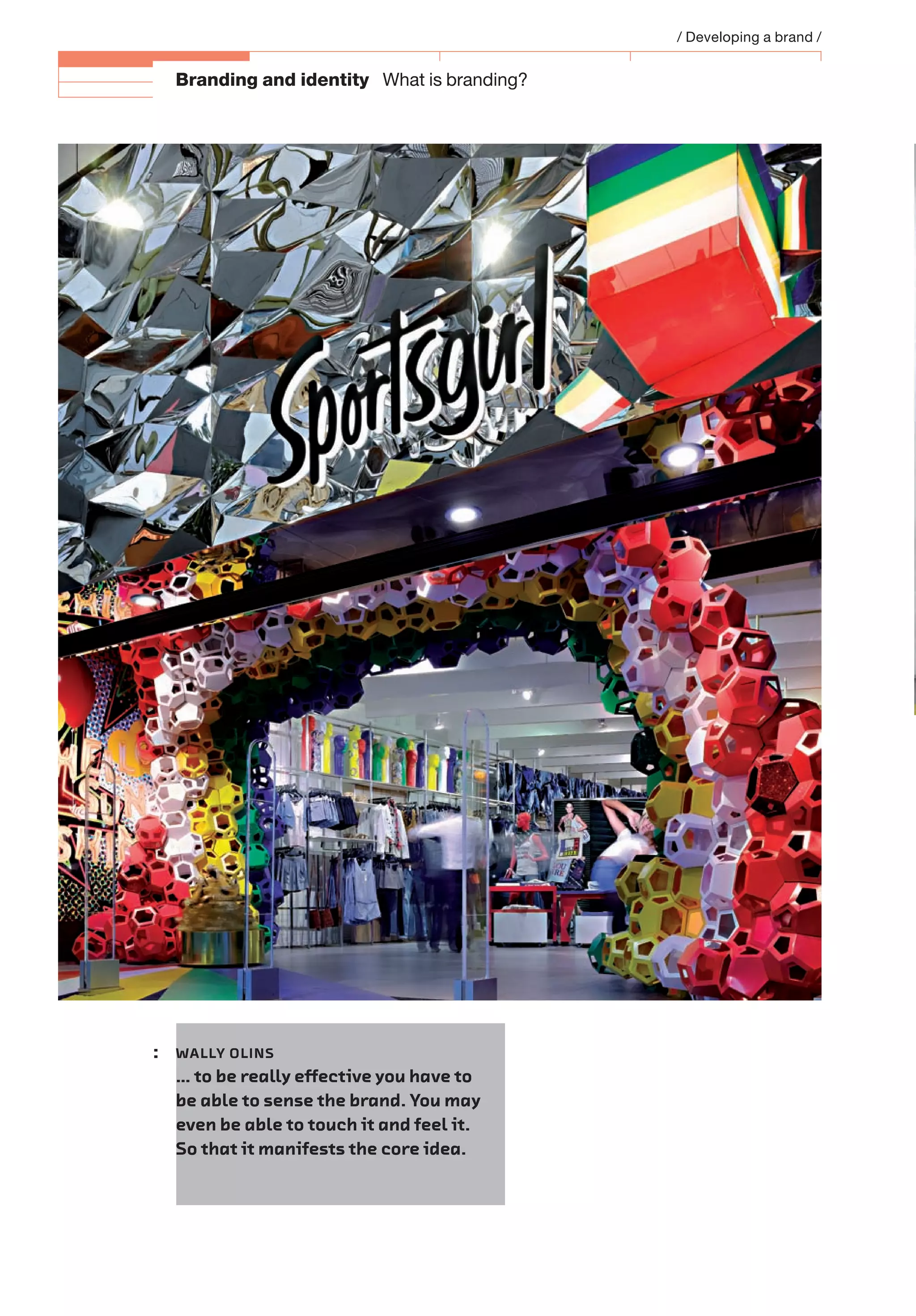
= SPORTSGIRL STORE
Melbourne, Australia
DESIGNER
= HMKM
DATE
= 2008
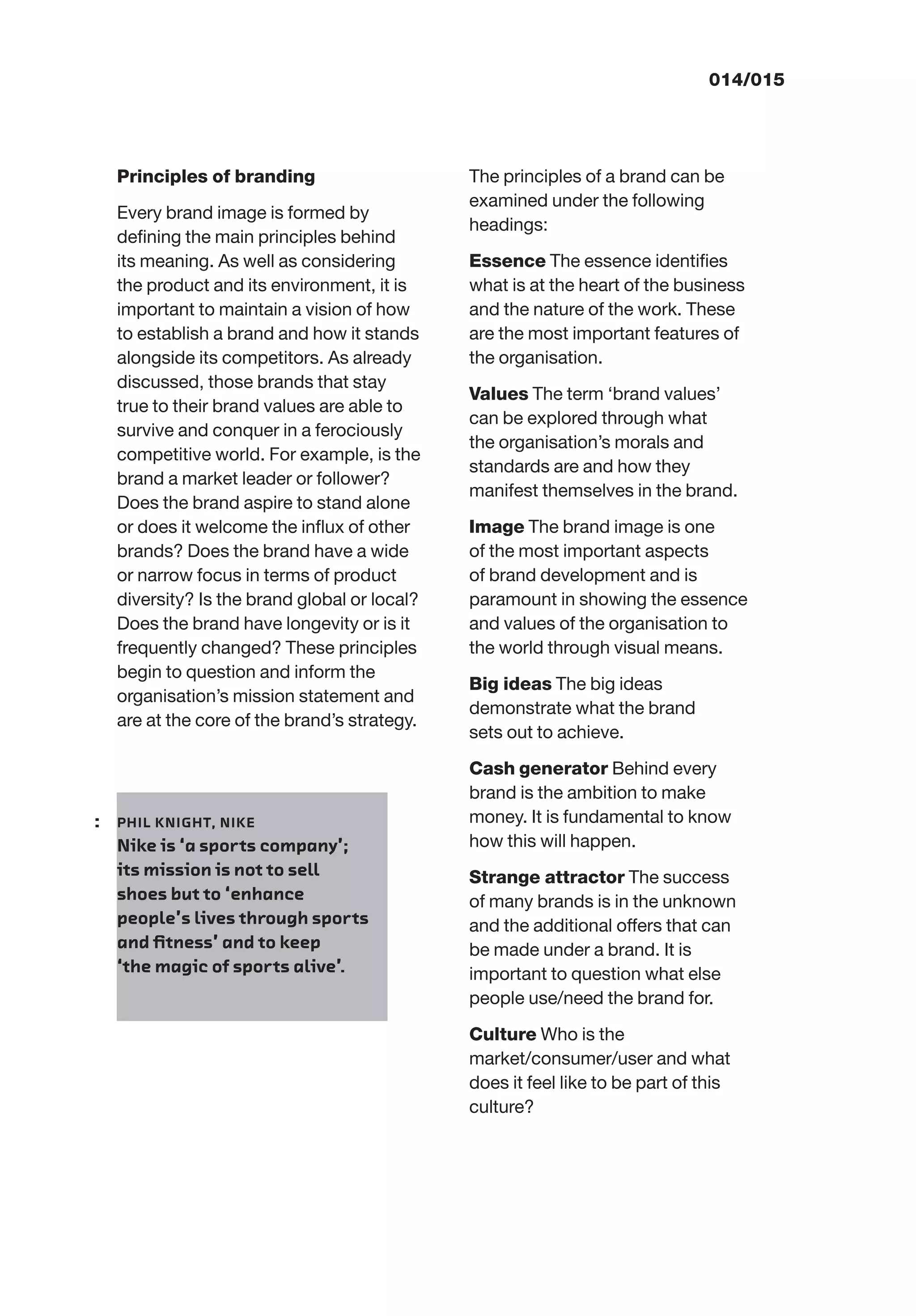
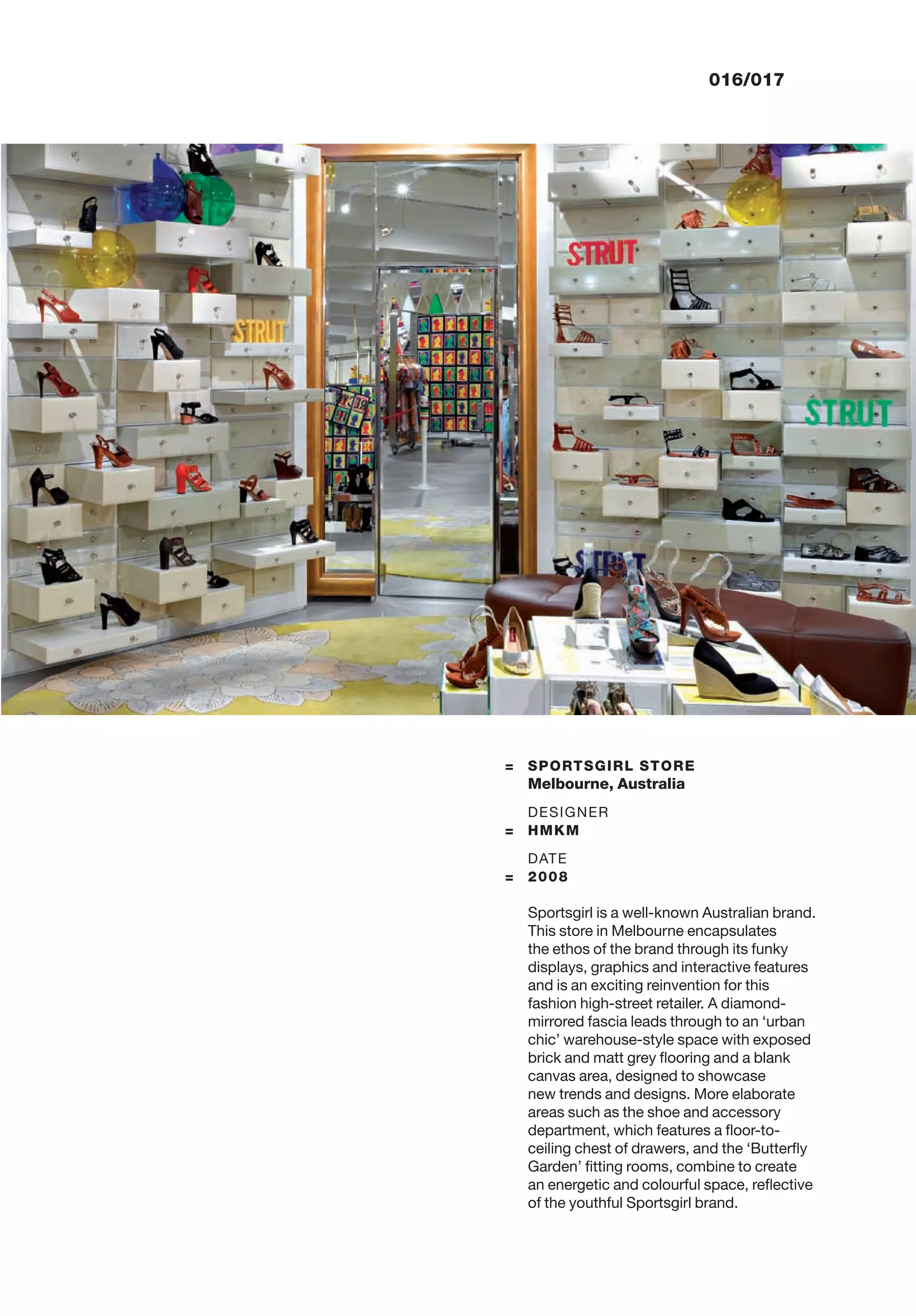
Sportsgirl is a well-known Australian brand.
This store in Melbourne encapsulates
the ethos of the brand through its funky
displays, graphics and interactive features
and is an exciting reinvention for this
fashion high-street retailer. A diamond-
mirrored fascia leads through to an ‘urban
chic’ warehouse-style space with exposed
brick and matt grey flooring and a blank
canvas area, designed to showcase
new trends and designs. More elaborate
areas such as the shoe and accessory
department, which features a floor-to-
ceiling chest of drawers, and the ‘Butterfly
Garden’ fitting rooms, combine to create
an energetic and colourful space, reflective
of the youthful Sportsgirl brand.
Branding and IdentityA BBranding and identity Developing a brand
 What is branding?  / Selling the brand /
In order to develop or reinvent
a brand, the organisation
involved will go through a series
of processes to gain an
understanding of the brand’s
nature or, in the case of
reinvention, to consider what
is not working.
Organisations often employ brand
consultants to manage this process,
as they may not have the expertise
in-house. There are various stages
involved. The first stage is to conduct
research and analysis to investigate
the nature of the organisation and its
characteristics. This is done through
auditing the organisation’s existing
position in terms of retail space,
products or facilities, for example.
Also at this point, the organisation
may look to examine its main
competitors in order to define their
place in the market. The information
generated during this initial stage then
goes on to inform the development
of the brand and to create a core idea
from which everything about the
organisation can be derived.
The next stage sees the involvement
of graphic designers as they
contextualise the meanings behind
the core ideas, questioning how the
brand looks and feels. This would be
demonstrated through graphic mood
and lifestyle boards as a starting point.
Once the feel and look is established
and agreed between designer and
client, a style can be established
that will work for both the graphic
and interior design. This is a good
example of how graphic designers
and interior designers work together.
Sometimes this process includes the
development of a new name or logo,
or working with a style that already
exists. During the graphic design
process, all kinds of decisions are
made as to how the brand will appear
in advertising. Once the designs have
been agreed, the brand guidelines
are established in a manual that is
put together by the graphic designer.
The guidelines are an important
document that is given to all
contractors involved in advertising
and signage so that consistency is
kept throughout the implementation
stage. The guidelines include logo
information, colour references,
typeface and imagery, as well as
examples of how to set out different
types of signage, stationery and other
communication tools. This manual
also informs the graphic quality and
finishes for the interior spaces.
018/019
Branding the interior
Imagine a shell of a building that is
a blank canvas with neutral walls,
floors and ceilings. Think of a well-
known brand and the associated
colour, pattern, logo, sound or scent.
Understand the product and who might
buy it. Analyse the lifestyle of someone
who would use this brand: What car
do they drive? Where do they live?
How much money do they earn?
And most importantly, what would
they expect from a retail experience?
All of these questions form the basis
from which to develop a concept that
will underpin the interior scheme.
The term used for turning a brand
into a three-dimensional spatial
experience is ‘brandscaping’.
Developing an interior concept
The interior scheme often takes its
lead from the graphic guidelines,
through understanding the aspirations
of the end-user and through analysing
the competition. This information is
portrayed through visual research
or ‘mood boards’ (images and
photographs retrieved from books
or journals that explain clearly the
thought process and ideas of the
design team) but will be interior
orientated rather than graphically
based. The key features of the visual
research are then extracted into
‘stories’ that lead to explicit ideas
about what the interior design scheme
could be and how the graphic identity
would impact on the space. From this
process, an interior concept is born.
: OTTO RIEWOLDT
Brandscaping transforms
the brand itself into a location.
Brandscaping
This is a term used to describe the mapping of a brand in a three-dimensional space.
Branding and identity Developing a brand
 What is branding?  / Selling the brand /
‘Rolling out’ a scheme
Once a design concept has been
agreed between client and designer,
a programme begins to ‘roll out’ the
new interior into the client’s existing
or new sites. The term ‘roll out’ simply
means to reproduce the same interior
across different sites. In order for this
to happen, the manual prepared by
the design team must contain all of the
elements of the design, describing
ways to adapt the scheme for different
types of site. A variety of layouts and
elevational configurations are drawn
up, as well as detailed drawings for
every fixture and fitting, a finishes
schedule and lighting information.
Sometimes the designer’s role ends
there and the information is handed
over to the client, who in turn employs
a contractor to oversee and implement
the design in each store. On other
occasions, the designer will work with
the client and contractors to prepare
separate drawing packages for each
site, using the manual as a guide
for consistency. This would entail
dealing with local authority planning
departments and making site visits.
This would usually be at the start of
a project, midway through the
programme, and to ‘snag’ the site,
fixing final details, before handover
at the end of the build. The designer
would also liase with the contractor
regarding any queries that may arise.
The designer may also become involved
with the visual merchandising of the
store, although most large retailers
have their own in-house team
specifically tasked with dressing
every store the same.
Concept interpretation
The concept is then interpreted
into a ‘mock’ interior space through
visual storyboards that may contain
adjacency and circulation plans,
animated sketch visuals and samples
of material finish. It is common for
different schemes to emerge at this
time, all of which will be presented
to the client. The client and designer
then work together to come to a
conclusive design idea: this may
result clearly from just one of the
presented concepts or may result
from a combination of all the potential
concepts. Once the concept has
been decided, the designer then
works on the detail of the design.
This process builds with each client
meeting until a conclusion is reached
and a set of drawings can be
produced in the form of a manual.
020/021
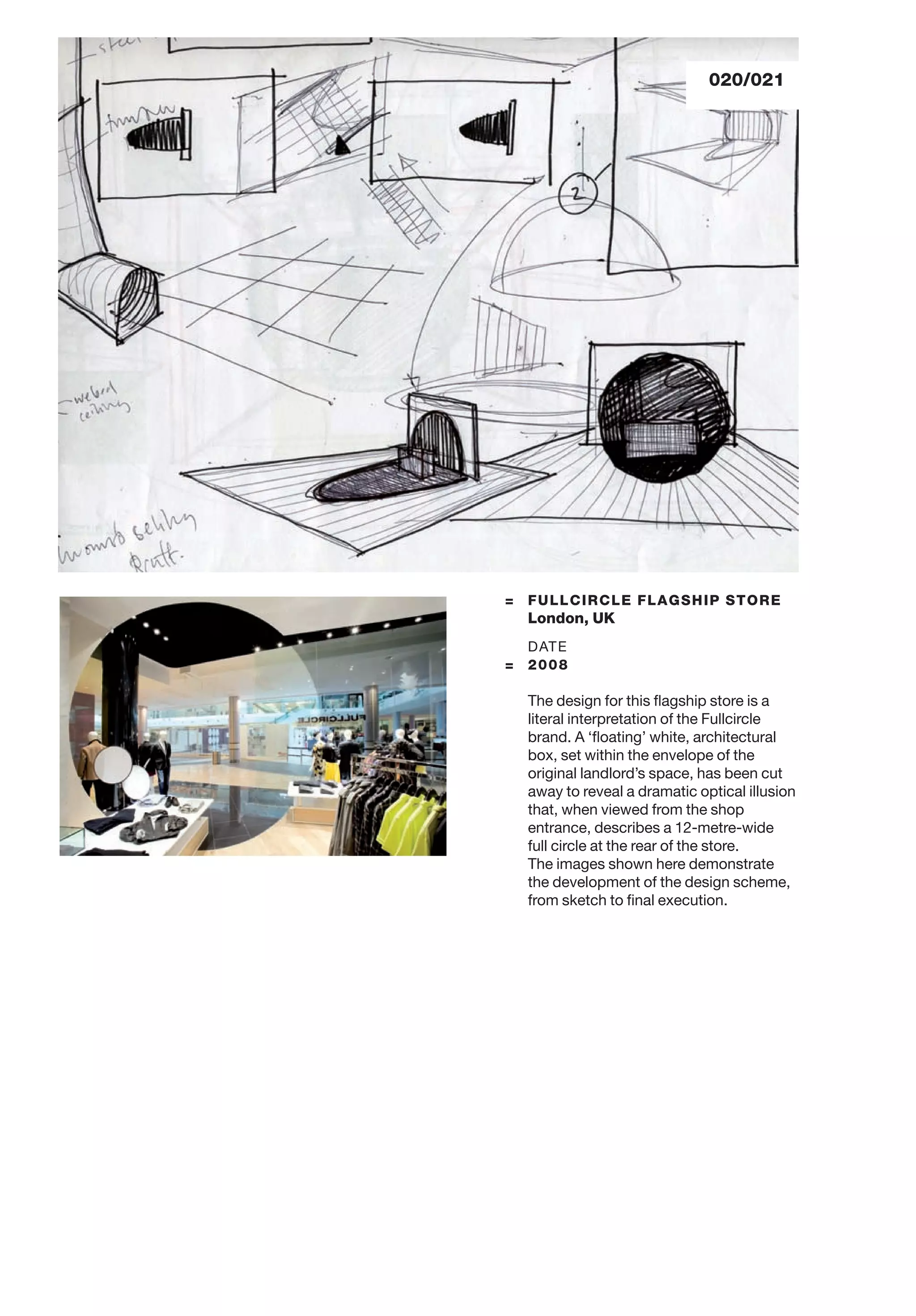
= FULLCIRCLE FLAGSHIP STORE
London, UK
DATE
= 2008
The design for this flagship store is a
literal interpretation of the Fullcircle
brand. A ‘floating’ white, architectural
box, set within the envelope of the
original landlord’s space, has been cut
away to reveal a dramatic optical illusion
that, when viewed from the shop
entrance, describes a 12-metre-wide
full circle at the rear of the store.
The images shown here demonstrate
the development of the design scheme,
from sketch to final execution.
Branding and identity Developing a brand
 What is branding?  / Selling the brand /
Building the interior
The design of a branded interior
is often split into clear areas of
development in each site. The
analysis of this reveals some
surprising results. Approximately
70 per cent of the client’s budget
would be spent on the architecture
of the building, meaning repair or
structural alteration work, electrics
and services as well as flooring,
ceilings and lighting. These elements
are critical to the interior structure
but would not necessarily be
apparent to the customer. They
must, however, have the potential
to last up to 20 years, so are a
worthwhile outlay for the client.
Secondly, the fixtures and fittings
to display the merchandise and
make the store function would cost
approximately 20 per cent of the
client’s budget and would have a
lifespan of around six years.
Although they are important in terms
of function and fit within the design
of the overall scheme, the customer
would not necessarily notice them.
The final 10 per cent of the budget
pays for the branded elements
of the scheme, through graphic
communication, finish (colour,
pattern or texture for instance), logos
displayed where possible, music
or scent. This is the critical element
that finally dresses the space and
portrays the lifestyle of the brand.
These elements may be changed
every season, week or day if fashion
and trend demands it and they mimic
the key message of the moment.
The retail store is under constant
reinvention.
: RASSHIED DIN
The retail designer’s task
is to combine elements of
psychology, technology and
ergonomics with the retailer’s
knowledge of the market.
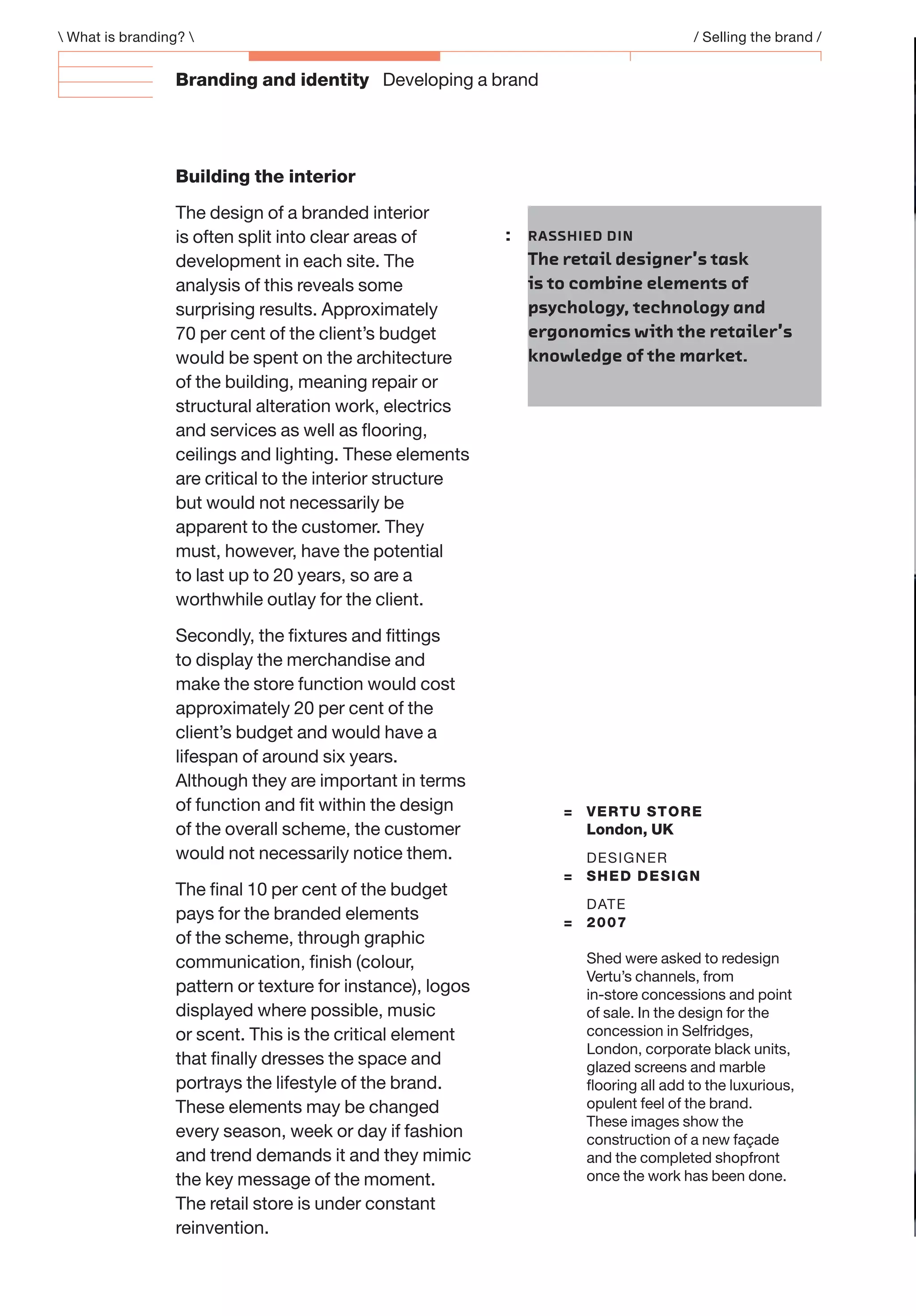
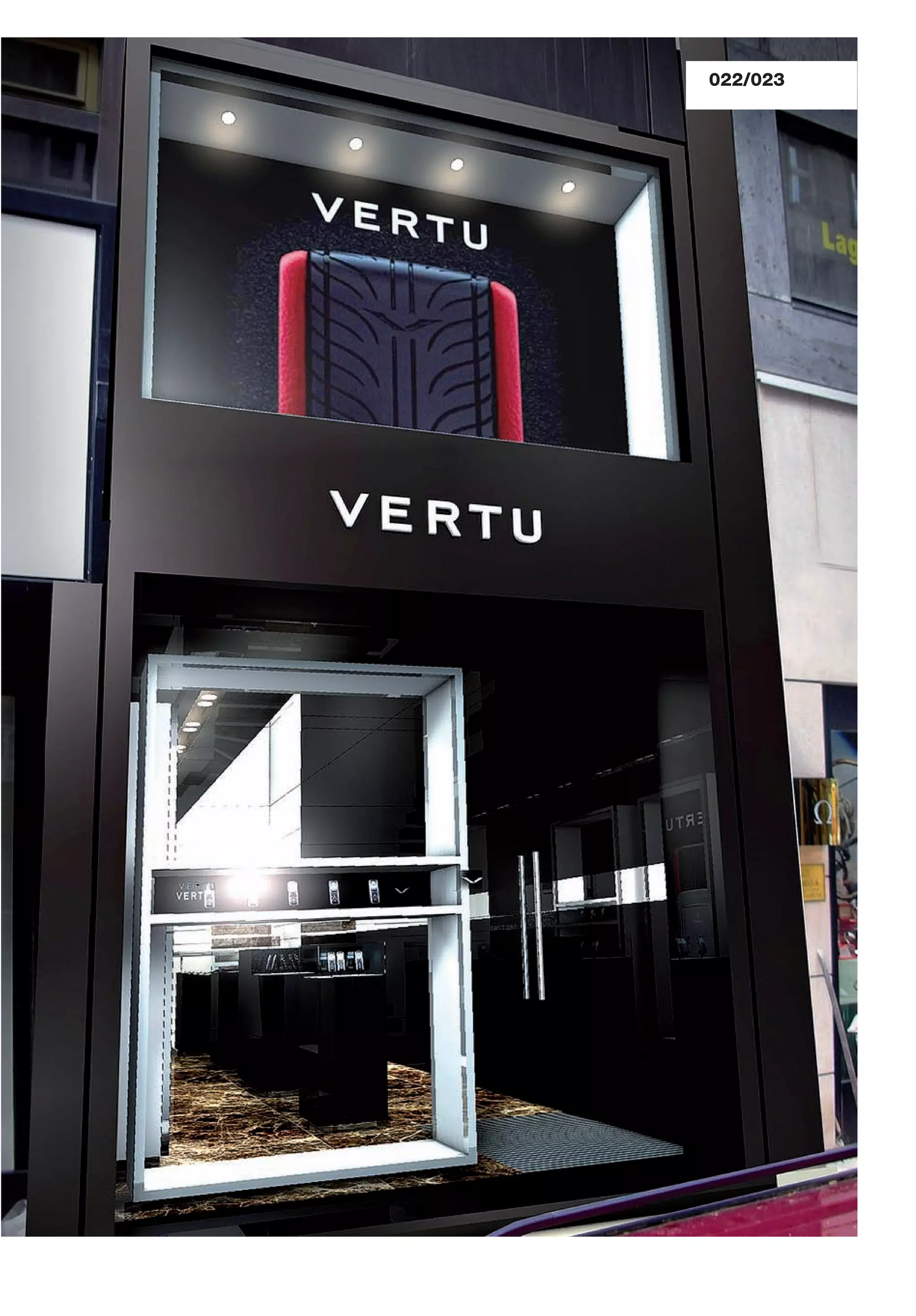
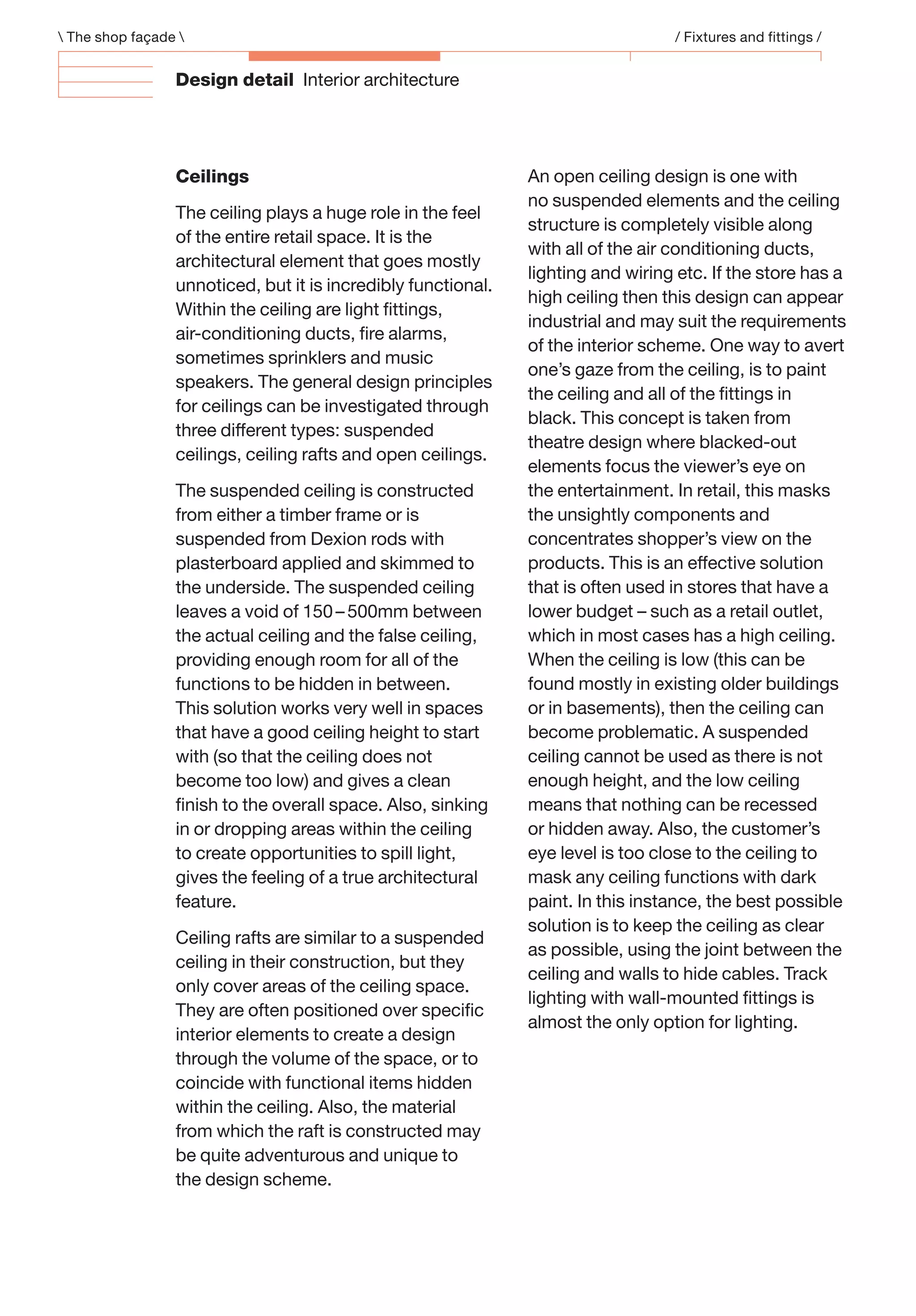
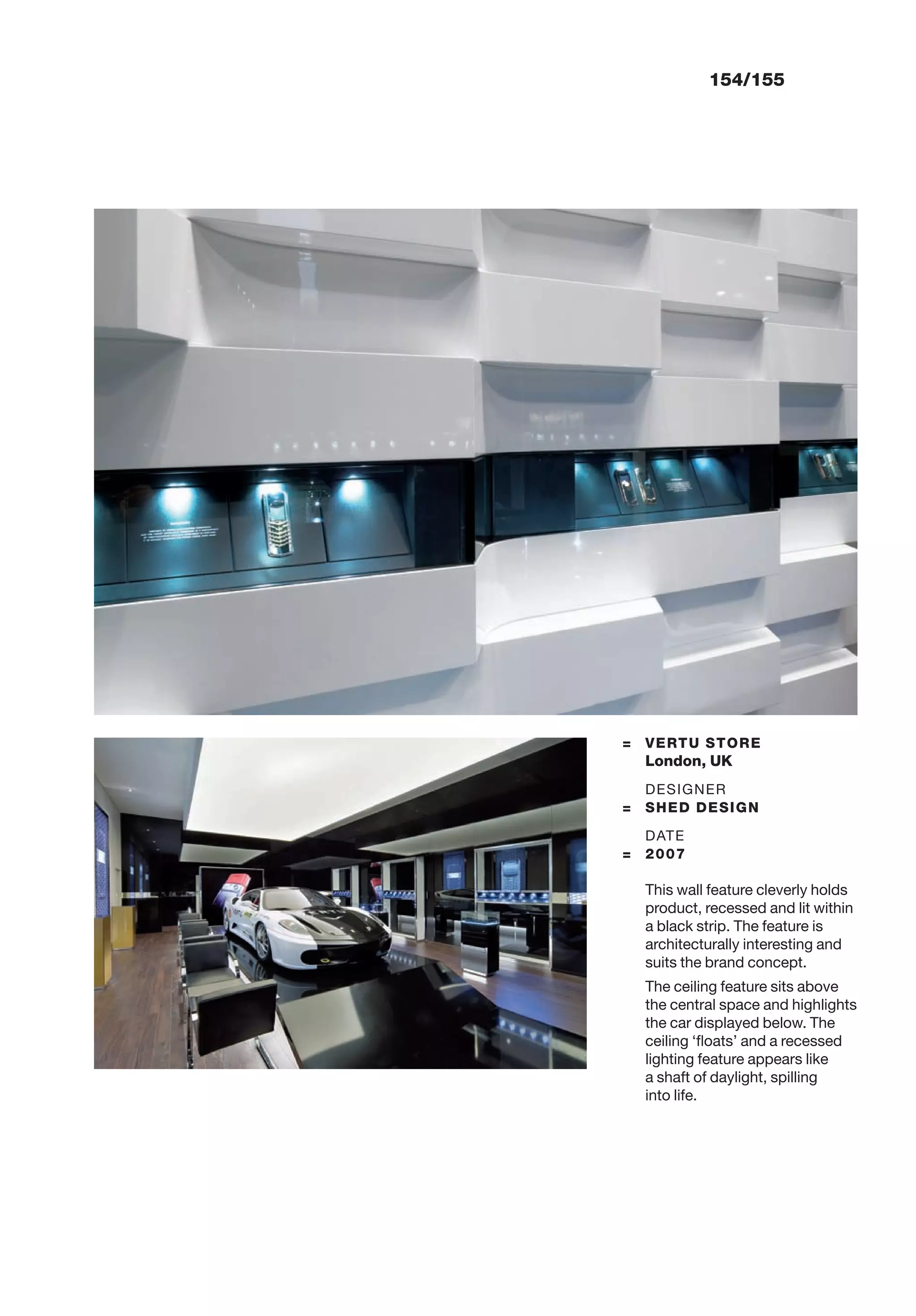
= VERTU STORE
London, UK
DESIGNER
= SHED DESIGN
DATE
= 2007
Shed were asked to redesign
Vertu’s channels, from
in-store concessions and point
of sale. In the design for the
concession in Selfridges,
London, corporate black units,
glazed screens and marble
flooring all add to the luxurious,
opulent feel of the brand.
These images show the
construction of a new façade
and the completed shopfront
once the work has been done.
022/023
Branding and IdentityBranding and identity Selling the brand
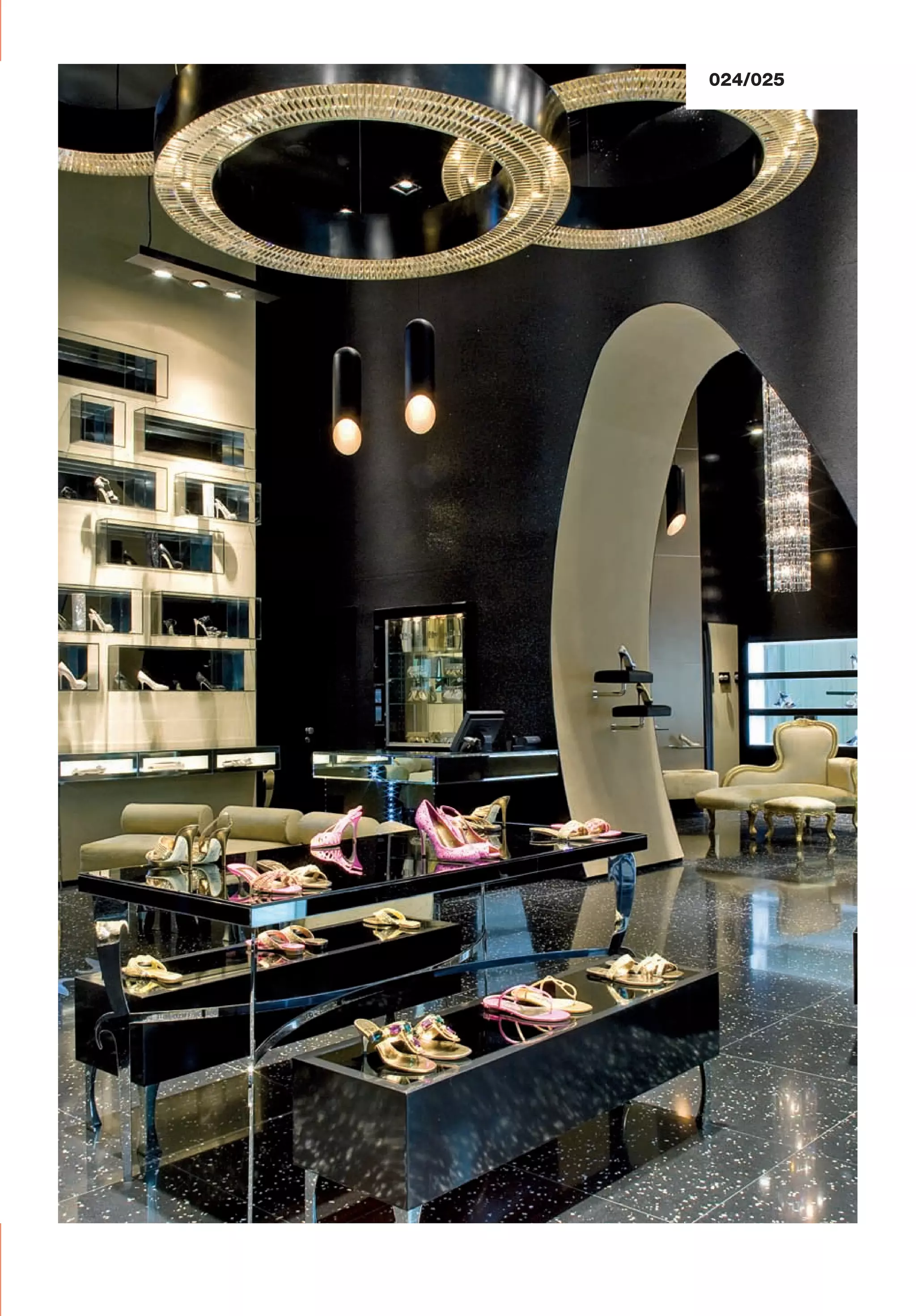
= GINA CONCEPT STORE
Dubai, UAE
DESIGNER
= CAULDER MOORE
DATE
= 2009
After establishing the Gina brand in
two prominent positions in London,
Caulder Moore were asked to transfer
the concept to appeal to a potential
Middle East market in Dubai. Using
the unique Gina motif, a distinctive
colour palette, bespoke items and
luxury finishes, the resulting design
for the interior incorporated the premium
values of the footwear brand. The
ultra-glamorous, iconic and highly
opulent look – created using black
gloss, stainless steel, suede, velvet,
full-length mirrors and Swarovski
chandeliers – reflects the quality
of the luxury merchandise.
 Developing a brand  / Student case study /
Although brand stores can
be seen throughout the world
in different formats, there are
particular mechanisms in place
for promoting a new concept
or to consolidate a brand
experience on the global market.
This usually happens in major retail
positions, to allow access to the larger
proportion of the world’s consumers.
The design is then reinterpreted down
into the smaller stores outside of the
major cities. These mechanisms can
be categorised as concept stores,
flagship stores and lifestyle stores.
As the retail market becomes more
and more saturated, retailers are
constantly trying to find new ways
to appeal to different markets. Online
selling has become mainstream for
most. More interestingly, the approach
of guerrilla marketing has taken retailing
by storm, bringing an element of
surprise and the unexpected to
the consumer.
: CAULDER MOORE
On the right-hand side of the area
an arch in the shape of the iconic
GINA shoe motif set into a black,
glitter-clad wall, inlaid with
champagne suede and holding
black velvet display pads, leads
through to the couture area.
024/025
Branding and identity Selling the brand
Concept stores
The concept store is a place where
new retailing ideas are tested or
promoted for the first time in a specific
location. The site is usually a key
retail space with a high footfall and
sales activity. The aim is to see if the
new store concept achieves a good
response from the public who would
usually buy into the brand and if a
new breed of consumer can also
be attracted. The success or failure
of a new concept is judged quite
crudely in sales figures. If sales go
up, then the concept is a success.
There are cases, however, where
the concept store in a major location
is successful, but a roll-out into
smaller sites may not work. This is
because in poorer areas, the
implementation of a polished new
scheme may indicate a more expensive
level of product that may appear
unobtainable, therefore resulting
in a downward turn in sales. For
this reason, retailers are careful in
understanding the market of a
particular place in relationship to
the brand, and can input the new
concept at a more acceptable level.
Flagship stores
The job of the flagship store is to
promote the brand in large, key retail
sites around the world. The interior is
often an extension of that found in a
retailer’s chain store, but produced to
a higher specification and with unique
features that act as a brand statement.
The flagship store influences the brand
choice made by the consumer through
creating an exhibition-like experience
that is more like a tourist attraction than
a place to shop. The idea is that the
consumer will visit a flagship store,
may or may not purchase goods, but
by visiting, they buy into the brand and
may shop in the retailer’s other stores
closer to home. The flagship store is
a clever marketing tool and aims to
subconsciously stimulate the consumer
into choosing a particular brand.
 Developing a brand  / Student case study /
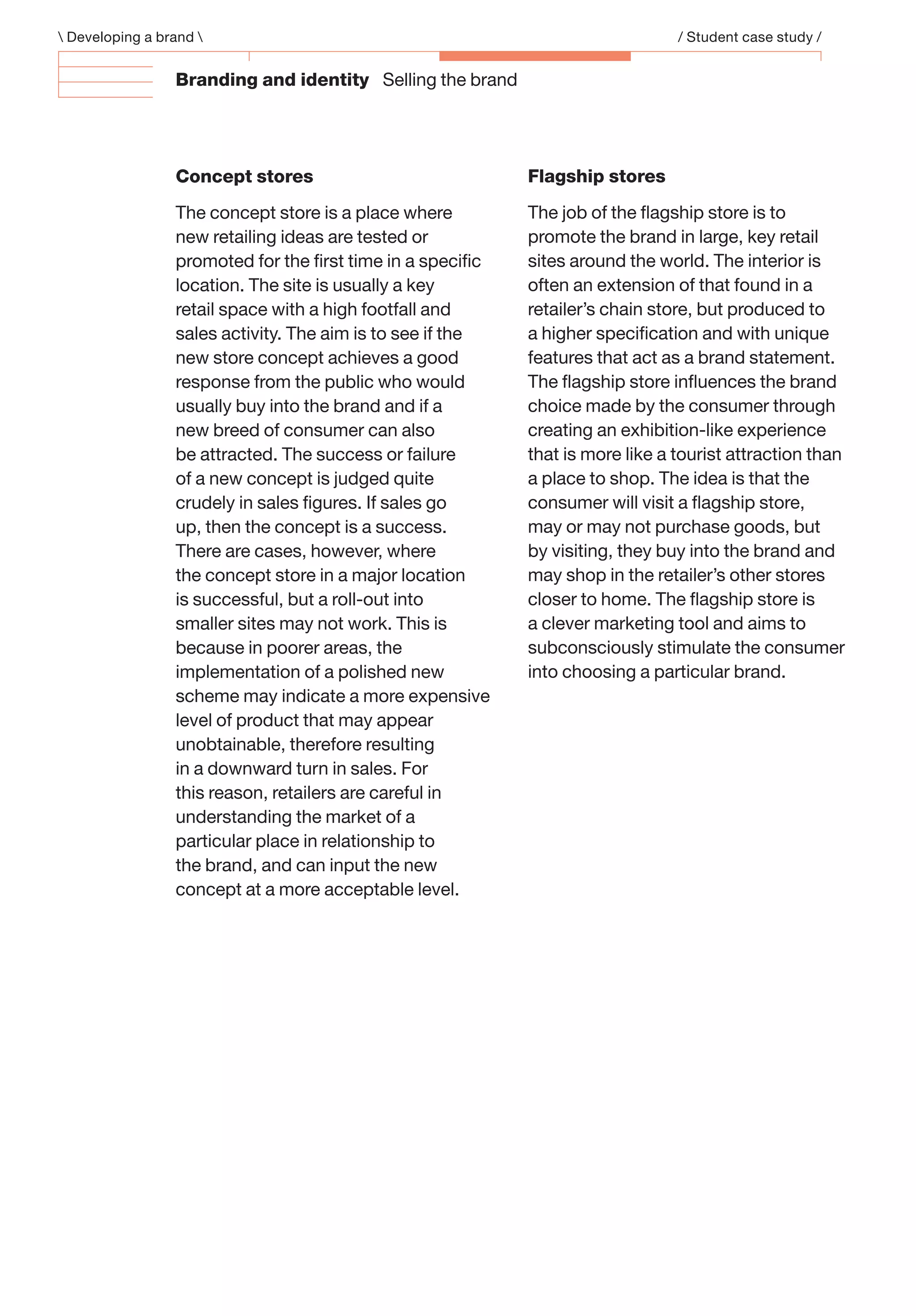
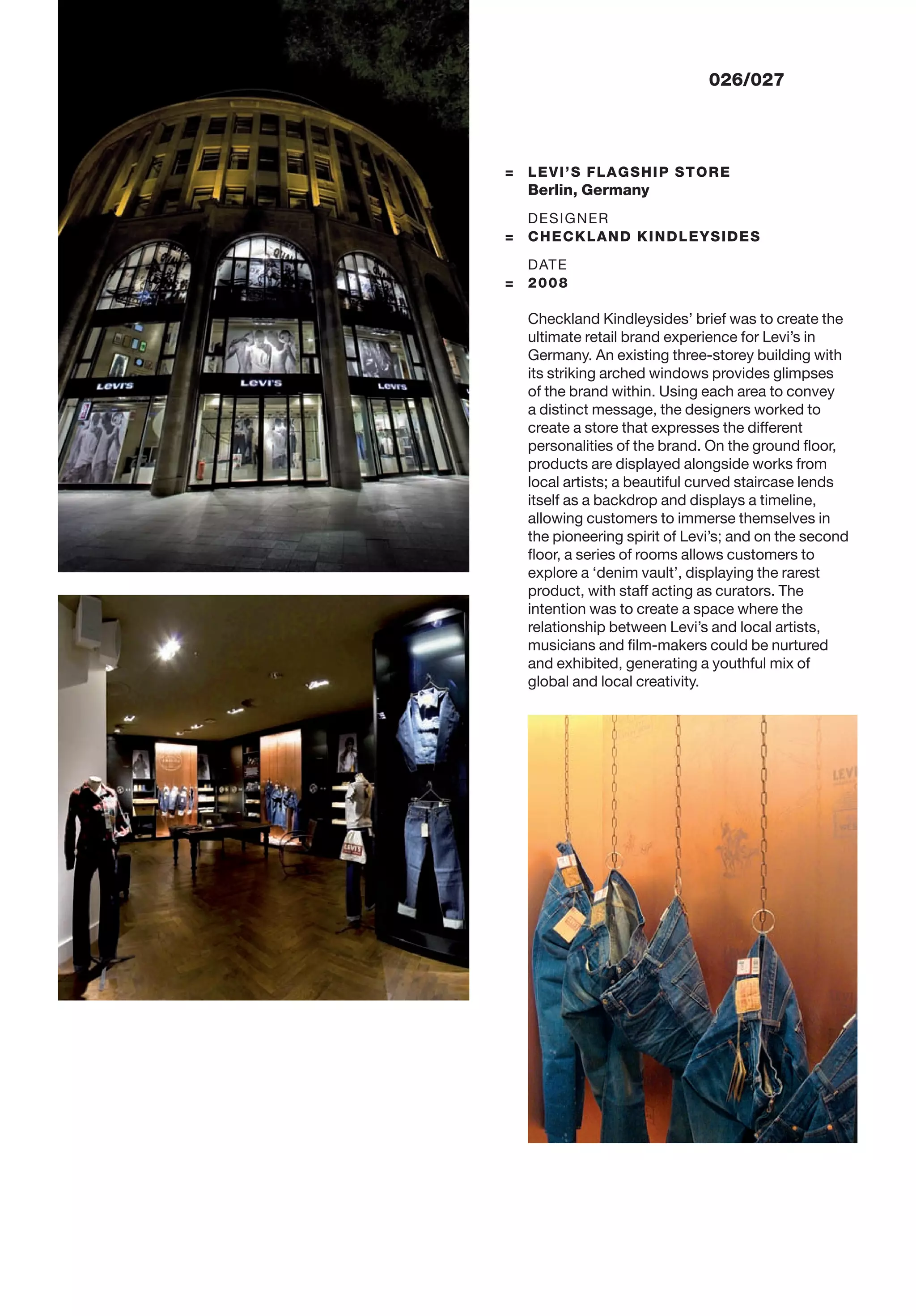
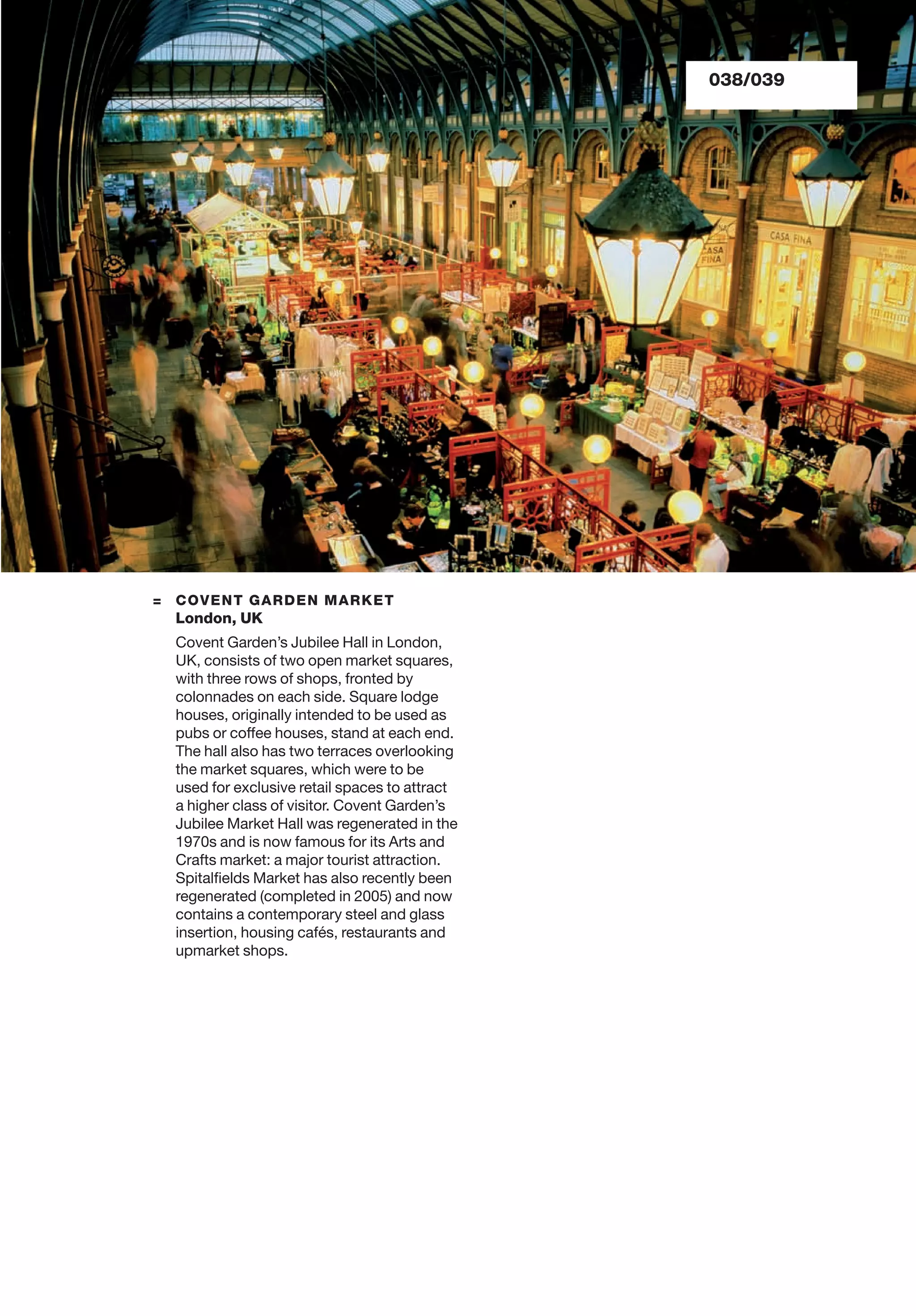
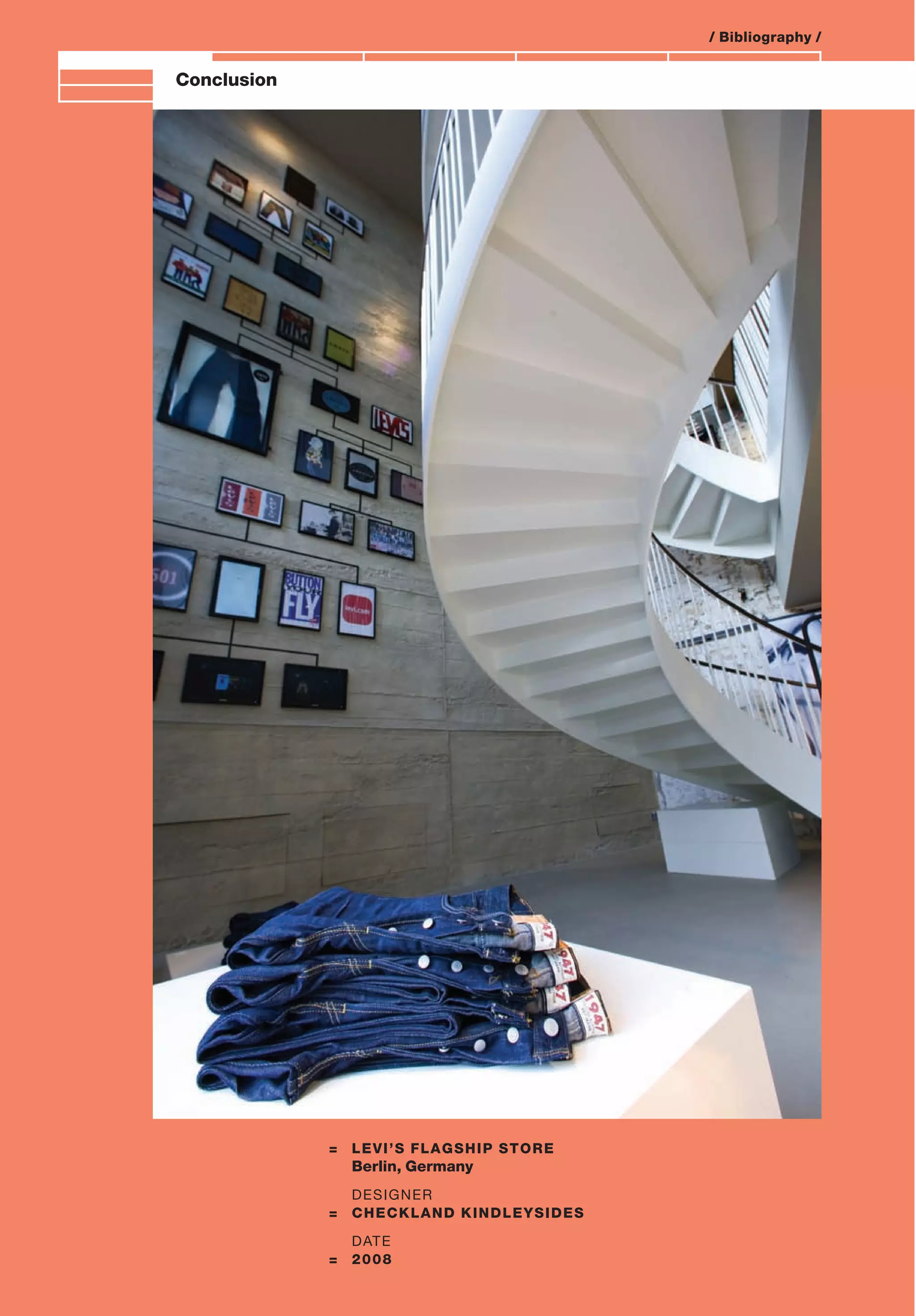
= LEVI’S FLAGSHIP STORE
Berlin, Germany
DESIGNER
= CHECKLAND KINDLEYSIDES
DATE
= 2008
Checkland Kindleysides’ brief was to create the
ultimate retail brand experience for Levi’s in
Germany. An existing three-storey building with
its striking arched windows provides glimpses
of the brand within. Using each area to convey
a distinct message, the designers worked to
create a store that expresses the different
personalities of the brand. On the ground floor,
products are displayed alongside works from
local artists; a beautiful curved staircase lends
itself as a backdrop and displays a timeline,
allowing customers to immerse themselves in
the pioneering spirit of Levi’s; and on the second
floor, a series of rooms allows customers to
explore a ‘denim vault’, displaying the rarest
product, with staff acting as curators. The
intention was to create a space where the
relationship between Levi’s and local artists,
musicians and film-makers could be nurtured
and exhibited, generating a youthful mix of
global and local creativity.
026/027
Branding and identity Selling the brand
 Developing a brand  / Student case study /
= LEVI’S POP-UP STORE
Various locations
DESIGNER
= CHECKLAND KINDLEYSIDES
DATE
= 2008
This portable retailing concept for Levi’s
allows the brand to bring the product to
the consumer, wherever they may be.
The entire concept of merchandising,
graphics, product and even changing
room folds away to be stored within a
series of flight cases, reminiscent of
those that a band would take on tour;
allowing the brand to be both agile and
spontaneous, generating an element of
exclusivity and surprise.
Pop-up stores and events
One phenomenon currently gripping
retail culture is the pop-up store or
installation, which is a derivative of
guerrilla marketing. The idea is that
a store will appear in a location for a
minimum amount of time. It may be
in the form of a temporary structure
or a space that is not usually
associated with retail. The venue
and event is not advertised, aiming
the concept at the cool, those in the
know. The pop-up store concept is
associated with cutting edge and
being with the ‘in’ crowd:
‘if you don’t know about it, you don’t
need to know’ type of psychology.
This concept is realised to lift the
status of the brand and will provide
the consumer with a different type of
product that can only be found in
this exclusive temporary location.
028/029
Lifestyle stores
The concept of the lifestyle store
was derived from the idea that
chain stores could provide a
diverse product range under one
brand. This was seen as being
aspirational for the consumer, as
they could then buy into a whole
lifestyle experience. The lifestyle
store can incorporate all of the
retail sectors by offering fashion,
homeware and entertainment
departments. The lifestyle store
sometimes sees the merger of
diverse retailing, such as a bank
with a coffee house, or a sports
store with a technology area.
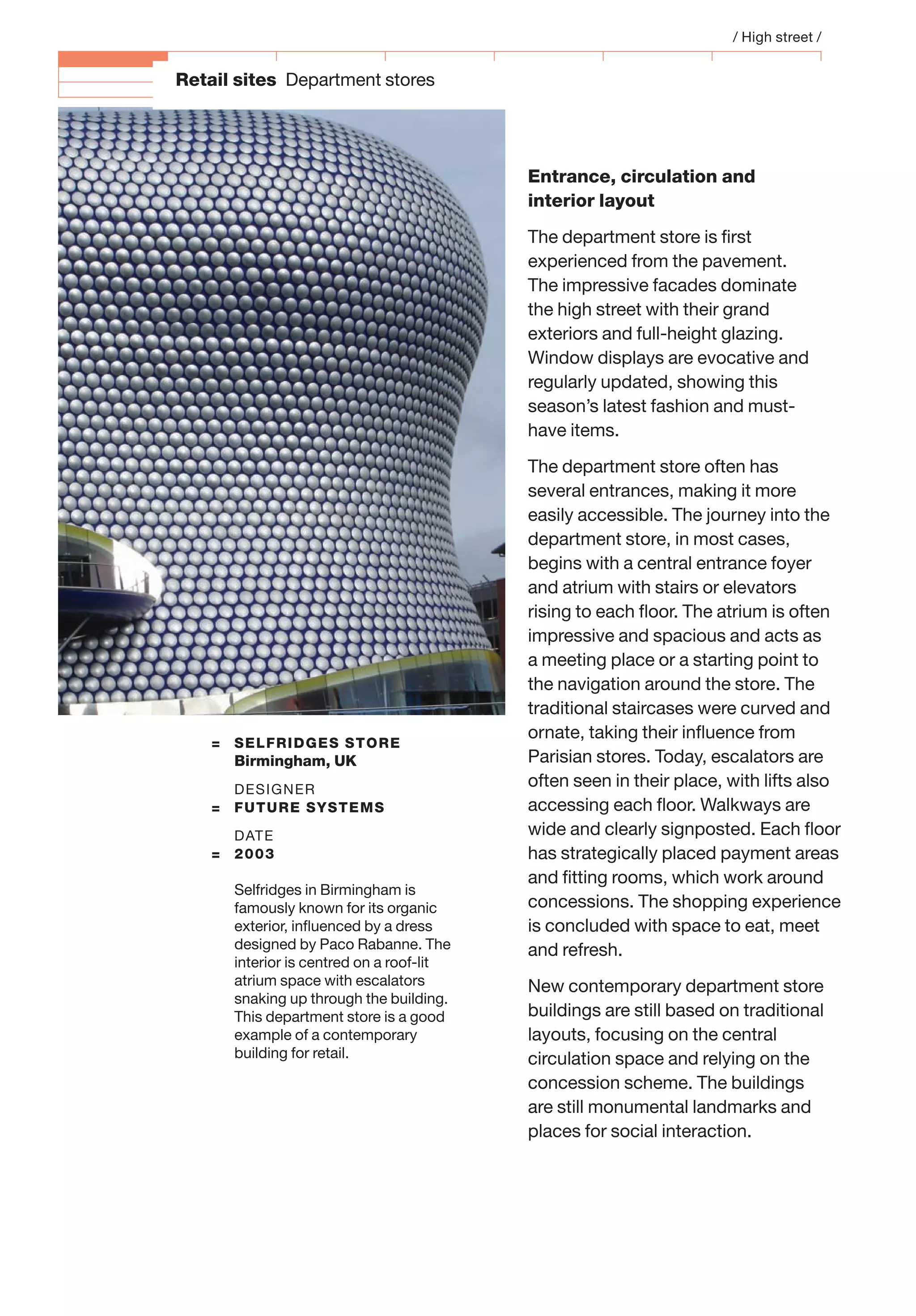
= M&S LIFESTORE
Gateshead, UK
DESIGNER
= JOHN PAWSON
DATE
= 2004
The M&S Lifestore incorporates a
diverse product range under one
roof, making it a ‘lifestyle’ store.
Characteristic of John Pawson,
this particular design explores
how architecture may be shaped
around rituals of use rather than
conventions of form. It draws
on the essential Pawson vocabulary
of wide floorboards, quiet white
walls, floating benches, the shadow
gap, floor-to-ceiling glazing with
minimal frames, the optimal
treatment of light and a restricted
palette of natural materials.
Photographer: Richard Davies
Branding and identity Selling the brand
 Developing a brand  / Student case study /
Endorsements, collaborations
and sponsorships
It is usual for brands to be seen
sponsoring major events, such as
sports competitions, in the form
of advertisement hoardings. More
recently, brands collaborate with
artists of different types as a way of
promoting the brand in particular
circles, therefore enhancing its
attraction. In recent years, we have
seen a rise in celebrities endorsing
products with their name, which in
turn is their brand, to raise the status
of a product type and to give the
consumer the opportunity to, in some
small way, become them. The sale
of perfume is a good example of this.
Whether the brand is a celebrity
endorsement, collaboration between
the arts and brand or sponsorship
of an event, the outcome impacts
on the interior space for its duration.
The space in some cases becomes
a one-off event in itself or a temporary
interior installation becomes the
centre point of the store or gallery.
This communicates an air of
exclusivity to consumers who are
quick enough and in the know,
enabling them to buy into the brand
for a limited period or to experience
the brand as an installation rather
than a place to shop.
= SONY PLAYSTATION® EVENT
Various locations
DESIGNER
= CHECKLAND KINDLEYSIDES
DATE
= 2007
To celebrate PlayStation’s six-month
season of arts collaborations with the
Baltic, English National Opera and
British Film Institute, an iconic interactive
installation was designed and moved
to different venues. The mirrored
sculptural form was developed to
enhance its surroundings and reflect
the rich visual content of each venue.
030/031
!
Branding and identity Student case study
= Computer-generated
visualisations of the
completed space.
PROJECT
= MOBILE PHONE STORE
DESIGNER
= MAGDALENA KUMALA
DATE
= 2006
= Plans of
the space.
Students were asked to design a retail
space for the display, selling and storage
of a luxury brand of mobile phone,
incorporating a strong brand identity that
can be easily recognised and accepted
throughout the world. This resulting design
considers the variety of product ranges
and the number of phones to be displayed.
The site used for the project is based on
a typical retail unit in a shopping mall of
approximately 40 square metres and a
ceiling height of three metres with adequate
storage for 70 phones. The sales process
allows staff to engage with customers
once they have shown interest in a specific
product, with space where the staff and
customer can sit down to discuss the
phones comfortably. The design concept
is based on opulence, seduction and
exclusivity and uses luxurious materials
and lighting to suggest the quality of
the product and to mimic the identity of
the brand.
 Selling the brand
= Sections of
the space.
? Now imagine that you have been
asked to design a retail space for
the display, storage and selling of
a luxury brand of mobile phone.
1 List other mobile phone brands.
What makes yours original?
2 Could these qualities be echoed
in the design of the space? How?
3 List the requirements of a space
of this nature. Can the qualities
of the brand be reflected in these
elements?
4 What elements can be carried
across other branches?
5 The mobile phone industry is
fast-paced and competitive.
How could your design be easily
updated?
032/033
Branding and Identity
 Branding and identity  / Retail sites /
Retail sectors
Retail spaces can be defined and identified
through different retail sectors. These
sectors can be broadly described as food –
the evolution of the market into supermarket
and speciality food stores; fashion – clothing,
shoes, accessories and beauty products;
home – DIY, furniture, fabrics and cookware;
and leisure and entertainment – sport,
technology, travel and finance. Each sector
has been influenced through social and
economic conditions, politics, history and
the development of design processes.
THIS CHAPTER aims to identify these influences
on the designed space of each sector and
explain the nature of the evolving retail
experience. This is demonstrated by
examining leading examples in retailing in
each sector.
034/035
Branding and IdentityRetail sectors Food
Food retail is a huge industry,
evident in every town and city
through its cafés, restaurants,
coffee shops and supermarkets.
Today, large conglomerates and
retail chains dominate food
sales in the Western world,
with many well-known brands
pitching against each other
and independent retailers for
local trade.
The design language of these retail
environments, often repeated from
town to town, can at first appear
monotonous, yet for many of us they
are part of our everyday routine for
sustenance. Delve deeper into the
concepts of such spaces and an
interesting process begins to emerge.
These spaces have derived from
cultural influences and worldwide
traditions, and have been interpreted
into a systematic, functional store
environment. For instance, many coffee
shops and restaurants reflect European
café culture, taking advantage of the
warm climate with open facades and
exterior seating; similarly, supermarket
product displays are reminiscent of
street markets and old market halls,
with produce stacked high, and the
colours of food and packaging utilised
to attract sales. The layout of aisles too,
pushing customers in a particular
direction, is set out in a similar way
to the market, but in a much more
regimented manner.
/ Fashion /
036/037
= FLOATING MARKET
Bangkok, Thailand
The floating fruit and vegetable
market in Bangkok is an
example of bringing food into
the city by whatever means
necessary.
= DJEMMA EL FNAA SQUARE
Marrakesh, Morocco
Many cities are centred on the market.
Here, the scent of herbal medicines and
incense fills the air, creating a unique
ambience associated with Morocco.
The market merges into the many
alleyways leading off it, where trading
continues from the souks. In markets
such as this, the produce sells itself.
Markets
Historically, the marketplace has played
a major role in the emergence of cities,
from the covered markets of Central
Asia and China, the Arab souk, the
Roman forum to the street markets and
marketplaces of European cities.
Markets are traditionally the places
where food and other essential items
were brought into the city from the
surrounding farmland or from the sea
to be sold to the masses. The trade
routes for the transportation of such
produce have been instrumental in
creating communities in the form of
villages and towns along the way.
In many countries, the market is still
the hub of the city. It is a place for
engagement, creating a buzz with its
richness in activity, sounds, colours,
smells and experience. The market is
transient, ever changing, and is part
of the urban landscape.
Market stalls are constructed from
simple frames to allow for flexibility,
disassembly and storage. Each stall
is like a little shop with the awning
overhead creating an interior space
and sheltering goods from the
elements. They are functional and
allow for the display of goods at table
height, with containers of food piled
high, and hanging for textiles. Here
it is the produce that sells itself rather
than the design of the display.
?
Retail sectors Food
Market halls
In the West, market halls were built as
a way of housing market traders and
sheltering them from the elements on
the streets. In the 1980s, many market
halls in the UK changed use or were
demolished, as supermarket shopping
became the norm. When the City of
London was originally built, the strategy
had been to meet the essential needs
of all of the residents of the city and as a
result, London had a wealth of sizeable
wholesale markets: Smithfield’s for
meat and Billingsgate for fish (both of
which are still running today). Borough
Market, Covent Garden Market and
Spitalfields Market were used for selling
fruit and vegetables (only Borough
remains as a food market). The market
hall has seen a re-emergence in recent
years and although it has lost its core
value, it is now a tourist destination
and a place for finding specialist high-
quality ingredients, arts and crafts,
textiles and fashion.
The layout of the market hall tends to
be based on rows of permanent shop
accommodation overlooking a central
open market space for pitching stands.
: R. THORNE
Markets were ‘intended to serve
bodily needs as the church
served spiritual ones’.
/ Fashion /
HISTORY AND NARRATIVE
Established practices and historical uses
can dramatically inform the design of a
retail interior. An aura of the past can
affect user experience and can be
regarded as a design tool of great worth.
These issues are dealt with in greater detail
in the AVA title, Basics Interior
Architecture: Context + Environment.
038/039
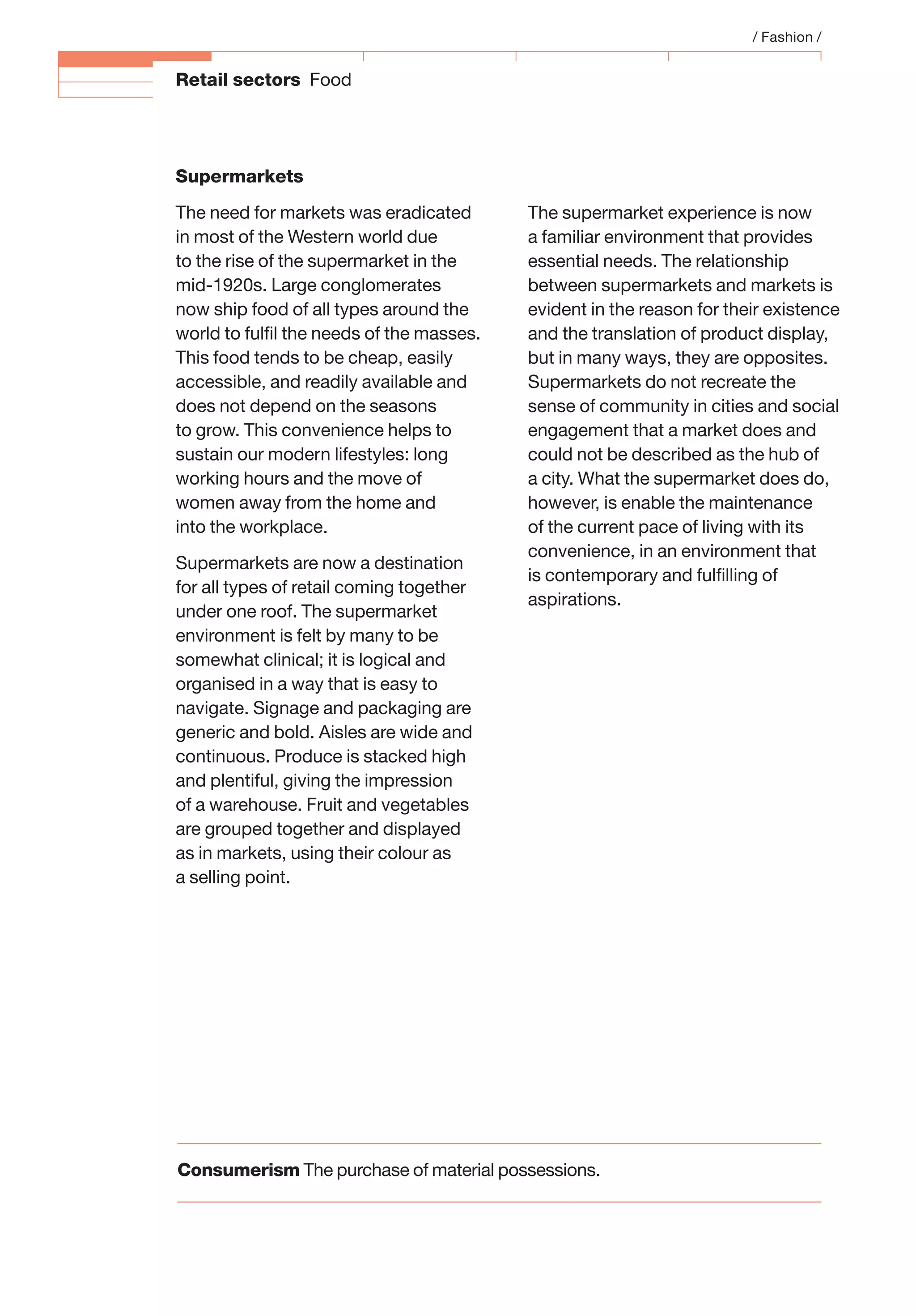
= COVENT GARDEN MARKET
London, UK
Covent Garden’s Jubilee Hall in London,
UK, consists of two open market squares,
with three rows of shops, fronted by
colonnades on each side. Square lodge
houses, originally intended to be used as
pubs or coffee houses, stand at each end.
The hall also has two terraces overlooking
the market squares, which were to be
used for exclusive retail spaces to attract
a higher class of visitor. Covent Garden’s
Jubilee Market Hall was regenerated in the
1970s and is now famous for its Arts and
Crafts market: a major tourist attraction.
Spitalfields Market has also recently been
regenerated (completed in 2005) and now
contains a contemporary steel and glass
insertion, housing cafés, restaurants and
upmarket shops.
Retail sectors Food
/ Fashion /
The supermarket experience is now
a familiar environment that provides
essential needs. The relationship
between supermarkets and markets is
evident in the reason for their existence
and the translation of product display,
but in many ways, they are opposites.
Supermarkets do not recreate the
sense of community in cities and social
engagement that a market does and
could not be described as the hub of
a city. What the supermarket does do,
however, is enable the maintenance
of the current pace of living with its
convenience, in an environment that
is contemporary and fulfilling of
aspirations.
Supermarkets
The need for markets was eradicated
in most of the Western world due
to the rise of the supermarket in the
mid-1920s. Large conglomerates
now ship food of all types around the
world to fulfil the needs of the masses.
This food tends to be cheap, easily
accessible, and readily available and
does not depend on the seasons
to grow. This convenience helps to
sustain our modern lifestyles: long
working hours and the move of
women away from the home and
into the workplace.
Supermarkets are now a destination
for all types of retail coming together
under one roof. The supermarket
environment is felt by many to be
somewhat clinical; it is logical and
organised in a way that is easy to
navigate. Signage and packaging are
generic and bold. Aisles are wide and
continuous. Produce is stacked high
and plentiful, giving the impression
of a warehouse. Fruit and vegetables
are grouped together and displayed
as in markets, using their colour as
a selling point.
Consumerism The purchase of material possessions.
040/041
Speciality food stores
The design of some speciality food
stores can be more easily directly
linked to the experience of the market
than supermarkets can. Displays
are more purposeful in creating an
authentic market atmosphere and
do not have the constraints of the large
conglomerate chain. Like some market
halls of today, these spaces bridge
both the retail and leisure sectors;
the products are an aspiration and
create an impression of a lifestyle. They
can combine a mix of contemporary
and traditional interiors with character
and charm.
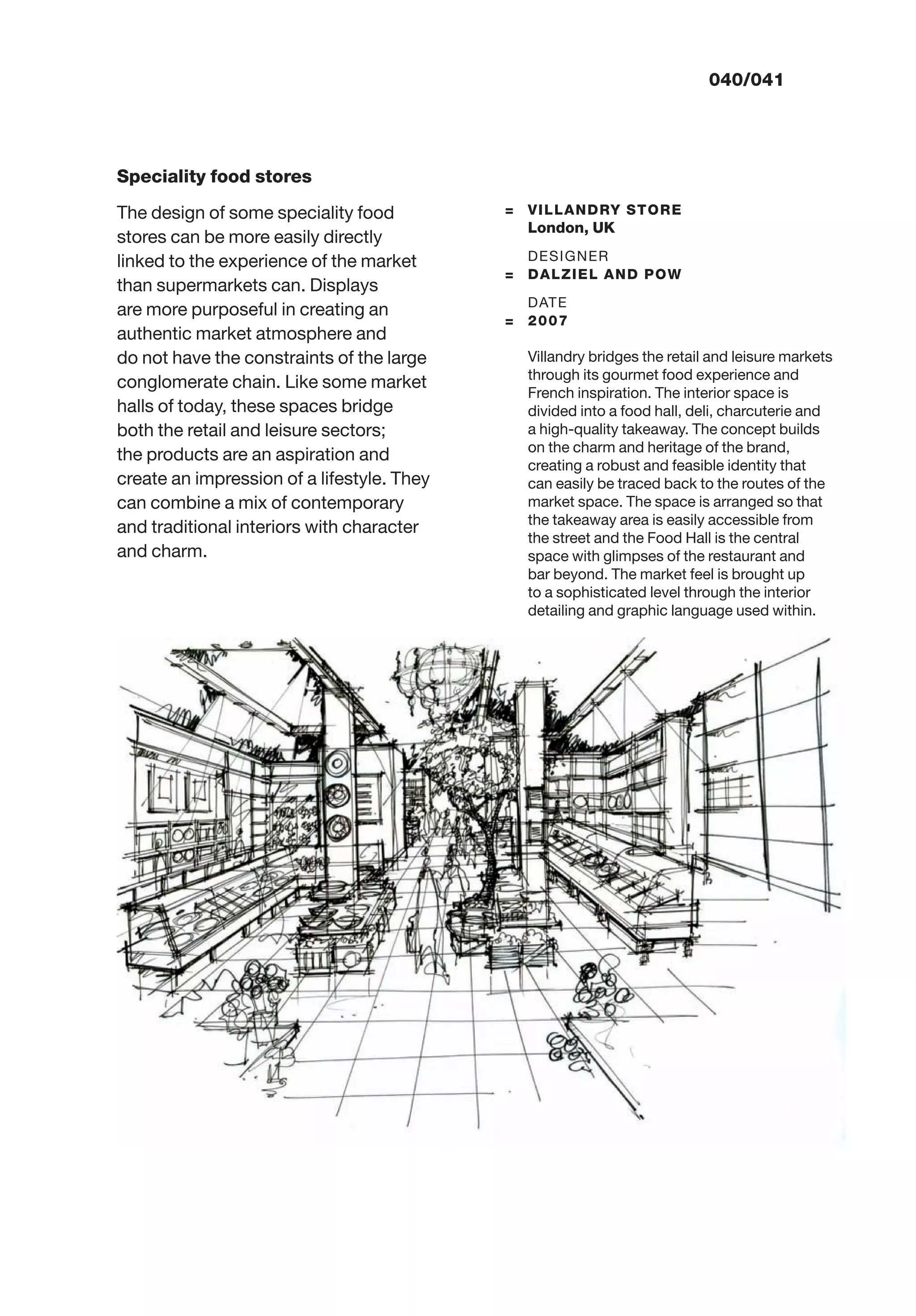
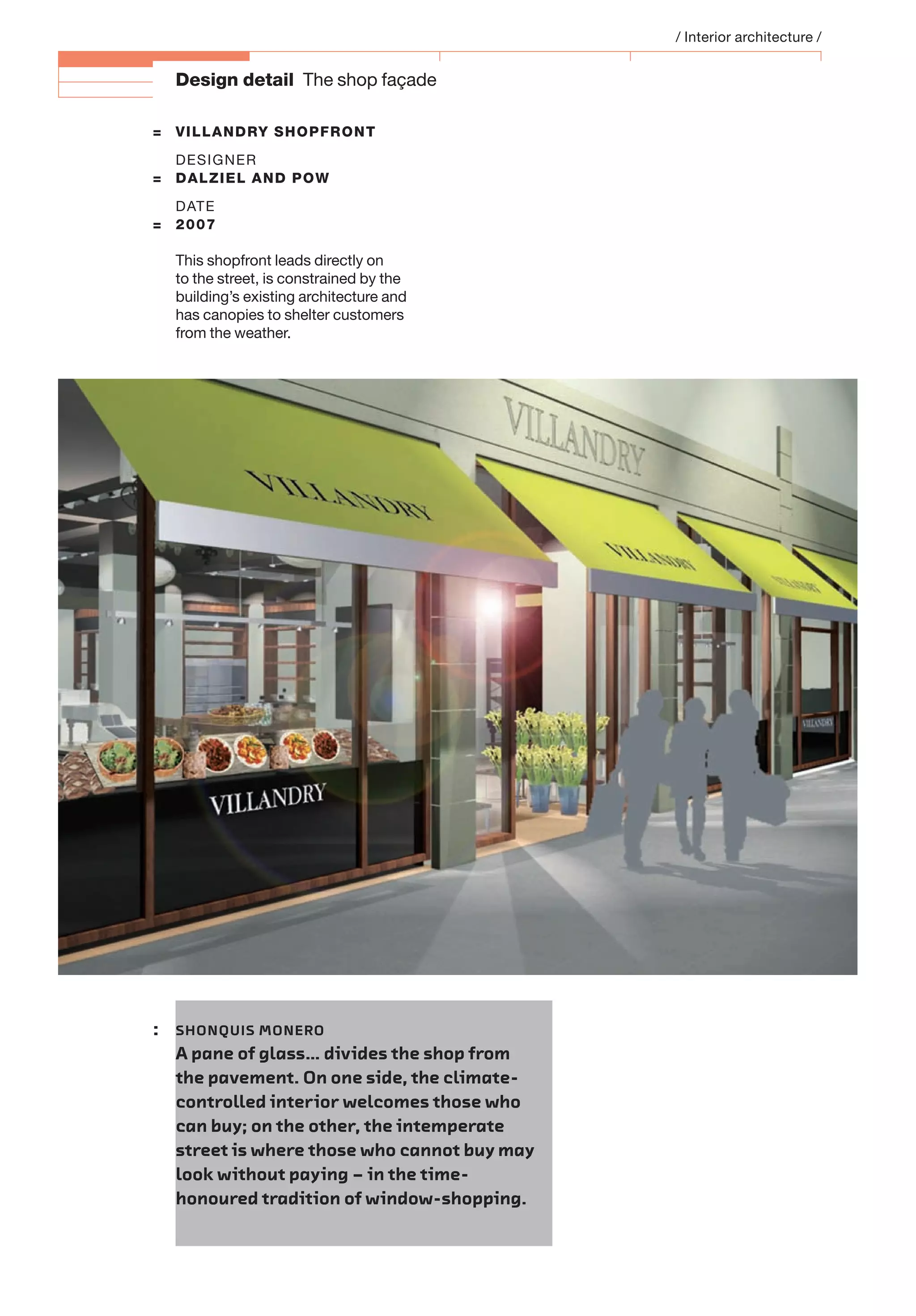
= VILLANDRY STORE
London, UK
DESIGNER
= DALZIEL AND POW
DATE
= 2007
Villandry bridges the retail and leisure markets
through its gourmet food experience and
French inspiration. The interior space is
divided into a food hall, deli, charcuterie and
a high-quality takeaway. The concept builds
on the charm and heritage of the brand,
creating a robust and feasible identity that
can easily be traced back to the routes of the
market space. The space is arranged so that
the takeaway area is easily accessible from
the street and the Food Hall is the central
space with glimpses of the restaurant and
bar beyond. The market feel is brought up
to a sophisticated level through the interior
detailing and graphic language used within.
Food  / Home /
Retail sectors Fashion
Fashion has an important
influence on the retail sector.
First, the interior space is
designed in line with current
trends in colour, material and
graphics. Secondly, the sector
is dominated by the huge
consumer boom in the fashion
industry, which covers the sales
of clothing, accessories and
shoes as well as beauty
products. Fashion is a market
that is largely dominated by
women and is very much an
interactive social experience
perceived by many as a day out.
Fashion has played an important role
throughout history in portraying class,
wealth and heritage. However, fashion
retail really took off with the birth of the
department store concept in Britain.
In Paris in 1850, this was developed
into a shopping experience for the
sophisticated Bourgeois, with the
launch of the Grand Magasin, Le Bon
Marché. The diverse product ranges
and fashions represented the
Bourgeois culture’s commitment to
appearance and material wealth,
which is mirrored in the displays
around the department store.
As the world of fashion is ever
changing, fashion stores demand
interiors that will appeal to the
appropriate market. Fashion retail
can be broken down into three areas:
premium fashion labels, where
innovative, cutting-edge fashions
and retail spaces lead the way for
their counterparts; boutiques, where
the interior space is unique and styled
to suit the needs of the individual;
and the mass-consumed commercial
fashion empire, where fashions and
interiors are fast paced, exciting and
sometimes controversial.
042/043
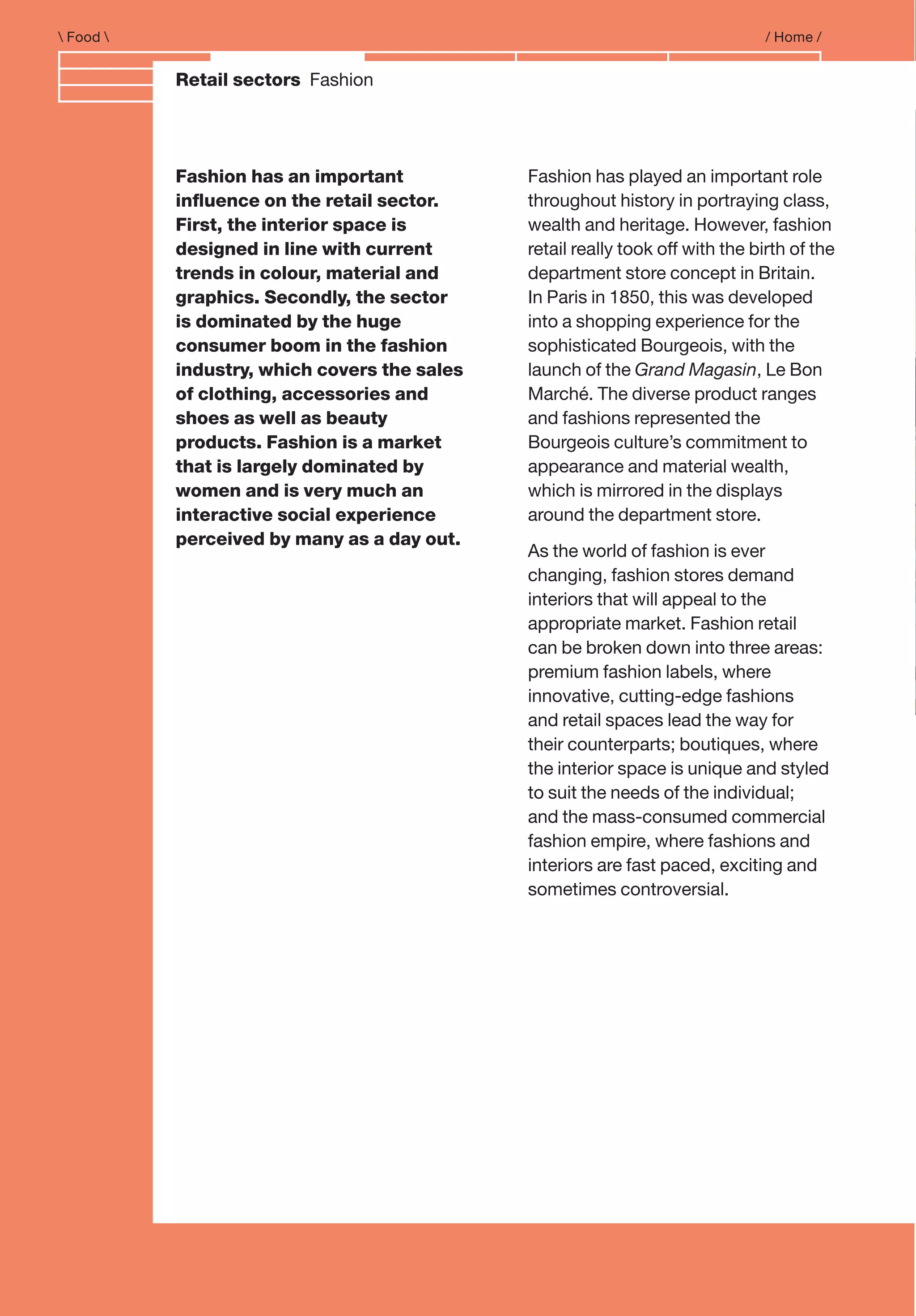
= CALVIN KLEIN STORE
Paris, France
DESIGNER
= CLAUDIO SILVESTRIN
DATE
= 1997
The design of this space provides a
simple, minimalist interior, common
in many premium fashion stores.
Using limestone floors, white walls
and satin glass screens, the space
is given a ‘showcase’ feel and is
unable to detract from the clothes
on display.
Retail sectors Fashion
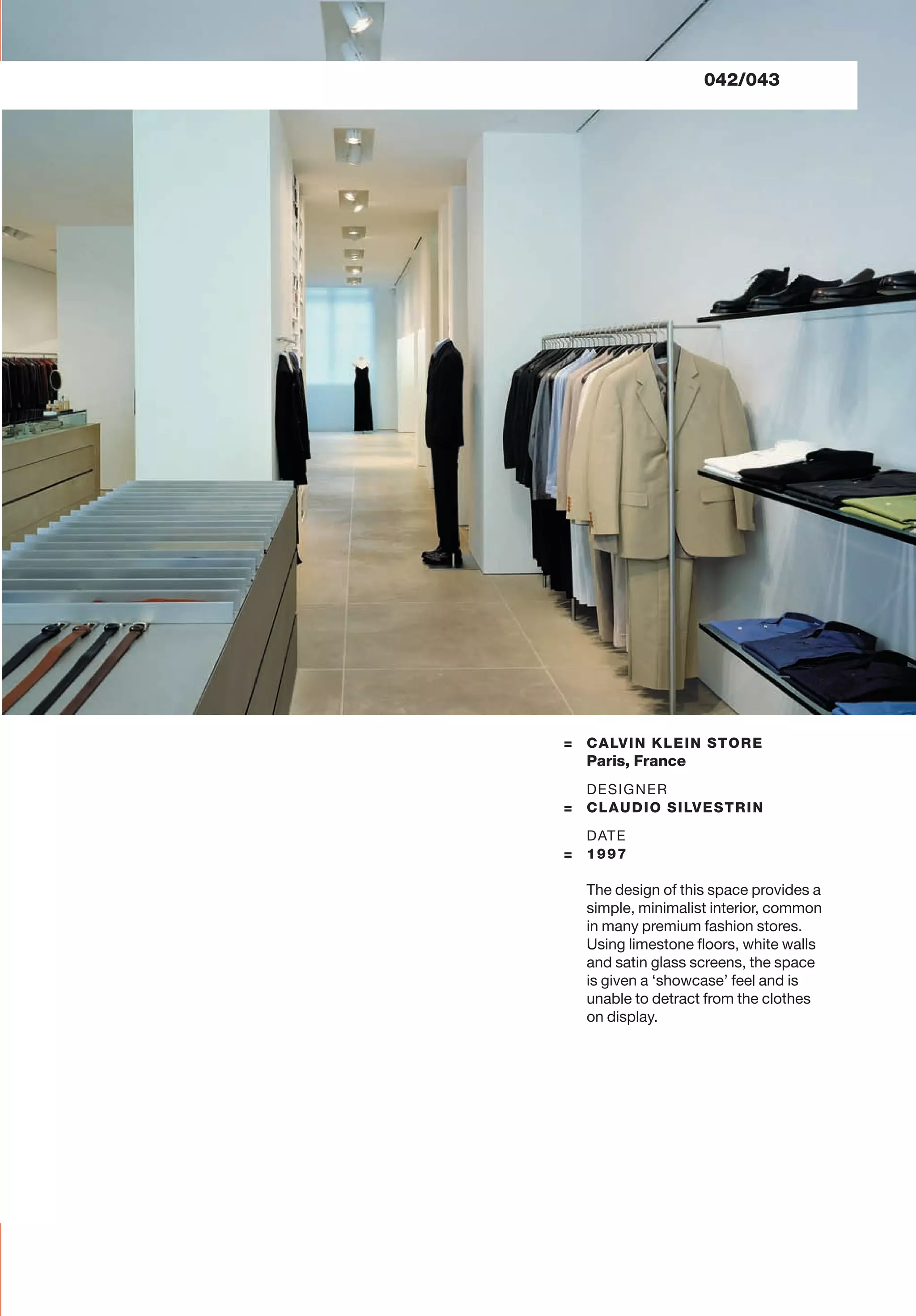
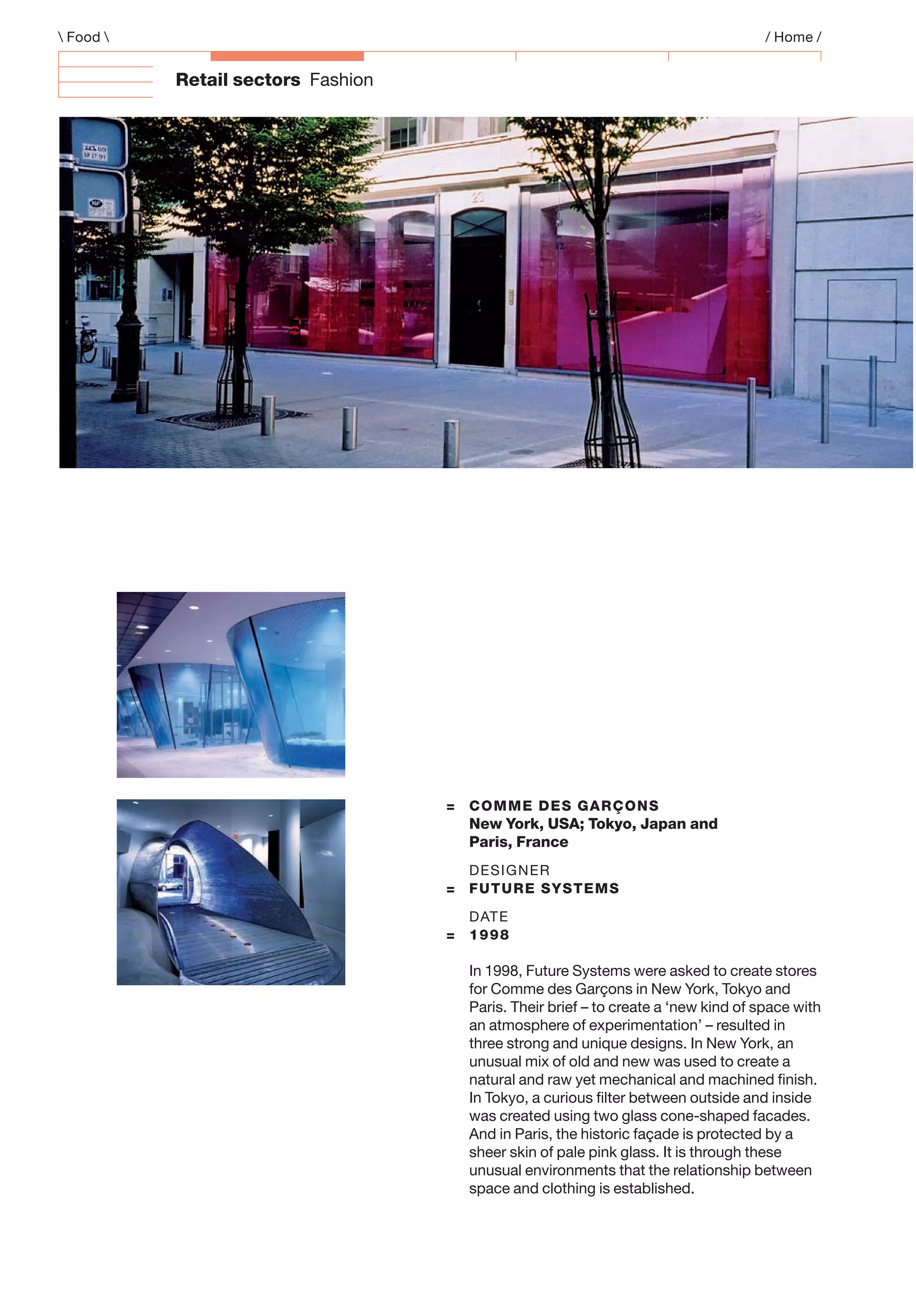
= COMME DES GARÇONS
New York, USA; Tokyo, Japan and
Paris, France
DESIGNER
= FUTURE SYSTEMS
DATE
= 1998
In 1998, Future Systems were asked to create stores
for Comme des Garçons in New York, Tokyo and
Paris. Their brief – to create a ‘new kind of space with
an atmosphere of experimentation’ – resulted in
three strong and unique designs. In New York, an
unusual mix of old and new was used to create a
natural and raw yet mechanical and machined finish.
In Tokyo, a curious filter between outside and inside
was created using two glass cone-shaped facades.
And in Paris, the historic façade is protected by a
sheer skin of pale pink glass. It is through these
unusual environments that the relationship between
space and clothing is established.
 Food  / Home /
The fashion house
The fashion house is a term that is
used to describe an exclusive fashion
label, which has a designer or collection
of designers working under its name.
The premium fashion interior has
become the most influential and
creative of retail spaces and has
fuelled a fertile fusion of fashion and
architectural design. The large fashion
houses often implement their major
brand stores in London, Paris, Milan
and New York, as these are considered
the most prestigious fashion capitals
of the world.
There are numerous displays of
successful collaborations between
fashion designers, artists, designers
and architects, resulting in exciting
and innovative retail spaces. This form
of collaboration started in the 1980s,
with minimalist stores created by leading
architects coming to the forefront in retail
design. These spaces were well crafted
and detailed, often referred to as ‘white
boxes’, in which clothing could be
displayed like pieces of art. Today, we
can still see examples of such interiors,
but there is also a different type of space
that has emerged. With the influence of
cyberspace, the use of CAD modelling
computer packages has transformed
the design process in such a way that
organic architectural forms are easier
to manipulate and are being showcased
as insertions into retail spaces.
The relationship between the fashion
designer and architect allows the
fashion designer to gain a strong,
unique identity that the architect is
able to realise in a quick timeframe.
It is interesting to note that although
these spaces exist, it is a trend that
is not commonplace in architectural
circles. In some cases, the architect
will design a building for the fashion
house, or work primarily on the interior
of an existing building. The fashion
house, in most cases, has a large
budget and can therefore push the
boundaries of contemporary design.
: REM KOOLHAAS
Shopping is a phenomenon that
has ‘remained mysteriously invisible
to the architectural eye … as one of
the most critical and … important
contributions to urban texture at
this moment’.
044/045
Retail sectors Fashion
 Food  / Home /
The boutique
The rise of the boutique as a small
independent retailer began in the late
1950s, in the aftermath of the Second
World War, when the youth of that era
was ready to embrace freedom and
self expression. Before this time, a
boutique was a department found in
a larger store that provided clothing
ranges somewhere between custom-
made couture clothes and cheap
mass-produced wholesale clothes.
The first of these revolutionary
independent shops to appear in
the UK was called Bazaar and
showcased clothes by the designer
Mary Quant, on the Kings Road
in London. It was designed and
implemented by Terence Conran.
The shop was innovative in the way
that it manipulated space in a cool
and contemporary way. It had a full-
height glass facade that allowed
the consumer to view the activities
of the shop from outside. This was
radically different from most retail
spaces of that time and became
symbolic of the rise of youth culture,
which took place in the 1960s.
Although Bazaar was influential in
this mini revolution, its clientele mainly
consisted of the wealthy and elite.
The boutique as we know it today
houses custom-made or one-off
speciality pieces – a far cry from the
most prominent brand stores in the
premium market place. The interiors
are small, considered and individually
designed to suit the image of the
clothing and accessories.
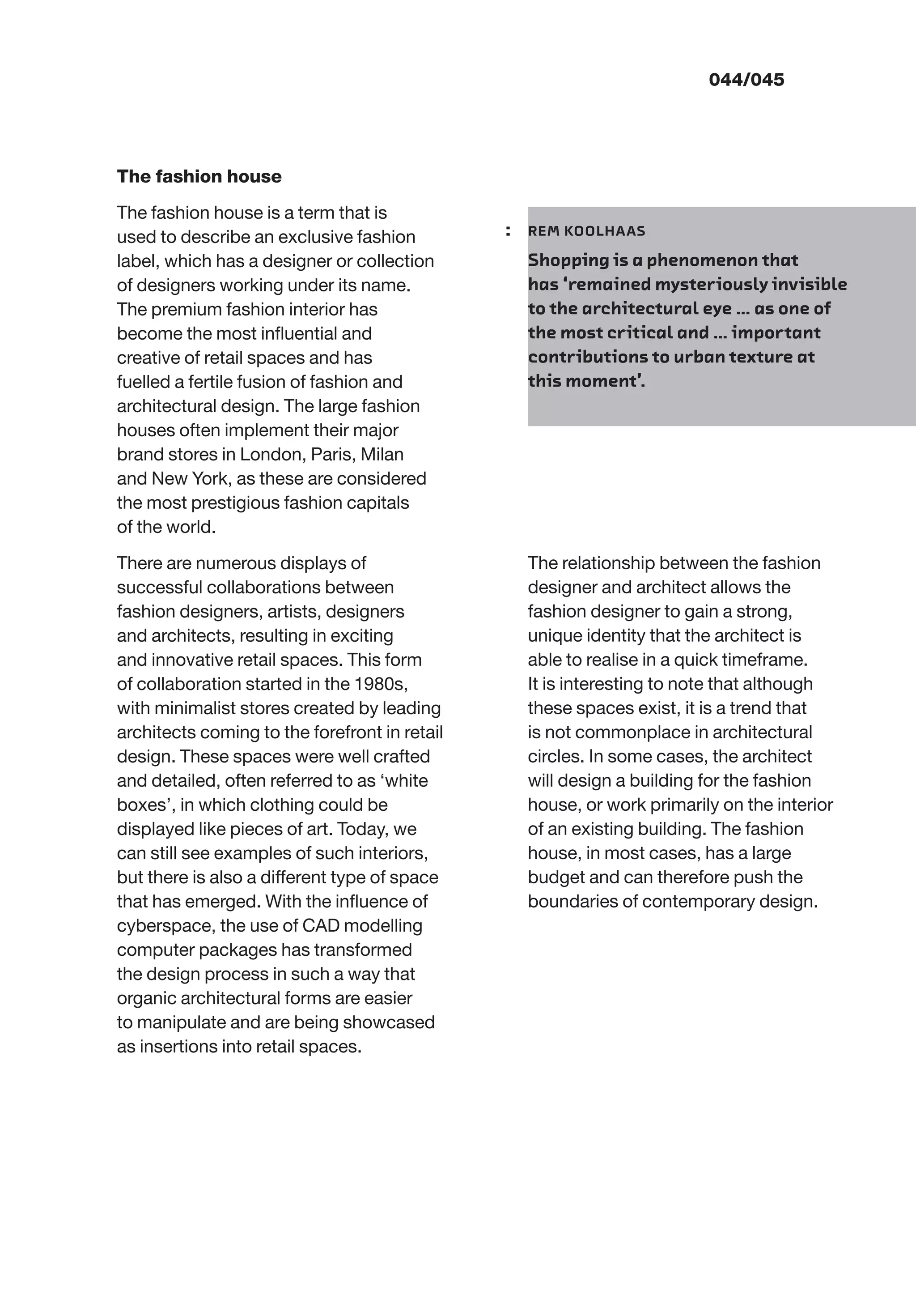
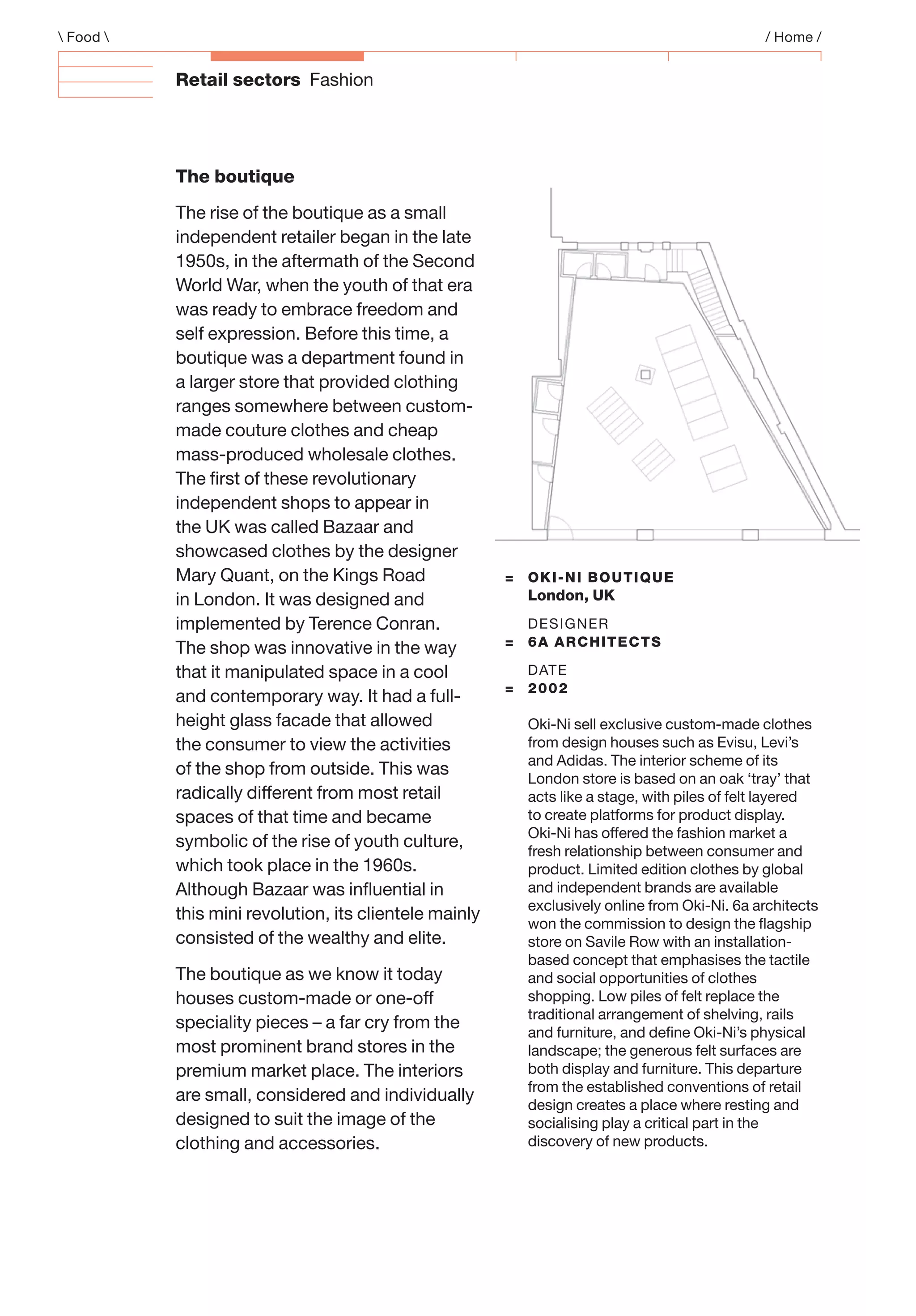
= OKI-NI BOUTIQUE
London, UK
DESIGNER
= 6A ARCHITECTS
DATE
= 2002
Oki-Ni sell exclusive custom-made clothes
from design houses such as Evisu, Levi’s
and Adidas. The interior scheme of its
London store is based on an oak ‘tray’ that
acts like a stage, with piles of felt layered
to create platforms for product display.
Oki-Ni has offered the fashion market a
fresh relationship between consumer and
product. Limited edition clothes by global
and independent brands are available
exclusively online from Oki-Ni. 6a architects
won the commission to design the flagship
store on Savile Row with an installation-
based concept that emphasises the tactile
and social opportunities of clothes
shopping. Low piles of felt replace the
traditional arrangement of shelving, rails
and furniture, and define Oki-Ni’s physical
landscape; the generous felt surfaces are
both display and furniture. This departure
from the established conventions of retail
design creates a place where resting and
socialising play a critical part in the
discovery of new products.
?
046/047
REPRESENTATION
Representation of space is central to all aspects of
interior design. Sketches, hand drawings,
technical drawings and computer generated plans
and models are all used by designers to
communicate ideas to the client. The AVA title,
Basics Interior Architecture: Drawing Out the
Interior, looks at this in greater detail.
Retail sectors Fashion
Chain stores
These are retail outlets sharing the same brand and management across locations.
 Food  / Home /
Commercial fashion
Barbara Hulanicki invented the concept
of mainstream fashion stores when she
opened Biba in London, UK, in 1964.
Today, commercial fashion is
dominated by chain stores with
numerous identical shops in major
towns and cities. The offer is available
from every high street and is affordable
to the masses. These shops often
take reference from premium fashion
brands in terms of both clothing
collections and interiors. They are
frequently changed to evolve with
consumer expectations and because
of the high level of activity, the interior
finish becomes easily tired and dated.
The interiors are varied, using materials,
lighting and graphics to create an
illusion. Retail designers work with
marketing experts to focus the store’s
identity and relationship to the brand.
In a heavily saturated market, being
competitive in style and price is the
key to success.
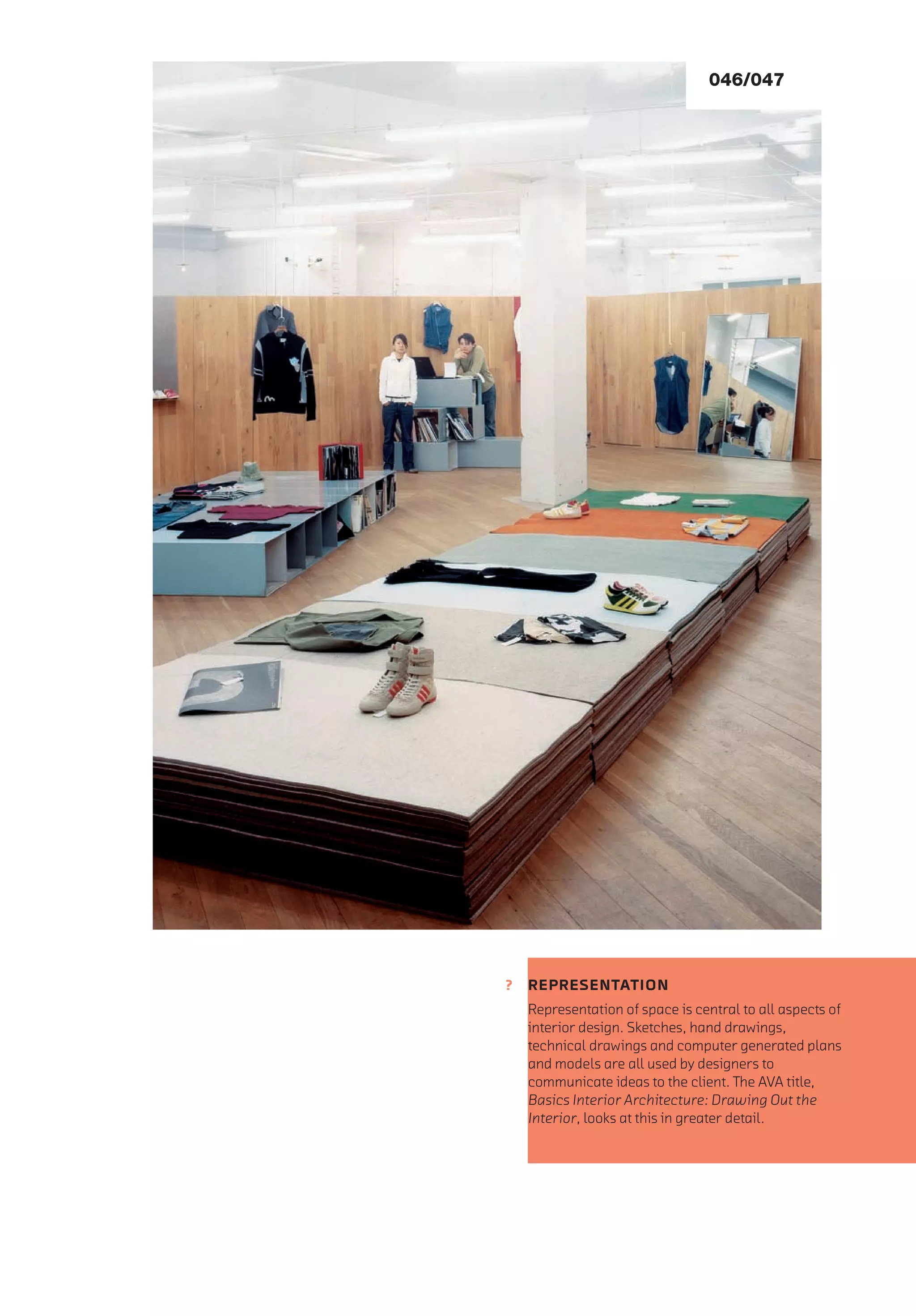
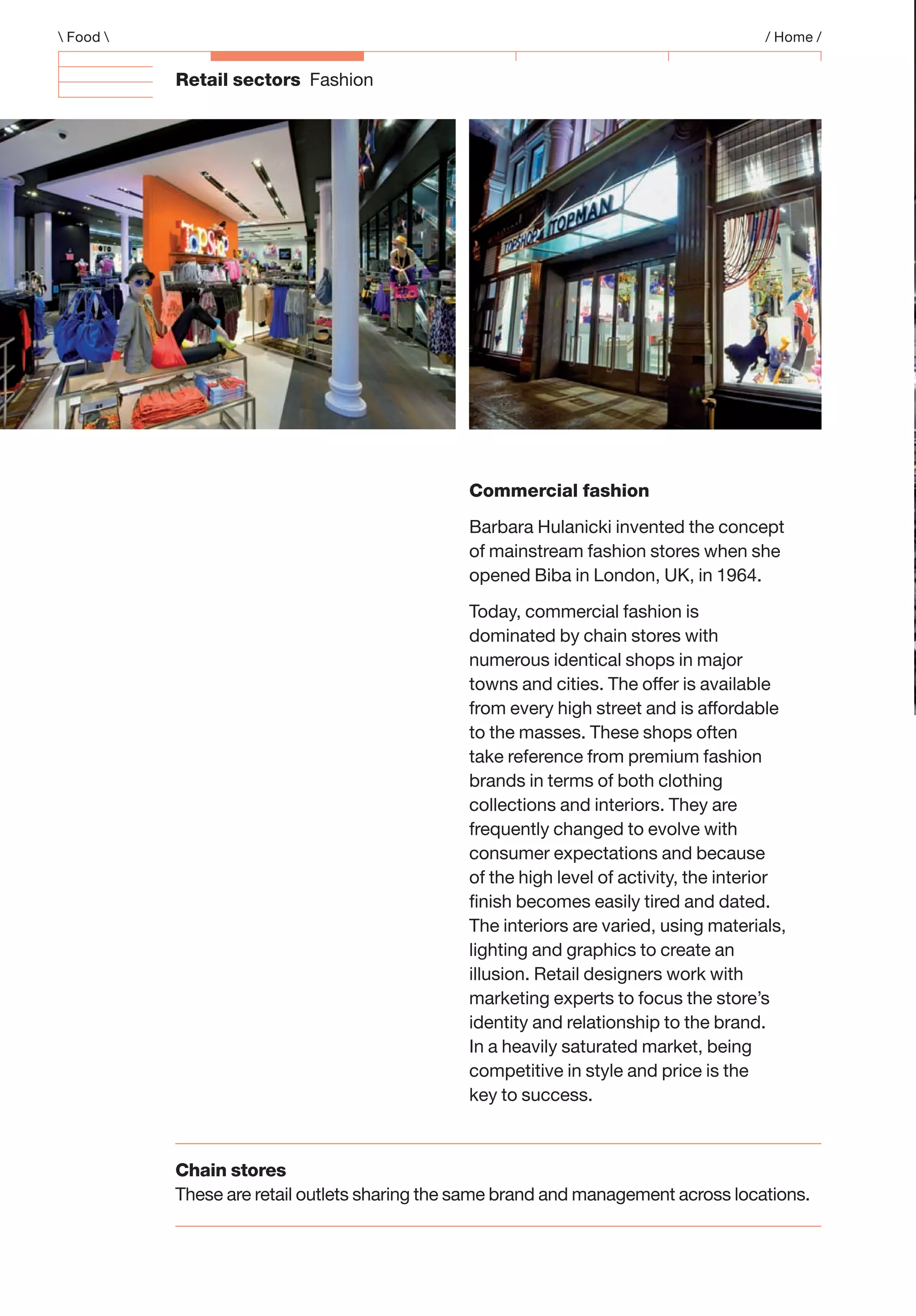
= TOPSHOP
New York, USA
DESIGNER
= DALZIEL AND POW
DATE
= 2009
Topshop is one of the UK’s leading commercial fashion
retailers. The launch of their New York flagship store in
2009 marked the transition to global brand. Replicating
many of the design features found in UK stores, Dalziel
and Pow have created a bold and confident statement
and have successfully carried the brand across to the
US market.
: BARBARA HULANICKI
I didn’t want to make clothes for kept
women … I wanted to make clothes
for people in the street … I always
tried to get prices down, down, down
to the bare minimum.
048/049
Branding and IdentityRetail sectors Home
 Fashion  / Leisure and entertainment /
Consumer culture emerged in
America in the 1950s following
the Second World War. The focus
of advertising was on enticing
women back into the home after
working in factories, filling jobs
vacated by servicemen fighting
abroad. The home featured
predominantly in the role of the
suburban housewife and kitchen
gadgets and appliances became
must-have items.
The Festival of Britain, held in 1951,
was a celebration of Britain’s past,
present and future and saw the launch
of the new ‘Contemporary Style’,
which was derived from the American
design, but was embedded with British
traditions. The Council of Industrial
Design (later to become the Design
Council), led by Sir Gordon Russell,
pioneered the role that designers were
to play in society during these post-war
years. The Contemporary Style
was successful in its campaign aimed
at British women. Furniture could be
bought from a small number of high-
street retailers. It was designed to suit
the space within new government-
owned houses and flats that were being
built at that time. Interior decoration and
home DIY were becoming Britain’s
post-war pre-occupation, and therefore
the need for paint, wallpaper, flooring
and furniture had a positive impact on
the retailing industry.
050/051
Homeware and mass consumerism
Britain first came in contact with the
flat-pack concept in the early 1960s
when Terence Conran launched his own
furniture collection, Habitat. Conran’s
aim was to introduce his commercial
furniture range to the domestic market
and was a reaction to the lack of good,
affordable furniture shops in the UK at
that time. Influenced by the markets
and shops of France and Northern Italy,
the store became very successful in
bringing a diverse range of inexpensive
lifestyle products to the high street.
Some of the cookware products had
never been seen on the British market
before. The pots, pans and other
cookware items were stacked high as
on the European market stalls, and this
has now become recognisable as the
Habitat retail concept.
In 1974, during the recession in the
West, Habitat launched its first Basics
range – a collection of 100 home
products at very low prices. The range
was a huge success and enabled the
company to attract a new clientele as
well as ride out the recession. When the
idea was re-launched in 1982, Habitat
was franchised in Japan. The Japanese
loved the Basics idea and asked for
permission to launch the concept under
a different name. The concept store
Muji was born and is now a leading
retailer of ‘no-brand’ products that are
simply packaged and sold cheaply
with the emphasis on recycling and
‘no-waste’.
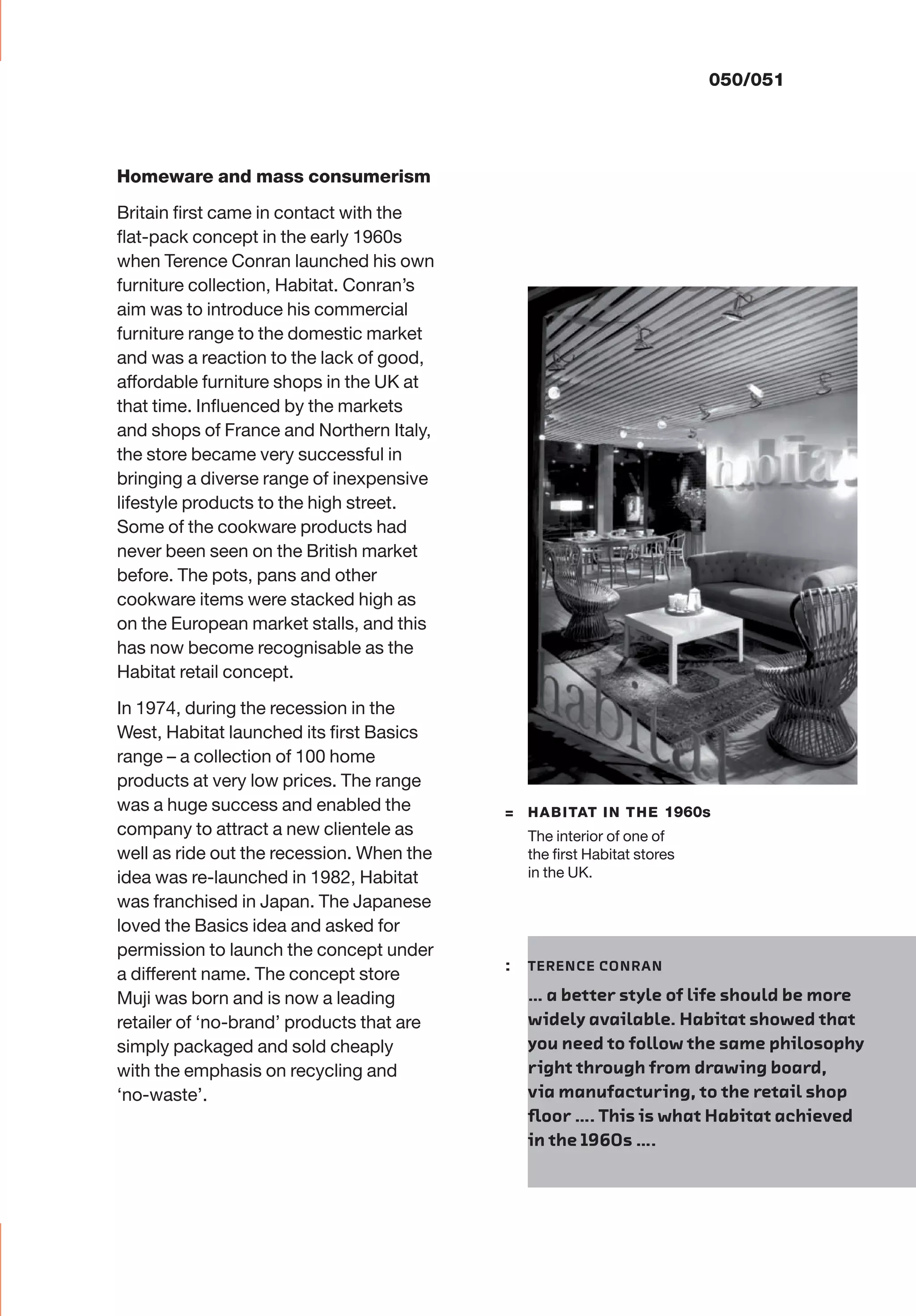
= HABITAT IN THE 1960s
The interior of one of
the first Habitat stores
in the UK.
: TERENCE CONRAN
… a better style of life should be more
widely available. Habitat showed that
you need to follow the same philosophy
right through from drawing board,
via manufacturing, to the retail shop
floor …. This is what Habitat achieved
in the 1960s ….
Retail sectors Home
 Fashion  / Leisure and entertainment /
IKEA and the birth of flat-pack
As interest increased in the design
of the home, the need for mass-
produced product ranges grew.
The biggest innovation in furniture
design of the late 1940s was flat-
pack furniture by the Swedish
designer, Gillis Lundgren. IKEA later
went on to develop their store concept
around this idea and opened the first
store in Sweden in 1958. The idea
was to promote cheap, mass-
produced furniture and homeware
that was easily accessible. The flat-
pack furniture is easy to store and
assemble, thus affecting the sale
price and the design of the showroom.
The IKEA store as we know it consists
of a showroom, marketplace and
warehouse. The idea of the layout is
that the customer walks a particular
long route so that they view all
of the products and room sets for
inspiration, and note down the
reference of the furniture they wish
to buy. There are, however, short
cuts through the space. Then, the
customer has to walk through the
marketplace, where products can
be picked up, into the warehouse,
where they select their furniture
before paying for their items. This
spatial structure was new to retailing
and promoted mass-consumerism
and accessibility.
Premium home stores
In contrast to the domestic furniture
retailers on the high street, another
breed of furniture and homeware
manufacturers targets the high-end
market. This market sees the
celebrated famous furniture and
product designer at the forefront
of the retail experience, with iconic
pieces being sold, much like pieces
of art, in both the domestic and
commercial sectors.
?
052/053
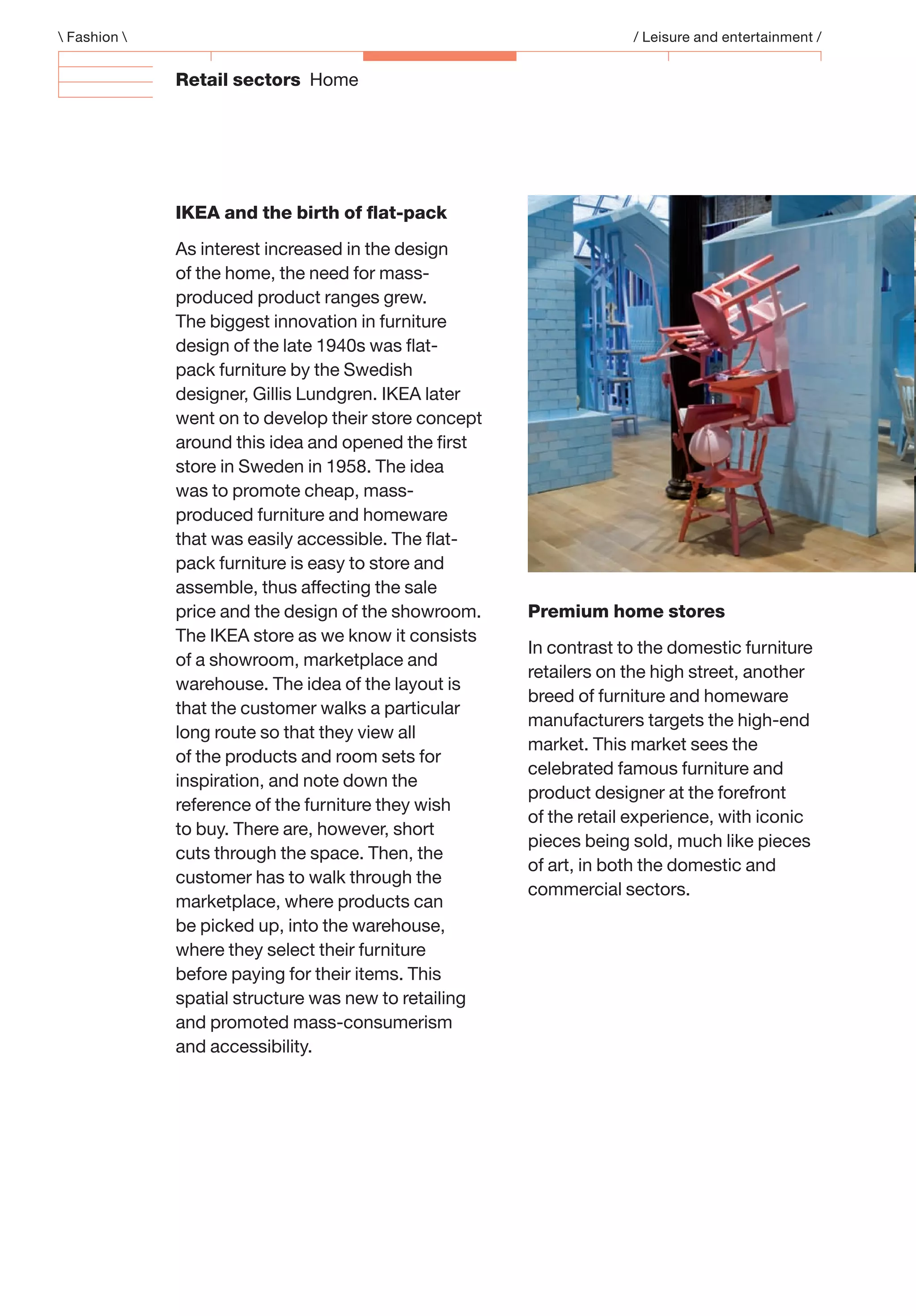
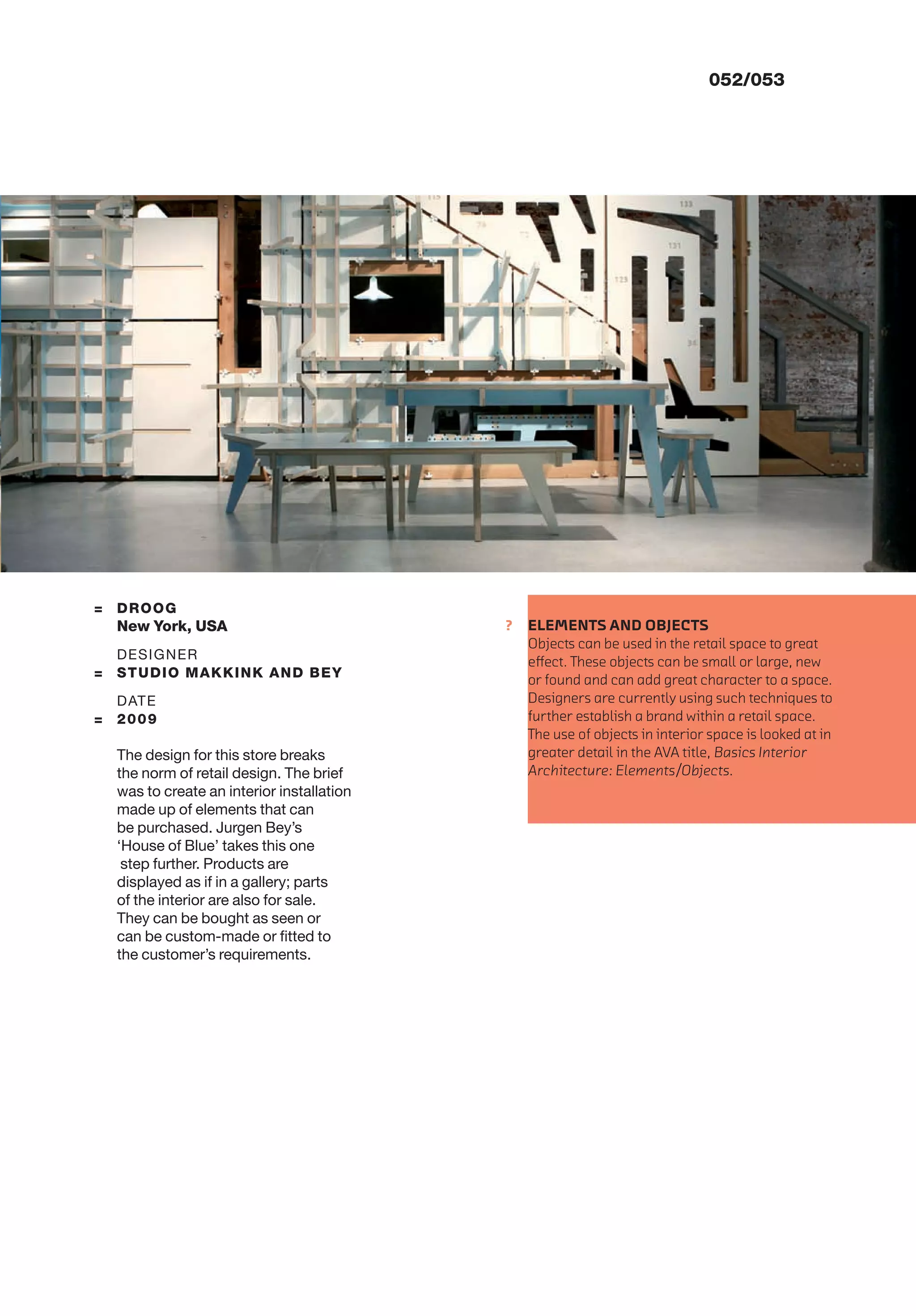
= DROOG
New York, USA
DESIGNER
= STUDIO MAKKINK AND BEY
DATE
= 2009
The design for this store breaks
the norm of retail design. The brief
was to create an interior installation
made up of elements that can
be purchased. Jurgen Bey’s
‘House of Blue’ takes this one
step further. Products are
displayed as if in a gallery; parts
of the interior are also for sale.
They can be bought as seen or
can be custom-made or fitted to
the customer’s requirements.
ELEMENTS AND OBJECTS
Objects can be used in the retail space to great
effect. These objects can be small or large, new
or found and can add great character to a space.
Designers are currently using such techniques to
further establish a brand within a retail space.
The use of objects in interior space is looked at in
greater detail in the AVA title, Basics Interior
Architecture: Elements/Objects.
Retail sectors Leisure and entertainment
The leisure and entertainment
sector has grown significantly in
the last ten years. Whether the
activity is based around a destination
or a product purchase, the chances
are the interior space will encapsulate
a brand. An outing to the cinema,
museum or theatre will each give an
opportunity to buy into the experience
through a shop, bar or café.
The leisure sector includes sport – as an
activity or apparel; technology – sound,
audio and gaming; travel – modes of
transport and travel agency; and finance –
the services of banks and building societies.
Banks are now abandoning the high street
and going online.
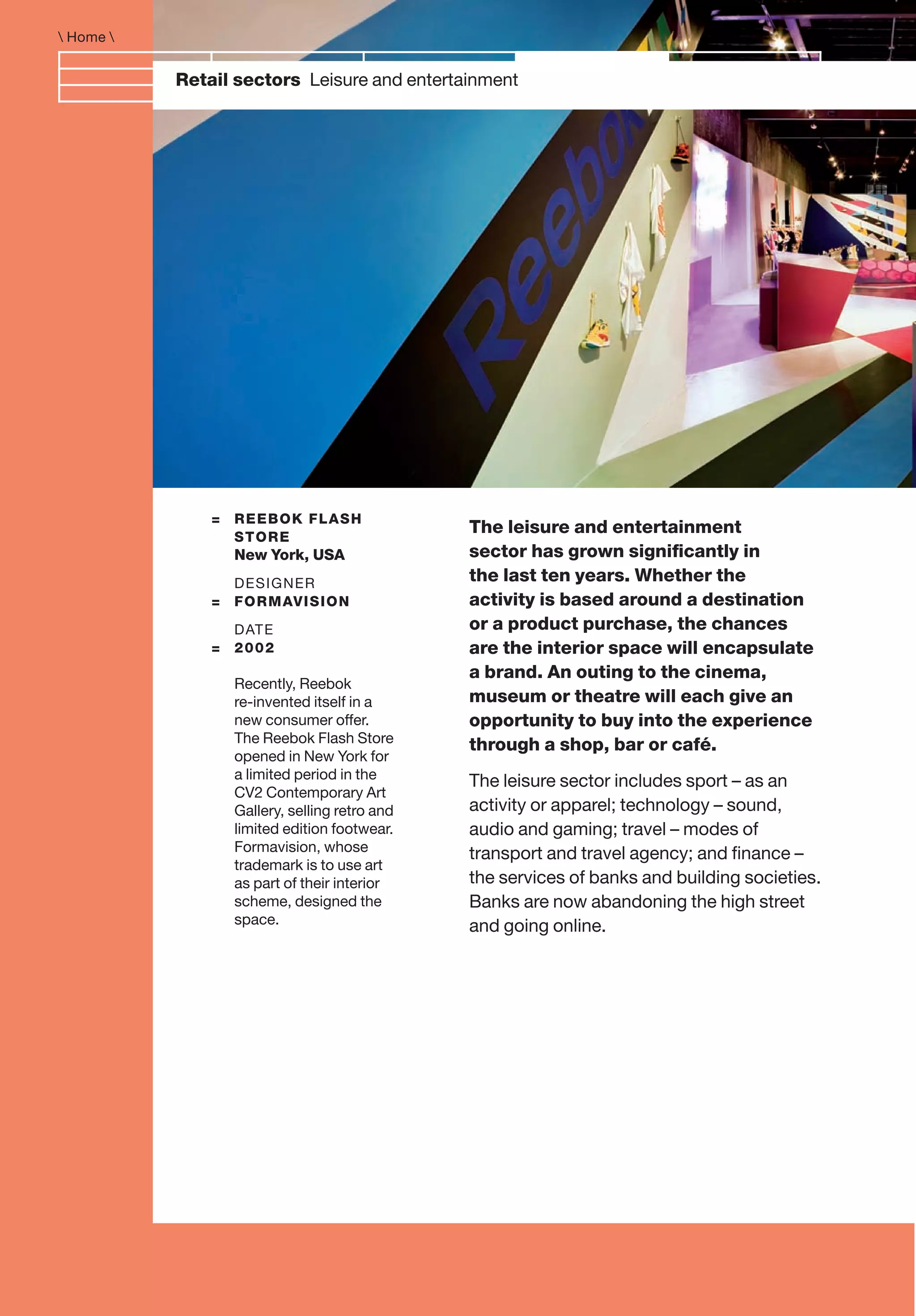
= REEBOK FLASH
STORE
New York, USA
DESIGNER
= FORMAVISION
DATE
= 2002
Recently, Reebok
re-invented itself in a
new consumer offer.
The Reebok Flash Store
opened in New York for
a limited period in the
CV2 Contemporary Art
Gallery, selling retro and
limited edition footwear.
Formavision, whose
trademark is to use art
as part of their interior
scheme, designed the
space.
 Home
?
Sport
In recent years, the sports industry
has taken on the idea of enforcing their
global brand identity through store
image. Retail spaces within the sports
sector are sparse in products and are
exhibition-like in the way that the
participator moves around the space
and interacts with displays. The graphic
language is prominent throughout and
a theme demonstrating youth and
physicality encapsulates the brand
message.
Sports brand Nike has opened a series
of Nike Towns around the world, each
Town taking its interior influence from
the surrounding city. In 2002, Reebok
also opened its world headquarters in
Boston, USA. The Reebok brand is
encapsulated in its headquarters and is
reinforced in every aspect of Reebok
design – from the apparel to the shop
floor – on every high street.
054/055
FORM AND FUNCTION
Interior designers and architects differ widely in
their views of how far the function of a space
should affect its design. Form and function are
discussed in greater detail in the AVA title, Basics
Interior Architecture: Form + Structure.
Retail sectors Leisure and entertainment
 Home  / Student case study /
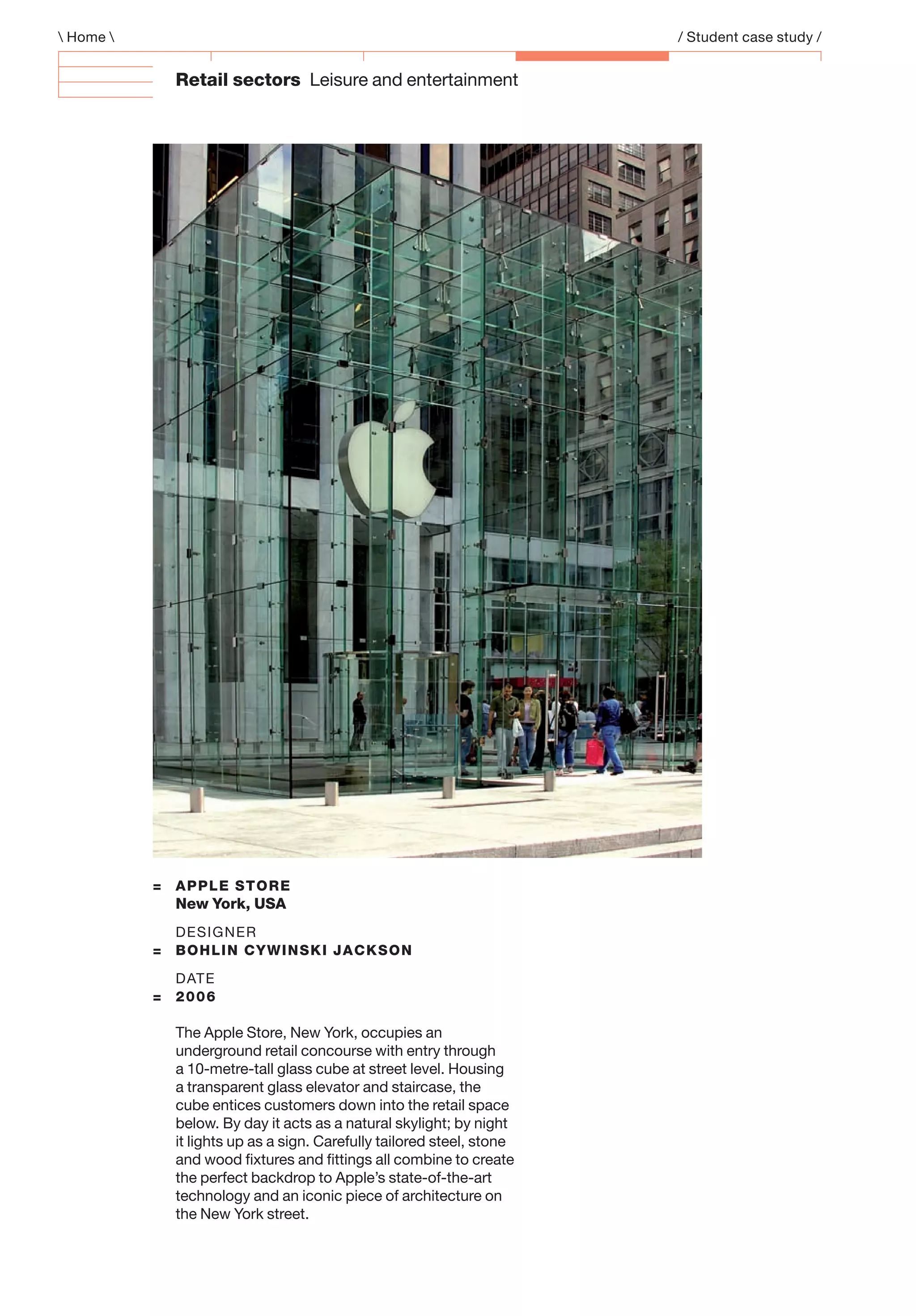
= APPLE STORE
New York, USA
DESIGNER
= BOHLIN CYWINSKI JACKSON
DATE
= 2006
The Apple Store, New York, occupies an
underground retail concourse with entry through
a 10-metre-tall glass cube at street level. Housing
a transparent glass elevator and staircase, the
cube entices customers down into the retail space
below. By day it acts as a natural skylight; by night
it lights up as a sign. Carefully tailored steel, stone
and wood fixtures and fittings all combine to create
the perfect backdrop to Apple’s state-of-the-art
technology and an iconic piece of architecture on
the New York street.
056/057
Technology
The use of technology in the home and
workplace has seen a phenomenal increase
as advancements have taken place and
products have become the must-have
gadgets of the moment. Products such as
mobile phones, games consoles, MP3
Players and home computers have taken
the high street by storm, creating a new
breed of shops geared towards the
technologically minded and youth market.
Many of these brands are global and need
an interior space and graphic language that
will appeal on all levels.
Apple Mac computers have long been
the favoured tool of choice for design
professionals. In 1998, the iMac was
released and became the fastest-selling
desktop computer in history. In 2001, the
iPod was launched and became the leading
MP3 player, setting a precedent for other
manufacturers. In the same year, Apple
opened its first retail store in San Francisco
and Washington DC. The Apple Store now
exists globally and reinforces the Apple
brand. The stores are revolutionary in the
technology sector and focus on being
user-friendly and an environment where
products can be tried and tested. The
stores have a children’s section, a ‘genius’
bar, a theatre and a solutions centre as
part of the store concept.
The mobile phone is also now a mainstream
essential product. Mobile phone stores are
commonplace on the high street and often
offer a personal service with consultation
areas, exhibition-like displays and brand
messages. The need for the consumer to
keep up with technology means that mobile
phones are regularly replaced, keeping the
market strong and competitive.
: JAMES GARDNER
The new plaza in front of the General
Motors building on Fifth Avenue at
59th Street is a triumph of urban
design... Suddenly, as if out of
nowhere, New York has a new public
space that will prove to be a source
of civic pride and aesthetic delight.
Retail sectors Leisure and entertainment
= PORSCHE SHOWROOM
Leusden, Netherlands
DESIGNER
= QUA
DATE
= 2004
The new scheme for the Porsche
showroom in Leusden was intended
to reflect the passion and emotion of
the brand. It needed to include a lounge
area, bar, atelier, shop, reception, and
delivery area, whilst retaining the
maximum number of cars inside the
showroom. The design shows the rich
racing history of Porsche, the luxury of
the cars, their technical and engineering
qualities, and is inclusive of non-owners
enthusiastic about the Porsche brand.
By using long, low shapes, a colour
palette of blacks, metals and whites,
the design emphasises the curves of
the cars and the material and technical
sophistication of the Porsche brand.
058/059
Travel
The motor industry is undergoing major
changes in the way it trades. The car
showroom and forecourt as we know
it is said to be disappearing. Today,
car manufacturers are jumping on the
branding bandwagon and are creating
retail experiences for the consumer.
Flagship stores are emerging with
exhibition spaces, cafés and
restaurants as part of the offer. Buying
a car these days is about buying
into a lifestyle, rather than buying a
commodity that will get you from A to B.
The future of car retailing is said to be
in showcasing cars to specific market
audiences rather than having physical
showrooms. This idea leads to the
purchase being made online. The effect
of this radical shift will see the car
showroom disappear from the high
street. Car sales will become friendlier
towards the public and less corporate
in their selling techniques.
Other aspects of travel retail concern
the holiday market. Although travel
agencies can still be seen on the high
street, many holiday purchases are
made online. Customers are able to
search numerous databases and
custom-make their own holidays for
a fraction of the price on the high street.
Leading dot com companies such
as <www.lastminute.com> have
transformed this retail sector to the
benefit of the consumer.
Finance
The finance sector has seen two main
shifts on the high street. The first is
the collaboration of high street banks
with other offers. In the UK, for
example, Santander and Costa Coffee
now share retail space, offering the
customer a lifestyle experience;
secondly, the rise in Internet banking
and online purchases. This has directly
affected the banking system, making
banks more accessible to the public
and bringing about the closure
of many high-street premises. The
remaining banks and building societies
have changed their appearance to
become more appealing to the general
public and less formal and traditional
in their presentation. They now rely
more heavily on self-service.
: CHATEL, F. AND HUNT, R.
Car retailing of the future must
be total retail therapy, otherwise
‘The Dream’ cannot be sustained ….
And what about the existing car
showroom? Expect that to be as
rare as a bank on the high street
in Britain by 2004.
!
Retail sectors Student case study
PROJECT
= MARKET PLACE
DESIGNER
= JEKATERINA ZLOTNIKOVA
STEPHANIE HARRIS
ANGELIKI IOANNOU
DATE
= 2009
Students were asked to design a
marketplace that would bring together
the different cultures and histories of
the surrounding area while being used
as a vehicle to explore the idea of
sustainable communities through
locally sourced produce. In this way,
the project looked at creating bridges
between user groups so that social
interaction could take place, and at
regenerating an existing building for
its original use, whilst exploring the
transient nature of space.
Students made careful consideration
of light and colour, using the market and
its products as a point of inspiration.
They also carefully considered their
use of materials, using only those that
related to the context of the area and
those that were locally sourced.
They explored the different strands of
the marketplace, through urban
analysis, geometric and structural
analysis of the building, light analysis
and ergonomics. Students also inserted
pattern, threshold, people movement
and people mapping as streams of
thinking. They discovered ways of
thinking about the transient nature of
human occupancy and the temporary
nature of human existence and how this
can inform the design process.
The research, analysis and concept
development formed the basis of the
design project, with the user at the
core of the design strategy.
 Leisure and entertainment
= The market stall is the place
where customer interaction
takes place. By Jekaterina
Zlotnikova.
= This plan demonstrates
circulation focused on pace –
there is a slow meandering pace
around the market stalls and a
quick pace that takes visitors
down the side of the building.
By Stephanie Harris.
= The garden is in the centre of the
building and open to the elements. It
provides the opportunity to grow
produce to sell in the market. By
Angeliki Ioannou.
? Now imagine you have been
asked to design a flexible
market space.
1 How are these spaces used
across the world? Where is your
design located and how will this
affect certain factors?
2 Are you trying to encourage or
discourage certain behaviours?
How will you do this?
3 Do you think this space will
appeal to particular groups of
people? How will you try to make
the space more accessible and
appealing to other groups?
060/061
Branding and IdentityRetail sites
The choice of space available to a retailer is
vast in terms of location and type. Since the
1980s retail boom, developers have sought to
take advantage of industrial wasteland and
have regenerated disused spaces for retail
purposes either away from the city centre or
as a connection to an already established
shopping area; or as a regeneration programme
to bring character and life back into a barren
urban setting. A retailer has an impact on the
surrounding environment through their choice
of site, and has a responsibility to adhere to
local planning restraints, to consider the effect
on local trade, and to evaluate noise, traffic
and congestion issues that may arise from
their positioning.
THIS CHAPTER broadly examines the variety of
sites available to retailers, from high street
to shopping centre, and discusses a range
of one-off scenarios. Each site maintains a
different design approach that is influenced
by both the context and the nature of the site.
 Retail sectors  / The retail environment /
062/063
Branding and IdentityRetail sites Department stores
= HARVEY NICHOLS STORE
Istanbul, Turkey
DESIGNER
= FOUR IV
DATE
= 2006
This three-floor, 86,000-square-foot
store, complete with food market and
a 100-cover restaurant, showcases the
very best in Western contemporary
retailing, complemented by rich swatches
of local material and the traditional skills
of Turkish craftsmen. The design details
are an exercise in exuberance. The fascia
entrance is in polished black stone and
gold embossing, the ground floor is
virtually crystalline, and the lingerie area
features a central chandelier of glass
polished butterflies and high-pile carpet.
Gilt, a 100-cover restaurant, sits atop the
Harvey Nichols store. Serving international
food in an environment featuring fine
traditional handiwork, the restaurant itself
is set to become a destination in its own
right for Istanbul.
The popularity of shopping as
a leisure activity took off in the
nineteenth century with the rise
of a British phenomenon: the
department store. For the first
time, huge arrays of products
were available under one roof.
Before the department store, shops
were highly specialised and expensive,
with a low turnover and high overheads
for non-food purchases. Drapery
retailers began to see that the rationale
of indoor food markets could work
for the textile industry, in supplying
products to a mass market. The layout
was forever changing and growing as
new lines were added, making the
stores into the rambling spaces we still
experience today. Later, buildings were
purpose built and designed in a range
of impressive architectural styles.
Today, the concept of the department
store is still successful. It houses
lifestyle merchandise from fashion
and accessories, to haberdashery,
home and cookware, to speciality food.
The interior of the department store
is controlled by an in-house team of
designers whose job it is to dress
window displays, design the layout of
the store and its concessions,
implement signage and other graphics,
and maintain a cohesive scheme
throughout the store.
/ High street /
064/065
Retail sites Department stores
= SELFRIDGES STORE
Birmingham, UK
DESIGNER
= FUTURE SYSTEMS
DATE
= 2003
Selfridges in Birmingham is
famously known for its organic
exterior, influenced by a dress
designed by Paco Rabanne. The
interior is centred on a roof-lit
atrium space with escalators
snaking up through the building.
This department store is a good
example of a contemporary
building for retail.
Entrance, circulation and
interior layout
The department store is first
experienced from the pavement.
The impressive facades dominate
the high street with their grand
exteriors and full-height glazing.
Window displays are evocative and
regularly updated, showing this
season’s latest fashion and must-
have items.
The department store often has
several entrances, making it more
easily accessible. The journey into the
department store, in most cases,
begins with a central entrance foyer
and atrium with stairs or elevators
rising to each floor. The atrium is often
impressive and spacious and acts as
a meeting place or a starting point to
the navigation around the store. The
traditional staircases were curved and
ornate, taking their influence from
Parisian stores. Today, escalators are
often seen in their place, with lifts also
accessing each floor. Walkways are
wide and clearly signposted. Each floor
has strategically placed payment areas
and fitting rooms, which work around
concessions. The shopping experience
is concluded with space to eat, meet
and refresh.
New contemporary department store
buildings are still based on traditional
layouts, focusing on the central
circulation space and relying on the
concession scheme. The buildings
are still monumental landmarks and
places for social interaction.
/ High street /
066/067
Concessions
The selling space in a department store
is split into concessions. This basically
means that each space is let out to
a different retailer. This creates the
opportunity for fashion labels to sell
alongside each other in one
establishment, making the department
store a one-stop place to shop. The
retailer’s design team implements
concessions and the space is designed
in line with the retailer’s brand and other
stores so that an identity is clear and
constant.
Each concession requires its own
cash counter, display elements such as
gondolas, tables and wall fixtures, and
must consider the adjoining junction to
neighbouring retailers and walkways.
Graphics and signage are an important
component to setting each concession
apart, and advertising the strength of
the brand; these also aid customer
navigation. Retailers are often grouped
together depending on product type
and relationship to each other; therefore
the reputation of the brand or brands
may attract the desired client base to
the department store.
= CONCESSION PLAN
The space demonstrated in this visual is
limited and used as effectively as possible,
displaying a lot of merchandising in the
given area.
Branding and IdentityRetail sites High street
 Department stores  / Shopping centres /
: RASSHIED DIN
The approach was simple, the product
was inexpensive and obtainable, and
the formula was widely reproduced.
The result was outlets that were
instantly recognisable and far more
accessible to most people than
exclusive department stores.
The high street is the busiest
central area for commerce in
any town or city. These streets
are connected by alleyways,
arcades and department stores
and are often defined by their
architectural style.
Depending on the era in which a town
or city was initially planned and
constructed, the high street can take
different forms. Older cities may have
grandeur and a mixture of architectural
styles, and buildings might be listed,
carrying many restraints on structural
changes. Older cities tend to be more
meandering, having evolved over time.
Newer cities and towns are much more
structured in their urban plan, with the
retail areas clearly defined and catered
for in adequate buildings that do not
carry many constraints. High-street
retailers tend to fall loosely into one of
these categories: boutiques or local
traders, department stores or chain
stores. The boutiques and local
traders, in most cases, take the
smaller retail units and can be found
in the connecting alleys or arcades.
The department store is housed in the
largest buildings, and the chain stores
take up everything in between.
068/069
The design of chain stores is in line
with current design trends and takes
inspiration from premium fashion
stores, as discussed in Chapter 2.
It does, however, tend to use a less
expensive palette of materials and
finishes. The interior schemes tend
to last around six years before being
completely replaced, but are often
updated through the use of colour
and graphics in between. Chain stores
tend to work on three different cost
levels in terms of the interior fit-out:
high-spend, medium-spend and
low-spend, depending on where the
store is being implemented. Retail
designers consider these three options
when putting together a package
of drawings for the interior space, and
offer alternative arrangements and
specifications to suit all three budgets.
In all cases, there would be a selection
of fixtures and finishes that would
remain for all schemes, which are often
main features such as the cash
desk/servery area, for instance.
Chain stores
In the Western world, high streets as
we know them today are often criticised
for having the same characteristics
from location to location. Many believe
this is because chain stores are rapidly
wiping out the existence of independent
retailers. The retail landscape is often
repeated from city to city, engulfing the
unique cultural and social qualities of
each place.
The chain store was formulated as an
alternative retail type to the department
store and offered mass-produced
goods at low prices, thus appealing to
the working classes. Woolworths was
one of the first recorded chain stores
with its first store opening in New York
in 1879. After 120 years of trading,
Woolworths finally closed its doors in
2009, unable to compete with online
retailing. Due to globalisation and the
ease of importing/exporting and
efficient travel, chain stores today
are implemented worldwide.
Retail sites High street
 Department stores  / Shopping centres /
Roll-out
A term used to describe the reproduction of an interior scheme into a number of
different sites. Although the scheme may need to alter to reflect the nature of the site,
the principles behind the design idea remain the same.
070/071
= HMV
Concept store
DESIGNER
= DALZIEL AND POW
DATE
= 2009
This chain store for HMV looks to
implement its ‘Next Generation Store’
concept into a number of different
sites from high street, to shopping
centre, to concourse. The concept
represents HMV’s blueprint for the
future of its retail offer, where the
physical comes together with digital
to create a compelling experience.
At the front of the store is a one-stop
shop, which houses the latest
releases, charts promotional items
and continuing the more accessible
theme, there is a social ‘hub’ with
IMacs for customers to browse the
internet.
Retail sites High street
= GALLERIA VITTORIO
EMANUELE II
Milan, Italy
DESIGNER
= GIUSEPPE MENGONI
DATE
= COMPLETED IN 1877
This arcade is one of the finest
examples of a public, covered
promenade. The building was
constructed between the cathedral
and the Scala in the shape of a
cross, in the centre of Milan. The
photograph shows the attention
to detail and the consistency in
the designed frontages throughout,
as well as the atrium shedding
natural light into the space.
: J.F. GIEST
If the nearby cathedral represents
the body of Christ, then the arcade
represents a kind of pantheon of
bourgeois society… it is filled with
the noise that incessantly flows
through it.
Arcades
The arcade as a public place for
shopping, socialising, entertainment
and political engagement, first emerged
in Paris following the French Revolution,
it was called the Palais Royal. An
arcade can generally be defined as a
passageway between shopping streets
that is covered, usually by a glass and
steel roof. The arcade comes in many
different layouts and contains rows of
shops on either side with storage space
above. The idea of the arcade can be
traced back to the passageways of
the Eastern bazaars and traditionally
provides space to smaller retailers and
designer/makers. The architectural
style of the arcade is incredibly ornate,
with many fine examples still existing
throughout the Western world. One
of the most prominent features of the
arcade is the glass atrium, which brings
in natural light and connects the interior
with the exterior. Each shop facade
has the same architectural detail and
retailers must keep to the design style in
terms of graphics and signage.
 Department stores  / Shopping centres /
072/073
Branding and IdentityRetail sites Shopping centres
 High street  / Out-of-town shopping /
In Britain, many shopping centres are
built in the centre of the city and are
the pinnacle of the shopping area,
with the high street leading from them.
The architecture of the early shopping
centres was often made up of concrete
structures that were oppressive and
unfriendly, and many have now been
replaced by airy glass and steel
structures with impressive atriums and
natural light flooding through to
the interior. The design and build of a
shopping centre is a good example of
how architects, landscape designers
and interior designers work together.
The architect is responsible for the
building scheme and working out
the general circulation and division
of space; the landscape designer
specialises in planting in the malls
and outdoor spaces, whilst the interior
designer, often specialising in retail
design, brings the building to life with
theatre, lighting, finishes, seating and
graphics. The role of the interior
designer also extends to the fit-out
of the retail units.
Shopping centres or malls were
pioneered in America during
the 1950s. The malls were built
on the outskirts of the cities
and had plenty of parking space
and service areas for suitable
access. The shopping centre
has been criticised over the years
for turning cities into ‘ghost
towns’; this is certainly evident
in America.
?
074/075
RHYTHM
The structural system of a building can help create an order
or rhythm. A procession of repeated elements can help to set
up this rhythm or an unusual object might be used to contrast
with it. Rhythm is discussed in greater detail in the AVA title,
Basics Interior Architecture: Form + Structure.
The shopping centre generally
comprises a number of different-sized
shop units with ‘anchor’ stores at either
end. The ‘anchor’ stores are typically
well-known department stores that take
up a large area of the shopping centre
and act as a magnet to draw customers
through the mall. Sometimes the anchor
is a cinema or bowling alley. This all
adds to the experience of a day out.
A main food court is often a central
feature with a good selection of traders
and plenty of seating. Toilets, banking
facilities and cafés appear at regular
intervals. Shopping centres are
accessible for families and sometimes
have crèche facilities, as well as baby
changing in the toilets and high chairs
in the food halls and cafés.
Circulation and layout
The experience of shopping in a mall
begins in the car park, which is very
accessible and sometimes in the
basement of the building or to the rear.
Upon entering the building, signage
and graphics play a major role in aiding
navigation. Maps and hanging banners
are clearly visible and define the brand
of the centre. Some malls are
configured in straight rows and others
are more meandering or have a circular
navigation. Many are set out over a
few floors with escalators and lifts
connecting the spaces. The walkways
are very wide and have planting and
seating to break up the space. The
shopfronts face on to the walkways
and sometimes pop out to make them
more visible.
Retail sites Shopping centres
= ZLOTE TARASY
Warsaw, Poland
DESIGNER
= THE JERDE
PARTNERSHIP INC.
DATE
= 2007
Shopping centres can bring new
life to urban areas. Zlote Tarasy,
a multi-level, mixed-use project
located in central Warsaw, serves
as a connection to the city, and
creates a model for further urban
redevelopment in the area. The
design takes its inspiration from
Warsaw’s historic urban parks,
with an undulating glass roof,
organised terraces and generous
open spaces.
 High street  / Out-of-town shopping /
076/077
Retail units
Retail units in a shopping centre are
fairly straightforward to fit out without
having to adjust the architectural
elements of the space. Unless the
centre is new, an old scheme may have
to be ripped out first, but this is usually
non-structural. They are purpose built
and always provide a rear door for
deliveries and services, adequate space
for storage adjacent to the delivery
door, a discreetly positioned soil vent
pipe connection for staff facilities,
accessible electric hook-up and a
position on the roof of the building
or outside wall for air conditioning. The
design of the unit has to be approved
by the shopping centre management
team and must adhere to the design
guidelines of the centre, as well as usual
building regulations. The shopfront
design is the most contentious part
of the design package, as it must work
alongside the other traders without
obscuring the view of its neighbours,
and must sometimes include generic
architectural details that are apparent
throughout the malls. There is often very
little natural light into the retail units,
the only source being from the covered
mall. Therefore, artificial lighting plays
an important role in the whole retail
scheme.
Branding and IdentityRetail sites Out-of-town shopping
= A TYPICAL RETAIL OUTLET
A typical retail outlet, partially
covered and with shopfronts and
signage protruding out on to
the walkway.
 Shopping centres  / The concourse /
Out-of-town shopping extends
far beyond the realms of the
shopping centre. The landscape of
many countries is scattered with
large warehouse-type buildings
that contain endless amounts of
merchandise. The advantage of
out-of-town shopping is in enabling
accessibility. Towns and cities are
often limited in parking space and
have heavy traffic congestion.
The out-of-town experience has an
abundance of parking and is often
situated near major roads. The
downside, however, is the effect these
buildings have on the countryside and
the ever-decreasing areas of natural
beauty. There are traders that naturally
fit into out-of-town retail spaces, which
can be broken down into the categories
of retail outlet or villages, retail parks,
megacentres and hypermarkets.
: N.K. SCOTT
The phenomenon of the out-of-town
shopping centre, the out-of-town
business park, leisure centre,
university or any other human
activity is singular to our age. The
reason is simple and a consequence
of the invention of the internal
combustion engine.
Retail outlets
The retail outlet or village is designed
around the idea of a shopping mall,
and can be open to the elements or
under a covered mall. The village will
include a food court and the usual
public conveniences alongside large
retail units. The units are warehouse-like
and often constructed from brick and
steel with full-height glazed shopfronts.
Retailers use these spaces for selling
off excess stock at discounted prices.
The interior fit-out of such units is often
done on a low budget with little attempt
to hide the industrial nature of the
space. Elements of the retailer’s
branded interior will appear in terms
of graphics, fixtures and finishes.
Retail parks and showrooms
For some retailers, the out-of-town
location is the ideal solution for their
product type. Large items such as
furniture and DIY paraphernalia, cars,
white goods, outdoor and gardening
equipment all benefit from having easy
access in terms of deliveries and
storage. The warehouse-like spaces
work well for displaying large items and
creating lifestyle spaces such as room
sets, that help the customer buy into
the product. The units also work well
as showrooms for cars due to the open
plan nature of the space and large
frontages for manoeuvring stock.
078/079
Retail sites Out-of-town shopping
= PON CATERPILLAR SHOWROOM
Leude, Netherlands
DESIGNER
= QUA
DATE
= 2003
This project saw the rebranding of CAT,
establishing the values, and applying
them to the architecture and interior of
a complete new building. The building
includes a CAT shop as well as the only
showroom for Caterpillar bulldozers in
the world.
 Shopping centres  / The concourse /
?
080/081
SUSTAINABILITY
In the fast-paced world of retail, designers
must pay particular attention to their use
of materials and resources. Reusing and
recycling as well as alternative methods of
heating and cooling spaces are just some
of the ways in which interior designers can
help to reduce the damage they are doing
to the environment. Sustainability and
environmental issues are discussed in greater
detail in the AVA title, Basics Interior
Architecture: Context + Environment.
Megacentres
‘Megacentre’ is the term used to
describe an out-of-town retail
shopping centre of huge proportions.
The megacentre offers thousands of
parking spaces, several anchor stores
and leisure facilities such as sports
complexes, multi-cinemas and in
some countries, water parks. The
centres are open throughout the day
and into the night, seven days a week.
The megacentre is a derivative of the
shopping centre and all the same
rules about its design and circulation
patterns apply.
Hypermarkets
The hypermarket is a concept created
by the major supermarket chains.
Supermarkets are often positioned
on the edge of a town or city with
smaller ‘express’ versions in the city
centre or at other points of high footfall.
The hypermarket is a much larger
version of the supermarket and carries
a generous variety of products under
one roof. The buildings are industrial-
looking warehouses and contain
everything from groceries to clothing,
to white goods, homeware and
gardening. The supermarket chains
buy stock in bulk, which makes it
cheaper, and they then pass some of
this discount on to the customers.
These spaces tend to be rambling
and organised in the same way as the
supermarket, with aisles of products
stacked high and divided into
categories depending on the product.
Some hypermarkets are spread
over two or more floors. Wide, long,
angled travelators are used to take
the customer between floors with
shopping trolleys.
Branding and IdentityRetail sites The concourse
 Out-of-town shopping  / Alternative venues /
Retail exists wherever there are
consumers with time on their
hands and money to buy. As the
travel industry has developed,
so has the opportunity to sell.
The concourse provides the retailer
with an opportunity to supply a
concessionary sample of stock to
the masses that are simply passing
through, en route to somewhere else,
sometimes 24 hours a day. Train
stations and airports particularly
have volumes of space between
platforms and gates that are ideal for
the positioning of retail units. The
concourse also aids the global success
of a brand as retailers gain access to
consumers from all over the world.
Retail units within a concourse
are simple structures. Some are
freestanding in the middle of the
concourse, with glass around all sides
acting as the shop window, whilst
others are divided along lengths of
walls by stud partitions. Units are
usually roller shuttered for security
when closed. The stock for each unit
is often locked away elsewhere in a
separate storeroom for maximum
security, with some retailers removing
their merchandise at night.
082/083
Train stations
Train station retailing suits particular
product types relating to travel or gifts.
In smaller cities, local trade can do
well as the train station is often the
beginning of a relationship between
the consumer and the local area; the
beginning or end of a journey. It would
be familiar to see a leading chemist, a
leading stationer, a leading fast-food
brand and coffee shop available at
most stations, however small, therefore
providing essentials to the commuter
or holiday-maker. In larger, more
modern stations the concourse has
been transformed into a full shopping
experience. Sometimes, the station
may lead into a shopping centre as
part of the exit from the station.
Petrol and service stations
Service stations were introduced along
major motorways to provide a break
for the fatigued driver. They have a
captive market and often raise their
prices, as they do not have any direct
competition. The choice and quality of
products and services available in the
service station is varied. Most service
stations provide a shop for snacks and
essentials, but the main income is
from the sale of food and beverages.
Like the train station and airport,
fast-food brands are readily available
alongside canteen-style dining.
Petrol stations have in more recent
years developed partnerships with
other retailers such as fast-food or
coffee chains, combining the sale of
petrol with forecourt retail potential.
This was started as a reaction to large
supermarket chains selling cheaper
petrol and was a bid to win customers
back to the forecourt.
Airports
Airports today have retail areas that
could be described as shopping malls.
Rows of units fill large areas of space
with many leading brands available.
The added bonus of airport shopping
used to be that goods were duty free,
but since this was abolished, airports
have had to change their strategy in
giving the traveller a shopping
experience that is both satisfying and
memorable. Airports were traditionally
places for buying perfume, cigarettes
and alcohol at discount prices. Today,
airports are the ultimate example of
destination shopping. Whole terminals
are branded as a lifestyle shopping
experience. To define the consumer
market within an airport, you need to
understand the type of traveller passing
through.
A terminal that deals with long-haul
flights for instance will have to appeal
to the culture and social aspirations of
different user groups and can cleverly
adjust the products and pitch to suit.
Retail sites The concourse
 Out-of-town shopping  / Alternative venues /
: R. DIN
Airports have… the advantage of
knowing who its customers are and
when they will be passing through
its doors; it is also in the almost
unique position of knowing its
customers’ sex, age and nationality
from air-ticket sales, passport
information and flight destinations.
= BIZA FLAGSHIP
DUTY FREE STORE
Manchester airport, UK
DESIGNER
= HMKM
DATE
= 2008
HMKM were tasked with designing
a customer-focused identity and
environment for Biza, a retail offering
that would ‘radically re-define the
UK airport shopping experience’.
Initially launched at Manchester airport,
the scheme is to be rolled out across
Newcastle and East Midlands airports
too. With a clear awareness of customer
needs and airport environments,
HMKM successfully created a unique
and exciting new experience. Their
holistic approach included attention to
customer flow, use of materials and
colour palette and a complementary
staff dress code. This was an important
total rebranding of the previous 'Alpha
Airport Shopping' and transformed the
way people shop within the duty-free
environment, creating a department
store feel.
084/085
Branding and IdentityRetail sites Alternative venues
The retail venue, rather than
standing alone, can be intertwined
with an event or exhibition and
is often a destination point to
signify the end of a journey
around a gallery.
As well as the physical sites discussed
in this chapter, retailing also happens
from home. The home catalogue has
been around for many years, but with
the growth in Internet usage over
the last decade, the majority of major
retailers also have an online offer.
Alternative venues outline these retail
ventures and the gap they fill in the
retail market.
 The concourse  / Student case study /
?
086/087
Galleries and exhibitions
On any day out to a theme or leisure
park, to see an exhibition or visit an art
gallery, there will inevitably be a shop
at the end of the journey that will allow
you to buy into the experience or take
home a souvenir. These shops are
dedicated to selling very specific
products and enhance the brand of the
event. They are individually designed
to suit the product type and market
audience; in the case of exhibitions
the shop content may be temporary
and frequently changed to match the
exhibition, needing flexibility in its
fixtures and display.
Large, well-known museums and art
galleries are beginning to take their
brand out of the building and on to the
high street, selling their merchandise
to a wider audience as a concession in
centralised department stores in major
cities. Art galleries are competing with
major bookshops to be the best
destination shop for art books. This
trend sees the leisure and entertainment
industry take a leap towards retailing
that has never been seen before.
Virtual shopping
The Internet has been the catalyst for
the phenomenon that is virtual shopping.
Consumers have access to virtual shops
24 hours a day and can buy almost anything
globally, from the safety and comfort of their
home. Not only is shopping available from
a computer, but also from a television or
mobile phone. No physical space is required,
goods can be stored off site or can be made
to order.
All major retailers have online shopping
sites that allow the consumer to place orders
and expect deliveries within days. Cheap
overheads also mean a mass of independent
retailers trade online. The website design
is crucial to virtual shopping. It should be
user friendly and must illuminate the brand
clearly. Search engines play an important
role in how many ‘hits’ the website has and
all major retailers want their site to be at the
top of the search list. The delivery service
also plays a big role in the success of
bringing customers back, as convenience
is the key to Internet shopping.
The emergence of virtual shopping raises
the question as to whether retailers need
physical shops at all. The answer lies
in understanding the human psyche and
the difference between shopping for
necessity and shopping for fun.
Convenience shopping is a chore; fun
shopping engages in social interaction
and the event of a day out. Also, physical
shopping engages our senses in a way
that virtual shopping cannot, through trying
on clothes, feeling the quality of fabric,
or smelling the printed pages of a book.
SITE
The site on which a retail space is situated
can have an important effect on the space
itself and the way in which the space is used.
These effects are discussed in more detail in
the AVA title, Basics Interior Architecture:
Context + Environment.
!
Retail sites Student case study
PROJECT
= FENDER CHAIN STORE
CONCEPT
DESIGNER
= FAHIROOL
ADZHAR MUHAMAD
DATE
= 2009
This project takes on the regeneration
of an existing Regency-style building
and converts it into a concept store for
instrument manufacturer Fender. In order
to understand an existing building and to
read its interior structure, research into
the building’s style and histories must take
place. Secondly, the geometries and
structure of the building and the ways in
which the building is affected by its
context must be analysed. Once this
information is collected and condensed,
the interior can be designed effectively.
The resulting interior focuses on material
qualities to enhance the acoustics of the
space, and the vertical circulation focuses
on a central stair that weaves organically
through the building.
 Alternative venues 
= The vertical circulation focuses
on the central staircase.
? Imagine that you have been
given an existing building in
which to implement a retail
interior.
1 What do you need to understand
about the building in order to
design a successful intervention?
2 What types of analysis would
you need to undertake at the
beginning of the design process?
3 How could you enhance an
existing building through the
interior scheme?
4 What specialists would you
work with to collect the
building’s data?
5 What areas of the building
might be affected by planning
and building regulations?
= Guitars and other instruments are
displayed to their best effect on the
ground floor so that customers can
come straight into the retail space
from the street.
= Material qualities enhance the
acoustics of the space. Seating
takes its concept from the form
of sound waves.
088/089
The retail environment consists of the factors
that play on the customer’s senses in terms of
sight, sound, smell and touch. This transpires
through materials and their textures, the use
of artificial lighting, the interior climate and the
acoustic qualities of the space. The designer
has a responsibility to be sensitive to the
effects that design and building have on the
environment and to minimise, where possible,
waste and energy use. This, however, is not
always under the designer’s control, but
considering these issues at the forefront of
the design process can minimise risk to the
environment further down the line.
THIS CHAPTER raises questions surrounding the
ecological effects that retail and construction
have on the environment and the ways in which
they might be addressed.
The retail environment
 Retail sites  / Methods of organising space /
090/091
Branding and IdentityThe retail environment Retail and sustainability
/ Materials /
The world of retail and its
connection with consumption
is often a controversial subject.
Retail is about selling in large
quantities, and in order to
do this, manufacturing and
mass-production is at the
heart of the business. This
uses vast amounts of materials
and the Earth’s resources in
terms of energy, and creates
carbon emissions that are
harmful to the environment.
Many manufacturers are
beginning to address these
issues, using materials that
are organically grown and
processes that are less harmful,
but there is still a long way to go
before these issues are resolved.
The built environment as a whole is
associated with waste. Retail interiors
are ripped out and replaced with every
new tenant, or changed every five to
seven years for a new concept. Also,
during the building process, materials
are wasted if not used and often end up
in landfill rather than being recycled. As
designers, part of our role is to consider
the materials that are specified in terms
of their ability to be reused or to last, or
if recycled materials can be used
instead. The designer and team of
contractors can work together to
eliminate waste and consider an
alternative use for materials that are
left over or changed.
In terms of energy consumption,
electrical and mechanical engineers
look carefully at the efficiency of
their installations as part of the design
process and produce documents
that outline to the client the correct
way to use the equipment. It is often
the misuse of buildings and such
equipment that can lead to energy
waste.
BREEAM (Building Research
Establishment Environmental
Assessment Method) is a voluntary
measurement rating for green
buildings. Now widespread across
Europe and the rest of the world, it
was initially established in the UK.
Its equivalents in other regions include
LEED in the USA and Green Star in
Australia. In terms of retail, their remit
is to carry out assessments on new
buildings; major refurbishments,
tenant fit-outs; and management and
operations assessment on existing
buildings. They can look at the general
display and sale of goods, food retail
and customer service retail. The
assessment aims to identify a score
that measures the building or fit-out
against a set of criteria that will identify
any major concerns. Designers now
work within the BREEAM guidelines,
which in turn help them consider
environmental issues.
An analysis of retail and its
responsibility to the environment
can be broken down into three areas
of consideration: the building shell,
the interior components and the
building’s energy consumption.
?
000/093
Interior shell
When considering the interior shell
of a building, the key to being
sustainable is to think through the
interior structure and the choice of
materials used. The first consideration
should be whether the structure needs
to be altered at all; is it useable in its
current state? If not, care should be
taken so that only minor alterations
need to be made. Any structural work,
building of walls (including those that
are not supporting), the floor finish
and ceiling finish is considered
part of the interior architecture. Older
properties in particular may have seen
many structural adjustments in their
lifetime so it is important to get the
interior shell right structurally so that
it should not have to be changed for
a very long time. The key to this is to
make the interior structure simple so
that fixtures and fittings can be adapted
around it. By considering the lifespan
of the interior shell, the implemented
design can have longevity, reducing
the amount of building work over time,
hence protecting the environment.
The materials used on the floor can
also be adopted in this way. A terrazzo
floor, for instance, could last 20 years
if laid properly, as it is both neutral in
appearance and durable. Using timber
for the flooring also means that
reclaimed materials can be reused.
This may mean a marked or dented
floor but it will again be durable and
neutral.
The ceiling plane is an important
element of the interior scheme as
it houses many of the necessary
electrical and mechanical components
that make the space function (such
as lighting and air conditioning). The
architecture of the ceiling plane again
can be considered as a fixed element
that must be flexible enough in its
design to meet the changing interior
concept. The trickiest part will be the
positioning of light fittings, as they
may have to be moved to suit a
new scheme.
In terms of sustainability, the more
the existing interior can be kept intact
the better. Minimising building work
is essential.
092/093
: JUHANI PALLASMAA
We behold, touch, listen and
measure the world with our entire
bodily existence…. We are in
constant dialogue and interaction
with the environment, to the degree
that it is impossible to detach the
image of the Self from its spatial
and situational existence.
REUSE
In terms of sustainability, the reuse of old
buildings is preferable to the creation of new
ones. But it can also serve as a useful link to
our cultural heritage and collective memory.
Building reuse and its effect on the environment is
discussed in greater detail in the AVA title, Basics
Interior Architecture: Context + Environment.
The retail environment Retail and sustainability
/ Materials /
094/095
Interior components
The components that furnish the
interior – the fixtures and fittings that
will drive the interior concept and
layout – are often replaced on a five-
to seven-year basis. This is because
they simply wear out and may not
meet the concept guidelines for a
new interior scheme. Some can be
refurbished and reused or adapted
to suit a new scheme; others are
thrown away and replaced. The key to
reducing their environmental impact is
through the materials. They could be
constructed from recycled material
or objects, for instance, or reclad to
suit a new design scheme.
Energy consumption
The amount of energy it takes to run
a retail unit or building is vast. The
building is often climate controlled.
The lighting consists of sometimes
hundreds of fittings that are on for
up to 12 hours a day, some 24 hours
a day. Tills, music systems and
cooking facilities all use large
quantities of electricity and, in food
retail, gas supply.
: 6A ARCHITECTS
Perforated polished stainless steel
cladding elicits an ambiguous quality
at the meeting point of reflection,
transparency and opacity. The object
reveals its contents through the
perforations and mirrors the
surroundings in its surface, creating
a constantly changing installation.
Cradle-to-cradle
This is a term used to describe the constant cyclical use of materials; the material is ‘born’,
used, ripped out and reused.
= K-SPACE CONCEPT STORE
London, UK
DESIGNER
= 6A ARCHITECTS
DATE
= 2008
K-Swiss is a global sportswear brand
renowned for its footwear; it also
actively supports and promotes cultural
events, especially live music and
exhibitions. The brief was to produce
K-Space – a retail space that located
new and classic K-Swiss products
alongside other culturally related objects
(such as CDs and books) representing
similar brand values. The key function of
the space was its ability to transform at
a moment’s notice from a working retail
space into an open, unbranded space
for music or art events. The installation
for both permanent and temporary
spaces adapts a library archive storage
system. Five of these units are
specifically designed to combine
display and storage and use slide-on
tracks to reveal or conceal products.
Photographer: David Grandorge
Branding and IdentityThe retail environment Materials
 Retail and sustainability  / Lighting /
Hundreds of materials are available
for use in the retail environment.
Some are innovative whilst others
are commonly found in every
space. In terms of sustainability,
certain materials can be used to
lower the build’s carbon footprint,
although it is important to point
out that this is still very much a
grey area.
Interior designers work predominantly
with materials, guaging how they
look, feel and enhance the interior
environment. The materials or sample
board is first produced as part of the
concept design and is discussed
with the client. For every design
project the material specification is
formulated as part of the design
scheme. The specification provides a
detailed document of every material,
the supplier and cost, as well as its
ecological status.
Some materials have structural qualities
that are used in the construction stage
of the interior. Some materials lend
themselves to creating the interior
look through the fixtures and finishes.
A diverse range of flooring solutions
is available. They need to be durable
as the amount of traffic moving through
the interior space is high. It is also
advantageous to think about the
cleaning process and how materials
will stand up to polishing machines
and suchlike over time. In this chapter,
the most common materials found in
a retail environment are explored.
000/097096/097
Timber
Timber is a versatile material that
comes in a range of shades depending
on the timber selected. It can be used
as an interior wall cladding, for fixture
and furniture construction or as a floor
finish. It has warmth and is full of
imperfections, which can add character
to a space. Softwoods, mainly pine,
are most commonly used for timber-
framed fixture carcasses, with an outer
skin applied for finishing. Hard woods
such as oak, ash, beech, walnut,
cherry and maple are more commonly
used for flooring. The use of MDF
and chipboard is mainstream in many
retail environments.
Steel
Stainless steel, aluminium and
powder-coated mild steel are
commonly used in the retail
environment. Steel can be used
structurally, in a shopfront as a
glazing frame, as part of the fixture
and furniture design, as system
upright posts between wall bays,
as a decorative cladding to walls or
as part of the signage construction.
The retail environment Materials
Laminate
Laminates are constructed by layering
and fusing kraft or printed papers
and resins, with a decorative layer
on top, coated in melamine. They
are hardwearing and often used as
surfaces for counters, wall and door
finishes as well as floor finishes
mimicking timber. Laminates can
be decorative and can be used in
innovative ways to create feature walls
and displays. They are easy to clean
and are durable.
Glass
Glass is incredibly diverse and
structurally strong. The retail
customer’s first experience of the
interior and product is through the
glazed shopfront window. This glass
is laminated (layered bonded glass)
for strength and safety. Glass is used
for shelving, cabinet displays and
sometimes screens. Glass can be
coloured using a gel, textured or
frosted. Glass can be recycled.
 Retail and sustainability  / Lighting /
098/099
Vinyl and rubber
Vinyl flooring comes in sheet form or
tiles in a variety of colours and finishes.
It is used in sheet form mainly in the
back of house area of the store and
ancillary areas, as it is relatively cheap
and hardwearing. Vinyl tiles are
available in a range of finishes and
can imitate timber or stone.
Rubber, like vinyl, comes in sheet
and tile formats but can be expensive.
It comes in a range of exciting colours
and, when sealed, can be water
resistant.
Textiles
Different types of textiles are used
widely in retail design, from upholstery
and fitting room curtains to carpets.
Sometimes, the retail designer will
work with an upholsterer to custom-
clad pieces of furniture. Leather
and specialist upholstery fabric are
most commonly used. Carpets
are sometimes specified for retail
environments and can be produced
to a specific design or pattern. They
come in a variety of finishes, either
in man-made or natural fibres.
Carpets tend to wear out quickly
with heavy traffic and need replacing
on a regular basis.
The retail environment Materials
Stone, slate and marble
These are traditional, natural materials
that can be mixed with concrete to create
a conglomerate, or used on their own
for flooring, cladding or surface finish.
They are hard wearing and have
longevity. Each piece will have its own
natural flaws. It is important to mention
that some stones such as limestone and
sandstone can be very porous and stain
easily. Vast amounts of water can be
used when quarrying, cutting and
polishing the stone, which wastes
valuable resources.
Concrete, terrazzo, quartz
These hard-wearing materials are
used predominantly for floor finishes,
but sometimes as a wall cladding.
Concrete can be polished to give it
sheen, coloured with a pigment or
moulded to a form of texture, making
it very versatile. Concrete, once refined
into terrazzo, can be mixed with
aggregates such as marble or granite
to create a conglomerate, which means
that different stones are mixed together.
Some conglomerates have quartz
added for sparkle. Concrete can be
ground down and recycled but this
process creates harmful emissions.
 Retail and sustainability  / Lighting /
100/101
Ceramic
Ceramic tiles are hardwearing and
a cost-effective choice. They come
in a variety of finishes and often
mimic the look of real stone.
They can be used on the floor,
walls or as a mosaic pattern, and
are waterproof. The finish can be
matt or gloss.
Paints and wallpapers
Walls and ceilings are clad in a specific
material, painted or wallpapered.
A cladding can easily be from a
reclaimed material. Some paints are
kinder to the environment in terms of
their production and emissions and
wallpapers can be made from recycled
paper and patterned or textured in a
range of ways. Wallpaper is once again
fashionable and is now widely used
both commercially and residentially.
The retail environment Materials
= THE TIMBERLAND BOOT
COMPANY, TRADING SPACE
London, UK
DESIGNER
= CHECKLAND KINDLEYSIDES
DATE
= 2005
Timberland seeks to engage in a positive
and sustainable way with the communities
and places located near to the store.
As such, the ‘spirit’ of the store evolves
from its context and expresses the
company’s desire to belong to its locality.
For this first site, the design evolved from
inventiveness, physically building as little
as possible, developing inexpensive and
effective solutions through recycling.
The building at 1 Fournier Street, London,
was previously a banana warehouse and
this provided one of the key display
concepts for the space. Boots are
displayed in clusters hung from the
ceilings, resembling bunches of bananas.
Box rolling racks unearthed from the
basement have been given a new purpose
as display tables and cardboard boxes
stacked on specially designed racking
have created a stockholding wall at the
rear of the store.
/ Lighting /
102/103
: NAOMI KLEIN
Brands are the main source of identity.
The brand fills a vacuum and forms a
kind of armour, taking over the part
once played by political, philosophical
or religious ideas.
Branding and IdentityThe retail environment Lighting
= SONY ERICSSON
FLAGSHIP STORE
DESIGNER
= CHECKLAND KINDLEYSIDES
DATE
= 2006
In their concept for the first Sony
Ericsson store, Checkland
Kindleysides created a design scheme
using simple architectural lines,
curvaceous, organic forms to enable
the products to be displayed with
clarity and elegance. Contrasting with
this, they also created a colour-
changing fascia that echoed the brand
palette and changed in sequence with
the lighting in store.
 Materials  / Climate and sound /
The retail environment is lit
predominantly artificially. Natural
daylight is evident through the
facade but does not always reach
into the depth of the store.
Also, natural daylight changes
throughout the day in terms of
its direction and intensity and is
affected by the seasons. Artificial
lighting is not subject to these
changing conditions and can be
controlled in a way that natural
lighting cannot. Lighting is used
to entice the customer into the
store and pinpoints the products
on display.
Artificial lighting has improved
significantly since the light bulb was
designed and most people are now
conscious of the impact that it has
on energy consumption (lighting
currently accounts for 40 per cent of
energy consumption of non-residential
buildings). New lamp technology
has given lighting energy-saving
efficiency, with LEDs, new CDM-T
lamps and fluorescent fittings now
in widespread use.
The brightness of artificial lighting is
measured in Lux. The brighter the light
source, the less energy efficient it
becomes. Retail spaces are known for
using high levels of Lux, so in recent
years research has been conducted to
find out the range in which the human
eye perceives differences in light levels.
In doing this, retailers have lowered the
Lux levels without affecting the overall
brightness of the interior. For example,
the window display, which used to be
1000 Lux, is the brightest element of
the store. This has now changed to
750 Lux following these studies, thus
decreasing its environmental impact.
The retail designer works closely with
a lighting designer to create the desired
effect for the branded interior. A
reflected ceiling plan is drawn to
indicate the positioning of light fittings
in relation to the displays, products
and services. This drawing is really
important in terms of setting out the
interior space and will contain a key
that identifies all of the light fittings as
symbols plotted on to the drawing.
Fixtures and fittings are often shown in
a dotted line or in a grey or fine line so
that the fitting can be lined up correctly
with what is happening below. Ceiling
features and rafts will also be indicated.
104/105
: DAN HEAP
Attention to detail is always at
the heart of our lighting design
philosophy. By designing the lighting
‘into’ the building, we ensure it
functions and integrates perfectly.
The retail environment Lighting
Principles of lighting
Retail interiors are lit in a very specific
way so that the product is illuminated
to the best advantage and so that the
journey around the store is highlighted
with different layers of brightness and
focus. There are usually three different
layers of light. First is accent lighting,
which highlights the product and is the
brightest element in the store. Second
is task lighting, which is present in the
service areas such as the cash desks,
fitting rooms or consultation spaces
and is not as bright as the accent
lighting. Third is ambient lighting,
which guides the customer around
the walkways and does not impact on
the lighting of the product or services.
Accent lighting
The shop window plays with the
contrast of daylight and artificial light.
As the time or season changes, daylight
fades and gives way to the artificial
illumination. As the customer
approaches the store, the window
display is strongly lit to focus the eye
and draw the customer in. Once inside
the store, the accent lighting is focused
on the product using a variety of fittings
and techniques. Downlighters in the
ceiling wash walls and mid-floor
fixtures, and lighting glows internally
from LEDs in cabinets, creating
lightboxes behind signage.
 Materials  / Climate and sound /
= WILLIAM & SONS
FLAGSHIP STORE
London, UK
DESIGNER
= SHED DESIGN
DATE
= 2008
A central raft that runs
through the length of the
store enhances the ceiling.
The detail shows that
fluorescent light fittings
are hidden around the
perimeter of the raft to
give an even glow.
Lux
The unit by which the brightness of light is measured.
106/107
Task and feature lighting
The task lighting illuminates cash
desks, fitting rooms, seated areas and
consultation spaces. The lighting level
is dropped slightly so that it does not
interfere with the accent lighting, but
is bright enough for the customer and
staff to see what they are doing. The
task lighting may be in the form of a
feature light; a pendant or chandelier
to highlight the activity below.
Ambient lighting
The ambient lighting’s task is to
highlight walkways and give a general
glow to the space that does not
encroach on the accent or task lighting.
The lighting over walkways may be
recessed into the ceiling or a row of
equally spaced pendants. Often the
ambient lighting is incorporated into
a ceiling feature, such as a lighting
trough, for instance.
= SELFRIDGES
London, UK
DATE
= 2006
This feature lighting runs
around the perimeter of
the wall and acts as accent
lighting, illuminating the
products below.
The retail environment Lighting
 Materials  / Climate and sound /
108/109
Light fittings
CDM (CERAMIC DICHARGE METAL
HALIDE): This light fitting is incredibly
bright and is used in window displays
and to wash walls filled with products.
LED (LIGHT EMITTING DIODE):
Suitable for cabinet lighting and
sometimes used as ambient floor
lighting, this fitting has a very low heat
emission and is energy efficient. The
fitting is made up of a series of small
bulbs that are very long lasting and
can come in a variety of colours.
LOW-VOLTAGE DOWNLIGHTERS:
Low-voltage fittings are used in
recessed downlighters. They are used
either independently or as secondary
lighting for products and can also
be used to wash the interior with
ambient light. These fittings should
be set at about 750mm apart to give
an even glow.
FLUORESCENT: These fittings are
very versatile and come in a range
of lengths between 300mm and
1500mm long. They can also be circular
and come small enough to fit inside
cabinets. They can be positioned
behind ceiling rafts or wall pelmets,
overlapping each other for an even glow
of ambient light, or using in back-of-
house areas as they are inexpensive
and efficient. They have an average
lifespan of 12,000– 20,000 hours.
TRACK LIGHTING: This is often used
when there is little or no ceiling void
available to recess a light fitting.
They are not the most attractive form
of lighting, but are efficient in certain
circumstances. They come in a range
of contemporary styles.
= MAMAS & PAPAS
Westfield, UK
DESIGNER
= FOUR IV
DATE
= 2008
This feature chandelier hangs
through the central circulation
void of the store and creates
an eye-catching feature.
= THE WHITE COMPANY
Brent Cross, UK
DESIGNER
= CAULDER MOORE
DATE
= 2006
This design incorporates a recessed
ceiling trough with feature lighting.
Branding and IdentityThe retail environment Climate and sound
= A TYPICAL CEILING PLAN
INDICATING SERVICES
This drawing shows a typical
reflected ceiling plan for
retail. The drawing contains
information about light fittings
and how they are positioned
in relation to the fixtures, and
also shows where the air
conditioning units will sit
within the ceiling and their
relationship to each other,
as they are evenly spaced.
 Lighting  / Student case study /
The atmosphere of the interior
space can be enhanced or let down
by factors that may seem beyond
our control, but they are essentially
another design consideration in
the whole interior scheme. As
with all interior projects, designing
a space for retail focuses on the
customer or user and their comfort
within the space. The temperature
in the store, as well as the sounds
in the store, become part of the
ambience and therefore the overall
experience. Decisions are clearly
made when selecting materials
regarding their acoustic qualities
and how that will impact on the feel
of the space. Climate control is a
necessary part of the services
required in retail space and sees
the merger of skills between the
retail designer and a mechanical
engineer in resolving these issues.
Air quality
The temperature of an interior space
can affect the overall shopping
experience and also, of course,
the working environment for staff.
Retail designers work closely with
mechanical engineers specialising in
air-conditioning to meet the approved
heating and cooling regulations.
Once the interior has been proposed,
the drawings are passed to the
mechanical engineer who then designs
the climate control scheme.
The air-conditioning system will
consist of ceiling- or wall-mounted
air-conditioning units evenly spaced
throughout the store and a warm air
curtain over the door to relieve the
cold draughts coming in from the
entrance, which might be permanently
open. Each air-conditioning unit is
connected to a condenser (most
commonly positioned outside), which
pulls fresh air through to the air-
conditioning unit inside and back again.
The connectors are hidden from view
in the ceiling void. The mechanical
engineer will also include extraction
from a kitchen area in the case of a café
or restaurant and provide ventilation
for toilet facilities.
110/111
The retail environment Climate and sound
= WHITE COMPANY STORE
Brent Cross, UK
DESIGNER
= CAULDER MOORE
DATE
= 2006
Using a tiled floor and gloss finishes on
the walls in this store enhances the sounds
of the space and will create echoes of
footsteps and conversations, enhancing
the acoustic qualities of the space.
 Lighting  / Student case study /
112/113
Acoustics
Retail spaces, in most cases, do not
have to deal with eliminating high levels
of noise from inside the space or from
the outside leaking in, and can use
the simplest forms of acoustic control
to enhance the environment. The
shopfront acts as a barrier from the
exterior to the interior against street
noise. The construction of the interior
shell will create an acoustic barrier
between retail units; in some instances
it may be necessary to use an acoustic
grade material between the skin of the
wall and stud partition. The main area
for concern is in the material finish.
Hard materials such as stone, concrete
or ceramic floors can be noisy
underfoot and would create echoes
in a lively store. Some of this noise
can add to the ambience of the space.
In contrast, soft floor finishes such as
carpet deaden sound and may need
to be considered for more quiet, private
areas such as consultation space or in a
book store. Materials cladding the walls
can also be used as a barrier for sound;
sound-reflecting materials can be used
to push sound in a particular direction.
: PETER ZUMTHOR
Listen! Interiors are like large
instruments, collecting sound,
amplifying it, transmitting it
elsewhere.
Acoustics
This describes the scientific study of sound. In terms of the interior, sound can be controlled
through the use of materials. Hard materials will bounce sound around a space, creating
echoes, while soft materials will absorb sound, creating a quieter space.
!
The retail environment Student case study
PROJECT
= TEA HOUSE
DESIGNER
= CAROLINE HART
DATE
= 2008
= Exterior drawing (above) and
interior drawing (below).
The intention of this project was to
create a new concept for a Japanese
Tea House on London’s wealthy Kings
Road. The resulting design encapsulates
the values of the traditions of the tea
ceremony and looks to incorporate a
retail space, a tea bar, a mini tasting area
on the ground floor and a classroom in
the basement. The journey through the
space is important and is influenced by
age-old rituals and rites of passage.
The client was concerned with ethical
trading and using sustainable materials
where possible to create the overall
interior scheme.
The final design concentrated on colour,
materiality, light and pattern. The design
centred around three uniquely different
spaces, each with its own material and
light quality. Each of the spaces indicated
a different function. The voids between
these different environments also played a
role in the transition between spaces.
Research was carried out to find locally
sourced materials and to consider the
‘cradle-to-cradle’ approach to recycling.
 Climate and sound 
? Imagine you are working on a
real project and are responsible
for advising both your client and
contractors, as well as specifying
materials.
1 What systems would you put in
place to ensure the comfort of
both staff and customers within
the interior?
2 How would you approach the
lighting scheme? How do you
highlight the product effectively?
3 What materials could you use to
create a particular acoustic
quality?
4 How could you reduce the energy
consumption of a retail space?
= Plans and sections.
114/115
Branding and IdentityMethods of organising space
The success of any retail interior does not
depend on brand, product or building alone.
The interior layout plays an important role in
making the transition for the customer from
outside to inside seamless. The organisation
of the space, from the entrance to the way
people navigate and use the area is governed
by the layout. This should not encroach on
the users; it should not become a conscious
part of the overall shopping experience but
rather should enhance the quality of the
space and the time spent within it.
THIS CHAPTER explores the principles of
organising retail space and gives an insight
into the techniques used to create an
effective, user-friendly layout.
 The retail environment  / Design detail /
116/117
Branding and IdentityMethods of organising space Principles of retail organisation
= ORANGE FLAGSHIP
STORE
Rotterdam, Netherlands
DESIGNER
= QUA
DATE
= 2005
The entrance to the Orange
store is spacious and
inviting, allowing for easy
access and a state of
transition from the outside
to the inside.
/ Merchandising /
Once the brand has been established
and the market for its products is
fully understood, an analysis of the
retailer’s current building stock or an
investigation into finding a suitable site
begins. The brand guidelines for the
interior demonstrate a typical size of
store for the implementation of the
scheme. Although these guidelines set
out the rules of layout, they are intended
to be adjusted on a site-by-site basis
to suit the building (considering its
location as well as the interior
structure) but the principles within
the guide will remain.
The retail designer must also work within the
guidelines of building regulations to make
sure that the space is accessible to pushchair
and wheelchair users and people with other
disabilities. The trick is to make these
necessary considerations appear seamless
and incorporated into the overall scheme as
part of the design rather than as an addition.
The overall principles of the interior layout
can be broken down into four areas: the
entrance, main circulation, pace and finally
sales in the form of displays, fixtures and
payment areas.
Entrance
The design of the entrance to a store is
very important. It needs to entice the
customer in and give a glimpse of the
products beyond the threshold. The
design of the shopfront is discussed in
more detail in Chapter 6. In general
though, it will be either a new element –
fitted as part of the overall scheme –
or an existing element preserved in
its original form or updated to meet
building and planning regulations.
Window displays are regularly updated
to show the latest products in store.
Often, the customer will also be able
to see past the window diplays to the
store beyond, allowing transparency
and interaction. Sometimes the view is
blocked by displays, giving a feeling of
mystery and bringing the customer’s
focus to the display.
Once beyond the threshold, the
entrance space is the starting point
of the interior journey. It is an area of
the store that is often left open and
spacious, giving the customer time to
pause and take in the store environment
and to make way for people entering
and exiting the store comfortably.
In larger stores, it is a place to meet
friends before or after shopping,
sometimes with seating areas on the
sides out of the main flow of traffic.
Signage is an important element of the
entrance, used to navigate customers
to a correct department or to clearly
signpost shop amenities. Lifestyle
graphics are also featured in the
windows and entrance for brand
enhancement.
The entrance is a key main area for
featuring new in-store merchandise.
This could be in the form of a feature
display, or a promotional event
including food tasting, free samples,
make-overs or sprays of perfume,
for example.
The design of the entrance also has
to consider access for all users. The
entrance must be wide enough for
wheelchair and pushchair users and
easy for them to manoeuvre. In an
existing site, the entrance may be
stepped and a ramp may need to
encroach into the interior, thus taking
a large amount of space from the
overall scheme.
118/119
: RODNEY FITCH
All the devices of the facade are
preludes to the entrance itself … there
should be some sense of transition from
the public world outside to the special
world of the retailer inside.
Methods of organising space Principles of retail organisation
Circulation
One of the first tasks the retail designer
faces when the site has been decided
is to work out the circulation around the
space, taking into consideration the
design guidelines and principles of the
scheme alongside the structural nature
of the interior. Circulation diagrams
are produced as ways of thinking and
describing different schemes to the
client. The diagrams are produced by
looking at the plans and sections of the
interior and drawing arrows and routes
over the technical drawings. The
circulation plan is often drawn in unison
with an adjacency plan (often on the
same drawing), which shows how the
areas of the space will be divided into
product, places to sell, space to browse
and ancillary areas. These drawings
form the starting point for planning the
interior layout.
The circulation performs two main tasks
in the retail scheme. The first is to allow
for the flow of people in the form of
walkways. These must be wide enough
for at least two people to pass each
other comfortably, whether walking or
in a wheelchair, or pushing a pram. The
second is to take the customer to the
merchandise and allow them ample
space to browse without bumping into
other people or displays.
The principles of circulation are quite
simple and are governed by the ways in
which people move around the space.
There are many ways that this can
happen but each is based around a
handful of solutions. Circulation can
work horizontally, allowing the customer
access through the shopfront, with
products displayed either side of the
walkway and with an exit at the back; or
vertically, with merchandise displayed
over more than one floor. This scheme
is more complicated in the sense that
stairs, lifts and escalators need to be
negotiated, and methods for enticing
people on to the upper floors must be
considered. Circulation in a zig-zag or
figure-of-eight fashion across the store
allows for points of interest to be
included and creates a longer journey
and a variety of ways to travel around
the space. The circular pattern takes
customers from the front to the back
and then to the front again.
/ Merchandising /
Circulation
A controlled route that users take around a building.
120/121
Pace
Pace is an interesting aspect of
circulation design that analyses how
people use the space as well as move
around it. Pace is very much influenced
by the nature of the user and their
lifestyle, which is one reason why it is
important to understand the market
targeted by the brand and the area in
which the store will be located. The
coffee shop concept is a good example
for describing how pace plays a part
in the overall plan of the interior as it
often considers many paces within the
scheme and is marketed at many
different types of user groups. The
paces described are fast, medium and
slow. The fast-paced user will want to
buy a take-away coffee and exit the
shop immediately. This is why most
large chain coffee shops have a service
counter that works very much like a
production line. The aim is to keep the
customers moving as much as possible
to give the impression of quick service.
Also, coffee shops have a high volume
of customers, which suits this type of
service. The medium-paced user will
go through this service process, then
they will sit in the shop to drink and eat
their purchase. They might stay for a
maximum time of 20 minutes.
This seating area is usually located at
the front of the shop, in the form of high
stools at the windows or on chairs
around small tables. This allows the
user to get back outside when finished
without having to move through the
whole shop. The slow-paced user
purchases food and drink and
sits for a longer period, often on
comfortable chairs and sofas with
access to newspapers. These users
may stay for an hour or so to meet
friends or have their lunch break at a
comfortable setting away from the
frenetic service area. Also, in some
coffee shops an area is put aside for
business meetings, offering a quiet
space at the back of the shop with a
boardroom-like table with up to eight
seats around it.
In smaller retail stores, pace is not
an issue, but larger stores such as
department stores consider the nature
of the users and provide a number of
entrances and exits for a quick visit as
well as a more meandering experience.
Pace
The speed at which someone moves around a space. Retail designers often
consider a range of paces when designing an interior scheme.
Methods of organising space Principles of retail organisation
/ Merchandising /
122/123
= LAFAYETTE MAISON
Paris, France
DESIGNER
= SAGUEZ & PARTNERS
DATE
= 2004
Lafayette Maison houses the home store
department within one of the largest
department stores in the world, Lafayette.
The store is laid out so that the products
on each floor correspond with a room in a
house. The basement is the kitchen, selling
cookware and utensils, the ground floor
is the entrance hall where visitors are
welcomed in the large foyer, the first floor
is the dining room containing dining furniture,
the second floor is the living room, stocking
essential lounge items and the third floor
houses the bedroom and bathroom ranges.
Signage played an important role in
the overall design. The designers
needed to ensure that the layout was
easy to navigate, enabling the customer
to wander around and discover other
areas of the store without getting lost.
The atrium is the central focus, with
horizontal movement around the
periphery and open views through
all windows. The tills and service desks
always remain in the same position and
furniture displays are arranged so as not
to interrupt views through the building.
Methods of organising space Principles of retail organisation
Sales
The most important thing about any
retail interior is its ability to sell products
and sustain the business. The entrance,
circulation and pace are all important
design issues for the retail designer to
contend with, but it is the products and
the way in which they are displayed that
is the biggest challenge. It is important
to mention that although it is the most
essential area for development within
the scheme, it would not function
without the other areas we have already
considered.
/ Merchandising /
124/125
= SONY ERICSSON
FLAGSHIP STORE
DESIGNER
= CHECKLAND KINDLEYSIDES
DATE
= 2006
This scheme shows the development
of Sony Ericsson’s first dedicated
store, which coincided with their fifth
anniversary and the launch of their
brand treatment. The aim of the store
was to reflect the new direction of
the brand by creating an engaging
environment and to encourage a
much broader range of consumers.
The look is cool and contemporary.
The images show the development
of the layout including adjacency
planning of the products and the
consideration of circulation. The
graphics clearly signpost the product
types. Merchandise is displayed in a
way that does not interrupt the
circulation flow.
Branding and IdentityMethods of organising space Merchandising
 Principles of retail organisation  / Service and ancillary space /
Understanding the product and the
necessary quantities needed on
display and in immediate storage
is paramount to successful
merchandising. Retailers’ stock
tends to change on a regular basis,
so flexibility is the key to a functional
display fixture. The positioning of
merchandise within the interior
is very important. Retailers
understand their key products and
what draws their customers in.
The retail designer must use this
wealth of knowledge and experience
to arrange the products throughout
the store so that the customer is
enticed from one to another on a
particular journey.
In the design manual, the retailer’s
merchandising principles are set out
as part of the branding and marketing
agenda. The retailer may have very
specific requirements depending on the
merchandise and the range of other
related products. For instance, it may
be important to always have four wall
bays in a row without a break with shelves
above. Most large retailers have an in-
house merchandising team who spend
their time working with the products in a
generic space (usually in the retailer’s
main branch office) and deriving solutions
to displaying the items effectively. Many
products work in collections. Fashion
and clothing is a good example of this,
where the clothes and related accessories
need to be displayed together.
126/127
= LULU GUINNESS BOUTIQUE
London, UK
DESIGNER
= HMKM
DATE
= 2009
In order to elevate the existing Sloane Street
Lulu Guinness flagship store to a luxury
boutique, HMKM created a concept that
would reflect the high quality of the
merchandise on display. They achieved this
using silver-leafed wall panels, Swarovski
crystal-encrusted wallpaper, plaster-moulded
mirrors and marble-topped display tables.
HMKM’s resulting design demonstrates a
thorough knowledge and understanding of
the merchandise being offered for sale.
Methods of organising space Merchandising
Product display
Taking up a large part of the retail
designer’s remit is the design of fixture
displays. Some fixtures can be bought
in a kit form and either used directly in
this state, or adjusted with finishes to
suit the interior design; other fixtures are
custom made. Custom-made pieces
work particularly well if the scheme is
to be rolled out; the cost of making the
fixtures becomes cheaper with larger
production quantities. For one-off
stores, an off-the-shelf system may
be a better solution. These elements,
although not at the forefront of the
consumer’s experience, are the vehicles
that drive the interior scheme and make
the space function and sell products.
Products can be displayed in a variety
of interesting ways, but can be broken
down into two different types: wall
display and mid-floor fixtures.
Using the interior walls is one of the
main ways to display products. Go into
most retail spaces and the walls will be
lined from floor to ceiling with goods.
The only instance where this may not
be seen is in the premium retail sector
as smaller amounts of product are
displayed to give a feeling of exclusivity.
The principle of the design of the
wall fixture is simple. They tend to be
(and should have the ability to be)
constructed from panels so that they
can hold an array of hooks and hangers
that can be adjusted to suit any
situation. The retail designer will make
the wall fixtures unique to the scheme
through its material finish. The wall
allows for a high level of stock over a
large surface, which frees up the central
spaces for circulation and feature
displays. Between the standard bays
are opportunities to make feature
statements through specialist display
and graphics.
The mid-floor fixtures consist of a
selection of different elements that
create interest and stagger the
customer’s view so that glimpses of
stock behind can be seen. The fixtures
could be in the form of tables, cabinets
or free-standing gondolas, or could be
wrapped around a column, for instance.
 Principles of retail organisation  / Service and ancillary space /
: WILLIAM GREEN
Display areas are at the heart
of a retail store. Display is the
mechanism that presents the
merchandise to the shopper in its
most favourable light and that
permits the shopper to evaluate
and select products for purchase.
BELTS SUNGLASSES PLANNERSRTW
128/129
= MULBERRY
Various locations
DESIGNER
= FOUR IV
DATE
= 2008
This is a sheet of technical
drawings showing the
variations of wall ‘wardrobe’
displays for Mulberry stores.
BELTS
RCP RCP RCP RCP
SUNGLASSES
MIRROR
RTW
RTW
ACCESSORIES
MIRROR
BELTS
PLAN PLAN PLAN PLAN
SUNGLASSES
MIRROR
RTW
RTW
ACCESSORIES
MIRROR
MIRROR
MIRROR
RTW
SUNGLASSES
SUNGLASSES
KEYS
KEYS
KEYS
KEYS
KEYS
KEYS
PLANNERS
PLANNERS
Branding and IdentityMethods of organising space Service and ancillary space
 Principles of retail organisation  / Student case study /
As well as displaying products,
the retail space must include
areas for customer service.
For most, this will happen at the
point of sale when goods are being
purchased. But there will also
be dedicated space at which
customer/staff contact can mean
a sale.
These spaces consist of fitting rooms
and staff/customer consultation areas.
These are support areas, and although
used for selling, they do not necessarily
contain displayed stock. The design
of these spaces is just as important as
that of the main displays. Because
they are used by the public they are
carefully considered in order that they
work alongside the branded interior in
terms of finish and graphics, and so
that they convey a positive image of
the customer service.
The ancillary space refers to the area
that is put aside to house the functional
elements of the store, aside from
selling. This area supports the running
and managing of the store on a daily
basis and provides essential areas for
storage and facilities for staff and is
often referred to as ‘back of house’.
Public toilets are often provided in
larger retail stores and come under
the heading of ‘ancillary’.
130/131
= SELFRIDGES FITTING ROOMS
London, UK
DATE
= 2006
The design of the fitting rooms in
this image coincides with that of
the store so that the shopping
experience continues.
Methods of organising space Service and ancillary space
 Principles of retail organisation  / Student case study /
Fitting rooms
In fashion stores, fitting rooms are
essential for customers to ‘try before
they buy’. There have been some trends
in fitting room design over the years
that are worth mentioning. High street
fashion stores once favoured one big
open space for all with mirrors all
around. Some stores also had a small
amount of very tight cubicles with badly
fitted curtains alongside the open
space, making the trying on of clothes
an uncomfortable experience for many.
Most now have separate spacious
cubicles for changing with mirrors on
all sides, a fixed seat, hooks for your
own clothes and bags and a solid
lockable door for added discretion.
The entrance into the fitting room can
be a key area to enhance the shopping
experience. In larger stores, this space
contains seating and sometimes even
entertainment for those who have to
wait. In smaller stores that do not have
the space to do this, the most basic
entrance will have a rail for unwanted
items and sometimes a sales assistant
to help and log the clothes that are
being tried on (fitting rooms are one
of the main places where shoplifting
occurs).
Another aspect of fitting room design
that is notoriously important is lighting.
The positioning of the light fitting in
relation to the mirror and the colour
of the light shining on to bare skin
can be unflattering and would not aid
a sale. As technology has progressed,
fitting room lighting has taken a
different approach with many cubicles
containing a switch so that the
customer can adjust the lighting levels
and colour to suit.
Every clothing store must have a fitting
room equipped for customers with
disabilities. The room must be large
enough to take a wheelchair; it must
have grab rails and a strategically
placed mirror as well as a seat. In very
small stores, it is acceptable to have
just one changing cubicle, but it must
comply with disability rights and laws
and building regulations.
: SAGUEZ & PARTNERS
… you need to catch your breath,
need a meeting point, somewhere to
sit down, to take a break... and clean
toilets where you can redo your
makeup, a left-luggage facility to
leave your packages while you carry
on shopping, refreshment areas, a
car park, a deliveries area ...
132/133
= PORSCHE SHOWROOM
Leusden, Netherlands
DESIGNER
= QUA
DATE
= 2004
This sketch of a consultation
area for a car showroom shows
a typical layout with three seats,
one for the salesperson opposite
the customers.
Consultation areas
For the majority of retailers, customer
service is key to consumer enjoyment.
In the mobile phone, jewellery and
now eyewear sectors, as well as
showrooms for cars, furniture and
white goods, consultation areas or
booths are an integral part of the interior
scheme. These are spaces where a
customer can sit with a salesperson
and discuss their purchase needs.
The area often consists of a table of
some sort with seats positioned so that
two customers can sit opposite the
salesperson. Some consultation areas
are private so that the customer feels
at ease with an expensive purchase,
or public, demonstrating to other
customers that transactions take place.
When designing consultation areas,
the designer has to be aware of the
customer’s needs: private or public,
noisy or quiet, so that the correct
furniture and screening can be used.
Also, the consultation desk will need to
house equipment so that transactions
can take place.
Point of sale
The point of sale marks the end of the
journey around the store and is the
point at which a customer will pay for
goods. The location of the point of sale
is very important. In larger stores,
there will be access to till points in
several locations, often relating to a
department, one in menswear and
one in womenswear, for example.
In supermarkets, the till points are
usually located in front of the exit doors.
This allows for heavy traffic flow in a
runway fashion and indicates the end
of the overall process. In smaller stores,
the till point or cash desk can be
located in a number of places: at the
back of the store, with a feature wall
behind it so that it can be seen from
the shopfront; halfway into the store
along a side wall, dividing the product
display; or at the front of the store,
close to the entrance and marking the
end of the shopping experience. Also,
positioning the till point by the entrance
of a small store where there may only
be one or two members of staff working
is advantageous. The entrance/exit
can be watched by the staff from the
till to deter shoplifters. In some retail
instances, the point of sale may be a
self-service coin/card machine. These
devices are increasingly being used in
supermarkets, petrol stations and train
stations to provide a quicker service
at peak times.
As well as being a place to pay for
goods, the point of sale also holds a
merchandising opportunity with
‘impulse’ buys such as chocolate,
stamps or phone top-ups.
= CASH DESK POSITION
These drawings depict the various
positions of the cash desk and
how they sit alongside the
merchandise and work with the
circulation. The design of the cash
desk coincides with the overall
design scheme. It is often well lit
and easy to see from all around
the store.
 Principles of retail organisation  / Student case study /
Methods of organising space Service and ancillary space
134/135
= SELFRIDGES CASH DESK
London, UK
DATE
= 2006
This stylish cash desk sits in front of a
feature wall and is internally lit, clearly
demonstrating its use with graphics.
Methods of organising space Service and ancillary space
 Principles of retail organisation  / Student case study /
= A TYPICAL
BACK-OF-
HOUSE PLAN
This drawing
shows a typical
back-of-house
plan.
office
rear service door
desk
disabled
fitting rooms
disabled w.c. staff room
fire protected lobby
store room
fitting rooms
136/137
Back of house
The ‘back-of-house’ area is the part
of the store that the customer never
sees. As its name suggests, it is almost
always positioned at the back of the
store. This is so that it is located off the
service area behind the shop unit for
easy access for deliveries and removing
packaging and other waste from site.
There is often a door that leads directly
to the service area from the back of the
store so that deliveries aren’t taken
through the main shop. This door can
also act as a secondary fire escape
from the building and it is important
to make sure that the hallway from
the store to the rear exit is wide and
without obstacles.
Within the back-of-house area there
will be, at the least, a staff room
containing a basic kitchen with
microwave, kettle and table and chairs,
staff toilets (this could be one disabled
cubicle for small stores, or a separate
male and female facility), a small
manager’s office and a stockroom.
The stockroom will be as large as
possible and racked up to the ceiling,
usually using a standard storage kit,
some of which come with mezzanine
constructions to take full advantage
of the height of the space. The finish
to the ‘back-of-house area’ is basic
but durable, using cost-effective
materials throughout.
Customer toilets
In department stores and
supermarkets, the provision of
customer toilet facilities is essential,
especially if the store contains
eating or refreshment facilities.
Some treat these areas like back of
house with basic fittings and finishes,
whilst others choose to continue the
branding into the toilets. The design
and choice of cubicle partitions and
sanitary ware, as well as floor and
wall finishes, depend on their durability
and easiness to clean as they are
very well used and are sometimes
subject to vandalism. If customer
toilets are offered, then facilities
for disabled customers must also
be provided.
!
Methods of organising space Student case study
PROJECT
= CHÉM DOL SOFIA
DESIGNER
= KATIE DRAKE-BURROWS
DATE
= 2005
This project sees the division of space
into a series of ‘haute couture’ parlour
and event areas that have been designed
to inform the consumer of latest fashions.
The space consists of three activities:
exhibition, retail, bar and restaurant.
The existing building that was to house
this fashion experience has seen many
structural changes through its life,
with different retailers taking ownership
of the space and dividing it up. The main
challenge of this project was to investigate
the building’s structure and to manipulate
it to suit the new circulation, which
became paramount to the store design.
The central space was opened up
to create a main atrium and circulation
space through all floors, which is
reminiscent of department store layouts
(see Chapter 3). This allowed for an easy
transition between each area both
vertically and horizontally.
The retail area is laid out using the
principles of organising retail space.
The walls are used effectively to display
racks of shoes and clothing in neat
arrangements, telling the story of each
collection, with feature areas in between.
Elegant free-standing wardrobes and
tree-like fixtures bring the product into
the centre of each space, leaving wide
circulation space around each object
and creating effectively lit features. Cash
areas are strategically placed in each
section and fitting rooms are tucked into
the corners. There is also space to sit
and linger, challenging the customer to
engage in the shopping experience and
adding quality to the customer service.
 Service and ancillary space 
? Imagine you are producing a
layout for a retail scheme.
1 What journey do you want the customer
to take around the space?
2 How will you position products in relation
to each other?
3 What features would you use to draw
the customer through the store?
4 What types of service space do you need
and how does their positioning relate to
the product?
= Image showing the
fitting rooms.
= Image showing the entrance
with directional signage.
= Plan showing the circulation
around the main retail space.
= Image showing
the exhibition
space in the
basement.
138/139
Branding and IdentityDesign detail
The final stage of designing for retail
is in the detail. Every component in
the overall scheme is developed alongside
the brand.
THIS CHAPTER examines the considerations
that need to be made: the architecture of
each building or site; the role of the shopfront
and how its configuration and style impacts
on the interior scheme; the interior structure
and the elements of the design scheme that
work within it in the form of walls, ceilings
and floor finishes, and the fixtures, fittings
and components.
 Methods of organising space
140/141
Branding and IdentityDesign detail The shop façade
/ Interior architecture /
The shopfront’s main task is
to communicate to potential
customers the essence of the
interior and to display a glimpse
of what can be found on the other
side of the glass. In most cases,
the shopfront is a draw to buyers
to make them feel comfortable
when approaching the store and
venturing over the threshold.
For others, it is an opportunity to
window-shop and aspire to buy
into the lifestyle on view. In some
instances, the shopfront and
entrance are designed to deter
the public from entering, with
security on the door, having to
ring a bell at the entrance or
needing an appointment to enter.
This particular method is used in
premium retail where exclusivity
and wealth are expected.
: MARCEL WANDERS
… product designers have a tendency
to work more on details – to be
innovative on the small parts and
make things function.
There are many considerations that
need to be made when designing a
shopfront. The shop facade must
first take on the essence of the
brand. This is done through graphic
communication: fascia signage, a
projecting sign, window details and
lifestyle graphics as part of the window
displays; the materials from which a
new shopfront is constructed, or how
an existing shopfront can be adapted
to meet the design requirements; the
merchandise in the window and the
brand message that is conveyed by
the window display; and the position
of the entrance door and how this will
be managed.
As part of the interior design manual
for the retailer, a variety of shopfront
configurations are explored. The
approach to shopfront design will
vary depending on the site location
and the impact of the design of the
neighbouring shop facades, as well
as planning and listed building
requirements. In the case of shopping
centres, neighbouring retail outlets and
arcades will have to be considered.
Also, when a retailer rents a shop unit,
a contract is drawn up between the
retailer and landlord to outline what
can and can’t be done to the unit or
building. If the shopfront is to be
retained, this contract will state
the conditions.
Although the design of the shopfront
varies from site to site, within the rules
of the location guidelines, there are
common principles and techniques that
are applied. The two main style choices
come under the headings of traditional
and contemporary; there are obvious
design differences under each heading.
The principles of entrance, its size and
the impact of its positioning on the
interior are also important areas of
consideration, as is the choice of
signage displays.
142/143
Design detail The shop façade
The traditional shopfront
The design of the traditional shopfront
has a sense of symmetry and is set out
in proportion to the existing building’s
elevation. In most cases, unless the
brand’s design states it, it is unusual to
put a ‘new’ traditional shopfront into a
site unless required to do so for
planning reasons or to suit the design
scheme of an arcade or shopping
centre as a replacement of an existing
older shopfront. If this is the case,
then restrictions may also be in place
regarding the application of signage
and the colour in which the shopfront
can be painted. In some instances,
a standard font, text size and colour
may be specified as well as the type
of signage. Signage may have to be
painted onto the fascia rather than
applied on a fascia box, and a standard
projecting sign to match all others in the
centre may be part of the conditions.
The contemporary shopfront
The design of the contemporary
shopfront focuses on allowing light
and visual access right into the store
from the street. The look is clean, with
glazing reaching from floor to fascia
panel, or sometimes with the fascia
situated inside the glass, sat in a
brushed stainless steel frame.
Sometimes the glazing is frameless
around the internal elements. The
signage is influenced by the brand,
using contemporary fonts and ways
of representing text. Illuminated sign
boxes are the normal application in
contrast to a traditional painted sign.
/ Interior architecture /
= A TRADITIONAL
SHOPFRONT
This line drawing reflects
the typical qualities of a
traditional shopfront,
taking its proportions
from the existing
building’s elevation.
144/145
= FULLCIRCLE
London, UK
DATE
= 2008
This shopfront has a large opening
directly onto the shopping mall, making
the transition from the walkway into the
store seamless.
Design detail The shop façade
= VILLANDRY SHOPFRONT
DESIGNER
= DALZIEL AND POW
DATE
= 2007
This shopfront leads directly on
to the street, is constrained by the
building’s existing architecture and
has canopies to shelter customers
from the weather.
/ Interior architecture /
: SHONQUIS MONERO
A pane of glass… divides the shop from
the pavement. On one side, the climate-
controlled interior welcomes those who
can buy; on the other, the intemperate
street is where those who cannot buy may
look without paying – in the time-
honoured tradition of window-shopping.
146/147
Entrance doors
The entrance doors need to be easily
accessible to all, so must therefore be
at least 1000mm in width. A hinged
door must open inwards so not to
obstruct the street or path in front and
must give good security to the store at
night. An alternative to the hinged door
is sliding doors that have a cleaner
look and do not impact on the interior
in any way. In some situations, a roller
shutter performs the function of a door.
The position of the entrance door is
key to the success of the entrance as
a whole. A central doorway allows for
symmetry and is therefore visually
comfortable. Also, this enables the
store to be laid out in a symmetrical
fashion so that the focus from the
entrance is on the central space, and
in some cases, the back wall of the
store, providing an opportunity to
draw the customer in with a feature.
Positioning the door to one side offsets
the interior. This may be necessary if
there is a particular reason for needing
one large window display instead of
two smaller ones, or if a cash desk is
positioned at the front of the store
directly behind the window. It is often
the case that the shopfront is inherited
from a previous owner and therefore the
current retailer has to adapt the scheme
to suit the existing entrance position.
Replacing a shopfront can be costly
and is often an area where costs can
be cut if the current structure can be
upgraded through decoration.
Internal/external shopfront
The designer faces different design
opportunities and solutions depending
on whether the store is in an internal
setting such as a shopping centre,
arcade or retail outlet or if it is directly
on the street. The design of the internal
shopfront in a mall, for example, does
not have to consider weather conditions
and so can be of a more open design.
The entrance into the unit may have a
shutter for security without a solid door
behind and may be very wide – some
are the width of the entire frontage.
Also, the internal shopfront, depending
on the guidelines of the shopping
centre, will probably have an area in
front of the unit called a ‘pop-out zone’,
which is usually about 500–1000mm
deep. This means that part of the
shopfront design can literally pop out
into the mall. This technique is used to
create visual differences between
shop units and is used when shopping
centres want to encourage
differentiation in shopfront design.
The external shopfront has to be
completely secure and weatherproof
and will have solid lockable access,
probably with a roller shutter, either just
in front of the door or the whole
frontage. The shopfront will
also have to sit comfortably with its
neighbours and possibly the whole
row, in order to comply with fascia panel
rules and guidelines. This restricts
opportunities to play with the design.
Design detail The shop façade
= THORNTONS
London, UK
DESIGNER
= CAULDER MOORE
DATE
= 2008
This shopfront allows the
customer to view the making
process of the products within.
The door is off-centre to allow
for space for a counter on the
left-hand side. The full-height
glazing has a coloured vinyl
applied to what would be the
underside of the counter and
window fixture, which enables
the product displayed in the
window to be raised to a more
comfortable viewing level.
/ Interior architecture /
148/149
The shop window
The shop window begins with a pane
of glass that creates a division between
the exterior and the interior. In most new
shopfronts, the glazing covers as large
an area as possible, so much so that the
division barely exists. Shop window
design is an art and a profession in its
own right, with new concepts reaching
windows on a cyclical basis.
The purpose of the display is to create
a memorable vision and to portray the
brand values in one punchy statement.
The display must be consistent with
the interior and product range in the
materials used, the way the display is
lit and the graphic communication.
The window suggests the lifestyle
that can be achieved from owning the
products and entices the customer
inside. The size of the window display
and the way the merchandise is set
out must be coherent to the products
displayed. For instance, larger items
need a spacious window so that the
shopper can stand back to look, whilst
smaller items need to be displayed at
eye level so that the shopper can walk
up close and view them without
bending or stretching.
Most window displays are designed
around a shallow plinth that raises the
merchandise to an appropriate height
in relation to the glazing, and allows for
mannequins, price statements and
additional blocks to be added for
smaller products. The retailer’s
merchandising team usually source
mannequins, but occasionally the retail
designer will advise them.
Some retailers use the window as the
main vehicle from which to sell stock.
The traditional jeweller’s window is a
good example of this. The window
display extends into the shop, taking
up a large proportion of the retail space,
leaving the interior for sales and service
alone. The display element for jewellery
is very detailed as it has the job of
holding a variety of pads containing
stock filling the whole window.
Facade
The front elevation of a building. In retailing, the facade acts as an advertisement for
the store within, displaying signage and large plate glass windows for display purposes.
= SIZE?
Bristol, UK
DESIGNER
= CHECKLAND
KINDLEYSIDES
DATE
= 2009
This unique shopfront has a
black-and-white photograph
applied to the facade. Inspired
by its location in The Horsefair,
Bristol, the signage of this
shopfront thus takes direct
reference from the store’s
locality.
Design detail The shop façade
Shopfront signage
The design of shopfront signage is
often governed by the location of the
site and any conditions applied by
landlords, centre management or
planning. There are a variety of options
available for each situation. The retail
designer will work with a signage
manufacturer to come up with suitable
solutions. The main signage types
are fascia sign, projecting sign and
window decals.
The design of the fascia sign may
appear varied on the high street,
but they commonly fall under one of
three types of signage: the traditional
painted sign as already discussed;
an illuminated box sign that is
constructed most commonly in a
‘biscuit-tin’ formation, constructed
from aluminium with the logo or
lettering fret cut out of the face and
replaced with frosted acrylic (the box
contains fluorescent light fittings that
are easily accessible by removing the
top of the ‘biscuit tin’) and, finally,
a logo or letters that have been fret
cut out of a sheet of aluminium or steel
(possibly spray painted or brushed)
that are then pegged off the fascia
panel and often illuminated from an
external source.
150/151
The projecting sign, in a similar fashion,
can either be a traditional painted sign
or an illuminated box sign (constructed
in the same way as the fascia sign)
suspended from a steel frame bolted
into the shopfront. Some retailers,
especially banks and jewellery stores,
have clocks projecting from the fascia
instead of signage.
Window decals are necessarily applied
to meet building regulations. A decal
is a graphic made from vinyl that is
applied directly to the glass at eye level
and is there to stop people from walking
through the glass. Most retailers stick
to a simple decal that does not detract
from the view into the shop and makes
the glass look as though it is frosted,
whilst others create a graphic statement
over the entire window. The vinyl is self-
adhesive and can be easily removed.
Branding and IdentityDesign detail Interior architecture
 The shop façade  / Fixtures and fittings /
Part of the retail designer’s job
is to survey the site before
producing the drawing package
for the implementation of the retail
scheme. This may be to check
dimensions from drawings that
may have already been obtained,
or it could be to carry out a full
survey so that an existing set of
drawings can be produced.
Depending on the complexities
of the site, it may be preferable
to employ an architect or surveyor
to undertake this task.
As retail sites tend to change hands
frequently, there are often anomalies
within the building’s structure where
major work may need to be done to
reconfigure the interior to suit the
new scheme. With this in mind, the
design solutions are often left open
to compromise. This is the challenge
facing any interior designer working
within an existing building.
It is sometimes possible to retain
the architectural details created or
maintained by others and working with
them is the most environmentally
friendly solution. Sometimes, this will
not work and, understandably, the
site will be stripped out.
In retail, the term ‘architecture’ refers
to the fabric of the building: ceilings,
walls and floors. These are all elements
that become part of the overall scheme,
but in many cases remain a neutral
backdrop against which to display the
main brand elements. Design trends
come and go, but over the past 20
years we have seen changes in retail
design so great that they have left a
stamp on the architecture of many
buildings. First came the ‘white box’;
a design concept based on an art
gallery, using a minimal interior to show
clothes off to their full potential. Then
came the ‘black box’ as a reaction to
the ‘white box’. Then came the
introduction of colour, pattern and
texture, hand in hand with the evolution
of the organic form.
Retail design often plays tricks with
the interior space, creating a stage for
the performance of the brand, or a
façade masking the true architecture
of the space.
: G. BROOKER & S. STONE
… they are re-modelled, reused,
rethought and yet a suggestion of
the former meaning disturbs and
inspires the subsequent design …
152/153
= ALL SAINTS
Glasgow, UK
DATE
= 2003
The interior of this retail space strongly
reflects the identity of the All Saints brand.
The design focuses on the rich heritage
features of the site, which was a former
post office, whilst contrasting with the
custom-made lighting and furniture. The
building has been stripped back to reveal
its fabric and structure and has been left,
in places, in its raw state.
Design detail Interior architecture
 The shop façade  / Fixtures and fittings /
Ceilings
The ceiling plays a huge role in the feel
of the entire retail space. It is the
architectural element that goes mostly
unnoticed, but it is incredibly functional.
Within the ceiling are light fittings,
air-conditioning ducts, fire alarms,
sometimes sprinklers and music
speakers. The general design principles
for ceilings can be investigated through
three different types: suspended
ceilings, ceiling rafts and open ceilings.
The suspended ceiling is constructed
from either a timber frame or is
suspended from Dexion rods with
plasterboard applied and skimmed to
the underside. The suspended ceiling
leaves a void of 150–500mm between
the actual ceiling and the false ceiling,
providing enough room for all of the
functions to be hidden in between.
This solution works very well in spaces
that have a good ceiling height to start
with (so that the ceiling does not
become too low) and gives a clean
finish to the overall space. Also, sinking
in or dropping areas within the ceiling
to create opportunities to spill light,
gives the feeling of a true architectural
feature.
Ceiling rafts are similar to a suspended
ceiling in their construction, but they
only cover areas of the ceiling space.
They are often positioned over specific
interior elements to create a design
through the volume of the space, or to
coincide with functional items hidden
within the ceiling. Also, the material
from which the raft is constructed may
be quite adventurous and unique to
the design scheme.
An open ceiling design is one with
no suspended elements and the ceiling
structure is completely visible along
with all of the air conditioning ducts,
lighting and wiring etc. If the store has a
high ceiling then this design can appear
industrial and may suit the requirements
of the interior scheme. One way to avert
one’s gaze from the ceiling, is to paint
the ceiling and all of the fittings in
black. This concept is taken from
theatre design where blacked-out
elements focus the viewer’s eye on
the entertainment. In retail, this masks
the unsightly components and
concentrates shopper’s view on the
products. This is an effective solution
that is often used in stores that have a
lower budget – such as a retail outlet,
which in most cases has a high ceiling.
When the ceiling is low (this can be
found mostly in existing older buildings
or in basements), then the ceiling can
become problematic. A suspended
ceiling cannot be used as there is not
enough height, and the low ceiling
means that nothing can be recessed
or hidden away. Also, the customer’s
eye level is too close to the ceiling to
mask any ceiling functions with dark
paint. In this instance, the best possible
solution is to keep the ceiling as clear
as possible, using the joint between the
ceiling and walls to hide cables. Track
lighting with wall-mounted fittings is
almost the only option for lighting.
154/155
= VERTU STORE
London, UK
DESIGNER
= SHED DESIGN
DATE
= 2007
This wall feature cleverly holds
product, recessed and lit within
a black strip. The feature is
architecturally interesting and
suits the brand concept.
The ceiling feature sits above
the central space and highlights
the car displayed below. The
ceiling ‘floats’ and a recessed
lighting feature appears like
a shaft of daylight, spilling
into life.
Design detail Interior architecture
Walls
Walls are one of the most important
elements in the retail environment.
Not only do they support the building
structurally, but they can be used to
display vast amounts of products,
create feature displays and have colour,
texture and pattern applied to them in
different finishes. Many retail designers
use the wall to carry the design concept
through the scheme. Walls can act as
dividers between product offers or
areas, as a piece of sculpture in its own
right, or to add focus to a space.
Floors
Floors come in a variety of materials
and finishes, but the key to a retail floor
is durability. The expected lifespan of
a floor finish can be anything from one
year to 20 years depending on the
retailer’s needs. The quality of the floor
finish often suggests something about
the quality of the merchandise. A cheap
floor such as vinyl or carpet will wear
out quickly and is often a quick fix,
whilst an expensive floor such as
granite or marble will have longevity
and a sense of luxury.
There are many medium-cost flooring
solutions that are durable and
interesting in terms of pattern and
colour, and work with the overall
branded interior. Rubber, timber,
ceramic or terrazzo are favourable
solutions.
The floor finish is used to define
different areas within the store.
Walkways, display areas and point
of sale may all have different finishes
within the same scheme.
 The shop façade  / Fixtures and fittings /
Shadow gap
A contemporary detail used to create a junction between walls, ceilings and floors; or
between a fixture and the floor, so that the objects displayed on it appear to be floating.
156/157
= CASIO
London, UK
DATE
= 2005
This was the first Casio brand store implemented in the
UK, bringing together all of the Casio sub-brands in a
unique ‘Casiology’environment. The site, on London’s
Carnaby Street, underwent a total transformation inside
and outside, using graphics and imagery from the
current ‘Casiology’ advertising campaign. Solid black
imagery of leaves, flowers and butterflies wraps right
around the walls and across the floor, creating
movement and fluidity as customers enter the store.
Passersby are drawn in by the layered imagery also
used on the windows, and Casio-blue mirrored glass
display plinths with thick faceted glass tops display
merchandise. Simple but effective lighting is hidden
within slots in the ceiling, creating a glow both day and
night, the total effect reinforcing the brand’s
timelessness and quality in a fresh aspirational way.
Branding and IdentityDesign detail Fixtures and fittings
 Interior architecture  / Student case study /
= MARNI STORE
London, UK
DESIGNER
= FUTURE SYSTEMS
DATE
= 1999
Future Systems were invited to
create a concept for all Marni
stand-alone shops and units
within department stores in
London, Milan, Paris, New York,
Tokyo and Kuwait. The store
concept was generated by the
textures, colour, composition
and beauty of the clothes
themselves, which were
presented on sculptural islands,
sitting against the brightly
coloured backdrop of the shop.
The fixtures and fittings are the
details that make up the functional
elements of the store’s interior.
The design of such fixtures sees
the retail designer taking on a role
very similar to that of a furniture
designer, who in most cases is
designing furniture or display
fixtures for mass-production. Each
fixture is designed down to the
last detail, specifying all materials
through to fastenings. In some
cases, off-the-shelf fixtures can be
used or adapted to suit, and this
may be an advantageous approach
for small retailers, but for roll-out
and premium retail, the bespoke
piece can be cost-effective in
terms of quantity or to convey an
air of exclusivity with the use of
high-quality materials.
In any retail fit-out, a contractor that
is a specialist shopfitter will be
employed to carry out all of the work
on site. Also, in the case of a roll-out,
the shopfitter will make the fixtures for
every site to the drawings provided
by the designer in the design manual.
Using one contractor to make all of the
fixtures usually cuts costs, as they are
then able to create tools to mass-
produce all of the internal fixtures.
The main elements of shop display
can be examined through three
elements: wall fixtures, mid-floor
fixtures, and fastenings that complete
the functional aspect of the space.
158/159
: SARA MANUELLI
British-crafted structures focus
on the essence and techniques
employed by Mulberry… bespoke
leather mannequins, chandeliers
and other ephemera aim to
challenge the traditional division
between shopfitting and art.
Design detail Fixtures and fittings
= MULBERRY
Concept store
DESIGNER
= FOUR IV
DATE
= 2008
These drawings show the
development of an idea for wall
fixtures for the Mulberry store
concept. The walls are versatile
and can take different formations
of display.
 Interior architecture  / Student case study /
160/161
Wall fixtures
The design of the wall fixture is created
around the standard size of a panel
(1200mm wide x 2400mm high) so it
does not have to be jointed, making
the fixture more cost-effective and less
time consuming to produce. These
can be custom made by the shopfitters
contracted to fit each site or bought
as a kit. The most basic of panels is the
slat wall, which is cheap and effective
to use. This is a panel that has a series
of evenly spaced tracks set within it
from which to hang a standard set of
hooks, shelves, brackets and rails.
These can be bought in different
finishes. There are other variations on
the slat wall; some contain holes that
take hooks, whilst others are planes
with just a neutral finish.
A custom-made wall fixture can
consist of a number of specialist design
features that are unique to the store’s
scheme, but will always use the
standard system of upright posts,
hooks, brackets and rails.
When setting out the wall layout, each
panel will have what is called a system
upright post in between them. These
posts have a series of slots that run
down them and can hold shelf brackets
and clothes rails. It is usual that the wall
display will consist of a panel, a shelf at
high level for product display and
possibly a graphic, and then either a rail
for hanging, more shelves evenly
spaced, or hooks. It is also possible to
connect cabinets to wall displays.
These might be used for storage and
can commonly be seen in mobile phone
stores at the base of each bay; they
could also be a glass cabinet for locking
away valuable merchandise.
Some wall fixtures are more like pieces
of grand furniture than a kit of parts. A
men’s clothing department displaying
shirts and suits may be reminiscent of
the design of a Gentleman’s club, for
instance; and some appear to be built-
in, part of the architecture of the interior.
In this case the designer is using the
building to inform part of the design
process, to mix in the architectural
detail with the standard scheme, and
it is seen more often in one-off stores
or small roll-outs.
Design detail Fixtures and fittings
Mid-floor fixtures
There are many variations of mid-floor
fixtures that are used for a selection
of merchandising purposes. The most
common displays are tables at different
heights and sizes, gondolas and
freestanding cabinets that hold both
storage and display. These will sit
alongside specialist feature displays,
for example, a rack for postcards or
a rotating display for CDs.
As well as an interesting display
feature, one of the important aspects
of the mid-floor fixture is to create
merchandising at different levels so
that the customer is drawn into the
store to view the displays beyond.
The table, often very simply
constructed, lends itself to low-level
display for smaller items and
accessories. Sometimes other
merchandising vehicles sit on the
tables to prop up merchandise
effectively. These are usually clear
acrylic stands that are bought from
specialist suppliers. Tables are
sometimes stacked on top of each
other to create more height.
The gondola is an apparatus that works
very hard. The design of a gondola can
vary in terms of finishes, but almost
all are constructed in the same way.
It is most commonly used for clothing,
but can also be adapted to hold
shelves. It is usually designed and
constructed using the same materials
and fittings as the wall panels. This
allows flexibility for the merchandise
on display. The gondola is usually
designed to be at eye-level height and
will consist of a central panel, which
sits on a rectangular frame with castors
underneath. The panel could be solid
or translucent, or simply be a frame,
with system upright posts either side.
A shelf sits close to the top of the unit
for merchandise purposes and in most
cases there will be a graphic panel
above the shelf. The clothing rails or
shelves are supported on brackets from
the system upright posts. On both ends
of the gondola are opportunities for
further display. This would usually be
used to tell a story about what is on the
gondola – an outfit, for instance.
From store to store, the cabinet is
probably the item which changes most
significantly in its size, shape and ability
to hold stock as it is very dependent
on the product. Mobile phone shops
and other technological gadgets
may be displayed on long, specially
designed cabinets with storage
underneath; jewellery stores favour
timber cabinets with a glass case on
top; menswear shops tend to favour
cabinets with slots or pigeon holes
for ties and shirts, for example.
 Interior architecture  / Student case study /
162/163
= MID-FLOOR FIXTURES
This is a mid-floor fixture
designed for stacking jeans.
Its simple stainless steel
construction with timber
shelves iis spacious enough
to hold a high level of
product. The graphic panel
on top clearly indicates
what’s for sale.
front elevation side elevation
Design detail Fixtures and fittings
Cash desk
One of the most important elements
of the interior scheme and one of the
hardest to design, is the cash desk. In
some cases, the cash desk appears to
be no more than a functional piece of
furniture, whilst in others the cash desk
is the main feature of the space, with
branding and a statement wall behind.
The reason that the cash desk is so
difficult to design is because it has to
contain a lot of equipment. The starting
point of designing the cash desk is
in understanding exactly what that
equipment is, what its function is and
the size of each component. Also, the
products will demand certain functions
from the cash desk. In a clothing store
for example, there needs to be space
for discarding hangers and in a
supermarket there will need to be
a conveyor belt.
In its simplest form, the cash desk will
need to house a till, which sometimes
has a separate register and drawer, a
credit card machine, a phone, a drawer
for receipt rolls etc., a bin and a space
to bag or pack merchandise. The cash
desk is most commonly formed from an
MDF and soft wood carcass; some
have a glass display, whilst others have
a more solid panel in the front. The top
is often staggered in height so that there
is a separate area for staff equipment
and a place at a comfortable height to
write cheques or use a chip and pin.
Also, the desk must have an area that is
at a low level for wheelchair users.
Rails, hooks and fastenings
All rails, hooks and fastenings can
be bought off the shelf from specialist
stockists. They are available in standard
sizes and therefore govern the design
of all fixtures. It is important for a retail
designer to know these standard sizes
before designing any form of fixture.
 Interior architecture  / Student case study /
Fixture
The term used to describe specially designed pieces of furniture
that hold product and display merchandise.
= VILLANDRY
London, UK
DESIGNER
= DALZIEL AND POW
DATE
= 2007
This counter is an important point of sale.
As well as selling and displaying product,
it offers a place to sit. Graphics and
finishes tie in with the rest of the interior.
164/165
!
Design detail Student case study
PROJECT
= RETAIL SPACE AT THE ISLE OF
WIGHT ZOO
DESIGNER
= FIONA DAMIANO
DATE
= 2009
The Isle of Wight Zoo, situated in
Sandown, UK, and constructed within
the walls of an existing Victorian fort,
is well known for its work, giving
sanctuary to tigers, lions, leopards,
jaguars, lemurs, monkeys, snakes,
spiders and lizards. All of the animals
are housed in a wide variety of
naturalistic enclosures that encourage
them to display their natural behaviours.
The zoo’s mission is ‘to promote the
survival of endangered species through
first class educational facilities and
recreational experiences, exemplary
animal management, conservation
and research.’
As part of a regeneration programme,
a group of students worked directly
with the zoo with a view to implementing
a new design scheme for the retail and
entrance space. As part of the brief,
students had to consider the zoo’s
ethical stance on supporting animal
welfare as well as demonstrating
sensitivity to material reuse.
 Fixtures and fittings 
= The proposed design
scheme for the zoo
entrance and retail space.
This concept by Fiona Damiano
combined the precedents of Zaha
Hadid's amorphous shapes and Victor
Horta’s curvilinear whiplash of the art
nouveau period, to create a sensual and
organic design.The retail space could be
accessed by a ramp from the entrance
before the journey around the zoo
begins, or more commonly entered at
the end of the visit, forcing the customer
to walk through retail before exiting the
whole zoo experience, making a
purchase more likely. Fixtures and
fittings for product display were
positioned in a way specifically to work
with the circulation route, and designed
intentionally for particular product types.
Two separate counters were positioned
in strategic places; one at the entrance
for ticket sales and a larger one located
close to the exit in the retail space.
The materials and existing cabinets
were reused where possible and were
clad and finished in white using the
merchandise to add colour and texture.
166/167
? Imagine you have designed the concept for
a retail interior and are at the detailing and
specification stage of the project.
1 What do you want the customer’s first
impression to be from the street?
2 How can the design of the ceiling and floor
become part of the whole scheme and act
as a device to sell the brand and enhance
the customer experience?
3 What types of wall feature displays could
you use that sell the brand?
4 What types of fixtures do you need to
enhance the display of products and make
them accessible to the customer?
Branding and IdentityConclusion
= LEVI’S FLAGSHIP STORE
Berlin, Germany
DESIGNER
= CHECKLAND KINDLEYSIDES
DATE
= 2008
/ Bibliography /
This book was compiled as an
insightful introduction to designing
interior spaces for the retail
sector, and to begin to simplify
the processes by which the
designer approaches this subject
area. By unpicking this exciting,
fast-moving, creative industry,
I hope I have inspired you as new
designers in your understanding
of what interior design can be as
a profession, and how you can see
yourself as part of it.
Seeing a design emerge from paper
to reality is exciting. It is even more
rewarding when people use the space
and enjoy the experience in the way
in which it was intended. Making
spaces happen is a complex art, but
can be achieved with creativity, flair
and passion.
Next time you enter a store, pause and
look around you. Take in the journey
that has been painstakingly analysed
through market research; what are
now age-old principles of retail design
and the telling of a story of a brand.
Ask yourself, ‘What is the message?’,
‘Why did I choose to enter this store?’,
‘Why does it appeal to me?’ and watch
the story unravel. This book will help
you to see through what was once in
the subconscious and engage with the
interior on a different level.
168/169
Bibliography
Anderson, J. & Shiers, D. The Green Guide to
Specification: Breeam Specification Wiley
Blackwell; 4th Edition, 2009
Beylerian, G. & Dent, A. Material Connexion:
The Global Resource for Innovative Materials
for Artists, Architects and Designers Thames &
Hudson, 2005
Brooker, G. & Stone, S. Rereadings: Interior
Architecture and the Design Principles of
Remodelling Existing Buildings RIBA
Enterprises, 2004
de Chatel, F. & Hunt, R. Retailisation: The
Here, There and Everywhere of Retail Europa
Publications, 2003
Conran, T. A Sort of Autobiography Q&A
Harper Collins, 2001
Curtis, E. Fashion Retail Wiley-Academy, 2004
Dean, C. The Inspired Retail Space Rockport
Publishers, 2003
Din, R. New Retail Conran Octopus, 2000
Fitch, R. Fitch on Retail Design Phaidon Press
Limited, 1990
Fogg, M. Boutique: A 60s Cultural
Phenomenon Mitchell Beazley, 2003
Giest, J.F. Arcades: The History of a Building
Type, MIT Press, 1983
Green, W. The Retail Store Design and
Construction iUniverse.com, 1991
Klein, N. No Logo Flamingo, 2000
Lancaster, B. The Department Store:
A Social History Leicester University
Press, 1995
Major, M. & Spe, J. Made of Light,
The Art of Light and Architecture Birkhäuser,
2005
Manuelli, S. Design for Shopping:
New Retail Interiors
Laurence King Publishing, 2006
Massey, A. Interior Design Since 1900
Thames and Hudson, 2008
McDonough, W. & Braungart, M.
Cradle to Cradle: Remaking the Way We
Make Things Rodale Press, 2003
Miller, M. B. The Bon Marché: Bourgeois
Culture and the Department Store,
1869–1920 George Allen & Unwin, 1981
Moreno S. et al Forefront: The Culture
of Shop Window Design Birkhäuser, 2005
Mun, D. Shops: A Manual of Planning and
Design The Architectural Press,1981
Olins, W. The Brand Handbook
Thames & Hudson, 2008
Pallasmaa, J. The Eyes of the Skin:
Architecture and the Sense
John Wiley & Sons, 2008
Reis, A. & L. The 22 Immutable Laws
of Branding Harper Collins, 1998
Riewoldt, Otto Brandscaping:
Worlds of Experience in Retail Design
Birkhauser Publishers, 2002
Scott, K. Shopping Centre Design
Von Nostrand Reinhold Co. Ltd, 1989
Steel, C. Hungry City: How Food Shapes
Our Lives Chatto & Windus, 2008
Thorne, R. Covent Garden Market:
Its History and Restoration
The Architectural Press, 2008
Turner, A. W. The Biba Experience
Roger Sears and Isobel Gilan, 2004
Vernet & de Wit Boutiques and
Other Retail Spaces: The Architecture
of Seduction Routledge, 2007
Yelavich, S. Contemporary World Interiors
Phaidon, 2007
Zumthor, P. Atmospheres Birkhäuser, 2006
Webology
BREEAM: The Building Research Establishment
Environmental Assessment Method For
Buildings Around the World www.breeam.org
www.echochamber.com
www.interiordesignhandbook.com
http://materialslibrary.org.uk
www.thecoolhunter.co.uk
 Conclusion  / Quote sources /
170/171
Quote sources
014
Knight, P. Nike, taken from
De Chatel, F. and Hunt, R.
Retailisation: The Here, There and
Everywhere of Retail
Europa Publications, 2003
016
Olins, W. The Brand Handbook
Thames & Hudson, 2008
019
Reitwoldt, O. Brandscaping:
Worlds of Experience in Retail Design
Birkhäuser, 2002
022
Din, R. New Retail Conran Octopus, 2000
024
Caulder Moore Gina Dubai Press Release,
2008
038
Thorne, R. Covent Garden Market:
Its History and Restoration
The Architectural Press, 2008
045
Koolhaas, R. taken from De Chatel, F.
and Hunt, R. Retailisation:
The here, there and everywhere of retail
Europa Publications, 2003
049
Hulanicki, B taken from Fogg, M.
Boutique: A 60’s cultural phenomenon
Mitchell Beazley, 2003
051
Conran, T. A Sort of Autobiography
Q&A, HarperCollins, 2001
057
Gardner, J. in The New York Sun.
Taken from www.bcj.com August 2009
068
Din, R. New Retail Conran Octopus, 2000
072
Giest, J.F. Arcades: A History of a Building
Type MIT Press, 1983
078
Scott, K Shopping Centre Design
Von Nostrand Reinhold Co. Ltd, 1989
084
Din, R. New Retail Conran Octopus, 2000
093
Pallasmaa, J. The Eyes of the Skin:
Architecture and the Sense John
Wiley & Sons, 2008
094
6a Architects K-Swiss Press Release, 2008
103
Klein, N. No Logo Flamingo, 2000
105
Heap, D. from www.danheap.com/
about.html August 2009
113
Zumthor, P. Atmospheres Birkhäuser, 2006
119
Fitch, R. Fitch on Retail Design
Phaidon Press Limited, 1990
129
Green, W. The Retail Store Design
and Construction iUniverse.com, 1991
132
Saguez & Partners Lafayette Maison Press
Release, 2004
026
Saguez & Partners Lafayette Maison Press
Release, 2004
142
Wanders, M. taken from Manuelli, S.
Design for Shopping: New Retail Interiors
Laurence King Publishing, 2006
146
Moreno S. et al Forefront: The Culture
of Shop Window Design Birkhäuser, 2005
152
Brooker, G. & Stone, S. Rereadings:
Interior Architecture and the Design
Principles of Remodelling Existing Buildings
RIBA Enterprises, 2004
159
Manuelli, S. Design for Shopping:
New Retail Interiors Laurence King Publishing,
2006
Glossary
Acoustics
The word acoustic describes the scientific
study of sound. In terms of the interior, sound
can be controlled through the use of materials.
Hard materials will bounce sound around a
space, creating echoes, whilst soft materials
will absorb sound, providing a quieter space.
Arcade
An enclosed public shopping area with
impressive glass and steel roof structures and
ornate decorative facades, that often creates
a passageway between high streets.
Atrium
A covered interior space with a glass domed
roof, often found in arcades and in the central
circulation space of a department store.
Branding
Branding is an approach to marketing products
and services under a particular name that has
an appeal to a focused group of people.
A brand can be a product, a person or a logo.
Anything that can be bought and sold as an
idea or artefact can be branded.
Brandscaping
This is a term used to describe the mapping
of a brand into a three-dimensional space.
Boutique
A small independent fashion retailer, often
with a distinct fashion style.
Chain store
The chain store is a design scheme for a
retailer that is repeated from city to city.
Circulation
A controlled route one takes around a building.
Concept store
A concept store is a retail space that is used
to test and promote new retail schemes for the
first time, in a specific location.
Concessions
Concessions are spaces occupied within a
department store by key retailers or labels.
Concessions are grouped together on each
floor depending on the product.
Concourse
The volume of space before or between
platforms at train stations and airports.
Consumerism
The purchase of material posessions.
‘Cradle to cradle’
This is a term used to describe the constant
cyclical reuse of materials: the material is born,
used, ripped out and reused.
Department store
A large purpose built building for retail that
houses a range of products and labels in the
form of concessions.
Facade
The façade is the front elevation of a building.
In retailing, the façade acts as an advertisement
for the store within, displaying signage and
large plate glass windows for display purposes.
Fashion house
A premium fashion label, which has a collection
of designers or one key designer working under
its name.
Fixture
The term used to describe specially designed
pieces of furniture that hold product and
display merchandise.
Flagship store
The flagship store is a larger, extended version
of a chain store, where a retailer will promote
the brand in large prominently positioned sites
around the world. It is usually fitted out to a high
specification and with unique features that act
as a brand statement, and is often exhibition-
like in its presentation.
 Quote sources  / Acknowledgements /
172/173
Gondola
A type of fixture that holds hanging garments in
a mid-floor position and is usually head height.
Hypermarket
A hypermarket is a larger version of a
supermarket, and will often house a generous
variety of products that go beyond grocery
shopping.
Lifestyle store
A lifestyle store encapsulates a range of
products under one venue or brand name,
thus giving the consumer the opportunity to
buy into a whole lifestyle experience from
one retailer.
Lux
The way in which the brightness of light is
measured.
Mega centre
A large out of town retail experience that usually
combines retail with leisure facilities.
Mood boards
A mood board consists of images taken from
books and photographs arranged on a board
to describe the feel of the interior space, and
the nature of the user.
Pace
Pace describes the speed at which someone
moves around the store. Retail designers
often consider a range of paces within an
interior scheme.
Pop-up store
A pop-up store is a temporary retail
environment, that is set up to promote the
brand in unusual places, often with an
exclusive range of products that are not
available in-store or sometimes purely as an
interactive advertisement without product.
Product
An object or artefact.
Retail unit
A custom-built space for retail purposes.
Roll-out
This is a term used to describe the reproduction
of an interior scheme into a number of different
locations. Although the scheme may need to
alter to reflect the nature of the site, the
principles behind the design idea remain the
same.
Shadow gap
A contemporary detail used to create a junction
between a wall and a ceiling or floor; or between
a fixture and the floor that makes the objects
displayed on it appear to be floating.
Sustainability
Using the Earth’s natural resources through
energy consumption, building and making
materials in a way that does not impact on the
environment.
System upright posts
Thin, steel posts with a series of slots running
up the front face that are used between wall
panels to hold rails and shelf brackets.
Virtual shopping
A non-physical retail space accessible online.
Acknowledgements
Creating this book was a challenging and
rewarding experience and could not have been
achieved without the support and knowledge
from AVA Publishers, material provided by
leading retail design practices without which
the visual content of this book would not
have been possible, staff and students from
the BA (hons) Interior Design course at
the University of Portsmouth’s School of
Architecture, family and friends.
Therefore, I would like to give special thanks
to Leafy Robinson at AVA Publishing for giving
me the opportunity to realise this potential
and for supporting me throughout the writing
process; Keith Ware from Dalziel & Pow,
Simon Ash from Brinkworth and Ben Phillips
from Shed Design for providing invaluable
information and sparing precious time to meet
with me; Lorraine Farrelly, Belinda Mitchell
and Rachael Brown for your insights and
constructive conversations; Terry and June
for babysitting when deadlines were tight;
and Andrew and Leo for your constant
encouragement.
 Glossary  / Picture credits /
174/175
Picture credits
Cover image Frank Oudeman 2010 ©
003 Image provided by Dalziel and Pow.
006 Photograph © James Winspear,
courtesy of Four IV
013 Images provided by Dalziel and Pow
014 Photograph provided by Andrew Mesher
016/017 Images provided by HMKM, London
021 Images provided by Brinkworth
022/023 Images reproduced
courtesy of Shed Design Ltd.
025 Image provided by Caulder Moore
027 Photography courtesy of
Checkland Kindleysides
028 Imagery courtesy of
Checkland Kindleysides
029 Photograph © Richard Davies,
courtesy of John Pawson
030/031 Photography courtesy of
Checkland Kindleysides
032/033 Images provided by
Magdalena Kumala
037 Images courtesy of Shutterstock
039 Image courtesy of Getty
041 Image provided by Dalziel and Pow
043 Photograph © Paul Raftery,
courtesy of View Pictures Ltd
044 Photographs © Yoshiko Seino (Paris),
and Masa Yuki Hayashi (Tokyo),
provided by Amanda Levete Architects
046 Drawing by 6a Architects
047 Photograph by David Grandorge
048/049 Images provided by Dalziel and Pow
051 John Maltby / RIBA Library Photographs
Collection
052/053 Images provided by Droog
054/055 Image provided by Formavision
056 Photo by Ed Uthman
058 Images provided by QuA Associates
060/061 Images provided by
Jekaterina Zlotnikova, Stephanie Harris
and Angeliki Ioannou
065 Photograph © James Winspear,
courtesy of Four IV
066 Photograph by Richard Davies
067 Drawing by Lynne Mesher
070/071 Images provided by Dalziel and Pow
073 Photograph by Lynne Mesher
076 Photographer: Marcin Czajkowski
Courtesy: The Jerde Partnership, Inc.
078 Image courtesy of echochamber.com
080 Images provided by QuA Associates
084/085 Images provided by HMKM, London
088/089 Images provided by Fahirool Adzhar
Muhmad
094 Photographs by David Grandorge
097 Images courtesy of Shutterstock
098 Images courtesy of Shutterstock
099 Images courtesy of Shutterstock
100 Images courtesy of Shutterstock
101 Images courtesy of Shutterstock
102/103 Photography courtesy of
Checkland Kindleysides
104 Photography courtesy of
Checkland Kindleysides
106 Image reproduced courtesy of
Shed Design Ltd.
107 Image provided by Brinkworth
108 Photograph © Rama Knight,
courtesy of Four IV
109 Photograph courtesy of Caulder Moore
110 Drawing by Lynne Mesher
112 Photograph courtesy of Caulder Moore
114/115 Images provided by Caroline Hart
118 Drawing by QuA Associates
122/123 Luc Boegly and Saguez and Partners
124/125 Imagery courtesy of
Checkland Kindleysides
127 Image provided by HMKM, London
129 Drawing by Four IV
131 Image provided by Brinkworth
133 Drawing by QuA Associates
134 Drawing by Lynne Mesher
135 Image provided by Brinkworth
136 Drawing by Lynne Mesher
139 Images provided by Katie Drake-Burrows
144 Drawing by Lynne Mesher
145 Photograph provided by Brinkworth
146 Image provided by Dalziel and Pow
148 Photograph courtesy of Caulder Moore
151 Photography courtesy of
Checkland Kindleysides
153 Images provided by Brinkworth
155 Images reproduced courtesy of
Shed Design Ltd.
157 Images provided by Brinkworth
158 Photograph provided by Amanda Levete
Architects
160 Drawings by Four IV
163 Drawings by Lynne Mesher
165 Image provided by Dalziel and Pow
167 Image provided by Fiona Damiano
168 Photography courtesy of
Checkland Kindleysides
Lynne Elvins
Naomi Goulder
The subject of ethics is not new, yet
its consideration within the applied
visual arts is perhaps not as prevalent
as it might be. Our aim here is to help a
new generation of students, educators
and practitioners find a methodology
for structuring their thoughts and
reflections in this vital area.
AVA Publishing hopes that these
Working with ethics pages provide
a platform for consideration and
a flexible method for incorporating
ethical concerns in the work of
educators, students and professionals.
Our approach consists of four parts:
The introduction is intended to be
an accessible snapshot of the ethical
landscape, both in terms of historical
development and current dominant
themes.
The framework positions ethical
consideration into four areas and
poses questions about the practical
implications that might occur.
Marking your response to each of
these questions on the scale shown
will allow your reactions to be
further explored by comparison.
The case study sets out a real project
and then poses some ethical questions
for further consideration. This is a focus
point for a debate rather than a critical
analysis so there are no predetermined
right or wrong answers.
A selection of further reading
for you to consider areas of particular
interest in more detail.
Publisher’s note
Interior Design
BASICS
Working with ethics
Ethics is a complex subject that
interlaces the idea of responsibilities
to society with a wide range of
considerations relevant to the
character and happiness of the
individual.
It concerns virtues of compassion,
loyalty and strength, but also of
confidence, imagination, humour and
optimism. As introduced in ancient
Greek philosophy, the fundamental
ethical question is: what should I do?
How we might pursue a ‘good’ life
not only raises moral concerns about
the effects of our actions on others,
but also personal concerns about our
own integrity.
In modern times the most important
and controversial questions in
ethics have been the moral ones. With
growing populations and improvements
in mobility and communications, it is
not surprising that considerations about
how to structure our lives together on
the planet should come to the forefront.
For visual artists and communicators,
it should be no surprise that these
considerations will enter into the
creative process.
Some ethical considerations are
already enshrined in government laws
and regulations or in professional codes
of conduct. For example, plagiarism
and breaches of confidentiality can be
punishable offences. Legislation in
various nations makes it unlawful to
exclude people with disabilities from
accessing information or spaces. The
trade of ivory as a material has been
banned in many countries. In these
cases, a clear line has been drawn
under what is unacceptable.
Introduction
But most ethical matters remain
open to debate, among experts and
lay-people alike, and in the end we have
to make our own choices on the basis
of our own guiding principles or values.
Is it more ethical to work for a charity
than for a commercial company? Is it
unethical to create something that
others find ugly or offensive?
Specific questions such as these may
lead to other questions that are more
abstract. For example, is it only effects
on humans (and what they care about)
that are important, or might effects on
the natural world require attention too?
Is promoting ethical consequences
justified even when it requires ethical
sacrifices along the way? Must there be
a single unifying theory of ethics (such
as the Utilitarian thesis that the right
course of action is always the one that
leads to the greatest happiness of the
greatest number), or might there always
be many different ethical values that
pull a person in various directions?
As we enter into ethical debate and
engage with these dilemmas on a
personal and professional level, we may
change our views or change our view of
others. The real test though is whether,
as we reflect on these matters, we
change the way we act as well as the
way we think. Socrates, the ‘father’ of
philosophy, proposed that people will
naturally do ‘good’ if they know what is
right. But this point might only lead us
to yet another question: how do we
know what is right?
178/179
YOU
What are your ethical beliefs?
Central to everything you do will be
your attitude to people and issues
around you. For some people, their
ethics are an active part of the
decisions they make every day as
a consumer, a voter or a working
professional. Others may think about
ethics very little and yet this does not
automatically make them unethical.
Personal beliefs, lifestyle, politics,
nationality, religion, gender, class or
education can all influence
your ethical viewpoint.
Using the scale, where would you
place yourself? What do you take into
account to make your decision?
Compare results with your friends
or colleagues.
YOUR CLIENT
What are your terms?
Working relationships are central to
whether ethics can be embedded into
a project, and your conduct on a day-
to-day basis is a demonstration of your
professional ethics. The decision with
the biggest impact is whom you choose
to work with in the first place. Cigarette
companies or arms traders are often-
cited examples when talking about
where a line might be drawn, but rarely
are real situations so extreme. At what
point might you turn down a project on
ethical grounds and how much does
the reality of having to earn a living
affect your ability to choose?
Using the scale, where would you
place a project? How does this
compare to your personal ethical
level?
01 02 03 04 05 06 07 08 09 10 01 02 03 04 05 06 07 08 09 10
A framework for ethics
YOUR SPECIFICATIONS
What are the impacts of your
materials?
In relatively recent times, we are
learning that many natural materials
are in short supply. At the same time,
we are increasingly aware that some
man-made materials can have harmful,
long-term effects on people or the
planet. How much do you know about
the materials that you use? Do you
know where they come from, how far
they travel and under what conditions
they are obtained? When your creation
is no longer needed, will it be easy
and safe to recycle? Will it disappear
without a trace? Are these considera-
tions your responsibility or are they
out of your hands?
Using the scale, mark how ethical
your material choices are.
YOUR CREATION
What is the purpose of your work?
Between you, your colleagues and an
agreed brief, what will your creation
achieve? What purpose will it have in
society and will it make a positive
contribution? Should your work result
in more than commercial success or
industry awards? Might your creation
help save lives, educate, protect or
inspire? Form and function are two
established aspects of judging a
creation, but there is little consensus
on the obligations of visual artists and
communicators toward society, or the
role they might have in solving social
or environmental problems. If you
want recognition for being the creator,
how responsible are you for what
you create and where might that
responsibility end?
Using the scale, mark how ethical the
purpose of your work is.
01 02 03 04 05 06 07 08 09 10 01 02 03 04 05 06 07 08 09 10
180/181
The Shakers
One aspect of interior design that
raises an ethical dilemma is that of
creating interior spaces that may
directly affect people’s health and
well-being. For example, some studies
have found concentrations of VOCs
(volatile organic compounds) up to ten
times higher indoors than outdoors.
VOCs are emitted, amongst other
things, by paints, lacquers, flooring
materials and furnishings.
The adverse health effects of over
exposure to harmful VOCs can include
eye and throat irritation, headaches,
fatigue, dizziness and nausea.
Electrical fields generated by everyday
equipment, such as computers, and
excess static electricity created
by certain materials, could also be
bad for human health. Prolonged
exposure to electrical fields may
cause increased risk of respiratory
diseases and infection, airborne
bacteria and viruses. At what point
should (or do) interior design projects
take into account these and other
health issues? Is it the responsibility
of the interior designer to consider
potential risks based on inconclusive
evidence that is still being explored
and debated? Or is it the responsibility
of scientific researchers and
governments working with the
manufacturers of the materials under
question?
The Shakers were a religious sect
that went to America from England in
1774 seeking freedom from religious
persecution. They pursued complete
independence from ‘the outside
world’, which led them to build their
own properties and design their
own objects.
Shaker interiors were entirely free of
ornament, contrasting starkly with the
mainstream excesses of the Victorian
appetite for the fancy and elaborate.
Beadings or mouldings were stripped
away. Walls were plain white and
painted floors were kept bare for
easy cleaning. On entering a Shaker
building, one commentator wrote:
‘The first impression of all is cleanliness,
with a suggestion of bareness which
is not inconsistent, however, with
comfort, and which comes chiefly
from the aspect of unpapered walls,
the scrubbed floors hidden only by
rugs and strips of carpeting, and the
plain flat finish of the woodwork.’
Window frames, chimneys and
stairways were all executed with
clean lines in basic forms. The results
reflected total simplicity, remarkable
functionality and beautifully
proportioned craftsmanship.
Shakers designed everything with
careful thought, working with the
belief that to produce something well
was in itself ‘an act of prayer’.
Working with ethics Case study
182/183
Shakers lived communal lives, so
furniture was built and arranged for
efficient use by large numbers of
people. Everything was functional,
including chairs, benches, tables and
huge banks of storage cabinets with
drawers. Lines of wooden pegs around
a room were used to hang up chairs,
baskets and hats. Furniture was made
out of pine or other inexpensive wood,
and so was light in colour and weight.
The interior of Shaker meeting houses
included large, open floor space to
allow for their religious dances. The
important factors within any building
were considered to be the quality of
light, an equal distribution of heat,
general care for protection and comfort,
and other factors that pertained to
health and long life. Typical communal
bedrooms might contain simple
rope beds, washbasins and wood-
burning stoves. Storage boxes, clocks,
brooms and woven materials were
also created, with some products
made available to sell.
By the middle of the twentieth century,
collectors, inspired by the modernist
assertion that ‘form follows function’,
were drawn to Shaker artefacts at the
same time as Shaker communities
were themselves disappearing.
Original Shaker furniture is costly and
still sought after today, due to its quality
and historical significance.
If an interior design is inspired
by religious belief, does it make
the result more ethical?
How might decoration seem
more unethical than plainness?
Would you work on providing
a Shaker interior to a wealthy
private client?
: WILLIAM MORRIS
Ornamental pattern work, to be
raised above the contempt of
reasonable men, must possess
three qualities: beauty, imagination
and order.
Working with ethics Further reading
AIGA
Design Business and Ethics
2007, AIGA
Eaton, Marcia Muelder
Aesthetics and the Good Life
1989, Associated University Press
Ellison, David
Ethics and Aesthetics in European Modernist Literature:
From the Sublime to the Uncanny
2001, Cambridge University Press
Fenner, David E W (Ed)
Ethics and the Arts:
An Anthology
1995, Garland Reference Library of Social Science
Gini, Al and Marcoux, Alexei M
Case Studies in Business Ethics
2005, Prentice Hall
McDonough, William and Braungart, Michael
Cradle to Cradle:
Remaking the Way We Make Things
2002, North Point Press
Papanek, Victor
Design for the Real World:
Making to Measure
1972, Thames & Hudson
United Nations Global Compact
The Ten Principles
www.unglobalcompact.org/About TheGC/TheTenPrinciples/index.html
Featured topics
branding
types of retail space
retail sites
the retail environment
entrance
materials
lighting
climate and sound
circulation
pace
product display
point of sale
back of house
the shop facade
fixtures and fittings
graphics
Featured contributors
6a Architects
Bohlin Cywinski Jackson
Brinkworth
Caulder Moore
Checkland Kindleysides
Dalziel and Pow
Droog
Formavision
Four IV
Future Systems
HMKM
Jerde Partnership Inc.
John Pawson
QuA
Saguez & Partners
Shed Design
Studio Makkink and Bey
BASICS
01
Interior Design
The Basics Interior Design series
from AVA Publishing’s Academia
list comprises a collection of titles
examining the application of interior
design principles to different types
of space. Packed with examples
from students and professionals
and fully illustrated with clear
diagrams and inspiring imagery,
they offer an essential introduction
to the subject.
The first in this series, Retail
Design takes the reader on a
journey through the retail space,
beginning with the notion of brand
and identity as a starting point for
the design concept. The relationship
between the interior and its context,
site and setting is examined and
with this understanding, the
journey progresses to an in-depth
investigation of layout, circulation
and pace. Methods for pushing
the boundaries of spatial design
and experience are demonstrated
and the effects of the building
industry on the environment are
discussed throughout.
This book offers an insightful
approach to interior design,
examined through retail, which
builds on the notion of an
experiential interpretation of
space geared towards a particular
set of users.
£19.95

Interior architecture basics- retail design

  • 1.
    retail design BASICS 01 Lynne Mesher interior design n theart or process of designing spaces to be used for the sale of goods to the public
  • 2.
    BASICS Interior Design LynneMesher retail design
  • 3.
    = AN AVABOOK Published by AVA Publishing SA Rue des Fontenailles 16 Case Postale 1000 Lausanne 6 Switzerland T +41 786 005 109 E enquiries@avabooks.ch Distributed by Thames & Hudson (ex-North America) 181a High Holborn London WC1V 7QX United Kingdom T +44 20 7845 5000 F +44 20 7845 5055 E sales@thameshudson.co.uk www.thamesandhudson.com Distributed in the USA and Canada by Ingram Publisher Services Inc. 1 Ingram Blvd. La Vergne TN 37086 USA T +1 866 400 5351 F +1 800 838 1149 E customer.service@ingrampublisherservices.com English Language Support Office AVA Publishing (UK) Ltd. T +44 1903 204 455 E enquiries@avabooks.ch Copyright © AVA Publishing SA 2010 All rights reserved. No part of this publication may be reproduced, stored in a retrieval system or transmitted in any form or by any means, electronic, mechanical, photocopying, recording or otherwise, without permission of the copyright holder. ISBN 978-2-940411-22-1 10 9 8 7 6 5 4 3 2 1 Design by Dechant Grafische Arbeiten, Vienna Production by AVA Book Production Pte. Ltd., Singapore T +65 6334 8173 F +65 6259 9830 E production@avabooks.com.sg All reasonable attempts have been made to trace, clear and credit the copyright holders of the images reproduced in this book. However, if any credits have been inadvertently omitted, the publisher will endeavour to incorporate amendments in future editions.
  • 4.
    = TOPSHOP New York,USA DESIGNER = DALZIEL AND POW DATE = 2009
  • 5.
    Basics Interior DesignRetail Design Table of contents 006 Introduction 008 How to get the most out of this book 01 Branding and identity 012 What is branding? 018 Developing a brand 024 Selling the brand 032 Student case study 02 Retail sectors 036 Food 042 Fashion 050 Home 054 Leisure and entertainment 060 Student case study 03 Retail sites 064 Department stores 068 High street 074 Shopping centres 078 Out-of-town shopping 082 The concourse 086 Alternative venues 088 Student case study
  • 6.
    036/037 04 The retail environment 092Retail and sustainability 096 Materials 104 Lighting 110 Climate and sound 114 Student case study 05 Methods of organising space 118 Principles of retail organisation 126 Merchandising 130 Service and ancillary space 138 Student case study 06 Design detail 142 The shop façade 152 Interior architecture 158 Fixtures and fittings 166 Student case study 168 Conclusion 170 Bibliography 171 Quote sources 172 Glossary 174 Acknowledgements 175 Picture credits 177 Working with ethics
  • 7.
    Introduction / How toget the most out of this book /
  • 8.
    006/007 The aim ofthis book is to examine the processes and strategies of designing space for retail. Shopping is an activity that is part of our everyday lives. Whether we are shopping to feed ourselves, clothe ourselves or simply out of enjoyment, the places we choose to shop say something about our lifestyle, culture and interests. We create a relationship with the retail environment we feel comfortable with and reject spaces that do not match our image. The design of shops is an ever-changing cycle, following fashion trends and consumer aspirations. Retail spaces are at the forefront of contemporary interior design because they are updated regularly to stay competitive and appealing. Some of the most innovative and interactive interiors can be seen in the retail sector. Designing retail interiors is complex, beginning with the analysis of a brand and identity. The aim of the designer is to entice, excite and enthral the consumer by creating an experience to which they can relate. This book thoroughly guides you through each step of the retail design process, providing strategies that can produce a successful retail space and a design that is appropriate for the brand, product, consumer and retailer. This will be seen through images and drawings from practice, as well as student project work. = CLUB 21, EMPORIO ARMANI DESIGNER = FOUR IV DATE = 2006 Designing space for retail is a complex and ever-changing process. It is hoped that this book will take the reader on a journey through the retail space, exploring the strategies and relationships to be found at each step of the way.
  • 9.
    ? Retail sectors Leisureand entertainment The leisure and entertainment sector has grown significantly in the last ten years. Whether the activity is based around a destination or a product purchase, the chances are the interior space will encapsulate a brand. An outing to the cinema, museum or theatre will each give an opportunity to buy into the experience through a shop, bar or café. The leisure sector includes sport – as an activity or apparel; technology – sound, audio and gaming; travel – modes of transport and travel agency; and finance – the services of banks and building societies. Banks are now abandoning the high street and going online. Sport In recent years, the sports industry has taken on the idea of enforcing their global brand identity through store image. Retail spaces within the sports sector are sparse in products and are exhibition-like in the way that the participator moves around the space and interacts with displays. The graphic language is prominent throughout and a theme demonstrating youth and physicality encapsulates the brand message. Sports brand Nike has opened a series of Nike Towns around the world, each Town taking its interior influence from the surrounding city. In 2002, Reebok also opened its world headquarters in Boston, USA. The Reebok brand is encapsulated in its headquarters and is reinforced in every aspect of Reebok design – from the apparel to the shop floor – on every high street. = REEBOK FLASH STORE New York, USA DESIGNER = FORMAVISION DATE = 2002 Recently, Reebok re-invented itself in a new consumer offer. The Reebok Flash Store opened in New York for a limited period in the CV2 Contemporary Art Gallery, selling retro and limited edition footwear. Formavision, whose trademark is to use art as part of their interior scheme, designed the space. 054/055 Home FORM AND FUNCTION Interior designers and architects differ widely in their views of how far the function of a space should affect its design. Form and function are discussed in greater detail in the AVA title, Basics Interior Architecture: Form + Structure. How to get the most out of this book This book introduces different aspects of retail design, via dedicated chapters for each topic. Using a variety of examples from both students and professionals, the processes and strategies involved in designing space for retail are examined, analysed and debated. Introduction SECTION HEADERS Current section headings are clearly named in the navigation bar. The numbers of topics within the chapter are indicated by vertical dividers. Past and future section headings are displayed above the navigation bar. SECTION INTRODUCTIONS Each section is introduced by a few brief paragraphs. THINKING POINTS Key design concepts and some of the debate surrounding them.
  • 10.
    ! Retail sectors Fashion Chainstores These are retail outlets sharing the same brand and management across locations. Food / Home / = TOPSHOP New York, USA DESIGNER = DALZIEL AND POW DATE = 2009 Topshop is one of the UK’s leading commercial fashion retailers. The launch of their New York flagship store in 2009 marked the transition to global brand. Replicating many of the design features found in UK stores, Dalziel and Pow have created a bold and confident statement and have successfully carried the brand across to the US market. Commercial fashion Barbara Hulanicki invented the concept of mainstream fashion stores when she opened Biba in London, UK, in 1964. Today, commercial fashion is dominated by chain stores with numerous identical shops in major towns and cities. The offer is available from every high street and is affordable to the masses. These shops often take reference from premium fashion brands in terms of both clothing collections and interiors. They are frequently changed to evolve with consumer expectations and because of the high level of activity, the interior finish becomes easily tired and dated. The interiors are varied, using materials, lighting and graphics to create an illusion. Retail designers work with marketing experts to focus the store’s identity and relationship to the brand. In a heavily saturated market, being competitive in style and price is the key to success. : BARBARA HULANICKI I didn’t want to make clothes for kept women … I wanted to make clothes for people in the street … I always tried to get prices down, down, down to the bare minimum. 048/049 Retail sites Student case study PROJECT = FENDER CHAIN STORE CONCEPT DESIGNER = FAHIROOL ADZHAR MUHAMAD DATE = 2009 = Guitars and other instruments are displayed to their best effect on the ground floor so that customers can come straight into the retail space from the street. This project takes on the regeneration of an existing Regency-style building and converts it into a concept store for instrument manufacturer Fender. In order to understand an existing building and to read its interior structure, research into the building’s style and histories must take place. Secondly, the geometries and structure of the building and the ways in which the building is affected by its context must be analysed. Once this information is collected and condensed, the interior can be designed effectively. The resulting interior focuses on material qualities to enhance the acoustics of the space, and the vertical circulation focuses on a central stair that weaves organically through the building. Alternative venues = The vertical circulation focuses on the central staircase. = Material qualities enhance the acoustics of the space. Seating takes its concept from the form of sound waves. ? Imagine that you have been given an existing building in which to implement a retail interior. 1 What do you need to understand about the building in order to design a successful intervention? 2 What types of analysis would you need to undertake at the beginning of the design process? 3 How could you enhance an existing building through the interior scheme? 4 What specialists would you work with to collect the building’s data? 5 What areas of the building might be affected by planning and building regulations? 088/089 008/009 CAPTIONS Detailed captions give information on the specifics of each project and the thinking behind the design decisions taken. RUNNING GLOSSARY Key terms are explained clearly and precisely within their context. PULL QUOTES Thoughts from well- known designers and retail experts provide insight into the world of retail design. STUDENT CASE STUDIES Examples of student work enable the reader to see how theory is put into practice. QUESTIONS AND EXERCISES Questions in summary allow the reader to consider how they might approach a design project.
  • 11.
    Branding and identity /Retail sectors / Branding is an approach used to market products and services under a particular name. We can all identify with brands that are familiar to us and part of our everyday life. But how does a brand translate from two dimensions into the volume of an interior space? The answer is somewhat complex and forms the basis of the design process; understanding a brand is one of the most important aspects of the retail designer’s role. In most interior design, understanding a building is the starting point and subject of investigation. In retail, however, the brand is the starting point and the building or site often comes later. THIS CHAPTER explores the notion of branding and examines how branding principles can be interpreted into an interior scheme. Different mechanisms for defining a brand are set out and examples of retail types are showcased to explain ways of appealing to consumer markets and trends through the interior.
  • 12.
  • 13.
    Branding and IdentityBrandingand identity What is branding? / Developing a brand / The concept of branding is intrinsically linked with advertising, marketing and playing on the subconscious aspirations of the consumer. A brand can be a product, a person or a logo – anything that can be bought and sold, as an idea or artefact, can be branded. Branding is a global culture fuelled by consumerism and the need for people to categorise their lifestyles, likes and dislikes through buying into particular products. It is evident that brands possess values that distinguish them from their competitors. It is interesting to consider why we buy a branded product over a supermarket named equivalent at half the price. What makes us believe that the contents of the tin are of a better quality? Some brands have crossed boundaries in becoming the name associated with the product. For instance, an MP3 player is most commonly called an iPod, at a bar we ask for coke (Coca Cola) rather than Pepsi. The power of the brand is evident in our everyday lives and our language is cluttered with brand references. No brand can appeal to everyone. Through marketing and advertising, the image of the brand is identified and sold to the public. The brand can be defined by analysing its core values through understanding the product, communicating it to the right consumer audience and understanding that audience, and finally matching the product to the physical environment. In retail terms, the store is built around the concept of the brand and the products sold within it. The interior emulates the aspirations of the brand values and qualities to enhance the relationship between the space and the message. Everything about the brand must be consistent – from the associated colour and graphic style to the product range, whether diverse or focused, and the interior. This consistency makes the message stronger and re-affirms the brand’s worth.
  • 14.
    012/013 = PRIMARK FLAGSHIPSTORE London, UK DESIGNER = DALZIEL AND POW DATE = 2007 Primark has seen a continuing success in the UK and is true to its brand values: fast fashion and lean operations. The flagship store in London makes a bold interior statement, creating a strong presence. This scheme is the basis from which future stores will be rolled out, both in the UK and throughout Europe. Dalziel and Pow’s involvement in every aspect of the Primark brand, from corporate identity and sub-brand strategies, through to the store environment and its graphic treatments, has ensured a strong, consistent identity across its stores.
  • 15.
    A BBranding andidentity What is branding? Evolution of branding The earliest examples of branding can be traced back as far as the 1880s when logos began to appear on food packages such as Campbell’s soup, Coca Cola and Lyle’s Golden Syrup. The use of branding began as a catch-phrase or image attached to a product. It wasn’t until the late 1940s that organisations began to adjust the laws of advertising to describe their business and function, rather than products, and the term ‘brand identity’ became mainstream in corporate language. The concept of branding really took off in the 1980s, following the recession and the downturn in profits and productivity of some of the world’s largest manufacturers. For the first time, production could be moved overseas, to places such as China and India, for a fraction of the cost, due to a reform in the law governing labour and trade. Prior to this, masterminding the manufacturing process was the core business strategy; this slowly began to be replaced by developing the brand essence. In the 1990s, big-brand names favoured cutting the prices of their products to spending money on advertising due to the market downturn, with detrimental consequences. Many did not survive the aftermath of the recession and Wall Street predicted the ‘death of the brand’. Those who stayed true to their brand values and marketing strategy did survive and are still major players in the retail sector today. / Developing a brand / = TIMES SQUARE New York, USA Competing brands vie for attention in New York’s Times Square.
  • 16.
    014/015 Principles of branding Everybrand image is formed by defining the main principles behind its meaning. As well as considering the product and its environment, it is important to maintain a vision of how to establish a brand and how it stands alongside its competitors. As already discussed, those brands that stay true to their brand values are able to survive and conquer in a ferociously competitive world. For example, is the brand a market leader or follower? Does the brand aspire to stand alone or does it welcome the influx of other brands? Does the brand have a wide or narrow focus in terms of product diversity? Is the brand global or local? Does the brand have longevity or is it frequently changed? These principles begin to question and inform the organisation’s mission statement and are at the core of the brand’s strategy. The principles of a brand can be examined under the following headings: Essence The essence identifies what is at the heart of the business and the nature of the work. These are the most important features of the organisation. Values The term ‘brand values’ can be explored through what the organisation’s morals and standards are and how they manifest themselves in the brand. Image The brand image is one of the most important aspects of brand development and is paramount in showing the essence and values of the organisation to the world through visual means. Big ideas The big ideas demonstrate what the brand sets out to achieve. Cash generator Behind every brand is the ambition to make money. It is fundamental to know how this will happen. Strange attractor The success of many brands is in the unknown and the additional offers that can be made under a brand. It is important to question what else people use/need the brand for. Culture Who is the market/consumer/user and what does it feel like to be part of this culture? : PHIL KNIGHT, NIKE Nike is ‘a sports company’; its mission is not to sell shoes but to ‘enhance people’s lives through sports and fitness’ and to keep ‘the magic of sports alive’.
  • 17.
    Branding and identityWhat is branding? / Developing a brand / : WALLY OLINS … to be really effective you have to be able to sense the brand. You may even be able to touch it and feel it. So that it manifests the core idea.
  • 18.
    016/017 = SPORTSGIRL STORE Melbourne,Australia DESIGNER = HMKM DATE = 2008 Sportsgirl is a well-known Australian brand. This store in Melbourne encapsulates the ethos of the brand through its funky displays, graphics and interactive features and is an exciting reinvention for this fashion high-street retailer. A diamond- mirrored fascia leads through to an ‘urban chic’ warehouse-style space with exposed brick and matt grey flooring and a blank canvas area, designed to showcase new trends and designs. More elaborate areas such as the shoe and accessory department, which features a floor-to- ceiling chest of drawers, and the ‘Butterfly Garden’ fitting rooms, combine to create an energetic and colourful space, reflective of the youthful Sportsgirl brand.
  • 19.
    Branding and IdentityABBranding and identity Developing a brand What is branding? / Selling the brand / In order to develop or reinvent a brand, the organisation involved will go through a series of processes to gain an understanding of the brand’s nature or, in the case of reinvention, to consider what is not working. Organisations often employ brand consultants to manage this process, as they may not have the expertise in-house. There are various stages involved. The first stage is to conduct research and analysis to investigate the nature of the organisation and its characteristics. This is done through auditing the organisation’s existing position in terms of retail space, products or facilities, for example. Also at this point, the organisation may look to examine its main competitors in order to define their place in the market. The information generated during this initial stage then goes on to inform the development of the brand and to create a core idea from which everything about the organisation can be derived. The next stage sees the involvement of graphic designers as they contextualise the meanings behind the core ideas, questioning how the brand looks and feels. This would be demonstrated through graphic mood and lifestyle boards as a starting point. Once the feel and look is established and agreed between designer and client, a style can be established that will work for both the graphic and interior design. This is a good example of how graphic designers and interior designers work together. Sometimes this process includes the development of a new name or logo, or working with a style that already exists. During the graphic design process, all kinds of decisions are made as to how the brand will appear in advertising. Once the designs have been agreed, the brand guidelines are established in a manual that is put together by the graphic designer. The guidelines are an important document that is given to all contractors involved in advertising and signage so that consistency is kept throughout the implementation stage. The guidelines include logo information, colour references, typeface and imagery, as well as examples of how to set out different types of signage, stationery and other communication tools. This manual also informs the graphic quality and finishes for the interior spaces.
  • 20.
    018/019 Branding the interior Imaginea shell of a building that is a blank canvas with neutral walls, floors and ceilings. Think of a well- known brand and the associated colour, pattern, logo, sound or scent. Understand the product and who might buy it. Analyse the lifestyle of someone who would use this brand: What car do they drive? Where do they live? How much money do they earn? And most importantly, what would they expect from a retail experience? All of these questions form the basis from which to develop a concept that will underpin the interior scheme. The term used for turning a brand into a three-dimensional spatial experience is ‘brandscaping’. Developing an interior concept The interior scheme often takes its lead from the graphic guidelines, through understanding the aspirations of the end-user and through analysing the competition. This information is portrayed through visual research or ‘mood boards’ (images and photographs retrieved from books or journals that explain clearly the thought process and ideas of the design team) but will be interior orientated rather than graphically based. The key features of the visual research are then extracted into ‘stories’ that lead to explicit ideas about what the interior design scheme could be and how the graphic identity would impact on the space. From this process, an interior concept is born. : OTTO RIEWOLDT Brandscaping transforms the brand itself into a location. Brandscaping This is a term used to describe the mapping of a brand in a three-dimensional space.
  • 21.
    Branding and identityDeveloping a brand What is branding? / Selling the brand / ‘Rolling out’ a scheme Once a design concept has been agreed between client and designer, a programme begins to ‘roll out’ the new interior into the client’s existing or new sites. The term ‘roll out’ simply means to reproduce the same interior across different sites. In order for this to happen, the manual prepared by the design team must contain all of the elements of the design, describing ways to adapt the scheme for different types of site. A variety of layouts and elevational configurations are drawn up, as well as detailed drawings for every fixture and fitting, a finishes schedule and lighting information. Sometimes the designer’s role ends there and the information is handed over to the client, who in turn employs a contractor to oversee and implement the design in each store. On other occasions, the designer will work with the client and contractors to prepare separate drawing packages for each site, using the manual as a guide for consistency. This would entail dealing with local authority planning departments and making site visits. This would usually be at the start of a project, midway through the programme, and to ‘snag’ the site, fixing final details, before handover at the end of the build. The designer would also liase with the contractor regarding any queries that may arise. The designer may also become involved with the visual merchandising of the store, although most large retailers have their own in-house team specifically tasked with dressing every store the same. Concept interpretation The concept is then interpreted into a ‘mock’ interior space through visual storyboards that may contain adjacency and circulation plans, animated sketch visuals and samples of material finish. It is common for different schemes to emerge at this time, all of which will be presented to the client. The client and designer then work together to come to a conclusive design idea: this may result clearly from just one of the presented concepts or may result from a combination of all the potential concepts. Once the concept has been decided, the designer then works on the detail of the design. This process builds with each client meeting until a conclusion is reached and a set of drawings can be produced in the form of a manual.
  • 22.
    020/021 = FULLCIRCLE FLAGSHIPSTORE London, UK DATE = 2008 The design for this flagship store is a literal interpretation of the Fullcircle brand. A ‘floating’ white, architectural box, set within the envelope of the original landlord’s space, has been cut away to reveal a dramatic optical illusion that, when viewed from the shop entrance, describes a 12-metre-wide full circle at the rear of the store. The images shown here demonstrate the development of the design scheme, from sketch to final execution.
  • 23.
    Branding and identityDeveloping a brand What is branding? / Selling the brand / Building the interior The design of a branded interior is often split into clear areas of development in each site. The analysis of this reveals some surprising results. Approximately 70 per cent of the client’s budget would be spent on the architecture of the building, meaning repair or structural alteration work, electrics and services as well as flooring, ceilings and lighting. These elements are critical to the interior structure but would not necessarily be apparent to the customer. They must, however, have the potential to last up to 20 years, so are a worthwhile outlay for the client. Secondly, the fixtures and fittings to display the merchandise and make the store function would cost approximately 20 per cent of the client’s budget and would have a lifespan of around six years. Although they are important in terms of function and fit within the design of the overall scheme, the customer would not necessarily notice them. The final 10 per cent of the budget pays for the branded elements of the scheme, through graphic communication, finish (colour, pattern or texture for instance), logos displayed where possible, music or scent. This is the critical element that finally dresses the space and portrays the lifestyle of the brand. These elements may be changed every season, week or day if fashion and trend demands it and they mimic the key message of the moment. The retail store is under constant reinvention. : RASSHIED DIN The retail designer’s task is to combine elements of psychology, technology and ergonomics with the retailer’s knowledge of the market. = VERTU STORE London, UK DESIGNER = SHED DESIGN DATE = 2007 Shed were asked to redesign Vertu’s channels, from in-store concessions and point of sale. In the design for the concession in Selfridges, London, corporate black units, glazed screens and marble flooring all add to the luxurious, opulent feel of the brand. These images show the construction of a new façade and the completed shopfront once the work has been done.
  • 24.
  • 25.
    Branding and IdentityBrandingand identity Selling the brand = GINA CONCEPT STORE Dubai, UAE DESIGNER = CAULDER MOORE DATE = 2009 After establishing the Gina brand in two prominent positions in London, Caulder Moore were asked to transfer the concept to appeal to a potential Middle East market in Dubai. Using the unique Gina motif, a distinctive colour palette, bespoke items and luxury finishes, the resulting design for the interior incorporated the premium values of the footwear brand. The ultra-glamorous, iconic and highly opulent look – created using black gloss, stainless steel, suede, velvet, full-length mirrors and Swarovski chandeliers – reflects the quality of the luxury merchandise. Developing a brand / Student case study / Although brand stores can be seen throughout the world in different formats, there are particular mechanisms in place for promoting a new concept or to consolidate a brand experience on the global market. This usually happens in major retail positions, to allow access to the larger proportion of the world’s consumers. The design is then reinterpreted down into the smaller stores outside of the major cities. These mechanisms can be categorised as concept stores, flagship stores and lifestyle stores. As the retail market becomes more and more saturated, retailers are constantly trying to find new ways to appeal to different markets. Online selling has become mainstream for most. More interestingly, the approach of guerrilla marketing has taken retailing by storm, bringing an element of surprise and the unexpected to the consumer. : CAULDER MOORE On the right-hand side of the area an arch in the shape of the iconic GINA shoe motif set into a black, glitter-clad wall, inlaid with champagne suede and holding black velvet display pads, leads through to the couture area.
  • 26.
  • 27.
    Branding and identitySelling the brand Concept stores The concept store is a place where new retailing ideas are tested or promoted for the first time in a specific location. The site is usually a key retail space with a high footfall and sales activity. The aim is to see if the new store concept achieves a good response from the public who would usually buy into the brand and if a new breed of consumer can also be attracted. The success or failure of a new concept is judged quite crudely in sales figures. If sales go up, then the concept is a success. There are cases, however, where the concept store in a major location is successful, but a roll-out into smaller sites may not work. This is because in poorer areas, the implementation of a polished new scheme may indicate a more expensive level of product that may appear unobtainable, therefore resulting in a downward turn in sales. For this reason, retailers are careful in understanding the market of a particular place in relationship to the brand, and can input the new concept at a more acceptable level. Flagship stores The job of the flagship store is to promote the brand in large, key retail sites around the world. The interior is often an extension of that found in a retailer’s chain store, but produced to a higher specification and with unique features that act as a brand statement. The flagship store influences the brand choice made by the consumer through creating an exhibition-like experience that is more like a tourist attraction than a place to shop. The idea is that the consumer will visit a flagship store, may or may not purchase goods, but by visiting, they buy into the brand and may shop in the retailer’s other stores closer to home. The flagship store is a clever marketing tool and aims to subconsciously stimulate the consumer into choosing a particular brand. Developing a brand / Student case study /
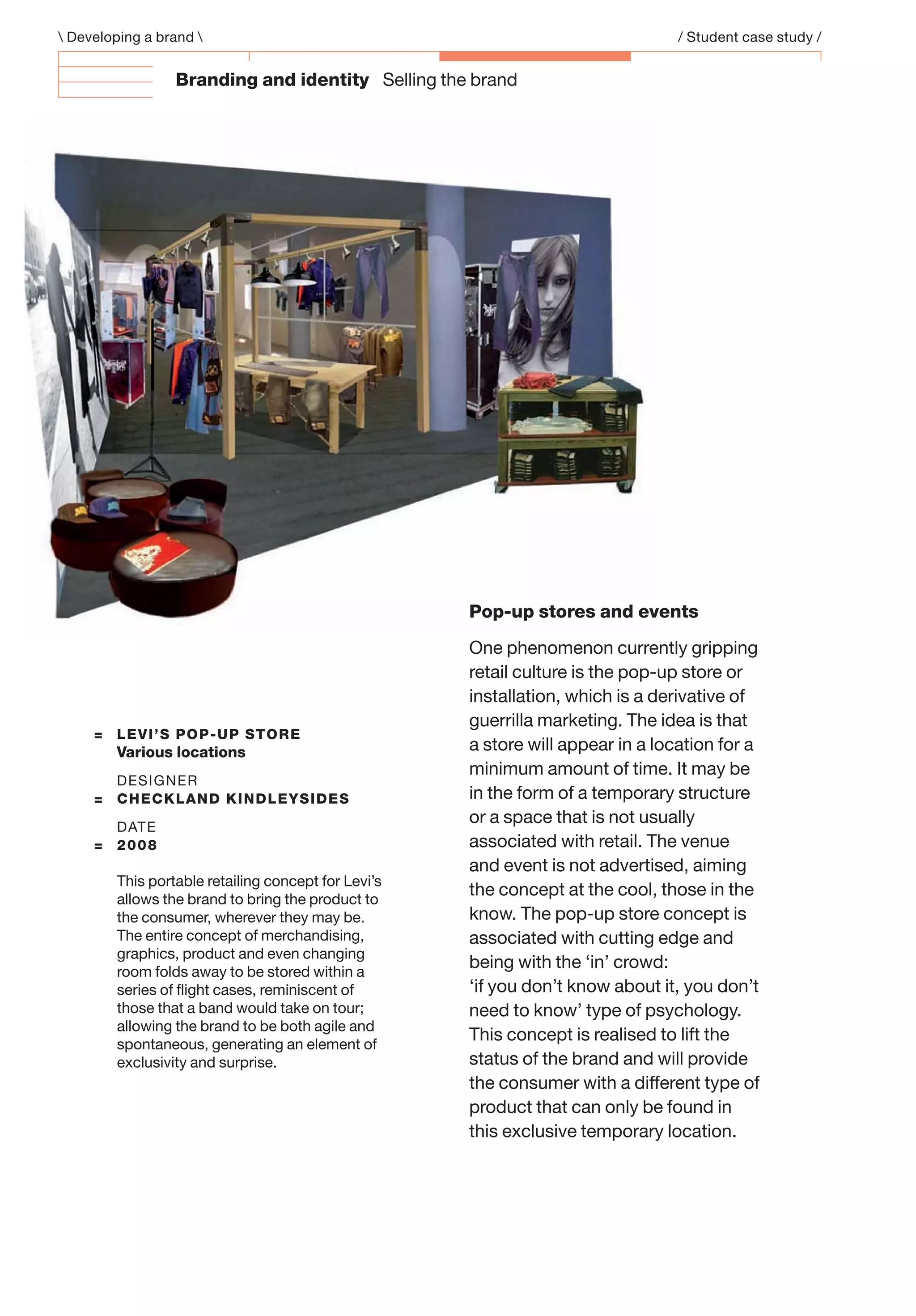
  • 28.
    = LEVI’S FLAGSHIPSTORE Berlin, Germany DESIGNER = CHECKLAND KINDLEYSIDES DATE = 2008 Checkland Kindleysides’ brief was to create the ultimate retail brand experience for Levi’s in Germany. An existing three-storey building with its striking arched windows provides glimpses of the brand within. Using each area to convey a distinct message, the designers worked to create a store that expresses the different personalities of the brand. On the ground floor, products are displayed alongside works from local artists; a beautiful curved staircase lends itself as a backdrop and displays a timeline, allowing customers to immerse themselves in the pioneering spirit of Levi’s; and on the second floor, a series of rooms allows customers to explore a ‘denim vault’, displaying the rarest product, with staff acting as curators. The intention was to create a space where the relationship between Levi’s and local artists, musicians and film-makers could be nurtured and exhibited, generating a youthful mix of global and local creativity. 026/027
  • 29.
    Branding and identitySelling the brand Developing a brand / Student case study / = LEVI’S POP-UP STORE Various locations DESIGNER = CHECKLAND KINDLEYSIDES DATE = 2008 This portable retailing concept for Levi’s allows the brand to bring the product to the consumer, wherever they may be. The entire concept of merchandising, graphics, product and even changing room folds away to be stored within a series of flight cases, reminiscent of those that a band would take on tour; allowing the brand to be both agile and spontaneous, generating an element of exclusivity and surprise. Pop-up stores and events One phenomenon currently gripping retail culture is the pop-up store or installation, which is a derivative of guerrilla marketing. The idea is that a store will appear in a location for a minimum amount of time. It may be in the form of a temporary structure or a space that is not usually associated with retail. The venue and event is not advertised, aiming the concept at the cool, those in the know. The pop-up store concept is associated with cutting edge and being with the ‘in’ crowd: ‘if you don’t know about it, you don’t need to know’ type of psychology. This concept is realised to lift the status of the brand and will provide the consumer with a different type of product that can only be found in this exclusive temporary location.
  • 30.
    028/029 Lifestyle stores The conceptof the lifestyle store was derived from the idea that chain stores could provide a diverse product range under one brand. This was seen as being aspirational for the consumer, as they could then buy into a whole lifestyle experience. The lifestyle store can incorporate all of the retail sectors by offering fashion, homeware and entertainment departments. The lifestyle store sometimes sees the merger of diverse retailing, such as a bank with a coffee house, or a sports store with a technology area. = M&S LIFESTORE Gateshead, UK DESIGNER = JOHN PAWSON DATE = 2004 The M&S Lifestore incorporates a diverse product range under one roof, making it a ‘lifestyle’ store. Characteristic of John Pawson, this particular design explores how architecture may be shaped around rituals of use rather than conventions of form. It draws on the essential Pawson vocabulary of wide floorboards, quiet white walls, floating benches, the shadow gap, floor-to-ceiling glazing with minimal frames, the optimal treatment of light and a restricted palette of natural materials. Photographer: Richard Davies
  • 31.
    Branding and identitySelling the brand Developing a brand / Student case study / Endorsements, collaborations and sponsorships It is usual for brands to be seen sponsoring major events, such as sports competitions, in the form of advertisement hoardings. More recently, brands collaborate with artists of different types as a way of promoting the brand in particular circles, therefore enhancing its attraction. In recent years, we have seen a rise in celebrities endorsing products with their name, which in turn is their brand, to raise the status of a product type and to give the consumer the opportunity to, in some small way, become them. The sale of perfume is a good example of this. Whether the brand is a celebrity endorsement, collaboration between the arts and brand or sponsorship of an event, the outcome impacts on the interior space for its duration. The space in some cases becomes a one-off event in itself or a temporary interior installation becomes the centre point of the store or gallery. This communicates an air of exclusivity to consumers who are quick enough and in the know, enabling them to buy into the brand for a limited period or to experience the brand as an installation rather than a place to shop.
  • 32.
    = SONY PLAYSTATION®EVENT Various locations DESIGNER = CHECKLAND KINDLEYSIDES DATE = 2007 To celebrate PlayStation’s six-month season of arts collaborations with the Baltic, English National Opera and British Film Institute, an iconic interactive installation was designed and moved to different venues. The mirrored sculptural form was developed to enhance its surroundings and reflect the rich visual content of each venue. 030/031
  • 33.
    ! Branding and identityStudent case study = Computer-generated visualisations of the completed space. PROJECT = MOBILE PHONE STORE DESIGNER = MAGDALENA KUMALA DATE = 2006 = Plans of the space. Students were asked to design a retail space for the display, selling and storage of a luxury brand of mobile phone, incorporating a strong brand identity that can be easily recognised and accepted throughout the world. This resulting design considers the variety of product ranges and the number of phones to be displayed. The site used for the project is based on a typical retail unit in a shopping mall of approximately 40 square metres and a ceiling height of three metres with adequate storage for 70 phones. The sales process allows staff to engage with customers once they have shown interest in a specific product, with space where the staff and customer can sit down to discuss the phones comfortably. The design concept is based on opulence, seduction and exclusivity and uses luxurious materials and lighting to suggest the quality of the product and to mimic the identity of the brand. Selling the brand
  • 34.
    = Sections of thespace. ? Now imagine that you have been asked to design a retail space for the display, storage and selling of a luxury brand of mobile phone. 1 List other mobile phone brands. What makes yours original? 2 Could these qualities be echoed in the design of the space? How? 3 List the requirements of a space of this nature. Can the qualities of the brand be reflected in these elements? 4 What elements can be carried across other branches? 5 The mobile phone industry is fast-paced and competitive. How could your design be easily updated? 032/033
  • 35.
    Branding and Identity Branding and identity / Retail sites / Retail sectors Retail spaces can be defined and identified through different retail sectors. These sectors can be broadly described as food – the evolution of the market into supermarket and speciality food stores; fashion – clothing, shoes, accessories and beauty products; home – DIY, furniture, fabrics and cookware; and leisure and entertainment – sport, technology, travel and finance. Each sector has been influenced through social and economic conditions, politics, history and the development of design processes. THIS CHAPTER aims to identify these influences on the designed space of each sector and explain the nature of the evolving retail experience. This is demonstrated by examining leading examples in retailing in each sector.
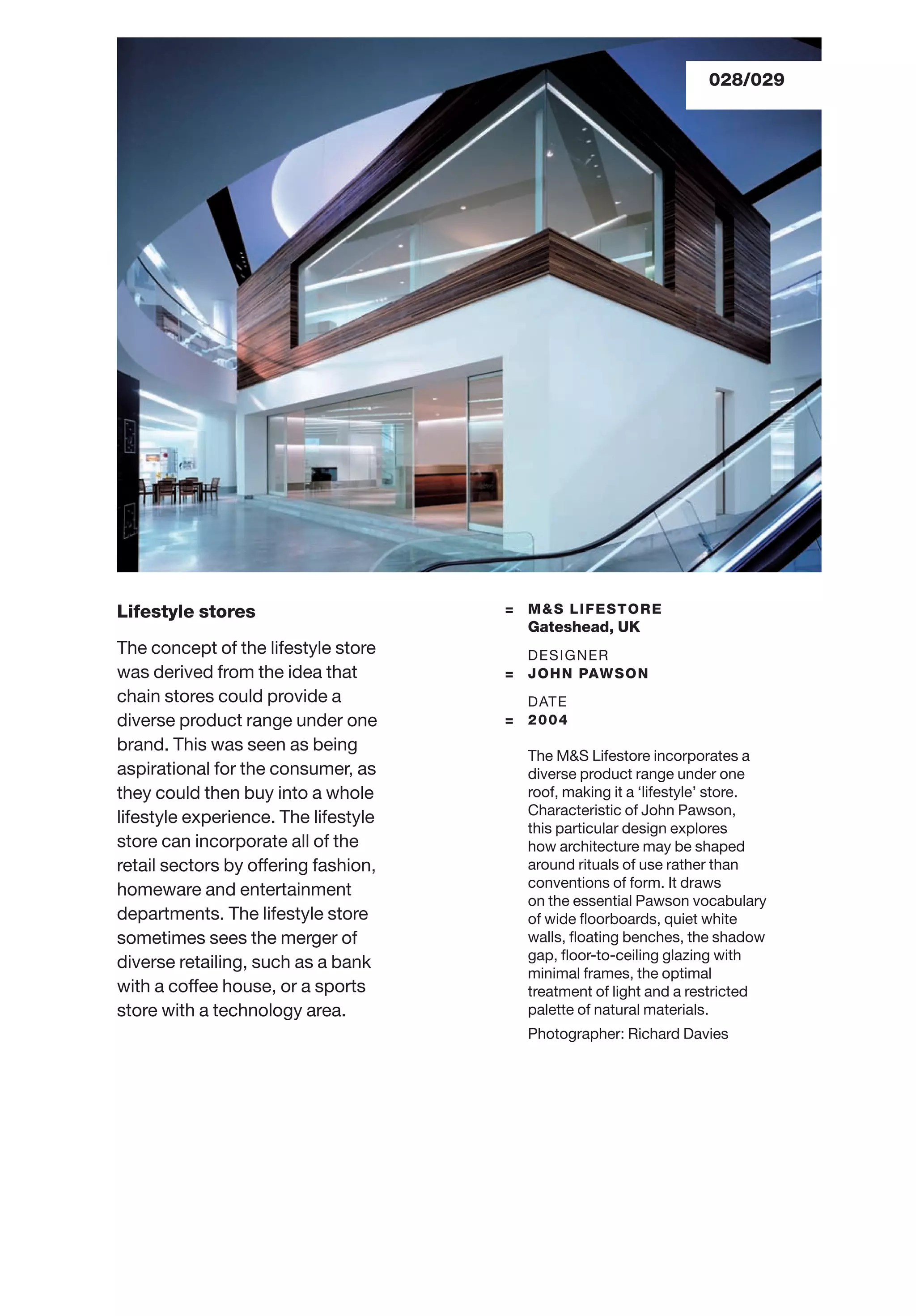
  • 36.
  • 37.
    Branding and IdentityRetailsectors Food Food retail is a huge industry, evident in every town and city through its cafés, restaurants, coffee shops and supermarkets. Today, large conglomerates and retail chains dominate food sales in the Western world, with many well-known brands pitching against each other and independent retailers for local trade. The design language of these retail environments, often repeated from town to town, can at first appear monotonous, yet for many of us they are part of our everyday routine for sustenance. Delve deeper into the concepts of such spaces and an interesting process begins to emerge. These spaces have derived from cultural influences and worldwide traditions, and have been interpreted into a systematic, functional store environment. For instance, many coffee shops and restaurants reflect European café culture, taking advantage of the warm climate with open facades and exterior seating; similarly, supermarket product displays are reminiscent of street markets and old market halls, with produce stacked high, and the colours of food and packaging utilised to attract sales. The layout of aisles too, pushing customers in a particular direction, is set out in a similar way to the market, but in a much more regimented manner. / Fashion /
  • 38.
    036/037 = FLOATING MARKET Bangkok,Thailand The floating fruit and vegetable market in Bangkok is an example of bringing food into the city by whatever means necessary. = DJEMMA EL FNAA SQUARE Marrakesh, Morocco Many cities are centred on the market. Here, the scent of herbal medicines and incense fills the air, creating a unique ambience associated with Morocco. The market merges into the many alleyways leading off it, where trading continues from the souks. In markets such as this, the produce sells itself. Markets Historically, the marketplace has played a major role in the emergence of cities, from the covered markets of Central Asia and China, the Arab souk, the Roman forum to the street markets and marketplaces of European cities. Markets are traditionally the places where food and other essential items were brought into the city from the surrounding farmland or from the sea to be sold to the masses. The trade routes for the transportation of such produce have been instrumental in creating communities in the form of villages and towns along the way. In many countries, the market is still the hub of the city. It is a place for engagement, creating a buzz with its richness in activity, sounds, colours, smells and experience. The market is transient, ever changing, and is part of the urban landscape. Market stalls are constructed from simple frames to allow for flexibility, disassembly and storage. Each stall is like a little shop with the awning overhead creating an interior space and sheltering goods from the elements. They are functional and allow for the display of goods at table height, with containers of food piled high, and hanging for textiles. Here it is the produce that sells itself rather than the design of the display.
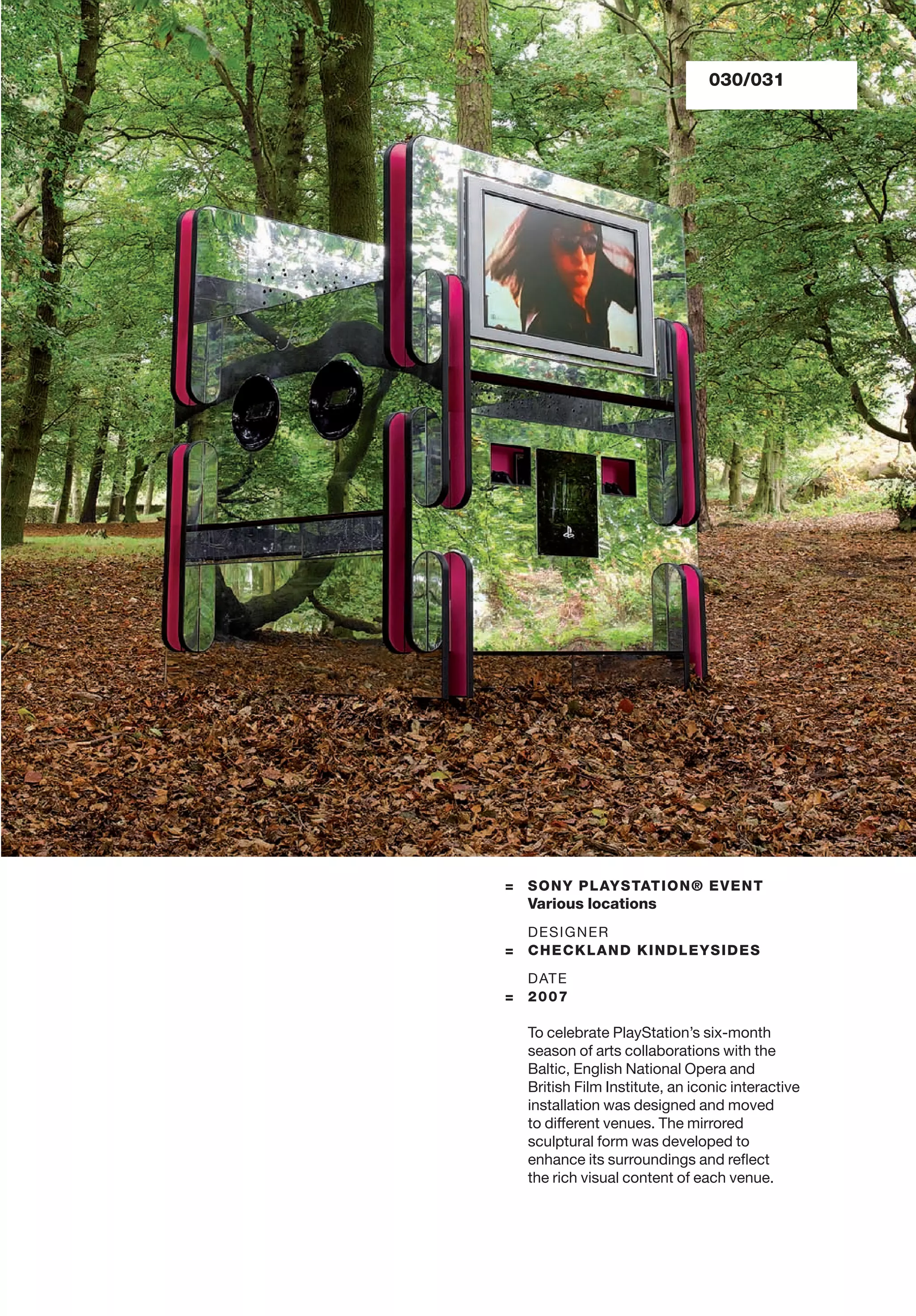
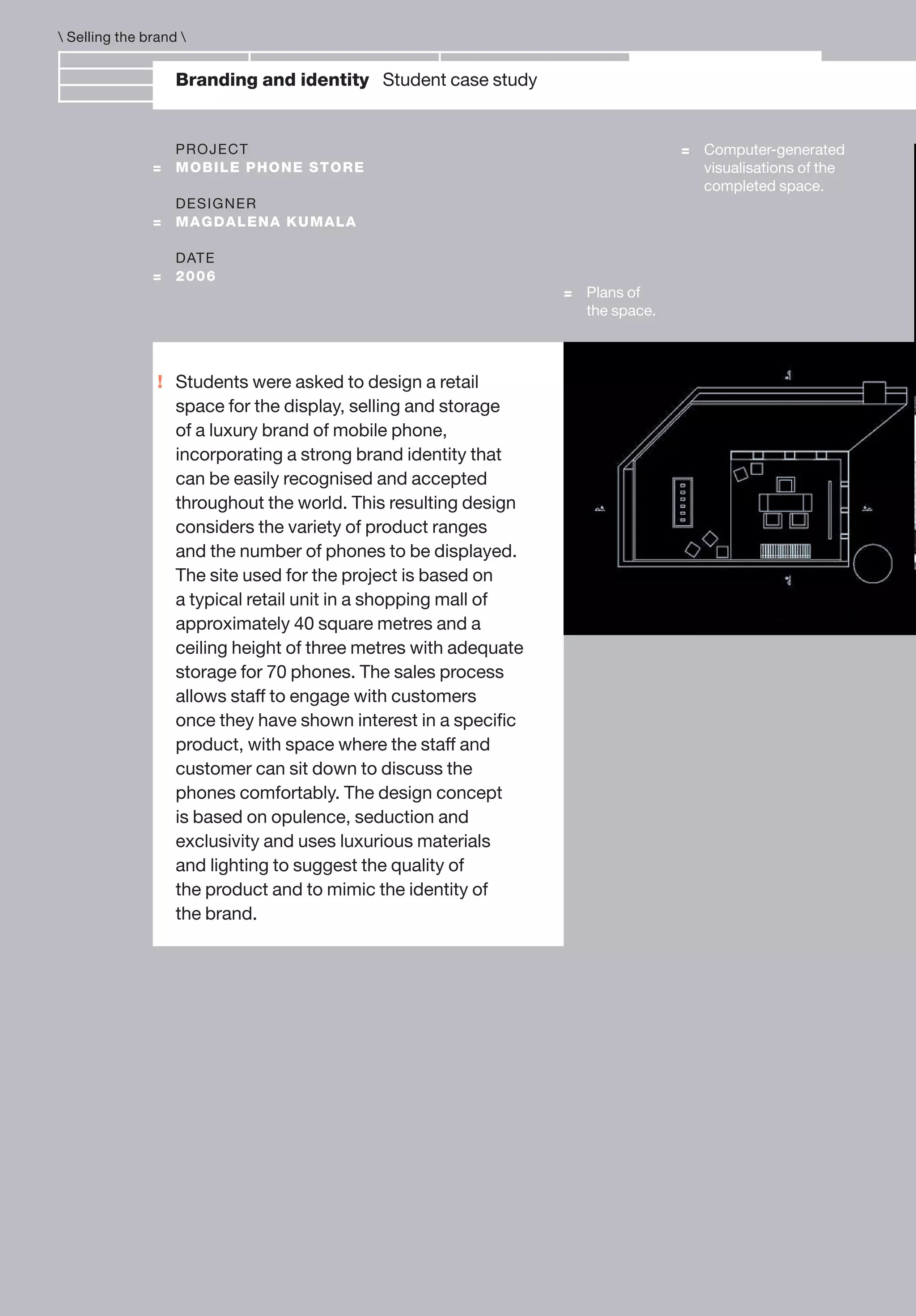
  • 39.
    ? Retail sectors Food Markethalls In the West, market halls were built as a way of housing market traders and sheltering them from the elements on the streets. In the 1980s, many market halls in the UK changed use or were demolished, as supermarket shopping became the norm. When the City of London was originally built, the strategy had been to meet the essential needs of all of the residents of the city and as a result, London had a wealth of sizeable wholesale markets: Smithfield’s for meat and Billingsgate for fish (both of which are still running today). Borough Market, Covent Garden Market and Spitalfields Market were used for selling fruit and vegetables (only Borough remains as a food market). The market hall has seen a re-emergence in recent years and although it has lost its core value, it is now a tourist destination and a place for finding specialist high- quality ingredients, arts and crafts, textiles and fashion. The layout of the market hall tends to be based on rows of permanent shop accommodation overlooking a central open market space for pitching stands. : R. THORNE Markets were ‘intended to serve bodily needs as the church served spiritual ones’. / Fashion / HISTORY AND NARRATIVE Established practices and historical uses can dramatically inform the design of a retail interior. An aura of the past can affect user experience and can be regarded as a design tool of great worth. These issues are dealt with in greater detail in the AVA title, Basics Interior Architecture: Context + Environment.
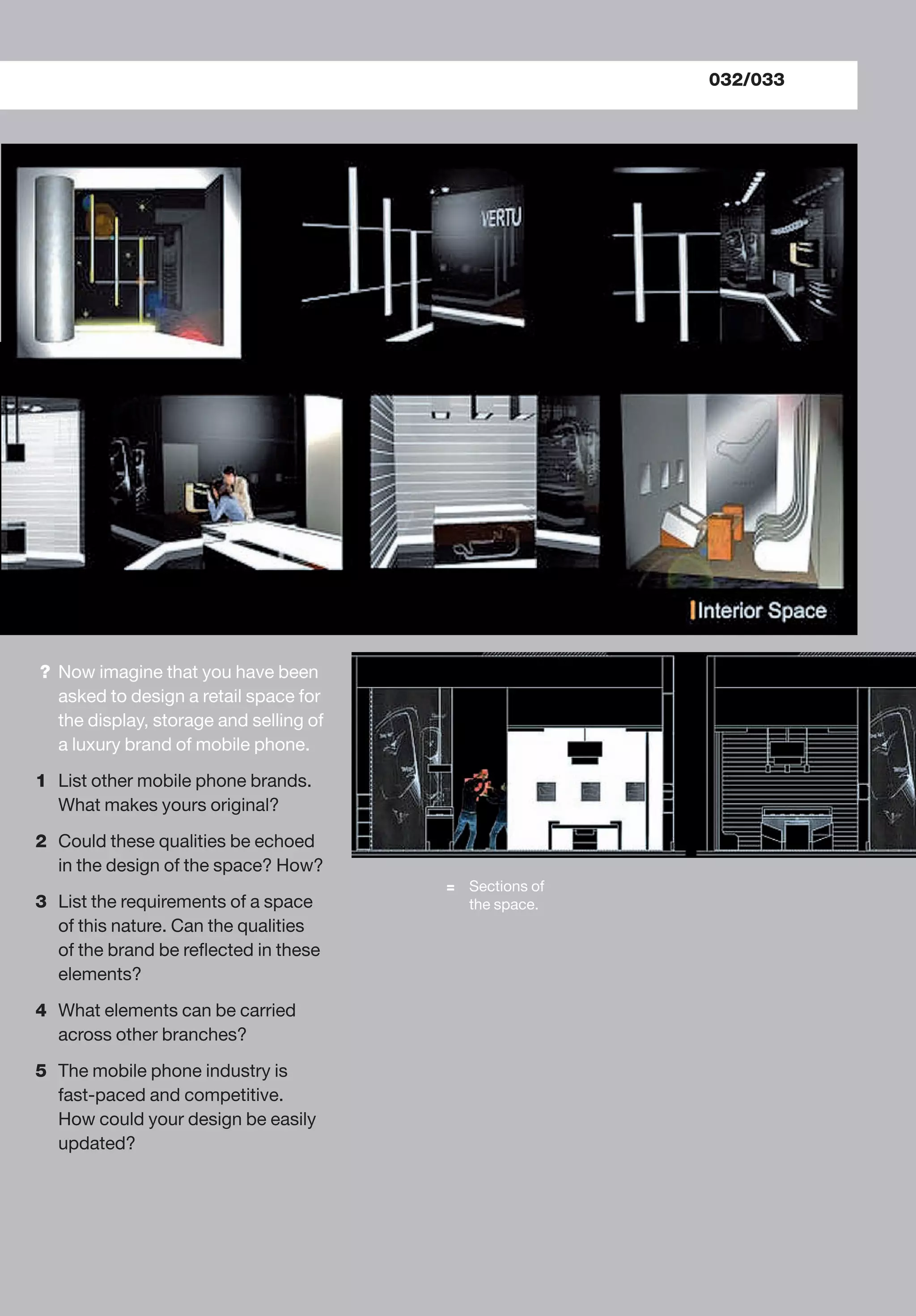
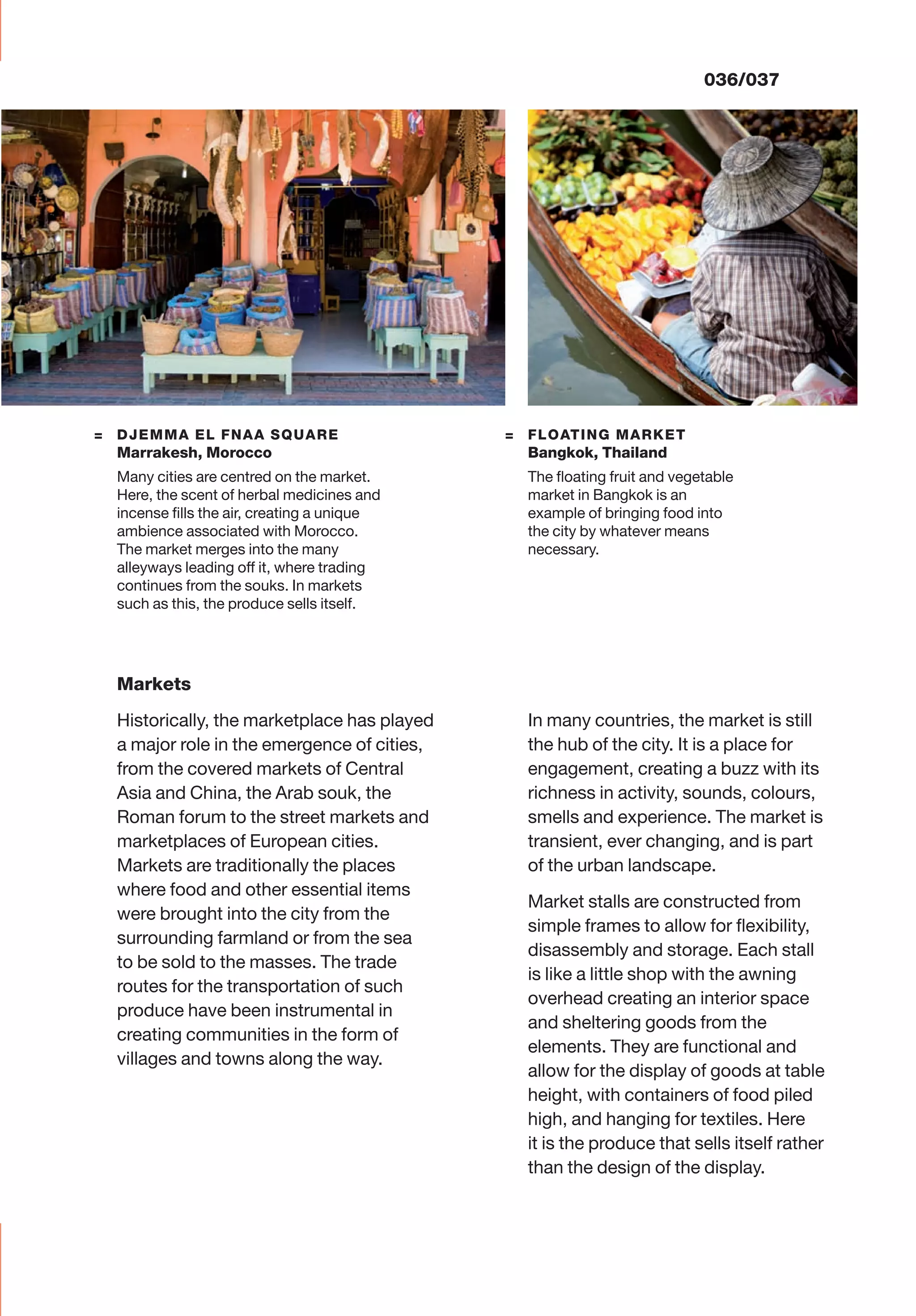
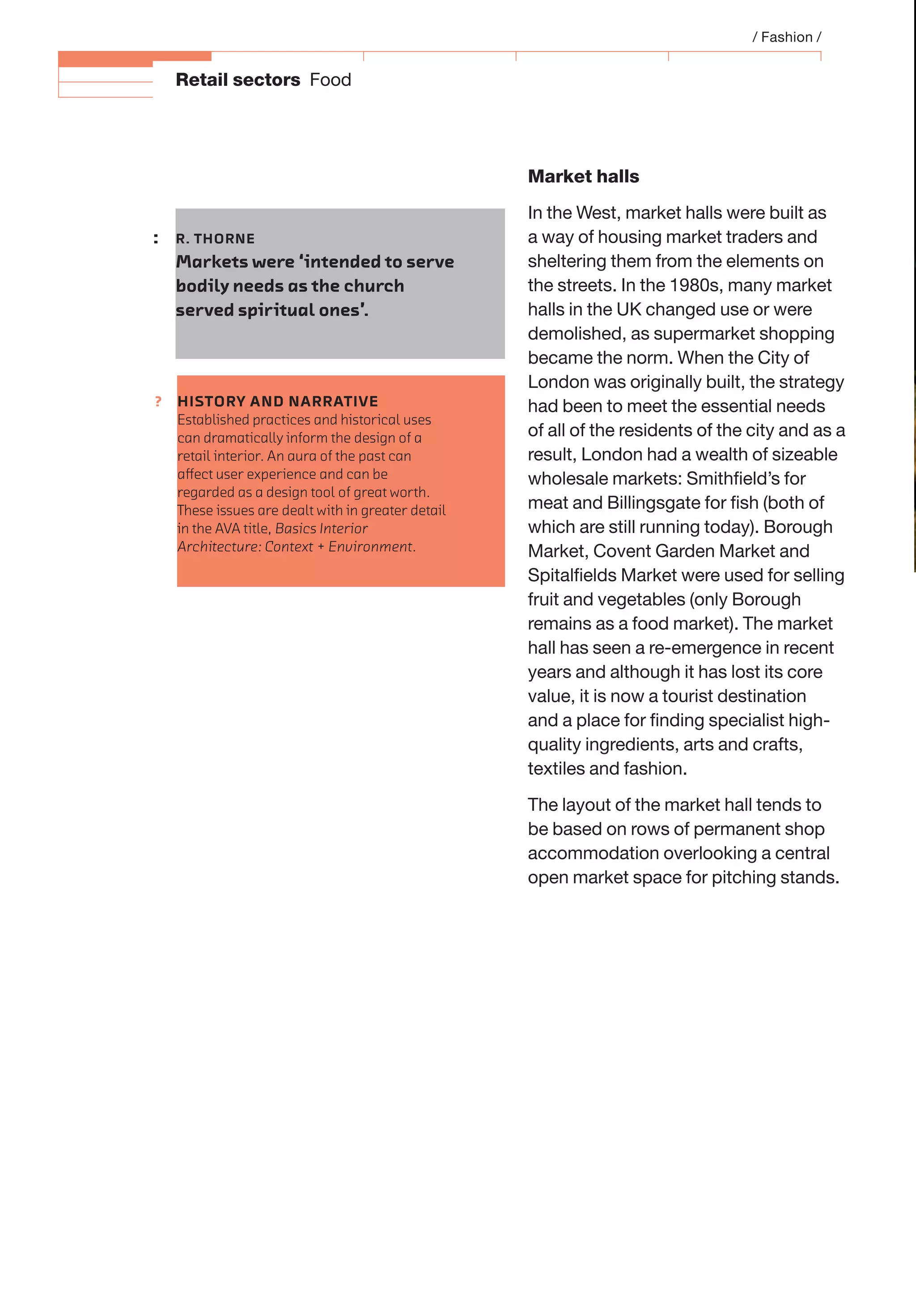
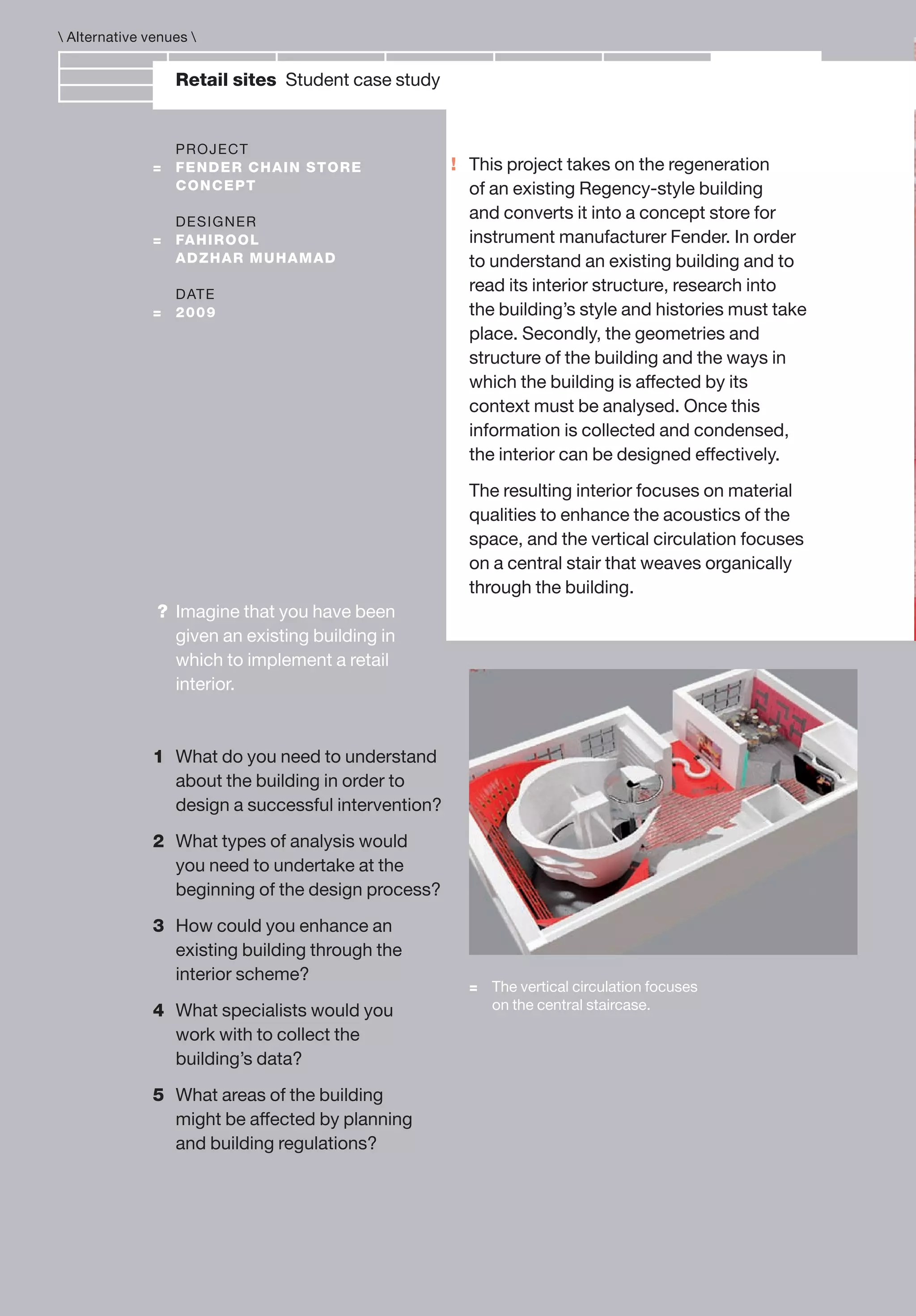
  • 40.
    038/039 = COVENT GARDENMARKET London, UK Covent Garden’s Jubilee Hall in London, UK, consists of two open market squares, with three rows of shops, fronted by colonnades on each side. Square lodge houses, originally intended to be used as pubs or coffee houses, stand at each end. The hall also has two terraces overlooking the market squares, which were to be used for exclusive retail spaces to attract a higher class of visitor. Covent Garden’s Jubilee Market Hall was regenerated in the 1970s and is now famous for its Arts and Crafts market: a major tourist attraction. Spitalfields Market has also recently been regenerated (completed in 2005) and now contains a contemporary steel and glass insertion, housing cafés, restaurants and upmarket shops.
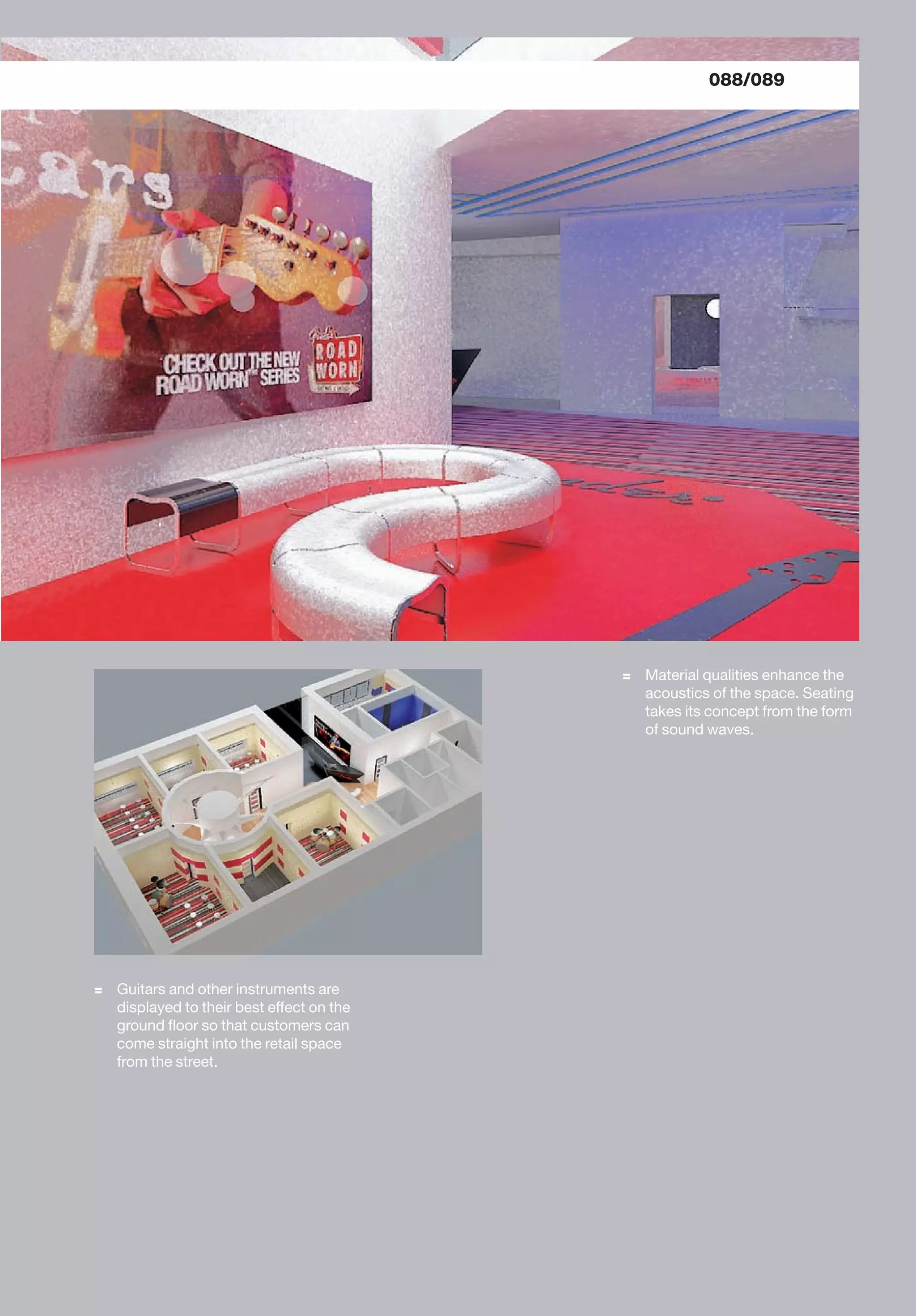
  • 41.
    Retail sectors Food /Fashion / The supermarket experience is now a familiar environment that provides essential needs. The relationship between supermarkets and markets is evident in the reason for their existence and the translation of product display, but in many ways, they are opposites. Supermarkets do not recreate the sense of community in cities and social engagement that a market does and could not be described as the hub of a city. What the supermarket does do, however, is enable the maintenance of the current pace of living with its convenience, in an environment that is contemporary and fulfilling of aspirations. Supermarkets The need for markets was eradicated in most of the Western world due to the rise of the supermarket in the mid-1920s. Large conglomerates now ship food of all types around the world to fulfil the needs of the masses. This food tends to be cheap, easily accessible, and readily available and does not depend on the seasons to grow. This convenience helps to sustain our modern lifestyles: long working hours and the move of women away from the home and into the workplace. Supermarkets are now a destination for all types of retail coming together under one roof. The supermarket environment is felt by many to be somewhat clinical; it is logical and organised in a way that is easy to navigate. Signage and packaging are generic and bold. Aisles are wide and continuous. Produce is stacked high and plentiful, giving the impression of a warehouse. Fruit and vegetables are grouped together and displayed as in markets, using their colour as a selling point. Consumerism The purchase of material possessions.
  • 42.
    040/041 Speciality food stores Thedesign of some speciality food stores can be more easily directly linked to the experience of the market than supermarkets can. Displays are more purposeful in creating an authentic market atmosphere and do not have the constraints of the large conglomerate chain. Like some market halls of today, these spaces bridge both the retail and leisure sectors; the products are an aspiration and create an impression of a lifestyle. They can combine a mix of contemporary and traditional interiors with character and charm. = VILLANDRY STORE London, UK DESIGNER = DALZIEL AND POW DATE = 2007 Villandry bridges the retail and leisure markets through its gourmet food experience and French inspiration. The interior space is divided into a food hall, deli, charcuterie and a high-quality takeaway. The concept builds on the charm and heritage of the brand, creating a robust and feasible identity that can easily be traced back to the routes of the market space. The space is arranged so that the takeaway area is easily accessible from the street and the Food Hall is the central space with glimpses of the restaurant and bar beyond. The market feel is brought up to a sophisticated level through the interior detailing and graphic language used within.
  • 43.
    Food /Home / Retail sectors Fashion Fashion has an important influence on the retail sector. First, the interior space is designed in line with current trends in colour, material and graphics. Secondly, the sector is dominated by the huge consumer boom in the fashion industry, which covers the sales of clothing, accessories and shoes as well as beauty products. Fashion is a market that is largely dominated by women and is very much an interactive social experience perceived by many as a day out. Fashion has played an important role throughout history in portraying class, wealth and heritage. However, fashion retail really took off with the birth of the department store concept in Britain. In Paris in 1850, this was developed into a shopping experience for the sophisticated Bourgeois, with the launch of the Grand Magasin, Le Bon Marché. The diverse product ranges and fashions represented the Bourgeois culture’s commitment to appearance and material wealth, which is mirrored in the displays around the department store. As the world of fashion is ever changing, fashion stores demand interiors that will appeal to the appropriate market. Fashion retail can be broken down into three areas: premium fashion labels, where innovative, cutting-edge fashions and retail spaces lead the way for their counterparts; boutiques, where the interior space is unique and styled to suit the needs of the individual; and the mass-consumed commercial fashion empire, where fashions and interiors are fast paced, exciting and sometimes controversial.
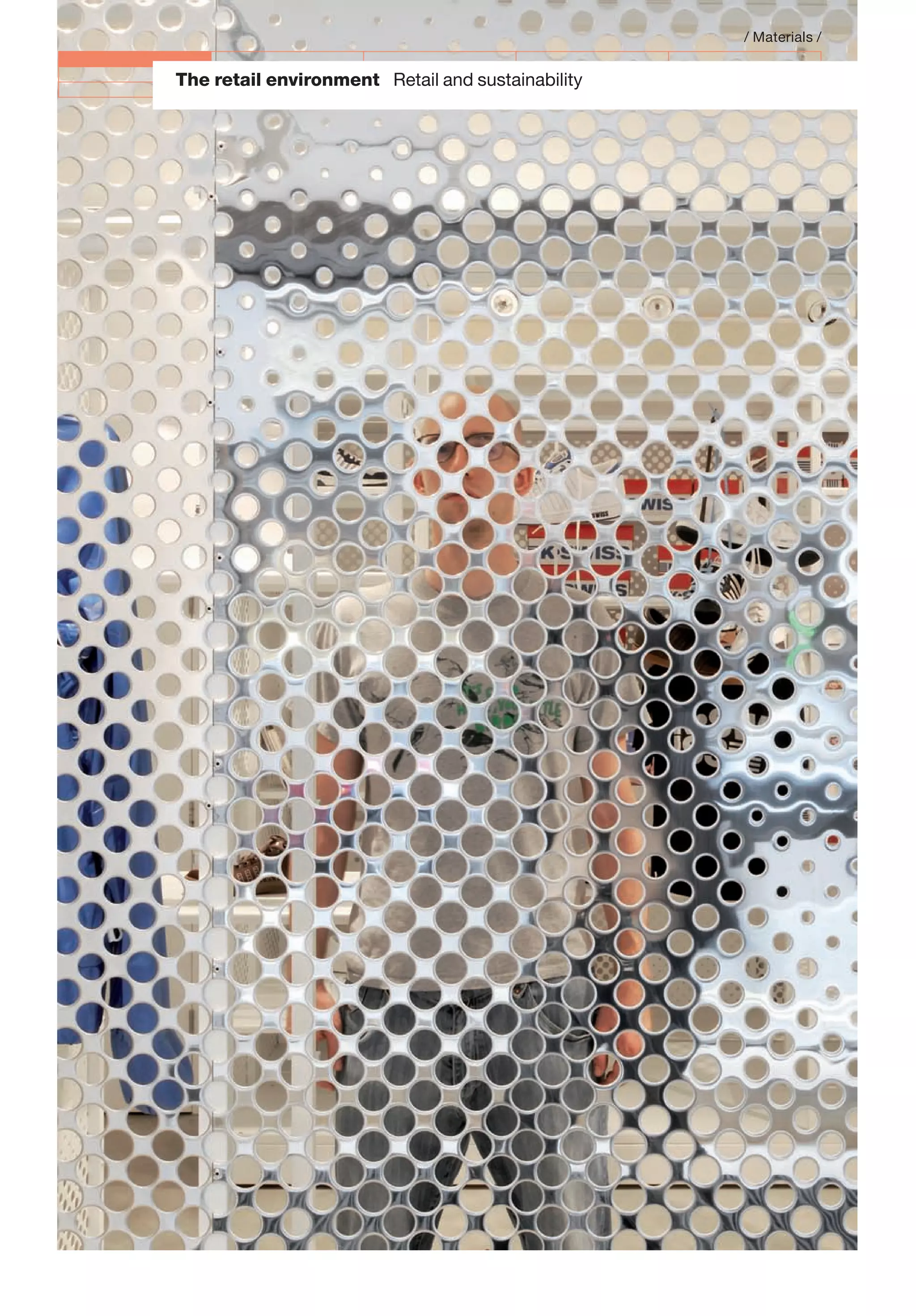
  • 44.
    042/043 = CALVIN KLEINSTORE Paris, France DESIGNER = CLAUDIO SILVESTRIN DATE = 1997 The design of this space provides a simple, minimalist interior, common in many premium fashion stores. Using limestone floors, white walls and satin glass screens, the space is given a ‘showcase’ feel and is unable to detract from the clothes on display.
  • 45.
    Retail sectors Fashion =COMME DES GARÇONS New York, USA; Tokyo, Japan and Paris, France DESIGNER = FUTURE SYSTEMS DATE = 1998 In 1998, Future Systems were asked to create stores for Comme des Garçons in New York, Tokyo and Paris. Their brief – to create a ‘new kind of space with an atmosphere of experimentation’ – resulted in three strong and unique designs. In New York, an unusual mix of old and new was used to create a natural and raw yet mechanical and machined finish. In Tokyo, a curious filter between outside and inside was created using two glass cone-shaped facades. And in Paris, the historic façade is protected by a sheer skin of pale pink glass. It is through these unusual environments that the relationship between space and clothing is established. Food / Home /
  • 46.
    The fashion house Thefashion house is a term that is used to describe an exclusive fashion label, which has a designer or collection of designers working under its name. The premium fashion interior has become the most influential and creative of retail spaces and has fuelled a fertile fusion of fashion and architectural design. The large fashion houses often implement their major brand stores in London, Paris, Milan and New York, as these are considered the most prestigious fashion capitals of the world. There are numerous displays of successful collaborations between fashion designers, artists, designers and architects, resulting in exciting and innovative retail spaces. This form of collaboration started in the 1980s, with minimalist stores created by leading architects coming to the forefront in retail design. These spaces were well crafted and detailed, often referred to as ‘white boxes’, in which clothing could be displayed like pieces of art. Today, we can still see examples of such interiors, but there is also a different type of space that has emerged. With the influence of cyberspace, the use of CAD modelling computer packages has transformed the design process in such a way that organic architectural forms are easier to manipulate and are being showcased as insertions into retail spaces. The relationship between the fashion designer and architect allows the fashion designer to gain a strong, unique identity that the architect is able to realise in a quick timeframe. It is interesting to note that although these spaces exist, it is a trend that is not commonplace in architectural circles. In some cases, the architect will design a building for the fashion house, or work primarily on the interior of an existing building. The fashion house, in most cases, has a large budget and can therefore push the boundaries of contemporary design. : REM KOOLHAAS Shopping is a phenomenon that has ‘remained mysteriously invisible to the architectural eye … as one of the most critical and … important contributions to urban texture at this moment’. 044/045
  • 47.
    Retail sectors Fashion Food / Home / The boutique The rise of the boutique as a small independent retailer began in the late 1950s, in the aftermath of the Second World War, when the youth of that era was ready to embrace freedom and self expression. Before this time, a boutique was a department found in a larger store that provided clothing ranges somewhere between custom- made couture clothes and cheap mass-produced wholesale clothes. The first of these revolutionary independent shops to appear in the UK was called Bazaar and showcased clothes by the designer Mary Quant, on the Kings Road in London. It was designed and implemented by Terence Conran. The shop was innovative in the way that it manipulated space in a cool and contemporary way. It had a full- height glass facade that allowed the consumer to view the activities of the shop from outside. This was radically different from most retail spaces of that time and became symbolic of the rise of youth culture, which took place in the 1960s. Although Bazaar was influential in this mini revolution, its clientele mainly consisted of the wealthy and elite. The boutique as we know it today houses custom-made or one-off speciality pieces – a far cry from the most prominent brand stores in the premium market place. The interiors are small, considered and individually designed to suit the image of the clothing and accessories. = OKI-NI BOUTIQUE London, UK DESIGNER = 6A ARCHITECTS DATE = 2002 Oki-Ni sell exclusive custom-made clothes from design houses such as Evisu, Levi’s and Adidas. The interior scheme of its London store is based on an oak ‘tray’ that acts like a stage, with piles of felt layered to create platforms for product display. Oki-Ni has offered the fashion market a fresh relationship between consumer and product. Limited edition clothes by global and independent brands are available exclusively online from Oki-Ni. 6a architects won the commission to design the flagship store on Savile Row with an installation- based concept that emphasises the tactile and social opportunities of clothes shopping. Low piles of felt replace the traditional arrangement of shelving, rails and furniture, and define Oki-Ni’s physical landscape; the generous felt surfaces are both display and furniture. This departure from the established conventions of retail design creates a place where resting and socialising play a critical part in the discovery of new products.
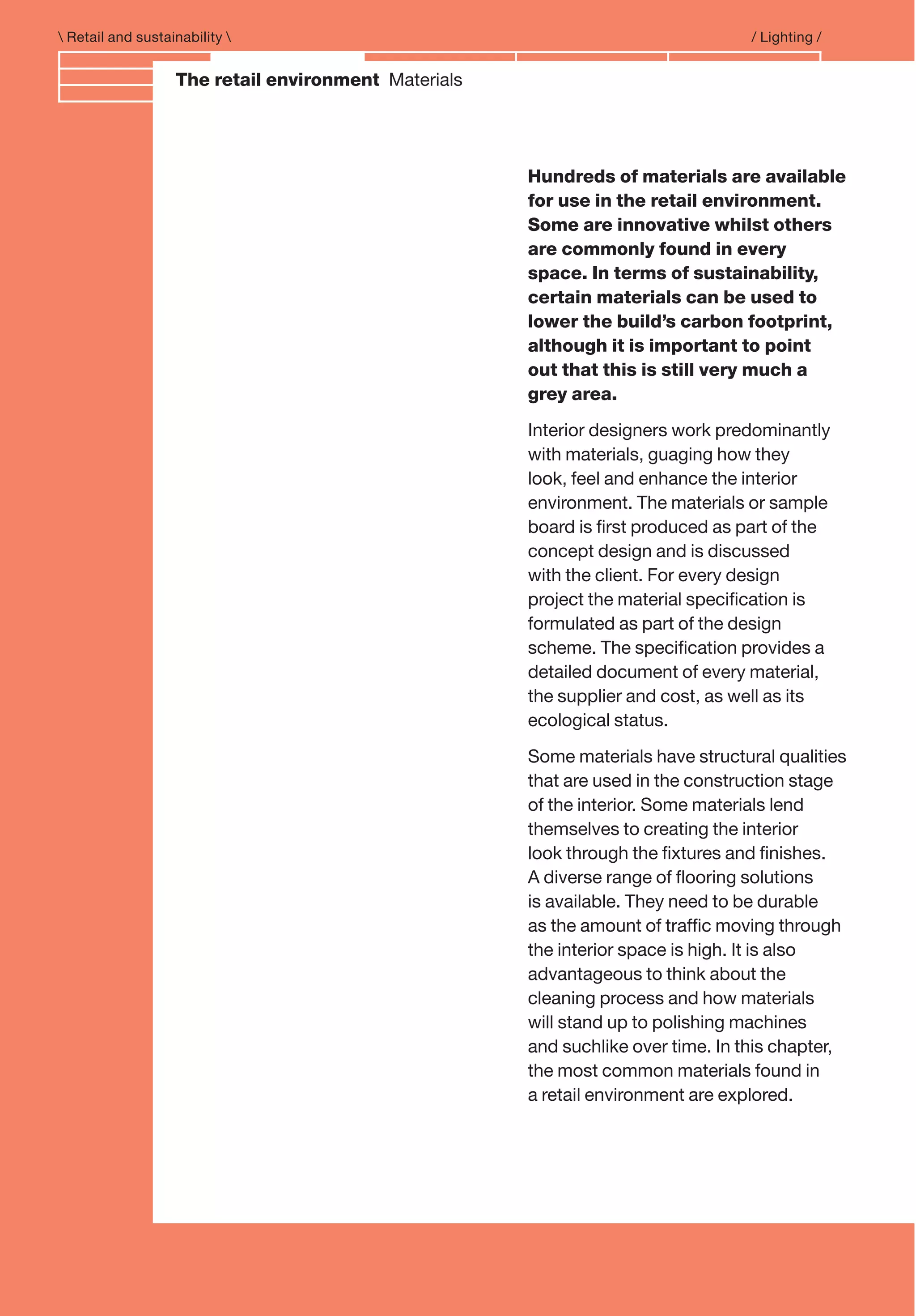
  • 48.
    ? 046/047 REPRESENTATION Representation of spaceis central to all aspects of interior design. Sketches, hand drawings, technical drawings and computer generated plans and models are all used by designers to communicate ideas to the client. The AVA title, Basics Interior Architecture: Drawing Out the Interior, looks at this in greater detail.
  • 49.
    Retail sectors Fashion Chainstores These are retail outlets sharing the same brand and management across locations. Food / Home / Commercial fashion Barbara Hulanicki invented the concept of mainstream fashion stores when she opened Biba in London, UK, in 1964. Today, commercial fashion is dominated by chain stores with numerous identical shops in major towns and cities. The offer is available from every high street and is affordable to the masses. These shops often take reference from premium fashion brands in terms of both clothing collections and interiors. They are frequently changed to evolve with consumer expectations and because of the high level of activity, the interior finish becomes easily tired and dated. The interiors are varied, using materials, lighting and graphics to create an illusion. Retail designers work with marketing experts to focus the store’s identity and relationship to the brand. In a heavily saturated market, being competitive in style and price is the key to success.
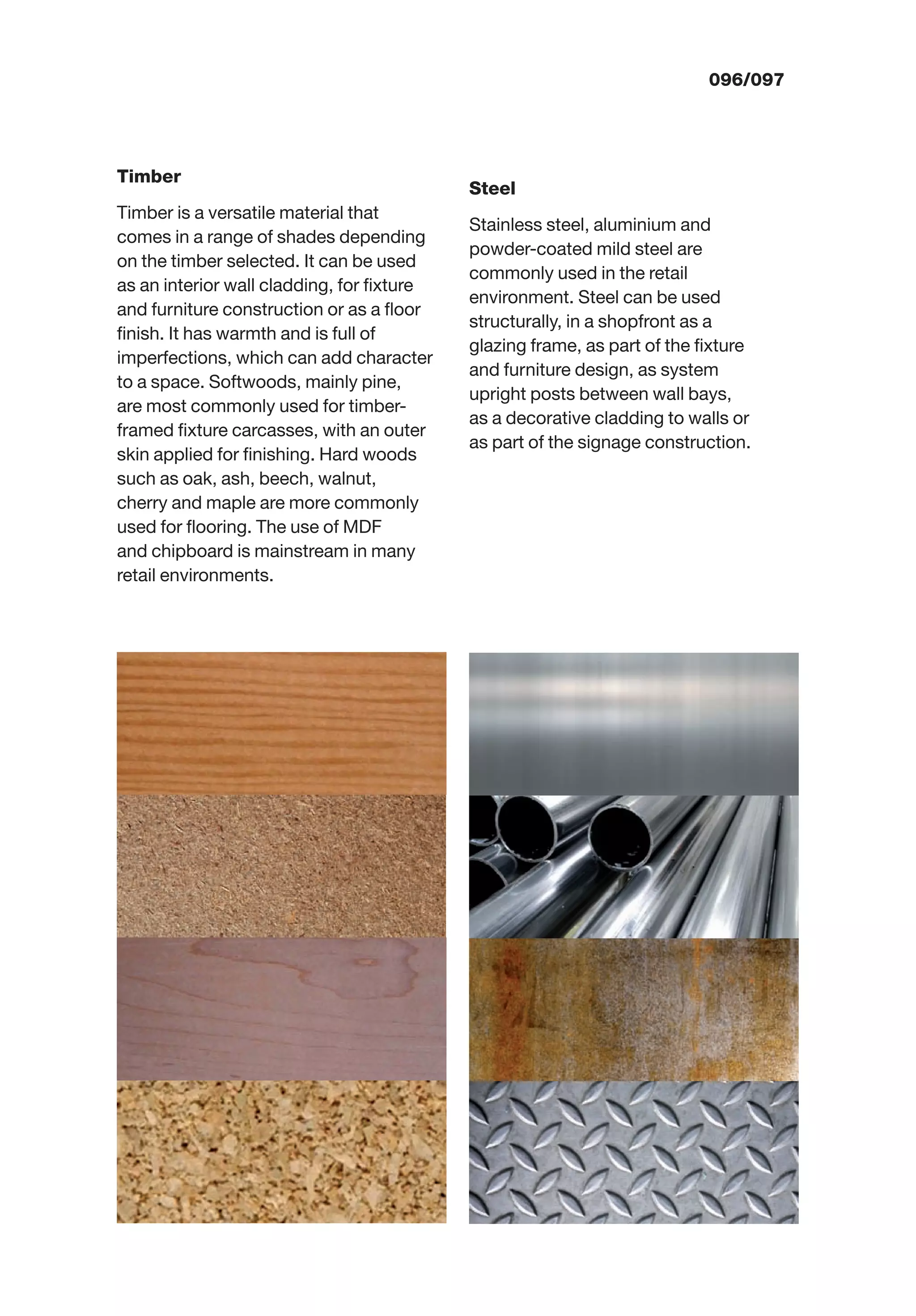
  • 50.
    = TOPSHOP New York,USA DESIGNER = DALZIEL AND POW DATE = 2009 Topshop is one of the UK’s leading commercial fashion retailers. The launch of their New York flagship store in 2009 marked the transition to global brand. Replicating many of the design features found in UK stores, Dalziel and Pow have created a bold and confident statement and have successfully carried the brand across to the US market. : BARBARA HULANICKI I didn’t want to make clothes for kept women … I wanted to make clothes for people in the street … I always tried to get prices down, down, down to the bare minimum. 048/049
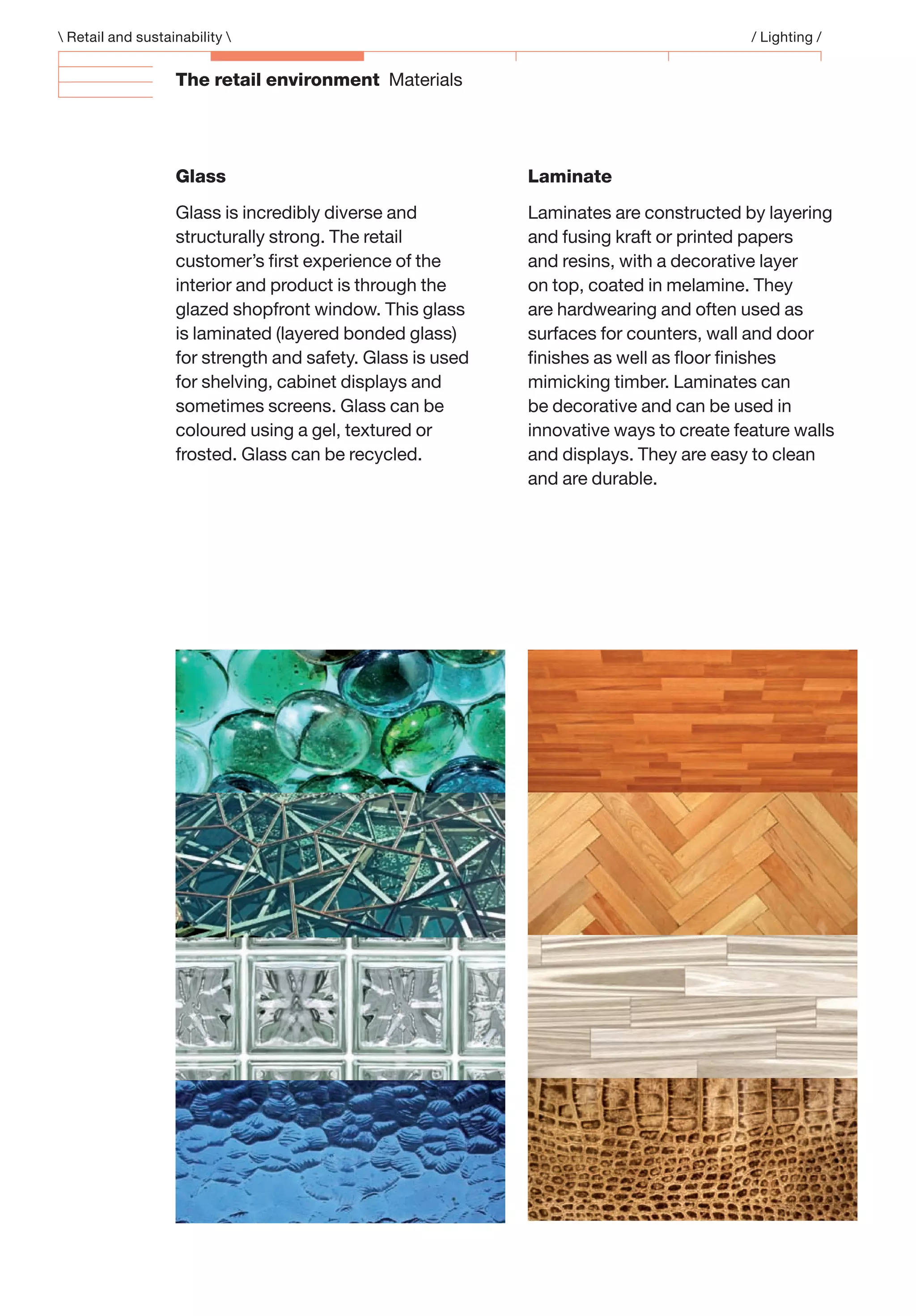
  • 51.
    Branding and IdentityRetailsectors Home Fashion / Leisure and entertainment / Consumer culture emerged in America in the 1950s following the Second World War. The focus of advertising was on enticing women back into the home after working in factories, filling jobs vacated by servicemen fighting abroad. The home featured predominantly in the role of the suburban housewife and kitchen gadgets and appliances became must-have items. The Festival of Britain, held in 1951, was a celebration of Britain’s past, present and future and saw the launch of the new ‘Contemporary Style’, which was derived from the American design, but was embedded with British traditions. The Council of Industrial Design (later to become the Design Council), led by Sir Gordon Russell, pioneered the role that designers were to play in society during these post-war years. The Contemporary Style was successful in its campaign aimed at British women. Furniture could be bought from a small number of high- street retailers. It was designed to suit the space within new government- owned houses and flats that were being built at that time. Interior decoration and home DIY were becoming Britain’s post-war pre-occupation, and therefore the need for paint, wallpaper, flooring and furniture had a positive impact on the retailing industry.
  • 52.
    050/051 Homeware and massconsumerism Britain first came in contact with the flat-pack concept in the early 1960s when Terence Conran launched his own furniture collection, Habitat. Conran’s aim was to introduce his commercial furniture range to the domestic market and was a reaction to the lack of good, affordable furniture shops in the UK at that time. Influenced by the markets and shops of France and Northern Italy, the store became very successful in bringing a diverse range of inexpensive lifestyle products to the high street. Some of the cookware products had never been seen on the British market before. The pots, pans and other cookware items were stacked high as on the European market stalls, and this has now become recognisable as the Habitat retail concept. In 1974, during the recession in the West, Habitat launched its first Basics range – a collection of 100 home products at very low prices. The range was a huge success and enabled the company to attract a new clientele as well as ride out the recession. When the idea was re-launched in 1982, Habitat was franchised in Japan. The Japanese loved the Basics idea and asked for permission to launch the concept under a different name. The concept store Muji was born and is now a leading retailer of ‘no-brand’ products that are simply packaged and sold cheaply with the emphasis on recycling and ‘no-waste’. = HABITAT IN THE 1960s The interior of one of the first Habitat stores in the UK. : TERENCE CONRAN … a better style of life should be more widely available. Habitat showed that you need to follow the same philosophy right through from drawing board, via manufacturing, to the retail shop floor …. This is what Habitat achieved in the 1960s ….
  • 53.
    Retail sectors Home Fashion / Leisure and entertainment / IKEA and the birth of flat-pack As interest increased in the design of the home, the need for mass- produced product ranges grew. The biggest innovation in furniture design of the late 1940s was flat- pack furniture by the Swedish designer, Gillis Lundgren. IKEA later went on to develop their store concept around this idea and opened the first store in Sweden in 1958. The idea was to promote cheap, mass- produced furniture and homeware that was easily accessible. The flat- pack furniture is easy to store and assemble, thus affecting the sale price and the design of the showroom. The IKEA store as we know it consists of a showroom, marketplace and warehouse. The idea of the layout is that the customer walks a particular long route so that they view all of the products and room sets for inspiration, and note down the reference of the furniture they wish to buy. There are, however, short cuts through the space. Then, the customer has to walk through the marketplace, where products can be picked up, into the warehouse, where they select their furniture before paying for their items. This spatial structure was new to retailing and promoted mass-consumerism and accessibility. Premium home stores In contrast to the domestic furniture retailers on the high street, another breed of furniture and homeware manufacturers targets the high-end market. This market sees the celebrated famous furniture and product designer at the forefront of the retail experience, with iconic pieces being sold, much like pieces of art, in both the domestic and commercial sectors.
  • 54.
    ? 052/053 = DROOG New York,USA DESIGNER = STUDIO MAKKINK AND BEY DATE = 2009 The design for this store breaks the norm of retail design. The brief was to create an interior installation made up of elements that can be purchased. Jurgen Bey’s ‘House of Blue’ takes this one step further. Products are displayed as if in a gallery; parts of the interior are also for sale. They can be bought as seen or can be custom-made or fitted to the customer’s requirements. ELEMENTS AND OBJECTS Objects can be used in the retail space to great effect. These objects can be small or large, new or found and can add great character to a space. Designers are currently using such techniques to further establish a brand within a retail space. The use of objects in interior space is looked at in greater detail in the AVA title, Basics Interior Architecture: Elements/Objects.
  • 55.
    Retail sectors Leisureand entertainment The leisure and entertainment sector has grown significantly in the last ten years. Whether the activity is based around a destination or a product purchase, the chances are the interior space will encapsulate a brand. An outing to the cinema, museum or theatre will each give an opportunity to buy into the experience through a shop, bar or café. The leisure sector includes sport – as an activity or apparel; technology – sound, audio and gaming; travel – modes of transport and travel agency; and finance – the services of banks and building societies. Banks are now abandoning the high street and going online. = REEBOK FLASH STORE New York, USA DESIGNER = FORMAVISION DATE = 2002 Recently, Reebok re-invented itself in a new consumer offer. The Reebok Flash Store opened in New York for a limited period in the CV2 Contemporary Art Gallery, selling retro and limited edition footwear. Formavision, whose trademark is to use art as part of their interior scheme, designed the space. Home
  • 56.
    ? Sport In recent years,the sports industry has taken on the idea of enforcing their global brand identity through store image. Retail spaces within the sports sector are sparse in products and are exhibition-like in the way that the participator moves around the space and interacts with displays. The graphic language is prominent throughout and a theme demonstrating youth and physicality encapsulates the brand message. Sports brand Nike has opened a series of Nike Towns around the world, each Town taking its interior influence from the surrounding city. In 2002, Reebok also opened its world headquarters in Boston, USA. The Reebok brand is encapsulated in its headquarters and is reinforced in every aspect of Reebok design – from the apparel to the shop floor – on every high street. 054/055 FORM AND FUNCTION Interior designers and architects differ widely in their views of how far the function of a space should affect its design. Form and function are discussed in greater detail in the AVA title, Basics Interior Architecture: Form + Structure.
  • 57.
    Retail sectors Leisureand entertainment Home / Student case study / = APPLE STORE New York, USA DESIGNER = BOHLIN CYWINSKI JACKSON DATE = 2006 The Apple Store, New York, occupies an underground retail concourse with entry through a 10-metre-tall glass cube at street level. Housing a transparent glass elevator and staircase, the cube entices customers down into the retail space below. By day it acts as a natural skylight; by night it lights up as a sign. Carefully tailored steel, stone and wood fixtures and fittings all combine to create the perfect backdrop to Apple’s state-of-the-art technology and an iconic piece of architecture on the New York street.
  • 58.
    056/057 Technology The use oftechnology in the home and workplace has seen a phenomenal increase as advancements have taken place and products have become the must-have gadgets of the moment. Products such as mobile phones, games consoles, MP3 Players and home computers have taken the high street by storm, creating a new breed of shops geared towards the technologically minded and youth market. Many of these brands are global and need an interior space and graphic language that will appeal on all levels. Apple Mac computers have long been the favoured tool of choice for design professionals. In 1998, the iMac was released and became the fastest-selling desktop computer in history. In 2001, the iPod was launched and became the leading MP3 player, setting a precedent for other manufacturers. In the same year, Apple opened its first retail store in San Francisco and Washington DC. The Apple Store now exists globally and reinforces the Apple brand. The stores are revolutionary in the technology sector and focus on being user-friendly and an environment where products can be tried and tested. The stores have a children’s section, a ‘genius’ bar, a theatre and a solutions centre as part of the store concept. The mobile phone is also now a mainstream essential product. Mobile phone stores are commonplace on the high street and often offer a personal service with consultation areas, exhibition-like displays and brand messages. The need for the consumer to keep up with technology means that mobile phones are regularly replaced, keeping the market strong and competitive. : JAMES GARDNER The new plaza in front of the General Motors building on Fifth Avenue at 59th Street is a triumph of urban design... Suddenly, as if out of nowhere, New York has a new public space that will prove to be a source of civic pride and aesthetic delight.
  • 59.
    Retail sectors Leisureand entertainment = PORSCHE SHOWROOM Leusden, Netherlands DESIGNER = QUA DATE = 2004 The new scheme for the Porsche showroom in Leusden was intended to reflect the passion and emotion of the brand. It needed to include a lounge area, bar, atelier, shop, reception, and delivery area, whilst retaining the maximum number of cars inside the showroom. The design shows the rich racing history of Porsche, the luxury of the cars, their technical and engineering qualities, and is inclusive of non-owners enthusiastic about the Porsche brand. By using long, low shapes, a colour palette of blacks, metals and whites, the design emphasises the curves of the cars and the material and technical sophistication of the Porsche brand.
  • 60.
    058/059 Travel The motor industryis undergoing major changes in the way it trades. The car showroom and forecourt as we know it is said to be disappearing. Today, car manufacturers are jumping on the branding bandwagon and are creating retail experiences for the consumer. Flagship stores are emerging with exhibition spaces, cafés and restaurants as part of the offer. Buying a car these days is about buying into a lifestyle, rather than buying a commodity that will get you from A to B. The future of car retailing is said to be in showcasing cars to specific market audiences rather than having physical showrooms. This idea leads to the purchase being made online. The effect of this radical shift will see the car showroom disappear from the high street. Car sales will become friendlier towards the public and less corporate in their selling techniques. Other aspects of travel retail concern the holiday market. Although travel agencies can still be seen on the high street, many holiday purchases are made online. Customers are able to search numerous databases and custom-make their own holidays for a fraction of the price on the high street. Leading dot com companies such as <www.lastminute.com> have transformed this retail sector to the benefit of the consumer. Finance The finance sector has seen two main shifts on the high street. The first is the collaboration of high street banks with other offers. In the UK, for example, Santander and Costa Coffee now share retail space, offering the customer a lifestyle experience; secondly, the rise in Internet banking and online purchases. This has directly affected the banking system, making banks more accessible to the public and bringing about the closure of many high-street premises. The remaining banks and building societies have changed their appearance to become more appealing to the general public and less formal and traditional in their presentation. They now rely more heavily on self-service. : CHATEL, F. AND HUNT, R. Car retailing of the future must be total retail therapy, otherwise ‘The Dream’ cannot be sustained …. And what about the existing car showroom? Expect that to be as rare as a bank on the high street in Britain by 2004.
  • 61.
    ! Retail sectors Studentcase study PROJECT = MARKET PLACE DESIGNER = JEKATERINA ZLOTNIKOVA STEPHANIE HARRIS ANGELIKI IOANNOU DATE = 2009 Students were asked to design a marketplace that would bring together the different cultures and histories of the surrounding area while being used as a vehicle to explore the idea of sustainable communities through locally sourced produce. In this way, the project looked at creating bridges between user groups so that social interaction could take place, and at regenerating an existing building for its original use, whilst exploring the transient nature of space. Students made careful consideration of light and colour, using the market and its products as a point of inspiration. They also carefully considered their use of materials, using only those that related to the context of the area and those that were locally sourced. They explored the different strands of the marketplace, through urban analysis, geometric and structural analysis of the building, light analysis and ergonomics. Students also inserted pattern, threshold, people movement and people mapping as streams of thinking. They discovered ways of thinking about the transient nature of human occupancy and the temporary nature of human existence and how this can inform the design process. The research, analysis and concept development formed the basis of the design project, with the user at the core of the design strategy. Leisure and entertainment
  • 62.
    = The marketstall is the place where customer interaction takes place. By Jekaterina Zlotnikova. = This plan demonstrates circulation focused on pace – there is a slow meandering pace around the market stalls and a quick pace that takes visitors down the side of the building. By Stephanie Harris. = The garden is in the centre of the building and open to the elements. It provides the opportunity to grow produce to sell in the market. By Angeliki Ioannou. ? Now imagine you have been asked to design a flexible market space. 1 How are these spaces used across the world? Where is your design located and how will this affect certain factors? 2 Are you trying to encourage or discourage certain behaviours? How will you do this? 3 Do you think this space will appeal to particular groups of people? How will you try to make the space more accessible and appealing to other groups? 060/061
  • 63.
    Branding and IdentityRetailsites The choice of space available to a retailer is vast in terms of location and type. Since the 1980s retail boom, developers have sought to take advantage of industrial wasteland and have regenerated disused spaces for retail purposes either away from the city centre or as a connection to an already established shopping area; or as a regeneration programme to bring character and life back into a barren urban setting. A retailer has an impact on the surrounding environment through their choice of site, and has a responsibility to adhere to local planning restraints, to consider the effect on local trade, and to evaluate noise, traffic and congestion issues that may arise from their positioning. THIS CHAPTER broadly examines the variety of sites available to retailers, from high street to shopping centre, and discusses a range of one-off scenarios. Each site maintains a different design approach that is influenced by both the context and the nature of the site. Retail sectors / The retail environment /
  • 64.
  • 65.
    Branding and IdentityRetailsites Department stores = HARVEY NICHOLS STORE Istanbul, Turkey DESIGNER = FOUR IV DATE = 2006 This three-floor, 86,000-square-foot store, complete with food market and a 100-cover restaurant, showcases the very best in Western contemporary retailing, complemented by rich swatches of local material and the traditional skills of Turkish craftsmen. The design details are an exercise in exuberance. The fascia entrance is in polished black stone and gold embossing, the ground floor is virtually crystalline, and the lingerie area features a central chandelier of glass polished butterflies and high-pile carpet. Gilt, a 100-cover restaurant, sits atop the Harvey Nichols store. Serving international food in an environment featuring fine traditional handiwork, the restaurant itself is set to become a destination in its own right for Istanbul. The popularity of shopping as a leisure activity took off in the nineteenth century with the rise of a British phenomenon: the department store. For the first time, huge arrays of products were available under one roof. Before the department store, shops were highly specialised and expensive, with a low turnover and high overheads for non-food purchases. Drapery retailers began to see that the rationale of indoor food markets could work for the textile industry, in supplying products to a mass market. The layout was forever changing and growing as new lines were added, making the stores into the rambling spaces we still experience today. Later, buildings were purpose built and designed in a range of impressive architectural styles. Today, the concept of the department store is still successful. It houses lifestyle merchandise from fashion and accessories, to haberdashery, home and cookware, to speciality food. The interior of the department store is controlled by an in-house team of designers whose job it is to dress window displays, design the layout of the store and its concessions, implement signage and other graphics, and maintain a cohesive scheme throughout the store. / High street /
  • 66.
  • 67.
    Retail sites Departmentstores = SELFRIDGES STORE Birmingham, UK DESIGNER = FUTURE SYSTEMS DATE = 2003 Selfridges in Birmingham is famously known for its organic exterior, influenced by a dress designed by Paco Rabanne. The interior is centred on a roof-lit atrium space with escalators snaking up through the building. This department store is a good example of a contemporary building for retail. Entrance, circulation and interior layout The department store is first experienced from the pavement. The impressive facades dominate the high street with their grand exteriors and full-height glazing. Window displays are evocative and regularly updated, showing this season’s latest fashion and must- have items. The department store often has several entrances, making it more easily accessible. The journey into the department store, in most cases, begins with a central entrance foyer and atrium with stairs or elevators rising to each floor. The atrium is often impressive and spacious and acts as a meeting place or a starting point to the navigation around the store. The traditional staircases were curved and ornate, taking their influence from Parisian stores. Today, escalators are often seen in their place, with lifts also accessing each floor. Walkways are wide and clearly signposted. Each floor has strategically placed payment areas and fitting rooms, which work around concessions. The shopping experience is concluded with space to eat, meet and refresh. New contemporary department store buildings are still based on traditional layouts, focusing on the central circulation space and relying on the concession scheme. The buildings are still monumental landmarks and places for social interaction. / High street /
  • 68.
    066/067 Concessions The selling spacein a department store is split into concessions. This basically means that each space is let out to a different retailer. This creates the opportunity for fashion labels to sell alongside each other in one establishment, making the department store a one-stop place to shop. The retailer’s design team implements concessions and the space is designed in line with the retailer’s brand and other stores so that an identity is clear and constant. Each concession requires its own cash counter, display elements such as gondolas, tables and wall fixtures, and must consider the adjoining junction to neighbouring retailers and walkways. Graphics and signage are an important component to setting each concession apart, and advertising the strength of the brand; these also aid customer navigation. Retailers are often grouped together depending on product type and relationship to each other; therefore the reputation of the brand or brands may attract the desired client base to the department store. = CONCESSION PLAN The space demonstrated in this visual is limited and used as effectively as possible, displaying a lot of merchandising in the given area.
  • 69.
    Branding and IdentityRetailsites High street Department stores / Shopping centres / : RASSHIED DIN The approach was simple, the product was inexpensive and obtainable, and the formula was widely reproduced. The result was outlets that were instantly recognisable and far more accessible to most people than exclusive department stores. The high street is the busiest central area for commerce in any town or city. These streets are connected by alleyways, arcades and department stores and are often defined by their architectural style. Depending on the era in which a town or city was initially planned and constructed, the high street can take different forms. Older cities may have grandeur and a mixture of architectural styles, and buildings might be listed, carrying many restraints on structural changes. Older cities tend to be more meandering, having evolved over time. Newer cities and towns are much more structured in their urban plan, with the retail areas clearly defined and catered for in adequate buildings that do not carry many constraints. High-street retailers tend to fall loosely into one of these categories: boutiques or local traders, department stores or chain stores. The boutiques and local traders, in most cases, take the smaller retail units and can be found in the connecting alleys or arcades. The department store is housed in the largest buildings, and the chain stores take up everything in between.
  • 70.
    068/069 The design ofchain stores is in line with current design trends and takes inspiration from premium fashion stores, as discussed in Chapter 2. It does, however, tend to use a less expensive palette of materials and finishes. The interior schemes tend to last around six years before being completely replaced, but are often updated through the use of colour and graphics in between. Chain stores tend to work on three different cost levels in terms of the interior fit-out: high-spend, medium-spend and low-spend, depending on where the store is being implemented. Retail designers consider these three options when putting together a package of drawings for the interior space, and offer alternative arrangements and specifications to suit all three budgets. In all cases, there would be a selection of fixtures and finishes that would remain for all schemes, which are often main features such as the cash desk/servery area, for instance. Chain stores In the Western world, high streets as we know them today are often criticised for having the same characteristics from location to location. Many believe this is because chain stores are rapidly wiping out the existence of independent retailers. The retail landscape is often repeated from city to city, engulfing the unique cultural and social qualities of each place. The chain store was formulated as an alternative retail type to the department store and offered mass-produced goods at low prices, thus appealing to the working classes. Woolworths was one of the first recorded chain stores with its first store opening in New York in 1879. After 120 years of trading, Woolworths finally closed its doors in 2009, unable to compete with online retailing. Due to globalisation and the ease of importing/exporting and efficient travel, chain stores today are implemented worldwide.
  • 71.
    Retail sites Highstreet Department stores / Shopping centres / Roll-out A term used to describe the reproduction of an interior scheme into a number of different sites. Although the scheme may need to alter to reflect the nature of the site, the principles behind the design idea remain the same.
  • 72.
    070/071 = HMV Concept store DESIGNER =DALZIEL AND POW DATE = 2009 This chain store for HMV looks to implement its ‘Next Generation Store’ concept into a number of different sites from high street, to shopping centre, to concourse. The concept represents HMV’s blueprint for the future of its retail offer, where the physical comes together with digital to create a compelling experience. At the front of the store is a one-stop shop, which houses the latest releases, charts promotional items and continuing the more accessible theme, there is a social ‘hub’ with IMacs for customers to browse the internet.
  • 73.
    Retail sites Highstreet = GALLERIA VITTORIO EMANUELE II Milan, Italy DESIGNER = GIUSEPPE MENGONI DATE = COMPLETED IN 1877 This arcade is one of the finest examples of a public, covered promenade. The building was constructed between the cathedral and the Scala in the shape of a cross, in the centre of Milan. The photograph shows the attention to detail and the consistency in the designed frontages throughout, as well as the atrium shedding natural light into the space. : J.F. GIEST If the nearby cathedral represents the body of Christ, then the arcade represents a kind of pantheon of bourgeois society… it is filled with the noise that incessantly flows through it. Arcades The arcade as a public place for shopping, socialising, entertainment and political engagement, first emerged in Paris following the French Revolution, it was called the Palais Royal. An arcade can generally be defined as a passageway between shopping streets that is covered, usually by a glass and steel roof. The arcade comes in many different layouts and contains rows of shops on either side with storage space above. The idea of the arcade can be traced back to the passageways of the Eastern bazaars and traditionally provides space to smaller retailers and designer/makers. The architectural style of the arcade is incredibly ornate, with many fine examples still existing throughout the Western world. One of the most prominent features of the arcade is the glass atrium, which brings in natural light and connects the interior with the exterior. Each shop facade has the same architectural detail and retailers must keep to the design style in terms of graphics and signage. Department stores / Shopping centres /
  • 74.
  • 75.
    Branding and IdentityRetailsites Shopping centres High street / Out-of-town shopping / In Britain, many shopping centres are built in the centre of the city and are the pinnacle of the shopping area, with the high street leading from them. The architecture of the early shopping centres was often made up of concrete structures that were oppressive and unfriendly, and many have now been replaced by airy glass and steel structures with impressive atriums and natural light flooding through to the interior. The design and build of a shopping centre is a good example of how architects, landscape designers and interior designers work together. The architect is responsible for the building scheme and working out the general circulation and division of space; the landscape designer specialises in planting in the malls and outdoor spaces, whilst the interior designer, often specialising in retail design, brings the building to life with theatre, lighting, finishes, seating and graphics. The role of the interior designer also extends to the fit-out of the retail units. Shopping centres or malls were pioneered in America during the 1950s. The malls were built on the outskirts of the cities and had plenty of parking space and service areas for suitable access. The shopping centre has been criticised over the years for turning cities into ‘ghost towns’; this is certainly evident in America.
  • 76.
    ? 074/075 RHYTHM The structural systemof a building can help create an order or rhythm. A procession of repeated elements can help to set up this rhythm or an unusual object might be used to contrast with it. Rhythm is discussed in greater detail in the AVA title, Basics Interior Architecture: Form + Structure. The shopping centre generally comprises a number of different-sized shop units with ‘anchor’ stores at either end. The ‘anchor’ stores are typically well-known department stores that take up a large area of the shopping centre and act as a magnet to draw customers through the mall. Sometimes the anchor is a cinema or bowling alley. This all adds to the experience of a day out. A main food court is often a central feature with a good selection of traders and plenty of seating. Toilets, banking facilities and cafés appear at regular intervals. Shopping centres are accessible for families and sometimes have crèche facilities, as well as baby changing in the toilets and high chairs in the food halls and cafés. Circulation and layout The experience of shopping in a mall begins in the car park, which is very accessible and sometimes in the basement of the building or to the rear. Upon entering the building, signage and graphics play a major role in aiding navigation. Maps and hanging banners are clearly visible and define the brand of the centre. Some malls are configured in straight rows and others are more meandering or have a circular navigation. Many are set out over a few floors with escalators and lifts connecting the spaces. The walkways are very wide and have planting and seating to break up the space. The shopfronts face on to the walkways and sometimes pop out to make them more visible.
  • 77.
    Retail sites Shoppingcentres = ZLOTE TARASY Warsaw, Poland DESIGNER = THE JERDE PARTNERSHIP INC. DATE = 2007 Shopping centres can bring new life to urban areas. Zlote Tarasy, a multi-level, mixed-use project located in central Warsaw, serves as a connection to the city, and creates a model for further urban redevelopment in the area. The design takes its inspiration from Warsaw’s historic urban parks, with an undulating glass roof, organised terraces and generous open spaces. High street / Out-of-town shopping /
  • 78.
    076/077 Retail units Retail unitsin a shopping centre are fairly straightforward to fit out without having to adjust the architectural elements of the space. Unless the centre is new, an old scheme may have to be ripped out first, but this is usually non-structural. They are purpose built and always provide a rear door for deliveries and services, adequate space for storage adjacent to the delivery door, a discreetly positioned soil vent pipe connection for staff facilities, accessible electric hook-up and a position on the roof of the building or outside wall for air conditioning. The design of the unit has to be approved by the shopping centre management team and must adhere to the design guidelines of the centre, as well as usual building regulations. The shopfront design is the most contentious part of the design package, as it must work alongside the other traders without obscuring the view of its neighbours, and must sometimes include generic architectural details that are apparent throughout the malls. There is often very little natural light into the retail units, the only source being from the covered mall. Therefore, artificial lighting plays an important role in the whole retail scheme.
  • 79.
    Branding and IdentityRetailsites Out-of-town shopping = A TYPICAL RETAIL OUTLET A typical retail outlet, partially covered and with shopfronts and signage protruding out on to the walkway. Shopping centres / The concourse / Out-of-town shopping extends far beyond the realms of the shopping centre. The landscape of many countries is scattered with large warehouse-type buildings that contain endless amounts of merchandise. The advantage of out-of-town shopping is in enabling accessibility. Towns and cities are often limited in parking space and have heavy traffic congestion. The out-of-town experience has an abundance of parking and is often situated near major roads. The downside, however, is the effect these buildings have on the countryside and the ever-decreasing areas of natural beauty. There are traders that naturally fit into out-of-town retail spaces, which can be broken down into the categories of retail outlet or villages, retail parks, megacentres and hypermarkets. : N.K. SCOTT The phenomenon of the out-of-town shopping centre, the out-of-town business park, leisure centre, university or any other human activity is singular to our age. The reason is simple and a consequence of the invention of the internal combustion engine.
  • 80.
    Retail outlets The retailoutlet or village is designed around the idea of a shopping mall, and can be open to the elements or under a covered mall. The village will include a food court and the usual public conveniences alongside large retail units. The units are warehouse-like and often constructed from brick and steel with full-height glazed shopfronts. Retailers use these spaces for selling off excess stock at discounted prices. The interior fit-out of such units is often done on a low budget with little attempt to hide the industrial nature of the space. Elements of the retailer’s branded interior will appear in terms of graphics, fixtures and finishes. Retail parks and showrooms For some retailers, the out-of-town location is the ideal solution for their product type. Large items such as furniture and DIY paraphernalia, cars, white goods, outdoor and gardening equipment all benefit from having easy access in terms of deliveries and storage. The warehouse-like spaces work well for displaying large items and creating lifestyle spaces such as room sets, that help the customer buy into the product. The units also work well as showrooms for cars due to the open plan nature of the space and large frontages for manoeuvring stock. 078/079
  • 81.
    Retail sites Out-of-townshopping = PON CATERPILLAR SHOWROOM Leude, Netherlands DESIGNER = QUA DATE = 2003 This project saw the rebranding of CAT, establishing the values, and applying them to the architecture and interior of a complete new building. The building includes a CAT shop as well as the only showroom for Caterpillar bulldozers in the world. Shopping centres / The concourse /
  • 82.
    ? 080/081 SUSTAINABILITY In the fast-pacedworld of retail, designers must pay particular attention to their use of materials and resources. Reusing and recycling as well as alternative methods of heating and cooling spaces are just some of the ways in which interior designers can help to reduce the damage they are doing to the environment. Sustainability and environmental issues are discussed in greater detail in the AVA title, Basics Interior Architecture: Context + Environment. Megacentres ‘Megacentre’ is the term used to describe an out-of-town retail shopping centre of huge proportions. The megacentre offers thousands of parking spaces, several anchor stores and leisure facilities such as sports complexes, multi-cinemas and in some countries, water parks. The centres are open throughout the day and into the night, seven days a week. The megacentre is a derivative of the shopping centre and all the same rules about its design and circulation patterns apply. Hypermarkets The hypermarket is a concept created by the major supermarket chains. Supermarkets are often positioned on the edge of a town or city with smaller ‘express’ versions in the city centre or at other points of high footfall. The hypermarket is a much larger version of the supermarket and carries a generous variety of products under one roof. The buildings are industrial- looking warehouses and contain everything from groceries to clothing, to white goods, homeware and gardening. The supermarket chains buy stock in bulk, which makes it cheaper, and they then pass some of this discount on to the customers. These spaces tend to be rambling and organised in the same way as the supermarket, with aisles of products stacked high and divided into categories depending on the product. Some hypermarkets are spread over two or more floors. Wide, long, angled travelators are used to take the customer between floors with shopping trolleys.
  • 83.
    Branding and IdentityRetailsites The concourse Out-of-town shopping / Alternative venues / Retail exists wherever there are consumers with time on their hands and money to buy. As the travel industry has developed, so has the opportunity to sell. The concourse provides the retailer with an opportunity to supply a concessionary sample of stock to the masses that are simply passing through, en route to somewhere else, sometimes 24 hours a day. Train stations and airports particularly have volumes of space between platforms and gates that are ideal for the positioning of retail units. The concourse also aids the global success of a brand as retailers gain access to consumers from all over the world. Retail units within a concourse are simple structures. Some are freestanding in the middle of the concourse, with glass around all sides acting as the shop window, whilst others are divided along lengths of walls by stud partitions. Units are usually roller shuttered for security when closed. The stock for each unit is often locked away elsewhere in a separate storeroom for maximum security, with some retailers removing their merchandise at night.
  • 84.
    082/083 Train stations Train stationretailing suits particular product types relating to travel or gifts. In smaller cities, local trade can do well as the train station is often the beginning of a relationship between the consumer and the local area; the beginning or end of a journey. It would be familiar to see a leading chemist, a leading stationer, a leading fast-food brand and coffee shop available at most stations, however small, therefore providing essentials to the commuter or holiday-maker. In larger, more modern stations the concourse has been transformed into a full shopping experience. Sometimes, the station may lead into a shopping centre as part of the exit from the station. Petrol and service stations Service stations were introduced along major motorways to provide a break for the fatigued driver. They have a captive market and often raise their prices, as they do not have any direct competition. The choice and quality of products and services available in the service station is varied. Most service stations provide a shop for snacks and essentials, but the main income is from the sale of food and beverages. Like the train station and airport, fast-food brands are readily available alongside canteen-style dining. Petrol stations have in more recent years developed partnerships with other retailers such as fast-food or coffee chains, combining the sale of petrol with forecourt retail potential. This was started as a reaction to large supermarket chains selling cheaper petrol and was a bid to win customers back to the forecourt. Airports Airports today have retail areas that could be described as shopping malls. Rows of units fill large areas of space with many leading brands available. The added bonus of airport shopping used to be that goods were duty free, but since this was abolished, airports have had to change their strategy in giving the traveller a shopping experience that is both satisfying and memorable. Airports were traditionally places for buying perfume, cigarettes and alcohol at discount prices. Today, airports are the ultimate example of destination shopping. Whole terminals are branded as a lifestyle shopping experience. To define the consumer market within an airport, you need to understand the type of traveller passing through. A terminal that deals with long-haul flights for instance will have to appeal to the culture and social aspirations of different user groups and can cleverly adjust the products and pitch to suit.
  • 85.
    Retail sites Theconcourse Out-of-town shopping / Alternative venues / : R. DIN Airports have… the advantage of knowing who its customers are and when they will be passing through its doors; it is also in the almost unique position of knowing its customers’ sex, age and nationality from air-ticket sales, passport information and flight destinations. = BIZA FLAGSHIP DUTY FREE STORE Manchester airport, UK DESIGNER = HMKM DATE = 2008 HMKM were tasked with designing a customer-focused identity and environment for Biza, a retail offering that would ‘radically re-define the UK airport shopping experience’. Initially launched at Manchester airport, the scheme is to be rolled out across Newcastle and East Midlands airports too. With a clear awareness of customer needs and airport environments, HMKM successfully created a unique and exciting new experience. Their holistic approach included attention to customer flow, use of materials and colour palette and a complementary staff dress code. This was an important total rebranding of the previous 'Alpha Airport Shopping' and transformed the way people shop within the duty-free environment, creating a department store feel.
  • 86.
  • 87.
    Branding and IdentityRetailsites Alternative venues The retail venue, rather than standing alone, can be intertwined with an event or exhibition and is often a destination point to signify the end of a journey around a gallery. As well as the physical sites discussed in this chapter, retailing also happens from home. The home catalogue has been around for many years, but with the growth in Internet usage over the last decade, the majority of major retailers also have an online offer. Alternative venues outline these retail ventures and the gap they fill in the retail market. The concourse / Student case study /
  • 88.
    ? 086/087 Galleries and exhibitions Onany day out to a theme or leisure park, to see an exhibition or visit an art gallery, there will inevitably be a shop at the end of the journey that will allow you to buy into the experience or take home a souvenir. These shops are dedicated to selling very specific products and enhance the brand of the event. They are individually designed to suit the product type and market audience; in the case of exhibitions the shop content may be temporary and frequently changed to match the exhibition, needing flexibility in its fixtures and display. Large, well-known museums and art galleries are beginning to take their brand out of the building and on to the high street, selling their merchandise to a wider audience as a concession in centralised department stores in major cities. Art galleries are competing with major bookshops to be the best destination shop for art books. This trend sees the leisure and entertainment industry take a leap towards retailing that has never been seen before. Virtual shopping The Internet has been the catalyst for the phenomenon that is virtual shopping. Consumers have access to virtual shops 24 hours a day and can buy almost anything globally, from the safety and comfort of their home. Not only is shopping available from a computer, but also from a television or mobile phone. No physical space is required, goods can be stored off site or can be made to order. All major retailers have online shopping sites that allow the consumer to place orders and expect deliveries within days. Cheap overheads also mean a mass of independent retailers trade online. The website design is crucial to virtual shopping. It should be user friendly and must illuminate the brand clearly. Search engines play an important role in how many ‘hits’ the website has and all major retailers want their site to be at the top of the search list. The delivery service also plays a big role in the success of bringing customers back, as convenience is the key to Internet shopping. The emergence of virtual shopping raises the question as to whether retailers need physical shops at all. The answer lies in understanding the human psyche and the difference between shopping for necessity and shopping for fun. Convenience shopping is a chore; fun shopping engages in social interaction and the event of a day out. Also, physical shopping engages our senses in a way that virtual shopping cannot, through trying on clothes, feeling the quality of fabric, or smelling the printed pages of a book. SITE The site on which a retail space is situated can have an important effect on the space itself and the way in which the space is used. These effects are discussed in more detail in the AVA title, Basics Interior Architecture: Context + Environment.
  • 89.
    ! Retail sites Studentcase study PROJECT = FENDER CHAIN STORE CONCEPT DESIGNER = FAHIROOL ADZHAR MUHAMAD DATE = 2009 This project takes on the regeneration of an existing Regency-style building and converts it into a concept store for instrument manufacturer Fender. In order to understand an existing building and to read its interior structure, research into the building’s style and histories must take place. Secondly, the geometries and structure of the building and the ways in which the building is affected by its context must be analysed. Once this information is collected and condensed, the interior can be designed effectively. The resulting interior focuses on material qualities to enhance the acoustics of the space, and the vertical circulation focuses on a central stair that weaves organically through the building. Alternative venues = The vertical circulation focuses on the central staircase. ? Imagine that you have been given an existing building in which to implement a retail interior. 1 What do you need to understand about the building in order to design a successful intervention? 2 What types of analysis would you need to undertake at the beginning of the design process? 3 How could you enhance an existing building through the interior scheme? 4 What specialists would you work with to collect the building’s data? 5 What areas of the building might be affected by planning and building regulations?
  • 90.
    = Guitars andother instruments are displayed to their best effect on the ground floor so that customers can come straight into the retail space from the street. = Material qualities enhance the acoustics of the space. Seating takes its concept from the form of sound waves. 088/089
  • 91.
    The retail environmentconsists of the factors that play on the customer’s senses in terms of sight, sound, smell and touch. This transpires through materials and their textures, the use of artificial lighting, the interior climate and the acoustic qualities of the space. The designer has a responsibility to be sensitive to the effects that design and building have on the environment and to minimise, where possible, waste and energy use. This, however, is not always under the designer’s control, but considering these issues at the forefront of the design process can minimise risk to the environment further down the line. THIS CHAPTER raises questions surrounding the ecological effects that retail and construction have on the environment and the ways in which they might be addressed. The retail environment Retail sites / Methods of organising space /
  • 92.
  • 93.
    Branding and IdentityTheretail environment Retail and sustainability / Materials / The world of retail and its connection with consumption is often a controversial subject. Retail is about selling in large quantities, and in order to do this, manufacturing and mass-production is at the heart of the business. This uses vast amounts of materials and the Earth’s resources in terms of energy, and creates carbon emissions that are harmful to the environment. Many manufacturers are beginning to address these issues, using materials that are organically grown and processes that are less harmful, but there is still a long way to go before these issues are resolved. The built environment as a whole is associated with waste. Retail interiors are ripped out and replaced with every new tenant, or changed every five to seven years for a new concept. Also, during the building process, materials are wasted if not used and often end up in landfill rather than being recycled. As designers, part of our role is to consider the materials that are specified in terms of their ability to be reused or to last, or if recycled materials can be used instead. The designer and team of contractors can work together to eliminate waste and consider an alternative use for materials that are left over or changed. In terms of energy consumption, electrical and mechanical engineers look carefully at the efficiency of their installations as part of the design process and produce documents that outline to the client the correct way to use the equipment. It is often the misuse of buildings and such equipment that can lead to energy waste. BREEAM (Building Research Establishment Environmental Assessment Method) is a voluntary measurement rating for green buildings. Now widespread across Europe and the rest of the world, it was initially established in the UK. Its equivalents in other regions include LEED in the USA and Green Star in Australia. In terms of retail, their remit is to carry out assessments on new buildings; major refurbishments, tenant fit-outs; and management and operations assessment on existing buildings. They can look at the general display and sale of goods, food retail and customer service retail. The assessment aims to identify a score that measures the building or fit-out against a set of criteria that will identify any major concerns. Designers now work within the BREEAM guidelines, which in turn help them consider environmental issues. An analysis of retail and its responsibility to the environment can be broken down into three areas of consideration: the building shell, the interior components and the building’s energy consumption.
  • 94.
    ? 000/093 Interior shell When consideringthe interior shell of a building, the key to being sustainable is to think through the interior structure and the choice of materials used. The first consideration should be whether the structure needs to be altered at all; is it useable in its current state? If not, care should be taken so that only minor alterations need to be made. Any structural work, building of walls (including those that are not supporting), the floor finish and ceiling finish is considered part of the interior architecture. Older properties in particular may have seen many structural adjustments in their lifetime so it is important to get the interior shell right structurally so that it should not have to be changed for a very long time. The key to this is to make the interior structure simple so that fixtures and fittings can be adapted around it. By considering the lifespan of the interior shell, the implemented design can have longevity, reducing the amount of building work over time, hence protecting the environment. The materials used on the floor can also be adopted in this way. A terrazzo floor, for instance, could last 20 years if laid properly, as it is both neutral in appearance and durable. Using timber for the flooring also means that reclaimed materials can be reused. This may mean a marked or dented floor but it will again be durable and neutral. The ceiling plane is an important element of the interior scheme as it houses many of the necessary electrical and mechanical components that make the space function (such as lighting and air conditioning). The architecture of the ceiling plane again can be considered as a fixed element that must be flexible enough in its design to meet the changing interior concept. The trickiest part will be the positioning of light fittings, as they may have to be moved to suit a new scheme. In terms of sustainability, the more the existing interior can be kept intact the better. Minimising building work is essential. 092/093 : JUHANI PALLASMAA We behold, touch, listen and measure the world with our entire bodily existence…. We are in constant dialogue and interaction with the environment, to the degree that it is impossible to detach the image of the Self from its spatial and situational existence. REUSE In terms of sustainability, the reuse of old buildings is preferable to the creation of new ones. But it can also serve as a useful link to our cultural heritage and collective memory. Building reuse and its effect on the environment is discussed in greater detail in the AVA title, Basics Interior Architecture: Context + Environment.
  • 95.
    The retail environmentRetail and sustainability / Materials /
  • 96.
    094/095 Interior components The componentsthat furnish the interior – the fixtures and fittings that will drive the interior concept and layout – are often replaced on a five- to seven-year basis. This is because they simply wear out and may not meet the concept guidelines for a new interior scheme. Some can be refurbished and reused or adapted to suit a new scheme; others are thrown away and replaced. The key to reducing their environmental impact is through the materials. They could be constructed from recycled material or objects, for instance, or reclad to suit a new design scheme. Energy consumption The amount of energy it takes to run a retail unit or building is vast. The building is often climate controlled. The lighting consists of sometimes hundreds of fittings that are on for up to 12 hours a day, some 24 hours a day. Tills, music systems and cooking facilities all use large quantities of electricity and, in food retail, gas supply. : 6A ARCHITECTS Perforated polished stainless steel cladding elicits an ambiguous quality at the meeting point of reflection, transparency and opacity. The object reveals its contents through the perforations and mirrors the surroundings in its surface, creating a constantly changing installation. Cradle-to-cradle This is a term used to describe the constant cyclical use of materials; the material is ‘born’, used, ripped out and reused. = K-SPACE CONCEPT STORE London, UK DESIGNER = 6A ARCHITECTS DATE = 2008 K-Swiss is a global sportswear brand renowned for its footwear; it also actively supports and promotes cultural events, especially live music and exhibitions. The brief was to produce K-Space – a retail space that located new and classic K-Swiss products alongside other culturally related objects (such as CDs and books) representing similar brand values. The key function of the space was its ability to transform at a moment’s notice from a working retail space into an open, unbranded space for music or art events. The installation for both permanent and temporary spaces adapts a library archive storage system. Five of these units are specifically designed to combine display and storage and use slide-on tracks to reveal or conceal products. Photographer: David Grandorge
  • 97.
    Branding and IdentityTheretail environment Materials Retail and sustainability / Lighting / Hundreds of materials are available for use in the retail environment. Some are innovative whilst others are commonly found in every space. In terms of sustainability, certain materials can be used to lower the build’s carbon footprint, although it is important to point out that this is still very much a grey area. Interior designers work predominantly with materials, guaging how they look, feel and enhance the interior environment. The materials or sample board is first produced as part of the concept design and is discussed with the client. For every design project the material specification is formulated as part of the design scheme. The specification provides a detailed document of every material, the supplier and cost, as well as its ecological status. Some materials have structural qualities that are used in the construction stage of the interior. Some materials lend themselves to creating the interior look through the fixtures and finishes. A diverse range of flooring solutions is available. They need to be durable as the amount of traffic moving through the interior space is high. It is also advantageous to think about the cleaning process and how materials will stand up to polishing machines and suchlike over time. In this chapter, the most common materials found in a retail environment are explored.
  • 98.
    000/097096/097 Timber Timber is aversatile material that comes in a range of shades depending on the timber selected. It can be used as an interior wall cladding, for fixture and furniture construction or as a floor finish. It has warmth and is full of imperfections, which can add character to a space. Softwoods, mainly pine, are most commonly used for timber- framed fixture carcasses, with an outer skin applied for finishing. Hard woods such as oak, ash, beech, walnut, cherry and maple are more commonly used for flooring. The use of MDF and chipboard is mainstream in many retail environments. Steel Stainless steel, aluminium and powder-coated mild steel are commonly used in the retail environment. Steel can be used structurally, in a shopfront as a glazing frame, as part of the fixture and furniture design, as system upright posts between wall bays, as a decorative cladding to walls or as part of the signage construction.
  • 99.
    The retail environmentMaterials Laminate Laminates are constructed by layering and fusing kraft or printed papers and resins, with a decorative layer on top, coated in melamine. They are hardwearing and often used as surfaces for counters, wall and door finishes as well as floor finishes mimicking timber. Laminates can be decorative and can be used in innovative ways to create feature walls and displays. They are easy to clean and are durable. Glass Glass is incredibly diverse and structurally strong. The retail customer’s first experience of the interior and product is through the glazed shopfront window. This glass is laminated (layered bonded glass) for strength and safety. Glass is used for shelving, cabinet displays and sometimes screens. Glass can be coloured using a gel, textured or frosted. Glass can be recycled. Retail and sustainability / Lighting /
  • 100.
    098/099 Vinyl and rubber Vinylflooring comes in sheet form or tiles in a variety of colours and finishes. It is used in sheet form mainly in the back of house area of the store and ancillary areas, as it is relatively cheap and hardwearing. Vinyl tiles are available in a range of finishes and can imitate timber or stone. Rubber, like vinyl, comes in sheet and tile formats but can be expensive. It comes in a range of exciting colours and, when sealed, can be water resistant. Textiles Different types of textiles are used widely in retail design, from upholstery and fitting room curtains to carpets. Sometimes, the retail designer will work with an upholsterer to custom- clad pieces of furniture. Leather and specialist upholstery fabric are most commonly used. Carpets are sometimes specified for retail environments and can be produced to a specific design or pattern. They come in a variety of finishes, either in man-made or natural fibres. Carpets tend to wear out quickly with heavy traffic and need replacing on a regular basis.
  • 101.
    The retail environmentMaterials Stone, slate and marble These are traditional, natural materials that can be mixed with concrete to create a conglomerate, or used on their own for flooring, cladding or surface finish. They are hard wearing and have longevity. Each piece will have its own natural flaws. It is important to mention that some stones such as limestone and sandstone can be very porous and stain easily. Vast amounts of water can be used when quarrying, cutting and polishing the stone, which wastes valuable resources. Concrete, terrazzo, quartz These hard-wearing materials are used predominantly for floor finishes, but sometimes as a wall cladding. Concrete can be polished to give it sheen, coloured with a pigment or moulded to a form of texture, making it very versatile. Concrete, once refined into terrazzo, can be mixed with aggregates such as marble or granite to create a conglomerate, which means that different stones are mixed together. Some conglomerates have quartz added for sparkle. Concrete can be ground down and recycled but this process creates harmful emissions. Retail and sustainability / Lighting /
  • 102.
    100/101 Ceramic Ceramic tiles arehardwearing and a cost-effective choice. They come in a variety of finishes and often mimic the look of real stone. They can be used on the floor, walls or as a mosaic pattern, and are waterproof. The finish can be matt or gloss. Paints and wallpapers Walls and ceilings are clad in a specific material, painted or wallpapered. A cladding can easily be from a reclaimed material. Some paints are kinder to the environment in terms of their production and emissions and wallpapers can be made from recycled paper and patterned or textured in a range of ways. Wallpaper is once again fashionable and is now widely used both commercially and residentially.
  • 103.
    The retail environmentMaterials = THE TIMBERLAND BOOT COMPANY, TRADING SPACE London, UK DESIGNER = CHECKLAND KINDLEYSIDES DATE = 2005 Timberland seeks to engage in a positive and sustainable way with the communities and places located near to the store. As such, the ‘spirit’ of the store evolves from its context and expresses the company’s desire to belong to its locality. For this first site, the design evolved from inventiveness, physically building as little as possible, developing inexpensive and effective solutions through recycling. The building at 1 Fournier Street, London, was previously a banana warehouse and this provided one of the key display concepts for the space. Boots are displayed in clusters hung from the ceilings, resembling bunches of bananas. Box rolling racks unearthed from the basement have been given a new purpose as display tables and cardboard boxes stacked on specially designed racking have created a stockholding wall at the rear of the store. / Lighting /
  • 104.
    102/103 : NAOMI KLEIN Brandsare the main source of identity. The brand fills a vacuum and forms a kind of armour, taking over the part once played by political, philosophical or religious ideas.
  • 105.
    Branding and IdentityTheretail environment Lighting = SONY ERICSSON FLAGSHIP STORE DESIGNER = CHECKLAND KINDLEYSIDES DATE = 2006 In their concept for the first Sony Ericsson store, Checkland Kindleysides created a design scheme using simple architectural lines, curvaceous, organic forms to enable the products to be displayed with clarity and elegance. Contrasting with this, they also created a colour- changing fascia that echoed the brand palette and changed in sequence with the lighting in store. Materials / Climate and sound /
  • 106.
    The retail environmentis lit predominantly artificially. Natural daylight is evident through the facade but does not always reach into the depth of the store. Also, natural daylight changes throughout the day in terms of its direction and intensity and is affected by the seasons. Artificial lighting is not subject to these changing conditions and can be controlled in a way that natural lighting cannot. Lighting is used to entice the customer into the store and pinpoints the products on display. Artificial lighting has improved significantly since the light bulb was designed and most people are now conscious of the impact that it has on energy consumption (lighting currently accounts for 40 per cent of energy consumption of non-residential buildings). New lamp technology has given lighting energy-saving efficiency, with LEDs, new CDM-T lamps and fluorescent fittings now in widespread use. The brightness of artificial lighting is measured in Lux. The brighter the light source, the less energy efficient it becomes. Retail spaces are known for using high levels of Lux, so in recent years research has been conducted to find out the range in which the human eye perceives differences in light levels. In doing this, retailers have lowered the Lux levels without affecting the overall brightness of the interior. For example, the window display, which used to be 1000 Lux, is the brightest element of the store. This has now changed to 750 Lux following these studies, thus decreasing its environmental impact. The retail designer works closely with a lighting designer to create the desired effect for the branded interior. A reflected ceiling plan is drawn to indicate the positioning of light fittings in relation to the displays, products and services. This drawing is really important in terms of setting out the interior space and will contain a key that identifies all of the light fittings as symbols plotted on to the drawing. Fixtures and fittings are often shown in a dotted line or in a grey or fine line so that the fitting can be lined up correctly with what is happening below. Ceiling features and rafts will also be indicated. 104/105 : DAN HEAP Attention to detail is always at the heart of our lighting design philosophy. By designing the lighting ‘into’ the building, we ensure it functions and integrates perfectly.
  • 107.
    The retail environmentLighting Principles of lighting Retail interiors are lit in a very specific way so that the product is illuminated to the best advantage and so that the journey around the store is highlighted with different layers of brightness and focus. There are usually three different layers of light. First is accent lighting, which highlights the product and is the brightest element in the store. Second is task lighting, which is present in the service areas such as the cash desks, fitting rooms or consultation spaces and is not as bright as the accent lighting. Third is ambient lighting, which guides the customer around the walkways and does not impact on the lighting of the product or services. Accent lighting The shop window plays with the contrast of daylight and artificial light. As the time or season changes, daylight fades and gives way to the artificial illumination. As the customer approaches the store, the window display is strongly lit to focus the eye and draw the customer in. Once inside the store, the accent lighting is focused on the product using a variety of fittings and techniques. Downlighters in the ceiling wash walls and mid-floor fixtures, and lighting glows internally from LEDs in cabinets, creating lightboxes behind signage. Materials / Climate and sound / = WILLIAM & SONS FLAGSHIP STORE London, UK DESIGNER = SHED DESIGN DATE = 2008 A central raft that runs through the length of the store enhances the ceiling. The detail shows that fluorescent light fittings are hidden around the perimeter of the raft to give an even glow. Lux The unit by which the brightness of light is measured.
  • 108.
    106/107 Task and featurelighting The task lighting illuminates cash desks, fitting rooms, seated areas and consultation spaces. The lighting level is dropped slightly so that it does not interfere with the accent lighting, but is bright enough for the customer and staff to see what they are doing. The task lighting may be in the form of a feature light; a pendant or chandelier to highlight the activity below. Ambient lighting The ambient lighting’s task is to highlight walkways and give a general glow to the space that does not encroach on the accent or task lighting. The lighting over walkways may be recessed into the ceiling or a row of equally spaced pendants. Often the ambient lighting is incorporated into a ceiling feature, such as a lighting trough, for instance. = SELFRIDGES London, UK DATE = 2006 This feature lighting runs around the perimeter of the wall and acts as accent lighting, illuminating the products below.
  • 109.
    The retail environmentLighting Materials / Climate and sound /
  • 110.
    108/109 Light fittings CDM (CERAMICDICHARGE METAL HALIDE): This light fitting is incredibly bright and is used in window displays and to wash walls filled with products. LED (LIGHT EMITTING DIODE): Suitable for cabinet lighting and sometimes used as ambient floor lighting, this fitting has a very low heat emission and is energy efficient. The fitting is made up of a series of small bulbs that are very long lasting and can come in a variety of colours. LOW-VOLTAGE DOWNLIGHTERS: Low-voltage fittings are used in recessed downlighters. They are used either independently or as secondary lighting for products and can also be used to wash the interior with ambient light. These fittings should be set at about 750mm apart to give an even glow. FLUORESCENT: These fittings are very versatile and come in a range of lengths between 300mm and 1500mm long. They can also be circular and come small enough to fit inside cabinets. They can be positioned behind ceiling rafts or wall pelmets, overlapping each other for an even glow of ambient light, or using in back-of- house areas as they are inexpensive and efficient. They have an average lifespan of 12,000– 20,000 hours. TRACK LIGHTING: This is often used when there is little or no ceiling void available to recess a light fitting. They are not the most attractive form of lighting, but are efficient in certain circumstances. They come in a range of contemporary styles. = MAMAS & PAPAS Westfield, UK DESIGNER = FOUR IV DATE = 2008 This feature chandelier hangs through the central circulation void of the store and creates an eye-catching feature. = THE WHITE COMPANY Brent Cross, UK DESIGNER = CAULDER MOORE DATE = 2006 This design incorporates a recessed ceiling trough with feature lighting.
  • 111.
    Branding and IdentityTheretail environment Climate and sound = A TYPICAL CEILING PLAN INDICATING SERVICES This drawing shows a typical reflected ceiling plan for retail. The drawing contains information about light fittings and how they are positioned in relation to the fixtures, and also shows where the air conditioning units will sit within the ceiling and their relationship to each other, as they are evenly spaced. Lighting / Student case study /
  • 112.
    The atmosphere ofthe interior space can be enhanced or let down by factors that may seem beyond our control, but they are essentially another design consideration in the whole interior scheme. As with all interior projects, designing a space for retail focuses on the customer or user and their comfort within the space. The temperature in the store, as well as the sounds in the store, become part of the ambience and therefore the overall experience. Decisions are clearly made when selecting materials regarding their acoustic qualities and how that will impact on the feel of the space. Climate control is a necessary part of the services required in retail space and sees the merger of skills between the retail designer and a mechanical engineer in resolving these issues. Air quality The temperature of an interior space can affect the overall shopping experience and also, of course, the working environment for staff. Retail designers work closely with mechanical engineers specialising in air-conditioning to meet the approved heating and cooling regulations. Once the interior has been proposed, the drawings are passed to the mechanical engineer who then designs the climate control scheme. The air-conditioning system will consist of ceiling- or wall-mounted air-conditioning units evenly spaced throughout the store and a warm air curtain over the door to relieve the cold draughts coming in from the entrance, which might be permanently open. Each air-conditioning unit is connected to a condenser (most commonly positioned outside), which pulls fresh air through to the air- conditioning unit inside and back again. The connectors are hidden from view in the ceiling void. The mechanical engineer will also include extraction from a kitchen area in the case of a café or restaurant and provide ventilation for toilet facilities. 110/111
  • 113.
    The retail environmentClimate and sound = WHITE COMPANY STORE Brent Cross, UK DESIGNER = CAULDER MOORE DATE = 2006 Using a tiled floor and gloss finishes on the walls in this store enhances the sounds of the space and will create echoes of footsteps and conversations, enhancing the acoustic qualities of the space. Lighting / Student case study /
  • 114.
    112/113 Acoustics Retail spaces, inmost cases, do not have to deal with eliminating high levels of noise from inside the space or from the outside leaking in, and can use the simplest forms of acoustic control to enhance the environment. The shopfront acts as a barrier from the exterior to the interior against street noise. The construction of the interior shell will create an acoustic barrier between retail units; in some instances it may be necessary to use an acoustic grade material between the skin of the wall and stud partition. The main area for concern is in the material finish. Hard materials such as stone, concrete or ceramic floors can be noisy underfoot and would create echoes in a lively store. Some of this noise can add to the ambience of the space. In contrast, soft floor finishes such as carpet deaden sound and may need to be considered for more quiet, private areas such as consultation space or in a book store. Materials cladding the walls can also be used as a barrier for sound; sound-reflecting materials can be used to push sound in a particular direction. : PETER ZUMTHOR Listen! Interiors are like large instruments, collecting sound, amplifying it, transmitting it elsewhere. Acoustics This describes the scientific study of sound. In terms of the interior, sound can be controlled through the use of materials. Hard materials will bounce sound around a space, creating echoes, while soft materials will absorb sound, creating a quieter space.
  • 115.
    ! The retail environmentStudent case study PROJECT = TEA HOUSE DESIGNER = CAROLINE HART DATE = 2008 = Exterior drawing (above) and interior drawing (below). The intention of this project was to create a new concept for a Japanese Tea House on London’s wealthy Kings Road. The resulting design encapsulates the values of the traditions of the tea ceremony and looks to incorporate a retail space, a tea bar, a mini tasting area on the ground floor and a classroom in the basement. The journey through the space is important and is influenced by age-old rituals and rites of passage. The client was concerned with ethical trading and using sustainable materials where possible to create the overall interior scheme. The final design concentrated on colour, materiality, light and pattern. The design centred around three uniquely different spaces, each with its own material and light quality. Each of the spaces indicated a different function. The voids between these different environments also played a role in the transition between spaces. Research was carried out to find locally sourced materials and to consider the ‘cradle-to-cradle’ approach to recycling. Climate and sound ? Imagine you are working on a real project and are responsible for advising both your client and contractors, as well as specifying materials. 1 What systems would you put in place to ensure the comfort of both staff and customers within the interior? 2 How would you approach the lighting scheme? How do you highlight the product effectively? 3 What materials could you use to create a particular acoustic quality? 4 How could you reduce the energy consumption of a retail space?
  • 116.
    = Plans andsections. 114/115
  • 117.
    Branding and IdentityMethodsof organising space The success of any retail interior does not depend on brand, product or building alone. The interior layout plays an important role in making the transition for the customer from outside to inside seamless. The organisation of the space, from the entrance to the way people navigate and use the area is governed by the layout. This should not encroach on the users; it should not become a conscious part of the overall shopping experience but rather should enhance the quality of the space and the time spent within it. THIS CHAPTER explores the principles of organising retail space and gives an insight into the techniques used to create an effective, user-friendly layout. The retail environment / Design detail /
  • 118.
  • 119.
    Branding and IdentityMethodsof organising space Principles of retail organisation = ORANGE FLAGSHIP STORE Rotterdam, Netherlands DESIGNER = QUA DATE = 2005 The entrance to the Orange store is spacious and inviting, allowing for easy access and a state of transition from the outside to the inside. / Merchandising / Once the brand has been established and the market for its products is fully understood, an analysis of the retailer’s current building stock or an investigation into finding a suitable site begins. The brand guidelines for the interior demonstrate a typical size of store for the implementation of the scheme. Although these guidelines set out the rules of layout, they are intended to be adjusted on a site-by-site basis to suit the building (considering its location as well as the interior structure) but the principles within the guide will remain. The retail designer must also work within the guidelines of building regulations to make sure that the space is accessible to pushchair and wheelchair users and people with other disabilities. The trick is to make these necessary considerations appear seamless and incorporated into the overall scheme as part of the design rather than as an addition. The overall principles of the interior layout can be broken down into four areas: the entrance, main circulation, pace and finally sales in the form of displays, fixtures and payment areas.
  • 120.
    Entrance The design ofthe entrance to a store is very important. It needs to entice the customer in and give a glimpse of the products beyond the threshold. The design of the shopfront is discussed in more detail in Chapter 6. In general though, it will be either a new element – fitted as part of the overall scheme – or an existing element preserved in its original form or updated to meet building and planning regulations. Window displays are regularly updated to show the latest products in store. Often, the customer will also be able to see past the window diplays to the store beyond, allowing transparency and interaction. Sometimes the view is blocked by displays, giving a feeling of mystery and bringing the customer’s focus to the display. Once beyond the threshold, the entrance space is the starting point of the interior journey. It is an area of the store that is often left open and spacious, giving the customer time to pause and take in the store environment and to make way for people entering and exiting the store comfortably. In larger stores, it is a place to meet friends before or after shopping, sometimes with seating areas on the sides out of the main flow of traffic. Signage is an important element of the entrance, used to navigate customers to a correct department or to clearly signpost shop amenities. Lifestyle graphics are also featured in the windows and entrance for brand enhancement. The entrance is a key main area for featuring new in-store merchandise. This could be in the form of a feature display, or a promotional event including food tasting, free samples, make-overs or sprays of perfume, for example. The design of the entrance also has to consider access for all users. The entrance must be wide enough for wheelchair and pushchair users and easy for them to manoeuvre. In an existing site, the entrance may be stepped and a ramp may need to encroach into the interior, thus taking a large amount of space from the overall scheme. 118/119 : RODNEY FITCH All the devices of the facade are preludes to the entrance itself … there should be some sense of transition from the public world outside to the special world of the retailer inside.
  • 121.
    Methods of organisingspace Principles of retail organisation Circulation One of the first tasks the retail designer faces when the site has been decided is to work out the circulation around the space, taking into consideration the design guidelines and principles of the scheme alongside the structural nature of the interior. Circulation diagrams are produced as ways of thinking and describing different schemes to the client. The diagrams are produced by looking at the plans and sections of the interior and drawing arrows and routes over the technical drawings. The circulation plan is often drawn in unison with an adjacency plan (often on the same drawing), which shows how the areas of the space will be divided into product, places to sell, space to browse and ancillary areas. These drawings form the starting point for planning the interior layout. The circulation performs two main tasks in the retail scheme. The first is to allow for the flow of people in the form of walkways. These must be wide enough for at least two people to pass each other comfortably, whether walking or in a wheelchair, or pushing a pram. The second is to take the customer to the merchandise and allow them ample space to browse without bumping into other people or displays. The principles of circulation are quite simple and are governed by the ways in which people move around the space. There are many ways that this can happen but each is based around a handful of solutions. Circulation can work horizontally, allowing the customer access through the shopfront, with products displayed either side of the walkway and with an exit at the back; or vertically, with merchandise displayed over more than one floor. This scheme is more complicated in the sense that stairs, lifts and escalators need to be negotiated, and methods for enticing people on to the upper floors must be considered. Circulation in a zig-zag or figure-of-eight fashion across the store allows for points of interest to be included and creates a longer journey and a variety of ways to travel around the space. The circular pattern takes customers from the front to the back and then to the front again. / Merchandising / Circulation A controlled route that users take around a building.
  • 122.
    120/121 Pace Pace is aninteresting aspect of circulation design that analyses how people use the space as well as move around it. Pace is very much influenced by the nature of the user and their lifestyle, which is one reason why it is important to understand the market targeted by the brand and the area in which the store will be located. The coffee shop concept is a good example for describing how pace plays a part in the overall plan of the interior as it often considers many paces within the scheme and is marketed at many different types of user groups. The paces described are fast, medium and slow. The fast-paced user will want to buy a take-away coffee and exit the shop immediately. This is why most large chain coffee shops have a service counter that works very much like a production line. The aim is to keep the customers moving as much as possible to give the impression of quick service. Also, coffee shops have a high volume of customers, which suits this type of service. The medium-paced user will go through this service process, then they will sit in the shop to drink and eat their purchase. They might stay for a maximum time of 20 minutes. This seating area is usually located at the front of the shop, in the form of high stools at the windows or on chairs around small tables. This allows the user to get back outside when finished without having to move through the whole shop. The slow-paced user purchases food and drink and sits for a longer period, often on comfortable chairs and sofas with access to newspapers. These users may stay for an hour or so to meet friends or have their lunch break at a comfortable setting away from the frenetic service area. Also, in some coffee shops an area is put aside for business meetings, offering a quiet space at the back of the shop with a boardroom-like table with up to eight seats around it. In smaller retail stores, pace is not an issue, but larger stores such as department stores consider the nature of the users and provide a number of entrances and exits for a quick visit as well as a more meandering experience. Pace The speed at which someone moves around a space. Retail designers often consider a range of paces when designing an interior scheme.
  • 123.
    Methods of organisingspace Principles of retail organisation / Merchandising /
  • 124.
    122/123 = LAFAYETTE MAISON Paris,France DESIGNER = SAGUEZ & PARTNERS DATE = 2004 Lafayette Maison houses the home store department within one of the largest department stores in the world, Lafayette. The store is laid out so that the products on each floor correspond with a room in a house. The basement is the kitchen, selling cookware and utensils, the ground floor is the entrance hall where visitors are welcomed in the large foyer, the first floor is the dining room containing dining furniture, the second floor is the living room, stocking essential lounge items and the third floor houses the bedroom and bathroom ranges. Signage played an important role in the overall design. The designers needed to ensure that the layout was easy to navigate, enabling the customer to wander around and discover other areas of the store without getting lost. The atrium is the central focus, with horizontal movement around the periphery and open views through all windows. The tills and service desks always remain in the same position and furniture displays are arranged so as not to interrupt views through the building.
  • 125.
    Methods of organisingspace Principles of retail organisation Sales The most important thing about any retail interior is its ability to sell products and sustain the business. The entrance, circulation and pace are all important design issues for the retail designer to contend with, but it is the products and the way in which they are displayed that is the biggest challenge. It is important to mention that although it is the most essential area for development within the scheme, it would not function without the other areas we have already considered. / Merchandising /
  • 126.
    124/125 = SONY ERICSSON FLAGSHIPSTORE DESIGNER = CHECKLAND KINDLEYSIDES DATE = 2006 This scheme shows the development of Sony Ericsson’s first dedicated store, which coincided with their fifth anniversary and the launch of their brand treatment. The aim of the store was to reflect the new direction of the brand by creating an engaging environment and to encourage a much broader range of consumers. The look is cool and contemporary. The images show the development of the layout including adjacency planning of the products and the consideration of circulation. The graphics clearly signpost the product types. Merchandise is displayed in a way that does not interrupt the circulation flow.
  • 127.
    Branding and IdentityMethodsof organising space Merchandising Principles of retail organisation / Service and ancillary space / Understanding the product and the necessary quantities needed on display and in immediate storage is paramount to successful merchandising. Retailers’ stock tends to change on a regular basis, so flexibility is the key to a functional display fixture. The positioning of merchandise within the interior is very important. Retailers understand their key products and what draws their customers in. The retail designer must use this wealth of knowledge and experience to arrange the products throughout the store so that the customer is enticed from one to another on a particular journey. In the design manual, the retailer’s merchandising principles are set out as part of the branding and marketing agenda. The retailer may have very specific requirements depending on the merchandise and the range of other related products. For instance, it may be important to always have four wall bays in a row without a break with shelves above. Most large retailers have an in- house merchandising team who spend their time working with the products in a generic space (usually in the retailer’s main branch office) and deriving solutions to displaying the items effectively. Many products work in collections. Fashion and clothing is a good example of this, where the clothes and related accessories need to be displayed together.
  • 128.
    126/127 = LULU GUINNESSBOUTIQUE London, UK DESIGNER = HMKM DATE = 2009 In order to elevate the existing Sloane Street Lulu Guinness flagship store to a luxury boutique, HMKM created a concept that would reflect the high quality of the merchandise on display. They achieved this using silver-leafed wall panels, Swarovski crystal-encrusted wallpaper, plaster-moulded mirrors and marble-topped display tables. HMKM’s resulting design demonstrates a thorough knowledge and understanding of the merchandise being offered for sale.
  • 129.
    Methods of organisingspace Merchandising Product display Taking up a large part of the retail designer’s remit is the design of fixture displays. Some fixtures can be bought in a kit form and either used directly in this state, or adjusted with finishes to suit the interior design; other fixtures are custom made. Custom-made pieces work particularly well if the scheme is to be rolled out; the cost of making the fixtures becomes cheaper with larger production quantities. For one-off stores, an off-the-shelf system may be a better solution. These elements, although not at the forefront of the consumer’s experience, are the vehicles that drive the interior scheme and make the space function and sell products. Products can be displayed in a variety of interesting ways, but can be broken down into two different types: wall display and mid-floor fixtures. Using the interior walls is one of the main ways to display products. Go into most retail spaces and the walls will be lined from floor to ceiling with goods. The only instance where this may not be seen is in the premium retail sector as smaller amounts of product are displayed to give a feeling of exclusivity. The principle of the design of the wall fixture is simple. They tend to be (and should have the ability to be) constructed from panels so that they can hold an array of hooks and hangers that can be adjusted to suit any situation. The retail designer will make the wall fixtures unique to the scheme through its material finish. The wall allows for a high level of stock over a large surface, which frees up the central spaces for circulation and feature displays. Between the standard bays are opportunities to make feature statements through specialist display and graphics. The mid-floor fixtures consist of a selection of different elements that create interest and stagger the customer’s view so that glimpses of stock behind can be seen. The fixtures could be in the form of tables, cabinets or free-standing gondolas, or could be wrapped around a column, for instance. Principles of retail organisation / Service and ancillary space / : WILLIAM GREEN Display areas are at the heart of a retail store. Display is the mechanism that presents the merchandise to the shopper in its most favourable light and that permits the shopper to evaluate and select products for purchase.
  • 130.
    BELTS SUNGLASSES PLANNERSRTW 128/129 =MULBERRY Various locations DESIGNER = FOUR IV DATE = 2008 This is a sheet of technical drawings showing the variations of wall ‘wardrobe’ displays for Mulberry stores. BELTS RCP RCP RCP RCP SUNGLASSES MIRROR RTW RTW ACCESSORIES MIRROR BELTS PLAN PLAN PLAN PLAN SUNGLASSES MIRROR RTW RTW ACCESSORIES MIRROR MIRROR MIRROR RTW SUNGLASSES SUNGLASSES KEYS KEYS KEYS KEYS KEYS KEYS PLANNERS PLANNERS
  • 131.
    Branding and IdentityMethodsof organising space Service and ancillary space Principles of retail organisation / Student case study / As well as displaying products, the retail space must include areas for customer service. For most, this will happen at the point of sale when goods are being purchased. But there will also be dedicated space at which customer/staff contact can mean a sale. These spaces consist of fitting rooms and staff/customer consultation areas. These are support areas, and although used for selling, they do not necessarily contain displayed stock. The design of these spaces is just as important as that of the main displays. Because they are used by the public they are carefully considered in order that they work alongside the branded interior in terms of finish and graphics, and so that they convey a positive image of the customer service. The ancillary space refers to the area that is put aside to house the functional elements of the store, aside from selling. This area supports the running and managing of the store on a daily basis and provides essential areas for storage and facilities for staff and is often referred to as ‘back of house’. Public toilets are often provided in larger retail stores and come under the heading of ‘ancillary’.
  • 132.
    130/131 = SELFRIDGES FITTINGROOMS London, UK DATE = 2006 The design of the fitting rooms in this image coincides with that of the store so that the shopping experience continues.
  • 133.
    Methods of organisingspace Service and ancillary space Principles of retail organisation / Student case study / Fitting rooms In fashion stores, fitting rooms are essential for customers to ‘try before they buy’. There have been some trends in fitting room design over the years that are worth mentioning. High street fashion stores once favoured one big open space for all with mirrors all around. Some stores also had a small amount of very tight cubicles with badly fitted curtains alongside the open space, making the trying on of clothes an uncomfortable experience for many. Most now have separate spacious cubicles for changing with mirrors on all sides, a fixed seat, hooks for your own clothes and bags and a solid lockable door for added discretion. The entrance into the fitting room can be a key area to enhance the shopping experience. In larger stores, this space contains seating and sometimes even entertainment for those who have to wait. In smaller stores that do not have the space to do this, the most basic entrance will have a rail for unwanted items and sometimes a sales assistant to help and log the clothes that are being tried on (fitting rooms are one of the main places where shoplifting occurs). Another aspect of fitting room design that is notoriously important is lighting. The positioning of the light fitting in relation to the mirror and the colour of the light shining on to bare skin can be unflattering and would not aid a sale. As technology has progressed, fitting room lighting has taken a different approach with many cubicles containing a switch so that the customer can adjust the lighting levels and colour to suit. Every clothing store must have a fitting room equipped for customers with disabilities. The room must be large enough to take a wheelchair; it must have grab rails and a strategically placed mirror as well as a seat. In very small stores, it is acceptable to have just one changing cubicle, but it must comply with disability rights and laws and building regulations. : SAGUEZ & PARTNERS … you need to catch your breath, need a meeting point, somewhere to sit down, to take a break... and clean toilets where you can redo your makeup, a left-luggage facility to leave your packages while you carry on shopping, refreshment areas, a car park, a deliveries area ...
  • 134.
    132/133 = PORSCHE SHOWROOM Leusden,Netherlands DESIGNER = QUA DATE = 2004 This sketch of a consultation area for a car showroom shows a typical layout with three seats, one for the salesperson opposite the customers. Consultation areas For the majority of retailers, customer service is key to consumer enjoyment. In the mobile phone, jewellery and now eyewear sectors, as well as showrooms for cars, furniture and white goods, consultation areas or booths are an integral part of the interior scheme. These are spaces where a customer can sit with a salesperson and discuss their purchase needs. The area often consists of a table of some sort with seats positioned so that two customers can sit opposite the salesperson. Some consultation areas are private so that the customer feels at ease with an expensive purchase, or public, demonstrating to other customers that transactions take place. When designing consultation areas, the designer has to be aware of the customer’s needs: private or public, noisy or quiet, so that the correct furniture and screening can be used. Also, the consultation desk will need to house equipment so that transactions can take place.
  • 135.
    Point of sale Thepoint of sale marks the end of the journey around the store and is the point at which a customer will pay for goods. The location of the point of sale is very important. In larger stores, there will be access to till points in several locations, often relating to a department, one in menswear and one in womenswear, for example. In supermarkets, the till points are usually located in front of the exit doors. This allows for heavy traffic flow in a runway fashion and indicates the end of the overall process. In smaller stores, the till point or cash desk can be located in a number of places: at the back of the store, with a feature wall behind it so that it can be seen from the shopfront; halfway into the store along a side wall, dividing the product display; or at the front of the store, close to the entrance and marking the end of the shopping experience. Also, positioning the till point by the entrance of a small store where there may only be one or two members of staff working is advantageous. The entrance/exit can be watched by the staff from the till to deter shoplifters. In some retail instances, the point of sale may be a self-service coin/card machine. These devices are increasingly being used in supermarkets, petrol stations and train stations to provide a quicker service at peak times. As well as being a place to pay for goods, the point of sale also holds a merchandising opportunity with ‘impulse’ buys such as chocolate, stamps or phone top-ups. = CASH DESK POSITION These drawings depict the various positions of the cash desk and how they sit alongside the merchandise and work with the circulation. The design of the cash desk coincides with the overall design scheme. It is often well lit and easy to see from all around the store. Principles of retail organisation / Student case study / Methods of organising space Service and ancillary space
  • 136.
    134/135 = SELFRIDGES CASHDESK London, UK DATE = 2006 This stylish cash desk sits in front of a feature wall and is internally lit, clearly demonstrating its use with graphics.
  • 137.
    Methods of organisingspace Service and ancillary space Principles of retail organisation / Student case study / = A TYPICAL BACK-OF- HOUSE PLAN This drawing shows a typical back-of-house plan. office rear service door desk disabled fitting rooms disabled w.c. staff room fire protected lobby store room fitting rooms
  • 138.
    136/137 Back of house The‘back-of-house’ area is the part of the store that the customer never sees. As its name suggests, it is almost always positioned at the back of the store. This is so that it is located off the service area behind the shop unit for easy access for deliveries and removing packaging and other waste from site. There is often a door that leads directly to the service area from the back of the store so that deliveries aren’t taken through the main shop. This door can also act as a secondary fire escape from the building and it is important to make sure that the hallway from the store to the rear exit is wide and without obstacles. Within the back-of-house area there will be, at the least, a staff room containing a basic kitchen with microwave, kettle and table and chairs, staff toilets (this could be one disabled cubicle for small stores, or a separate male and female facility), a small manager’s office and a stockroom. The stockroom will be as large as possible and racked up to the ceiling, usually using a standard storage kit, some of which come with mezzanine constructions to take full advantage of the height of the space. The finish to the ‘back-of-house area’ is basic but durable, using cost-effective materials throughout. Customer toilets In department stores and supermarkets, the provision of customer toilet facilities is essential, especially if the store contains eating or refreshment facilities. Some treat these areas like back of house with basic fittings and finishes, whilst others choose to continue the branding into the toilets. The design and choice of cubicle partitions and sanitary ware, as well as floor and wall finishes, depend on their durability and easiness to clean as they are very well used and are sometimes subject to vandalism. If customer toilets are offered, then facilities for disabled customers must also be provided.
  • 139.
    ! Methods of organisingspace Student case study PROJECT = CHÉM DOL SOFIA DESIGNER = KATIE DRAKE-BURROWS DATE = 2005 This project sees the division of space into a series of ‘haute couture’ parlour and event areas that have been designed to inform the consumer of latest fashions. The space consists of three activities: exhibition, retail, bar and restaurant. The existing building that was to house this fashion experience has seen many structural changes through its life, with different retailers taking ownership of the space and dividing it up. The main challenge of this project was to investigate the building’s structure and to manipulate it to suit the new circulation, which became paramount to the store design. The central space was opened up to create a main atrium and circulation space through all floors, which is reminiscent of department store layouts (see Chapter 3). This allowed for an easy transition between each area both vertically and horizontally. The retail area is laid out using the principles of organising retail space. The walls are used effectively to display racks of shoes and clothing in neat arrangements, telling the story of each collection, with feature areas in between. Elegant free-standing wardrobes and tree-like fixtures bring the product into the centre of each space, leaving wide circulation space around each object and creating effectively lit features. Cash areas are strategically placed in each section and fitting rooms are tucked into the corners. There is also space to sit and linger, challenging the customer to engage in the shopping experience and adding quality to the customer service. Service and ancillary space ? Imagine you are producing a layout for a retail scheme. 1 What journey do you want the customer to take around the space? 2 How will you position products in relation to each other? 3 What features would you use to draw the customer through the store? 4 What types of service space do you need and how does their positioning relate to the product?
  • 140.
    = Image showingthe fitting rooms. = Image showing the entrance with directional signage. = Plan showing the circulation around the main retail space. = Image showing the exhibition space in the basement. 138/139
  • 141.
    Branding and IdentityDesigndetail The final stage of designing for retail is in the detail. Every component in the overall scheme is developed alongside the brand. THIS CHAPTER examines the considerations that need to be made: the architecture of each building or site; the role of the shopfront and how its configuration and style impacts on the interior scheme; the interior structure and the elements of the design scheme that work within it in the form of walls, ceilings and floor finishes, and the fixtures, fittings and components. Methods of organising space
  • 142.
  • 143.
    Branding and IdentityDesigndetail The shop façade / Interior architecture / The shopfront’s main task is to communicate to potential customers the essence of the interior and to display a glimpse of what can be found on the other side of the glass. In most cases, the shopfront is a draw to buyers to make them feel comfortable when approaching the store and venturing over the threshold. For others, it is an opportunity to window-shop and aspire to buy into the lifestyle on view. In some instances, the shopfront and entrance are designed to deter the public from entering, with security on the door, having to ring a bell at the entrance or needing an appointment to enter. This particular method is used in premium retail where exclusivity and wealth are expected. : MARCEL WANDERS … product designers have a tendency to work more on details – to be innovative on the small parts and make things function.
  • 144.
    There are manyconsiderations that need to be made when designing a shopfront. The shop facade must first take on the essence of the brand. This is done through graphic communication: fascia signage, a projecting sign, window details and lifestyle graphics as part of the window displays; the materials from which a new shopfront is constructed, or how an existing shopfront can be adapted to meet the design requirements; the merchandise in the window and the brand message that is conveyed by the window display; and the position of the entrance door and how this will be managed. As part of the interior design manual for the retailer, a variety of shopfront configurations are explored. The approach to shopfront design will vary depending on the site location and the impact of the design of the neighbouring shop facades, as well as planning and listed building requirements. In the case of shopping centres, neighbouring retail outlets and arcades will have to be considered. Also, when a retailer rents a shop unit, a contract is drawn up between the retailer and landlord to outline what can and can’t be done to the unit or building. If the shopfront is to be retained, this contract will state the conditions. Although the design of the shopfront varies from site to site, within the rules of the location guidelines, there are common principles and techniques that are applied. The two main style choices come under the headings of traditional and contemporary; there are obvious design differences under each heading. The principles of entrance, its size and the impact of its positioning on the interior are also important areas of consideration, as is the choice of signage displays. 142/143
  • 145.
    Design detail Theshop façade The traditional shopfront The design of the traditional shopfront has a sense of symmetry and is set out in proportion to the existing building’s elevation. In most cases, unless the brand’s design states it, it is unusual to put a ‘new’ traditional shopfront into a site unless required to do so for planning reasons or to suit the design scheme of an arcade or shopping centre as a replacement of an existing older shopfront. If this is the case, then restrictions may also be in place regarding the application of signage and the colour in which the shopfront can be painted. In some instances, a standard font, text size and colour may be specified as well as the type of signage. Signage may have to be painted onto the fascia rather than applied on a fascia box, and a standard projecting sign to match all others in the centre may be part of the conditions. The contemporary shopfront The design of the contemporary shopfront focuses on allowing light and visual access right into the store from the street. The look is clean, with glazing reaching from floor to fascia panel, or sometimes with the fascia situated inside the glass, sat in a brushed stainless steel frame. Sometimes the glazing is frameless around the internal elements. The signage is influenced by the brand, using contemporary fonts and ways of representing text. Illuminated sign boxes are the normal application in contrast to a traditional painted sign. / Interior architecture / = A TRADITIONAL SHOPFRONT This line drawing reflects the typical qualities of a traditional shopfront, taking its proportions from the existing building’s elevation.
  • 146.
    144/145 = FULLCIRCLE London, UK DATE =2008 This shopfront has a large opening directly onto the shopping mall, making the transition from the walkway into the store seamless.
  • 147.
    Design detail Theshop façade = VILLANDRY SHOPFRONT DESIGNER = DALZIEL AND POW DATE = 2007 This shopfront leads directly on to the street, is constrained by the building’s existing architecture and has canopies to shelter customers from the weather. / Interior architecture / : SHONQUIS MONERO A pane of glass… divides the shop from the pavement. On one side, the climate- controlled interior welcomes those who can buy; on the other, the intemperate street is where those who cannot buy may look without paying – in the time- honoured tradition of window-shopping.
  • 148.
    146/147 Entrance doors The entrancedoors need to be easily accessible to all, so must therefore be at least 1000mm in width. A hinged door must open inwards so not to obstruct the street or path in front and must give good security to the store at night. An alternative to the hinged door is sliding doors that have a cleaner look and do not impact on the interior in any way. In some situations, a roller shutter performs the function of a door. The position of the entrance door is key to the success of the entrance as a whole. A central doorway allows for symmetry and is therefore visually comfortable. Also, this enables the store to be laid out in a symmetrical fashion so that the focus from the entrance is on the central space, and in some cases, the back wall of the store, providing an opportunity to draw the customer in with a feature. Positioning the door to one side offsets the interior. This may be necessary if there is a particular reason for needing one large window display instead of two smaller ones, or if a cash desk is positioned at the front of the store directly behind the window. It is often the case that the shopfront is inherited from a previous owner and therefore the current retailer has to adapt the scheme to suit the existing entrance position. Replacing a shopfront can be costly and is often an area where costs can be cut if the current structure can be upgraded through decoration. Internal/external shopfront The designer faces different design opportunities and solutions depending on whether the store is in an internal setting such as a shopping centre, arcade or retail outlet or if it is directly on the street. The design of the internal shopfront in a mall, for example, does not have to consider weather conditions and so can be of a more open design. The entrance into the unit may have a shutter for security without a solid door behind and may be very wide – some are the width of the entire frontage. Also, the internal shopfront, depending on the guidelines of the shopping centre, will probably have an area in front of the unit called a ‘pop-out zone’, which is usually about 500–1000mm deep. This means that part of the shopfront design can literally pop out into the mall. This technique is used to create visual differences between shop units and is used when shopping centres want to encourage differentiation in shopfront design. The external shopfront has to be completely secure and weatherproof and will have solid lockable access, probably with a roller shutter, either just in front of the door or the whole frontage. The shopfront will also have to sit comfortably with its neighbours and possibly the whole row, in order to comply with fascia panel rules and guidelines. This restricts opportunities to play with the design.
  • 149.
    Design detail Theshop façade = THORNTONS London, UK DESIGNER = CAULDER MOORE DATE = 2008 This shopfront allows the customer to view the making process of the products within. The door is off-centre to allow for space for a counter on the left-hand side. The full-height glazing has a coloured vinyl applied to what would be the underside of the counter and window fixture, which enables the product displayed in the window to be raised to a more comfortable viewing level. / Interior architecture /
  • 150.
    148/149 The shop window Theshop window begins with a pane of glass that creates a division between the exterior and the interior. In most new shopfronts, the glazing covers as large an area as possible, so much so that the division barely exists. Shop window design is an art and a profession in its own right, with new concepts reaching windows on a cyclical basis. The purpose of the display is to create a memorable vision and to portray the brand values in one punchy statement. The display must be consistent with the interior and product range in the materials used, the way the display is lit and the graphic communication. The window suggests the lifestyle that can be achieved from owning the products and entices the customer inside. The size of the window display and the way the merchandise is set out must be coherent to the products displayed. For instance, larger items need a spacious window so that the shopper can stand back to look, whilst smaller items need to be displayed at eye level so that the shopper can walk up close and view them without bending or stretching. Most window displays are designed around a shallow plinth that raises the merchandise to an appropriate height in relation to the glazing, and allows for mannequins, price statements and additional blocks to be added for smaller products. The retailer’s merchandising team usually source mannequins, but occasionally the retail designer will advise them. Some retailers use the window as the main vehicle from which to sell stock. The traditional jeweller’s window is a good example of this. The window display extends into the shop, taking up a large proportion of the retail space, leaving the interior for sales and service alone. The display element for jewellery is very detailed as it has the job of holding a variety of pads containing stock filling the whole window. Facade The front elevation of a building. In retailing, the facade acts as an advertisement for the store within, displaying signage and large plate glass windows for display purposes.
  • 151.
    = SIZE? Bristol, UK DESIGNER =CHECKLAND KINDLEYSIDES DATE = 2009 This unique shopfront has a black-and-white photograph applied to the facade. Inspired by its location in The Horsefair, Bristol, the signage of this shopfront thus takes direct reference from the store’s locality. Design detail The shop façade Shopfront signage The design of shopfront signage is often governed by the location of the site and any conditions applied by landlords, centre management or planning. There are a variety of options available for each situation. The retail designer will work with a signage manufacturer to come up with suitable solutions. The main signage types are fascia sign, projecting sign and window decals. The design of the fascia sign may appear varied on the high street, but they commonly fall under one of three types of signage: the traditional painted sign as already discussed; an illuminated box sign that is constructed most commonly in a ‘biscuit-tin’ formation, constructed from aluminium with the logo or lettering fret cut out of the face and replaced with frosted acrylic (the box contains fluorescent light fittings that are easily accessible by removing the top of the ‘biscuit tin’) and, finally, a logo or letters that have been fret cut out of a sheet of aluminium or steel (possibly spray painted or brushed) that are then pegged off the fascia panel and often illuminated from an external source.
  • 152.
    150/151 The projecting sign,in a similar fashion, can either be a traditional painted sign or an illuminated box sign (constructed in the same way as the fascia sign) suspended from a steel frame bolted into the shopfront. Some retailers, especially banks and jewellery stores, have clocks projecting from the fascia instead of signage. Window decals are necessarily applied to meet building regulations. A decal is a graphic made from vinyl that is applied directly to the glass at eye level and is there to stop people from walking through the glass. Most retailers stick to a simple decal that does not detract from the view into the shop and makes the glass look as though it is frosted, whilst others create a graphic statement over the entire window. The vinyl is self- adhesive and can be easily removed.
  • 153.
    Branding and IdentityDesigndetail Interior architecture The shop façade / Fixtures and fittings / Part of the retail designer’s job is to survey the site before producing the drawing package for the implementation of the retail scheme. This may be to check dimensions from drawings that may have already been obtained, or it could be to carry out a full survey so that an existing set of drawings can be produced. Depending on the complexities of the site, it may be preferable to employ an architect or surveyor to undertake this task. As retail sites tend to change hands frequently, there are often anomalies within the building’s structure where major work may need to be done to reconfigure the interior to suit the new scheme. With this in mind, the design solutions are often left open to compromise. This is the challenge facing any interior designer working within an existing building. It is sometimes possible to retain the architectural details created or maintained by others and working with them is the most environmentally friendly solution. Sometimes, this will not work and, understandably, the site will be stripped out. In retail, the term ‘architecture’ refers to the fabric of the building: ceilings, walls and floors. These are all elements that become part of the overall scheme, but in many cases remain a neutral backdrop against which to display the main brand elements. Design trends come and go, but over the past 20 years we have seen changes in retail design so great that they have left a stamp on the architecture of many buildings. First came the ‘white box’; a design concept based on an art gallery, using a minimal interior to show clothes off to their full potential. Then came the ‘black box’ as a reaction to the ‘white box’. Then came the introduction of colour, pattern and texture, hand in hand with the evolution of the organic form. Retail design often plays tricks with the interior space, creating a stage for the performance of the brand, or a façade masking the true architecture of the space. : G. BROOKER & S. STONE … they are re-modelled, reused, rethought and yet a suggestion of the former meaning disturbs and inspires the subsequent design …
  • 154.
    152/153 = ALL SAINTS Glasgow,UK DATE = 2003 The interior of this retail space strongly reflects the identity of the All Saints brand. The design focuses on the rich heritage features of the site, which was a former post office, whilst contrasting with the custom-made lighting and furniture. The building has been stripped back to reveal its fabric and structure and has been left, in places, in its raw state.
  • 155.
    Design detail Interiorarchitecture The shop façade / Fixtures and fittings / Ceilings The ceiling plays a huge role in the feel of the entire retail space. It is the architectural element that goes mostly unnoticed, but it is incredibly functional. Within the ceiling are light fittings, air-conditioning ducts, fire alarms, sometimes sprinklers and music speakers. The general design principles for ceilings can be investigated through three different types: suspended ceilings, ceiling rafts and open ceilings. The suspended ceiling is constructed from either a timber frame or is suspended from Dexion rods with plasterboard applied and skimmed to the underside. The suspended ceiling leaves a void of 150–500mm between the actual ceiling and the false ceiling, providing enough room for all of the functions to be hidden in between. This solution works very well in spaces that have a good ceiling height to start with (so that the ceiling does not become too low) and gives a clean finish to the overall space. Also, sinking in or dropping areas within the ceiling to create opportunities to spill light, gives the feeling of a true architectural feature. Ceiling rafts are similar to a suspended ceiling in their construction, but they only cover areas of the ceiling space. They are often positioned over specific interior elements to create a design through the volume of the space, or to coincide with functional items hidden within the ceiling. Also, the material from which the raft is constructed may be quite adventurous and unique to the design scheme. An open ceiling design is one with no suspended elements and the ceiling structure is completely visible along with all of the air conditioning ducts, lighting and wiring etc. If the store has a high ceiling then this design can appear industrial and may suit the requirements of the interior scheme. One way to avert one’s gaze from the ceiling, is to paint the ceiling and all of the fittings in black. This concept is taken from theatre design where blacked-out elements focus the viewer’s eye on the entertainment. In retail, this masks the unsightly components and concentrates shopper’s view on the products. This is an effective solution that is often used in stores that have a lower budget – such as a retail outlet, which in most cases has a high ceiling. When the ceiling is low (this can be found mostly in existing older buildings or in basements), then the ceiling can become problematic. A suspended ceiling cannot be used as there is not enough height, and the low ceiling means that nothing can be recessed or hidden away. Also, the customer’s eye level is too close to the ceiling to mask any ceiling functions with dark paint. In this instance, the best possible solution is to keep the ceiling as clear as possible, using the joint between the ceiling and walls to hide cables. Track lighting with wall-mounted fittings is almost the only option for lighting.
  • 156.
    154/155 = VERTU STORE London,UK DESIGNER = SHED DESIGN DATE = 2007 This wall feature cleverly holds product, recessed and lit within a black strip. The feature is architecturally interesting and suits the brand concept. The ceiling feature sits above the central space and highlights the car displayed below. The ceiling ‘floats’ and a recessed lighting feature appears like a shaft of daylight, spilling into life.
  • 157.
    Design detail Interiorarchitecture Walls Walls are one of the most important elements in the retail environment. Not only do they support the building structurally, but they can be used to display vast amounts of products, create feature displays and have colour, texture and pattern applied to them in different finishes. Many retail designers use the wall to carry the design concept through the scheme. Walls can act as dividers between product offers or areas, as a piece of sculpture in its own right, or to add focus to a space. Floors Floors come in a variety of materials and finishes, but the key to a retail floor is durability. The expected lifespan of a floor finish can be anything from one year to 20 years depending on the retailer’s needs. The quality of the floor finish often suggests something about the quality of the merchandise. A cheap floor such as vinyl or carpet will wear out quickly and is often a quick fix, whilst an expensive floor such as granite or marble will have longevity and a sense of luxury. There are many medium-cost flooring solutions that are durable and interesting in terms of pattern and colour, and work with the overall branded interior. Rubber, timber, ceramic or terrazzo are favourable solutions. The floor finish is used to define different areas within the store. Walkways, display areas and point of sale may all have different finishes within the same scheme. The shop façade / Fixtures and fittings / Shadow gap A contemporary detail used to create a junction between walls, ceilings and floors; or between a fixture and the floor, so that the objects displayed on it appear to be floating.
  • 158.
    156/157 = CASIO London, UK DATE =2005 This was the first Casio brand store implemented in the UK, bringing together all of the Casio sub-brands in a unique ‘Casiology’environment. The site, on London’s Carnaby Street, underwent a total transformation inside and outside, using graphics and imagery from the current ‘Casiology’ advertising campaign. Solid black imagery of leaves, flowers and butterflies wraps right around the walls and across the floor, creating movement and fluidity as customers enter the store. Passersby are drawn in by the layered imagery also used on the windows, and Casio-blue mirrored glass display plinths with thick faceted glass tops display merchandise. Simple but effective lighting is hidden within slots in the ceiling, creating a glow both day and night, the total effect reinforcing the brand’s timelessness and quality in a fresh aspirational way.
  • 159.
    Branding and IdentityDesigndetail Fixtures and fittings Interior architecture / Student case study / = MARNI STORE London, UK DESIGNER = FUTURE SYSTEMS DATE = 1999 Future Systems were invited to create a concept for all Marni stand-alone shops and units within department stores in London, Milan, Paris, New York, Tokyo and Kuwait. The store concept was generated by the textures, colour, composition and beauty of the clothes themselves, which were presented on sculptural islands, sitting against the brightly coloured backdrop of the shop.
  • 160.
    The fixtures andfittings are the details that make up the functional elements of the store’s interior. The design of such fixtures sees the retail designer taking on a role very similar to that of a furniture designer, who in most cases is designing furniture or display fixtures for mass-production. Each fixture is designed down to the last detail, specifying all materials through to fastenings. In some cases, off-the-shelf fixtures can be used or adapted to suit, and this may be an advantageous approach for small retailers, but for roll-out and premium retail, the bespoke piece can be cost-effective in terms of quantity or to convey an air of exclusivity with the use of high-quality materials. In any retail fit-out, a contractor that is a specialist shopfitter will be employed to carry out all of the work on site. Also, in the case of a roll-out, the shopfitter will make the fixtures for every site to the drawings provided by the designer in the design manual. Using one contractor to make all of the fixtures usually cuts costs, as they are then able to create tools to mass- produce all of the internal fixtures. The main elements of shop display can be examined through three elements: wall fixtures, mid-floor fixtures, and fastenings that complete the functional aspect of the space. 158/159 : SARA MANUELLI British-crafted structures focus on the essence and techniques employed by Mulberry… bespoke leather mannequins, chandeliers and other ephemera aim to challenge the traditional division between shopfitting and art.
  • 161.
    Design detail Fixturesand fittings = MULBERRY Concept store DESIGNER = FOUR IV DATE = 2008 These drawings show the development of an idea for wall fixtures for the Mulberry store concept. The walls are versatile and can take different formations of display. Interior architecture / Student case study /
  • 162.
    160/161 Wall fixtures The designof the wall fixture is created around the standard size of a panel (1200mm wide x 2400mm high) so it does not have to be jointed, making the fixture more cost-effective and less time consuming to produce. These can be custom made by the shopfitters contracted to fit each site or bought as a kit. The most basic of panels is the slat wall, which is cheap and effective to use. This is a panel that has a series of evenly spaced tracks set within it from which to hang a standard set of hooks, shelves, brackets and rails. These can be bought in different finishes. There are other variations on the slat wall; some contain holes that take hooks, whilst others are planes with just a neutral finish. A custom-made wall fixture can consist of a number of specialist design features that are unique to the store’s scheme, but will always use the standard system of upright posts, hooks, brackets and rails. When setting out the wall layout, each panel will have what is called a system upright post in between them. These posts have a series of slots that run down them and can hold shelf brackets and clothes rails. It is usual that the wall display will consist of a panel, a shelf at high level for product display and possibly a graphic, and then either a rail for hanging, more shelves evenly spaced, or hooks. It is also possible to connect cabinets to wall displays. These might be used for storage and can commonly be seen in mobile phone stores at the base of each bay; they could also be a glass cabinet for locking away valuable merchandise. Some wall fixtures are more like pieces of grand furniture than a kit of parts. A men’s clothing department displaying shirts and suits may be reminiscent of the design of a Gentleman’s club, for instance; and some appear to be built- in, part of the architecture of the interior. In this case the designer is using the building to inform part of the design process, to mix in the architectural detail with the standard scheme, and it is seen more often in one-off stores or small roll-outs.
  • 163.
    Design detail Fixturesand fittings Mid-floor fixtures There are many variations of mid-floor fixtures that are used for a selection of merchandising purposes. The most common displays are tables at different heights and sizes, gondolas and freestanding cabinets that hold both storage and display. These will sit alongside specialist feature displays, for example, a rack for postcards or a rotating display for CDs. As well as an interesting display feature, one of the important aspects of the mid-floor fixture is to create merchandising at different levels so that the customer is drawn into the store to view the displays beyond. The table, often very simply constructed, lends itself to low-level display for smaller items and accessories. Sometimes other merchandising vehicles sit on the tables to prop up merchandise effectively. These are usually clear acrylic stands that are bought from specialist suppliers. Tables are sometimes stacked on top of each other to create more height. The gondola is an apparatus that works very hard. The design of a gondola can vary in terms of finishes, but almost all are constructed in the same way. It is most commonly used for clothing, but can also be adapted to hold shelves. It is usually designed and constructed using the same materials and fittings as the wall panels. This allows flexibility for the merchandise on display. The gondola is usually designed to be at eye-level height and will consist of a central panel, which sits on a rectangular frame with castors underneath. The panel could be solid or translucent, or simply be a frame, with system upright posts either side. A shelf sits close to the top of the unit for merchandise purposes and in most cases there will be a graphic panel above the shelf. The clothing rails or shelves are supported on brackets from the system upright posts. On both ends of the gondola are opportunities for further display. This would usually be used to tell a story about what is on the gondola – an outfit, for instance. From store to store, the cabinet is probably the item which changes most significantly in its size, shape and ability to hold stock as it is very dependent on the product. Mobile phone shops and other technological gadgets may be displayed on long, specially designed cabinets with storage underneath; jewellery stores favour timber cabinets with a glass case on top; menswear shops tend to favour cabinets with slots or pigeon holes for ties and shirts, for example. Interior architecture / Student case study /
  • 164.
    162/163 = MID-FLOOR FIXTURES Thisis a mid-floor fixture designed for stacking jeans. Its simple stainless steel construction with timber shelves iis spacious enough to hold a high level of product. The graphic panel on top clearly indicates what’s for sale. front elevation side elevation
  • 165.
    Design detail Fixturesand fittings Cash desk One of the most important elements of the interior scheme and one of the hardest to design, is the cash desk. In some cases, the cash desk appears to be no more than a functional piece of furniture, whilst in others the cash desk is the main feature of the space, with branding and a statement wall behind. The reason that the cash desk is so difficult to design is because it has to contain a lot of equipment. The starting point of designing the cash desk is in understanding exactly what that equipment is, what its function is and the size of each component. Also, the products will demand certain functions from the cash desk. In a clothing store for example, there needs to be space for discarding hangers and in a supermarket there will need to be a conveyor belt. In its simplest form, the cash desk will need to house a till, which sometimes has a separate register and drawer, a credit card machine, a phone, a drawer for receipt rolls etc., a bin and a space to bag or pack merchandise. The cash desk is most commonly formed from an MDF and soft wood carcass; some have a glass display, whilst others have a more solid panel in the front. The top is often staggered in height so that there is a separate area for staff equipment and a place at a comfortable height to write cheques or use a chip and pin. Also, the desk must have an area that is at a low level for wheelchair users. Rails, hooks and fastenings All rails, hooks and fastenings can be bought off the shelf from specialist stockists. They are available in standard sizes and therefore govern the design of all fixtures. It is important for a retail designer to know these standard sizes before designing any form of fixture. Interior architecture / Student case study / Fixture The term used to describe specially designed pieces of furniture that hold product and display merchandise.
  • 166.
    = VILLANDRY London, UK DESIGNER =DALZIEL AND POW DATE = 2007 This counter is an important point of sale. As well as selling and displaying product, it offers a place to sit. Graphics and finishes tie in with the rest of the interior. 164/165
  • 167.
    ! Design detail Studentcase study PROJECT = RETAIL SPACE AT THE ISLE OF WIGHT ZOO DESIGNER = FIONA DAMIANO DATE = 2009 The Isle of Wight Zoo, situated in Sandown, UK, and constructed within the walls of an existing Victorian fort, is well known for its work, giving sanctuary to tigers, lions, leopards, jaguars, lemurs, monkeys, snakes, spiders and lizards. All of the animals are housed in a wide variety of naturalistic enclosures that encourage them to display their natural behaviours. The zoo’s mission is ‘to promote the survival of endangered species through first class educational facilities and recreational experiences, exemplary animal management, conservation and research.’ As part of a regeneration programme, a group of students worked directly with the zoo with a view to implementing a new design scheme for the retail and entrance space. As part of the brief, students had to consider the zoo’s ethical stance on supporting animal welfare as well as demonstrating sensitivity to material reuse. Fixtures and fittings = The proposed design scheme for the zoo entrance and retail space. This concept by Fiona Damiano combined the precedents of Zaha Hadid's amorphous shapes and Victor Horta’s curvilinear whiplash of the art nouveau period, to create a sensual and organic design.The retail space could be accessed by a ramp from the entrance before the journey around the zoo begins, or more commonly entered at the end of the visit, forcing the customer to walk through retail before exiting the whole zoo experience, making a purchase more likely. Fixtures and fittings for product display were positioned in a way specifically to work with the circulation route, and designed intentionally for particular product types. Two separate counters were positioned in strategic places; one at the entrance for ticket sales and a larger one located close to the exit in the retail space. The materials and existing cabinets were reused where possible and were clad and finished in white using the merchandise to add colour and texture.
  • 168.
    166/167 ? Imagine youhave designed the concept for a retail interior and are at the detailing and specification stage of the project. 1 What do you want the customer’s first impression to be from the street? 2 How can the design of the ceiling and floor become part of the whole scheme and act as a device to sell the brand and enhance the customer experience? 3 What types of wall feature displays could you use that sell the brand? 4 What types of fixtures do you need to enhance the display of products and make them accessible to the customer?
  • 169.
    Branding and IdentityConclusion =LEVI’S FLAGSHIP STORE Berlin, Germany DESIGNER = CHECKLAND KINDLEYSIDES DATE = 2008 / Bibliography /
  • 170.
    This book wascompiled as an insightful introduction to designing interior spaces for the retail sector, and to begin to simplify the processes by which the designer approaches this subject area. By unpicking this exciting, fast-moving, creative industry, I hope I have inspired you as new designers in your understanding of what interior design can be as a profession, and how you can see yourself as part of it. Seeing a design emerge from paper to reality is exciting. It is even more rewarding when people use the space and enjoy the experience in the way in which it was intended. Making spaces happen is a complex art, but can be achieved with creativity, flair and passion. Next time you enter a store, pause and look around you. Take in the journey that has been painstakingly analysed through market research; what are now age-old principles of retail design and the telling of a story of a brand. Ask yourself, ‘What is the message?’, ‘Why did I choose to enter this store?’, ‘Why does it appeal to me?’ and watch the story unravel. This book will help you to see through what was once in the subconscious and engage with the interior on a different level. 168/169
  • 171.
    Bibliography Anderson, J. &Shiers, D. The Green Guide to Specification: Breeam Specification Wiley Blackwell; 4th Edition, 2009 Beylerian, G. & Dent, A. Material Connexion: The Global Resource for Innovative Materials for Artists, Architects and Designers Thames & Hudson, 2005 Brooker, G. & Stone, S. Rereadings: Interior Architecture and the Design Principles of Remodelling Existing Buildings RIBA Enterprises, 2004 de Chatel, F. & Hunt, R. Retailisation: The Here, There and Everywhere of Retail Europa Publications, 2003 Conran, T. A Sort of Autobiography Q&A Harper Collins, 2001 Curtis, E. Fashion Retail Wiley-Academy, 2004 Dean, C. The Inspired Retail Space Rockport Publishers, 2003 Din, R. New Retail Conran Octopus, 2000 Fitch, R. Fitch on Retail Design Phaidon Press Limited, 1990 Fogg, M. Boutique: A 60s Cultural Phenomenon Mitchell Beazley, 2003 Giest, J.F. Arcades: The History of a Building Type, MIT Press, 1983 Green, W. The Retail Store Design and Construction iUniverse.com, 1991 Klein, N. No Logo Flamingo, 2000 Lancaster, B. The Department Store: A Social History Leicester University Press, 1995 Major, M. & Spe, J. Made of Light, The Art of Light and Architecture Birkhäuser, 2005 Manuelli, S. Design for Shopping: New Retail Interiors Laurence King Publishing, 2006 Massey, A. Interior Design Since 1900 Thames and Hudson, 2008 McDonough, W. & Braungart, M. Cradle to Cradle: Remaking the Way We Make Things Rodale Press, 2003 Miller, M. B. The Bon Marché: Bourgeois Culture and the Department Store, 1869–1920 George Allen & Unwin, 1981 Moreno S. et al Forefront: The Culture of Shop Window Design Birkhäuser, 2005 Mun, D. Shops: A Manual of Planning and Design The Architectural Press,1981 Olins, W. The Brand Handbook Thames & Hudson, 2008 Pallasmaa, J. The Eyes of the Skin: Architecture and the Sense John Wiley & Sons, 2008 Reis, A. & L. The 22 Immutable Laws of Branding Harper Collins, 1998 Riewoldt, Otto Brandscaping: Worlds of Experience in Retail Design Birkhauser Publishers, 2002 Scott, K. Shopping Centre Design Von Nostrand Reinhold Co. Ltd, 1989 Steel, C. Hungry City: How Food Shapes Our Lives Chatto & Windus, 2008 Thorne, R. Covent Garden Market: Its History and Restoration The Architectural Press, 2008 Turner, A. W. The Biba Experience Roger Sears and Isobel Gilan, 2004 Vernet & de Wit Boutiques and Other Retail Spaces: The Architecture of Seduction Routledge, 2007 Yelavich, S. Contemporary World Interiors Phaidon, 2007 Zumthor, P. Atmospheres Birkhäuser, 2006 Webology BREEAM: The Building Research Establishment Environmental Assessment Method For Buildings Around the World www.breeam.org www.echochamber.com www.interiordesignhandbook.com http://materialslibrary.org.uk www.thecoolhunter.co.uk Conclusion / Quote sources /
  • 172.
    170/171 Quote sources 014 Knight, P.Nike, taken from De Chatel, F. and Hunt, R. Retailisation: The Here, There and Everywhere of Retail Europa Publications, 2003 016 Olins, W. The Brand Handbook Thames & Hudson, 2008 019 Reitwoldt, O. Brandscaping: Worlds of Experience in Retail Design Birkhäuser, 2002 022 Din, R. New Retail Conran Octopus, 2000 024 Caulder Moore Gina Dubai Press Release, 2008 038 Thorne, R. Covent Garden Market: Its History and Restoration The Architectural Press, 2008 045 Koolhaas, R. taken from De Chatel, F. and Hunt, R. Retailisation: The here, there and everywhere of retail Europa Publications, 2003 049 Hulanicki, B taken from Fogg, M. Boutique: A 60’s cultural phenomenon Mitchell Beazley, 2003 051 Conran, T. A Sort of Autobiography Q&A, HarperCollins, 2001 057 Gardner, J. in The New York Sun. Taken from www.bcj.com August 2009 068 Din, R. New Retail Conran Octopus, 2000 072 Giest, J.F. Arcades: A History of a Building Type MIT Press, 1983 078 Scott, K Shopping Centre Design Von Nostrand Reinhold Co. Ltd, 1989 084 Din, R. New Retail Conran Octopus, 2000 093 Pallasmaa, J. The Eyes of the Skin: Architecture and the Sense John Wiley & Sons, 2008 094 6a Architects K-Swiss Press Release, 2008 103 Klein, N. No Logo Flamingo, 2000 105 Heap, D. from www.danheap.com/ about.html August 2009 113 Zumthor, P. Atmospheres Birkhäuser, 2006 119 Fitch, R. Fitch on Retail Design Phaidon Press Limited, 1990 129 Green, W. The Retail Store Design and Construction iUniverse.com, 1991 132 Saguez & Partners Lafayette Maison Press Release, 2004 026 Saguez & Partners Lafayette Maison Press Release, 2004 142 Wanders, M. taken from Manuelli, S. Design for Shopping: New Retail Interiors Laurence King Publishing, 2006 146 Moreno S. et al Forefront: The Culture of Shop Window Design Birkhäuser, 2005 152 Brooker, G. & Stone, S. Rereadings: Interior Architecture and the Design Principles of Remodelling Existing Buildings RIBA Enterprises, 2004 159 Manuelli, S. Design for Shopping: New Retail Interiors Laurence King Publishing, 2006
  • 173.
    Glossary Acoustics The word acousticdescribes the scientific study of sound. In terms of the interior, sound can be controlled through the use of materials. Hard materials will bounce sound around a space, creating echoes, whilst soft materials will absorb sound, providing a quieter space. Arcade An enclosed public shopping area with impressive glass and steel roof structures and ornate decorative facades, that often creates a passageway between high streets. Atrium A covered interior space with a glass domed roof, often found in arcades and in the central circulation space of a department store. Branding Branding is an approach to marketing products and services under a particular name that has an appeal to a focused group of people. A brand can be a product, a person or a logo. Anything that can be bought and sold as an idea or artefact can be branded. Brandscaping This is a term used to describe the mapping of a brand into a three-dimensional space. Boutique A small independent fashion retailer, often with a distinct fashion style. Chain store The chain store is a design scheme for a retailer that is repeated from city to city. Circulation A controlled route one takes around a building. Concept store A concept store is a retail space that is used to test and promote new retail schemes for the first time, in a specific location. Concessions Concessions are spaces occupied within a department store by key retailers or labels. Concessions are grouped together on each floor depending on the product. Concourse The volume of space before or between platforms at train stations and airports. Consumerism The purchase of material posessions. ‘Cradle to cradle’ This is a term used to describe the constant cyclical reuse of materials: the material is born, used, ripped out and reused. Department store A large purpose built building for retail that houses a range of products and labels in the form of concessions. Facade The façade is the front elevation of a building. In retailing, the façade acts as an advertisement for the store within, displaying signage and large plate glass windows for display purposes. Fashion house A premium fashion label, which has a collection of designers or one key designer working under its name. Fixture The term used to describe specially designed pieces of furniture that hold product and display merchandise. Flagship store The flagship store is a larger, extended version of a chain store, where a retailer will promote the brand in large prominently positioned sites around the world. It is usually fitted out to a high specification and with unique features that act as a brand statement, and is often exhibition- like in its presentation. Quote sources / Acknowledgements /
  • 174.
    172/173 Gondola A type offixture that holds hanging garments in a mid-floor position and is usually head height. Hypermarket A hypermarket is a larger version of a supermarket, and will often house a generous variety of products that go beyond grocery shopping. Lifestyle store A lifestyle store encapsulates a range of products under one venue or brand name, thus giving the consumer the opportunity to buy into a whole lifestyle experience from one retailer. Lux The way in which the brightness of light is measured. Mega centre A large out of town retail experience that usually combines retail with leisure facilities. Mood boards A mood board consists of images taken from books and photographs arranged on a board to describe the feel of the interior space, and the nature of the user. Pace Pace describes the speed at which someone moves around the store. Retail designers often consider a range of paces within an interior scheme. Pop-up store A pop-up store is a temporary retail environment, that is set up to promote the brand in unusual places, often with an exclusive range of products that are not available in-store or sometimes purely as an interactive advertisement without product. Product An object or artefact. Retail unit A custom-built space for retail purposes. Roll-out This is a term used to describe the reproduction of an interior scheme into a number of different locations. Although the scheme may need to alter to reflect the nature of the site, the principles behind the design idea remain the same. Shadow gap A contemporary detail used to create a junction between a wall and a ceiling or floor; or between a fixture and the floor that makes the objects displayed on it appear to be floating. Sustainability Using the Earth’s natural resources through energy consumption, building and making materials in a way that does not impact on the environment. System upright posts Thin, steel posts with a series of slots running up the front face that are used between wall panels to hold rails and shelf brackets. Virtual shopping A non-physical retail space accessible online.
  • 175.
    Acknowledgements Creating this bookwas a challenging and rewarding experience and could not have been achieved without the support and knowledge from AVA Publishers, material provided by leading retail design practices without which the visual content of this book would not have been possible, staff and students from the BA (hons) Interior Design course at the University of Portsmouth’s School of Architecture, family and friends. Therefore, I would like to give special thanks to Leafy Robinson at AVA Publishing for giving me the opportunity to realise this potential and for supporting me throughout the writing process; Keith Ware from Dalziel & Pow, Simon Ash from Brinkworth and Ben Phillips from Shed Design for providing invaluable information and sparing precious time to meet with me; Lorraine Farrelly, Belinda Mitchell and Rachael Brown for your insights and constructive conversations; Terry and June for babysitting when deadlines were tight; and Andrew and Leo for your constant encouragement. Glossary / Picture credits /
  • 176.
    174/175 Picture credits Cover imageFrank Oudeman 2010 © 003 Image provided by Dalziel and Pow. 006 Photograph © James Winspear, courtesy of Four IV 013 Images provided by Dalziel and Pow 014 Photograph provided by Andrew Mesher 016/017 Images provided by HMKM, London 021 Images provided by Brinkworth 022/023 Images reproduced courtesy of Shed Design Ltd. 025 Image provided by Caulder Moore 027 Photography courtesy of Checkland Kindleysides 028 Imagery courtesy of Checkland Kindleysides 029 Photograph © Richard Davies, courtesy of John Pawson 030/031 Photography courtesy of Checkland Kindleysides 032/033 Images provided by Magdalena Kumala 037 Images courtesy of Shutterstock 039 Image courtesy of Getty 041 Image provided by Dalziel and Pow 043 Photograph © Paul Raftery, courtesy of View Pictures Ltd 044 Photographs © Yoshiko Seino (Paris), and Masa Yuki Hayashi (Tokyo), provided by Amanda Levete Architects 046 Drawing by 6a Architects 047 Photograph by David Grandorge 048/049 Images provided by Dalziel and Pow 051 John Maltby / RIBA Library Photographs Collection 052/053 Images provided by Droog 054/055 Image provided by Formavision 056 Photo by Ed Uthman 058 Images provided by QuA Associates 060/061 Images provided by Jekaterina Zlotnikova, Stephanie Harris and Angeliki Ioannou 065 Photograph © James Winspear, courtesy of Four IV 066 Photograph by Richard Davies 067 Drawing by Lynne Mesher 070/071 Images provided by Dalziel and Pow 073 Photograph by Lynne Mesher 076 Photographer: Marcin Czajkowski Courtesy: The Jerde Partnership, Inc. 078 Image courtesy of echochamber.com 080 Images provided by QuA Associates 084/085 Images provided by HMKM, London 088/089 Images provided by Fahirool Adzhar Muhmad 094 Photographs by David Grandorge 097 Images courtesy of Shutterstock 098 Images courtesy of Shutterstock 099 Images courtesy of Shutterstock 100 Images courtesy of Shutterstock 101 Images courtesy of Shutterstock 102/103 Photography courtesy of Checkland Kindleysides 104 Photography courtesy of Checkland Kindleysides 106 Image reproduced courtesy of Shed Design Ltd. 107 Image provided by Brinkworth 108 Photograph © Rama Knight, courtesy of Four IV 109 Photograph courtesy of Caulder Moore 110 Drawing by Lynne Mesher 112 Photograph courtesy of Caulder Moore 114/115 Images provided by Caroline Hart 118 Drawing by QuA Associates 122/123 Luc Boegly and Saguez and Partners 124/125 Imagery courtesy of Checkland Kindleysides 127 Image provided by HMKM, London 129 Drawing by Four IV 131 Image provided by Brinkworth 133 Drawing by QuA Associates 134 Drawing by Lynne Mesher 135 Image provided by Brinkworth 136 Drawing by Lynne Mesher 139 Images provided by Katie Drake-Burrows 144 Drawing by Lynne Mesher 145 Photograph provided by Brinkworth 146 Image provided by Dalziel and Pow 148 Photograph courtesy of Caulder Moore 151 Photography courtesy of Checkland Kindleysides 153 Images provided by Brinkworth 155 Images reproduced courtesy of Shed Design Ltd. 157 Images provided by Brinkworth 158 Photograph provided by Amanda Levete Architects 160 Drawings by Four IV 163 Drawings by Lynne Mesher 165 Image provided by Dalziel and Pow 167 Image provided by Fiona Damiano 168 Photography courtesy of Checkland Kindleysides
  • 178.
    Lynne Elvins Naomi Goulder Thesubject of ethics is not new, yet its consideration within the applied visual arts is perhaps not as prevalent as it might be. Our aim here is to help a new generation of students, educators and practitioners find a methodology for structuring their thoughts and reflections in this vital area. AVA Publishing hopes that these Working with ethics pages provide a platform for consideration and a flexible method for incorporating ethical concerns in the work of educators, students and professionals. Our approach consists of four parts: The introduction is intended to be an accessible snapshot of the ethical landscape, both in terms of historical development and current dominant themes. The framework positions ethical consideration into four areas and poses questions about the practical implications that might occur. Marking your response to each of these questions on the scale shown will allow your reactions to be further explored by comparison. The case study sets out a real project and then poses some ethical questions for further consideration. This is a focus point for a debate rather than a critical analysis so there are no predetermined right or wrong answers. A selection of further reading for you to consider areas of particular interest in more detail. Publisher’s note Interior Design BASICS Working with ethics
  • 179.
    Ethics is acomplex subject that interlaces the idea of responsibilities to society with a wide range of considerations relevant to the character and happiness of the individual. It concerns virtues of compassion, loyalty and strength, but also of confidence, imagination, humour and optimism. As introduced in ancient Greek philosophy, the fundamental ethical question is: what should I do? How we might pursue a ‘good’ life not only raises moral concerns about the effects of our actions on others, but also personal concerns about our own integrity. In modern times the most important and controversial questions in ethics have been the moral ones. With growing populations and improvements in mobility and communications, it is not surprising that considerations about how to structure our lives together on the planet should come to the forefront. For visual artists and communicators, it should be no surprise that these considerations will enter into the creative process. Some ethical considerations are already enshrined in government laws and regulations or in professional codes of conduct. For example, plagiarism and breaches of confidentiality can be punishable offences. Legislation in various nations makes it unlawful to exclude people with disabilities from accessing information or spaces. The trade of ivory as a material has been banned in many countries. In these cases, a clear line has been drawn under what is unacceptable. Introduction
  • 180.
    But most ethicalmatters remain open to debate, among experts and lay-people alike, and in the end we have to make our own choices on the basis of our own guiding principles or values. Is it more ethical to work for a charity than for a commercial company? Is it unethical to create something that others find ugly or offensive? Specific questions such as these may lead to other questions that are more abstract. For example, is it only effects on humans (and what they care about) that are important, or might effects on the natural world require attention too? Is promoting ethical consequences justified even when it requires ethical sacrifices along the way? Must there be a single unifying theory of ethics (such as the Utilitarian thesis that the right course of action is always the one that leads to the greatest happiness of the greatest number), or might there always be many different ethical values that pull a person in various directions? As we enter into ethical debate and engage with these dilemmas on a personal and professional level, we may change our views or change our view of others. The real test though is whether, as we reflect on these matters, we change the way we act as well as the way we think. Socrates, the ‘father’ of philosophy, proposed that people will naturally do ‘good’ if they know what is right. But this point might only lead us to yet another question: how do we know what is right? 178/179
  • 181.
    YOU What are yourethical beliefs? Central to everything you do will be your attitude to people and issues around you. For some people, their ethics are an active part of the decisions they make every day as a consumer, a voter or a working professional. Others may think about ethics very little and yet this does not automatically make them unethical. Personal beliefs, lifestyle, politics, nationality, religion, gender, class or education can all influence your ethical viewpoint. Using the scale, where would you place yourself? What do you take into account to make your decision? Compare results with your friends or colleagues. YOUR CLIENT What are your terms? Working relationships are central to whether ethics can be embedded into a project, and your conduct on a day- to-day basis is a demonstration of your professional ethics. The decision with the biggest impact is whom you choose to work with in the first place. Cigarette companies or arms traders are often- cited examples when talking about where a line might be drawn, but rarely are real situations so extreme. At what point might you turn down a project on ethical grounds and how much does the reality of having to earn a living affect your ability to choose? Using the scale, where would you place a project? How does this compare to your personal ethical level? 01 02 03 04 05 06 07 08 09 10 01 02 03 04 05 06 07 08 09 10 A framework for ethics
  • 182.
    YOUR SPECIFICATIONS What arethe impacts of your materials? In relatively recent times, we are learning that many natural materials are in short supply. At the same time, we are increasingly aware that some man-made materials can have harmful, long-term effects on people or the planet. How much do you know about the materials that you use? Do you know where they come from, how far they travel and under what conditions they are obtained? When your creation is no longer needed, will it be easy and safe to recycle? Will it disappear without a trace? Are these considera- tions your responsibility or are they out of your hands? Using the scale, mark how ethical your material choices are. YOUR CREATION What is the purpose of your work? Between you, your colleagues and an agreed brief, what will your creation achieve? What purpose will it have in society and will it make a positive contribution? Should your work result in more than commercial success or industry awards? Might your creation help save lives, educate, protect or inspire? Form and function are two established aspects of judging a creation, but there is little consensus on the obligations of visual artists and communicators toward society, or the role they might have in solving social or environmental problems. If you want recognition for being the creator, how responsible are you for what you create and where might that responsibility end? Using the scale, mark how ethical the purpose of your work is. 01 02 03 04 05 06 07 08 09 10 01 02 03 04 05 06 07 08 09 10 180/181
  • 183.
    The Shakers One aspectof interior design that raises an ethical dilemma is that of creating interior spaces that may directly affect people’s health and well-being. For example, some studies have found concentrations of VOCs (volatile organic compounds) up to ten times higher indoors than outdoors. VOCs are emitted, amongst other things, by paints, lacquers, flooring materials and furnishings. The adverse health effects of over exposure to harmful VOCs can include eye and throat irritation, headaches, fatigue, dizziness and nausea. Electrical fields generated by everyday equipment, such as computers, and excess static electricity created by certain materials, could also be bad for human health. Prolonged exposure to electrical fields may cause increased risk of respiratory diseases and infection, airborne bacteria and viruses. At what point should (or do) interior design projects take into account these and other health issues? Is it the responsibility of the interior designer to consider potential risks based on inconclusive evidence that is still being explored and debated? Or is it the responsibility of scientific researchers and governments working with the manufacturers of the materials under question? The Shakers were a religious sect that went to America from England in 1774 seeking freedom from religious persecution. They pursued complete independence from ‘the outside world’, which led them to build their own properties and design their own objects. Shaker interiors were entirely free of ornament, contrasting starkly with the mainstream excesses of the Victorian appetite for the fancy and elaborate. Beadings or mouldings were stripped away. Walls were plain white and painted floors were kept bare for easy cleaning. On entering a Shaker building, one commentator wrote: ‘The first impression of all is cleanliness, with a suggestion of bareness which is not inconsistent, however, with comfort, and which comes chiefly from the aspect of unpapered walls, the scrubbed floors hidden only by rugs and strips of carpeting, and the plain flat finish of the woodwork.’ Window frames, chimneys and stairways were all executed with clean lines in basic forms. The results reflected total simplicity, remarkable functionality and beautifully proportioned craftsmanship. Shakers designed everything with careful thought, working with the belief that to produce something well was in itself ‘an act of prayer’. Working with ethics Case study
  • 184.
    182/183 Shakers lived communallives, so furniture was built and arranged for efficient use by large numbers of people. Everything was functional, including chairs, benches, tables and huge banks of storage cabinets with drawers. Lines of wooden pegs around a room were used to hang up chairs, baskets and hats. Furniture was made out of pine or other inexpensive wood, and so was light in colour and weight. The interior of Shaker meeting houses included large, open floor space to allow for their religious dances. The important factors within any building were considered to be the quality of light, an equal distribution of heat, general care for protection and comfort, and other factors that pertained to health and long life. Typical communal bedrooms might contain simple rope beds, washbasins and wood- burning stoves. Storage boxes, clocks, brooms and woven materials were also created, with some products made available to sell. By the middle of the twentieth century, collectors, inspired by the modernist assertion that ‘form follows function’, were drawn to Shaker artefacts at the same time as Shaker communities were themselves disappearing. Original Shaker furniture is costly and still sought after today, due to its quality and historical significance. If an interior design is inspired by religious belief, does it make the result more ethical? How might decoration seem more unethical than plainness? Would you work on providing a Shaker interior to a wealthy private client? : WILLIAM MORRIS Ornamental pattern work, to be raised above the contempt of reasonable men, must possess three qualities: beauty, imagination and order.
  • 185.
    Working with ethicsFurther reading AIGA Design Business and Ethics 2007, AIGA Eaton, Marcia Muelder Aesthetics and the Good Life 1989, Associated University Press Ellison, David Ethics and Aesthetics in European Modernist Literature: From the Sublime to the Uncanny 2001, Cambridge University Press Fenner, David E W (Ed) Ethics and the Arts: An Anthology 1995, Garland Reference Library of Social Science Gini, Al and Marcoux, Alexei M Case Studies in Business Ethics 2005, Prentice Hall McDonough, William and Braungart, Michael Cradle to Cradle: Remaking the Way We Make Things 2002, North Point Press Papanek, Victor Design for the Real World: Making to Measure 1972, Thames & Hudson United Nations Global Compact The Ten Principles www.unglobalcompact.org/About TheGC/TheTenPrinciples/index.html
  • 186.
    Featured topics branding types ofretail space retail sites the retail environment entrance materials lighting climate and sound circulation pace product display point of sale back of house the shop facade fixtures and fittings graphics Featured contributors 6a Architects Bohlin Cywinski Jackson Brinkworth Caulder Moore Checkland Kindleysides Dalziel and Pow Droog Formavision Four IV Future Systems HMKM Jerde Partnership Inc. John Pawson QuA Saguez & Partners Shed Design Studio Makkink and Bey BASICS 01 Interior Design The Basics Interior Design series from AVA Publishing’s Academia list comprises a collection of titles examining the application of interior design principles to different types of space. Packed with examples from students and professionals and fully illustrated with clear diagrams and inspiring imagery, they offer an essential introduction to the subject. The first in this series, Retail Design takes the reader on a journey through the retail space, beginning with the notion of brand and identity as a starting point for the design concept. The relationship between the interior and its context, site and setting is examined and with this understanding, the journey progresses to an in-depth investigation of layout, circulation and pace. Methods for pushing the boundaries of spatial design and experience are demonstrated and the effects of the building industry on the environment are discussed throughout. This book offers an insightful approach to interior design, examined through retail, which builds on the notion of an experiential interpretation of space geared towards a particular set of users. £19.95