Interest Rate Swap
Vaulation Pratical Guide
Alan White
FinPricing
http://www.finpricing.com
Swap
Summary
◆ Interest Rate Swap Introduction
◆ The Use of Interest Rate Swap
◆ Swap or Swaplet Payoff
◆ Valuation
◆ Practical Notes
◆ A real world example
Swap
Interest Rate Swap Introduction
◆ An interest rate swap is an agreement between two parties to exchange
future interest rate payments over a set period of time.
◆ An interest rate swap consists of a series of payment periods, called
swaplets.
◆ Vanilla Interest Rate Swaps involve the exchange of a fixed interest rate
for a floating rate, or vice versa.
◆ There are two legs associated with each party: a fixed leg and a floating
leg.
◆ Swaps are OTC derivatives that bear counterparty credit risk.
Swap
The Use of Interest Rate Swap
◆ Swaps are the most popular OTC derivatives that are generally used to
manage exposure to fluctuations in interest rates.
◆ Swaps can also be used to obtain a marginally lower interest rate. Thus
they are often utilized by a firm that can borrow money easily at one
type of interest rate but prefers a different type.
◆ Swaps allow investors to adjust interest rate exposure and offset
interest rate risk.
◆ Speculators use swaps to speculate on the movement of interest rates.
◆ More and more swaps are cleared through central counterparties (CCPs)
nowadays.
Swap
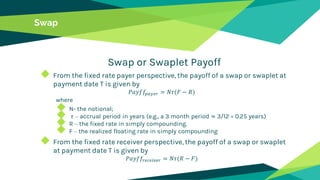
Swap or Swaplet Payoff
◆ From the fixed rate payer perspective, the payoff of a swap or swaplet at
payment date T is given by
𝑃𝑎𝑦𝑓𝑓𝑝𝑎𝑦𝑒𝑟 = 𝑁𝜏(𝐹 − 𝑅)
where
◆ N- the notional;
◆ 𝜏 – accrual period in years (e.g., a 3 month period ≈ 3/12 = 0.25 years)
◆ R – the fixed rate in simply compounding.
◆ F – the realized floating rate in simply compounding
◆ From the fixed rate receiver perspective, the payoff of a swap or swaplet
at payment date T is given by
𝑃𝑎𝑦𝑓𝑓𝑟𝑒𝑐𝑒𝑖𝑣𝑒𝑟 = 𝑁𝜏(𝑅 − 𝐹)
Swap
Valuation
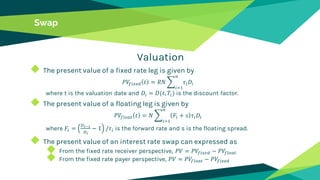
◆ The present value of a fixed rate leg is given by
𝑃𝑉𝑓𝑖𝑥𝑒𝑑 𝑡 = 𝑅𝑁 𝜏𝑖 𝐷𝑖
𝑛
𝑖=1
where t is the valuation date and 𝐷𝑖 = 𝐷(𝑡, 𝑇𝑖) is the discount factor.
◆ The present value of a floating leg is given by
𝑃𝑉𝑓𝑙𝑜𝑎𝑡 𝑡 = 𝑁 𝐹𝑖 + 𝑠 𝜏𝑖 𝐷𝑖
𝑛
𝑖=1
where 𝐹𝑖 =
𝐷 𝑖−1
𝐷 𝑖
− 1 /𝜏𝑖 is the forward rate and s is the floating spread.
◆ The present value of an interest rate swap can expressed as
◆ From the fixed rate receiver perspective, 𝑃𝑉 = 𝑃𝑉𝑓𝑖𝑥𝑒𝑑 − 𝑃𝑉𝑓𝑙𝑜𝑎𝑡
◆ From the fixed rate payer perspective, 𝑃𝑉 = 𝑃𝑉𝑓𝑙𝑜𝑎𝑡 − 𝑃𝑉𝑓𝑖𝑥𝑒𝑑
Swap
Practical Notes
◆ First of all, you need to generate accurate cash flows for each leg. The cash
flow generation is based on the start time, end time and payment frequency
of the leg, plus calendar (holidays), business convention (e.g., modified
following, following, etc.) and whether sticky month end.
◆ We assume that accrual periods are the same as reset periods and payment
dates are the same as accrual end dates in the above formulas for brevity.
But in fact, they are different due to different market conventions. For
example, index periods can overlap each other but swap cash flows are not
allowed to overlap.
◆ The accrual period is calculated according to the start date and end date of
a cash flow plus day count convention
Swap
Practical Notes (Cont)
◆ The forward rate should be computed based on the reset period (index reset
date, index start date, index end date) that are determined by index
definition, such as index tenor and convention. it is simply compounded.
◆ Sometimes there is a floating spread added on the top of the floating rate in
the floating leg.
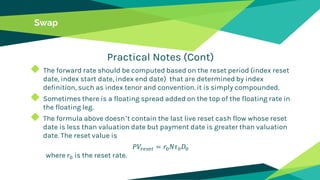
◆ The formula above doesn’t contain the last live reset cash flow whose reset
date is less than valuation date but payment date is greater than valuation
date. The reset value is
𝑃𝑉𝑟𝑒𝑠𝑒𝑡 = 𝑟0 𝑁𝜏0 𝐷0
where 𝑟0 is the reset rate.
Swap
Practical Notes (Cont)
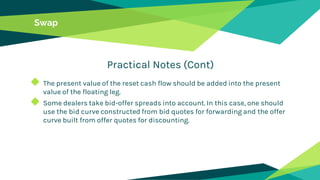
◆ The present value of the reset cash flow should be added into the present
value of the floating leg.
◆ Some dealers take bid-offer spreads into account. In this case, one should
use the bid curve constructed from bid quotes for forwarding and the offer
curve built from offer quotes for discounting.
Swap
A Real World Example
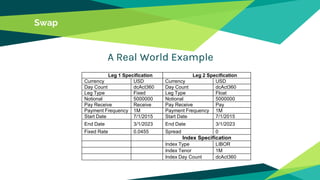
Leg 1 Specification Leg 2 Specification
Currency USD Currency USD
Day Count dcAct360 Day Count dcAct360
Leg Type Fixed Leg Type Float
Notional 5000000 Notional 5000000
Pay Receive Receive Pay Receive Pay
Payment Frequency 1M Payment Frequency 1M
Start Date 7/1/2015 Start Date 7/1/2015
End Date 3/1/2023 End Date 3/1/2023
Fixed Rate 0.0455 Spread 0
Index Specification
Index Type LIBOR
Index Tenor 1M
Index Day Count dcAct360
Thanks!

Interest Rate Swap Valuation Introduction and Practical Guide

  • 1.
    Interest Rate Swap VaulationPratical Guide Alan White FinPricing http://www.finpricing.com
  • 2.
    Swap Summary ◆ Interest RateSwap Introduction ◆ The Use of Interest Rate Swap ◆ Swap or Swaplet Payoff ◆ Valuation ◆ Practical Notes ◆ A real world example
  • 3.
    Swap Interest Rate SwapIntroduction ◆ An interest rate swap is an agreement between two parties to exchange future interest rate payments over a set period of time. ◆ An interest rate swap consists of a series of payment periods, called swaplets. ◆ Vanilla Interest Rate Swaps involve the exchange of a fixed interest rate for a floating rate, or vice versa. ◆ There are two legs associated with each party: a fixed leg and a floating leg. ◆ Swaps are OTC derivatives that bear counterparty credit risk.
  • 4.
    Swap The Use ofInterest Rate Swap ◆ Swaps are the most popular OTC derivatives that are generally used to manage exposure to fluctuations in interest rates. ◆ Swaps can also be used to obtain a marginally lower interest rate. Thus they are often utilized by a firm that can borrow money easily at one type of interest rate but prefers a different type. ◆ Swaps allow investors to adjust interest rate exposure and offset interest rate risk. ◆ Speculators use swaps to speculate on the movement of interest rates. ◆ More and more swaps are cleared through central counterparties (CCPs) nowadays.
  • 5.
    Swap Swap or SwapletPayoff ◆ From the fixed rate payer perspective, the payoff of a swap or swaplet at payment date T is given by 𝑃𝑎𝑦𝑓𝑓𝑝𝑎𝑦𝑒𝑟 = 𝑁𝜏(𝐹 − 𝑅) where ◆ N- the notional; ◆ 𝜏 – accrual period in years (e.g., a 3 month period ≈ 3/12 = 0.25 years) ◆ R – the fixed rate in simply compounding. ◆ F – the realized floating rate in simply compounding ◆ From the fixed rate receiver perspective, the payoff of a swap or swaplet at payment date T is given by 𝑃𝑎𝑦𝑓𝑓𝑟𝑒𝑐𝑒𝑖𝑣𝑒𝑟 = 𝑁𝜏(𝑅 − 𝐹)
  • 6.
    Swap Valuation ◆ The presentvalue of a fixed rate leg is given by 𝑃𝑉𝑓𝑖𝑥𝑒𝑑 𝑡 = 𝑅𝑁 𝜏𝑖 𝐷𝑖 𝑛 𝑖=1 where t is the valuation date and 𝐷𝑖 = 𝐷(𝑡, 𝑇𝑖) is the discount factor. ◆ The present value of a floating leg is given by 𝑃𝑉𝑓𝑙𝑜𝑎𝑡 𝑡 = 𝑁 𝐹𝑖 + 𝑠 𝜏𝑖 𝐷𝑖 𝑛 𝑖=1 where 𝐹𝑖 = 𝐷 𝑖−1 𝐷 𝑖 − 1 /𝜏𝑖 is the forward rate and s is the floating spread. ◆ The present value of an interest rate swap can expressed as ◆ From the fixed rate receiver perspective, 𝑃𝑉 = 𝑃𝑉𝑓𝑖𝑥𝑒𝑑 − 𝑃𝑉𝑓𝑙𝑜𝑎𝑡 ◆ From the fixed rate payer perspective, 𝑃𝑉 = 𝑃𝑉𝑓𝑙𝑜𝑎𝑡 − 𝑃𝑉𝑓𝑖𝑥𝑒𝑑
  • 7.
    Swap Practical Notes ◆ Firstof all, you need to generate accurate cash flows for each leg. The cash flow generation is based on the start time, end time and payment frequency of the leg, plus calendar (holidays), business convention (e.g., modified following, following, etc.) and whether sticky month end. ◆ We assume that accrual periods are the same as reset periods and payment dates are the same as accrual end dates in the above formulas for brevity. But in fact, they are different due to different market conventions. For example, index periods can overlap each other but swap cash flows are not allowed to overlap. ◆ The accrual period is calculated according to the start date and end date of a cash flow plus day count convention
  • 8.
    Swap Practical Notes (Cont) ◆The forward rate should be computed based on the reset period (index reset date, index start date, index end date) that are determined by index definition, such as index tenor and convention. it is simply compounded. ◆ Sometimes there is a floating spread added on the top of the floating rate in the floating leg. ◆ The formula above doesn’t contain the last live reset cash flow whose reset date is less than valuation date but payment date is greater than valuation date. The reset value is 𝑃𝑉𝑟𝑒𝑠𝑒𝑡 = 𝑟0 𝑁𝜏0 𝐷0 where 𝑟0 is the reset rate.
  • 9.
    Swap Practical Notes (Cont) ◆The present value of the reset cash flow should be added into the present value of the floating leg. ◆ Some dealers take bid-offer spreads into account. In this case, one should use the bid curve constructed from bid quotes for forwarding and the offer curve built from offer quotes for discounting.
  • 10.
    Swap A Real WorldExample Leg 1 Specification Leg 2 Specification Currency USD Currency USD Day Count dcAct360 Day Count dcAct360 Leg Type Fixed Leg Type Float Notional 5000000 Notional 5000000 Pay Receive Receive Pay Receive Pay Payment Frequency 1M Payment Frequency 1M Start Date 7/1/2015 Start Date 7/1/2015 End Date 3/1/2023 End Date 3/1/2023 Fixed Rate 0.0455 Spread 0 Index Specification Index Type LIBOR Index Tenor 1M Index Day Count dcAct360
  • 11.