International Journal of Trend in
International Open Access Journal
ISSN No: 2456
@ IJTSRD | Available Online @ www.ijtsrd.com
Inter
Aamir Nazir Beigh
1
M
Department of
Sri Sai College of Engineering
ABSTRACT
The continuously increasing demand for higher data
rates results in increasing network density, so that
inter-cell interference is becoming the most serious
obstacle towards spectral efficiency. Considering that
radio resources are limited and expensive, new
techniques are required for the next generation of
cellular networks, to enable a more efficient way to
allocate and use radio resources. In this framework,
we target the design of a frequency reuse 1 scheme,
which exploits the coordination between base stations
as a tool to mitigate inter-cell interference.
Keyword: LTE, FRF, ICI
I. INTRODUCTION
Long Term Evolution (LTE) is all about 4G, which
tends to complement LTE (3G) networks with higher
data rates, low latency and a flat, IP
architecture. It also allows operators to use a new and
a much wider spectrum when compared to the
previous standards. A part from the enhancements in
the radio link, the next performance leap in wireless
networks will come from an evolved network
topology. The concept is to improve spectral
efficiency per unit area. With various combinations of
femto cells, relays and Pico cells, heterogeneous
networks can provide the optimal experience to the
user. In any cellular mobile communication system,
two major classes of interference must be considered,
namely: intra-cell interference, and inter
interference. When a travelling user, connected to a
large, umbrella-type of cell, stops then the call may be
transferred to a smaller macro cell or even to a micro
cell in order to free capacity on the umbrella cell for
other travelling users and to reduce the potential
interference to other cells or users :this works in
reverse too, when a user is detected to be moving
faster than a certain threshold, the call can be
International Journal of Trend in Scientific Research and Development (IJTSRD)
International Open Access Journal | www.ijtsrd.com
ISSN No: 2456 - 6470 | Volume - 2 | Issue – 6 | Sep
www.ijtsrd.com | Volume – 2 | Issue – 6 | Sep-Oct
Inter-Cell Interference
Aamir Nazir Beigh1
, Er. Prabhjot Kaur2
M.Tech Scholar, 2
Assistant Professor
f Electronics and Communication Engineering,
Engineering & Technology Badhani, Pathankot, Punjab
The continuously increasing demand for higher data
rates results in increasing network density, so that
ence is becoming the most serious
Considering that
radio resources are limited and expensive, new
techniques are required for the next generation of
cellular networks, to enable a more efficient way to
resources. In this framework,
we target the design of a frequency reuse 1 scheme,
which exploits the coordination between base stations
cell interference.
Long Term Evolution (LTE) is all about 4G, which
tends to complement LTE (3G) networks with higher
data rates, low latency and a flat, IP-based
architecture. It also allows operators to use a new and
a much wider spectrum when compared to the
dards. A part from the enhancements in
the radio link, the next performance leap in wireless
networks will come from an evolved network
topology. The concept is to improve spectral
efficiency per unit area. With various combinations of
and Pico cells, heterogeneous
networks can provide the optimal experience to the
user. In any cellular mobile communication system,
two major classes of interference must be considered,
cell interference, and inter-cell
ravelling user, connected to a
type of cell, stops then the call may be
transferred to a smaller macro cell or even to a micro
cell in order to free capacity on the umbrella cell for
other travelling users and to reduce the potential
erence to other cells or users :this works in
reverse too, when a user is detected to be moving
faster than a certain threshold, the call can be
transferred to a larger umbrella
minimize the frequency of the handovers due to this
movement. Bandwidth Spectrum flexibility is a key
feature of the LTE system to operate in different
geographical areas with the different frequency bands
and different bandwidth. It can be implemented on
either paired or unpaired frequency bands. In paire
frequency bands, a separate frequency band is
allocated for uplink and downlink transmissions,
respectively, while uplink and downlink share the
same frequency band in the unpaired frequency bands.
II. INTER-CELL INTERFERENCE
MITIGATION
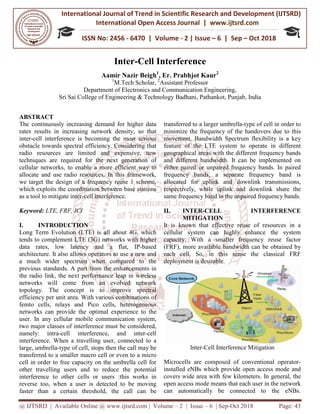
It is known that effective reuse of resources in a
cellular system can highly enhance the system
capacity. With a smaller frequency reuse factor
(FRF), more available bandwidth can be obtained by
each cell. So, in this sense the classical FRF
deployment is desirable.
Inter-Cell Interference Mitigation
Microcells are composed of conventional operator
installed eNBs which provide open access mode and
covers wide area with few kilometers. In general, the
open access mode means that each user in the network
can automatically be connected to the eNBs.
Research and Development (IJTSRD)
www.ijtsrd.com
| Sep – Oct 2018
2018 Page: 43
Punjab, India
transferred to a larger umbrella-type of cell in order to
minimize the frequency of the handovers due to this
Spectrum flexibility is a key
feature of the LTE system to operate in different
geographical areas with the different frequency bands
and different bandwidth. It can be implemented on
either paired or unpaired frequency bands. In paired
frequency bands, a separate frequency band is
allocated for uplink and downlink transmissions,
respectively, while uplink and downlink share the
same frequency band in the unpaired frequency bands.
CELL INTERFERENCE
that effective reuse of resources in a
cellular system can highly enhance the system
capacity. With a smaller frequency reuse factor
(FRF), more available bandwidth can be obtained by
each cell. So, in this sense the classical FRF
Cell Interference Mitigation
Microcells are composed of conventional operator-
installed eNBs which provide open access mode and
covers wide area with few kilometers. In general, the
open access mode means that each user in the network
can automatically be connected to the eNBs.
International Journal of Trend in Scientific Research and Development (IJTSRD) ISSN: 2456
@ IJTSRD | Available Online @ www.ijtsrd.com
Microcells are designed to guarantee the minimum
data rate under maximum tolerable delay and outage
restrictions. Macro eNBs emit transmission power up
to 46 dBm and can serve thousands of customers.
Pico cells are low power nodes which are deployed by
the operator. Pico eNBs have lower transmission
powers compared to macro eNB within a range from
23 to 30 dBm. Pico cells can improve capacity as well
as the coverage of outdoor or indoor regions for
environments with inadequate macro penetration (e.g.,
office buildings). Since microcells work in open
access mode, all users can access them.
III. INTERFERENCE AVOIDANCE
SCHEMES
In cellular network, different power and frequency
allocation schemes are deployed to avoid the impact
of ICI so as the system’s spectral efficiency can be
improved. In many ICI mitigation schemes, frequency
reuse technique is taken as the main idea. These
frequency reuse planning algorithms aim to improve
the SINR, and must fulfill the power constraint of
each cell by making sure that the transmit power of an
eNB is not exceeding the maximum allowable limit.
Based on time scale, ICI avoidance schemes can be
categorized as static, semi-static and dynamic
schemes. Static allocation schemes can operate on a
relatively large time scale. In static
resource allocation for each cell is determined during
radio planning and only long-term readjustments are
made during network operation. Therefore, the power
levels and the set of sub-carriers assigned for each cell
and cell regions are static (fixed). In semi
approach, a part of the RB allocation is predefined
and the other RBs allocations reserved for cell edge
users are dynamically changed. Timescale of
reallocation is in seconds or several hundred
milliseconds. In dynamic scheme, resource allocation
is dynamically updated based on the variations of
network conditions. Dynamic allocations are done
after a very short time period.
IV. INTERFERENCE RANDOMIZATION
One of three ICI mitigation techniques is named as
interference randomization. In interference
randomization policy, the users’ data are spread up
over a distributed set of subcarriers so that
interference scenario can be randomized and
frequency diversity gain can be achieved. In
interference randomization, in each cell the users
data are sequentially allocated over a time
International Journal of Trend in Scientific Research and Development (IJTSRD) ISSN: 2456
www.ijtsrd.com | Volume – 2 | Issue – 6 | Sep-Oct
ells are designed to guarantee the minimum
data rate under maximum tolerable delay and outage
restrictions. Macro eNBs emit transmission power up
to 46 dBm and can serve thousands of customers.
Pico cells are low power nodes which are deployed by
ator. Pico eNBs have lower transmission
powers compared to macro eNB within a range from
23 to 30 dBm. Pico cells can improve capacity as well
as the coverage of outdoor or indoor regions for
environments with inadequate macro penetration (e.g.,
ldings). Since microcells work in open
INTERFERENCE AVOIDANCE
In cellular network, different power and frequency
allocation schemes are deployed to avoid the impact
ficiency can be
improved. In many ICI mitigation schemes, frequency
reuse technique is taken as the main idea. These
frequency reuse planning algorithms aim to improve
the SINR, and must fulfill the power constraint of
nsmit power of an
eNB is not exceeding the maximum allowable limit.
Based on time scale, ICI avoidance schemes can be
static and dynamic
schemes. Static allocation schemes can operate on a
relatively large time scale. In static scheme, the
resource allocation for each cell is determined during
term readjustments are
made during network operation. Therefore, the power
carriers assigned for each cell
(fixed). In semi-static
approach, a part of the RB allocation is predefined
and the other RBs allocations reserved for cell edge
users are dynamically changed. Timescale of
reallocation is in seconds or several hundred
ource allocation
is dynamically updated based on the variations of
network conditions. Dynamic allocations are done
INTERFERENCE RANDOMIZATION
One of three ICI mitigation techniques is named as
n. In interference
randomization policy, the users’ data are spread up
over a distributed set of subcarriers so that
interference scenario can be randomized and
frequency diversity gain can be achieved. In
interference randomization, in each cell the users’
data are sequentially allocated over a time-frequency
chunks. When all the requested transmission is
allocated, subcarriers permutation is made in random
manner so that each UE’s transmission is arbitrarily
spread up over the total time
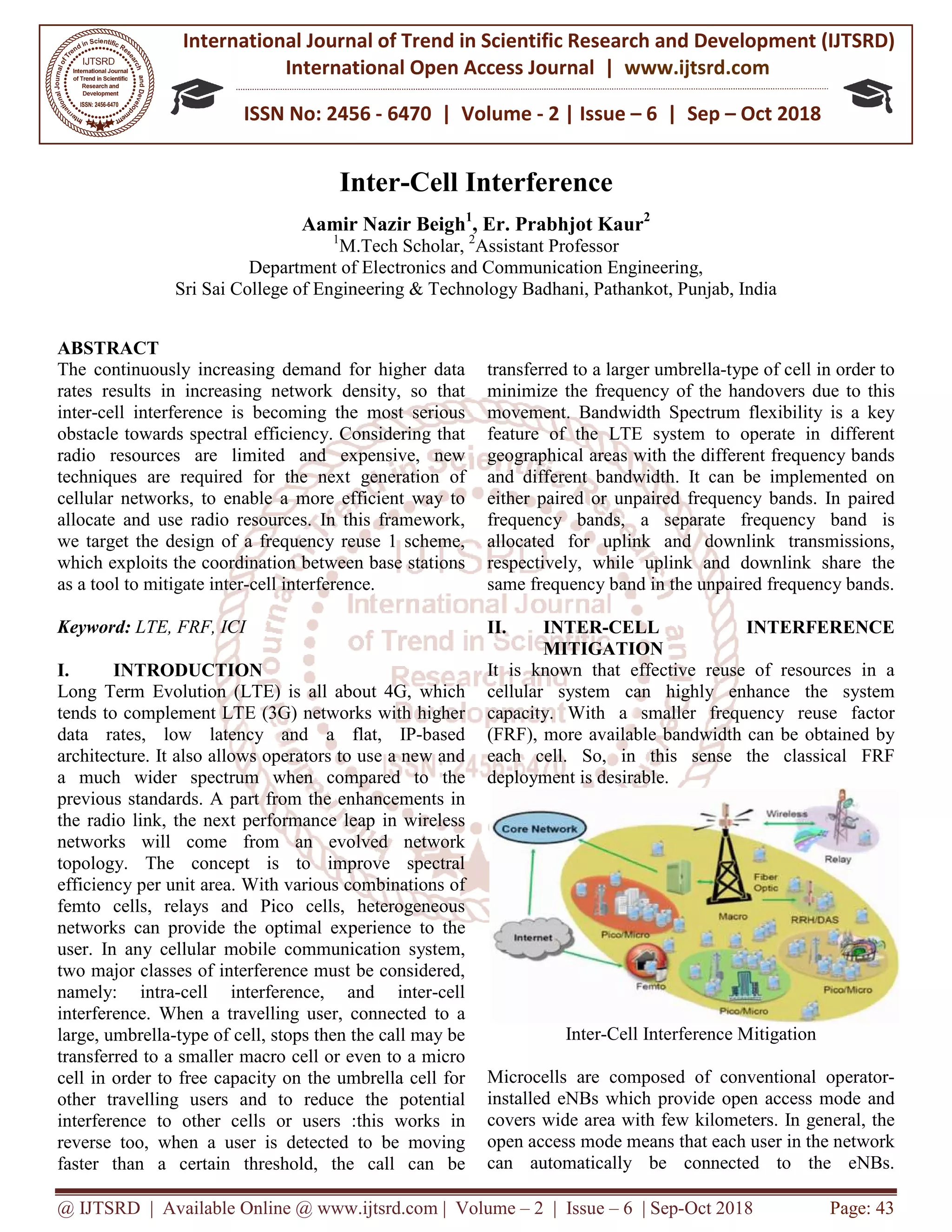
following figure shows the allocation of subcarriers in
a given cell before and after the pseudorandom
permutation. In each interfering cell, the
pseudorandom permutation is performed
independently. The cell specific scrambling causes the
interference spread up along with the transmission of
a given user. As the coding is performed at the
transmitter during transmission, the whole bit stream
can be easily recovered at the receiving end.
Subcarrier allocation before (a) a
permutation
V. FEMTOCELLS
Femtocells are low-power base stations that can be
installed inside buildings as a single stand
device or in clusters, and provide improved indoor
coverage at low-cost. The femtocells are linked to the
main core network using the mobile backhaul scheme
that uses the user’s Digital Subscriber Line (DSL) or
other internet connections. In addition to high
performance and better coverage, femtocells can also
help to reduce load from MBS by channelling a
fraction of its traffic through
provider of the user. This freed
used to accommodate more users entering the
network.
The femtocell encrypted all voice calls and data
sent or received by the mobile phone. This makes
it impossible for an external us
user’s home network. For a standard 3G cellular
phone, the femtocell appears as another cell site or
microcell, hence communicating with it as it
would with a macrocell, when the mobile phone is
used outdoors. Since femtocells operate at
low radio power levels, battery life is high. Also
call quality is excellent, when the distance
between the femtocell and the mobile handset is
International Journal of Trend in Scientific Research and Development (IJTSRD) ISSN: 2456-6470
2018 Page: 44
chunks. When all the requested transmission is
allocated, subcarriers permutation is made in random
manner so that each UE’s transmission is arbitrarily
spread up over the total time-frequency grid. The
following figure shows the allocation of subcarriers in
a given cell before and after the pseudorandom
permutation. In each interfering cell, the
pseudorandom permutation is performed
independently. The cell specific scrambling causes the
pread up along with the transmission of
a given user. As the coding is performed at the
transmitter during transmission, the whole bit stream
can be easily recovered at the receiving end.
Subcarrier allocation before (a) and after (b) random
permutation
power base stations that can be
installed inside buildings as a single stand-alone
device or in clusters, and provide improved indoor
cost. The femtocells are linked to the
mobile backhaul scheme
that uses the user’s Digital Subscriber Line (DSL) or
other internet connections. In addition to high
performance and better coverage, femtocells can also
help to reduce load from MBS by channelling a
fraction of its traffic through the internet service
provider of the user. This freed-up capacity can be
used to accommodate more users entering the
The femtocell encrypted all voice calls and data
sent or received by the mobile phone. This makes
it impossible for an external user to break into a
user’s home network. For a standard 3G cellular
phone, the femtocell appears as another cell site or
, hence communicating with it as it
would with a macrocell, when the mobile phone is
used outdoors. Since femtocells operate at very
low radio power levels, battery life is high. Also
call quality is excellent, when the distance
between the femtocell and the mobile handset is
International Journal of Trend in Scientific Research and Development (IJTSRD) ISSN: 2456
@ IJTSRD | Available Online @ www.ijtsrd.com
short. The connection between the femtocell
gateway and the femtocell is encrypted using
IPsec, which prevents interception.
There is also authentication when the femtocell is
installed for the first time to ensure that the access
point is a valid one. Inside the femtocell there are
the complete workings of a mobile phone base
station. Some additional function
included, such as the RNC (Radio Network
Controller) processing, which would normally
reside at the mobile switching centre
Large cells can be subdivided into smaller cells
for high volume areas. Cell phone companies also
use this directional signal to improve reception
along highways and inside buildings and arenas.
VI. CONCLUSION
In a multi-cell environment, inter-cell interference is
the most important problem addressed. In order to
avoid resource collisions during transmission from
adjacent cells, several techniques have been
suggested. The research paper describes number of
parameters related to inter-cell interference
Interference Avoidance Schemes and Interference
Randomization. The need is to have a scheme to
coordinate neighbouring base stations that minimize
inter-cell interference while achieving high spectral
efficiency.
REFERENCES:
1. Artist4g. denitions and architecture requirements
for supporting interference avoidance techniques.
D1.1 - WP1, 2010.
2. N. Baldo, M. Miozzo, M. Requena-
Nin-Guerrero. An open source product
LTE network simulator based on ns
Proceedings of ACM MSWiM,
November 2011.
3. P. Bender, P. Black, M. Grob, R. Padovani, N.
Sindhushayana, and A. Viterbi. CDMA/HDR: a
bandwidth-efficient high-speed wireless data
service for nomadic users. IEEE Communications
Magazine, 38(7):70–77, 2000.
4. R. Bendlin, H. Y.-F., M. Ivrlac, and J. Nossek.
Fast Distributed Multi-Cell Scheduling with
Delayed Limited-Capacity Backhaul Links. In
Procedings of IEEE ICC, June 2009.
5. T. Bonald, S. Borst, and A. Portie
coordination in wireless data networks. European
International Journal of Trend in Scientific Research and Development (IJTSRD) ISSN: 2456
www.ijtsrd.com | Volume – 2 | Issue – 6 | Sep-Oct
connection between the femtocell
gateway and the femtocell is encrypted using
There is also authentication when the femtocell is
installed for the first time to ensure that the access
point is a valid one. Inside the femtocell there are
the complete workings of a mobile phone base
station. Some additional functions are also
included, such as the RNC (Radio Network
Controller) processing, which would normally
centre.
Large cells can be subdivided into smaller cells
phone companies also
ignal to improve reception
along highways and inside buildings and arenas.
cell interference is
the most important problem addressed. In order to
avoid resource collisions during transmission from
cells, several techniques have been
suggested. The research paper describes number of
cell interference like
Interference Avoidance Schemes and Interference
Randomization. The need is to have a scheme to
base stations that minimize
cell interference while achieving high spectral
nitions and architecture requirements
for supporting interference avoidance techniques.
-Esteso, and J.
Guerrero. An open source product-oriented
LTE network simulator based on ns-3. In
Proceedings of ACM MSWiM, October-
P. Bender, P. Black, M. Grob, R. Padovani, N.
Sindhushayana, and A. Viterbi. CDMA/HDR: a
speed wireless data
service for nomadic users. IEEE Communications
F., M. Ivrlac, and J. Nossek.
Cell Scheduling with
Capacity Backhaul Links. In
IEEE ICC, June 2009.
Bonald, S. Borst, and A. Portiere. Inter-cell
coordination in wireless data networks. European
Transactions on Telecommunications, 17(3):303
312, 2006.
6. G. Boudreau, J. Panicker, N. Guo, R. Chang, N.
Wang, and S. Vrzic. Interference
cancellation for 4G networks. IEEE
Communications Magazine, 47(4):74
2009.
7. E. Coffman Jr., M. Garey, and D. Johnson.
Approximation algorithms for bin packing: A
survey. Approximation Algorithms for NP
Problems, pages 46–93, 1996.
8. P. D. I. J. Eberspacher. Interference management:
From autonomous to closely co
approaches. VDE/ITG Fachgruppe 5.2.4
Workshop Darmstadt 2010, Interference
Management and Cooperation Strategies in
Communication Networks, February 2010.
9. IEEE 802.16 W.G. IEEE Std. for Local and
Metropolitan Area Networks. Part 16: Air
Interface for Broadband Wireless Access Systems.
Amendment 3: Advanced Air Interface. IEEE
802.16m May 2011.
10. R. Irmer, H. Droste, P. Marsch, M. Grieger, G.
Fettweis, S. Brueck, H.-P. Mayer, L. Thiele, and
V. Jungnickel. Coordinated multipoint: Concepts,
performance, and eld trial results. IEEE
Communications Magazine, 49(2):102
February 2011.
11. L. Kantorovich. Mathematical methods of
organizing and planning production. Managem
Science, 6(4):366–422, 1960.
12. S. Kiani and D. Gesbert. Optimal and Distributed
Scheduling for Multi cell Capacity Maximization.
IEEE Transactions on Wireless Communications,
7(1):288–297, January 2008.
13. E. Y. Kim and J. Chun. Coordinated beam
forming with reduced overhead for the downlink
of multiuser MIMO systems. IEEE
Communications Letters, pages 810
14. D. Lu and D. Li. A Novel Pre
MIMO Systems with Multi
Transmission. In Proceedings of IEEE VTC 2010
spring, May 2010.
15. S. Martello and P. Toth. Knapsack problems:
algorithms and computer implementations. John
Wiley & Sons, Inc., 1990.
International Journal of Trend in Scientific Research and Development (IJTSRD) ISSN: 2456-6470
2018 Page: 45
Transactions on Telecommunications, 17(3):303–
G. Boudreau, J. Panicker, N. Guo, R. Chang, N.
Wang, and S. Vrzic. Interference coordination and
cancellation for 4G networks. IEEE
Communications Magazine, 47(4):74–81, April
E. Coffman Jr., M. Garey, and D. Johnson.
Approximation algorithms for bin packing: A
survey. Approximation Algorithms for NP-Hard
1996.
P. D. I. J. Eberspacher. Interference management:
From autonomous to closely co-ordinated
VDE/ITG Fachgruppe 5.2.4
Workshop Darmstadt 2010, Interference
Management and Cooperation Strategies in
Communication Networks, February 2010.
802.16 W.G. IEEE Std. for Local and
Metropolitan Area Networks. Part 16: Air
Interface for Broadband Wireless Access Systems.
Amendment 3: Advanced Air Interface. IEEE
R. Irmer, H. Droste, P. Marsch, M. Grieger, G.
P. Mayer, L. Thiele, and
V. Jungnickel. Coordinated multipoint: Concepts,
eld trial results. IEEE
Communications Magazine, 49(2):102–111,
L. Kantorovich. Mathematical methods of
organizing and planning production. Management
422, 1960.
S. Kiani and D. Gesbert. Optimal and Distributed
cell Capacity Maximization.
IEEE Transactions on Wireless Communications,
297, January 2008.
E. Y. Kim and J. Chun. Coordinated beam-
h reduced overhead for the downlink
of multiuser MIMO systems. IEEE
Communications Letters, pages 810– 812, 2008.
D. Lu and D. Li. A Novel Pre-coding Method for
MIMO Systems with Multi-Cell Joint
Transmission. In Proceedings of IEEE VTC 2010-
S. Martello and P. Toth. Knapsack problems:
algorithms and computer implementations. John
International Journal of Trend in Scientific Research and Development (IJTSRD) ISSN: 2456
@ IJTSRD | Available Online @ www.ijtsrd.com
16. M. C. Necker. Interference Coordination in
Cellular OFDMA Networks. IEEE Net
22(6):12, December 2008.
17. R. Panigrahy, K. Talwar, L. Uyeda, and U.
Wieder. Heuristics for Vector Bin Packing.
http://research.microsoft.com/apps/pubs/default.as
px?id=147927.
18. E. Pateromichelakis, M. Shariat, A. Ul Quddus,
and R. Tafazolli. Dynamic graph-based multi
scheduling for femtocell networks. In
of IEEE WCNCW, pages 98–102, 2012.
19. S. Shukry, K. Elsayed, A. Elmoghazy, and A.
Nassar. Adaptive Fractional Frequency Reuse
(AFFR) scheme for multi-cell IEEE 802.16 e
systems. In Proceedings of IEEE HONET,
December 2009.
20. X. Tang, S. Ramprashad, and H. Papadopoulos.
Multi-Cell User-Scheduling and Random Beam
International Journal of Trend in Scientific Research and Development (IJTSRD) ISSN: 2456
www.ijtsrd.com | Volume – 2 | Issue – 6 | Sep-Oct
M. C. Necker. Interference Coordination in
Cellular OFDMA Networks. IEEE Net- work,
Uyeda, and U.
Wieder. Heuristics for Vector Bin Packing.
http://research.microsoft.com/apps/pubs/default.as
E. Pateromichelakis, M. Shariat, A. Ul Quddus,
based multi-cell
cell networks. In Proceedings
102, 2012.
S. Shukry, K. Elsayed, A. Elmoghazy, and A.
Nassar. Adaptive Fractional Frequency Reuse
cell IEEE 802.16 e
systems. In Proceedings of IEEE HONET,
and H. Papadopoulos.
Scheduling and Random Beam-
forming Strategies for Downlink Wireless
Communications. In Proceedings of IEEE VTC
2009-Fall, Sept. 2009.
21. O. Technologies. Opnet modeler 17.1.
http://www.opnet.com/events/webinars/webinar
archived/index.html.
22. Third Generation Partnership Project (3GPP).
Requirements for further advancements for
Evolved Universal Terrestrial Radio Access (E
UTRA). 3GPP TR 36.913 v 10.0.0, March 2011.
23. Third Generation Partnership Project (3GPP).
Physical layer procedures (Release 10) for
Evolved Universal Terrestrial Radio Access (E
UTRA). 3GPP TR 36.213 v 10.5.0, March 2012.
24. W. Yu, T. Kwon, and C. Shin. Multi
coordination via joint scheduling, beam
and power spectrum adaptation. In Proceedings
IEEE INFOCOM, pages 2570
International Journal of Trend in Scientific Research and Development (IJTSRD) ISSN: 2456-6470
2018 Page: 46
forming Strategies for Downlink Wireless
Communications. In Proceedings of IEEE VTC
O. Technologies. Opnet modeler 17.1.
http://www.opnet.com/events/webinars/webinar
Third Generation Partnership Project (3GPP).
Requirements for further advancements for
Evolved Universal Terrestrial Radio Access (E-
UTRA). 3GPP TR 36.913 v 10.0.0, March 2011.
Third Generation Partnership Project (3GPP).
rocedures (Release 10) for
Evolved Universal Terrestrial Radio Access (E-
UTRA). 3GPP TR 36.213 v 10.5.0, March 2012.
W. Yu, T. Kwon, and C. Shin. Multi cell
coordination via joint scheduling, beam-forming
and power spectrum adaptation. In Proceedings
INFOCOM, pages 2570– 2578, April 2011.

Inter-Cell Interference

  • 1.
    International Journal ofTrend in International Open Access Journal ISSN No: 2456 @ IJTSRD | Available Online @ www.ijtsrd.com Inter Aamir Nazir Beigh 1 M Department of Sri Sai College of Engineering ABSTRACT The continuously increasing demand for higher data rates results in increasing network density, so that inter-cell interference is becoming the most serious obstacle towards spectral efficiency. Considering that radio resources are limited and expensive, new techniques are required for the next generation of cellular networks, to enable a more efficient way to allocate and use radio resources. In this framework, we target the design of a frequency reuse 1 scheme, which exploits the coordination between base stations as a tool to mitigate inter-cell interference. Keyword: LTE, FRF, ICI I. INTRODUCTION Long Term Evolution (LTE) is all about 4G, which tends to complement LTE (3G) networks with higher data rates, low latency and a flat, IP architecture. It also allows operators to use a new and a much wider spectrum when compared to the previous standards. A part from the enhancements in the radio link, the next performance leap in wireless networks will come from an evolved network topology. The concept is to improve spectral efficiency per unit area. With various combinations of femto cells, relays and Pico cells, heterogeneous networks can provide the optimal experience to the user. In any cellular mobile communication system, two major classes of interference must be considered, namely: intra-cell interference, and inter interference. When a travelling user, connected to a large, umbrella-type of cell, stops then the call may be transferred to a smaller macro cell or even to a micro cell in order to free capacity on the umbrella cell for other travelling users and to reduce the potential interference to other cells or users :this works in reverse too, when a user is detected to be moving faster than a certain threshold, the call can be International Journal of Trend in Scientific Research and Development (IJTSRD) International Open Access Journal | www.ijtsrd.com ISSN No: 2456 - 6470 | Volume - 2 | Issue – 6 | Sep www.ijtsrd.com | Volume – 2 | Issue – 6 | Sep-Oct Inter-Cell Interference Aamir Nazir Beigh1 , Er. Prabhjot Kaur2 M.Tech Scholar, 2 Assistant Professor f Electronics and Communication Engineering, Engineering & Technology Badhani, Pathankot, Punjab The continuously increasing demand for higher data rates results in increasing network density, so that ence is becoming the most serious Considering that radio resources are limited and expensive, new techniques are required for the next generation of cellular networks, to enable a more efficient way to resources. In this framework, we target the design of a frequency reuse 1 scheme, which exploits the coordination between base stations cell interference. Long Term Evolution (LTE) is all about 4G, which tends to complement LTE (3G) networks with higher data rates, low latency and a flat, IP-based architecture. It also allows operators to use a new and a much wider spectrum when compared to the dards. A part from the enhancements in the radio link, the next performance leap in wireless networks will come from an evolved network topology. The concept is to improve spectral efficiency per unit area. With various combinations of and Pico cells, heterogeneous networks can provide the optimal experience to the user. In any cellular mobile communication system, two major classes of interference must be considered, cell interference, and inter-cell ravelling user, connected to a type of cell, stops then the call may be transferred to a smaller macro cell or even to a micro cell in order to free capacity on the umbrella cell for other travelling users and to reduce the potential erence to other cells or users :this works in reverse too, when a user is detected to be moving faster than a certain threshold, the call can be transferred to a larger umbrella minimize the frequency of the handovers due to this movement. Bandwidth Spectrum flexibility is a key feature of the LTE system to operate in different geographical areas with the different frequency bands and different bandwidth. It can be implemented on either paired or unpaired frequency bands. In paire frequency bands, a separate frequency band is allocated for uplink and downlink transmissions, respectively, while uplink and downlink share the same frequency band in the unpaired frequency bands. II. INTER-CELL INTERFERENCE MITIGATION It is known that effective reuse of resources in a cellular system can highly enhance the system capacity. With a smaller frequency reuse factor (FRF), more available bandwidth can be obtained by each cell. So, in this sense the classical FRF deployment is desirable. Inter-Cell Interference Mitigation Microcells are composed of conventional operator installed eNBs which provide open access mode and covers wide area with few kilometers. In general, the open access mode means that each user in the network can automatically be connected to the eNBs. Research and Development (IJTSRD) www.ijtsrd.com | Sep – Oct 2018 2018 Page: 43 Punjab, India transferred to a larger umbrella-type of cell in order to minimize the frequency of the handovers due to this Spectrum flexibility is a key feature of the LTE system to operate in different geographical areas with the different frequency bands and different bandwidth. It can be implemented on either paired or unpaired frequency bands. In paired frequency bands, a separate frequency band is allocated for uplink and downlink transmissions, respectively, while uplink and downlink share the same frequency band in the unpaired frequency bands. CELL INTERFERENCE that effective reuse of resources in a cellular system can highly enhance the system capacity. With a smaller frequency reuse factor (FRF), more available bandwidth can be obtained by each cell. So, in this sense the classical FRF Cell Interference Mitigation Microcells are composed of conventional operator- installed eNBs which provide open access mode and covers wide area with few kilometers. In general, the open access mode means that each user in the network can automatically be connected to the eNBs.
  • 2.
    International Journal ofTrend in Scientific Research and Development (IJTSRD) ISSN: 2456 @ IJTSRD | Available Online @ www.ijtsrd.com Microcells are designed to guarantee the minimum data rate under maximum tolerable delay and outage restrictions. Macro eNBs emit transmission power up to 46 dBm and can serve thousands of customers. Pico cells are low power nodes which are deployed by the operator. Pico eNBs have lower transmission powers compared to macro eNB within a range from 23 to 30 dBm. Pico cells can improve capacity as well as the coverage of outdoor or indoor regions for environments with inadequate macro penetration (e.g., office buildings). Since microcells work in open access mode, all users can access them. III. INTERFERENCE AVOIDANCE SCHEMES In cellular network, different power and frequency allocation schemes are deployed to avoid the impact of ICI so as the system’s spectral efficiency can be improved. In many ICI mitigation schemes, frequency reuse technique is taken as the main idea. These frequency reuse planning algorithms aim to improve the SINR, and must fulfill the power constraint of each cell by making sure that the transmit power of an eNB is not exceeding the maximum allowable limit. Based on time scale, ICI avoidance schemes can be categorized as static, semi-static and dynamic schemes. Static allocation schemes can operate on a relatively large time scale. In static resource allocation for each cell is determined during radio planning and only long-term readjustments are made during network operation. Therefore, the power levels and the set of sub-carriers assigned for each cell and cell regions are static (fixed). In semi approach, a part of the RB allocation is predefined and the other RBs allocations reserved for cell edge users are dynamically changed. Timescale of reallocation is in seconds or several hundred milliseconds. In dynamic scheme, resource allocation is dynamically updated based on the variations of network conditions. Dynamic allocations are done after a very short time period. IV. INTERFERENCE RANDOMIZATION One of three ICI mitigation techniques is named as interference randomization. In interference randomization policy, the users’ data are spread up over a distributed set of subcarriers so that interference scenario can be randomized and frequency diversity gain can be achieved. In interference randomization, in each cell the users data are sequentially allocated over a time International Journal of Trend in Scientific Research and Development (IJTSRD) ISSN: 2456 www.ijtsrd.com | Volume – 2 | Issue – 6 | Sep-Oct ells are designed to guarantee the minimum data rate under maximum tolerable delay and outage restrictions. Macro eNBs emit transmission power up to 46 dBm and can serve thousands of customers. Pico cells are low power nodes which are deployed by ator. Pico eNBs have lower transmission powers compared to macro eNB within a range from 23 to 30 dBm. Pico cells can improve capacity as well as the coverage of outdoor or indoor regions for environments with inadequate macro penetration (e.g., ldings). Since microcells work in open INTERFERENCE AVOIDANCE In cellular network, different power and frequency allocation schemes are deployed to avoid the impact ficiency can be improved. In many ICI mitigation schemes, frequency reuse technique is taken as the main idea. These frequency reuse planning algorithms aim to improve the SINR, and must fulfill the power constraint of nsmit power of an eNB is not exceeding the maximum allowable limit. Based on time scale, ICI avoidance schemes can be static and dynamic schemes. Static allocation schemes can operate on a relatively large time scale. In static scheme, the resource allocation for each cell is determined during term readjustments are made during network operation. Therefore, the power carriers assigned for each cell (fixed). In semi-static approach, a part of the RB allocation is predefined and the other RBs allocations reserved for cell edge users are dynamically changed. Timescale of reallocation is in seconds or several hundred ource allocation is dynamically updated based on the variations of network conditions. Dynamic allocations are done INTERFERENCE RANDOMIZATION One of three ICI mitigation techniques is named as n. In interference randomization policy, the users’ data are spread up over a distributed set of subcarriers so that interference scenario can be randomized and frequency diversity gain can be achieved. In interference randomization, in each cell the users’ data are sequentially allocated over a time-frequency chunks. When all the requested transmission is allocated, subcarriers permutation is made in random manner so that each UE’s transmission is arbitrarily spread up over the total time following figure shows the allocation of subcarriers in a given cell before and after the pseudorandom permutation. In each interfering cell, the pseudorandom permutation is performed independently. The cell specific scrambling causes the interference spread up along with the transmission of a given user. As the coding is performed at the transmitter during transmission, the whole bit stream can be easily recovered at the receiving end. Subcarrier allocation before (a) a permutation V. FEMTOCELLS Femtocells are low-power base stations that can be installed inside buildings as a single stand device or in clusters, and provide improved indoor coverage at low-cost. The femtocells are linked to the main core network using the mobile backhaul scheme that uses the user’s Digital Subscriber Line (DSL) or other internet connections. In addition to high performance and better coverage, femtocells can also help to reduce load from MBS by channelling a fraction of its traffic through provider of the user. This freed used to accommodate more users entering the network. The femtocell encrypted all voice calls and data sent or received by the mobile phone. This makes it impossible for an external us user’s home network. For a standard 3G cellular phone, the femtocell appears as another cell site or microcell, hence communicating with it as it would with a macrocell, when the mobile phone is used outdoors. Since femtocells operate at low radio power levels, battery life is high. Also call quality is excellent, when the distance between the femtocell and the mobile handset is International Journal of Trend in Scientific Research and Development (IJTSRD) ISSN: 2456-6470 2018 Page: 44 chunks. When all the requested transmission is allocated, subcarriers permutation is made in random manner so that each UE’s transmission is arbitrarily spread up over the total time-frequency grid. The following figure shows the allocation of subcarriers in a given cell before and after the pseudorandom permutation. In each interfering cell, the pseudorandom permutation is performed independently. The cell specific scrambling causes the pread up along with the transmission of a given user. As the coding is performed at the transmitter during transmission, the whole bit stream can be easily recovered at the receiving end. Subcarrier allocation before (a) and after (b) random permutation power base stations that can be installed inside buildings as a single stand-alone device or in clusters, and provide improved indoor cost. The femtocells are linked to the mobile backhaul scheme that uses the user’s Digital Subscriber Line (DSL) or other internet connections. In addition to high performance and better coverage, femtocells can also help to reduce load from MBS by channelling a fraction of its traffic through the internet service provider of the user. This freed-up capacity can be used to accommodate more users entering the The femtocell encrypted all voice calls and data sent or received by the mobile phone. This makes it impossible for an external user to break into a user’s home network. For a standard 3G cellular phone, the femtocell appears as another cell site or , hence communicating with it as it would with a macrocell, when the mobile phone is used outdoors. Since femtocells operate at very low radio power levels, battery life is high. Also call quality is excellent, when the distance between the femtocell and the mobile handset is
  • 3.
    International Journal ofTrend in Scientific Research and Development (IJTSRD) ISSN: 2456 @ IJTSRD | Available Online @ www.ijtsrd.com short. The connection between the femtocell gateway and the femtocell is encrypted using IPsec, which prevents interception. There is also authentication when the femtocell is installed for the first time to ensure that the access point is a valid one. Inside the femtocell there are the complete workings of a mobile phone base station. Some additional function included, such as the RNC (Radio Network Controller) processing, which would normally reside at the mobile switching centre Large cells can be subdivided into smaller cells for high volume areas. Cell phone companies also use this directional signal to improve reception along highways and inside buildings and arenas. VI. CONCLUSION In a multi-cell environment, inter-cell interference is the most important problem addressed. In order to avoid resource collisions during transmission from adjacent cells, several techniques have been suggested. The research paper describes number of parameters related to inter-cell interference Interference Avoidance Schemes and Interference Randomization. The need is to have a scheme to coordinate neighbouring base stations that minimize inter-cell interference while achieving high spectral efficiency. REFERENCES: 1. Artist4g. definitions and architecture requirements for supporting interference avoidance techniques. D1.1 - WP1, 2010. 2. N. Baldo, M. Miozzo, M. Requena- Nin-Guerrero. An open source product LTE network simulator based on ns Proceedings of ACM MSWiM, November 2011. 3. P. Bender, P. Black, M. Grob, R. Padovani, N. Sindhushayana, and A. Viterbi. CDMA/HDR: a bandwidth-efficient high-speed wireless data service for nomadic users. IEEE Communications Magazine, 38(7):70–77, 2000. 4. R. Bendlin, H. Y.-F., M. Ivrlac, and J. Nossek. Fast Distributed Multi-Cell Scheduling with Delayed Limited-Capacity Backhaul Links. In Procedings of IEEE ICC, June 2009. 5. T. Bonald, S. Borst, and A. Portie coordination in wireless data networks. European International Journal of Trend in Scientific Research and Development (IJTSRD) ISSN: 2456 www.ijtsrd.com | Volume – 2 | Issue – 6 | Sep-Oct connection between the femtocell gateway and the femtocell is encrypted using There is also authentication when the femtocell is installed for the first time to ensure that the access point is a valid one. Inside the femtocell there are the complete workings of a mobile phone base station. Some additional functions are also included, such as the RNC (Radio Network Controller) processing, which would normally centre. Large cells can be subdivided into smaller cells phone companies also ignal to improve reception along highways and inside buildings and arenas. cell interference is the most important problem addressed. In order to avoid resource collisions during transmission from cells, several techniques have been suggested. The research paper describes number of cell interference like Interference Avoidance Schemes and Interference Randomization. The need is to have a scheme to base stations that minimize cell interference while achieving high spectral finitions and architecture requirements for supporting interference avoidance techniques. -Esteso, and J. Guerrero. An open source product-oriented LTE network simulator based on ns-3. In Proceedings of ACM MSWiM, October- P. Bender, P. Black, M. Grob, R. Padovani, N. Sindhushayana, and A. Viterbi. CDMA/HDR: a speed wireless data service for nomadic users. IEEE Communications F., M. Ivrlac, and J. Nossek. Cell Scheduling with Capacity Backhaul Links. In IEEE ICC, June 2009. Bonald, S. Borst, and A. Portiere. Inter-cell coordination in wireless data networks. European Transactions on Telecommunications, 17(3):303 312, 2006. 6. G. Boudreau, J. Panicker, N. Guo, R. Chang, N. Wang, and S. Vrzic. Interference cancellation for 4G networks. IEEE Communications Magazine, 47(4):74 2009. 7. E. Coffman Jr., M. Garey, and D. Johnson. Approximation algorithms for bin packing: A survey. Approximation Algorithms for NP Problems, pages 46–93, 1996. 8. P. D. I. J. Eberspacher. Interference management: From autonomous to closely co approaches. VDE/ITG Fachgruppe 5.2.4 Workshop Darmstadt 2010, Interference Management and Cooperation Strategies in Communication Networks, February 2010. 9. IEEE 802.16 W.G. IEEE Std. for Local and Metropolitan Area Networks. Part 16: Air Interface for Broadband Wireless Access Systems. Amendment 3: Advanced Air Interface. IEEE 802.16m May 2011. 10. R. Irmer, H. Droste, P. Marsch, M. Grieger, G. Fettweis, S. Brueck, H.-P. Mayer, L. Thiele, and V. Jungnickel. Coordinated multipoint: Concepts, performance, and field trial results. IEEE Communications Magazine, 49(2):102 February 2011. 11. L. Kantorovich. Mathematical methods of organizing and planning production. Managem Science, 6(4):366–422, 1960. 12. S. Kiani and D. Gesbert. Optimal and Distributed Scheduling for Multi cell Capacity Maximization. IEEE Transactions on Wireless Communications, 7(1):288–297, January 2008. 13. E. Y. Kim and J. Chun. Coordinated beam forming with reduced overhead for the downlink of multiuser MIMO systems. IEEE Communications Letters, pages 810 14. D. Lu and D. Li. A Novel Pre MIMO Systems with Multi Transmission. In Proceedings of IEEE VTC 2010 spring, May 2010. 15. S. Martello and P. Toth. Knapsack problems: algorithms and computer implementations. John Wiley & Sons, Inc., 1990. International Journal of Trend in Scientific Research and Development (IJTSRD) ISSN: 2456-6470 2018 Page: 45 Transactions on Telecommunications, 17(3):303– G. Boudreau, J. Panicker, N. Guo, R. Chang, N. Wang, and S. Vrzic. Interference coordination and cancellation for 4G networks. IEEE Communications Magazine, 47(4):74–81, April E. Coffman Jr., M. Garey, and D. Johnson. Approximation algorithms for bin packing: A survey. Approximation Algorithms for NP-Hard 1996. P. D. I. J. Eberspacher. Interference management: From autonomous to closely co-ordinated VDE/ITG Fachgruppe 5.2.4 Workshop Darmstadt 2010, Interference Management and Cooperation Strategies in Communication Networks, February 2010. 802.16 W.G. IEEE Std. for Local and Metropolitan Area Networks. Part 16: Air Interface for Broadband Wireless Access Systems. Amendment 3: Advanced Air Interface. IEEE R. Irmer, H. Droste, P. Marsch, M. Grieger, G. P. Mayer, L. Thiele, and V. Jungnickel. Coordinated multipoint: Concepts, field trial results. IEEE Communications Magazine, 49(2):102–111, L. Kantorovich. Mathematical methods of organizing and planning production. Management 422, 1960. S. Kiani and D. Gesbert. Optimal and Distributed cell Capacity Maximization. IEEE Transactions on Wireless Communications, 297, January 2008. E. Y. Kim and J. Chun. Coordinated beam- h reduced overhead for the downlink of multiuser MIMO systems. IEEE Communications Letters, pages 810– 812, 2008. D. Lu and D. Li. A Novel Pre-coding Method for MIMO Systems with Multi-Cell Joint Transmission. In Proceedings of IEEE VTC 2010- S. Martello and P. Toth. Knapsack problems: algorithms and computer implementations. John
  • 4.
    International Journal ofTrend in Scientific Research and Development (IJTSRD) ISSN: 2456 @ IJTSRD | Available Online @ www.ijtsrd.com 16. M. C. Necker. Interference Coordination in Cellular OFDMA Networks. IEEE Net 22(6):12, December 2008. 17. R. Panigrahy, K. Talwar, L. Uyeda, and U. Wieder. Heuristics for Vector Bin Packing. http://research.microsoft.com/apps/pubs/default.as px?id=147927. 18. E. Pateromichelakis, M. Shariat, A. Ul Quddus, and R. Tafazolli. Dynamic graph-based multi scheduling for femtocell networks. In of IEEE WCNCW, pages 98–102, 2012. 19. S. Shukry, K. Elsayed, A. Elmoghazy, and A. Nassar. Adaptive Fractional Frequency Reuse (AFFR) scheme for multi-cell IEEE 802.16 e systems. In Proceedings of IEEE HONET, December 2009. 20. X. Tang, S. Ramprashad, and H. Papadopoulos. Multi-Cell User-Scheduling and Random Beam International Journal of Trend in Scientific Research and Development (IJTSRD) ISSN: 2456 www.ijtsrd.com | Volume – 2 | Issue – 6 | Sep-Oct M. C. Necker. Interference Coordination in Cellular OFDMA Networks. IEEE Net- work, Uyeda, and U. Wieder. Heuristics for Vector Bin Packing. http://research.microsoft.com/apps/pubs/default.as E. Pateromichelakis, M. Shariat, A. Ul Quddus, based multi-cell cell networks. In Proceedings 102, 2012. S. Shukry, K. Elsayed, A. Elmoghazy, and A. Nassar. Adaptive Fractional Frequency Reuse cell IEEE 802.16 e systems. In Proceedings of IEEE HONET, and H. Papadopoulos. Scheduling and Random Beam- forming Strategies for Downlink Wireless Communications. In Proceedings of IEEE VTC 2009-Fall, Sept. 2009. 21. O. Technologies. Opnet modeler 17.1. http://www.opnet.com/events/webinars/webinar archived/index.html. 22. Third Generation Partnership Project (3GPP). Requirements for further advancements for Evolved Universal Terrestrial Radio Access (E UTRA). 3GPP TR 36.913 v 10.0.0, March 2011. 23. Third Generation Partnership Project (3GPP). Physical layer procedures (Release 10) for Evolved Universal Terrestrial Radio Access (E UTRA). 3GPP TR 36.213 v 10.5.0, March 2012. 24. W. Yu, T. Kwon, and C. Shin. Multi coordination via joint scheduling, beam and power spectrum adaptation. In Proceedings IEEE INFOCOM, pages 2570 International Journal of Trend in Scientific Research and Development (IJTSRD) ISSN: 2456-6470 2018 Page: 46 forming Strategies for Downlink Wireless Communications. In Proceedings of IEEE VTC O. Technologies. Opnet modeler 17.1. http://www.opnet.com/events/webinars/webinar Third Generation Partnership Project (3GPP). Requirements for further advancements for Evolved Universal Terrestrial Radio Access (E- UTRA). 3GPP TR 36.913 v 10.0.0, March 2011. Third Generation Partnership Project (3GPP). rocedures (Release 10) for Evolved Universal Terrestrial Radio Access (E- UTRA). 3GPP TR 36.213 v 10.5.0, March 2012. W. Yu, T. Kwon, and C. Shin. Multi cell coordination via joint scheduling, beam-forming and power spectrum adaptation. In Proceedings INFOCOM, pages 2570– 2578, April 2011.