SSRLAB
Cognitive Radio: BrainCognitive Radio: Brain--
Empowered WirelessEmpowered Wireless
CommunicationsCommunications
2006/10/16 Min Hong
Simon Haykin,
IEEE Journal on,
Vol.23, Iss.2, Feb. 2005
Introduction
Receiver
Transmitter
1
2
3
Radio scene analysis
Interference temperature
Channel state estimation and predictive modeling
Contents
Discussion and Conclusions4
Transmit power control
Dynamic spectrum management
Introduction
Definition of Cognitive Radio
Cognitive radio is an intelligent wireless communication
system that is aware of its surrounding environment and
uses the methodology to learn from the environment and
adapt its internal state
Primary objectives
Highly reliable communications whenever and wherever
Efficient utilization of the radio spectrum
Introduction
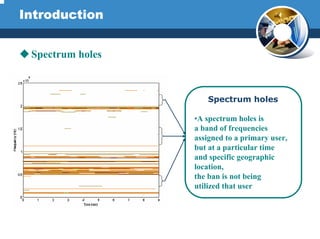
Spectrum holes
Spectrum holes
•A spectrum holes is
a band of frequencies
assigned to a primary user,
but at a particular time
and specific geographic
location,
the ban is not being
utilized that user
Introduction
Basic cognitive cycle
Introduction
Purpose of this Paper
How do cognitive radios learn best? (by Mitola, 2000)
The internal tuning of parameters
The external structuring of the environment to enhance
machine learning
Since many aspects of wireless networks are artificial,
they may be adjusted to enhance machine learning
Presenting detailed expositions of signal processing and
adaptive procedure
Radio-scene analysis
Signals depend on both time and space
Space-time processing
Adaptive beamforming for interference control
Estimation of he interference temperature
Detection of spectrum holes
Time-Frequency distribution
The incoming RF stimuli are sectioned into a continuous sequence of
successive busts
The section is long enough to produce an accurate spectral estimate
Radio-scene analysis
Multitaper Spectral Estimation
Accounting for the temporal characteristic of RF stimuli
Radio-scene analysis
Adaptive Beamforming for Interference Control
Accounting for the spatial characteristic of RF stimuli
There are two stages
Transmitter Receiver
• Power is preserved by avoiding
radiation of the transmitted signal
in all directions
• Interference at the receiver due
to the actions of other transmitters
is minimized
•It is performed for the adaptive
cancellation
• It protects the target RF signal
and place nulls along the
directions of interferers
Interference Temperature Estimation
The receiver be provided with a reliable spectral estimate
of the interference temperature
Cognitive radio is receiver-centric
Requirements
Time
Use the multitaper method to estimate the power spectrum of the
interference temperature
Space
Use a large number of sensors to properly sniff the RF environment
Interference Temperature Estimation
Interference Temperature model
Detection of spectrum holes
Three types of spectra
Black spaces
Occupied by high power local
interferers some of time
Candidate,
If it is switched OFF
Grey spaces
Partially occupied by low power
interferers
Free of RF interferes except for
ambient noise, made up of natural and
artificial forms of noise
Candidate
White spaces Candidate
Detection of spectrum holes
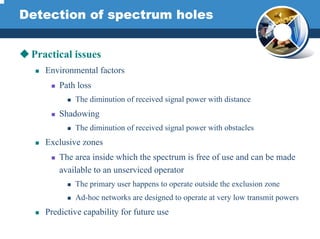
Practical issues
Environmental factors
Path loss
The diminution of received signal power with distance
Shadowing
The diminution of received signal power with obstacles
Exclusive zones
The area inside which the spectrum is free of use and can be made
available to an unserviced operator
The primary user happens to operate outside the exclusion zone
Ad-hoc networks are designed to operate at very low transmit powers
Predictive capability for future use
Channel state estimation & predictive modeling
Traditional ways
Differential detection
Use of M-ary phase modulation
Pilot transmission
Periodic transmission of a pilot
Semi-bind training
Supervised training mode
Performed under the supervision of a short training sequence
Tracking mode
The training sequence is switched off, actual data transmission is
initiated
Transmit power control
Conventional wireless communication
Centralized and receiver side
Cognitive radio
Decentralized manner and transmitter side
How can transmit-power control be achieved at the transmitter?
Cooperative mechanism & competitive mechanism
Base Station
Transmit power control
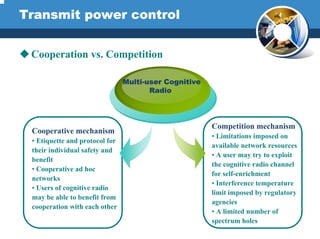
Cooperation vs. Competition
Competition mechanism
• Limitations imposed on
available network resources
• A user may try to exploit
the cognitive radio channel
for self-enrichment
• Interference temperature
limit imposed by regulatory
agencies
• A limited number of
spectrum holes
Cooperative mechanism
• Etiquette and protocol for
their individual safety and
benefit
• Cooperative ad hoc
networks
• Users of cognitive radio
may be able to benefit from
cooperation with each other
Multi-user Cognitive
Radio
Stochastic games
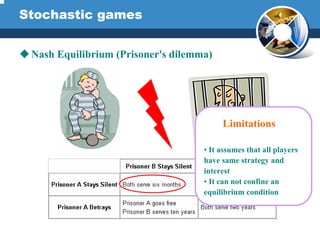
Nash Equilibrium (Prisoner's dilemma)
Limitations
• It assumes that all players
have same strategy and
interest
• It can not confine an
equilibrium condition
Stochastic games
Water filling
Definition of problem
Giver a limited number of spectrum holes, select the transmit
power levels of n unserviced users so as to jointly maximize their
data transmission rates, subject to the constraint that the
interference temperature limit is not violated
Competitive optimality
Considering a multi-user cognitive radio environment viewed as a
noncooperative game, maximize the performance of each
unserviced transceiver, regardless of what all the other transceivers
do, but subject to the constraint that the interference temperature
limit not be violated
Dynamic spectrum management
Purpose
To develop an adaptive strategy for the efficient and
effective utilization of RF spectrum
Spectrum management algorithm
Building on the spectrum holes detected by the radio-scene
analyzer and the output of transmit power controller, select
a modulation strategy that adapts to the time-varying
conditions of the radio environment, all the time assuring
reliable communication across the channel
Two considerations
Modulation and Traffic
Dynamic spectrum management
Modulation considerations
A modulation strategy is the OFDM in cognitive radio
Flexibility and computational efficiency
Dynamic spectrum management
Traffic considerations
There is a phenomenon called cell breathing in CDMA
Considering traffic and interference level
Traffic model
The means for predicting the future
traffic patterns
Makes it possible to predict the duration
for the spectrum hole which is vacated by the incumbent primary user
Two class of traffic data pattern in wireless environment
Deterministic patter : assigned a fixed time slot for transmission
Stochastic patterns : traffic data can only be described in statistical term
Discussion & Conclusions
Future works
Language understanding
For satisfying user’s need accurately
Cognitive MIMO radio
For a spectacular increase in the spectral efficiency and flexibility
of wireless communication
Cognitive turbo processing
Nanoscale processing
Conclusions
Trust by users of cognitive radio
Trust by all other user who might be interfered with
SSRLAB
Q&AQ&A

27. cognitive radio

  • 1.
    SSRLAB Cognitive Radio: BrainCognitiveRadio: Brain-- Empowered WirelessEmpowered Wireless CommunicationsCommunications 2006/10/16 Min Hong Simon Haykin, IEEE Journal on, Vol.23, Iss.2, Feb. 2005
  • 2.
    Introduction Receiver Transmitter 1 2 3 Radio scene analysis Interferencetemperature Channel state estimation and predictive modeling Contents Discussion and Conclusions4 Transmit power control Dynamic spectrum management
  • 3.
    Introduction Definition of CognitiveRadio Cognitive radio is an intelligent wireless communication system that is aware of its surrounding environment and uses the methodology to learn from the environment and adapt its internal state Primary objectives Highly reliable communications whenever and wherever Efficient utilization of the radio spectrum
  • 4.
    Introduction Spectrum holes Spectrum holes •Aspectrum holes is a band of frequencies assigned to a primary user, but at a particular time and specific geographic location, the ban is not being utilized that user
  • 5.
  • 6.
    Introduction Purpose of thisPaper How do cognitive radios learn best? (by Mitola, 2000) The internal tuning of parameters The external structuring of the environment to enhance machine learning Since many aspects of wireless networks are artificial, they may be adjusted to enhance machine learning Presenting detailed expositions of signal processing and adaptive procedure
  • 7.
    Radio-scene analysis Signals dependon both time and space Space-time processing Adaptive beamforming for interference control Estimation of he interference temperature Detection of spectrum holes Time-Frequency distribution The incoming RF stimuli are sectioned into a continuous sequence of successive busts The section is long enough to produce an accurate spectral estimate
  • 8.
    Radio-scene analysis Multitaper SpectralEstimation Accounting for the temporal characteristic of RF stimuli
  • 9.
    Radio-scene analysis Adaptive Beamformingfor Interference Control Accounting for the spatial characteristic of RF stimuli There are two stages Transmitter Receiver • Power is preserved by avoiding radiation of the transmitted signal in all directions • Interference at the receiver due to the actions of other transmitters is minimized •It is performed for the adaptive cancellation • It protects the target RF signal and place nulls along the directions of interferers
  • 10.
    Interference Temperature Estimation Thereceiver be provided with a reliable spectral estimate of the interference temperature Cognitive radio is receiver-centric Requirements Time Use the multitaper method to estimate the power spectrum of the interference temperature Space Use a large number of sensors to properly sniff the RF environment
  • 11.
  • 12.
    Detection of spectrumholes Three types of spectra Black spaces Occupied by high power local interferers some of time Candidate, If it is switched OFF Grey spaces Partially occupied by low power interferers Free of RF interferes except for ambient noise, made up of natural and artificial forms of noise Candidate White spaces Candidate
  • 13.
    Detection of spectrumholes Practical issues Environmental factors Path loss The diminution of received signal power with distance Shadowing The diminution of received signal power with obstacles Exclusive zones The area inside which the spectrum is free of use and can be made available to an unserviced operator The primary user happens to operate outside the exclusion zone Ad-hoc networks are designed to operate at very low transmit powers Predictive capability for future use
  • 14.
    Channel state estimation& predictive modeling Traditional ways Differential detection Use of M-ary phase modulation Pilot transmission Periodic transmission of a pilot Semi-bind training Supervised training mode Performed under the supervision of a short training sequence Tracking mode The training sequence is switched off, actual data transmission is initiated
  • 15.
    Transmit power control Conventionalwireless communication Centralized and receiver side Cognitive radio Decentralized manner and transmitter side How can transmit-power control be achieved at the transmitter? Cooperative mechanism & competitive mechanism Base Station
  • 16.
    Transmit power control Cooperationvs. Competition Competition mechanism • Limitations imposed on available network resources • A user may try to exploit the cognitive radio channel for self-enrichment • Interference temperature limit imposed by regulatory agencies • A limited number of spectrum holes Cooperative mechanism • Etiquette and protocol for their individual safety and benefit • Cooperative ad hoc networks • Users of cognitive radio may be able to benefit from cooperation with each other Multi-user Cognitive Radio
  • 17.
    Stochastic games Nash Equilibrium(Prisoner's dilemma) Limitations • It assumes that all players have same strategy and interest • It can not confine an equilibrium condition
  • 18.
    Stochastic games Water filling Definitionof problem Giver a limited number of spectrum holes, select the transmit power levels of n unserviced users so as to jointly maximize their data transmission rates, subject to the constraint that the interference temperature limit is not violated Competitive optimality Considering a multi-user cognitive radio environment viewed as a noncooperative game, maximize the performance of each unserviced transceiver, regardless of what all the other transceivers do, but subject to the constraint that the interference temperature limit not be violated
  • 19.
    Dynamic spectrum management Purpose Todevelop an adaptive strategy for the efficient and effective utilization of RF spectrum Spectrum management algorithm Building on the spectrum holes detected by the radio-scene analyzer and the output of transmit power controller, select a modulation strategy that adapts to the time-varying conditions of the radio environment, all the time assuring reliable communication across the channel Two considerations Modulation and Traffic
  • 20.
    Dynamic spectrum management Modulationconsiderations A modulation strategy is the OFDM in cognitive radio Flexibility and computational efficiency
  • 21.
    Dynamic spectrum management Trafficconsiderations There is a phenomenon called cell breathing in CDMA Considering traffic and interference level Traffic model The means for predicting the future traffic patterns Makes it possible to predict the duration for the spectrum hole which is vacated by the incumbent primary user Two class of traffic data pattern in wireless environment Deterministic patter : assigned a fixed time slot for transmission Stochastic patterns : traffic data can only be described in statistical term
  • 22.
    Discussion & Conclusions Futureworks Language understanding For satisfying user’s need accurately Cognitive MIMO radio For a spectacular increase in the spectral efficiency and flexibility of wireless communication Cognitive turbo processing Nanoscale processing Conclusions Trust by users of cognitive radio Trust by all other user who might be interfered with
  • 23.