COGNITIVE RADIOS
(Wireless & Mobile Comm.)
ECPC72
PRESENTED BY
RIYA SAINI (11710460)
JYOTIKA (11710469)
EC-7
CONTENTS
 History & Brief
 Intuition behind Cognitive Radio
 Types of frequency spectrum
 Why do we need CR?
 Cognitive Radio Cycle
 Network Architecture
 Characteristics of CR
 Security Issues & Attacks
 Advantages of CR
 Applications of CR
 Techniques used
HISTORY & BRIEF
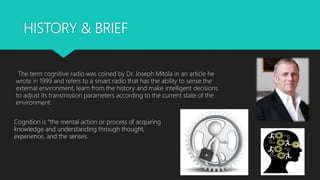
The term cognitive radio was coined by Dr. Joseph Mitola in an article he
wrote in 1999 and refers to a smart radio that has the ability to sense the
external environment, learn from the history and make intelligent decisions
to adjust its transmission parameters according to the current state of the
environment.
Cognition is "the mental action or process of acquiring
knowledge and understanding through thought,
experience, and the senses.
INTUITION BEHIND COGNITIVE RADIO
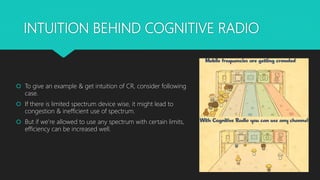
 To give an example & get intuition of CR, consider following
case.
 If there is limited spectrum device wise, it might lead to
congestion & inefficient use of spectrum.
 But if we’re allowed to use any spectrum with certain limits,
efficiency can be increased well.
TYPES OF FREQUENCY SPECTRUM
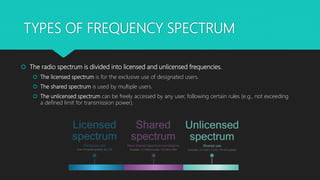
 The radio spectrum is divided into licensed and unlicensed frequencies.
 The licensed spectrum is for the exclusive use of designated users.
 The shared spectrum is used by multiple users.
 The unlicensed spectrum can be freely accessed by any user, following certain rules (e.g., not exceeding
a defined limit for transmission power).
WHY DO WE NEED CR?
 The key enabling technology of dynamic spectrum access
is cognitive radio (CR) has emerged as one of the keys that
can help addressing the inefficient usage of the radio
spectrum.
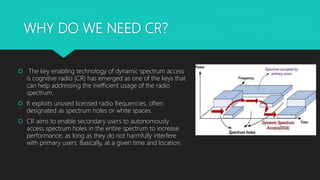
 It exploits unused licensed radio frequencies, often
designated as spectrum holes or white spaces.
 CR aims to enable secondary users to autonomously
access spectrum holes in the entire spectrum to increase
performance, as long as they do not harmfully interfere
with primary users. Basically, at a given time and location.
Cognitive Radio Cycle
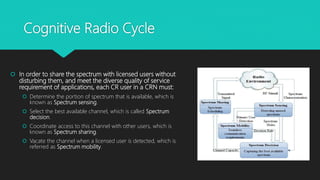
 In order to share the spectrum with licensed users without
disturbing them, and meet the diverse quality of service
requirement of applications, each CR user in a CRN must:
 Determine the portion of spectrum that is available, which is
known as Spectrum sensing.
 Select the best available channel, which is called Spectrum
decision.
 Coordinate access to this channel with other users, which is
known as Spectrum sharing.
 Vacate the channel when a licensed user is detected, which is
referred as Spectrum mobility.
NETWORK ARCHITECTURE
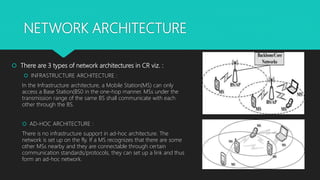
 There are 3 types of network architectures in CR viz. :
 INFRASTRUCTURE ARCHITECTURE :
In the Infrastructure architecture, a Mobile Station(MS) can only
access a Base Station(BS0 in the one-hop manner. MSs under the
transmission range of the same BS shall communicate with each
other through the BS.
 AD-HOC ARCHITECTURE :
There is no infrastructure support in ad-hoc architecture. The
network is set up on the fly. If a MS recognizes that there are some
other MSs nearby and they are connectable through certain
communication standards/protocols, they can set up a link and thus
form an ad-hoc network.
NETWORK ARCHITECTURE contd.
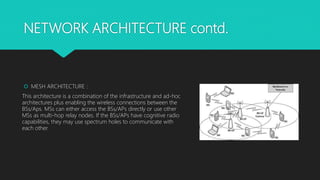
 MESH ARCHITECTURE :
This architecture is a combination of the infrastructure and ad-hoc
architectures plus enabling the wireless connections between the
BSs/Aps. MSs can either access the BSs/APs directly or use other
MSs as multi-hop relay nodes. If the BSs/APs have cognitive radio
capabilities, they may use spectrum holes to communicate with
each other.
CHARACTERISTICS OF CR
 Cognitive Radio have 3 main characteristics :
 Cognitive capability (Identify the unused spectrum at a specific time or location - Spectrum sensing,
Location identification, Network/System/Service discovery.)
 Reconfigurable Capability (A CR can be programmed to transmit and receive on a variety of frequencies,
and use different access technologies supported by its hardware design)
 Self-organized capability (With more intelligence to communication terminal devices, CRs should be able
to self-organize their communication based on sensing and reconfigurable functions)
SECURITY ISSUES & ATTACKS
 Some of the security issues with CR are :
 How to protect the licensed spectrum and users?
 How to avoid unlicensed users from causing interference with existing licensed users or use of special reserved
frequencies like, e.g., for emergency services?
 Other possible security risks are involuntary downloading of malicious software, licensed user emulation.
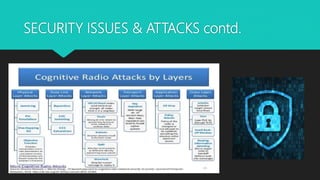
 We define an attack on cognitive networks as any activity that results in :
 unacceptable interference to the licensed primary users
 missed opportunities for secondary users.
SECURITY ISSUES & ATTACKS contd.
ADVANTAGES OF CR
 Senses the radio frequency environment for presence of white spaces
 Manages the unused spectrum
 Increase the efficiency of the spectrum utilization significantly
 Improves the spectrum utilization by neglecting the over occupied spectrum channels and filling
the unused spectrum channels
 Improves the performance of the overall spectrum by increasing the data Rate on good channels
and moving away from the bad channels
 Use the unused spectrum for a new business propositions, such as providing high speed internet
in the rural areas and high data rate network application like video confrencing can be made
 Automatically improves and accomplishes its progress and minimize interference
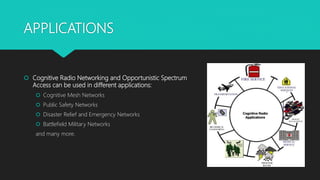
APPLICATIONS
 Cognitive Radio Networking and Opportunistic Spectrum
Access can be used in different applications:
 Cognitive Mesh Networks
 Public Safety Networks
 Disaster Relief and Emergency Networks
 Battlefield Military Networks
and many more.
TECHNIQUES
 A list of popular cognition techniques that can be used in CF for the control of CRNs :
 Bayesian signal processing
 Dynamic programming
 Learning machines with feedback
 Game theory
 Dynamic frequency management
 Software defined radio
THANK YOU
REFERENCES :
• Cognitive Radio Networks Book by: Professor
Kwang-Cheng Chen
• COGNITIVE NETWORKS Towards Self-Aware
Networks
• Cognitive Radio Networks Edited by Yang Xiao

Cognitive Radio

  • 1.
    COGNITIVE RADIOS (Wireless &Mobile Comm.) ECPC72 PRESENTED BY RIYA SAINI (11710460) JYOTIKA (11710469) EC-7
  • 2.
    CONTENTS  History &Brief  Intuition behind Cognitive Radio  Types of frequency spectrum  Why do we need CR?  Cognitive Radio Cycle  Network Architecture  Characteristics of CR  Security Issues & Attacks  Advantages of CR  Applications of CR  Techniques used
  • 3.
    HISTORY & BRIEF Theterm cognitive radio was coined by Dr. Joseph Mitola in an article he wrote in 1999 and refers to a smart radio that has the ability to sense the external environment, learn from the history and make intelligent decisions to adjust its transmission parameters according to the current state of the environment. Cognition is "the mental action or process of acquiring knowledge and understanding through thought, experience, and the senses.
  • 4.
    INTUITION BEHIND COGNITIVERADIO  To give an example & get intuition of CR, consider following case.  If there is limited spectrum device wise, it might lead to congestion & inefficient use of spectrum.  But if we’re allowed to use any spectrum with certain limits, efficiency can be increased well.
  • 5.
    TYPES OF FREQUENCYSPECTRUM  The radio spectrum is divided into licensed and unlicensed frequencies.  The licensed spectrum is for the exclusive use of designated users.  The shared spectrum is used by multiple users.  The unlicensed spectrum can be freely accessed by any user, following certain rules (e.g., not exceeding a defined limit for transmission power).
  • 6.
    WHY DO WENEED CR?  The key enabling technology of dynamic spectrum access is cognitive radio (CR) has emerged as one of the keys that can help addressing the inefficient usage of the radio spectrum.  It exploits unused licensed radio frequencies, often designated as spectrum holes or white spaces.  CR aims to enable secondary users to autonomously access spectrum holes in the entire spectrum to increase performance, as long as they do not harmfully interfere with primary users. Basically, at a given time and location.
  • 7.
    Cognitive Radio Cycle In order to share the spectrum with licensed users without disturbing them, and meet the diverse quality of service requirement of applications, each CR user in a CRN must:  Determine the portion of spectrum that is available, which is known as Spectrum sensing.  Select the best available channel, which is called Spectrum decision.  Coordinate access to this channel with other users, which is known as Spectrum sharing.  Vacate the channel when a licensed user is detected, which is referred as Spectrum mobility.
  • 8.
    NETWORK ARCHITECTURE  Thereare 3 types of network architectures in CR viz. :  INFRASTRUCTURE ARCHITECTURE : In the Infrastructure architecture, a Mobile Station(MS) can only access a Base Station(BS0 in the one-hop manner. MSs under the transmission range of the same BS shall communicate with each other through the BS.  AD-HOC ARCHITECTURE : There is no infrastructure support in ad-hoc architecture. The network is set up on the fly. If a MS recognizes that there are some other MSs nearby and they are connectable through certain communication standards/protocols, they can set up a link and thus form an ad-hoc network.
  • 9.
    NETWORK ARCHITECTURE contd. MESH ARCHITECTURE : This architecture is a combination of the infrastructure and ad-hoc architectures plus enabling the wireless connections between the BSs/Aps. MSs can either access the BSs/APs directly or use other MSs as multi-hop relay nodes. If the BSs/APs have cognitive radio capabilities, they may use spectrum holes to communicate with each other.
  • 10.
    CHARACTERISTICS OF CR Cognitive Radio have 3 main characteristics :  Cognitive capability (Identify the unused spectrum at a specific time or location - Spectrum sensing, Location identification, Network/System/Service discovery.)  Reconfigurable Capability (A CR can be programmed to transmit and receive on a variety of frequencies, and use different access technologies supported by its hardware design)  Self-organized capability (With more intelligence to communication terminal devices, CRs should be able to self-organize their communication based on sensing and reconfigurable functions)
  • 11.
    SECURITY ISSUES &ATTACKS  Some of the security issues with CR are :  How to protect the licensed spectrum and users?  How to avoid unlicensed users from causing interference with existing licensed users or use of special reserved frequencies like, e.g., for emergency services?  Other possible security risks are involuntary downloading of malicious software, licensed user emulation.  We define an attack on cognitive networks as any activity that results in :  unacceptable interference to the licensed primary users  missed opportunities for secondary users.
  • 12.
    SECURITY ISSUES &ATTACKS contd.
  • 13.
    ADVANTAGES OF CR Senses the radio frequency environment for presence of white spaces  Manages the unused spectrum  Increase the efficiency of the spectrum utilization significantly  Improves the spectrum utilization by neglecting the over occupied spectrum channels and filling the unused spectrum channels  Improves the performance of the overall spectrum by increasing the data Rate on good channels and moving away from the bad channels  Use the unused spectrum for a new business propositions, such as providing high speed internet in the rural areas and high data rate network application like video confrencing can be made  Automatically improves and accomplishes its progress and minimize interference
  • 14.
    APPLICATIONS  Cognitive RadioNetworking and Opportunistic Spectrum Access can be used in different applications:  Cognitive Mesh Networks  Public Safety Networks  Disaster Relief and Emergency Networks  Battlefield Military Networks and many more.
  • 15.
    TECHNIQUES  A listof popular cognition techniques that can be used in CF for the control of CRNs :  Bayesian signal processing  Dynamic programming  Learning machines with feedback  Game theory  Dynamic frequency management  Software defined radio
  • 16.
    THANK YOU REFERENCES : •Cognitive Radio Networks Book by: Professor Kwang-Cheng Chen • COGNITIVE NETWORKS Towards Self-Aware Networks • Cognitive Radio Networks Edited by Yang Xiao