Cognitive Radio for Smart Grid
Yasser Hassen
Supervisor: Dr.Ali Khadim
JUN 4st
, 2017
Outline
 Introduction.
 Related Work.
 Cognitive Radio Network (CRN)
– What is Cognitive Radio Network ?
– Types of Users in Cognitive Radio Network.
– Major functions for Cognitive Radio.
 Smart Grid (SG)
– What is Smart Grid ?
– Smart Grid Architecture.
– Smart Grid Feature.
 Applications of CR-based Smart Grid.
– Cognitive Radio HAN.
– Cognitive Radio NAN.
– Cognitive Radio WAN.
 CONCLUSION.
Introduction
 CONVENTIONAL power grids are large interconnected networks that
widely distribute energy from suppliers to consumers.
 The electric power only flows from the power generating stations to the
consumers.
 These power grids face new challenges, such as :
– growing energy demands.
– aging infrastructure.
– emerging renewable energy sources.
– reliability and security problems.
Introduction
Introduction
 To overcome these challenges, the Smart Grid (SG) paradigm has
been introduced with a variety enabling information technologies. These
technologies cover the areas of embedded sensing, broadband
wireless communication, pervasive computing, adaptive control, as well
as automated and intelligent management.
 These SG technologies can achieve significant improvements in the
efficiency, reliability, security, and stability of the electrical grid.
Related Work
 Our present survey on SGs is different from previous surveys as we
comprehensively cover the area of CR-based SG systems. There is
an extensive literature of prior surveys that focus on either CR
communications or SG systems in isolation; however, to the best of
our knowledge there are no prior detailed surveys that cover the
intersection of CR communications and SG systems. our present
survey gives a comprehensive up-to-date review of CR-based SG
communications.
 Other present focus either on CRN or SG.
Cognitive Radio Network
 wireless networks are regulated by a spectrum assignment policy
which makes fixed assignments of spectrum to license holders on a
long term basis for large geographical regions.
 Dynamic Spectrum Access (DSA) may be a promising option to solve
these spectrum inefficiencies.
 A DSA network is implemented with the help of cognitive radios
(CRs). CRs use the existing spectrum through opportunistic access
without interfering with the licensed users.
 CRs determine the available portion of the spectrum known as
spectrum hole or white space. The best available channel is then
used by the CR users if there are no licensed users operating in
these licensed bands.
What is Cognitive Radio Network
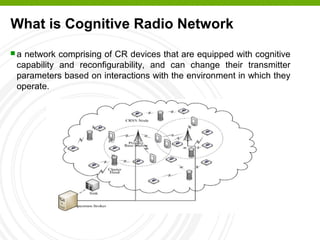
 a network comprising of CR devices that are equipped with cognitive
capability and reconfigurability, and can change their transmitter
parameters based on interactions with the environment in which they
operate.
Types of Users in Cognitive Radio Network
 There are two types of users:
– Primary users (PUs) : are the licensed/legitimate/ authorized
users, which have the license to operate in a prescribed
spectrum band accessing the primary base station.
– Secondary users (SUs) : which are also referred to as “CR
users,” or as “CRs” for brevity, are unlicensed users without a
spectrum license. These CR users need additional
functionalities to share the licensed spectrum band. SUs look
for opportunistic access to both licensed and unlicensed
spectrum and are allowed to operate only if no interference is
caused for licensed PUs
Major functions for Cognitive Radio
 There are four major functions for CR :
– Spectrum sensing : detecting unused spectrum.
– Spectrum management : which is the selection of the best
available channels.
– Spectrum mobility : switching to a new unused spectrum band.
– Spectrum sharing : sharing spectrum for both PU and SU.
Smart Grid
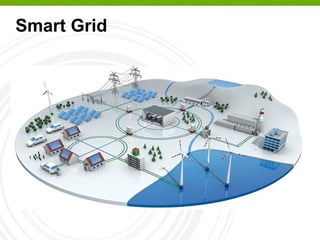
 Smart grid (SG) is envisioned to be the next-generation electric power
system.
 Smart control centers will utilize modern communication technologies to
monitor and interact with remote smart electric devices in real time.
 SG has functional domains including power generation, transmission, and
distribution by service providers to customers (consumers).
 n the current top-down layer approach of the power grids, the
communication flow is uni-directional from the service provider to the
consumers. The SG will feature a bidirectional communication flow
between service provider and consumer.
Smart Grid
Smart Grid Architecture
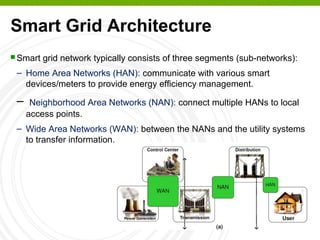
 Smart grid network typically consists of three segments (sub-networks):
– Home Area Networks (HAN): communicate with various smart
devices/meters to provide energy efficiency management.
– Neighborhood Area Networks (NAN): connect multiple HANs to local
access points.
– Wide Area Networks (WAN): between the NANs and the utility systems
to transfer information.
Smart Grid Architecture
 The HAN, which can be considered the bottom layer, provides
communication paths between home appliances, in-home displays,
energy management systems, and energy dashboards. There may be
multiple smart meters in a given HAN, responsible for collecting energy-
related data and transmitting the data to a local access point; thus forming
an AMI. The NAN, which can be considered the middle layer, collects the
metering and service information from multiple HANs and transmits the
information to the data collectors, connecting the NAN to the top layer,
i.e., the WAN. The presence of AMIs constitutes a hybrid architecture
spanning the HAN and NAN layers.
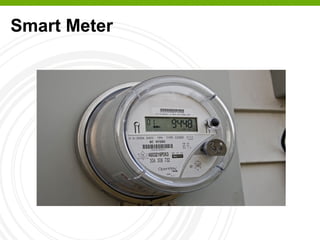
 Smart Meter : is a device to measure energy usage.
Smart Meter
Smart Grid Feature
 multi-way communication among energy generation, transmission,
distribution, and usage facilities.
 The reliable, efficient, and intelligent management of complex power
systems requires integration of high-speed, reliable.
 secure data information and communication technology into the SGs to
monitor and regulate power generation and usage.
Applications of CR-based Smart Grid
Cognitive Radio HAN
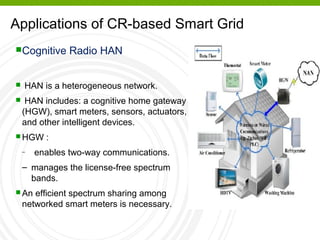
 HAN is a heterogeneous network.
 HAN includes: a cognitive home gateway
(HGW), smart meters, sensors, actuators,
and other intelligent devices.
 HGW :
– enables two-way communications.
– manages the license-free spectrum
bands.
 An efficient spectrum sharing among
networked smart meters is necessary.
Applications of CR-based Smart Grid
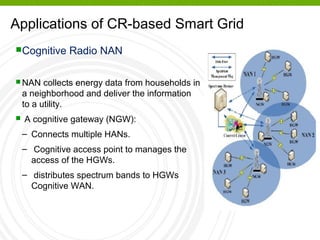
Cognitive Radio NAN
 NAN collects energy data from households in
a neighborhood and deliver the information
to a utility.
 A cognitive gateway (NGW):
– Connects multiple HANs.
– Cognitive access point to manages the
access of the HGWs.
– distributes spectrum bands to HGWs
Cognitive WAN.
Applications of CR-based Smart Grid
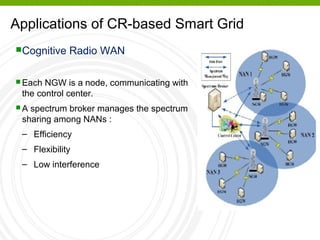
Cognitive Radio WAN
 Each NGW is a node, communicating with
the control center.
 A spectrum broker manages the spectrum
sharing among NANs :
– Efficiency
– Flexibility
– Low interference
CONCLUSION
 The smart grid (SG) is the future development of the traditional
electrical power grid. By leveraging the tight integration of
communications and information technologies with electrical power
systems, the SG provides advanced features, such as adaptive control
for dynamic demand response management (DRM) and wide area
monitoring. These advanced features can improve the efficiency and
reliability of the electrical power service. Wireless communications can
effectively support many of the SG applications that require flexible
communication over diverse terrain.
Questions?
Cognitive Radio For Smart Grid

Cognitive Radio For Smart Grid

  • 1.
    Cognitive Radio forSmart Grid Yasser Hassen Supervisor: Dr.Ali Khadim JUN 4st , 2017
  • 2.
    Outline  Introduction.  RelatedWork.  Cognitive Radio Network (CRN) – What is Cognitive Radio Network ? – Types of Users in Cognitive Radio Network. – Major functions for Cognitive Radio.  Smart Grid (SG) – What is Smart Grid ? – Smart Grid Architecture. – Smart Grid Feature.  Applications of CR-based Smart Grid. – Cognitive Radio HAN. – Cognitive Radio NAN. – Cognitive Radio WAN.  CONCLUSION.
  • 3.
    Introduction  CONVENTIONAL powergrids are large interconnected networks that widely distribute energy from suppliers to consumers.  The electric power only flows from the power generating stations to the consumers.  These power grids face new challenges, such as : – growing energy demands. – aging infrastructure. – emerging renewable energy sources. – reliability and security problems.
  • 4.
  • 5.
    Introduction  To overcomethese challenges, the Smart Grid (SG) paradigm has been introduced with a variety enabling information technologies. These technologies cover the areas of embedded sensing, broadband wireless communication, pervasive computing, adaptive control, as well as automated and intelligent management.  These SG technologies can achieve significant improvements in the efficiency, reliability, security, and stability of the electrical grid.
  • 6.
    Related Work  Ourpresent survey on SGs is different from previous surveys as we comprehensively cover the area of CR-based SG systems. There is an extensive literature of prior surveys that focus on either CR communications or SG systems in isolation; however, to the best of our knowledge there are no prior detailed surveys that cover the intersection of CR communications and SG systems. our present survey gives a comprehensive up-to-date review of CR-based SG communications.  Other present focus either on CRN or SG.
  • 7.
    Cognitive Radio Network wireless networks are regulated by a spectrum assignment policy which makes fixed assignments of spectrum to license holders on a long term basis for large geographical regions.  Dynamic Spectrum Access (DSA) may be a promising option to solve these spectrum inefficiencies.  A DSA network is implemented with the help of cognitive radios (CRs). CRs use the existing spectrum through opportunistic access without interfering with the licensed users.  CRs determine the available portion of the spectrum known as spectrum hole or white space. The best available channel is then used by the CR users if there are no licensed users operating in these licensed bands.
  • 8.
    What is CognitiveRadio Network  a network comprising of CR devices that are equipped with cognitive capability and reconfigurability, and can change their transmitter parameters based on interactions with the environment in which they operate.
  • 9.
    Types of Usersin Cognitive Radio Network  There are two types of users: – Primary users (PUs) : are the licensed/legitimate/ authorized users, which have the license to operate in a prescribed spectrum band accessing the primary base station. – Secondary users (SUs) : which are also referred to as “CR users,” or as “CRs” for brevity, are unlicensed users without a spectrum license. These CR users need additional functionalities to share the licensed spectrum band. SUs look for opportunistic access to both licensed and unlicensed spectrum and are allowed to operate only if no interference is caused for licensed PUs
  • 10.
    Major functions forCognitive Radio  There are four major functions for CR : – Spectrum sensing : detecting unused spectrum. – Spectrum management : which is the selection of the best available channels. – Spectrum mobility : switching to a new unused spectrum band. – Spectrum sharing : sharing spectrum for both PU and SU.
  • 11.
    Smart Grid  Smartgrid (SG) is envisioned to be the next-generation electric power system.  Smart control centers will utilize modern communication technologies to monitor and interact with remote smart electric devices in real time.  SG has functional domains including power generation, transmission, and distribution by service providers to customers (consumers).  n the current top-down layer approach of the power grids, the communication flow is uni-directional from the service provider to the consumers. The SG will feature a bidirectional communication flow between service provider and consumer.
  • 12.
  • 13.
    Smart Grid Architecture Smart grid network typically consists of three segments (sub-networks): – Home Area Networks (HAN): communicate with various smart devices/meters to provide energy efficiency management. – Neighborhood Area Networks (NAN): connect multiple HANs to local access points. – Wide Area Networks (WAN): between the NANs and the utility systems to transfer information.
  • 14.
    Smart Grid Architecture The HAN, which can be considered the bottom layer, provides communication paths between home appliances, in-home displays, energy management systems, and energy dashboards. There may be multiple smart meters in a given HAN, responsible for collecting energy- related data and transmitting the data to a local access point; thus forming an AMI. The NAN, which can be considered the middle layer, collects the metering and service information from multiple HANs and transmits the information to the data collectors, connecting the NAN to the top layer, i.e., the WAN. The presence of AMIs constitutes a hybrid architecture spanning the HAN and NAN layers.  Smart Meter : is a device to measure energy usage.
  • 15.
  • 16.
    Smart Grid Feature multi-way communication among energy generation, transmission, distribution, and usage facilities.  The reliable, efficient, and intelligent management of complex power systems requires integration of high-speed, reliable.  secure data information and communication technology into the SGs to monitor and regulate power generation and usage.
  • 17.
    Applications of CR-basedSmart Grid Cognitive Radio HAN  HAN is a heterogeneous network.  HAN includes: a cognitive home gateway (HGW), smart meters, sensors, actuators, and other intelligent devices.  HGW : – enables two-way communications. – manages the license-free spectrum bands.  An efficient spectrum sharing among networked smart meters is necessary.
  • 18.
    Applications of CR-basedSmart Grid Cognitive Radio NAN  NAN collects energy data from households in a neighborhood and deliver the information to a utility.  A cognitive gateway (NGW): – Connects multiple HANs. – Cognitive access point to manages the access of the HGWs. – distributes spectrum bands to HGWs Cognitive WAN.
  • 19.
    Applications of CR-basedSmart Grid Cognitive Radio WAN  Each NGW is a node, communicating with the control center.  A spectrum broker manages the spectrum sharing among NANs : – Efficiency – Flexibility – Low interference
  • 20.
    CONCLUSION  The smartgrid (SG) is the future development of the traditional electrical power grid. By leveraging the tight integration of communications and information technologies with electrical power systems, the SG provides advanced features, such as adaptive control for dynamic demand response management (DRM) and wide area monitoring. These advanced features can improve the efficiency and reliability of the electrical power service. Wireless communications can effectively support many of the SG applications that require flexible communication over diverse terrain.
  • 21.

Editor's Notes

  • #2 本模板来源于网络,由第一课件网整理发布,免费分享给大家使用。 第一课件网是国内最专业的PPT模板分享网站,所有模板均经严格测试,保证100%下载,100%精彩! 更多精彩PPT模板,敬请访问http://www.1kejian.com 使用时删除此备注即可。 配色方案修改: 配色方案在【格式】-->【幻灯片设计】-->【配色方案】-->【编辑配色方案】下调整。 LOGO的添加: Logo添加修改在【视图】-->【母版】-->【幻灯片母版】下调整。直接选择logo图片删除或修改。 字体格式的设置: 括标题和文本格式的设置在【视图】-->【母版】-->【幻灯片母版】下调整。