Cognitive Radio Sensor Network
(CRSN)
Prepared by :
Satyaki Mitra
Pranab Sahoo
Avijit Karmakar
Souradeep Hazra
Topics to be discussed
1. What is CR Network
2. CR Antennas
3. CR Mechanism
4. CR Network Accessibility, Adaptively, Scalability,
Reliability and Interconnectivity
5. How Cognitive Radio Works
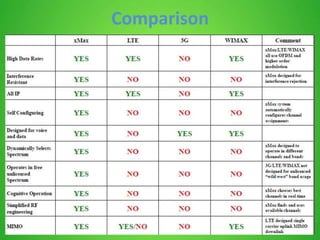
6. Cognitive Radios vs. Conventional Radios
7. Cognitive Radio benefits
8. Application of Cognitive Radio
What is CR Network ?
• Cognitive radios have the ability to monitor, sense, and detect
the conditions of their operating environment and dynamically
reconfigure their own characteristics to best match conditions to
transmit and receive on a variety of bands using a variety of
protocols.
• Cognitive radios sense unused times or
frequencies and may decide to transmit on other user’s
band.
CONT.
CR can be defined as “…a radio that is aware of
its surroundings and adapts intelligently”.
Cognitive radio networks, like xG’s xMax system,
represent an innovative approach to wireless
engineering in which radios are designed with
an unused level of intelligence
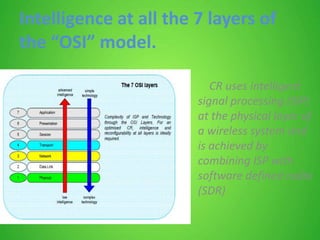
Intelligence at all the 7 layers of
the “OSI” model.
CR uses intelligent
signal processing (ISP)
at the physical layer of
a wireless system and
is achieved by
combining ISP with
software defined radio
(SDR)
CR Network Mechanism
1.Sense -> Sensing
antenna
2.Analyze
3.Decide
4.Tune in ->
Reconfigurable
antenna
Types of CR Antennas
1.Sensing antenna: wide band antenna which continuously
monitors the frequency spectrum for activity
2. Reconfigurable antenna: narrow-band antenna which
dynamically tune to a specific range within the frequency
spectrum to perform data transfer
CR Network Improves
Accessibility
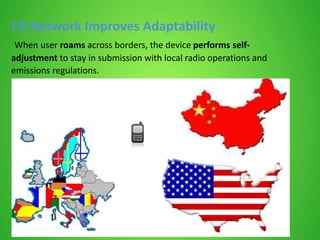
CR Network Improves Adaptability
When user roams across borders, the device performs self-
adjustment to stay in submission with local radio operations and
emissions regulations.
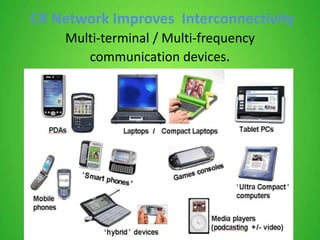
CR Network Improves Interconnectivity
Multi-terminal / Multi-frequency
communication devices.
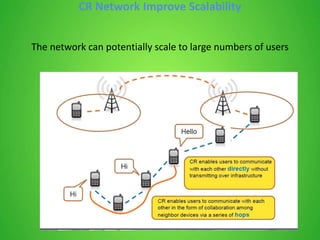
CR Network Improve Scalability
The network can potentially scale to large numbers of users
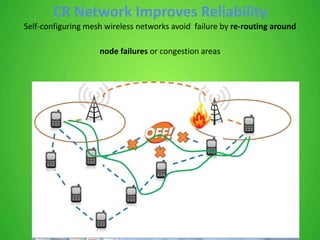
CR Network Improves Reliability
Self-configuring mesh wireless networks avoid failure by re-routing around
node failures or congestion areas
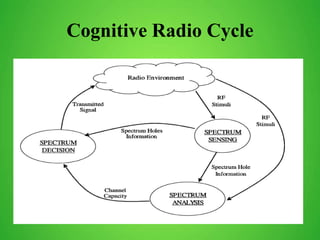
How Cognitive Radio Works
Cognitive Radio Cycle
Cont.
1. Cognitive radios can identify potential impairments to
communication quality in their environment, for example,
interference, path loss, shadowing and multipath fading.
2. They can adjust their transmitting parameters, such as
power output, frequency, and modulation to ensure an
optimized communications experience for users.
Cognitive Radios
vs
Conventional Radios
Conventional Radios:
•Operating in interference-free spectrum.
•Unable to dynamically change parameters, channels or
spectrum bands in response to interference.
•View congested radio spectrum as essentially unusable for
communications due to heavy interference.
Cognitive Radios
vs
Conventional Radios
Cognitive Radios:
• Function in challenging conditions to quickly identify unused
“gaps” in spectrum that are not being used.
•Find and tune to other spectrum if interference is detected on
the frequencies being used (example - xMax detects and
determines if interference has reached unacceptable
levels up to 33 times a second)
Cognitive Radios
vs
Conventional Radios
Comparison
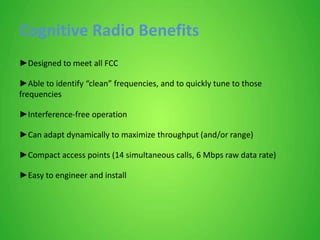
Cognitive Radio Benefits
►Designed to meet all FCC
►Able to identify “clean” frequencies, and to quickly tune to those
frequencies
►Interference-free operation
►Can adapt dynamically to maximize throughput (and/or range)
►Compact access points (14 simultaneous calls, 6 Mbps raw data rate)
►Easy to engineer and install
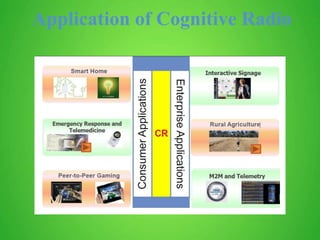
Application of Cognitive Radio
Conclusion
The term Cognitive Radio was first suggested by prof. Joseph
Mitola 1999
controlled by powerful microprocessors which have been
programmed to analyze a number of the radio channel
parameters.
The key feature of a Cognitive Radio is its ability to recognize the
unused parts of spectrum that is licensed to a primary user and
adapt
its communication strategy to use these parts while minimizing
the interference that it generates to the primary user.
Thank You

Cognitive-Radio-Sensor-Network

  • 1.
    Cognitive Radio SensorNetwork (CRSN) Prepared by : Satyaki Mitra Pranab Sahoo Avijit Karmakar Souradeep Hazra
  • 2.
    Topics to bediscussed 1. What is CR Network 2. CR Antennas 3. CR Mechanism 4. CR Network Accessibility, Adaptively, Scalability, Reliability and Interconnectivity 5. How Cognitive Radio Works 6. Cognitive Radios vs. Conventional Radios 7. Cognitive Radio benefits 8. Application of Cognitive Radio
  • 3.
    What is CRNetwork ? • Cognitive radios have the ability to monitor, sense, and detect the conditions of their operating environment and dynamically reconfigure their own characteristics to best match conditions to transmit and receive on a variety of bands using a variety of protocols. • Cognitive radios sense unused times or frequencies and may decide to transmit on other user’s band.
  • 4.
    CONT. CR can bedefined as “…a radio that is aware of its surroundings and adapts intelligently”. Cognitive radio networks, like xG’s xMax system, represent an innovative approach to wireless engineering in which radios are designed with an unused level of intelligence
  • 5.
    Intelligence at allthe 7 layers of the “OSI” model. CR uses intelligent signal processing (ISP) at the physical layer of a wireless system and is achieved by combining ISP with software defined radio (SDR)
  • 6.
    CR Network Mechanism 1.Sense-> Sensing antenna 2.Analyze 3.Decide 4.Tune in -> Reconfigurable antenna
  • 7.
    Types of CRAntennas 1.Sensing antenna: wide band antenna which continuously monitors the frequency spectrum for activity 2. Reconfigurable antenna: narrow-band antenna which dynamically tune to a specific range within the frequency spectrum to perform data transfer
  • 8.
  • 9.
    CR Network ImprovesAdaptability When user roams across borders, the device performs self- adjustment to stay in submission with local radio operations and emissions regulations.
  • 10.
    CR Network ImprovesInterconnectivity Multi-terminal / Multi-frequency communication devices.
  • 11.
    CR Network ImproveScalability The network can potentially scale to large numbers of users
  • 12.
    CR Network ImprovesReliability Self-configuring mesh wireless networks avoid failure by re-routing around node failures or congestion areas
  • 13.
  • 14.
  • 15.
    Cont. 1. Cognitive radioscan identify potential impairments to communication quality in their environment, for example, interference, path loss, shadowing and multipath fading. 2. They can adjust their transmitting parameters, such as power output, frequency, and modulation to ensure an optimized communications experience for users.
  • 16.
    Cognitive Radios vs Conventional Radios ConventionalRadios: •Operating in interference-free spectrum. •Unable to dynamically change parameters, channels or spectrum bands in response to interference. •View congested radio spectrum as essentially unusable for communications due to heavy interference.
  • 17.
    Cognitive Radios vs Conventional Radios CognitiveRadios: • Function in challenging conditions to quickly identify unused “gaps” in spectrum that are not being used. •Find and tune to other spectrum if interference is detected on the frequencies being used (example - xMax detects and determines if interference has reached unacceptable levels up to 33 times a second)
  • 18.
  • 20.
  • 21.
    Cognitive Radio Benefits ►Designedto meet all FCC ►Able to identify “clean” frequencies, and to quickly tune to those frequencies ►Interference-free operation ►Can adapt dynamically to maximize throughput (and/or range) ►Compact access points (14 simultaneous calls, 6 Mbps raw data rate) ►Easy to engineer and install
  • 22.
  • 23.
    Conclusion The term CognitiveRadio was first suggested by prof. Joseph Mitola 1999 controlled by powerful microprocessors which have been programmed to analyze a number of the radio channel parameters. The key feature of a Cognitive Radio is its ability to recognize the unused parts of spectrum that is licensed to a primary user and adapt its communication strategy to use these parts while minimizing the interference that it generates to the primary user. Thank You