TECHNICAL SEMINAR ON
BY
UMERA ANJUM
INTRODUCTION
 Evolution of numerous wireless applications.
 Limited Public Bandwidth or Spectrum
 Inefficient use of Licensed Spectrum
 In order to address the resulting congestion and shortage of
capacity, the cognitive radio (CR) concept has been
envisioned to increase the efficiency of spectrum utilization,
and improve the management, performance and coexistence
of heterogeneous networks with diverse radio access
technologies.
Umera Anjum - B.Tech2015
INTRODUCTION TO CR..
 Cognitive radios have been engineered from the
ground up to function in challenging conditions
 Can view their environment in great detail, allowing
them to quickly identify unused “gaps” in spectrum
that are not being used
 Can instantly find and tune to other spectrum if
interference is detected on the frequencies being
used (example - xMax samples, detects and
determines if interference has reached unacceptable
levels up to 33 times a second)
Umera Anjum - B.Tech2015
What is
CR..???
• Cognitive Radio (CR) is an adaptive, intelligent radio and network technology
that can automatically detect available channels in a wireless spectrum and
change transmission parameters enabling more communications to run
concurrently and also improve radio operating behavior.
Umera Anjum - B.Tech2015
Cognitive Radios vs. Conventional
Radios
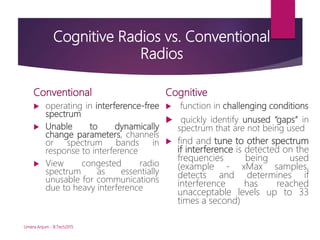
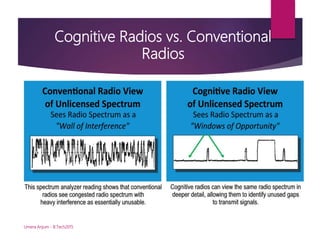
Conventional
 operating in interference-free
spectrum
 Unable to dynamically
change parameters, channels
or spectrum bands in
response to interference
 View congested radio
spectrum as essentially
unusable for communications
due to heavy interference
Cognitive
 function in challenging conditions
 quickly identify unused “gaps” in
spectrum that are not being used
 find and tune to other spectrum
if interference is detected on the
frequencies being used
(example - xMax samples,
detects and determines if
interference has reached
unacceptable levels up to 33
times a second)
Umera Anjum - B.Tech2015
Cognitive Radios vs. Conventional
Radios
Umera Anjum - B.Tech2015
How Cognitive Radio Works
Umera Anjum - B.Tech2015
How Cognitive Radio Works
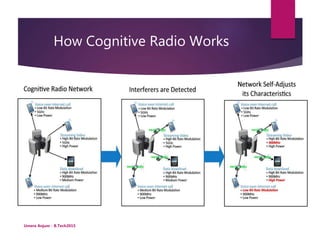
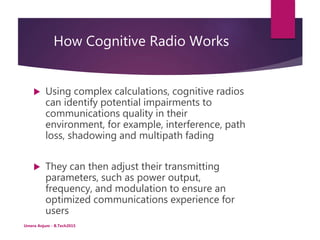
 Using complex calculations, cognitive radios
can identify potential impairments to
communications quality in their
environment, for example, interference, path
loss, shadowing and multipath fading
 They can then adjust their transmitting
parameters, such as power output,
frequency, and modulation to ensure an
optimized communications experience for
users
Umera Anjum - B.Tech2015
Why CR is important..
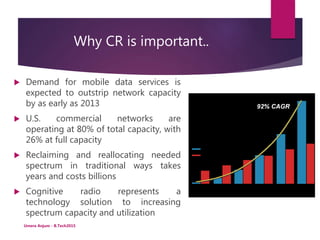
 Demand for mobile data services is
expected to outstrip network capacity
by as early as 2013
 U.S. commercial networks are
operating at 80% of total capacity, with
26% at full capacity
 Reclaiming and reallocating needed
spectrum in traditional ways takes
years and costs billions
 Cognitive radio represents a
technology solution to increasing
spectrum capacity and utilization
Umera Anjum - B.Tech2015
Cognitive Radio Uses..
 Incumbent Wireless Carriers: allows incumbent wireless providers to dramatically
increase capacity of their networks and reduce interference
 Rural Broadband Telcos: can help independent local providers overcome the
obstacle of high cost/scarcity of spectrum to deploying wireless in underserved rural
markets
 Department of Defense/Military Applications: satisfies the need for a mobile,
interference-resistant, scalable, frequency agile, cost-efficient wireless system
 Public Safety: provides resilience and continuity of operations in wireless-impaired
environments that is NOT AVAILABLE from commercial wireless systems
 Utilities/Smart Grids: provides an efficient means of measuring and reporting usage
 Mobile Content Providers: gives content providers (Google, Facebook, etc.) control
of their own content delivery systems
 Cable Markets: allows operators without spectrum to have a competitive entry into
the wireless marketUmera Anjum - B.Tech2015
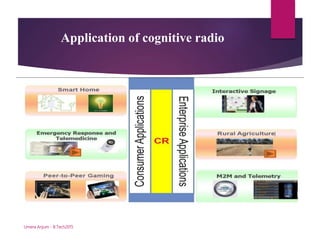
Application of cognitive radio
Umera Anjum - B.Tech2015
Summary
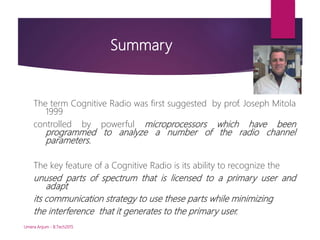
The term Cognitive Radio was first suggested by prof. Joseph Mitola
1999
controlled by powerful microprocessors which have been
programmed to analyze a number of the radio channel
parameters.
The key feature of a Cognitive Radio is its ability to recognize the
unused parts of spectrum that is licensed to a primary user and
adapt
its communication strategy to use these parts while minimizing
the interference that it generates to the primary user.
Umera Anjum - B.Tech2015

What is Cognitive Radio ?

  • 1.
  • 2.
    INTRODUCTION  Evolution ofnumerous wireless applications.  Limited Public Bandwidth or Spectrum  Inefficient use of Licensed Spectrum  In order to address the resulting congestion and shortage of capacity, the cognitive radio (CR) concept has been envisioned to increase the efficiency of spectrum utilization, and improve the management, performance and coexistence of heterogeneous networks with diverse radio access technologies. Umera Anjum - B.Tech2015
  • 3.
    INTRODUCTION TO CR.. Cognitive radios have been engineered from the ground up to function in challenging conditions  Can view their environment in great detail, allowing them to quickly identify unused “gaps” in spectrum that are not being used  Can instantly find and tune to other spectrum if interference is detected on the frequencies being used (example - xMax samples, detects and determines if interference has reached unacceptable levels up to 33 times a second) Umera Anjum - B.Tech2015
  • 4.
    What is CR..??? • CognitiveRadio (CR) is an adaptive, intelligent radio and network technology that can automatically detect available channels in a wireless spectrum and change transmission parameters enabling more communications to run concurrently and also improve radio operating behavior. Umera Anjum - B.Tech2015
  • 5.
    Cognitive Radios vs.Conventional Radios Conventional  operating in interference-free spectrum  Unable to dynamically change parameters, channels or spectrum bands in response to interference  View congested radio spectrum as essentially unusable for communications due to heavy interference Cognitive  function in challenging conditions  quickly identify unused “gaps” in spectrum that are not being used  find and tune to other spectrum if interference is detected on the frequencies being used (example - xMax samples, detects and determines if interference has reached unacceptable levels up to 33 times a second) Umera Anjum - B.Tech2015
  • 6.
    Cognitive Radios vs.Conventional Radios Umera Anjum - B.Tech2015
  • 7.
    How Cognitive RadioWorks Umera Anjum - B.Tech2015
  • 8.
    How Cognitive RadioWorks  Using complex calculations, cognitive radios can identify potential impairments to communications quality in their environment, for example, interference, path loss, shadowing and multipath fading  They can then adjust their transmitting parameters, such as power output, frequency, and modulation to ensure an optimized communications experience for users Umera Anjum - B.Tech2015
  • 9.
    Why CR isimportant..  Demand for mobile data services is expected to outstrip network capacity by as early as 2013  U.S. commercial networks are operating at 80% of total capacity, with 26% at full capacity  Reclaiming and reallocating needed spectrum in traditional ways takes years and costs billions  Cognitive radio represents a technology solution to increasing spectrum capacity and utilization Umera Anjum - B.Tech2015
  • 10.
    Cognitive Radio Uses.. Incumbent Wireless Carriers: allows incumbent wireless providers to dramatically increase capacity of their networks and reduce interference  Rural Broadband Telcos: can help independent local providers overcome the obstacle of high cost/scarcity of spectrum to deploying wireless in underserved rural markets  Department of Defense/Military Applications: satisfies the need for a mobile, interference-resistant, scalable, frequency agile, cost-efficient wireless system  Public Safety: provides resilience and continuity of operations in wireless-impaired environments that is NOT AVAILABLE from commercial wireless systems  Utilities/Smart Grids: provides an efficient means of measuring and reporting usage  Mobile Content Providers: gives content providers (Google, Facebook, etc.) control of their own content delivery systems  Cable Markets: allows operators without spectrum to have a competitive entry into the wireless marketUmera Anjum - B.Tech2015
  • 11.
    Application of cognitiveradio Umera Anjum - B.Tech2015
  • 12.
    Summary The term CognitiveRadio was first suggested by prof. Joseph Mitola 1999 controlled by powerful microprocessors which have been programmed to analyze a number of the radio channel parameters. The key feature of a Cognitive Radio is its ability to recognize the unused parts of spectrum that is licensed to a primary user and adapt its communication strategy to use these parts while minimizing the interference that it generates to the primary user. Umera Anjum - B.Tech2015