BY EDGAR HUMBERTO PÁEZ TEQUIA HELP AJBR. I.E.D. SAN BENITO www.iedsanbenito.edu.co
TABLE OF CONTENTS. INTERACTIVE ENGLISH INTRODUCTION 1 . OBJETIVES. 1.1  GNERAL OBJETIVE 1.2  SPECIFICS OBJETIVE. 2.VERB TENSES 2.1  THE SIMPLE TENSE 2.2  THE SIMPLE PAST TENSE  2.3  THE SIMPLE FUTURE TENSE. 3.REGULAR AND IRREGULAR VERBS. 4. THE FAMILY 4.1 DESCRIPTION OOF THE FAMILY 5. THE COMPARATIVE AND SUPERLATIVE FORM 6. IF CONDITIONAL.
INTRODUCTION. This work we want to make people understand and resolve their concerns fundamental issues facing the English language, as are the tenses, the comparative and superlative, and other issues as mentioned above are essential to fully understand the English, this is done with very simple exercises and to apply from time to time in everyday life and will be helpful.
OBJETIVES  GENERAL OBJETIVE. Do people learn quickly to distinguish between tenses, including comparative, superlative and use the information given to answer certain questions SPECIFIC OBJETIVES. Easy exercises for understanding And give a good explanation for the issues are not complex to understand. Return to the explanation of the topic if at any case the person comes to answering incorrectly is that the concern is. Through tables help readers in this way will facilitate the understanding of most viewed topic.
VERB TENSES: The verbs tenses are  Present Past  Future Put each sentence in affirmative form , interrogative form and negative form THE SIMPLE TENSE  The simple tense , also called the indicative tense is the simplest of English. It is often used to talk about things that are habits or customs. If the verb ends in  "y"  when it is placed before a consonant is changed it with an  "i"  and add the ending "is" in the third person singular. However, if the verb ends in  O, CH, SH, X, SS  or  Z  are not changed these endings and add the ending-is in the third person singular. Example: She goes to the house's father  They  run all the time  Do I drink every time soda? Yes I am  no, I amn´t
THE SIMPLE PAST TENSE  In English, the simple past tense refers to the past, a time when an action grammar  occurred and was completed in the past.  For regular verbs, the simple past normally formed by adding-ED to the infinitive (without to).  verb  +  ed =  past simple    (Past) Example: He  drank juice of lemon Did They help us with the homeworks? Yes , they did  no , they didn´t She didn´t  l ove to her boyfriend THE SIMPLE FUTURE TENSE  As such, there is no specific future time in English, but there are several verbs and expressions to refer to it. A common way of future in English has the following structure: Subject + will + verb EXAMPLE: I will play / yo jugare I won´t play /yo no jugare
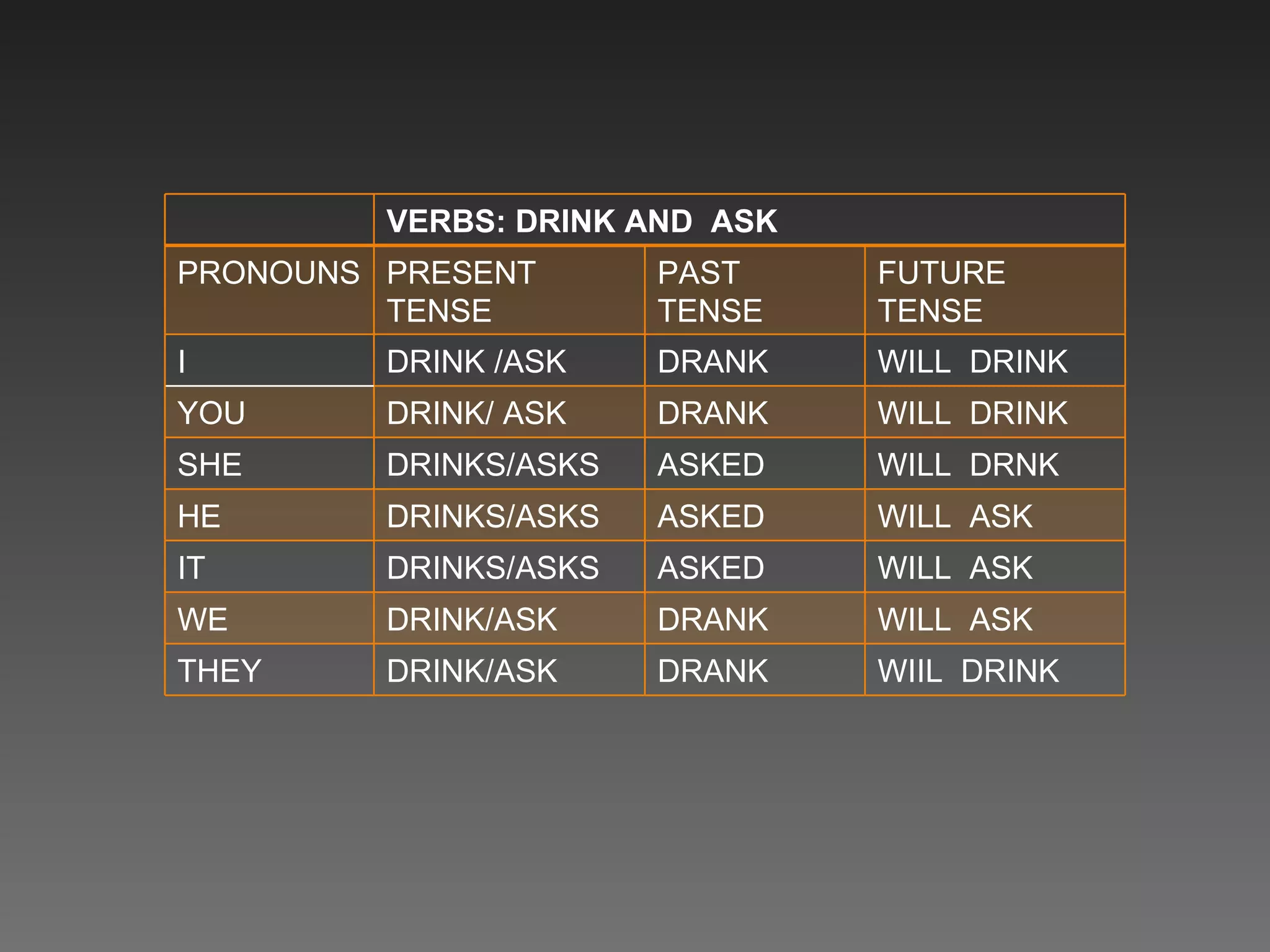
VERBS: DRINK AND  ASK PRONOUNS PRESENT TENSE PAST TENSE FUTURE TENSE I DRINK /ASK DRANK WILL  DRINK YOU DRINK/ ASK DRANK WILL  DRINK SHE DRINKS/ASKS ASKED WILL  DRNK HE DRINKS/ASKS ASKED WILL  ASK IT DRINKS/ASKS ASKED WILL  ASK WE DRINK/ASK DRANK WILL  ASK THEY DRINK/ASK DRANK WIIL  DRINK
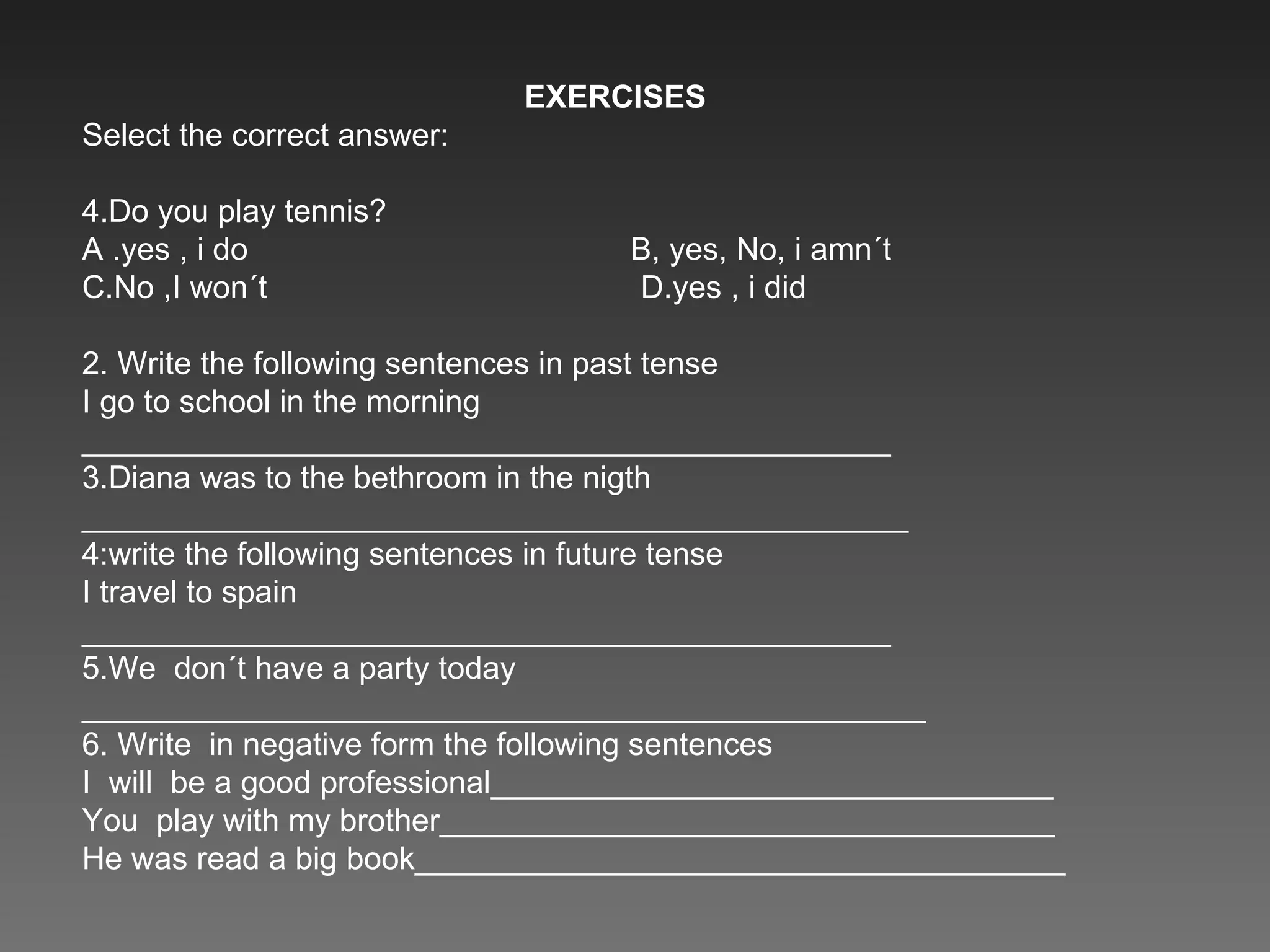
EXERCISES Select the correct answer: Do you play tennis? A .yes , i do  B, yes, No, i amn´t C.No ,I won´t  D.yes , i did 2. Write the following sentences in past tense I go to school in the morning ______________________________________________ 3.Diana was to the bethroom in the nigth _______________________________________________ 4:write the following sentences in future tense I travel to spain ______________________________________________ 5.We  don´t have a party today ________________________________________________ 6. Write  in negative form the following sentences I  will  be a good professional________________________________ You  play with my brother___________________________________ He was read a big book_____________________________________
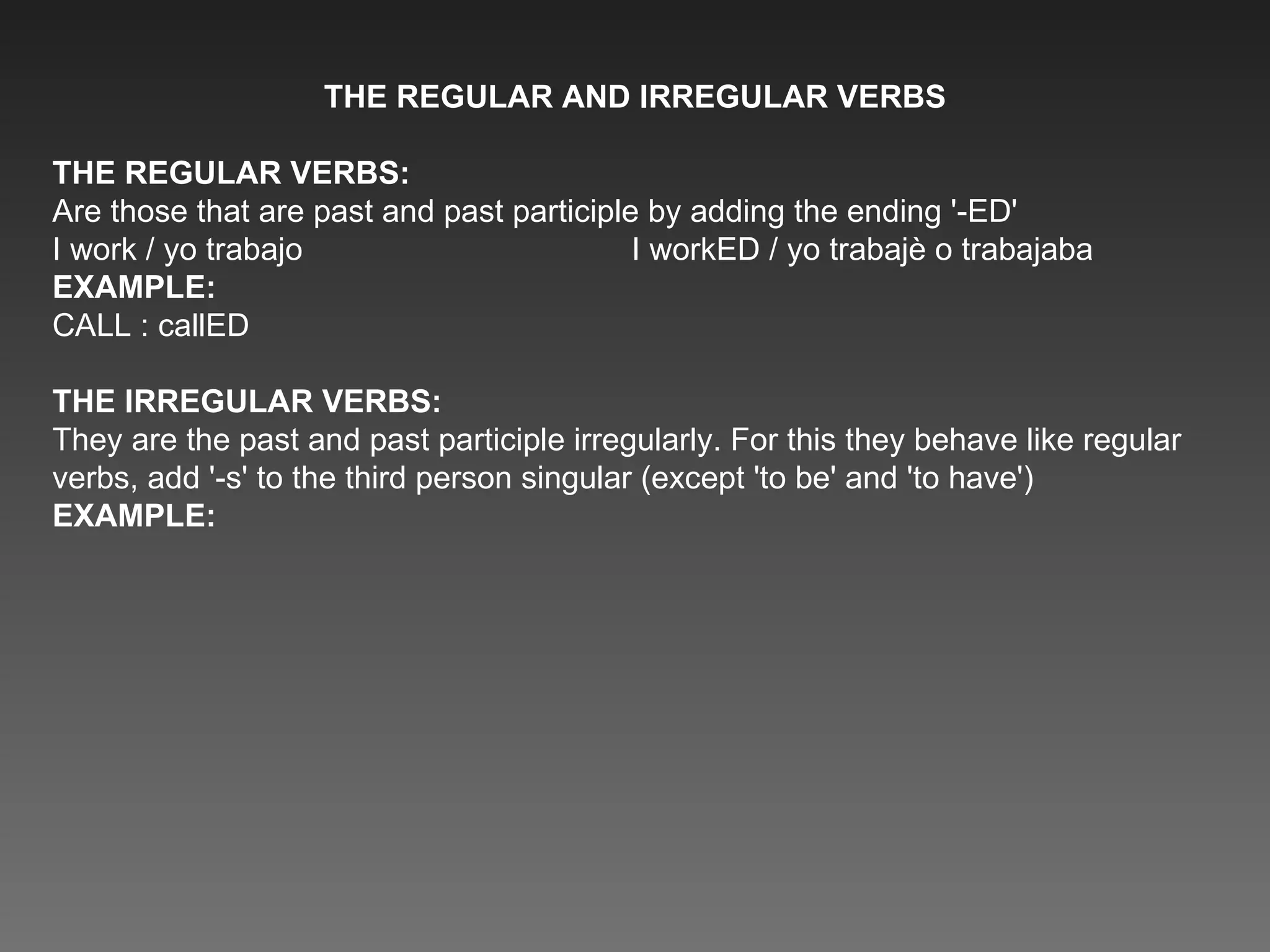
THE REGULAR AND IRREGULAR VERBS THE REGULAR VERBS: Are those that are past and past participle by adding the ending '-ED' I work / yo trabajo  I workED / yo trabajè o trabajaba EXAMPLE: CALL : callED THE IRREGULAR VERBS: They are the past and past participle irregularly. For this they behave like regular verbs, add '-s' to the third person singular (except 'to be' and 'to have') EXAMPLE:
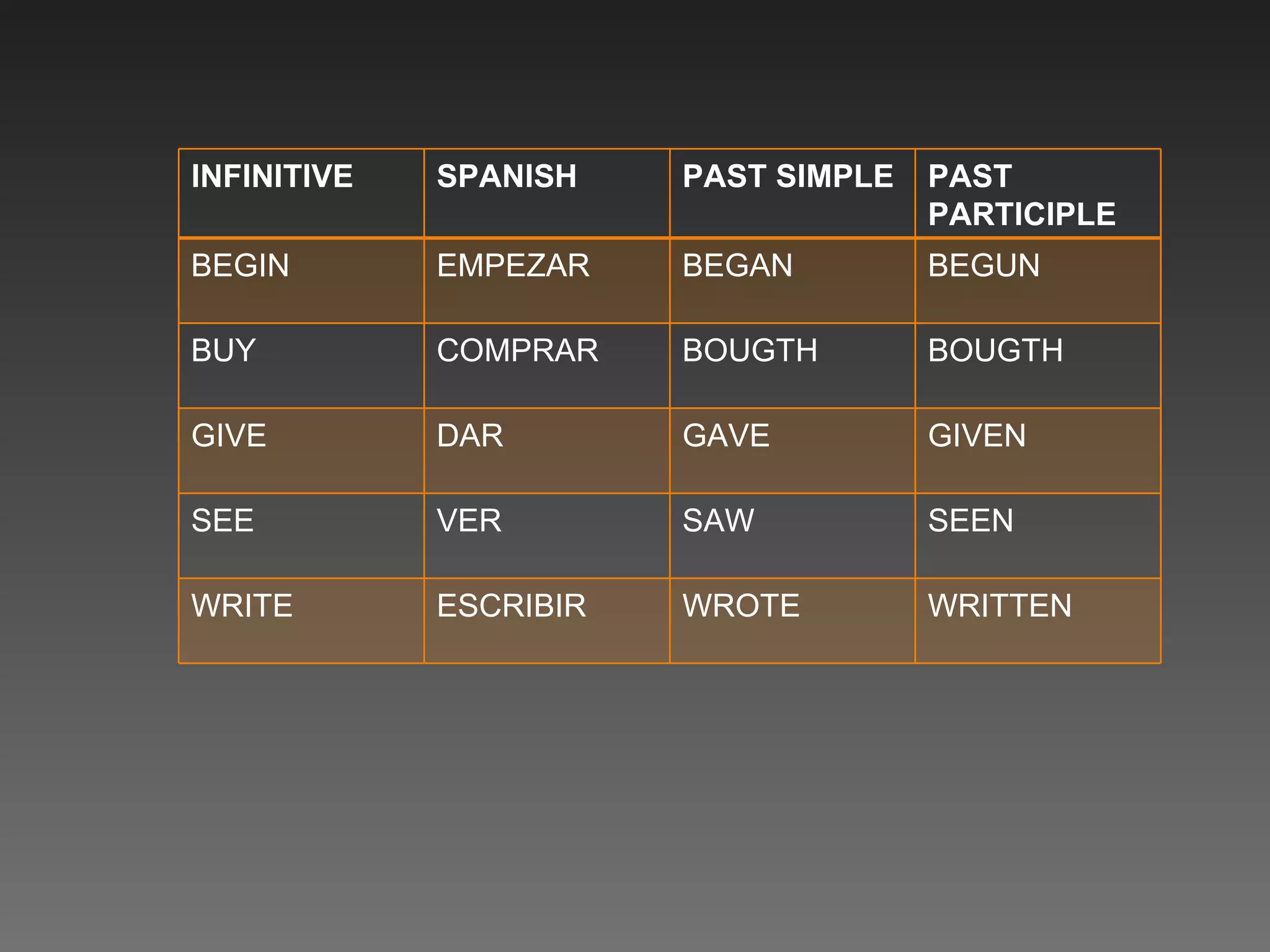
INFINITIVE SPANISH PAST SIMPLE PAST PARTICIPLE BEGIN EMPEZAR BEGAN  BEGUN BUY COMPRAR BOUGTH BOUGTH GIVE DAR GAVE GIVEN SEE VER SAW SEEN WRITE  ESCRIBIR WROTE WRITTEN
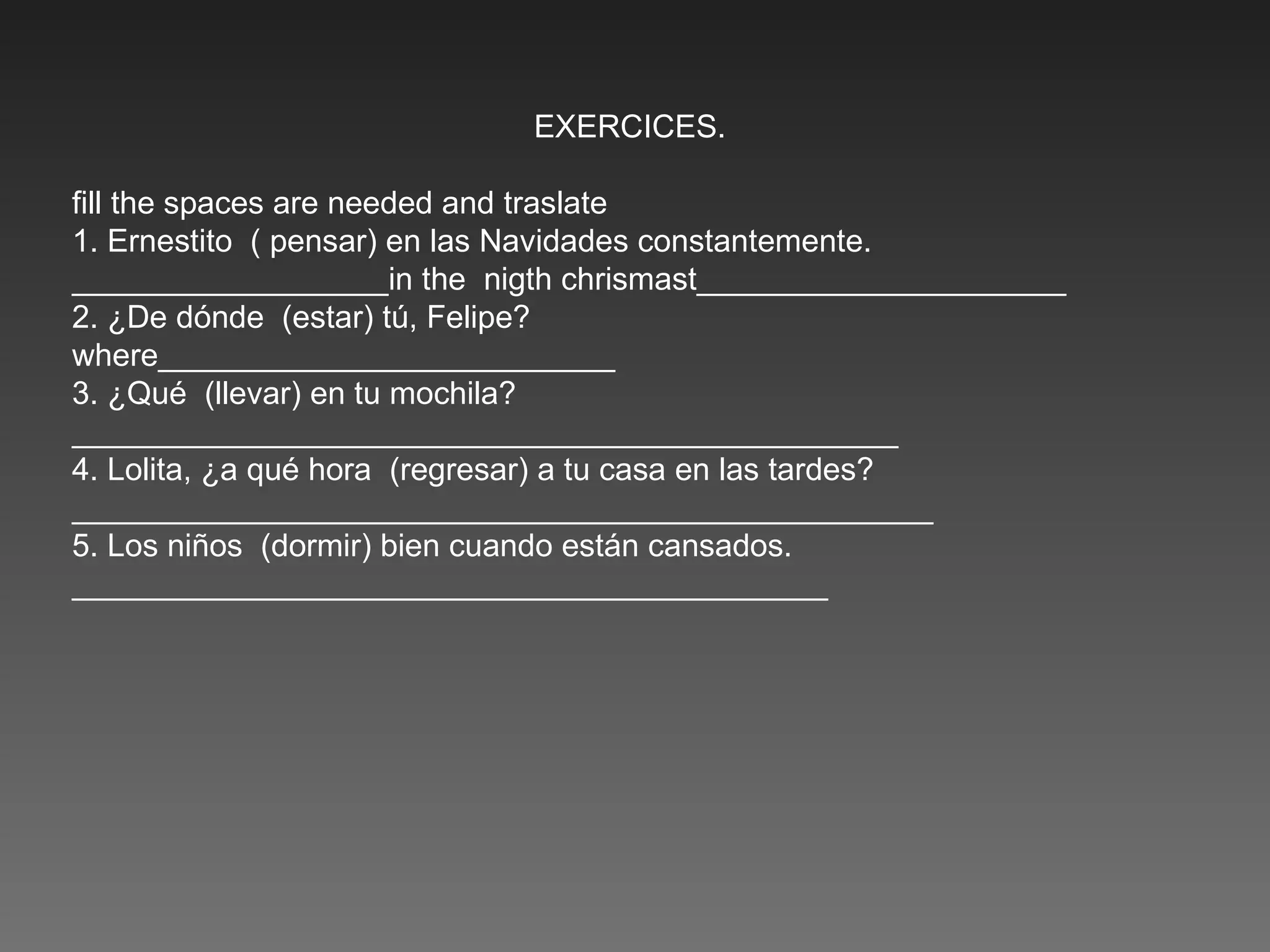
EXERCICES. fill the spaces are needed and traslate 1. Ernestito  ( pensar) en las Navidades constantemente. __________________in the  nigth chrismast_____________________ 2. ¿De dónde  (estar) tú, Felipe? where__________________________ 3. ¿Qué  (llevar) en tu mochila? _______________________________________________ 4. Lolita, ¿a qué hora  (regresar) a tu casa en las tardes?  _________________________________________________ 5. Los niños  (dormir) bien cuando están cansados. ___________________________________________
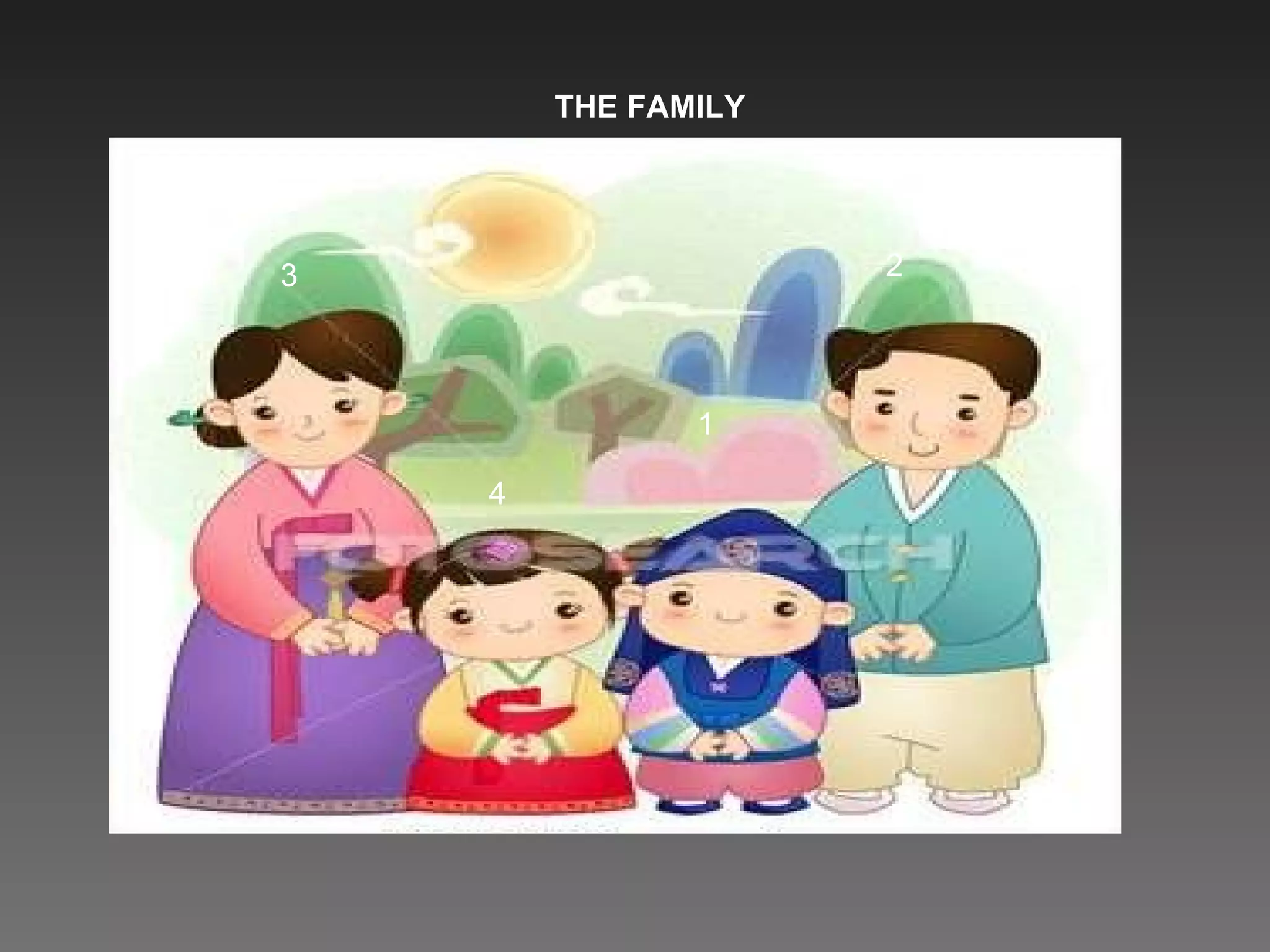
THE FAMILY 3 1 2 4
DESCRIPTION OF THE FAMILY. 1 I am Carl and i am nine years old . I am short and plump . I have got short brown hair and brown eyes 2 this is my father his name is Mike . He is  thirty –five  years old . He is teacher . He is tall and well-built. he has no hair and he has brown eyes 3 this is my mother . Her name is sussan . She is thirty- four years old and she is a doctor . She has got long hair and pretty eyes. 4 She is my sister. Her name is sally and she is  ten years old . She has got long brown hair and she is short and she is very kind.
EXERCICES. Write  ito the sentences YES or NO 1.Carl is nineteen ears old  NO  2.Carl´s father is tall  YES  3 sally has got short fair hair  4.Car´s mother is teacher  5. Carl´S mother is thirty-four years old  6. Carl is short and plump  7. Carl´s father has got abig brown eyes
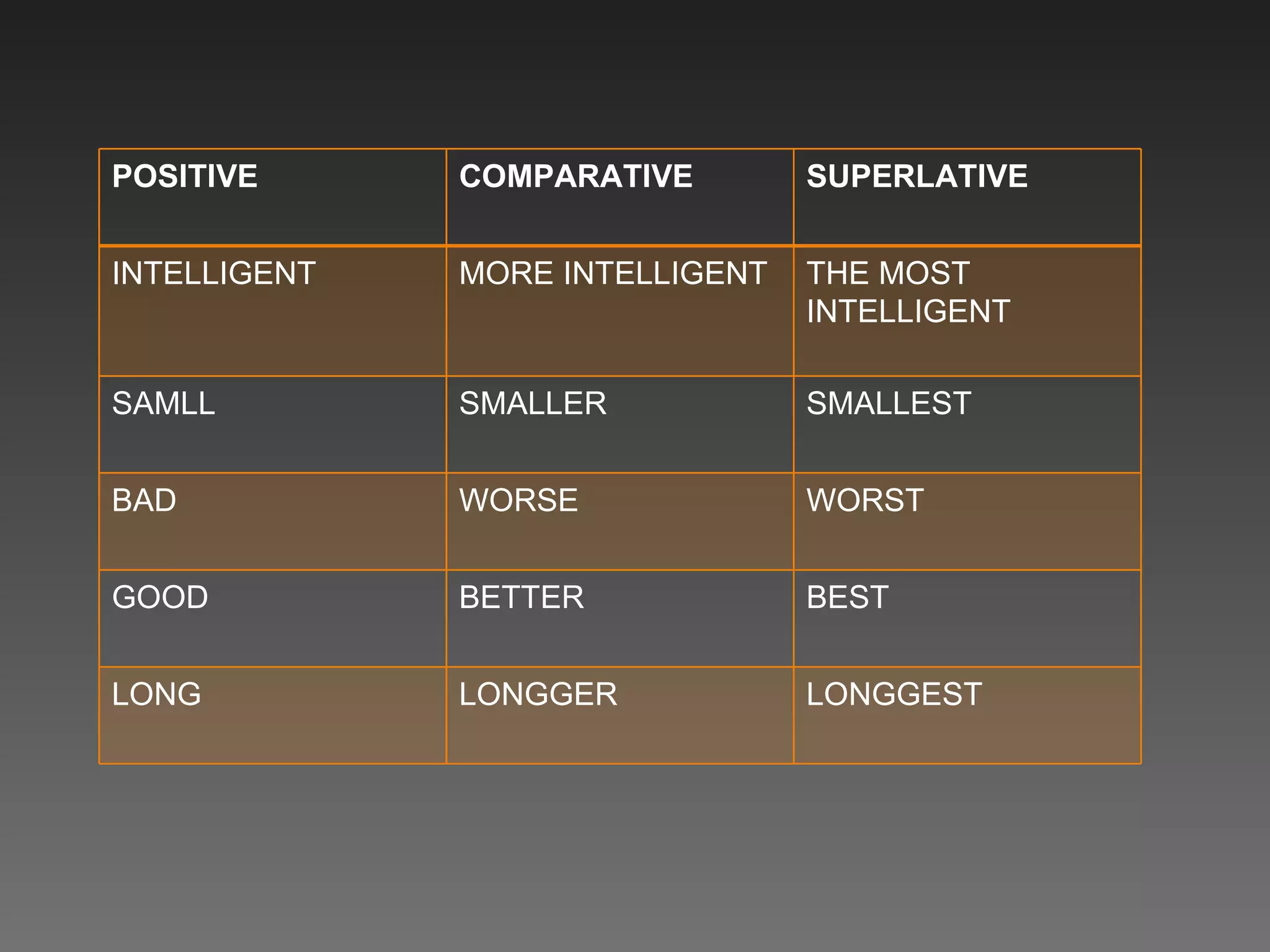
THE COMPARATIVE AND SUPERLATIVE FORM THE COMPARATIVE FORM: the adjective is added to the final "er" to the adjectives except  bad and good when the adjectives are more than three syllables are preceded by “more” THE SUPERLATIVE FORM: at the end of the adjective is added "est“  bad and good adjectives spelled differently, also for words that have more than three syllables are added to the beginning the most Example:
POSITIVE COMPARATIVE SUPERLATIVE INTELLIGENT MORE INTELLIGENT THE MOST INTELLIGENT SAMLL SMALLER SMALLEST BAD WORSE WORST GOOD BETTER BEST LONG LONGGER LONGGEST
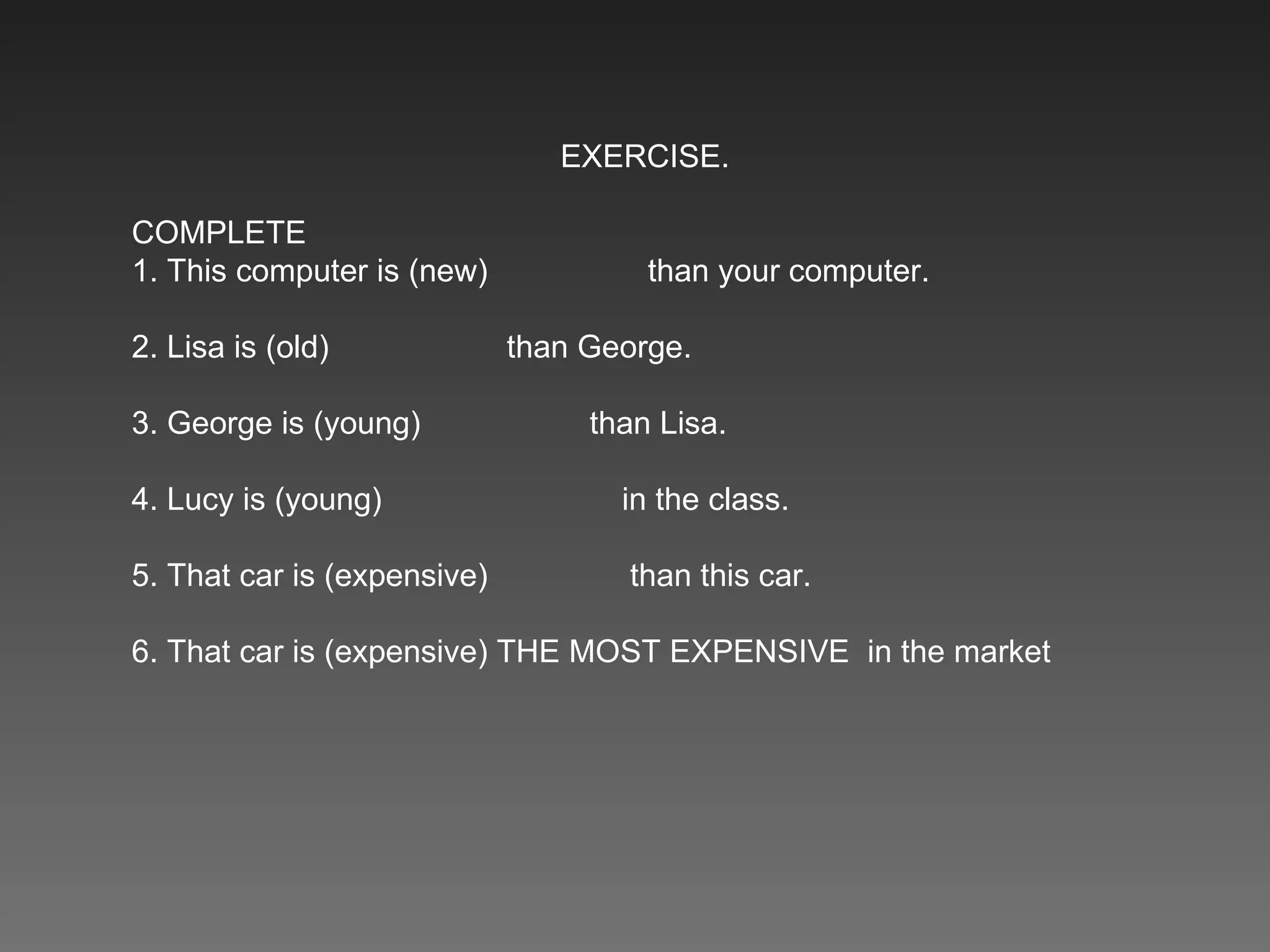
EXERCISE. COMPLETE 1. This computer is (new)    than your computer.  2. Lisa is (old)    than George.  3. George is (young)    than Lisa.  4. Lucy is (young)    in the class.  5. That car is (expensive)    than this car.  6. That car is (expensive) THE MOST EXPENSIVE  in the market
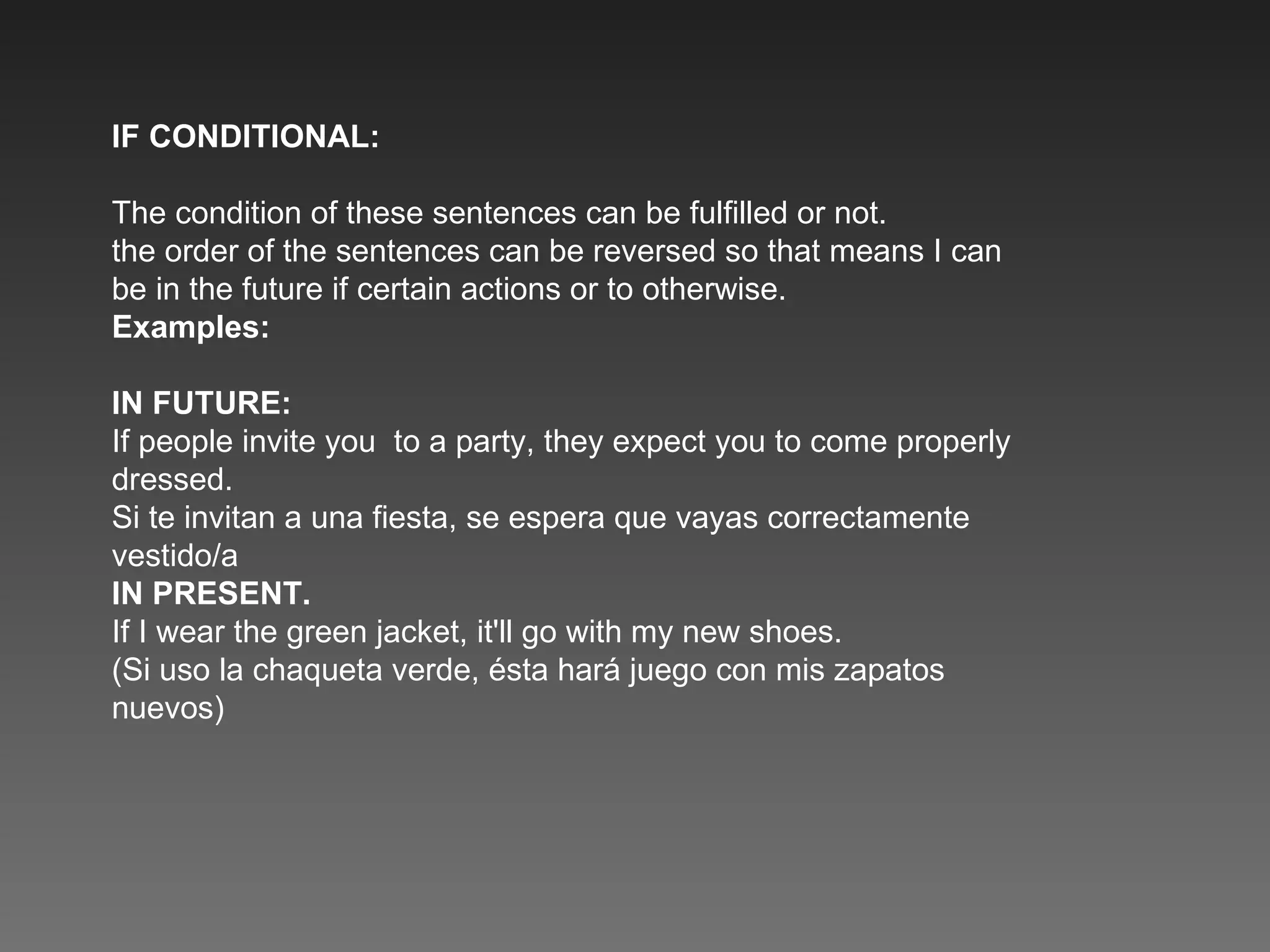
IF CONDITIONAL: The condition of these sentences can be fulfilled or not. the order of the sentences can be reversed so that means I can be in the future if certain actions or to otherwise. Examples: IN FUTURE: If people invite you  to a party, they expect you to come properly dressed. Si te invitan a una fiesta, se espera que vayas correctamente vestido/a IN PRESENT. If I wear the green jacket, it'll go with my new shoes. (Si uso la chaqueta verde, ésta hará juego con mis zapatos nuevos)
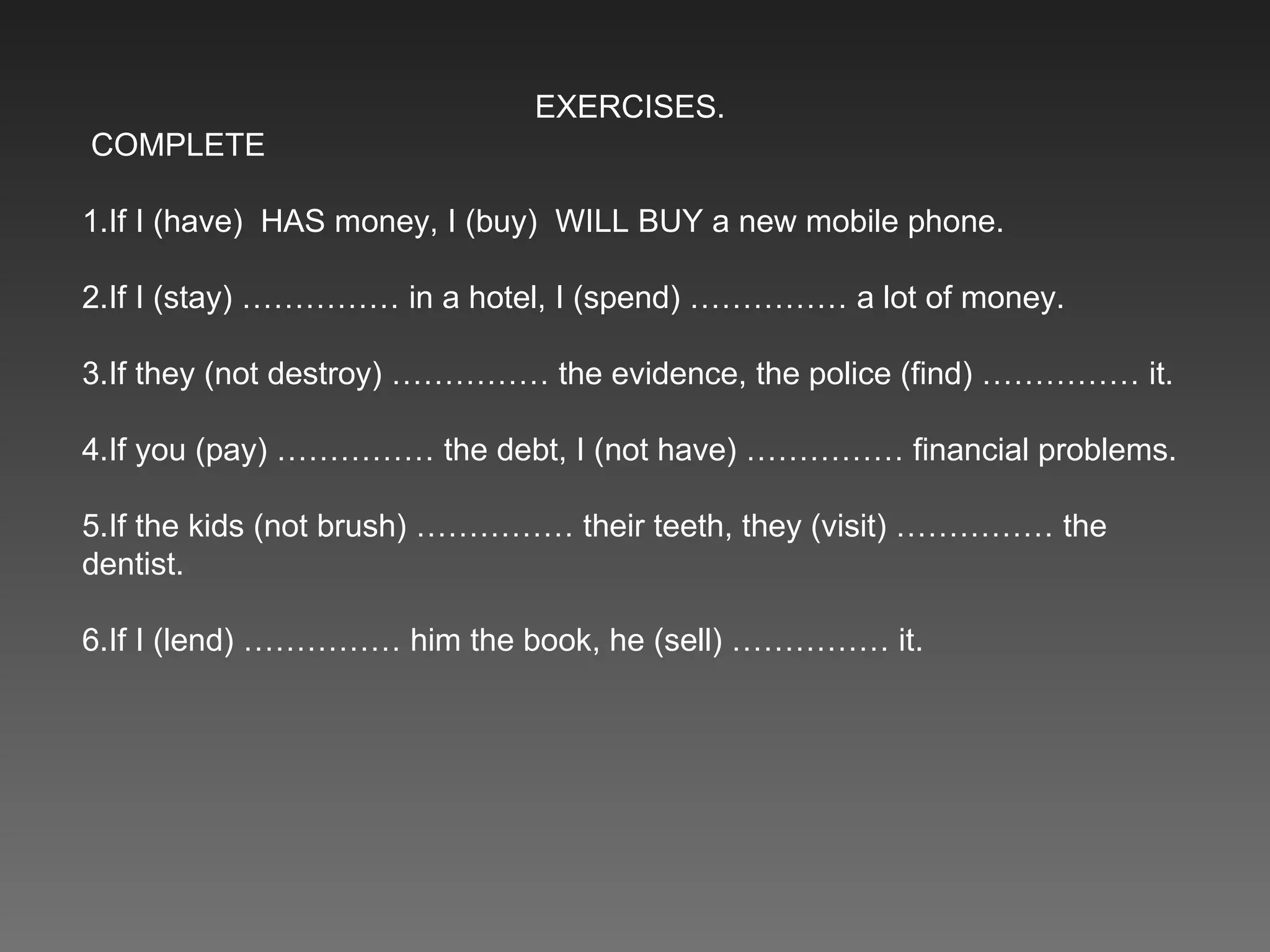
EXERCISES. COMPLETE 1.If I (have)  HAS money, I (buy)  WILL BUY a new mobile phone. 2.If I (stay) …………… in a hotel, I (spend) …………… a lot of money. 3.If they (not destroy) …………… the evidence, the police (find) …………… it. 4.If you (pay) …………… the debt, I (not have) …………… financial problems. 5.If the kids (not brush) …………… their teeth, they (visit) …………… the dentist. 6.If I (lend) …………… him the book, he (sell) …………… it.

INTERACTIVE ENGLISH

  • 1.
  • 2.
    BY EDGAR HUMBERTOPÁEZ TEQUIA HELP AJBR. I.E.D. SAN BENITO www.iedsanbenito.edu.co
  • 3.
    TABLE OF CONTENTS.INTERACTIVE ENGLISH INTRODUCTION 1 . OBJETIVES. 1.1 GNERAL OBJETIVE 1.2 SPECIFICS OBJETIVE. 2.VERB TENSES 2.1 THE SIMPLE TENSE 2.2 THE SIMPLE PAST TENSE 2.3 THE SIMPLE FUTURE TENSE. 3.REGULAR AND IRREGULAR VERBS. 4. THE FAMILY 4.1 DESCRIPTION OOF THE FAMILY 5. THE COMPARATIVE AND SUPERLATIVE FORM 6. IF CONDITIONAL.
  • 4.
    INTRODUCTION. This workwe want to make people understand and resolve their concerns fundamental issues facing the English language, as are the tenses, the comparative and superlative, and other issues as mentioned above are essential to fully understand the English, this is done with very simple exercises and to apply from time to time in everyday life and will be helpful.
  • 5.
    OBJETIVES GENERALOBJETIVE. Do people learn quickly to distinguish between tenses, including comparative, superlative and use the information given to answer certain questions SPECIFIC OBJETIVES. Easy exercises for understanding And give a good explanation for the issues are not complex to understand. Return to the explanation of the topic if at any case the person comes to answering incorrectly is that the concern is. Through tables help readers in this way will facilitate the understanding of most viewed topic.
  • 6.
    VERB TENSES: Theverbs tenses are Present Past Future Put each sentence in affirmative form , interrogative form and negative form THE SIMPLE TENSE The simple tense , also called the indicative tense is the simplest of English. It is often used to talk about things that are habits or customs. If the verb ends in "y" when it is placed before a consonant is changed it with an "i" and add the ending "is" in the third person singular. However, if the verb ends in O, CH, SH, X, SS or Z are not changed these endings and add the ending-is in the third person singular. Example: She goes to the house's father They run all the time Do I drink every time soda? Yes I am no, I amn´t
  • 7.
    THE SIMPLE PASTTENSE In English, the simple past tense refers to the past, a time when an action grammar occurred and was completed in the past. For regular verbs, the simple past normally formed by adding-ED to the infinitive (without to). verb + ed = past simple (Past) Example: He drank juice of lemon Did They help us with the homeworks? Yes , they did no , they didn´t She didn´t l ove to her boyfriend THE SIMPLE FUTURE TENSE As such, there is no specific future time in English, but there are several verbs and expressions to refer to it. A common way of future in English has the following structure: Subject + will + verb EXAMPLE: I will play / yo jugare I won´t play /yo no jugare
  • 8.
    VERBS: DRINK AND ASK PRONOUNS PRESENT TENSE PAST TENSE FUTURE TENSE I DRINK /ASK DRANK WILL DRINK YOU DRINK/ ASK DRANK WILL DRINK SHE DRINKS/ASKS ASKED WILL DRNK HE DRINKS/ASKS ASKED WILL ASK IT DRINKS/ASKS ASKED WILL ASK WE DRINK/ASK DRANK WILL ASK THEY DRINK/ASK DRANK WIIL DRINK
  • 9.
    EXERCISES Select thecorrect answer: Do you play tennis? A .yes , i do B, yes, No, i amn´t C.No ,I won´t D.yes , i did 2. Write the following sentences in past tense I go to school in the morning ______________________________________________ 3.Diana was to the bethroom in the nigth _______________________________________________ 4:write the following sentences in future tense I travel to spain ______________________________________________ 5.We don´t have a party today ________________________________________________ 6. Write in negative form the following sentences I will be a good professional________________________________ You play with my brother___________________________________ He was read a big book_____________________________________
  • 10.
    THE REGULAR ANDIRREGULAR VERBS THE REGULAR VERBS: Are those that are past and past participle by adding the ending '-ED' I work / yo trabajo I workED / yo trabajè o trabajaba EXAMPLE: CALL : callED THE IRREGULAR VERBS: They are the past and past participle irregularly. For this they behave like regular verbs, add '-s' to the third person singular (except 'to be' and 'to have') EXAMPLE:
  • 11.
    INFINITIVE SPANISH PASTSIMPLE PAST PARTICIPLE BEGIN EMPEZAR BEGAN BEGUN BUY COMPRAR BOUGTH BOUGTH GIVE DAR GAVE GIVEN SEE VER SAW SEEN WRITE ESCRIBIR WROTE WRITTEN
  • 12.
    EXERCICES. fill thespaces are needed and traslate 1. Ernestito  ( pensar) en las Navidades constantemente. __________________in the nigth chrismast_____________________ 2. ¿De dónde  (estar) tú, Felipe? where__________________________ 3. ¿Qué  (llevar) en tu mochila? _______________________________________________ 4. Lolita, ¿a qué hora  (regresar) a tu casa en las tardes?  _________________________________________________ 5. Los niños  (dormir) bien cuando están cansados. ___________________________________________
  • 13.
  • 14.
    DESCRIPTION OF THEFAMILY. 1 I am Carl and i am nine years old . I am short and plump . I have got short brown hair and brown eyes 2 this is my father his name is Mike . He is thirty –five years old . He is teacher . He is tall and well-built. he has no hair and he has brown eyes 3 this is my mother . Her name is sussan . She is thirty- four years old and she is a doctor . She has got long hair and pretty eyes. 4 She is my sister. Her name is sally and she is ten years old . She has got long brown hair and she is short and she is very kind.
  • 15.
    EXERCICES. Write ito the sentences YES or NO 1.Carl is nineteen ears old NO 2.Carl´s father is tall YES 3 sally has got short fair hair 4.Car´s mother is teacher 5. Carl´S mother is thirty-four years old 6. Carl is short and plump 7. Carl´s father has got abig brown eyes
  • 16.
    THE COMPARATIVE ANDSUPERLATIVE FORM THE COMPARATIVE FORM: the adjective is added to the final "er" to the adjectives except bad and good when the adjectives are more than three syllables are preceded by “more” THE SUPERLATIVE FORM: at the end of the adjective is added "est“ bad and good adjectives spelled differently, also for words that have more than three syllables are added to the beginning the most Example:
  • 17.
    POSITIVE COMPARATIVE SUPERLATIVEINTELLIGENT MORE INTELLIGENT THE MOST INTELLIGENT SAMLL SMALLER SMALLEST BAD WORSE WORST GOOD BETTER BEST LONG LONGGER LONGGEST
  • 18.
    EXERCISE. COMPLETE 1.This computer is (new)   than your computer.  2. Lisa is (old)   than George.  3. George is (young)   than Lisa.  4. Lucy is (young)   in the class.  5. That car is (expensive)   than this car.  6. That car is (expensive) THE MOST EXPENSIVE in the market
  • 19.
    IF CONDITIONAL: Thecondition of these sentences can be fulfilled or not. the order of the sentences can be reversed so that means I can be in the future if certain actions or to otherwise. Examples: IN FUTURE: If people invite you to a party, they expect you to come properly dressed. Si te invitan a una fiesta, se espera que vayas correctamente vestido/a IN PRESENT. If I wear the green jacket, it'll go with my new shoes. (Si uso la chaqueta verde, ésta hará juego con mis zapatos nuevos)
  • 20.
    EXERCISES. COMPLETE 1.IfI (have) HAS money, I (buy) WILL BUY a new mobile phone. 2.If I (stay) …………… in a hotel, I (spend) …………… a lot of money. 3.If they (not destroy) …………… the evidence, the police (find) …………… it. 4.If you (pay) …………… the debt, I (not have) …………… financial problems. 5.If the kids (not brush) …………… their teeth, they (visit) …………… the dentist. 6.If I (lend) …………… him the book, he (sell) …………… it.