SIMPLE PRESENT TENSE
The presenttense isthe base form of the verb:I work in London.
But the thirdperson(she/he/it) addsan -s:She works inLondon.
Use
We use the presenttense totalkabout:
 somethingthatistrue inthe present:
I’m nineteenyears old.
He livesinLondon.
I’m a student.
 somethingthathappensagainandagaininthe present:
I play football everyweekend.
We use wordslike sometimes, often. always,and never (adverbsof frequency) with thepresent
tense:
I sometimesgoto the cinema.
She neverplaysfootball.
 somethingthatis always true:
The adult humanbody contains 206 bones.
Lighttravels at almost300,000 kilometrespersecond.
 somethingthatisfixedinthe future.
The school term starts nextweek.
The train leavesat 1945 thisevening.
We flyto Parisnextweek.
Questionsand negatives
Look at these questions:
Do youplay the piano?
Where do youlive?
DoesJack playfootball?
Where doeshe come from?
Do Rita andAngelalive inManchester?
Where do theywork?
 Withthe presenttense,we use doanddoesto make questions.We use doesforthe third
person(she/he/it) andwe use dofor the others.
We use do and doeswithquestionwordslike where,whatand why:
But lookat these questionswithwho:
Who livesinLondon?
Who playsfootball atthe weekend?
Who worksat Liverpool CityHospital?
Look at these sentences:
I like tennis,butIdon’tlike football.(don’t=do not)
I don’tlive inLondonnow.
I don’tplaythe piano,but I playthe guitar.
Theydon’twork at the weekend.
Johndoesn’tlive inManchester.(doesn’t=doesnot)
Angeladoesn’tdrive towork.She goesbybus.
 Withthe presenttense we use doanddoes to make negatives.We use doesnot(doesn’t) for
the thirdperson(she/he/it) andwe use donot(don’t) forthe others.
PRESENT CONTINUOUS
The presentcontinuoustense isformedfromthe presenttense of the verb beandthe present
participle (-ingform) of averb:
Use
1. We use the presentcontinuoustense totalkaboutthe present:
 for somethingthatishappening atthe moment ofspeaking:
I’m just leavingwork.I’ll be home inan hour.
Please be quiet.The children are sleeping.
 for somethingwhichishappeningbefore andafteragiven time:
At eighto’clockwe are usually having breakfast.
WhenI get home the children are doingtheirhomework.
 for somethingwhich we thinkistemporary:
Michael isat university.He’sstudyinghistory.
I’m working inLondonfor the nexttwoweeks.
 for somethingwhichis newandcontrasts witha previousstate:
These days mostpeople are usingemail insteadof writingletters.
What sort of clothes are teenagerswearingnowadays?Whatsort of musicare they
listeningto?
 to showthat somethingischanging,growingor developing:
The children are growing quickly.
The climate ischanging rapidly.
Your English isimproving.
 for somethingwhichhappens againand again:
It’s always rainingin London.
They are always arguing.
George isgreat. He’salways laughing.
Note:We normallyuse alwayswiththisuse.
2. We use the presentcontinuoustense totalkaboutthe future:
 for somethingwhichhasbeen arrangedor planned:
Mary isgoing to a newschool nextterm.
What are you doing nextweek?
3. We can use the presentcontinuoustotalkaboutthe past:
 Whenwe are tellingastory
 Whenwe are summarisingthe storyfroma book,filmorplay
SIMPLE PAST TENSE
The past tense inEnglishisused:
 to talkabout the past
 to talkabout hypotheses– thingsthatare imaginedratherthantrue.
 for politeness.
There are four pasttense formsinEnglish:
Past simple: I worked
Past continuous: I was working
Past perfect: I had worked
Past perfectcontinuous: I had beenworking
We use these forms:
 to talkabout the past:
He workedat McDonald’s.He had workedthere since July..
He was working at McDonald’s.He had beenworking since July.
 to referto the presentor future in conditions:
He couldgeta newjobif he really tried.
If Jack was playingtheywouldprobablywin.
and hypotheses:
It mightbe dangerous. Suppose they gotlost.
I wouldalwayshelpsomeone whoreally neededhelp.
and wishes:
I wishitwasn’t so cold.
# Inconditions,hypothesesandwishes,if we wantto talk aboutthe past, we always use the past
perfect:
I wouldhave helpedhimif he hadasked.
It was verydangerous,Whatif you had got lost?
I wishI hadn’t spentso much moneylastmonth.
 We can use the past forms to talkabout the presentina few polite expressions:
Excuse me,I was wonderingif thiswas the trainfor York.
I justhopedyou wouldbe able tohelpme.
PAST CONTINUOUS
The past continuousisformedfromthe pasttense of be withthe -ingform of the verb:
We use the past continuoustotalkaboutthe past:
 for somethingwhichcontinued before andafteranotheraction:
The children were doingtheir homeworkwhenI gothome.
Compare:
I got home. The childrendidtheirhomework.
and
The childrendidtheirhomeworkwhenIgothome.
As I waswatchingtelevisionthe telephonerang.
Thisuse of the past continuousisverycommonat the beginningof astory:
The other day I was waitingfor a bus when…
Last week as I was driving to work…
 for somethingthathappened before andaftera particular time:
It was eighto’clock.Iwaswritinga letter.
Compare:
At eighto’clockI wrote some letters.
In Julyshe wasworkinginMcDonald’s.
 to showthat something continuedforsome time:
My headwas aching.
Everyone wasshouting.
 for somethingthatwashappening againand again:
I was practising everyday,three timesaday.
They were meetingsecretlyafterschool.
They were always quarrelling.
 withverbswhichshow change or growth:
The children were growingup quickly.
Her English was improving.
My hairwas going grey.
The town was changing quickly.
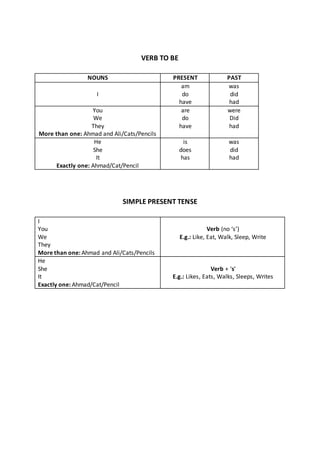
VERB TO BE
SIMPLE PRESENT TENSE
NOUNS PRESENT PAST
I
am
do
have
was
did
had
You
We
They
More than one: Ahmad and Ali/Cats/Pencils
are
do
have
were
Did
had
He
She
It
Exactly one: Ahmad/Cat/Pencil
is
does
has
was
did
had
I
You
We
They
More than one: Ahmad and Ali/Cats/Pencils
Verb (no ‘s’)
E.g.: Like, Eat, Walk, Sleep, Write
He
She
It
Exactly one: Ahmad/Cat/Pencil
Verb + ‘s’
E.g.: Likes, Eats, Walks, Sleeps, Writes
EXERCISE 1
Fill in the blank using the given word
(1) He ____________ (talk) to me yesterday evening.
(2) I ____________ (wash) the socks yesterday.
(3) They _____________ (miss) their bus yesterday.
(4) Last week, the girl _____________ (show) us her new bicycle.
(5) Yesterday, I _____________ (borrow) a sharpener from her.
(6) I ___________ (post) the letter yesterday.
(7) Just now, She ____________ (pour) the water away.
(8) My mother ______________ (scold) me yesterday.
(9) She ______________ (switch) off the light just now.
(10) It is a month since his sister ______________ (meet) him.
(11) She ______________ (show) me the dictionary last night.
(12) Selvam ______________ (heat) the chicken curry before serving it yesterday.
(13) Last week, we ______________ (clean) our classroom.
(14) They ______________ (go) watching a movie last weekend.
(15) Siti ____________ (broke) her leg during sports day last year.
EXERCISE 2
Choose the right answer from the box and fill in the blank.
woke borrowed fell had drank caught camped slept
came baked got happened returned sat rained worked
(1) Last week, my mother ___________ a chocolate cake.
(2) Ruby __________ down yesterday.
(3) They ____________ home late last night.
(4) She ____________ up late yesterday morning.
(5) They _____________ coffee last night.
(6) Sandy ___________ next to me last year.
(7) Yesterday, the fisherman _____________ some fishes and prawns.
(8) “What _____________ to you yesterday?” asks Ahmad to Ali.
(9) It ____________ heavily last night.
(10) Last weekend, we ____________ near the jungle.
(11) I _______ a cell phone for my birthday last year.
(12) Ahmad _____________ as a salesman before he continues his study.
(13) Yesterday, I _____________ the book that I _____________ from Adam.
(14) Last night, I _____________ over at Zaid’s house.
EXERCISE 1
Fill in the blank using the word given.
(1) I (do) my homework.
(2) She (sweep) the floor.
(3) My mother (buy) vegetables.
(4) I (play) at the playground.
(5) They (like) to stay at home.
(6) He (sleep) at 9 o’clock.
(7) My sister (sew) a button.
(8) She always (listen) to the radio.
(9) I (clean) my room every weekend.
(10) Cows (give) us milk.
(11) Cats (eat) fish.
(12) My uncle (work) in the bank.
(13) Mary (enjoy) singing.
(14) Ali (like) to read books.
(15) Plants (need) water.
EXERCISE 3
Underline the correct answer.
(1) They (visit, visits) their grandfather every week.
(2) The birds (sing, sings) in the morning.
(3) Rita (drink, drinks) orange juice every day.
(4) Susan and her brother (sleep, sleeps) at ten o’clock.
(5) The girls (help, helps) their mother in the garden.
(6) The maid (lock, locks) the door every night.
(7) The children (do, does) their homework every afternoon.
(8) Hassan (collect, collects) stamps from his friends.
(9) I (live, lives) at 9, Jalan Ipoh.
(10) We (spend, spends) RM 1 every day.
(11) Birds (like, likes) to eat worms.
(12) The workers (walk, walks) to the bus stop.
(13) My aunt always (bring, brings) us presents.
(14) I always (get, gets) up early.
(15) These girls (help, helps) him every day.
(16) The children (run, runs) in the field every evening.
(17) The gardeners (work, works) in the garden every day.
(18) It is usually (rain, rains) in the evening.

Present Tense & Past Tense

  • 1.
    SIMPLE PRESENT TENSE Thepresenttense isthe base form of the verb:I work in London. But the thirdperson(she/he/it) addsan -s:She works inLondon. Use We use the presenttense totalkabout:  somethingthatistrue inthe present: I’m nineteenyears old. He livesinLondon. I’m a student.  somethingthathappensagainandagaininthe present: I play football everyweekend. We use wordslike sometimes, often. always,and never (adverbsof frequency) with thepresent tense: I sometimesgoto the cinema. She neverplaysfootball.  somethingthatis always true: The adult humanbody contains 206 bones. Lighttravels at almost300,000 kilometrespersecond.  somethingthatisfixedinthe future. The school term starts nextweek. The train leavesat 1945 thisevening. We flyto Parisnextweek. Questionsand negatives Look at these questions: Do youplay the piano? Where do youlive? DoesJack playfootball? Where doeshe come from? Do Rita andAngelalive inManchester? Where do theywork?
  • 2.
     Withthe presenttense,weuse doanddoesto make questions.We use doesforthe third person(she/he/it) andwe use dofor the others. We use do and doeswithquestionwordslike where,whatand why: But lookat these questionswithwho: Who livesinLondon? Who playsfootball atthe weekend? Who worksat Liverpool CityHospital? Look at these sentences: I like tennis,butIdon’tlike football.(don’t=do not) I don’tlive inLondonnow. I don’tplaythe piano,but I playthe guitar. Theydon’twork at the weekend. Johndoesn’tlive inManchester.(doesn’t=doesnot) Angeladoesn’tdrive towork.She goesbybus.  Withthe presenttense we use doanddoes to make negatives.We use doesnot(doesn’t) for the thirdperson(she/he/it) andwe use donot(don’t) forthe others. PRESENT CONTINUOUS The presentcontinuoustense isformedfromthe presenttense of the verb beandthe present participle (-ingform) of averb: Use 1. We use the presentcontinuoustense totalkaboutthe present:  for somethingthatishappening atthe moment ofspeaking: I’m just leavingwork.I’ll be home inan hour. Please be quiet.The children are sleeping.  for somethingwhichishappeningbefore andafteragiven time: At eighto’clockwe are usually having breakfast. WhenI get home the children are doingtheirhomework.  for somethingwhich we thinkistemporary:
  • 3.
    Michael isat university.He’sstudyinghistory. I’mworking inLondonfor the nexttwoweeks.  for somethingwhichis newandcontrasts witha previousstate: These days mostpeople are usingemail insteadof writingletters. What sort of clothes are teenagerswearingnowadays?Whatsort of musicare they listeningto?  to showthat somethingischanging,growingor developing: The children are growing quickly. The climate ischanging rapidly. Your English isimproving.  for somethingwhichhappens againand again: It’s always rainingin London. They are always arguing. George isgreat. He’salways laughing. Note:We normallyuse alwayswiththisuse. 2. We use the presentcontinuoustense totalkaboutthe future:  for somethingwhichhasbeen arrangedor planned: Mary isgoing to a newschool nextterm. What are you doing nextweek? 3. We can use the presentcontinuoustotalkaboutthe past:  Whenwe are tellingastory  Whenwe are summarisingthe storyfroma book,filmorplay SIMPLE PAST TENSE The past tense inEnglishisused:  to talkabout the past  to talkabout hypotheses– thingsthatare imaginedratherthantrue.  for politeness.
  • 4.
    There are fourpasttense formsinEnglish: Past simple: I worked Past continuous: I was working Past perfect: I had worked Past perfectcontinuous: I had beenworking We use these forms:  to talkabout the past: He workedat McDonald’s.He had workedthere since July.. He was working at McDonald’s.He had beenworking since July.  to referto the presentor future in conditions: He couldgeta newjobif he really tried. If Jack was playingtheywouldprobablywin. and hypotheses: It mightbe dangerous. Suppose they gotlost. I wouldalwayshelpsomeone whoreally neededhelp. and wishes: I wishitwasn’t so cold. # Inconditions,hypothesesandwishes,if we wantto talk aboutthe past, we always use the past perfect: I wouldhave helpedhimif he hadasked. It was verydangerous,Whatif you had got lost? I wishI hadn’t spentso much moneylastmonth.  We can use the past forms to talkabout the presentina few polite expressions: Excuse me,I was wonderingif thiswas the trainfor York. I justhopedyou wouldbe able tohelpme. PAST CONTINUOUS The past continuousisformedfromthe pasttense of be withthe -ingform of the verb: We use the past continuoustotalkaboutthe past:
  • 5.
     for somethingwhichcontinuedbefore andafteranotheraction: The children were doingtheir homeworkwhenI gothome. Compare: I got home. The childrendidtheirhomework. and The childrendidtheirhomeworkwhenIgothome. As I waswatchingtelevisionthe telephonerang. Thisuse of the past continuousisverycommonat the beginningof astory: The other day I was waitingfor a bus when… Last week as I was driving to work…  for somethingthathappened before andaftera particular time: It was eighto’clock.Iwaswritinga letter. Compare: At eighto’clockI wrote some letters. In Julyshe wasworkinginMcDonald’s.  to showthat something continuedforsome time: My headwas aching. Everyone wasshouting.  for somethingthatwashappening againand again: I was practising everyday,three timesaday. They were meetingsecretlyafterschool. They were always quarrelling.  withverbswhichshow change or growth: The children were growingup quickly. Her English was improving. My hairwas going grey. The town was changing quickly.
  • 6.
    VERB TO BE SIMPLEPRESENT TENSE NOUNS PRESENT PAST I am do have was did had You We They More than one: Ahmad and Ali/Cats/Pencils are do have were Did had He She It Exactly one: Ahmad/Cat/Pencil is does has was did had I You We They More than one: Ahmad and Ali/Cats/Pencils Verb (no ‘s’) E.g.: Like, Eat, Walk, Sleep, Write He She It Exactly one: Ahmad/Cat/Pencil Verb + ‘s’ E.g.: Likes, Eats, Walks, Sleeps, Writes
  • 7.
    EXERCISE 1 Fill inthe blank using the given word (1) He ____________ (talk) to me yesterday evening. (2) I ____________ (wash) the socks yesterday. (3) They _____________ (miss) their bus yesterday. (4) Last week, the girl _____________ (show) us her new bicycle. (5) Yesterday, I _____________ (borrow) a sharpener from her. (6) I ___________ (post) the letter yesterday. (7) Just now, She ____________ (pour) the water away. (8) My mother ______________ (scold) me yesterday. (9) She ______________ (switch) off the light just now. (10) It is a month since his sister ______________ (meet) him. (11) She ______________ (show) me the dictionary last night. (12) Selvam ______________ (heat) the chicken curry before serving it yesterday. (13) Last week, we ______________ (clean) our classroom. (14) They ______________ (go) watching a movie last weekend. (15) Siti ____________ (broke) her leg during sports day last year. EXERCISE 2 Choose the right answer from the box and fill in the blank. woke borrowed fell had drank caught camped slept came baked got happened returned sat rained worked (1) Last week, my mother ___________ a chocolate cake. (2) Ruby __________ down yesterday. (3) They ____________ home late last night. (4) She ____________ up late yesterday morning. (5) They _____________ coffee last night. (6) Sandy ___________ next to me last year. (7) Yesterday, the fisherman _____________ some fishes and prawns. (8) “What _____________ to you yesterday?” asks Ahmad to Ali. (9) It ____________ heavily last night. (10) Last weekend, we ____________ near the jungle. (11) I _______ a cell phone for my birthday last year. (12) Ahmad _____________ as a salesman before he continues his study. (13) Yesterday, I _____________ the book that I _____________ from Adam. (14) Last night, I _____________ over at Zaid’s house.
  • 8.
    EXERCISE 1 Fill inthe blank using the word given. (1) I (do) my homework. (2) She (sweep) the floor. (3) My mother (buy) vegetables. (4) I (play) at the playground. (5) They (like) to stay at home. (6) He (sleep) at 9 o’clock. (7) My sister (sew) a button. (8) She always (listen) to the radio. (9) I (clean) my room every weekend. (10) Cows (give) us milk. (11) Cats (eat) fish. (12) My uncle (work) in the bank. (13) Mary (enjoy) singing. (14) Ali (like) to read books. (15) Plants (need) water. EXERCISE 3 Underline the correct answer. (1) They (visit, visits) their grandfather every week. (2) The birds (sing, sings) in the morning. (3) Rita (drink, drinks) orange juice every day. (4) Susan and her brother (sleep, sleeps) at ten o’clock. (5) The girls (help, helps) their mother in the garden. (6) The maid (lock, locks) the door every night. (7) The children (do, does) their homework every afternoon. (8) Hassan (collect, collects) stamps from his friends. (9) I (live, lives) at 9, Jalan Ipoh. (10) We (spend, spends) RM 1 every day. (11) Birds (like, likes) to eat worms. (12) The workers (walk, walks) to the bus stop. (13) My aunt always (bring, brings) us presents. (14) I always (get, gets) up early. (15) These girls (help, helps) him every day. (16) The children (run, runs) in the field every evening. (17) The gardeners (work, works) in the garden every day. (18) It is usually (rain, rains) in the evening.