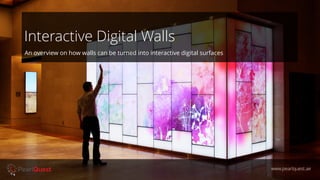
Interactive Digital Walls
www.pearlquest.ae
An overview on how walls can be turned into interactive digital surfaces
A formal
definition
An interactive wall is a physical wall surface
that is mapped with a digital display, such as
projection or digital screens and can be
interacted with - to manipulate content
displayed on it.
www.pearlquest.aeInteractive Digital Walls
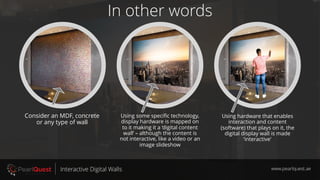
In other words
www.pearlquest.aeInteractive Digital Walls
Consider an MDF, concrete
or any type of wall
Using some specific technology,
display hardware is mapped on
to it making it a ‘digital content
wall’ – although the content is
not interactive, like a video or an
image slideshow
Using hardware that enables
interaction and content
(software) that plays on it, the
digital display wall is made
‘interactive'
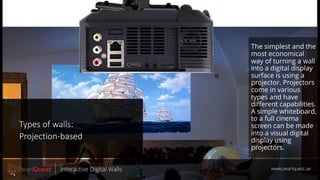
Types of walls:
Projection-based
www.pearlquest.aeInteractive Digital Walls
The simplest and the
most economical
way of turning a wall
into a digital display
surface is using a
projector. Projectors
come in various
types and have
different capabilities.
A simple whiteboard,
to a full cinema
screen can be made
into a visual digital
display using
projectors.
Types of walls:
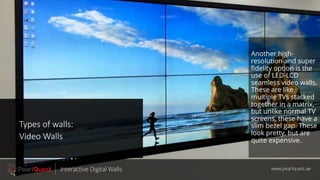
Video Walls
www.pearlquest.aeInteractive Digital Walls
Another high-
resolution and super
fidelity option is the
use of LED-LCD
seamless video walls.
These are like
multiple TVs stacked
together in a matrix,
but unlike normal TV
screens, these have a
slim bezel gap. These
look pretty, but are
quite expensive.
Types of walls:
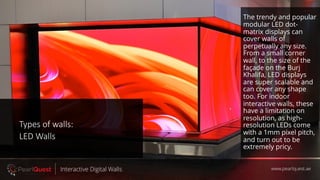
LED Walls
www.pearlquest.aeInteractive Digital Walls
The trendy and popular
modular LED dot-
matrix displays can
cover walls of
perpetually any size.
From a small corner
wall, to the size of the
façade on the Burj
Khalifa, LED displays
are super scalable and
can cover any shape
too. For indoor
interactive walls, these
have a limitation on
resolution, as high-
resolution LEDs come
with a 1mm pixel pitch,
and turn out to be
extremely pricy.
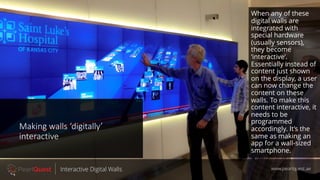
Making walls ‘digitally’
interactive
www.pearlquest.aeInteractive Digital Walls
When any of these
digital walls are
integrated with
special hardware
(usually sensors),
they become
‘interactive’.
Essentially instead of
content just shown
on the display, a user
can now change the
content on these
walls. To make this
content interactive, it
needs to be
programmed
accordingly. It’s the
same as making an
app for a wall-sized
smartphone.
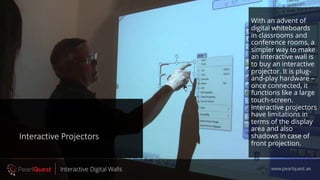
Interactive Projectors
www.pearlquest.aeInteractive Digital Walls
With an advent of
digital whiteboards
in classrooms and
conference rooms, a
simpler way to make
an interactive wall is
to buy an interactive
projector. It is plug-
and-play hardware –
once connected, it
functions like a large
touch-screen.
Interactive projectors
have limitations in
terms of the display
area and also
shadows in case of
front projection.
Overlays
www.pearlquest.aeInteractive Digital Walls
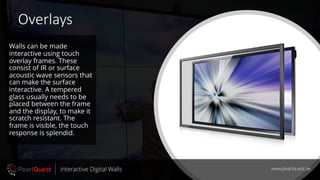
Walls can be made
interactive using touch
overlay frames. These
consist of IR or surface
acoustic wave sensors that
can make the surface
interactive. A tempered
glass usually needs to be
placed between the frame
and the display, to make it
scratch resistant. The
frame is visible, the touch
response is splendid.
Gesture sensors
www.pearlquest.aeInteractive Digital Walls
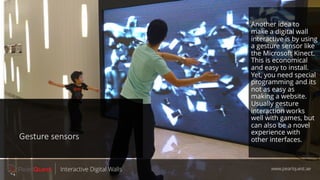
Another idea to
make a digital wall
interactive is by using
a gesture sensor like
the Microsoft Kinect.
This is economical
and easy to install.
Yet, you need special
programming and its
not as easy as
making a website.
Usually gesture
interaction works
well with games, but
can also be a novel
experience with
other interfaces.
Conductive Paint/Copper tapes:
Making flex or vinyl sticker based
surfaces interactive
www.pearlquest.aeInteractive Digital Walls
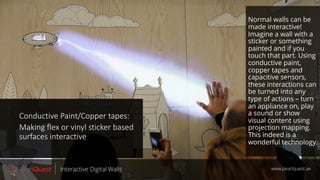
Normal walls can be
made interactive!
Imagine a wall with a
sticker or something
painted and if you
touch that part. Using
conductive paint,
copper tapes and
capacitive sensors,
these interactions can
be turned into any
type of actions – turn
an appliance on, play
a sound or show
visual content using
projection mapping.
This indeed is a
wonderful technology.
Considerations
for
requirement
gathering
Is there a display
mapped on the wall?
If yes, is it projection,
video wall or LED
tiles?
Depending on the
display, what type of
interaction hardware
can be chosen –
touch, gesture etc.?
Does your client
really need
interactivity and why?
Do they have
content? If yes, is it
designed and
developed for a larger
wall size?
The budget?
www.pearlquest.aeInteractive Digital Walls
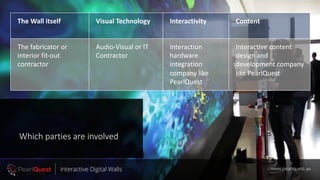
Which parties are involved
The Wall itself Visual Technology Interactivity Content
The fabricator or
interior fit-out
contractor
Audio-Visual or IT
Contractor
Interaction
hardware
integration
company like
PearlQuest
Interactive content
design and
development company
like PearlQuest
www.pearlquest.aeInteractive Digital Walls
Thank you
PearlQuest Technology FZE
E-4, Level 15, Damac XL Tower, Marasi Drive,
Business Bay, Dubai, UAE
Landline: +971 4 2460119
Email: info@pearlquest.ae
Web: www.pearlquest.ae
We to create interactive walls

Interactive Digital Walls

  • 1.
    Interactive Digital Walls www.pearlquest.ae Anoverview on how walls can be turned into interactive digital surfaces
  • 2.
    A formal definition An interactivewall is a physical wall surface that is mapped with a digital display, such as projection or digital screens and can be interacted with - to manipulate content displayed on it. www.pearlquest.aeInteractive Digital Walls
  • 3.
    In other words www.pearlquest.aeInteractiveDigital Walls Consider an MDF, concrete or any type of wall Using some specific technology, display hardware is mapped on to it making it a ‘digital content wall’ – although the content is not interactive, like a video or an image slideshow Using hardware that enables interaction and content (software) that plays on it, the digital display wall is made ‘interactive'
  • 4.
    Types of walls: Projection-based www.pearlquest.aeInteractiveDigital Walls The simplest and the most economical way of turning a wall into a digital display surface is using a projector. Projectors come in various types and have different capabilities. A simple whiteboard, to a full cinema screen can be made into a visual digital display using projectors.
  • 5.
    Types of walls: VideoWalls www.pearlquest.aeInteractive Digital Walls Another high- resolution and super fidelity option is the use of LED-LCD seamless video walls. These are like multiple TVs stacked together in a matrix, but unlike normal TV screens, these have a slim bezel gap. These look pretty, but are quite expensive.
  • 6.
    Types of walls: LEDWalls www.pearlquest.aeInteractive Digital Walls The trendy and popular modular LED dot- matrix displays can cover walls of perpetually any size. From a small corner wall, to the size of the façade on the Burj Khalifa, LED displays are super scalable and can cover any shape too. For indoor interactive walls, these have a limitation on resolution, as high- resolution LEDs come with a 1mm pixel pitch, and turn out to be extremely pricy.
  • 7.
    Making walls ‘digitally’ interactive www.pearlquest.aeInteractiveDigital Walls When any of these digital walls are integrated with special hardware (usually sensors), they become ‘interactive’. Essentially instead of content just shown on the display, a user can now change the content on these walls. To make this content interactive, it needs to be programmed accordingly. It’s the same as making an app for a wall-sized smartphone.
  • 8.
    Interactive Projectors www.pearlquest.aeInteractive DigitalWalls With an advent of digital whiteboards in classrooms and conference rooms, a simpler way to make an interactive wall is to buy an interactive projector. It is plug- and-play hardware – once connected, it functions like a large touch-screen. Interactive projectors have limitations in terms of the display area and also shadows in case of front projection.
  • 9.
    Overlays www.pearlquest.aeInteractive Digital Walls Wallscan be made interactive using touch overlay frames. These consist of IR or surface acoustic wave sensors that can make the surface interactive. A tempered glass usually needs to be placed between the frame and the display, to make it scratch resistant. The frame is visible, the touch response is splendid.
  • 10.
    Gesture sensors www.pearlquest.aeInteractive DigitalWalls Another idea to make a digital wall interactive is by using a gesture sensor like the Microsoft Kinect. This is economical and easy to install. Yet, you need special programming and its not as easy as making a website. Usually gesture interaction works well with games, but can also be a novel experience with other interfaces.
  • 11.
    Conductive Paint/Copper tapes: Makingflex or vinyl sticker based surfaces interactive www.pearlquest.aeInteractive Digital Walls Normal walls can be made interactive! Imagine a wall with a sticker or something painted and if you touch that part. Using conductive paint, copper tapes and capacitive sensors, these interactions can be turned into any type of actions – turn an appliance on, play a sound or show visual content using projection mapping. This indeed is a wonderful technology.
  • 12.
    Considerations for requirement gathering Is there adisplay mapped on the wall? If yes, is it projection, video wall or LED tiles? Depending on the display, what type of interaction hardware can be chosen – touch, gesture etc.? Does your client really need interactivity and why? Do they have content? If yes, is it designed and developed for a larger wall size? The budget? www.pearlquest.aeInteractive Digital Walls
  • 13.
    Which parties areinvolved The Wall itself Visual Technology Interactivity Content The fabricator or interior fit-out contractor Audio-Visual or IT Contractor Interaction hardware integration company like PearlQuest Interactive content design and development company like PearlQuest www.pearlquest.aeInteractive Digital Walls
  • 14.
    Thank you PearlQuest TechnologyFZE E-4, Level 15, Damac XL Tower, Marasi Drive, Business Bay, Dubai, UAE Landline: +971 4 2460119 Email: info@pearlquest.ae Web: www.pearlquest.ae We to create interactive walls